SUBSCRIBE TO OUR FREE NEWSLETTER
Daily news & progressive opinion—funded by the people, not the corporations—delivered straight to your inbox.
5
#000000
#FFFFFF
To donate by check, phone, or other method, see our More Ways to Give page.
Daily news & progressive opinion—funded by the people, not the corporations—delivered straight to your inbox.
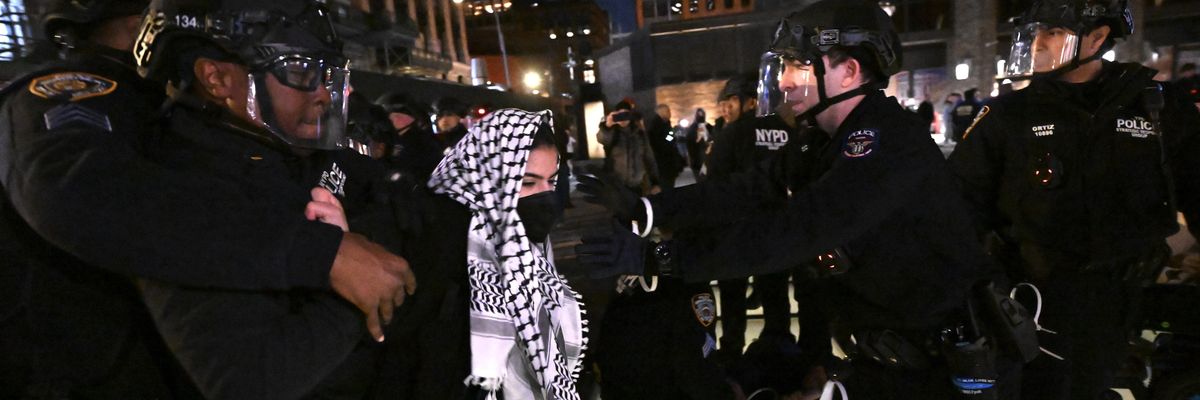
Police arrest New York students protesting Israel's assault on Gaza on April 22, 2024.
Police use of "catch-and-release" tactics is particularly worrying for press freedom advocates, according to the U.S. Press Freedom Tracker.
Arrests and detainments of journalists in the United States surged in 2024 compared to the year prior, according to the U.S. Press Freedom Tracker, a project of the Freedom of the Press Foundation.
The tracker reports that journalists were arrested or detained by police at least 48 times this year—eclipsing the number of arrests that took place in the previous two years combined, and constituting the third highest number of yearly arrests and detentions since the project began cataloging press freedom violations in 2017. 2020, however, still stands as far and away the year with the most arrests and detentions.
The 48 arrests and detentions this year is also part of a larger list of "press freedom incidents" that the tracker documents, including things like equipment damage, equipment seizure, and assault.
While a year with a high number of protests typically leads to more arrests, "it was protests in response to the Israel-Gaza war that caused this year's uptick," according to the tracker.
The vast majority of the arrests and detainments out of the total 48 were linked to these sorts of demonstrations, and it was protests at Columbia University's Manhattan campus that were the site of this year's largest detainment of journalists.
The report also recounts the story of Roni Jacobson, a freelance reporter whose experience on the last day of 2023 was a harbinger of press freedom incidents to come in 2024. Jacobson was on assignment to cover a pro-Palestinian demonstration for the New York Daily News on December 31, 2023 when she was told to leave by police because she didn't have city-issued press credentials with her. She recounted that she accidentally bumped into an officer and was arrested. She was held overnight at a precinct and then released after the charges against her, which included disorderly conduct, were dropped.
Even five arrests that the tracker deems "election-related" took place at protests that were "at least partially if not entirely focused on the Israel-Gaza war." Three of those election-related arrests took place at protests happening around the Democratic National Convention in August.
One police force in particular bears responsibility for this year's crackdown: Nearly 50% of the arrests of journalists this year were at the hands of the New York Police Department (NYPD). Many of those taken into custody had their charges dropped quickly, but the tracker notes that the NYPD's use of "catch-and-release" tactics was particularly worrying to press freedom advocates.
Two photojournalists, Josh Pacheco and Olga Federova, were detained four times this year in both New York City and Chicago while photographing protests. They were both "assaulted and arrested and [had] their equipment damaged" while documenting police clearing a student encampment at Manhattan's Fashion Institute of Technology; however, they were released the next day and told their arrests had been voided.
"While [we are] glad that some common sense prevailed by the NYPD not charging these two photographers with any crime, we are very concerned that they are perfecting 'catch-and-release' to an art form,” Mickey Osterreicher, general counsel for the National Press Photographers Association, told the tracker.
"The fact that they took two photojournalists off the street, preventing them from making any more images or transmitting the ones they already had on a matter of extreme public concern, is very disturbing," he said.
Besides covering protests, 2024 also saw the continued practice of "criminally charging journalists for standard journalistic practices," according to the tracker. For example, one investigative journalist in Los Angeles was repeatedly threatened with arrest while attempting to cover a homeless encampment sweep in the city, and then was detained in October, though he was let go without charges.
Dear Common Dreams reader, It’s been nearly 30 years since I co-founded Common Dreams with my late wife, Lina Newhouser. We had the radical notion that journalism should serve the public good, not corporate profits. It was clear to us from the outset what it would take to build such a project. No paid advertisements. No corporate sponsors. No millionaire publisher telling us what to think or do. Many people said we wouldn't last a year, but we proved those doubters wrong. Together with a tremendous team of journalists and dedicated staff, we built an independent media outlet free from the constraints of profits and corporate control. Our mission has always been simple: To inform. To inspire. To ignite change for the common good. Building Common Dreams was not easy. Our survival was never guaranteed. When you take on the most powerful forces—Wall Street greed, fossil fuel industry destruction, Big Tech lobbyists, and uber-rich oligarchs who have spent billions upon billions rigging the economy and democracy in their favor—the only bulwark you have is supporters who believe in your work. But here’s the urgent message from me today. It's never been this bad out there. And it's never been this hard to keep us going. At the very moment Common Dreams is most needed, the threats we face are intensifying. We need your support now more than ever. We don't accept corporate advertising and never will. We don't have a paywall because we don't think people should be blocked from critical news based on their ability to pay. Everything we do is funded by the donations of readers like you. When everyone does the little they can afford, we are strong. But if that support retreats or dries up, so do we. Will you donate now to make sure Common Dreams not only survives but thrives? —Craig Brown, Co-founder |
Arrests and detainments of journalists in the United States surged in 2024 compared to the year prior, according to the U.S. Press Freedom Tracker, a project of the Freedom of the Press Foundation.
The tracker reports that journalists were arrested or detained by police at least 48 times this year—eclipsing the number of arrests that took place in the previous two years combined, and constituting the third highest number of yearly arrests and detentions since the project began cataloging press freedom violations in 2017. 2020, however, still stands as far and away the year with the most arrests and detentions.
The 48 arrests and detentions this year is also part of a larger list of "press freedom incidents" that the tracker documents, including things like equipment damage, equipment seizure, and assault.
While a year with a high number of protests typically leads to more arrests, "it was protests in response to the Israel-Gaza war that caused this year's uptick," according to the tracker.
The vast majority of the arrests and detainments out of the total 48 were linked to these sorts of demonstrations, and it was protests at Columbia University's Manhattan campus that were the site of this year's largest detainment of journalists.
The report also recounts the story of Roni Jacobson, a freelance reporter whose experience on the last day of 2023 was a harbinger of press freedom incidents to come in 2024. Jacobson was on assignment to cover a pro-Palestinian demonstration for the New York Daily News on December 31, 2023 when she was told to leave by police because she didn't have city-issued press credentials with her. She recounted that she accidentally bumped into an officer and was arrested. She was held overnight at a precinct and then released after the charges against her, which included disorderly conduct, were dropped.
Even five arrests that the tracker deems "election-related" took place at protests that were "at least partially if not entirely focused on the Israel-Gaza war." Three of those election-related arrests took place at protests happening around the Democratic National Convention in August.
One police force in particular bears responsibility for this year's crackdown: Nearly 50% of the arrests of journalists this year were at the hands of the New York Police Department (NYPD). Many of those taken into custody had their charges dropped quickly, but the tracker notes that the NYPD's use of "catch-and-release" tactics was particularly worrying to press freedom advocates.
Two photojournalists, Josh Pacheco and Olga Federova, were detained four times this year in both New York City and Chicago while photographing protests. They were both "assaulted and arrested and [had] their equipment damaged" while documenting police clearing a student encampment at Manhattan's Fashion Institute of Technology; however, they were released the next day and told their arrests had been voided.
"While [we are] glad that some common sense prevailed by the NYPD not charging these two photographers with any crime, we are very concerned that they are perfecting 'catch-and-release' to an art form,” Mickey Osterreicher, general counsel for the National Press Photographers Association, told the tracker.
"The fact that they took two photojournalists off the street, preventing them from making any more images or transmitting the ones they already had on a matter of extreme public concern, is very disturbing," he said.
Besides covering protests, 2024 also saw the continued practice of "criminally charging journalists for standard journalistic practices," according to the tracker. For example, one investigative journalist in Los Angeles was repeatedly threatened with arrest while attempting to cover a homeless encampment sweep in the city, and then was detained in October, though he was let go without charges.
Arrests and detainments of journalists in the United States surged in 2024 compared to the year prior, according to the U.S. Press Freedom Tracker, a project of the Freedom of the Press Foundation.
The tracker reports that journalists were arrested or detained by police at least 48 times this year—eclipsing the number of arrests that took place in the previous two years combined, and constituting the third highest number of yearly arrests and detentions since the project began cataloging press freedom violations in 2017. 2020, however, still stands as far and away the year with the most arrests and detentions.
The 48 arrests and detentions this year is also part of a larger list of "press freedom incidents" that the tracker documents, including things like equipment damage, equipment seizure, and assault.
While a year with a high number of protests typically leads to more arrests, "it was protests in response to the Israel-Gaza war that caused this year's uptick," according to the tracker.
The vast majority of the arrests and detainments out of the total 48 were linked to these sorts of demonstrations, and it was protests at Columbia University's Manhattan campus that were the site of this year's largest detainment of journalists.
The report also recounts the story of Roni Jacobson, a freelance reporter whose experience on the last day of 2023 was a harbinger of press freedom incidents to come in 2024. Jacobson was on assignment to cover a pro-Palestinian demonstration for the New York Daily News on December 31, 2023 when she was told to leave by police because she didn't have city-issued press credentials with her. She recounted that she accidentally bumped into an officer and was arrested. She was held overnight at a precinct and then released after the charges against her, which included disorderly conduct, were dropped.
Even five arrests that the tracker deems "election-related" took place at protests that were "at least partially if not entirely focused on the Israel-Gaza war." Three of those election-related arrests took place at protests happening around the Democratic National Convention in August.
One police force in particular bears responsibility for this year's crackdown: Nearly 50% of the arrests of journalists this year were at the hands of the New York Police Department (NYPD). Many of those taken into custody had their charges dropped quickly, but the tracker notes that the NYPD's use of "catch-and-release" tactics was particularly worrying to press freedom advocates.
Two photojournalists, Josh Pacheco and Olga Federova, were detained four times this year in both New York City and Chicago while photographing protests. They were both "assaulted and arrested and [had] their equipment damaged" while documenting police clearing a student encampment at Manhattan's Fashion Institute of Technology; however, they were released the next day and told their arrests had been voided.
"While [we are] glad that some common sense prevailed by the NYPD not charging these two photographers with any crime, we are very concerned that they are perfecting 'catch-and-release' to an art form,” Mickey Osterreicher, general counsel for the National Press Photographers Association, told the tracker.
"The fact that they took two photojournalists off the street, preventing them from making any more images or transmitting the ones they already had on a matter of extreme public concern, is very disturbing," he said.
Besides covering protests, 2024 also saw the continued practice of "criminally charging journalists for standard journalistic practices," according to the tracker. For example, one investigative journalist in Los Angeles was repeatedly threatened with arrest while attempting to cover a homeless encampment sweep in the city, and then was detained in October, though he was let go without charges.