SUBSCRIBE TO OUR FREE NEWSLETTER
Daily news & progressive opinion—funded by the people, not the corporations—delivered straight to your inbox.
5
#000000
#FFFFFF
To donate by check, phone, or other method, see our More Ways to Give page.

Daily news & progressive opinion—funded by the people, not the corporations—delivered straight to your inbox.
"We're hoping that this is a call to everybody to say this species is in decline, and now is our opportunity to help reverse that decline," said one federal scientist.
Biodiversity defenders on Tuesday welcomed a "long overdue" move by the U.S. Fish and Wildlife Service toward protecting the monarch butterfly under the Endangered Species Act—the result, the Center for Biological Diversity said, of a lawsuit filed by several groups to safeguard the pollinators and their fragile habitat.
The FWS proposed designating the butterfly as threatened with extinction, four years after monarchs were placed on a waiting list for protection.
"For too long, the monarch butterfly has been waiting in line, hoping for new protections while its population has plummeted. This announcement by the Fish and Wildlife Service gets this iconic flier closer to the protections it needs, and given its staggering drop in numbers, that can't happen soon enough," said Steve Blackledge, senior director of conservation campaigns for Environment America.
Monarch butterflies journey from Mexico each spring to points across the United States east of the Rocky Mountains to pollinate and reproduce. When cooler weather arrives they migrate back to the south for the winter.
But their populations have declined by more than 95% from over 4.5 million in the 1980s, leaving the western monarch with a 99% chance of becoming extinct over the next six decades, according to federal scientists.
The decline has been driven by the widespread use of herbicides like Roundup on milkweed, the monarch's sole food source, as well as the use of neonicotinoid insecticides. Millions of monarchs are also killed by vehicles annually during their migration, and in their winter habitats they face the loss of forests due to logging.
"The monarch butterfly is an iconic North American species and like other such iconic species, including the bald eagle and American peregrine falcon, it too deserves a chance at recovery."
Rising temperatures have also disrupted the monarch's reproduction and migration, with warmer weather tricking them into staying in the north later in the year.
"The species has been declining for a number of years," FWS biologist Kristen Lundh told The Washington Post. "We're hoping that this is a call to everybody to say this species is in decline, and now is our opportunity to help reverse that decline."
Western monarchs are down to an estimated 233,394 butterflies, while experts say there are several million eastern monarchs in existence.
"The protections that come with Endangered Species Act listing increase the chance that these precious pollinators will rebound and recover throughout their historic range," said Andrew Carter, director of conservation policy for Defenders of Wildlife. "The monarch butterfly is an iconic North American species and like other such iconic species, including the bald eagle and American peregrine falcon, it too deserves a chance at recovery."
The FWS is also proposing to designate 4,395 acres of the western monarch's overwintering sites as a critical habitat.
If the butterfly's protections are finalized—a process that could be completed by the end of 2025—landowners would be required to get federal approval for development that could harm the monarch.
During his first term, President-elect Donald Trump weakened the Endangered Species Act, limiting the definition of a "critical habitat."
"Today's monarch listing decision is a landmark victory 10 years in the making. It is also a damning precedent, revealing the driving role of pesticides and industrial agriculture in the ongoing extinction crisis," said George Kimbrell, legal director at the Center for Food Safety. "But the job isn't done... The service must do what science and the law require and promptly finalize protection for monarchs."
Climate change, along with habitat loss and exploitation, are accelerating extinction at a terrifying rate.
In 2019, we traveled with our colleagues to Michoacán, Mexico, to witness the great monarch butterfly migration. Scientists predicted that it may have been one of the last massive flourishes of this fast-dwindling phenomenon.
It can only be described as otherworldly to experience the great Eastern Monarch migration, where each winter millions of monarchs fly more than 2,500 miles south from Canada through the United States to Mexico.
At the end of their arduous journey, the butterflies’ fluttering tapestry of orange and black enveloped the clear blue Michoacán skies. Thick clusters of monarchs clothed oyamel trees to roost. The flapping of millions of pairs of wings bathed us in a sound dome like the pitter-patter of a summer rain.
Earth Week serves as a reality check that we have the tools to rapidly phase out the burning of fossil fuels driving our climate and extinction emergencies.
But the iconic monarch migration is at risk of being lost forever. And scientists say climate change is now the driving factor.
Though pesticides drove their initial decline in the early 2000s, the climate emergency has since taken the driver’s seat. Their migration is threatened year-round by severe and abnormal weather—winter storms, summer droughts, year-round forest fires.
Just this past winter, one of their overwintering forests in Mexico caught fire before all the monarchs took flight back north for spring. On the other end, warm temperatures are keeping them too long in the north and putting them at risk of fall freezes before they reach their overwintering grounds in Mexico.
The climate crisis—largely fueled by burning coal, oil and gas—is driving higher temperatures and severe storm events that threaten the butterflies’ ability to survive, as well as the growth of milkweed they feed on. Meanwhile, destruction of Mexican forests and the widespread use of toxic pesticides on grasslands and milkweed endanger the butterflies’ critical habitats, flyways, and sustenance.
This year, monarch numbers dropped by 59% in Mexico, to the second-lowest level in recorded history. The current population is only a sixth of the size scientists say is needed to avoid migratory collapse.
The migratory monarch is but one of the over 44,000 species around the globe that are known to be threatened with extinction, according to the International Union for Conservation of Nature, or IUCN.
And that’s just the species we have data for. IUCN found that 28% of assessed species are at risk of extinction. The United Nations multiplied that proportion of species at risk by the number of species on Earth and estimated that 1 million species could be gone in the coming decades, especially as profound climate threats are expected to grow.
Climate change, along with habitat loss and exploitation, are accelerating extinction at a terrifying rate. Humankind has never witnessed so many species being annihilated so quickly and in so many places. This is an existential threat to continued human life, and all life on Earth.
Consider the coral reefs now facing an ocean heat-induced mass bleaching event on track to be the most extensive on record. Coral reefs are the rainforests of the ocean that support a quarter of marine life and the livelihoods of half a billion people.
Meanwhile communities across the United States—disproportionately low-income neighborhoods, communities of color, and vulnerable workers—are suffering the intensifying consequences of climate chaos: fatal heatwaves and destructive wildfires, cycles of drought and catastrophic flooding.
2023 destroyed global heat records, and March temperatures marked the 10th record-breaking month in a row.
Last year saw a record 130 million Americans under heat alerts. Heat caused record-high rates of health emergencies. Arizona’s Maricopa County alone recorded a record 645 heat deaths.
Climate change combined with the hangover effect of the El Niño cycle may make this year even worse.
But Earth Week serves as a reality check that we have the tools to rapidly phase out the burning of fossil fuels driving our climate and extinction emergencies.
As the world’s top producer of the oil and gas driving the climate crisis, the United States has more power than any country on Earth to confront it. A suite of key actions across all agencies can launch us on the path forward:
We have no more time to waste. The nation’s Fifth National Climate Assessment found that every region of the country is suffering increasingly harmful effects from climate change.
And Americans understand it: 75,000 people hit the streets of New York City last year for the March to End Fossil Fuels, a movement the Center for Biological Diversity co-led with environmental justice and youth partners across the country.
Unfortunately, the politicians and fossil fuel corporations treating our planet as simply a source for profit and greed view our wildlife in much the same way. But everything in the world is connected, including the air we breathe, the water we drink, the lands and the climate that sustain us. When we destroy nature and what’s wild, we are writing humanity’s own death sentence. It may come later than other species, but it’s only a matter of time.
We can choose a different future for ourselves and the species around us, and this Earth Week is a great time to start.
We can commit to ending fossil fuels, locking in plans that are just and match the magnitude of the crisis that confronts us. And we can move with speed and urgency, as if all life on Earth depends on it. Because it does.
"Despite heroic efforts... we could still lose these extraordinary butterflies by not taking bolder action," warned one conservationist.
Wildlife conservationists sounded the alarm Wednesday as an annual count of monarch butterflies revealed a sharp decline in the number of the iconic insects hibernating in Mexican forests, stoking renewed fears of their extinction.
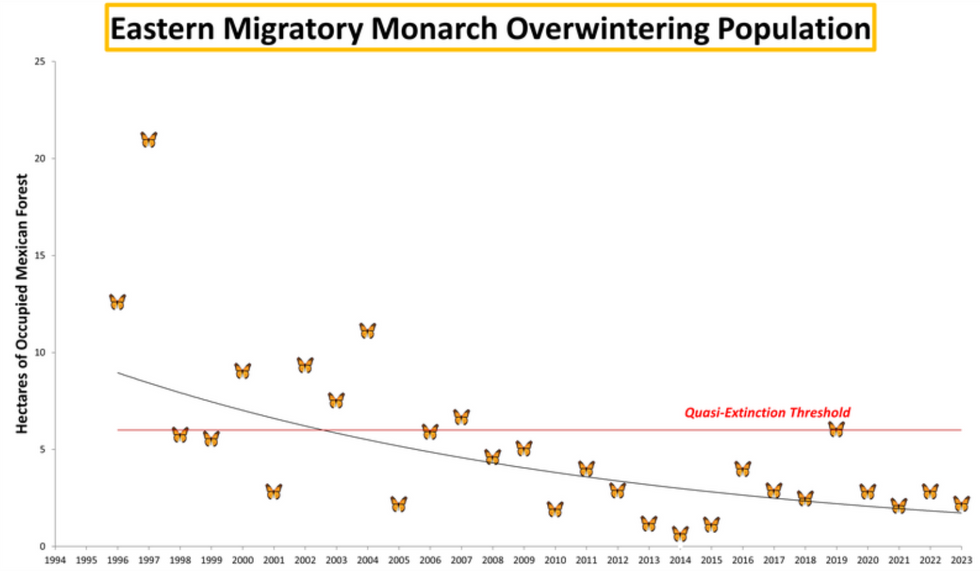
The annual survey—led by Mexico's National Commission of Natural Protected Areas and the Mexican branch of the World Wildlife Fund for Nature (WWF)—showed a 22% drop in the hibernating monarch population amid accelerating habitat loss driven primarily by deforestation.
"Despite heroic efforts to save monarchs by planting milkweed, we could still lose these extraordinary butterflies by not taking bolder action," Tierra Curry, a senior scientist at the Center for Biological Diversity (CBD), said in a statement.
"Monarchs were once incredibly common," she added. "Now they're the face of the extinction crisis as U.S. populations crash amid habitat loss and the climate meltdown."
Renowned for its epic annual migrations from the northern U.S. and southern Canada to Florida, California, and Mexico, monarchs have suffered a precipitous plunge in population in North America this century.
According to the U.S. Fish and Wildlife Service (FWS), the number of eastern monarchs fell from around 384 million in 1996 to 60 million in 2019, and in the West their numbers declined from 1.2 million in 1997 to fewer than 30,000 last year.
As CBD noted:
At the end of summer, eastern monarchs migrate from the northern United States and southern Canada to high-elevation fir forests in central Mexico. Scientists estimate the population size by measuring the area of trees turned orange by the clustering butterflies...The eastern population has been perilously low since 2008.
Last year, the International Union for Conservation of Nature formally listed the monarch butterfly as endangered, citing critical threats posed by the climate emergency, deforestation, pesticides, and logging.
In the United States, the Trump administration in 2020 placed monarchs on the wait list for consideration for Endangered Species Act protection. FWS has until next year to make a final listing determination.
"It is not just about conserving a species, it's also about conserving a unique migratory phenomenon in nature," said WWF Mexico general director Jorge Rickards. "Monarchs contribute to healthy and diverse terrestrial ecosystems across North America as they carry pollen from one plant to another."
"With 80% of agricultural food production depending on pollinators like monarchs, when people help the species, we are also helping ourselves," he added.
"We are currently experiencing and causing the Sixth Extinction—the mass extinction of species across the planet," said the head of NatureServe, which also found a third of plants nationwide are under threat.
Underscoring the need for humanity to overhaul its relationship with nature, 34% of plants species and 40% of animal species across the United States are at risk of extinction while 41% of U.S. ecosystems could collapse, according to an analysis published Monday by the nonprofit NatureServe.
"For 50 years, the NatureServe Network has been collecting the information necessary to understand biodiversity imperilment in the United States. This new analysis of that data, a first in 20 years, makes crystal clear the urgency of that work," said the group's vice president for data and methods, Regan Smyth.
"It's suicidal of us to pretend that business as usual is more important than safeguarding the natural world we all depend on."
"Two-fifths of our ecosystems are in trouble. Freshwater invertebrates and many pollinators, the foundation of a healthy, functional planet, are in precipitous decline," she pointed out. "Understanding and addressing these risks is critical if we are to forestall devastating consequences for the biodiversity that humanity needs to survive."
Noting that roughly a third of plants are in danger, the report—Biodiversity in Focus: United States Edition—explains that "this is an alarming general finding, but certain taxa face even greater threats. For example, 48% of cactus species are at risk of extinction, while around 200 tree species (about 20%) are at risk of extinction."
"Of the hundreds of grass species that form our nation's great prairies and marshes, about 19% are at risk of vanishing forever," the document states. "Preventing plant extinction is essential to maintaining ecosystem function and the services that wildlife and people rely upon."
As for animals, the analysis says that "as a group, species associated with fresh water, including amphibians, snails, mussels, crayfish, and many aquatic insects, have the highest percentage of at-risk species, highlighting the importance of conservation strategies to protect freshwater ecosystems."
"Among pollinators, bees are particularly threatened, with 37% of assessed species at risk," the report continues. "The conservation needs of these, and other invertebrate species, are often overlooked, yet many invertebrates are integral to maintaining the ecological functions of freshwater and terrestrial ecosystems."
Ecosystems across the country face potential "range-wide collapse due to extensive threats such as land-cover conversion," the publication warns. "Tropical ecosystems in the U.S. are all under substantial risk, but account for relatively small proportions in number and area."
"Temperate grasslands, boreal grasslands, and shrublands stand out among highly threatened ecosystems that extend over vast areas of the country, with 51% of the 78 grassland types known to be at risk of range-wide collapse," the report adds. "Temperate forests, boreal forests, and woodlands have also experienced multiple pressures, leading to an at-risk status for 40% of the 107 types of native U.S. forests."

NatureServe president and CEO Sean T. O'Brien stressed that "we are currently experiencing and causing the Sixth Extinction—the mass extinction of species across the planet. NatureServe's data highlight where the threats are right here at home."
"The plants, animals, and ecosystems found in our state, tribal, and federal lands are key components of our cultural and natural heritage," he said. "We should be proud of the biodiversity in our backyard and should prioritize protecting what is here, now."
The report is just the latest to emphasize the growing threat to various species. Others include the International Union for Conservation of Nature (IUCN) Red List of Threatened Species, updated in December during a summit in Montreal that ultimately produced what many experts and advocates agree is a "weak" global framework to protect biodiversity.
The IUCN update revealed "a perfect storm of unsustainable human activity decimating marine life around the globe," Bruno Oberle, the group's director general, said at the time. He warned that "we urgently need to address the linked climate and biodiversity crises, with profound changes to our economic systems, or we risk losing the crucial benefits the oceans provide us with."
The NatureServe analysis provoked similar demands for action. As Reuters reported:
Vivian Negron-Ortiz, the president of the Botanical Society of America and a botanist with the U.S. Fish and Wildlife Service, who was not involved in the NatureServe report, said there is still a lot scientists do not know and have not yet discovered about biodiversity in the United States, and that NatureServe's data helped illuminate that darkness.
More than anything, she sees the new data as a call to action.
"This report shows the need for the public to help prevent the disappearance of many of our plant species," she said. "The public can help by finding and engaging with local organizations that are actively working to protect wild places and conserve rare species."
Tierra Curry, a senior scientist at the Center for Biological Diversity, said in a statement Monday that "this grim assessment adds to the mountain of science showing that we're creating an extinction crisis."
"It's suicidal of us to pretend that business as usual is more important than safeguarding the natural world we all depend on," Curry declared, spotlighting some potential solutions including the Extinction Prevention Act and Recovering America's Wildlife Act.
"Grassland loss is the biggest U.S. environmental disaster that gets the least attention," she said. "Conversion of grasslands to suburban sprawl and pesticide-intensive agriculture is a primary reason we've lost 3 billion birds and why we could lose monarch butterflies and vital pollinators."
"By taking nature for granted we've pushed natural systems to the brink of collapse," Curry continued. "We've been so neglectful for so long, but we can create a different world that doesn't exploit nature and vulnerable human communities for never-ending sprawl and consumption."
In a major victory for pollinators and other wildlife, the U.S. Court of Appeals for the 9th Circuit on Wednesday ruled that the U.S. Environmental Protection Agency's registration of the bee-killing insecticide sulfoxaflor is unlawful.
In response to a legal challenge brought by the Center for Food Safety and the Center for Biological Diversity, the court argued that the EPA's 2019 decision authorizing the expanded use of sulfoxaflor across more than 200 million acres of pollinator-attractive crops violated the Endangered Species Act (ESA). The court gave the agency 180 days to collect public comment and issue a new decision on the insecticide, which is produced by Corteva, formerly Dow AgroSciences.
"Studies show that the widespread adoption of systemic insecticides has made our landscapes 48 times more deadly for pollinators like honeybees."
"When an agency deliberately ignores Congress' legislative command, it undermines the will of the people and ultimately our constitutional structure of government," the court wrote in a strongly worded decision.
By routinely failing to protect endangered species when registering pesticides--thereby forcing the public to sue to obtain protections that should be automatic--EPA is "engaging in a whack-a-mole strategy for complying with the ESA," the court stated.
Sylvia Wu, a senior attorney at the Center for Food Safety and counsel in the case, said that "for far too long, EPA has bent to the pesticide industry's desire to get their toxic chemicals to market as quickly as possible."
"Today the court told EPA, 'No more: Congress tasked the agency with protecting endangered species and the environment at-large, not just the interests of the pesticide companies,'" Wu added.
EPA originally approved sulfoxaflor in 2013, but thanks to an Earthjustice lawsuit filed on behalf of the Pollinator Stewardship Council and the American Beekeeper Federation, the 9th Circuit vacated that decision. The court ruled at the time that EPA failed to comply with the Federal Insecticide, Fungicide, and Rodenticide Act, which requires all pesticide applications to prove they will not cause "unreasonable adverse effects on the environment."
"In 2016, EPA re-approved sulfoxaflor subject to significant restrictions to reduce the risk to honeybees and other pollinators," Earthjustice explained. "But in 2019, and without any public notice, EPA removed these restrictions and approved new uses for the bee-killing insecticide." In response, Earthjustice once again sued the agency, this time on behalf of the Pollinator Stewardship Council, the American Beekeeping Federation, and commercial beekeeper Jeffrey Anderson.
According to the Center for Food Safety and the Center for Biological Diversity, EPA's 2019 decision "to expand use of sulfoxaflor on a wide range of crops that attract bees, including soybeans, cotton, strawberries, squash, and citrus... came despite the fact that its own scientists found the insecticide could threaten honeybee colonies and other pollinators," including the imperiled monarch butterfly.
The groups continued:
The EPA also weakened the few spraying restrictions it previously had in place to protect native pollinators and other wildlife, eliminating all requirements for buffers even during aerial spraying.
The EPA admitted to the court that it had not considered any of sulfoxaflor's effects on species protected by the Endangered Species Act. The agency belatedly issued a draft endangered species assessment earlier this summer. In the draft assessment, the EPA found sulfoxaflor is potentially putting 24 species of insects in jeopardy of extinction, including the Karner blue butterfly and American burying beetle.
Stephanie Parent, a senior attorney at the Center for Biological Diversity and co-counsel on the case, called Wednesday's ruling "a huge win for monarch butterflies, rusty patched bumblebees, and all the other struggling populations of insects and birds constantly under threat from harmful insecticides."
"It's long past time for the EPA to take meaningful action to protect our most imperiled wildlife and put protections in place for endangered species before approving use of toxic pesticides on millions of acres of crops," said Parent.
Earthjustice attorney Greg Loarie noted that "scientists have long said systemic insecticides like sulfoxaflor are behind the unprecedented colony collapse of the last few years."
"It makes no sense to allow a bee-killing insecticide on a bee-attractive crop, when we know we need bees for agriculture," said Loarie. "EPA must protect pollinators from sulfoxaflor, and all other systemic insecticides that end up in pollen and nectar."
Citing data from the U.S. Department of Agriculture, Earthjustice pointed out that "pollinators' ecological service in the country is valued at $200 billion a year."
"More than 80% of plants worldwide need pollinators to survive," the group continued. "From April 2020 to April 2021, U.S. beekeepers lost 45.5% of their colonies. This is the second-highest loss on record."
According to Steve Ellis, president of the Pollinator Stewardship Council, "Studies show that the widespread adoption of systemic insecticides has made our landscapes 48 times more deadly for pollinators like honeybees."
"Pollinators are critical for the country's food supply," said Ellis. "EPA must immediately stop pesticides like sulfoxaflor that kill pollinators."
Last week, a new comprehensive study of almost 32,000 populations of 5,230 species around the world estimated that wildlife on earth has decreased by almost 70 percent since 1970. The mind can't really wrap around the scale of loss conveyed by this number.
Bill McKibben framed this loss in terms of a "fast-emptying ark," and a world growing "quieter by the day." Another working of this metaphor would have humans crowding onto the ark, other species tossed overboard or crushed underfoot. In 2020, the weight of human-made materials surpassed the weight of all life on earth for the first time. As Atlantic writer Ed Yong wrote in an extraordinary piece on animal perception, humans have "filled the silence with noise and the night with light," have remade the earth in fundamental ways. But like every other species, we depend on other species for our survival. We are not exempt from the mass extinction debt the earth is accruing. The question is: will we act to protect the magnificently complex ecosystems upon which everything depends?
As climate crises and biodiversity loss accelerate, the Endangered Species Act will be a far more important tool for preserving national stability than a nuclear weapons program.
That question has no one final answer. It has already been answered thousands of times, by voters and donors and autocrats and shareholders, by soldiers and protestors and lawyers and landowners, in transfer after transfer of dollars. Brazilian voters have the chance to offer a massively consequential answer on October 30, when they will choose between presidential candidates Lula and Bolsonaro, with the fate of the Amazon Rainforest hanging in the balance. Lula reduced Amazon deforestation by 80 percent when he was last president, while Bolsonaro has accelerated Amazon deforestation by 75 percent from the previous decade.
A Look at Endangered Species Act Appropriations
It's worth looking at how the US government spends over a trillion and a half dollars in discretionary spending each year through this same lens. Unfortunately, even a cursory glance at federal spending makes clear that the ongoing sixth mass extinction event is barely a blip on the government's radar.
Last Wednesday, The Guardian reported on a new study which found that the US's foremost law for protecting biodiversity, the Endangered Species Act of 1973, has long been undermined by inadequate resources for its implementation. Though over a thousand species are listed as endangered under the law (which is itself a gross underrepresentation of the number of species in need of protection), only 54 species have fully recovered. As it turns out, the federal appropriations process deserves a large share of the blame:
"The new report, which examined data from the Federal Register, found that since 1985, one of the main sources of funding for ESA has decreased by almost 50% when measured on a per species basis. Although the law has been shown to be effective when it comes to keeping species from going extinct (it has saved over 99% of listed species from extinction, according to the US Fish and Wildlife Service), it has not been as successful when it comes to species recovery. The authors explained that typically by the time a species has received protection, it has already reached 'dangerously low population sizes', which makes recovery extremely difficult."
The study looked specifically at the money allocated to the US Fish and Wildlife Service through annual congressional appropriations bills for resource management and implementing Section 4 of the Endangered Species Act. Section 4 outlines how the agency should determine species to be endangered or threatened. For 2023, the draft appropriations bills from the House and Senate would cap spending on implementing Section 4 of the Endangered Species Act at just under $26 million.
$26 million. That's a minuscule amount of money compared to practically any branch of the government. It looks even more devastatingly trivial in the face of the Pentagon's profligate waste. Take the cost of one new nuclear intercontinental ballistic missile: $264 billion over its lifetime. That's over ten thousand times the money allowed to be spent on endangered species protection under Section 4, in order to fund a dangerous and unnecessary nuclear weapon that experts say raises the risk of accidental nuclear war.
The Project on Government Oversight highlighted last year the Congressional Budget Office's unwillingness to even consider the "possible savings from simply scaling back (not even ending) the Pentagon's $2-trillion, three-decades-long plan to build a new generation of nuclear-armed missiles, bombers, and submarines, complete with accompanying new warheads. Scaling back such a buildup, which will only further imperil this planet, could easily save in excess of $100 billion over the next decade." Imagine what programs that actually protect public and ecological health could do with an extra $100 billion.
Every year since 1998, Congress has put a spending cap on the amount of money that the US Fish and Wildlife Service can spend on its endangered species listing program. This spending cap has a seriously deleterious effect on the agency's capacity to protect endangered species, and the agency knows it. In 2020, the Fish and Wildlife Service found that both monarch butterflies and northern spotted owls deserved to be classified as endangered--classification was "warranted," they said--but the action was "precluded by work on higher-priority listing actions." Monarch butterflies' western population has declined a staggering 99 percent, and their eastern population by 85 percent since the 1990s; northern spotted owl populations have declined somewhere between 50 and 75 percent since 1995. Still, neither is protected by the Endangered Species Act.
These are the terrible choices that systemically underfunded agencies make. In each of these findings, the Fish and Wildlife Service published this incensed note:
"...for more than two decades, the size and cost of the workload in these categories of actions have far exceeded the amount of funding available to the Service under the spending cap for completing listing and critical habitat actions under the Act. Since we cannot exceed the spending cap without violating the Anti-Deficiency Act, each year we have been compelled to determine that work on at least some actions was precluded by work on higher-priority actions."
A decade ago, overwhelmed by a massive backlog of petitions and lawsuits from environmental groups pushing the Fish and Wildlife Service to protect hundreds of fast-disappearing species, the agency responded not by asking Congress for increased resources, but by asking Congress to impose a limit on the number of species it had to consider for protection. Luckily, this limit didn't come to pass. But it underscores the longstanding importance of the fight to get agencies and congressional appropriations committees alike to stop approaching non-defense agency programs with an austerity mindset.
As climate crises and biodiversity loss accelerate, the Endangered Species Act will be a far more important tool for preserving national stability than a nuclear weapons program. Take pollinators, for instance, without whom you simply cannot grow crops. The American bumblebee population has declined by 90 percent, and nearly vanished from sixteen states. The Fish and Wildlife Service is currently reviewing whether it warrants endangered species protection. Of course, even if it's "warranted," it may be "precluded" by the deadly ignorance of those who write the budget.
The International Union for Conservation of Nature on Thursday formally listed the beloved migratory monarch butterfly as endangered, citing dire threats to the subspecies posed by the climate crisis, deforestation, pesticide use, and logging.
Dr. Bruno Oberle, the director-general of IUCN--the world's leading scientific authority on species conservation--said the new listing "highlights the fragility of nature's wonders, such as the unique spectacle of monarch butterflies migrating across thousands of kilometers," a reference to the insects' remarkable biannual journey across North America.
"To preserve the rich diversity of nature, we need effective, fairly governed protected and conserved areas, alongside decisive action to tackle climate change and restore ecosystems," Oberle added. "In turn, conserving biodiversity supports communities by providing essential services such as food, water, and sustainable jobs."
The population of monarch butterflies in North America has been falling rapidly in recent years, a decline largely unabated by government action to protect the imperiled insects or to fight the climate crisis that is pushing them to the brink of extinction.
Echoing recent research attributing the monarch butterfly's decline to the climate emergency, IUCN notes that "climate change has significantly impacted the migratory monarch butterfly and is a fast-growing threat; drought limits the growth of milkweed and increases the frequency of catastrophic wildfires, temperature extremes trigger earlier migrations before milkweed is available, while severe weather has killed millions of butterflies."
"The western population is at greatest risk of extinction, having declined by an estimated 99.9%, from as many as 10 million to 1,914 butterflies between the 1980s and 2021," the organization observed. "The larger eastern population also shrunk by 84% from 1996 to 2014. Concern remains as to whether enough butterflies survive to maintain the populations and prevent extinction."
Additionally, IUCN stressed that "legal and illegal logging and deforestation to make space for agriculture and urban development" have also "destroyed substantial areas of the butterflies' winter shelter in Mexico and California, while pesticides and herbicides used in intensive agriculture across the range kill butterflies and milkweed, the host plant that the larvae of the monarch butterfly feed on."
Anna Walker, a member of the IUCN SSC Butterfly and Moth Specialist Group, said Thursday that while "it is difficult to watch monarch butterflies and their extraordinary migration teeter on the edge of collapse... there are signs of hope."
"So many people and organizations have come together to try and protect this butterfly and its habitats," said Walker, who spearheaded the monarch butterfly assessment. "From planting native milkweed and reducing pesticide use to supporting the protection of overwintering sites and contributing to community science, we all have a role to play in making sure this iconic insect makes a full recovery."
Wildlife defenders on Tuesday welcomed a California appeals court ruling affirming that a regulatory agency can classify four types of bumblebees as "fish" under the law in order to consider them for candidacy on the state's endangered species list, a ruling that paves the way for the protection of other insects including the monarch butterfly.
"With one out of every three bites of food we eat coming from a crop pollinated by bees, this court decision is critical to protecting our food supply," said Rebecca Spector, West Coast director at the advocacy group Center for Food Safety, a party to the case.
"The decision clarifies that insects such as bees qualify for protections under CESA, which are necessary to ensure that populations of endangered species can survive and thrive," she added, referring to the California Endangered Species Act.
In Almond Alliance of California v. Fish and Game Commission, the California Third District Court of Appeal overturned a lower court's ruling and affirmed that the state wildlife regulatory agency has the authority to classify invertebrates--both aquatic and terrestrial--as endangered species.
"The issue presented here is whether the bumblebee, a terrestrial invertebrate, falls within the definition of fish, as that term is used in the definitions of endangered species," the ruling explained. "More specifically, we must determine whether the commission exceeded its statutorily delegated authority when it designated four bumblebee species as candidate species under consideration for listing as endangered species."
The court agreed with the commission that the agency may "designate any invertebrate" as a candidate for CESA listing. Under state law, a "fish" is defined as a "wild fish, mollusk, crustacean, invertebrate, [or] amphibian," a broad definition designed to allow better regulation of the harvesting of species such as starfish, sea urchins, sponges, and worms.
In 2018, Center for Food Safety, Defenders of Wildlife, and Xerces Society petitioned the Fish and Game Commission to list four species--the Western bumblebee, Franklin's bumblebee, Crotch's bumblebee, and the Suckley cuckoo bumblebee--as endangered under CESA. The agency subsequently voted to begin the listing process, but was sued by California agricultural groups including the Almond Alliance of California, California Citrus Mutual, Western Growers Association, California Association of Pest Control Advisers, and others.
The four bumblebee species are the first insects to gain CESA protection. Like many pollinators--including other insect species as well as birds, bats, and additional small mammals--bees in California and around the world have suffered dramatic population declines in recent decades due to habitat destruction, pesticide use, pathogens and parasites, and climate change.
"This is an important decision that makes clear that all invertebrates can be protected under the species-saving protections of CESA," Center for Food Safety staff attorney Jenny Loda said in a statement. "And it affirms the role of the Fish and Game Commission in protecting imperiled insects like the four bumblebees at issue in this case."
A new report released Wednesday by the Endangered Species Coalition details the plight of 10 rapidly vanishing species in the United States that are already suffering the destructive consequences of the global climate emergency--characterized by rising temperatures that bring increasingly frequent, prolonged, and intense heatwaves, droughts, wildfires, storms, and floods.
"Without sufficient and vibrant biodiversity, we lose the resources... to support life."
Animals being "pushed to the edge of extinction in our warming world" include the Diamondback terrapin; Elkhorn coral; Florida Key deer; Maui parrotbill; Mexican long-nosed bat; Monarch butterfly; Sierra Nevada yellow-legged frog; and Western ridged mussel.
Plants that are increasingly at risk of being wiped off the face of the Earth due to extreme weather driven primarily by fossil fuel emissions include the Ka palupalu o Kanaloa and the Whitebark pine.
The 10 highly vulnerable species described in the report were selected by a committee of distinguished scientists, who reviewed nominations submitted by the Endangered Species Coalition's member groups.
"Scientists have long known about the impact of greenhouse gases and carbon pollution on the planet," Leda Huta, executive director of the Endangered Species Coalition, said in a statement. "Plants and wildlife are going extinct at an unprecedented rate, and it's way past time for our elected leaders to take bold action to protect our planet and all its inhabitants."
The report stresses that "biodiversity is the key to a healthy planet. Indeed, without sufficient and vibrant biodiversity, we lose the resources--think clean air and water, and sufficient food--to support life. And biodiversity is being hit hard by climate change."
Both issues, the report notes, "are inextricably linked with significant feedback loops: Climate change speeds biodiversity loss, and biodiversity loss, in turn, speeds climate change."
"We increasingly see this dynamic play out around the world," the authors point out. "When we destroy habitats, for example, we lose not only homes for species, but also nature's storehouses for carbon."
Citing the latest comprehensive report published by the Intergovernmental Panel on Climate Change--described by United Nations Secretary-General Antonio Guterres as a "code red for humanity"--the Endangered Species Coalition's new analysis emphasizes that "climate change will only be solved if governments address it concurrently with biodiversity loss. Biodiversity loss cannot remain the forgotten environmental crisis."
The coalition said in a statement that world leaders in 2021 "have finally begun to pay more attention to the twin crises of climate and biodiversity loss," although progressives have criticized U.S. President Joe Biden for failing to govern in a way that is commensurate with his rhetoric about the existential threats facing the planet.
A joint report published in June by the U.N.'s scientific agencies on climate change and biodiversity highlighted the interconnection between the two issues and warned that further destruction of biodiversity will exacerbate the climate crisis, and vice versa.
"We will be able to curb the worst consequences of climate change--if we act."
The U.N. has called on global policymakers to urgently pursue measures that can meaningfully address both problems simultaneously, including restoring terrestrial and marine ecosystems as well as expanding sustainable agriculture and forestry practices.
In mid-October, conservation advocates welcomed the adoption of the "Kunming Declaration"--which acknowledges that biodiversity destruction and the climate crisis "pose an existential threat to our society, our culture, our prosperity, and our planet"--during the first part of COP15, the U.N.'s Biodiversity Conference, while also demanding that words be matched with bold and concrete policies.
That pledge sets the stage for the development of a post-2020 global biodiversity framework, which governments are scheduled to negotiate further in January 2022 and adopt next May at part two of the U.N. Biodiversity Conference, hosted by China.
However, while diplomats from around the globe were debating how to update the Convention on Biological Diversity, Biden's delegates could only observe because the U.S. remains the only country in the world that has refused to ratify the international treaty meant to better protect the variety of life on Earth.
Domestically, Biden has also come under fire for perpetuating harmful "tactics so often employed during the Trump era," as one environmentalist put it earlier this week when responding to the U.S. Fish and Wildlife Service's plan to weaken or eliminate protections for several endangered species, including at least one discussed in the report--Florida's Key deer.
"We are at an urgent choice point," states the report. "We will be able to curb the worst consequences of climate change--if we act. We have the ability, the resources, the technology, and the talent and ingenuity to make meaningful change."
The insect world's version of the ultramarathon is now taking place across the United States. Monarch butterflies have started their journey to the groves where they'll spend the winter. Monarchs west of the Rocky Mountains have a long trip to the California coast before them, while eastern monarchs have a hefty 3,000-mile trek to the forests of Mexico.
Despite their hardy nature, monarchs have suffered severe population losses. In the past several decades the eastern population has declined 80%, while its western counterpart has fared even more poorly. In the West, monarchs are at less than 0.1% of the population they had in the 1980s. Last year's winter count fell short of just 2,000 butterflies. These numbers reflect a very real threat of extinction for this iconic species.
America's pollinators face an imperiled future due to decades of exposure to toxic pesticides, disappearing habitat and a changing climate.
But there's hope, and it comes from an unexpected place: the Biden administration's infrastructure agenda.
In addition to supporting traditional infrastructure such as roads and bridges, the current version of the Infrastructure Investments and Jobs Act in Congress contains funding for pollinator-friendly roadsides, as well as provisions to revegetate areas devastated by invasive species.
Throughout the United States, there are 10 million acres of prime space for habitat along roadsides. Why not use it to rebuild populations for butterflies and bees? That's the opportunity before us, and the infrastructure bill would provide $2 million annually to relevant agencies for pollinator-friendly plantings. Grants of up to $150,000 would go toward much-needed projects for "planting and seeding of native, locally appropriate grasses and wildflowers, including milkweed." Other techniques to protect pollinators detailed in the bill--yes, it's that thorough--are as simple as reducing mowing frequency, timing mowing to avoid disturbing pollinators, and using pesticides more judiciously.
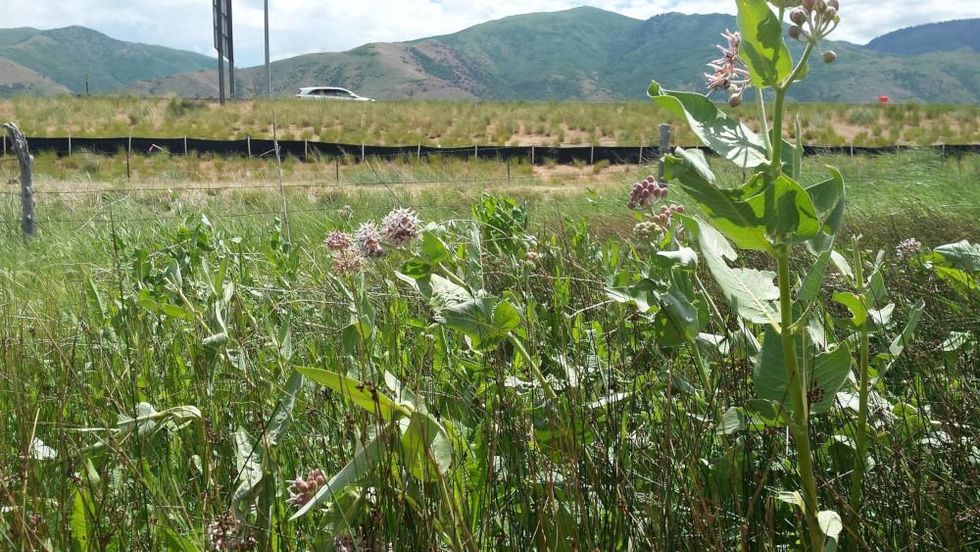
None of these concepts are new. Earlier this year, similar language appeared in the Monarch and Pollinator Highway Act of 2021, a bill introduced by Rep. Jimmy Panetta (D-Calif.) and Sen. Jeff Merkley (D-Ore). Several years before that, the U.S. Department of Transportation issued best management practices for this type of roadside habitat. On a more local level, nine state departments of transportation--including those in California, Iowa and Florida--have led the way on these common-sense projects.
Another piece of the infrastructure bill would provide $50 million annually in grants to eliminate, control and prevent invasive plants, which throw native ecosystems out of balance. The Invasive Plant Elimination Program would prioritize funding to revegetation programs utilizing native plants and wildflowers, including pollinator-friendly species. This strategy offers a boon to pollinators and other wildlife in these healing ecosystems.
And they need the help. America's pollinators face an imperiled future due to decades of exposure to toxic pesticides, disappearing habitat and a changing climate. In addition to monarchs, one report found that more than half of native bee species in North America are in decline, including the rusty patched bumblebee. We need infrastructure that prioritizes these creatures.
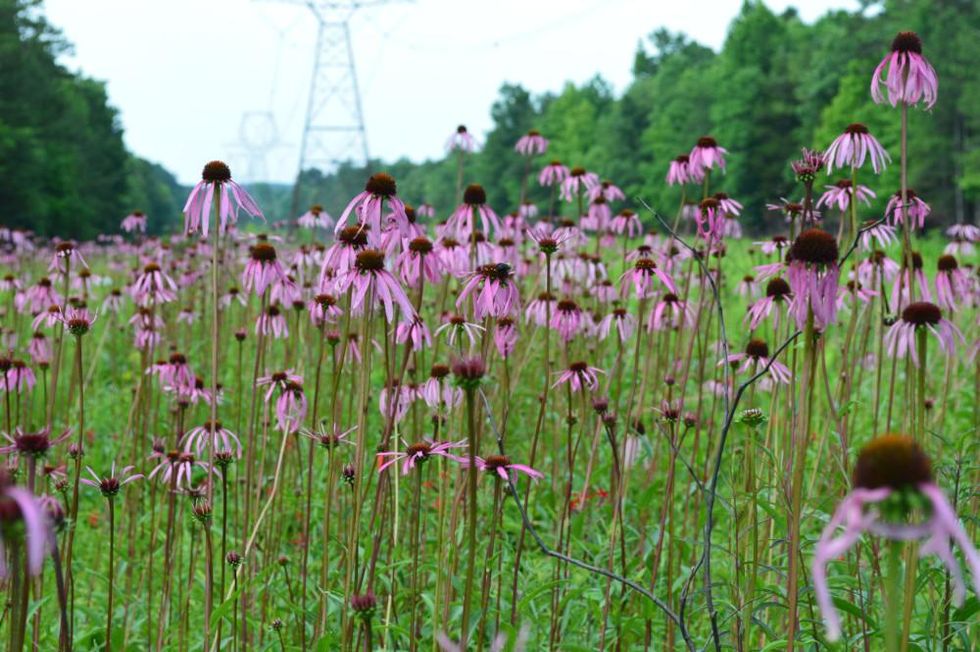
If we're wise, we'll invest in pollinator habitats for several reasons. First, given that insect pollinators contribute tens of billions of dollars of value to our agriculture, it makes economic sense to ensure they're abundant and healthy themselves. Roadside habitats near farms can increase pollination services and boost crop yields while reducing crop pests in the process.
Second, losing pollinators--especially native species--can have permanent ecological repercussions. Tremors in the web of life caused by the extinction of our pollinators affect animals that depend on them for food and nearly 90% of all flowering plants, including those that have co-evolved with these pollinators.
Third, losing monarch butterflies and other pollinators would make our lives less rich and less beautiful.
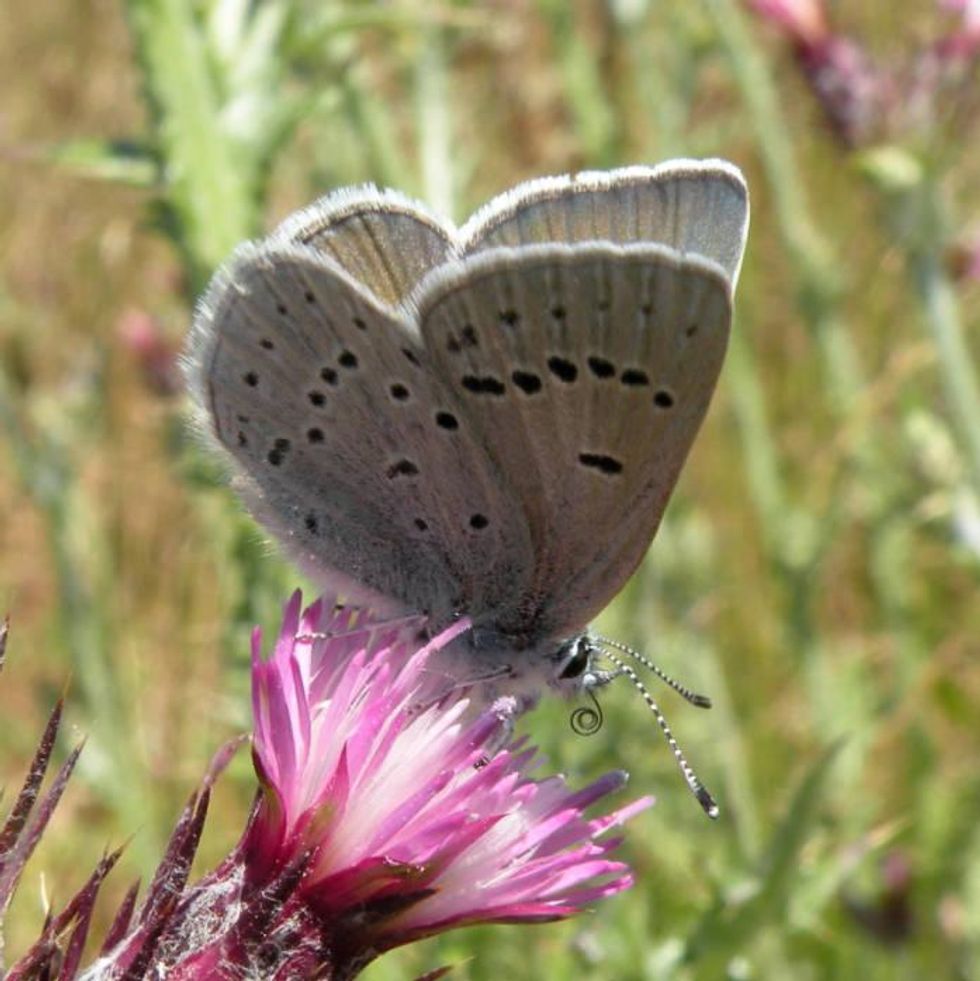
Congress can help. While building roads and a more robust infrastructure system, Congress should also vote for the bill so we can build roadside habitats and increase the resiliency of pollinator populations. Providing diverse, healthy habitat will meet a long-neglected need for the thousands of native pollinators in the country. Along the way, it will help put these vital insects to work--for nature's benefit and for our own.
The work to save our pollinators will not end with the infrastructure bill, but with this added to the protections already in place, we can halt the monarch's flutter toward extinction.