

SUBSCRIBE TO OUR FREE NEWSLETTER
Daily news & progressive opinion—funded by the people, not the corporations—delivered straight to your inbox.
5
#000000
#FFFFFF
To donate by check, phone, or other method, see our More Ways to Give page.
Daily news & progressive opinion—funded by the people, not the corporations—delivered straight to your inbox.
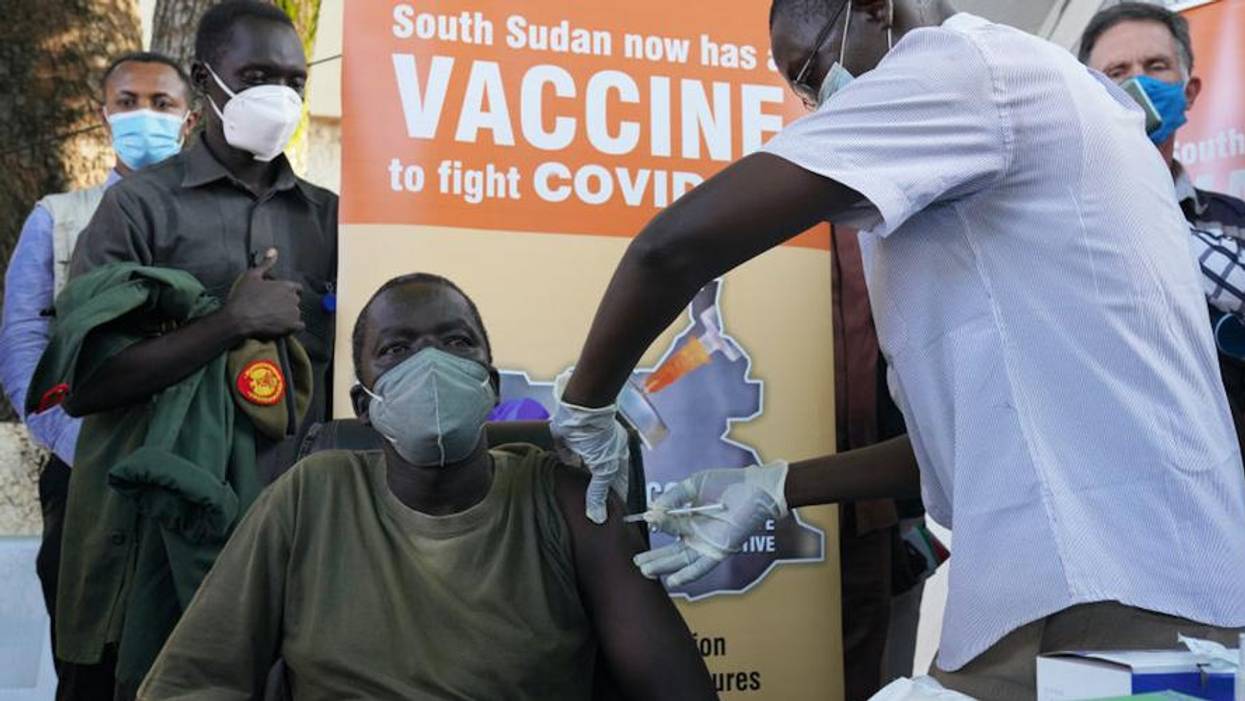
As international financial institutions convene virtually to discuss the world's response to the ongoing coronavirus pandemic, 260 faith, labor, and development groups on Wednesday sent letters to U.S. President Joe Biden and the heads of the International Monetary Fund and G20 urging them to provide more aid to developing nations and enact policies to avert future crises and protect the environment.
The identical letters--addressed to Biden, G20 chair Mario Draghi, and IMF managing director Kristalina Georgieva--were organized by the nonprofit religious development and financial reform group Jubilee USA Network and call on the White House and the organizations to:
While both the G20 and IMF have agreed to temporarily suspend debt payments for dozens of developing nations, Eric LeCompte, a United Nations finance expert who heads the Jubilee USA Network, said these moves are not enough.
"World leaders worked hard over the last year to tackle the health and economic crises spurred by the [Covid-19] pandemic," said LeCompte on Wednesday. "We must do more. Unless we take immediate action to solidify more aid and relief, we face lost decades of development and millions more will suffer."
Finance ministers from G7 nations--Canada, France, Germany, Italy, Japan, the United Kingdom, and the United States--last month agreed to create emergency reserve funds, or Special Drawing Rights (SDR), in what LeCompte at the time called an effort "to confront the [Covid-19] economic crisis that is ravaging developing countries."
"If the IMF and G20 move forward emergency reserves, it means right away developing countries can access more than $200 billion to fight the health and economic impacts of the coronavirus," LeCompte said Wednesday. "We will likely see another additional process where hundreds of billions of more dollars in Special Drawing Rights could be transferred from wealthy countries to developing countries for further support."
In addition to scores of faith-based groups, labor unions including the International Trade Union Confederation, United Steelworkers (USW), American Federation of Labor and Congress of Industrial Organizations (AFL-CIO), and American Federation of State, County, and Municipal Employees (AFSCME) signed the letter, as did numerous human rights and environmental organizations including Amazon Watch, Amnesty International, Friends of the Earth U.S., and Oxfam America.
As the Jubilee USA Network letters were sent, progressive campaigners on Wednesday denounced G20 nations for paying lip service to the need for treating coronavirus vaccines as a "global public good" while simultaneously blocking an effort to lift restrictive patent protections and share vaccine recipes with the developing world.
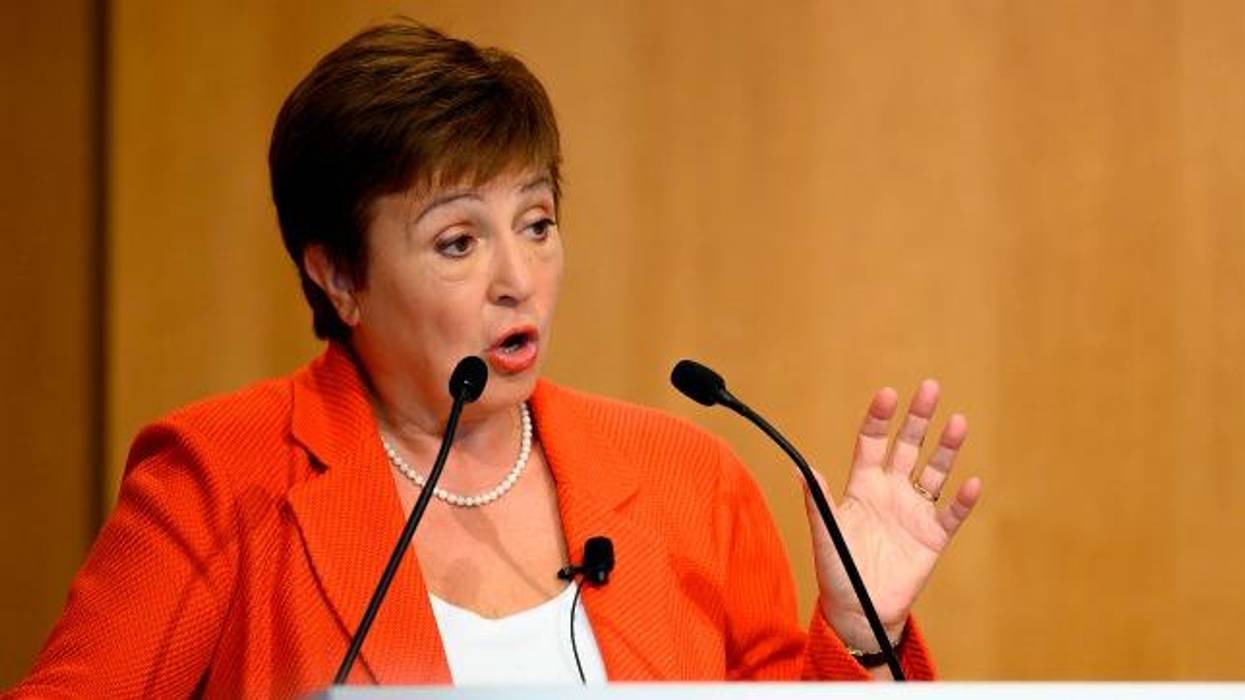
Increasing inequality and the climate crisis are pushing the world towards another financial disaster, the International Monetary Fund chief said Friday--a warning, according to one anti-poverty group, that should be taken seriously.
IMF managing director Kristalina Georgieva made the remarks in a speech at the Peterson Institute for International Economics in Washington, D.C.
A theme of "increasing uncertainty," some of which is driven by inequality, has already emerged from the new year, Georgieva said.
The trend of rising inequality within countries, she said, "is reminiscent of the early part of the 20th century, when the twin forces of technology and integration led to the first Gilded Age, the Roaring Twenties, and, ultimately, financial disaster."
Unlike the 1920s, however, the new decade is confronted with an urgent climate crisis.
"In the 2020s," said Georgieva "the financial sector will have to grapple with preventing the traditional type of crisis, and handle newer ones, including climate-related shocks. Think of how stranded assets can trigger unexpected loss. Some estimates suggest the potential costs of devaluing these assets range from $4 trillion to $20 trillion."
She also pointed to new IMF research showing rising inequality--which her institution has helped fuel by promoting neoliberal policies--is a predictor of coming a financial crisis. Staving off that threat includes increasing affordable and readily available access to financial services to address inequality, sustaining regulatory mechanisms, and ensuring more stability. Key to the latter point is addressing the climate crisis.
"The financial sector can play a crucial role in moving the world to net zero carbon emissions and reach the targets of the Paris Agreement," said Georgieva. "To get there, firms will need to better price climate change impacts in their loans." Institutions will also increase stability and help lessen inequality by boosting lending to smaller firms, she added.
According to Jubilee USA director Eric LeCompte, it would be unwise to let Georgieva's comments fall on deaf ears.
"The IMF delivered a stark message about the potential for another massive financial disaster that we last experienced during the Great Depression," said LeCompte, also a United Nations finance expert. "With inequality on the rise and concerns of stability in the markets, we need to take this warning seriously."
" Trade problems and climate-driven weather events pose additional risks at this time," LeCompte added. "It's imperative that we ensure the financial sector is free of risky behavior and corruption if we want to protect ourselves from another global financial crisis."
Puerto Rico says it will default on its debt on Monday, escalating the economic crisis on the island that sees no sign of stopping in the face of exploitative hedge funds.
The commonwealth is expected to miss its upcoming $422 million bond payment for its Government Development Bank. The default comes after U.S. Congress failed to act to help the island territory last week, in a decision that followed a concerted lobbying push by hedge funds angling to profit off its debt crisis.
As the International Business Times reports:
Over the last few years, hedge funds and mutual funds have bought up large tranches of Puerto Rico's bonds at cut-rate prices, hoping the island will pay back its debts in full, thereby giving those financial interests a big payout. That gamble, however, has relied in part on the bet that the island will make draconian cuts to social services and worker pensions and use the savings to pay back 100 cents on the dollar to its Wall Street creditors -- a bet, in other words, that Congress will prevent the island from simply erasing some of its debt through the kind of bankruptcy protections that are afforded U.S. cities.
To that end, federal lobbying records show that major banks, bond insurers and hedge funds spent millions last year to try to shape bankruptcy proposals for the island. Two so-called dark money groups linked to the billionaire Koch brothers and Republican strategist Karl Rove are also working to influence the debate over Puerto Rico's debt.
"Faced with the inability to meet the demands of our creditors and the needs of our people, I had to make a choice," Puerto Rico Governor Alejandro Garcia Padilla said during a televised speech on Sunday. "I decided that essential services for the 3.5 million American citizens in Puerto Rico came first."
The Sunlight Foundation reported earlier this month that one of the dark-money groups behind the lobbying push, the Center for Individual Freedom (CFIF), purchased at least $200,000 in ads around Washington, D.C., to influence lawmakers away from passing legislation that would ease the island's debt burden. The Koch-backed American Future Fund also placed ads with Politico and the Wall Street Journal that attacked Garcia Padilla.
Congress continued to drag its feet on legislation that could have eased some of Puerto Rico's debt burden despite efforts by economic justice groups like Jubilee USA, which organized a call-in day of action urging constituents to ask their representatives in the House to pass the Puerto Rico Oversight, Management, and Economic Stability Act (PROMESA), which would have allowed the commonwealth to restructure its debt.
"There are no budget cuts or tax hikes that can solve this crisis," said Jubilee USA executive director Eric LeCompte. "Debt restructuring is a necessity before we can see any economic growth."
The $422 million is only a small chunk of the island's $70 billion debt burden. Its human impact has been enormous, fueling a poverty rate of nearly 45 percent, tens of thousands of public employee layoffs, tax hikes, and widespread school closures. As a result, Puerto Rico is seeing its largest exodus in 50 years, its population dropping nine percent from 2000 to 2015.
Puerto Rico's next payment is due in July. As LeCompte said on Monday, "Congress could have prevented the May default. With even greater consequences around a July default, Congress needs to act quickly."
"Puerto Rico needs to bring its debt back to payable levels," he said. "Any solution must respect the rights of the creditors, Puerto Rico's government and the needs of the island's people. We remain concerned how this fiscal crisis is impacting the poor and vulnerable. 57 percent of Puerto Rico's kids live in poverty. The most important cost to be concerned about is the human cost of this crisis."
Puerto Rico asked the U.S. Supreme Court on Tuesday for permission to restructure the debt of its financially struggling public utilities under a court-supervised regime similar to Chapter 9 bankruptcy laws used by U.S. cities such as Detroit and Stockton, California.
In addition to potentially giving the commonwealth a better chance at repaying some of its $70 billion debt, the case "tests, at a fundamental level, how much authority the island of more than 3.5 million people has to manage its own governmental affairs," Lyle Denniston wrote at SCOTUSblog last week.
"And lurking just beneath the surface," he continued, "is the broader question of whether it is unconstitutional to treat Puerto Rico differently than the fifty state governments on the mainland and in Alaska and Hawaii."
What's more, the case could chip away at hedge funds' stranglehold on the island. As journalist David Dayen wrote for the Winter 2016 issue of The American Prospect: "Puerto Rico is just the latest battlefield for a phalanx of hedge funds called 'vultures,' which pick at the withered sinews of troubled governments. In Greece, Argentina, Detroit, and now Puerto Rico, vultures have bought distressed debt on the cheap, and then used coercion, threats, and legal action to secure a massive windfall, compounding the effects on millions of citizens."
Reuters reports Tuesday:
Puerto Rico, which as a U.S. commonwealth is excluded from Chapter 9, passed the Recovery Act in 2014, a local restructuring law that lets it put public entities, such as power authority PREPA, into bankruptcy.
Two U.S. court decisions deemed the Recovery Act invalid after PREPA creditors sued, with the Supreme Court agreeing in December to hear an appeal.
Creditors say the act contradicts federal bankruptcy law, which prohibits states from making their own debt restructuring laws.
Puerto Rico argues that if it is exempt from Chapter 9, it must also be exempt from the limitation on states passing their own laws.
According to the Associated Press, "four liberal justices on a short-handed Supreme Court seemed sympathetic" to Puerto Rico's argument on Tuesday. Justice Samuel A. Alito, Jr. has recused himself from the case and the late Justice Antonin Scalia's seat remains vacant.
Bloomberg added:
Justice Sonia Sotomayor, whose parents moved to New York from Puerto Rico, emerged as the island's strongest supporter.
Justice Ruth Bader Ginsburg also hinted she might back the commonwealth. She voiced doubt that Congress would have left Puerto Rico's utilities unable to use either the federal bankruptcy system or a local restructuring law.
"Why would Congress put Puerto Rico in this never-never land?" Ginsburg asked.
If the outcome is favorable for Puerto Rico, "we'll have some additional tools to address some of the debt in an orderly way," said Eric LeCompte, a United Nations sovereign debt expert and executive director of the religious development group Jubilee USA, on Tuesday.
However, LeCompte added, "while this could be positive, it still doesn't offer a comprehensive solution" because it addresses only one portion of the island nation's ballooning financial obligations.
Jubilee USA has described the situation in Puerto Rico as a "humanitarian crisis" and opposes further austerity or cuts to help pay down the territory's debt. To that end, thousands of college students from the University of Puerto Rico approved a three-day, full-campus shutdown last week to protest recent austerity measures.
A solidarity protest against colonialism and capitalism took place Tuesday in New York City.
In testimony (pdf) to Congress last month, LeCompte appealed for lawmakers to support "reforms that ensure Puerto Rico's economy serves its people, debt restructuring to allows for economic growth, and accountability measures to stave off corruption."
Meanwhile, House Speaker Paul Ryan told reporters on Tuesday that the House Natural Resources Committee was "closing in" on a final Puerto Rico relief bill, according to The Hill. The committee is expected to hold a hearing on the draft legislation on April 13 with a markup the following day, according to a House Democratic leadership aide.
Denouncing new austerity plans and proposed "fiscal adjustments" that they say will adversely impact Puerto Rico's poor and needy people, the island's faith leaders on Monday called for debt relief and a resolution to the financial crisis that eschews further austerity.
With a working group restructuring plan due to be delivered to Gov. Alejandro Garcia Padilla on or before September 8, the letter from religious leaders (pdf) comes as the U.S. territory struggles to address crippling debt and double-digit unemployment.
Two recent reports suggest new austerity plans to pay off portions of the debt, one commissioned by a group of hedge funds that purchased the island's distressed debt and the other authorized by Puerto Rico's government. These plans include reducing the minimum wage and cutting education and healthcare programs.
Citing the Biblical concept of debt relief, or Jubilee, the letter's signatories express concern about "predatory hedge funds which seek to benefit from our distress and push our economy to the brink of collapse" while calling for full-scale debt restructuring "that invests in Puerto Rico's people."
"This debt crisis threatens to push more of our people into poverty and put people out of work," stated San Juan Archbishop Roberto Gonzalez Nieves, leader of Puerto Rico's mostly Catholic population. "The religious community stands with vulnerable people and we call for the crisis to be resolved in a way that protects the poor and grows our economy."
In resolving the financial crisis, the religious leaders call for policymakers to adhere to six principles:
"Puerto Rico's religious leaders are fighting for the lives of their people," stated Eric LeCompte, the faith-based development coalition Jubilee USA Network executive director. LeCompte, who visited Puerto Rico in mid-August to advise religious and political leaders on solutions to the crisis, said: "We need to get Puerto Rico's debt back to sustainable levels and ensure that the island has a path for economic growth."
However, the letter acknowledges how Puerto Rico's complicated geopolitical standing makes finding solutions to the crisis more challenging:
We understand that some processes and options typically available to indebted governments are not available to ours. Because Puerto Rico is not a sovereign country, we can't receive low-interest loans or emergency financing from the International Monetary Fund. Because Puerto Rico is not a US state or city, we can't access US bankruptcy laws. In the absence of Congress extending bankruptcy protection to Puerto Rico, we must call for greater involvement from the Federal Reserve to act and to arbitrate our debt according to our six principles to protect the common good. The Federal Reserve has the power to act and should act. The Federal Reserve has the ability to restructure our debt in ways that limit austerity and ensure debt relief without harmful conditions.
It expresses solidarity with communities worldwide- such as Greece, Argentina, and some of Puerto Rico's Caribbean neighbors- that are also struggling against austerity politics in the face of high debt burdens and poverty.
"As we call for a Jubilee for Puerto Rico's people, we call for a Jubilee for all people," the letter reads. "We call for economies to serve people, not for people to serve economies."