SUBSCRIBE TO OUR FREE NEWSLETTER
Daily news & progressive opinion—funded by the people, not the corporations—delivered straight to your inbox.
5
#000000
#FFFFFF
To donate by check, phone, or other method, see our More Ways to Give page.
Daily news & progressive opinion—funded by the people, not the corporations—delivered straight to your inbox.
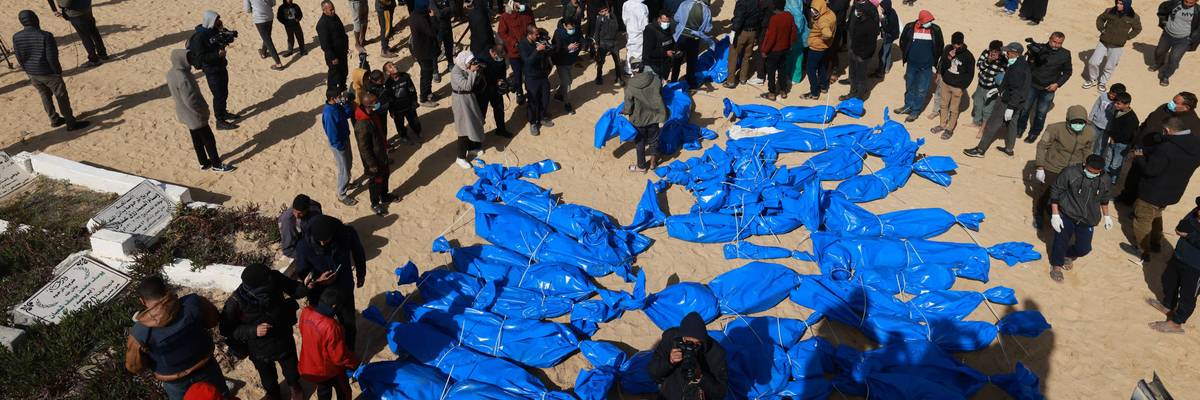
Palestinians watch as Gaza Health Ministry workers prepare to bury the bodies of unidentified Palestinians returned by Israel at a mass grave east of Rafah in the southern Gaza Strip on January 30, 2024.
One Israeli expert placed discrepancies in the list at "around 1%." Another said the error rate appears even lower.
An Israeli analysis published Tuesday examining the Gaza Health Ministry's list of Palestinians killed during Israel's US-backed annihilation of the Gaza Strip largely affirmed the official death count, while noting some imperfections in the 2,000-page document.
Haaretz, Israel's oldest daily newspaper, dissected the Gaza Health Ministry's (GHM) database of Palestinians killed by Israeli forces in Gaza, which at the time contained nearly 70,000 names—it's now over 72,000—in part by using artificial intelligence to analyze the massive file.
"A consensus has taken shape: Even if the list has weaknesses, including the fact that it does not differentiate between combatants and civilians, it reflects the scale of the disaster inflicted on Gaza and its people," article author Nir Hasson wrote. "It also forms the basis for allegations that Israel committed war crimes, crimes against humanity, and even genocide."
Lee Mordechai, a historian at the Hebrew University of Jerusalem who says Israeli is committing genocide in Gaza, told Hasson, "It's clear that the list isn't 100% accurate and that it has errors, but I think they're around 1%."
Gabriel Epstein, an associate at the US-based Israel Policy Forum who was formerly skeptical of the GHM list, "now believes it is largely accurate and may even slightly undercount the dead," according to Hasson.
"Epstein reviewed the list obtained by Haaretz," the article states. "He found 24 duplicates and 38 entries with problems in the ID numbers. That means 99.91% of the entries were complete, with verified ID numbers. He also found that 64 deaths that had appeared on earlier lists were later removed, while 158 names removed by March of last year were added back."
The GHM list notably only contains the names of people who died from combat-related violence, not from "hunger, disease, accidents, or the collapse of the health system."
It also does not include the thousands of people who are missing and likely dead and buried beneath the rubble of the 80% of Gaza's buildings that have been destroyed or damaged during the war.
Other research, including multiple peer-reviewed studies in the prestigious British medical journal the Lancet, have also concluded that the ministry was undercounting the number of people killed by Israel's war on Gaza.
As for the issue of Hamas not differentiating between combatants and civilians on the ministry's death list, an investigation last year by Israeli journalist and filmmaker Yuval Abraham and Guardian senior international affairs correspondent Emma Graham-Harrison analyzed classified Israel Defense Forces intelligence data showing that 5 in 6 Palestinians killed by Israeli troops through the first 19 months of the war were civilians. The probe obliterated IDF claims of a historically low civilian-to-combatant kill ratio.
Last September, Former IDF Chief of Staff Herzi Halevi—who was in command for much of the war—said that “over 10%” of Gaza’s approximately 2.2 million people “were killed or injured” since October 2023. Halevi’s acknowledgment tracked with GHM figures showing at least 228,815 people killed or wounded at the time.
In January, Israeli media outlets including Haaretz, the Jerusalem Post, and the Times of Israel reported that the IDF accepted the accuracy of GHM's death count, which at the time stood at over 71,000.
Israeli officials and media, along with their supportive US counterparts during both the Biden and Trump administrations, once cast doubt upon or outright denied GHM figures because the ministry is under Hamas' control. These aspersions came in addition to widespread Israeli and US denials of Israel’s forced famine and starvation deaths and IDF war crimes in Gaza.
"As the months have passed, claims of fabrication and exaggeration have largely remained confined to Israeli television panels," Hasson wrote in the new analysis. "At the end of January, an apparent dispute over the number of dead seemed to end in Israel when a senior army source confirmed that the IDF recognizes that 70,000 people died, precisely the figure cited by Gazan authorities."
"Even if the argument over the total number of dead is, for now, largely settled, disagreement in Israel continues over who the dead were," he continued. "How many were gunmen, how many were affiliated with Hamas, how many were killed under circumstances that meet the conditions of international law?"
"None of this alters the stark figures in the table," Hasson added. "Of the recorded deaths, 20,876, about 30%, are young girls, teenage girls, and women. Another 3,220 were aged 65 and over, including the final name on the list, Tamam al-Batsh, who was 110 when she died."
While Israel officials continue to insist that GHM figures are "misleading and unreliable"—or even "fake"—Hasson noted the general consistency between Israeli and Palestinian tallies across past Israeli attacks on Gaza. During Operation Cast Lead (2008-09), the Palestinian count was 23% higher than Israel's. For Operation Pillar of Success (2012), Israel's tally of Gazan deaths was 11% higher than the Palestinian figure. In Operation Protective Edge (2014), the Palestinian count was 8% higher. And during 2021's Operation Guardian of the Walls, Palestinian officials counted 10% more Gaza deaths than Israel.
The United Nations and US administrations of both major political parties have long acknowledged the GHM's accounting of Palestinian casualties in Israeli attacks, including the assault that began in October 2023.
Hasson noted that "it has been increasingly harder to find Israeli officials commenting on the subject" of the GHM death count in the ongoing war as evidence of its accuracy mounts.
"Since the war began," he said, "Israel has made no serious effort to demonstrate that the list is false or to present an alternative. It has not proven even once that a person listed as deceased is in fact alive."
Dear Common Dreams reader, It’s been nearly 30 years since I co-founded Common Dreams with my late wife, Lina Newhouser. We had the radical notion that journalism should serve the public good, not corporate profits. It was clear to us from the outset what it would take to build such a project. No paid advertisements. No corporate sponsors. No millionaire publisher telling us what to think or do. Many people said we wouldn't last a year, but we proved those doubters wrong. Together with a tremendous team of journalists and dedicated staff, we built an independent media outlet free from the constraints of profits and corporate control. Our mission has always been simple: To inform. To inspire. To ignite change for the common good. Building Common Dreams was not easy. Our survival was never guaranteed. When you take on the most powerful forces—Wall Street greed, fossil fuel industry destruction, Big Tech lobbyists, and uber-rich oligarchs who have spent billions upon billions rigging the economy and democracy in their favor—the only bulwark you have is supporters who believe in your work. But here’s the urgent message from me today. It's never been this bad out there. And it's never been this hard to keep us going. At the very moment Common Dreams is most needed, the threats we face are intensifying. We need your support now more than ever. We don't accept corporate advertising and never will. We don't have a paywall because we don't think people should be blocked from critical news based on their ability to pay. Everything we do is funded by the donations of readers like you. When everyone does the little they can afford, we are strong. But if that support retreats or dries up, so do we. Will you donate now to make sure Common Dreams not only survives but thrives? —Craig Brown, Co-founder |
An Israeli analysis published Tuesday examining the Gaza Health Ministry's list of Palestinians killed during Israel's US-backed annihilation of the Gaza Strip largely affirmed the official death count, while noting some imperfections in the 2,000-page document.
Haaretz, Israel's oldest daily newspaper, dissected the Gaza Health Ministry's (GHM) database of Palestinians killed by Israeli forces in Gaza, which at the time contained nearly 70,000 names—it's now over 72,000—in part by using artificial intelligence to analyze the massive file.
"A consensus has taken shape: Even if the list has weaknesses, including the fact that it does not differentiate between combatants and civilians, it reflects the scale of the disaster inflicted on Gaza and its people," article author Nir Hasson wrote. "It also forms the basis for allegations that Israel committed war crimes, crimes against humanity, and even genocide."
Lee Mordechai, a historian at the Hebrew University of Jerusalem who says Israeli is committing genocide in Gaza, told Hasson, "It's clear that the list isn't 100% accurate and that it has errors, but I think they're around 1%."
Gabriel Epstein, an associate at the US-based Israel Policy Forum who was formerly skeptical of the GHM list, "now believes it is largely accurate and may even slightly undercount the dead," according to Hasson.
"Epstein reviewed the list obtained by Haaretz," the article states. "He found 24 duplicates and 38 entries with problems in the ID numbers. That means 99.91% of the entries were complete, with verified ID numbers. He also found that 64 deaths that had appeared on earlier lists were later removed, while 158 names removed by March of last year were added back."
The GHM list notably only contains the names of people who died from combat-related violence, not from "hunger, disease, accidents, or the collapse of the health system."
It also does not include the thousands of people who are missing and likely dead and buried beneath the rubble of the 80% of Gaza's buildings that have been destroyed or damaged during the war.
Other research, including multiple peer-reviewed studies in the prestigious British medical journal the Lancet, have also concluded that the ministry was undercounting the number of people killed by Israel's war on Gaza.
As for the issue of Hamas not differentiating between combatants and civilians on the ministry's death list, an investigation last year by Israeli journalist and filmmaker Yuval Abraham and Guardian senior international affairs correspondent Emma Graham-Harrison analyzed classified Israel Defense Forces intelligence data showing that 5 in 6 Palestinians killed by Israeli troops through the first 19 months of the war were civilians. The probe obliterated IDF claims of a historically low civilian-to-combatant kill ratio.
Last September, Former IDF Chief of Staff Herzi Halevi—who was in command for much of the war—said that “over 10%” of Gaza’s approximately 2.2 million people “were killed or injured” since October 2023. Halevi’s acknowledgment tracked with GHM figures showing at least 228,815 people killed or wounded at the time.
In January, Israeli media outlets including Haaretz, the Jerusalem Post, and the Times of Israel reported that the IDF accepted the accuracy of GHM's death count, which at the time stood at over 71,000.
Israeli officials and media, along with their supportive US counterparts during both the Biden and Trump administrations, once cast doubt upon or outright denied GHM figures because the ministry is under Hamas' control. These aspersions came in addition to widespread Israeli and US denials of Israel’s forced famine and starvation deaths and IDF war crimes in Gaza.
"As the months have passed, claims of fabrication and exaggeration have largely remained confined to Israeli television panels," Hasson wrote in the new analysis. "At the end of January, an apparent dispute over the number of dead seemed to end in Israel when a senior army source confirmed that the IDF recognizes that 70,000 people died, precisely the figure cited by Gazan authorities."
"Even if the argument over the total number of dead is, for now, largely settled, disagreement in Israel continues over who the dead were," he continued. "How many were gunmen, how many were affiliated with Hamas, how many were killed under circumstances that meet the conditions of international law?"
"None of this alters the stark figures in the table," Hasson added. "Of the recorded deaths, 20,876, about 30%, are young girls, teenage girls, and women. Another 3,220 were aged 65 and over, including the final name on the list, Tamam al-Batsh, who was 110 when she died."
While Israel officials continue to insist that GHM figures are "misleading and unreliable"—or even "fake"—Hasson noted the general consistency between Israeli and Palestinian tallies across past Israeli attacks on Gaza. During Operation Cast Lead (2008-09), the Palestinian count was 23% higher than Israel's. For Operation Pillar of Success (2012), Israel's tally of Gazan deaths was 11% higher than the Palestinian figure. In Operation Protective Edge (2014), the Palestinian count was 8% higher. And during 2021's Operation Guardian of the Walls, Palestinian officials counted 10% more Gaza deaths than Israel.
The United Nations and US administrations of both major political parties have long acknowledged the GHM's accounting of Palestinian casualties in Israeli attacks, including the assault that began in October 2023.
Hasson noted that "it has been increasingly harder to find Israeli officials commenting on the subject" of the GHM death count in the ongoing war as evidence of its accuracy mounts.
"Since the war began," he said, "Israel has made no serious effort to demonstrate that the list is false or to present an alternative. It has not proven even once that a person listed as deceased is in fact alive."
An Israeli analysis published Tuesday examining the Gaza Health Ministry's list of Palestinians killed during Israel's US-backed annihilation of the Gaza Strip largely affirmed the official death count, while noting some imperfections in the 2,000-page document.
Haaretz, Israel's oldest daily newspaper, dissected the Gaza Health Ministry's (GHM) database of Palestinians killed by Israeli forces in Gaza, which at the time contained nearly 70,000 names—it's now over 72,000—in part by using artificial intelligence to analyze the massive file.
"A consensus has taken shape: Even if the list has weaknesses, including the fact that it does not differentiate between combatants and civilians, it reflects the scale of the disaster inflicted on Gaza and its people," article author Nir Hasson wrote. "It also forms the basis for allegations that Israel committed war crimes, crimes against humanity, and even genocide."
Lee Mordechai, a historian at the Hebrew University of Jerusalem who says Israeli is committing genocide in Gaza, told Hasson, "It's clear that the list isn't 100% accurate and that it has errors, but I think they're around 1%."
Gabriel Epstein, an associate at the US-based Israel Policy Forum who was formerly skeptical of the GHM list, "now believes it is largely accurate and may even slightly undercount the dead," according to Hasson.
"Epstein reviewed the list obtained by Haaretz," the article states. "He found 24 duplicates and 38 entries with problems in the ID numbers. That means 99.91% of the entries were complete, with verified ID numbers. He also found that 64 deaths that had appeared on earlier lists were later removed, while 158 names removed by March of last year were added back."
The GHM list notably only contains the names of people who died from combat-related violence, not from "hunger, disease, accidents, or the collapse of the health system."
It also does not include the thousands of people who are missing and likely dead and buried beneath the rubble of the 80% of Gaza's buildings that have been destroyed or damaged during the war.
Other research, including multiple peer-reviewed studies in the prestigious British medical journal the Lancet, have also concluded that the ministry was undercounting the number of people killed by Israel's war on Gaza.
As for the issue of Hamas not differentiating between combatants and civilians on the ministry's death list, an investigation last year by Israeli journalist and filmmaker Yuval Abraham and Guardian senior international affairs correspondent Emma Graham-Harrison analyzed classified Israel Defense Forces intelligence data showing that 5 in 6 Palestinians killed by Israeli troops through the first 19 months of the war were civilians. The probe obliterated IDF claims of a historically low civilian-to-combatant kill ratio.
Last September, Former IDF Chief of Staff Herzi Halevi—who was in command for much of the war—said that “over 10%” of Gaza’s approximately 2.2 million people “were killed or injured” since October 2023. Halevi’s acknowledgment tracked with GHM figures showing at least 228,815 people killed or wounded at the time.
In January, Israeli media outlets including Haaretz, the Jerusalem Post, and the Times of Israel reported that the IDF accepted the accuracy of GHM's death count, which at the time stood at over 71,000.
Israeli officials and media, along with their supportive US counterparts during both the Biden and Trump administrations, once cast doubt upon or outright denied GHM figures because the ministry is under Hamas' control. These aspersions came in addition to widespread Israeli and US denials of Israel’s forced famine and starvation deaths and IDF war crimes in Gaza.
"As the months have passed, claims of fabrication and exaggeration have largely remained confined to Israeli television panels," Hasson wrote in the new analysis. "At the end of January, an apparent dispute over the number of dead seemed to end in Israel when a senior army source confirmed that the IDF recognizes that 70,000 people died, precisely the figure cited by Gazan authorities."
"Even if the argument over the total number of dead is, for now, largely settled, disagreement in Israel continues over who the dead were," he continued. "How many were gunmen, how many were affiliated with Hamas, how many were killed under circumstances that meet the conditions of international law?"
"None of this alters the stark figures in the table," Hasson added. "Of the recorded deaths, 20,876, about 30%, are young girls, teenage girls, and women. Another 3,220 were aged 65 and over, including the final name on the list, Tamam al-Batsh, who was 110 when she died."
While Israel officials continue to insist that GHM figures are "misleading and unreliable"—or even "fake"—Hasson noted the general consistency between Israeli and Palestinian tallies across past Israeli attacks on Gaza. During Operation Cast Lead (2008-09), the Palestinian count was 23% higher than Israel's. For Operation Pillar of Success (2012), Israel's tally of Gazan deaths was 11% higher than the Palestinian figure. In Operation Protective Edge (2014), the Palestinian count was 8% higher. And during 2021's Operation Guardian of the Walls, Palestinian officials counted 10% more Gaza deaths than Israel.
The United Nations and US administrations of both major political parties have long acknowledged the GHM's accounting of Palestinian casualties in Israeli attacks, including the assault that began in October 2023.
Hasson noted that "it has been increasingly harder to find Israeli officials commenting on the subject" of the GHM death count in the ongoing war as evidence of its accuracy mounts.
"Since the war began," he said, "Israel has made no serious effort to demonstrate that the list is false or to present an alternative. It has not proven even once that a person listed as deceased is in fact alive."