

SUBSCRIBE TO OUR FREE NEWSLETTER
Daily news & progressive opinion—funded by the people, not the corporations—delivered straight to your inbox.
5
#000000
#FFFFFF
To donate by check, phone, or other method, see our More Ways to Give page.
Daily news & progressive opinion—funded by the people, not the corporations—delivered straight to your inbox.
When I urge my writing students to juice up their stories, I tell them about "disruptive technologies," inventions and concepts that end up irrevocably changing industries. Think: iPhones, personal computers, or to reach deep into history, steamships. It's the tech version of what we used to call a paradigm shift. (President Biden likes to refer to it as an inflection point.)
Certain events function that way, too. After they occur, it's impossible to go back to how things were: World War II for one generation, the Vietnam War for another, and 9/11 for a third. Tell me it isn't hard now to remember what it was like to catch a flight without schlepping down roped-off chutes like cattle to the slaughter, even if for most of the history of air travel, no one worried about underwear bombers or explosive baby formula. Of course, once upon a time, we weren't incessantly at war either.
However, for my students, the clumsily named Gen Z, the transformative event in their lives hasn't been a war at all -- no matter that their country has been enmeshed in one or more of them for all of their conscious lives. It's probably George Floyd's murder or the Covid pandemic or the double whammy of both, mixed in with a deadly brew of Trumpism. That alone strikes me as a paradigm shift.
It's not that they are uncaring. Those I know are ardent about fixing myriad wrongs in the world and prepared to work at it, too. And like many Americans, for a few weeks as August 2021 ended, they were alarmed by the heartbreaking consequences of their country's failed mission in Afghanistan and its betrayal of the people there. How could you not be heartbroken about people desperate to save their lives and livelihoods? And the girls... ah, the girls, the 37% of teenage girls who learned to read in those years, went to school with boys, saw their lives change, and probably will be denied all of that in the years to come.
In my more cynical moments, though, I note that it was the girls and women who were regularly trotted out by our government officials and generals insisting that U.S. troops must remain in Afghanistan until -- until what? Until, as it turned out, disaster struck. After all, what good American heart doesn't warm to educating the young and freeing girls from forced marriages (as opposed, of course, to killing civilians and causing chaos)?
Militarism is among the all-American problems the young activists I meet do sometimes bring up. It's just not very high on their list of issues to be faced. The reasons boil down to this: the wars in Iraq and Afghanistan, interminable as they seemed, had little or no direct effect on most of my students or the lives they imagined having and that was reflected in their relative lack of attention to them, which tells us all too much about this country in the twenty-first century.
Spare Change
So here we are, 20 years after U.S. troops invaded Afghanistan and months since they hotfooted it out. That two-decade-long boots-on-the-ground (and planes in the air) episode has now officially been declared over and done with, if not exactly paid for. But was that an inflection point, as this country turned its military attention to China and Russia? Not so fast. I'm impatient with the conventional wisdom about our twenty-first-century wars and the reaction to them at home. Still, I do think it's important to try to figure out what has (or hasn't) been learned from them and what may have changed because of them.
In the changed column, alas, the answer seems to be: not enough. Once again, in the pandemic moment, our military is filling roles that would be left to civil society if it were adequately funded -- helping in hospitals and nursing homes, administering Covid-19 vaccinations and tests, teaching school and driving school buses -- because, as Willie Sutton answered when asked why he robbed banks, that's where the money is.
Apparently, it's so much money that even the Defense Department doesn't quite know how to spend it. Between 2008 and 2019, the Pentagon returned almost $128 billion in unspent funds from its staggeringly vast and still expanding budget. Admittedly, that's a smaller percentage of that budget than other departments turned back, but it started with so much more and, as a result, that Pentagon spare change accounted for nearly half of all "cancelled" government funds during that time.
Yet too little of those vast sums spent go to active-duty troops. A recent survey found that 29% of the families of junior-level, active-duty soldiers experienced food insecurity (that is, hunger) in the past year, a strong indicator of the economic precariousness of everyday military life, even here at home.
It didn't help that the U.S. military's wars only sporadically drew extended public attention. Of course, before 1979, when the Soviet Union invaded Afghanistan, that country's name was shorthand for a place too obscure for most Americans even to find on a world map. And maybe that was still true in 2020, when, nearly two decades after the U.S invaded that nation, the American presence there got all of five minutes of coverage on the national evening newscasts of CBS, NBC, and ABC.
Years earlier, when the focus was more on Iraq than Afghanistan, I attended a meeting of the Smedley Butler Brigade of Veterans For Peace. I was writing a story for the Boston Globe, which made me an easy target for the veterans' anger. As a result, they badgered me to make our city's newspaper of record print a daily report of deaths in the war. I explained that, as a freelancer, I had even less influence than they did and, unsurprisingly, such an accounting never came to pass.
Years later, as the U.S. endeavor in Afghanistan wound down and the Globe and other mainstream outlets did actually publish calculations of the costs, I found myself wondering if all those credible, influential media sources would ever publish a reckoning of how many times in the past 20 years, when it might have made a difference, they had run cost analyses of the blinding arrogance that defined U.S. foreign and military policy in those decades. The impact of such accountings might have been vanishingly small anyway.
It's true, by the way, that Brown University's Costs of War Project did a formidable job of tackling that issue in those endless war years, but their accounts were, of course, anything but mainstream. Even today, in that mainstream, accurate counts are still hard to come by. The New York Times, which recently published a groundbreaking report on civilian deaths in the Middle East caused by U.S. airstrikes, was stymied by the Pentagon for years when trying to get the necessary documents for just such an accounting, while provincial authorities in Afghanistan often denied that civilian casualties had even occurred.
Presence and Power
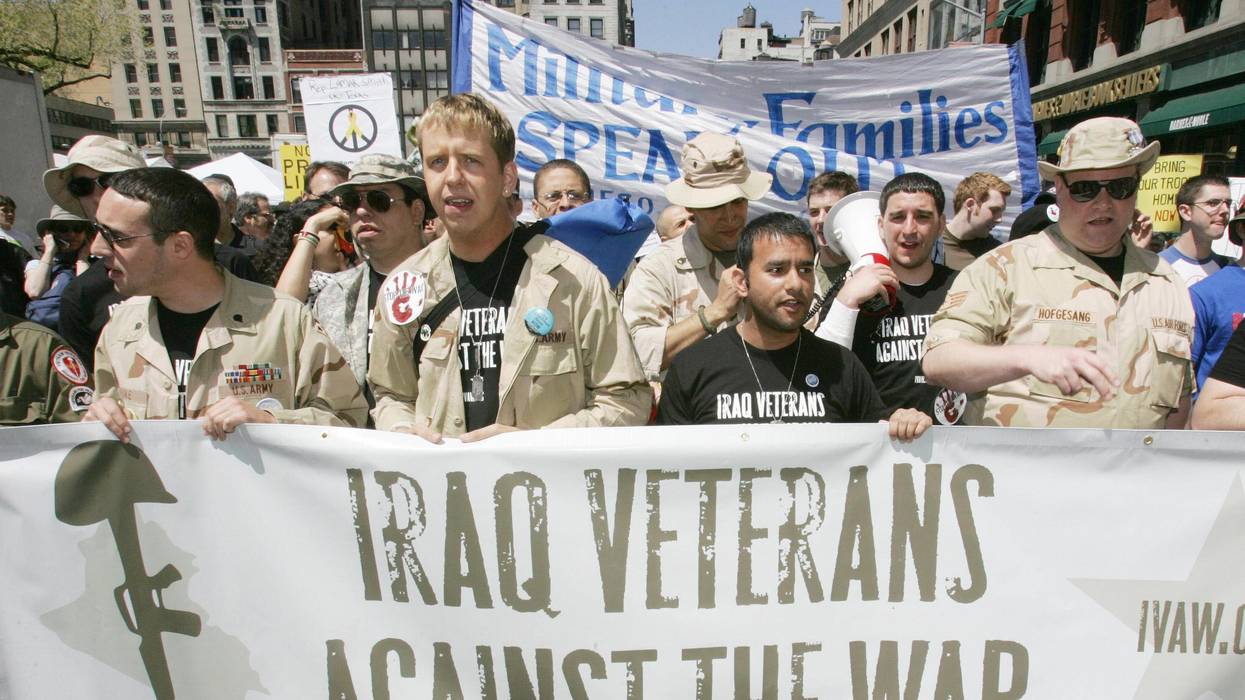
In 2004, when Iraq Veterans Against the War (IVAW) was just getting started, I was introduced to a small group of disillusioned but determined young vets, wonderfully full of themselves and intent on doing things their way. While they appreciated the earlier soldier-led antiwar efforts of the Vietnam War era, they wanted to do it all in a new fashion. "We're sort of reinventing the wheel," Eli Wright, a young medic, who had served in Iraq, told me, "But we're making it a much nicer wheel, I think." I was smitten.
At first, those newly minted anti-warriors thought the very novelty of their existence in war-on-terror America would be enough. So, they told and retold their stories to anyone who would listen: stories of misguided raids and policing actions for which they were ill-equipped and ill-trained; of soul-destroying cruelty they found themselves implicated in; and of their dawning awareness, even while they were in Iraq, that they could no longer be a party to any of it. Believe me, those veterans told powerful and moving stories, but it wasn't nearly enough.
In a piece about the power and pitfalls of storytelling, Jonathan Gottschall notes that, in the tales we tell, we tend to divide people into a tidy triad of heroes, victims, and villains. My longtime trope was that we -- by which I mean we Americans -- allowed those fighting our endless wars to be only heroes or victims -- the former to valorize, the latter to pity -- but nothing else. (Admittedly, sometimes civilian peace workers did see them as villains, but despite an inevitable jockeying for position, civilian and military antiwar groups generally recognized each other as comrades-against-arms.) IVAW insisted on adding activist to that dichotomy, as they attempted to change minds and history.
When you're trying to do that, or at least influence policy, your odds of success are greater if you have a clear, specific goal you can advocate and agitate for and build coalitions around. Then, when you achieve it, you can, of course, claim victory. IVAW's overriding aim was to bring the troops home immediately. That goal was finally (more or less) achieved, though at great cost and so much later than they had been demanding, making it anything but a resounding victory; nor did it, in the end, have much to do with those young veterans.
Their significance may lie elsewhere. Last August, in the midst of the chaotic U.S. pull-out from Afghanistan, I tuned in to a podcast about political and social activism just as Rashad Robinson, president of the racial justice organization, Color of Change, was making a distinction between presence ("retweets, shout-outs from the stage") and power ("the ability to change the rules").
It would be hard to come up with a better illustration of that difference than Camp Casey, the August 2005 encampment of antiwar military families, veterans, and their sympathizers. It was sprawled across a ditch in Crawford, Texas, a few miles down the road from the ranch of a vacationing President George W. Bush. Their protest made significant news for those five weeks, as media around the world featured heart-rending stories of mothers in mourning and veterans in tears, photos of an iconic white tent, and interviews with Cindy Sheehan whose son, Casey, had been killed in Iraq the year before. The media anointed her the Grieving-Mother-in-Chief and news reports sometimes even got the protesters' end-the-war, bring-the-troops-home message right.
Whizzing past in a motorcade on his way to a fundraiser, President Bush ignored them, and the war in Iraq continued for another five years with the deaths of about 2,700 more sons and daughters of grieving American mothers. But the next month, when somewhere between 100,000 and 300,000 Camp Casey participants, veterans, and their supporters gathered for an antiwar march through downtown Washington, D.C., the government was forced to acknowledge, perhaps for the first time, the existence of opposition to the war in Iraq. For context, the National Park Service estimated then that, of the approximately 3,000 permits it issued for demonstrations on the National Mall yearly, only about a dozen attracted more than 5,000 people.
Presence matters and in the few years following Camp Casey, when the antiwar veterans were at their most effective, they learned how to make themselves harder to ignore. They've since renamed their group About Face and reconceived its purpose and goals, but the perennial challenge to political activists is how to turn presence into power.
Why Didn't the Anti-War Movement Catch On?
In February 2003, as many as 10 million people took to the streets in 60 countries to protest the impending U.S. invasion of Iraq. But once that invasion happened, it was primarily the military-related groups, sometimes joined by other peace organizations, that kept the opposition alive. Why, though, couldn't they turn presence into power? Why didn't more Americans take up the campaign to end two such pointless wars? Why didn't we learn?
I make no claim to answering those questions in a definitive way. Nonetheless, here's my stab at it.
Let's start with the obvious: the repercussions of an all-volunteer military. Only a small proportion of Americans, self-selected and concentrated in certain parts of the country, have been directly involved in and affected by our twenty-first-century wars. Deployed over and over, they didn't circulate in civil society in the way the previous draft military had and, as warfare became increasingly mechanized and automated (or drone-ified), there have been ever fewer American casualties to remind everyone else in this country that we were indeed at war in Afghanistan and Iraq. For the troops, that distancing from battle also undoubtedly lessened an innate human resistance to killing and also objections to those wars within the military itself.
Next, stylish as it might be in this country to honor veterans of our wars (thank you for your service!), as Kelly Dougherty, IVAW's first executive director, complained, "We come home and everyone shakes our hands and calls us heroes, but no one wants to listen to us." Stories of bravery, horrific wounds, and even post-traumatic stress syndrome were acceptable. Analysis, insight, or testimony about what was actually going on in the war zones? Not so much.
Folk singer, labor organizer, and vet, "Utah" Phillips observed that having a long memory is the most radical idea in America. With items in the news cycle lasting for ever-shorter periods of time before being replaced, administrations becoming ever harder to embarrass, and a voting public getting accustomed to being lied to, even a short memory became a challenge.
The hollowing out of local news in these years only exacerbated the problem. Less local reporting meant fewer stories about people we might actually know or examples of how world events affect our daily lives. Pro-war PR, better funded and connected than any antiwar group could hope to be, filled the gap. Think soldiers striding onto ballfields at sports events to the teary surprise of families and self-congratulatory cheers from the stands. Between 2012 and 2015, the Pentagon paid pro sports teams some $6.8 million to regularly and repeatedly honor the military. Meanwhile, the mainstream media has made it ever harder for peace groups to gain traction by applying a double standard to protest or outsider politics, a reality sociologist Sarah Sobieraj has explored strikingly in her book Soundbitten.
The nature of political protest changed, too. As information was disseminated and shared more and more through social media -- activism by way of hashtag, tweet, and Instagram -- organizing turned ever more virtual and ever less communal. Finally, despite protestations about the United States being a peace-loving country, the military in these years has proven a rare bipartisan darling, while, historically speaking, violence has been bred into America's bones.
Maybe, however, the lack of active opposition to the endless wars wasn't a new normal, but something like the old normal. Sadly enough, conflicts don't simply end because people march against them. Even the far larger Vietnam antiwar movement was only one pressure point in winding down that conflict. War policy is directed by what happens on the ground and, to a lesser degree, at the ballot box. What an antiwar movement can do is help direct the public response, which may, fingers crossed, save the country from going to war someplace else and save another generation of soldiers from having to repeat the mistakes of the past 20 years.
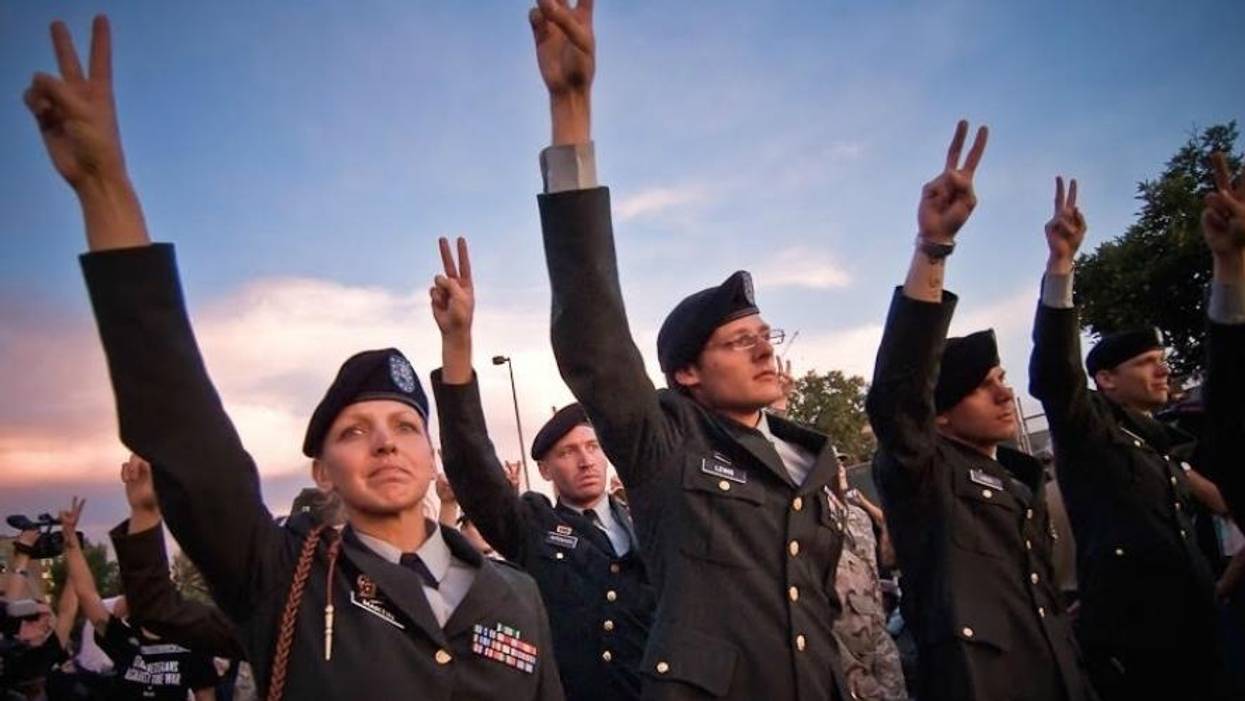
We just celebrated Veterans Day last week, paying tribute to the young men and women who have served our country. Across the country, families gathered at the gravesites of those who gave their lives. Veterans drank toasts to their fellow soldiers.
In football and basketball stadiums, crowds offered a moment of silence for the fallen. The rituals are heartfelt, but far from complete
Too often ignored is the far greater number of lives that are lost not on the battlefield but at home, not from the enemy's guns but from our veterans' own hands.
Now, in the sober aftermath of the celebration, there should be a reckoning.
On an average day, a staggering 20 veterans commit suicide. The deaths from suicide outnumber the losses on the battlefield in Iraq and Afghanistan.
The risk to veterans who served in combat holds true for all generations.
It doesn't matter if the war is popular or unpopular; the veterans celebrated or controversial. Even the Greatest Generation that fought in World War II suffers current suicide rates four times that of civilians.
In a stunning essay, Matthew Hoh, an Iraqi veteran who came close to suicide himself, tries to put this in perspective.
The famous Vietnam Memorial, he writes, "is a wall that contains 58,000 names. It would have to lengthened by some 2,000 feet to include the 100,000 to 200,000 plus Vietnam vets who are estimated to have been lost to suicide, while keeping space for those yet to come. VA data reveals that almost two Afghan and Iraq veterans die by suicide each day on average. That adds to an estimated 7,300 veterans who have killed themselves since just 2009, after coming home from Afghanistan and Iraq, a number greater than the 7,012 service members killed in those wars since 2001."
The military is aware of the depth of this horror and has dedicated a billion dollars in trying to solve it.
The New York Times reports that the Veterans Crisis Line (VCL) is incredibly active, staffed 24/7 at 800-273-8255. This service, only available since 2007, has helped stave off hundreds of thousands of potential suicides. More than 30 times a day, VCL responders call police, fire or EMS to intervene in a suicide situation.
Thirty times a day.
There are many explanations offered for why veterans -- and the families of veterans -- are at greater risk of suicide: the difficulty of readjusting to civilian society; the macho military culture that keeps soldiers from seeking help; the post-traumatic stress disorders that result from combat.
Hoh, wisely in my view, offers a broader explanation: that veterans suffer from a moral injury -- a shock to their own sense of themselves, their basic moral values from what they have done or have not done in combat: The killing of the enemy, the failure to save the life of a comrade, the mistaken shooting of the innocent.
Thou shalt not kill is a basic precept of all religions.
In war, the state gives soldiers the mandate to kill. The military has perfected ways of conditioning young men and women to be able to kill in combat.
Yet, Hoh argues, the conditioning does not prevent some from seeing themselves in the enemy, from feeling deeply the violation that comes from violence.
There is a lesson from this.
We should reject the easy assumption that the U.S. military should police the world, that we've perfected ways of fighting wars with drones and air power and with limited U.S. casualties from "boots on the ground."
The national security managers who too often have never served in the military should be far more constrained in sending our soldiers into combat.
War is hell. It is hell for those who fall in combat -- and for their families and friends suffering their loss. It is hell for those who survive it -- and for their families and friends dealing with their struggles on return.
Risking lives constantly in endless wars is a moral violation and strategic failure.
If we are truly to celebrate the service of our veterans, we should demand that war not be a routine part of American policy, but a last resort used rarely and only to defend our people when attacked.
The best tribute to our combat veterans would be to create fewer of them in the future.
As millions of Democrats, Greens, liberals, progressives, and lefties across America prepare to resist Trump, it's time to build greater unity and alliances among this vast rainbow of people, communities, and movements. With heightened attacks on immigrants, women, people of color, Muslims, the environment, workers' rights, and more, we simply cannot afford political isolation and fracturing.
As millions of Democrats, Greens, liberals, progressives, and lefties across America prepare to resist Trump, it's time to build greater unity and alliances among this vast rainbow of people, communities, and movements. With heightened attacks on immigrants, women, people of color, Muslims, the environment, workers' rights, and more, we simply cannot afford political isolation and fracturing.
Imagine a national strategic alliance around shared principles and priorities that could collectively mobilize tens of millions of people to support and defend human rights, economic justice, and environmental sustainability. Protests, petitions, and grassroots meet-ups are a great start, but they are not enough for the task at hand. Now more than ever, all those wanting an egalitarian, racially just, and sustainable society fueled by participatory democracy need to forge a broad united front.
"It's time to think big."
A new alliance would enable groups to retain their turf and integrity while joining forces on specific campaigns, such as the Standing Rock/Dakota Access Pipeline struggle and upcoming battles with Trump and the Republican Congress. Together, we could promote a bold progressive populist agenda while opposing rightwing and centrist policies from both major parties.
Think of the array of generally like-minded groups and initiatives across the country, which together count tens of millions of members or supporters: Our Revolution, Brand New Congress, Working Families Party, Progressive Democrats of America, Democracy for America, the Green Party, and many other regional, state, and local groups. These could unite on core goals and principles, agreeing to support each other's efforts and collaborate whenever possible.
It's time to think big. Let's push the Democratic Party in an unapologetically progressive direction and build up electorally independent alternatives. This is no time for fracturing. Progressives need a coherent strategy that remains independent of the corporate, centrist Democratic Party, and that can wield direct pressure and power. Participating groups will continue to have differences, some likely never resolved--but they can still work together whenever possible.
The left must also build a new media movement to reach mainstream America, including Trump's America, with accessible fact-driven journalism. One good start would be expanding on The Progressive magazine's Media Project with an initiative to reach readers in battleground states, through legacy and social media, with op-eds that inform people about the concrete human and environmental impacts of the Trump-Ryan agenda.
The right has been successful at building a media network to tilt voters its way; it's time for a major independent progressive media push, backed by real dollars, that can get out stories and op-eds beyond the leftwing echo chambers.
"The best alliances are going to come together around the biggest ideas for change," says Becky Bond, a top adviser and organizer on Bernie Sanders's campaign, and coauthor with Zack Exley of the new book Rules for Revolutionaries. "An alliance around a big agenda that embraces economic populism and racial justice could create a wave of victories in 2018."
Much of this alliance building may take shape first on state and local levels, and around specific individual campaigns. Bill Fletcher, former president of TransAfrica Forum and a longtime labor leader, advocates a "fifty-state strategy for progressives. We have to anticipate all kinds of attacks, including repression," he says. "We need to be thinking in each state, what is the road to power?"
Shannon Jackson, director of the Sanders-inspired Our Revolution, sees growing interest in progressive alliances:
The recent victories to defeat the Trans-Pacific Partnership and against the Dakota Access Pipeline at Standing Rock are ideal examples of what is possible when people come together. It is Our Revolution's responsibility to help strengthen the active collaboration and unification that is essential to these great successes.
Progressive alliances "will need to be organic so that we can create an environment where many different ideas are allowed to thrive," argues Brand New Congress co-founder and organizer Saikat Chakrabarti. "We need to bring the fight on multiple fronts at once. We need organizations that are focused on direct action, organizations that are focused on building local political power, organizations focused on building national political power, and organizations focused on creating a new media."
The Working Families Party and other national groups have helped to organize local emergency community meetings across the country (one drawing about 1,000 people), where people can connect and organize. Groups endorsing this effort include 350.org, the Center for Popular Democracy, the Courage Campaign, Iraq Veterans Against the War, Friends of the Earth, CODEPINK, and Public Citizen.
These grassroots meetings focus on "activities everyone can take locally to protect communities and defend democracy," the Working Families Party explained in response to my inquiry. "People are developing substantive plans for fighting back against Trump's cabinet and agency appointments, taking action around the Inauguration, protecting the status of sanctuary cities, and standing in solidarity with communities under attack, including immigrants and Muslim Americans."
At one of these meet-ups I attended recently in San Francisco, hundreds of people stayed late on a Friday evening discussing actions and strategies. Focus groups peeled off to discuss such topic areas as climate change, women's rights, media democracy, and electoral strategies. The commitment and energy were palpable.
But what felt missing, at least from this gathering, was a larger political movement strategy to connect people with existing groups--local, state, and national--rather than reinventing the wheel. Despite the impressive organizing and sense of urgency, there was little talk of bolstering larger alliances, or further stitching together the movement apparatus of the progressive left.
Of course any alliance, even a nonbinding one that doesn't intrude on turf or funds, presents challenges. Significant divides on the left, some intensified in this past election, cannot be shrugged off.
Greens and Democrats have longstanding tension and often enmity. The labor movement has many rifts, spanning union members' support for Sanders, Clinton, and Trump. Given the ongoing debate over who is to blame for Trump's election and what it means for Democrats and the left, it is clear that "we" will not all agree on a single path forward. Reformists, revolutionaries, liberals, and radicals have scuffled for centuries over how to address inequality, exploitation, and the consolidation of wealth and power.
Not everyone will join these new alliances, but the more who do, the better. As a longtime journalistic observer and participant in left-progressive movements, I believe the Trump moment--how it came about and the dangers it poses--highlights the need for broad, far-reaching rapprochement on the left. Groups and movements sharing progressive aims must figure out how to work together where they agree, even when they disagree on other things.
"This is no time to squabble among ourselves or work separately--and there's no time to lose."
There are at least partial models for this around the country. In California, the Richmond Progressive Alliance, made up of labor, housing, environmental and racial justice groups, has won many local victories; the Progressive Leadership Alliance of Nevada brings together dozens of institutions, including labor unions, the NAACP, Sierra Club, Planned Parenthood, and others. Numerous local, state, and regional coalitions are sprouting up--and a national alliance could bring yet greater power, resources, and profile to progressive causes and movements.
The potential for unity is heightened by Trump's prolific threats to so many communities and causes. The more people his policies offend, the bigger and stronger the resistance. For instance, Fletcher notes, there is concern in labor circles that the Trump Administration will try to undermine the Davis-Bacon Act, which requires prevailing wages be paid on publicly contracted jobs. This could potentially unite more conservative building trades unions with left-liberal unions.
Trump's attacks on workers and unions could play a lead role in his undoing. His first tweet-promoted "win" as President-elect, the Carrier plant jobs deal in Indiana, backfired when it was revealed that the deal would allow hundreds of jobs to go to Mexico while costing the state more than $7 million in corporate tax perks. Trump's subsequent tweet-lashing of Chuck Jones, president of United Steelworkers Local 1999, ignited bipartisan criticism that could begin to erode his working-class support. A blue-collar backlash could turn the tables against Trump, and progressive labor unions can help lay the groundwork for that.
Trump's cabinet picks and his emerging policy agenda are already uniting millions in outraged opposition. Groups and communities are holding emergency meetings and creating rapid response networks to defend people under attack. The challenge now is to weave this tapestry of resistance into a movement that can create legislative and electoral wins.
The protests and social media eruptions will be YUGE. We must harness this into a coherent and sustainable rebellion. A working-class backlash and a smart alliance among the diverse constituencies that make up the progressive majority in this country could lead to a big midterm repudiation of the Republicans at the polls, state-level victories, and the birth of a broad-based and effective progressive movement. This is no time to squabble among ourselves or work separately--and there's no time to lose. It's time for progressive unity.
As we think about the election--what went wrong, what's been unleashed and what we should do about it--please, please, let us expand our vision beyond some technical fix or updated "message."
Even if we're talking about the Democratic Party.
James Zogby, founder of the Arab American Institute and a longtime member of the Democratic National Committee, discussing the Bernie Sanders phenomenon and the future direction of the party, wrote recently: "Many rank and file Democrats had lost confidence in their establishment and were looking for an authentic message that spoke to their needs."
He was making the case for a progressive takeover of the party and the naming of Keith Ellison as DNC chair. As I read his commentary, however, even though I essentially agreed with him, I couldn't get past the word "authentic"--especially linked as it was to the word "message," which made it sound like the Democrat leadership needs to search its soul and come up with a better ad slogan.
And this is American politics--American democracy--as presented for our entertainment and distraction by the corporate media and the custodians of power. "The people" are acknowledged to be participants in the process of governing, which is to say, the process of creating the future, only to the extent that they have a set of limited, specific interests the powerful have to look out for. Jobs, for instance. Or protection from the enemy of the moment.
What the Democrats need to do is become a party of transcendence. That may be too much to ask of a political party, but I'm asking it anyway--asking the Dem leadership to open themselves to something bigger than mere change, something that one might call, instead, a shift in consciousness: beyond racism, beyond war, beyond exploitative capitalism . . . beyond militarism and a punishment-based justice system, beyond alienation from nature and the circle of life.
What if?
What if, for instance, the Democratic leadership joined former congressman and Democratic presidential candidate Dennis Kucinich in standing with Veterans for Peace and Iraq Veterans Against the War, as they stood with the protesters at Standing Rock, acting as human shields and rewriting history?
"On December 5 -- the birthday of Lt. Col. George Armstrong Custer, who led the Battle of Little Bighorn against Lakota and Cheyenne warriors -- (Wes Clark Jr.) and a dozen members of United States military branches got down on bended knee to beg forgiveness from the Lakota people," according to a story posted at New American Media.
In the presence of hundreds of veterans and Lakota medicine people, elders and leaders, Clark donned the uniform of the Seventh Cavalry and spoke of the history of his unit. With tears in his eyes, Clark said:
"Many of us, me particularly, are from the units that have hurt you over the many years. We came. We fought you. We took your land. We signed treaties that we broke. We stole minerals from your sacred hills. We blasted the faces of our presidents onto your sacred mountain. . . . We didn't respect you, we polluted your Earth, we've hurt you in so many ways but we've come to say that we are sorry. We are at your service and we beg for your forgiveness."
In an open letter to the vets, Kucinich wrote: "Your presence holds the promise of bringing about a great healing as you join a movement which is prayerful, peaceful and nonviolent, the enduring strength of great moral suasion.
"I urge you to stand as defenders and not aggressors."
I realize I'm pushing the limits of cynicism, to suggest that the Democratic Party drop to its knee and seek atonement for American history: for genocide, slavery, endless war. But why ask less of our political system? Why ask less of democracy?
People looking for an "authentic message" may also resonate with a Democratic Party that stood for an end to global weapons sales and endless war. As Rebecca Gordon wrote recently for TomDispatch:
Along with a deeply divided country, the worst income inequality since at least the 1920s, and a crumbling infrastructure, Trump will inherit a 15-year-old, apparently never-ending worldwide war. While the named enemy may be a mere emotion ('terror') or an incendiary strategy ('terrorism'), the victims couldn't be more real, and as in all modern wars, the majority of them are civilians.
On how many countries is U.S. ordnance falling at the moment? Some put the total at six; others, seven. For the record, those seven would be Afghanistan, Iraq, Libya, Pakistan, Somalia, Syria, and, oh yes, Yemen.
We're either waging or catering wars across the Middle East and Africa--wars against evil, according to that former president whose name is never mentioned these days. The Democrats were not the party in power at the time the current, post-Cold War phase of our endless wars started, but the Dems accepted these wars as their own in 2009 and proceeded to perpetuate them.
Politics as usual will not rescue Planet Earth. Angry idealists and visionaries will not rescue it either. The only hope is a merging of power and vision: transcendent politics, you might say. This is the "authentic message" people are looking for. Maybe it's impossible--way too unacceptable to the financial interests that underwrite the American political system. But it could have beaten Donald Trump.
Here in Kabul, last week, at the Afghan Peace Volunteer (APV) community home that hosts me, I watched Abdulhai and visiting activist Aaron Hughes work out ways to secure the greenhouse which they had partially assembled that morning. Warmed by the effort and with the sun beaming down on all of us, they sat on the garden ledge in their shirtsleeves although it is a quite cold winter here, talking about the greenhouse perched on an uneven garden plot before them.
I had watched Aaron, Abdulhai, Ron and Hakim maneuver the partly assembled greenhouse from a neighbor's storage area, over a fence, and onto the garden plot. Aaron is 6 ft. 5 inches tall. His strength and height helped the process considerably.
Aaron and I first met in 2005, shortly after he returned from deployment to Iraq with the Illinois National Guard. The U.S. military had assigned him to drive trucks from Kuwaiti supply depots to Forward Operating Bases across Iraq. At the end of his deployment, convinced he couldn't endure another stint with the military, after seeing how futile, dehumanizing and destructive the U.S. occupation of Iraq had been, he took an option to come home, and decided, beyond committing to work organizing with Iraq Veterans Against the War, to become an artist, to create beauty. At age 33, he feels plenty of energy both for artwork and antiwar organizing efforts.
Aaron came to Afghanistan to present a particular project, related to prisoners in Guantanamo, called "Tea," and to join the Afghan Peace Volunteers in various efforts to teach and create art. His construction skills became a greatly needed bonus as the greenhouse took shape.
Every day has been filled with learning exchanges. Tea creates an occasion for community, for having conversations together. Aaron taught children at the Borderfree Center to make potato prints using halved potatoes and acrylic paint. Several teachers at the school have learned sketching and print making skills from him. And Aaron says he's been learning, too.
Ali describes the plight of five "day laborers" the APVs have gotten to know. Their names are Mohammed Dawoud, Ali Reza, Jalaladeen, Mirajadeen, and Qurban. The men wait all day, at Pul-e-Surkh intersection, where a bridge spans a putrid, dried up riverbed, hoping for a single day's work even if at days' end they take home just two or three dollars. Many shiver outdoors for hours, unemployed and desperate.
Especially during winter months, when construction shuts down, work is scarce. If chosen to work for part or all of a day, a laborer has no choice but to settle for extremely low wages. Hundreds of other laborers would take the rate being offered, so there is no point in bargaining for more. Day laborers live in miserable homes, always at a loss for resources to feed their families. When hired for temporary work, it will likely involve hauling heavy materials all day, back straining labor which some project managers might not impose on animals, since the animals would be more expensive to replace.
The five have talked about their needs with APV members. Each dreams of acquiring a cart from which he could sell goods. Qurban would like to set up a tea serving cart and serve tea to laborers waiting for possible work. The equipment would give them a small measure of independence. The APVs try to learn about micro-loans and possibilities for offering limited assistance.
Most afternoons during Aaron's visit, a team of Afghan Peace Volunteers would return from visits to families living on nearby mountainsides, surveying for families most in need of help from "The Duvet Project," the APV's program hiring local seamstresses to make 3,000 heavy blankets for distribution, free of charge, to impoverished families, or assistance through the "Borderfree Center Street Kids' School", supplemental schooling for child street vendors with community support for their families making it possible for the children to attend schools in Kabul. The school's name is inspired by a call for a border-free world issued by U.S. professor Noam Chomsky - throughout the world, working to build community with impoverished people seems necessary to keeping ourselves honest and dedicated in a struggle against war. Decades of war have brought the people of Kabul to the place where they are now. The APVs call for an Afghanistan undivided by ethnic hostilities and external intrusions, with hard work on their neighbors' behalf. And they also simply want to help.
The young people exude health and vigor, warming themselves at a wood-burning stove after the long hikes up the slopes. Ali flopped down on a mat, one day, leaning back with legs crossed, and described a man he had met whose wife could not bear him a child, and so the man adopted a child left by parents at a mosque. The child, at age three, could not walk, and there was no hope of obtaining whatever treatment might have been available in a rich country or one not at war. At age 18, living as a shut-in with his parents, the child can communicate with no-one but his adoptive father. Meanwhile no-one in the family can find work.
In another home, a woman doesn't have work and her husband cannot walk. She was away from home when Ali stopped by - when asked, the children said she has work in the nearby mosque, but Ali believes the woman may be obtaining money by begging. Living on a mountainside, in primitive homes a long way from drinking water, lacking income and caring for loved ones unable to walk seems unbearably challenging.
As APVs learn the stories of families they visit, relationships grow. "I was out running early one morning," said Abdulhai, "and I heard a woman begging. I couldn't see her under her burqa, but I recognized her voice and stopped." "Aren't you Habib's grandmother?" he had politely asked. The Afghan Peace Volunteers have been encouraging Habib to not only be part of the Borderfree Center Street Kids School, but also to join five older street kids who will begin learning how to organize the duvet production and distribution.
The young volunteers find their lives touched and shaped by ongoing challenges in these stories, especially since some of the stories are similar to their own experiences growing up during Afghanistan's civil war and often being without food and blankets in their own homes.
Hoor, for instance, faces challenges from teachers, friends and relatives, who question the generous choices he makes. Hoor has been earning small sums of money as a researcher for a project sponsored by an American university. When he is paid, he first goes to a sprawling refugee camp where he has gotten to know one of the neediest families. He gives a portion of his earnings to this family, even though his own family depends very much on his income.
On Aaron's final day with us here in Kabul, he and the APVs were putting finishing touches on the greenhouse and getting ready to plant cucumber seeds. The Dari term for a greenhouse literally translates as "flower house." Aaron will entrust to the APVs twenty plaster cast cups, decorated with flowers, each bearing the name of an Afghan citizen who lived in Guantanamo Prison. Each vessel is a testament to the withering effects of war and the crushing realities faced by detainees living under tortuous conditions. You could say the economy here is another such imprisoning consequence of war, of great-power ambitions, played out over many decades, in bloodshed and greed.
The path out of war seems to involve creating peace where we can, in earnest community with people whose basic needs aren't met. As the APVs put it, it involves creating a green and equal world, acting conscientiously to abolish war.
Aaron helps build a "flower house" to shelter new seeds. He forges links with people who might otherwise be forgotten, and urges us to sit down with each other and talk. These are small seeds, and we shelter and nurture them in our hope to find future generations ready to abandon the violence of economic and environmental exploitation, --young people convinced that war is futile, whose empathy for neighbors in need steadies and energizes them.
They have descended from homes built on the mountainside. Women sit together in the cemetery not to mourn but to wait for the duvet distribution to begin. When I approach them, each woman extends a hand in greeting. Some have the needed small stamped pieces of paper to receive two duvets but most don't. One of the women tells me about the pain in her chest, her legs. She talks about the war. I listen to all the manifestations of her suffering. I understand only a handful of words but as she clasps my hand, I know she wants my help in receiving a pair of duvets, too.
They have descended from homes built on the mountainside. Women sit together in the cemetery not to mourn but to wait for the duvet distribution to begin. When I approach them, each woman extends a hand in greeting. Some have the needed small stamped pieces of paper to receive two duvets but most don't. One of the women tells me about the pain in her chest, her legs. She talks about the war. I listen to all the manifestations of her suffering. I understand only a handful of words but as she clasps my hand, I know she wants my help in receiving a pair of duvets, too. I tell her I don't make any decisions here. It is the elder representative of the neighborhood who determines who receives the quilted bed covers. Standing with the women, I say I'm sorry I'm sorry. All other words fail me.
Someone calls me over to the truck as the distribution will soon begin. In the Afghan gesture of greeting and leave-taking, I place my right hand over my heart and say goodbye.
A balloon seller approaches. A boy wheels a cart of apples nearby. Where a crowd gathers, there's a potential sale, but no one buys. So the sellers observe the scene as I do. Colorful duvets, like clouds enveloping the bearers, seem to float by. I take a photo of a pair of girls. They become my shadow, following me and requesting more pictures.
The truck piled high with duvets is in a narrow gated car park. Perhaps two times as many people arrive as have the needed pieces of paper. The crowd presses towards the open gate, hoping. I observe one of the volunteers at work. Abdulhai has just finished 12th grade and is one of the founding members of the Afghan Peace Volunteers with a gift for crowd control. Instead of pushing the crowd back with outward facing palms, he smiles and snaps his fingers so the children laugh. He speaks kindly and softly. Both children and adults stop trying to edge forward, at least while he's there. Their shoulders visibly relax. Some return smiles.
It isn't that they want to be there, Abdulhai says a couple nights later about those who show up without a ticket. The people are desperate. Understanding without judgment seems the key to Abdulhai's gentle effectiveness.
***
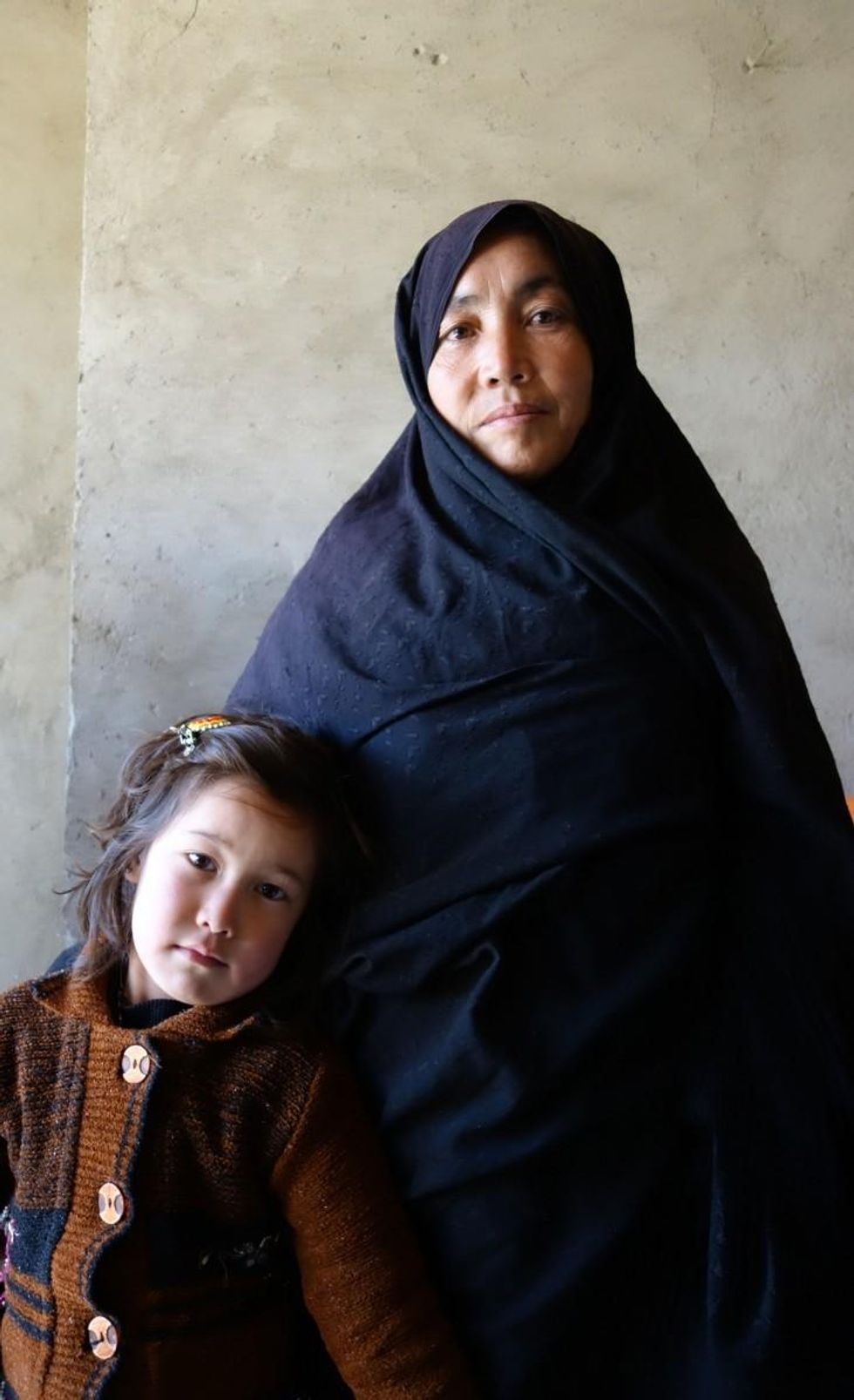
Safeh Zakira says she wants to continue sewing. Before this work, she would sometimes break the shells of almonds, using the shells as fuel. I wonder how much heat such shells can generate, then learn her family also heats with coal. She lifts her hands. They are covered in coal dust.
Her husband is a day laborer, laying mud on walls. Most days he can't find work. When he does work, his average pay is 300 Afghanis a day, but in the winter he earns less, 200 Afghanis. So many are seeking work that employers take advantage of the situation. Officially, Afghanistan has 40% unemployment. The unofficial estimate is higher: more than 80%.
Safeh Zakira's family lives in a rented home that costs 2,500 Afghanis a month. They also pay for water, 500-1,000 a month. I think about her coal-covered hands, the cost of water.
Along with the finished duvets, she arrived today with a bag of the remainder material. (The cover fabric, polyester stuffing and thread were all issued about a week earlier.) I remark on this act of returning the extra stuffing. Honesty is important, she says.
Safeh Zakira learned about the duvet project from her neighbor. She asked where this place was and took the initiative to come and ask to be involved. A team of Afghan Peace Volunteers visited her home to survey her home situation and gave her employment.
Another woman, standing nearby, explains she was hoping to sew, too, but when she got here, she learned the project is already full. Ali, a student volunteer, took her name so that the volunteers can help her in some other way. She will receive a duvet. I worry about the investment in taxi fare as she traveled for an hour. Fortunately, the fare is by trip, not by the number of passengers, so she didn't lose money. Safeh Zakira is given money for transportation as well as for the sewing, and the women traveled together.
Safeh Zakira tells me she hopes there will always be work for her, not just with this winter's duvet project. What the people need, she says, is work so that they can provide for their family.
***
The workshop has two rules.
First, if you get paint on your fingers, you can't touch your clothes.
Second, there is no mixing of colors, so a potato dipped into the red paint shouldn't later be dipped in the green or orange paint.
Rule two is blissfully ignored.
Not following the rules is how they have survived, Hakim says.
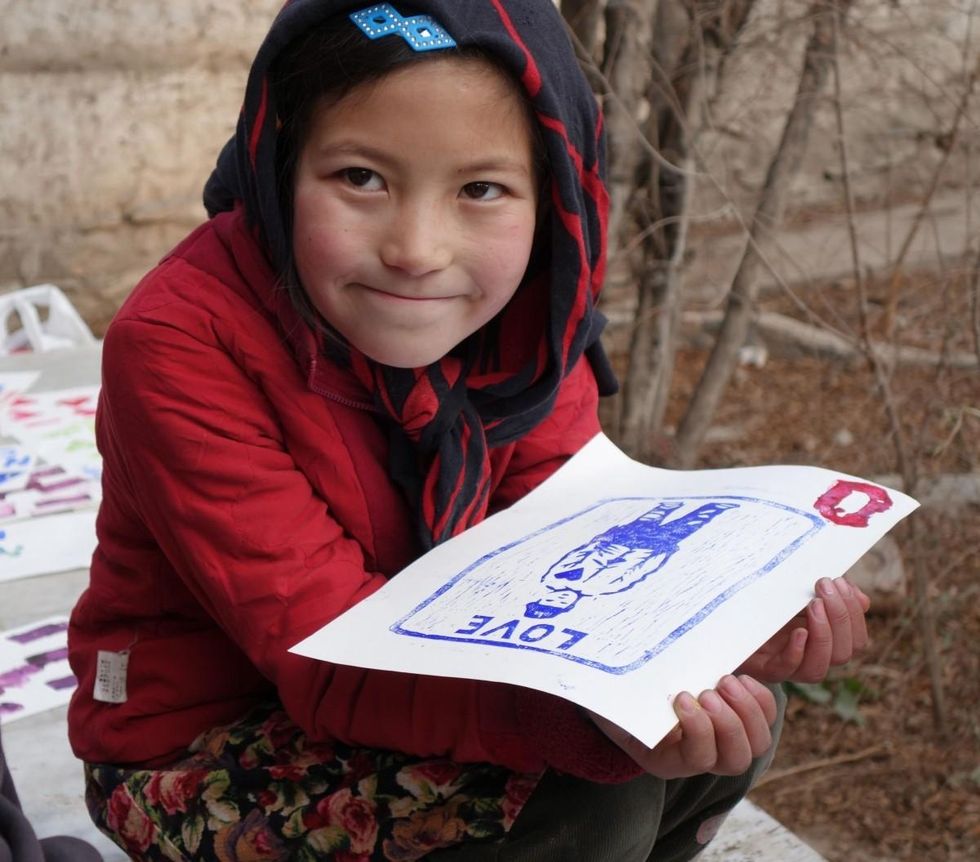
Twenty-some child laborers have joined the afternoon workshop. One boy shows me the design he has printed from potatoes cut into the shape a leaf and a star. The boy names his flower design in English and asks me how it is.
Maqbool, I answer. Beautiful.
Later, he approaches me holding a relief print in each hand, eager for more praise.
Listen for the chuh-chuh-chuh, Aaron says, imitating the sound the roller makes when it is sucking up blue paint. He directs Imam, another boy at the street kids school, to make sure the roller catches the corners of the linoleum. Imam's eyes brighten as he lifts the paper to reveal his self portrait.
In less than an hour, the children have gone through one hundred sheets of paper, which they've spread out on the grass to dry. A few girls and boys walk between the designs, leaning over to pick some up for a closer look before turning their gaze to others. It is as if they are smelling flowers.
In a move that civil liberties groups decried as allowing for "blanket discrimination," the U.S. House of Representatives on Tuesday overwhelmingly voted to increase restrictions on the Visa Waiver Program (VWP).
The legislation passed easily in a 407-19 vote. The New York Times called it "a rare area of bipartisan agreement," and noted that it has the backing of President Barack Obama.
The VWP allows citizens of 38 countries, which include many western European nations like France, the UK, and Ireland, to travel to the U.S. without needing a visa for stays of 90 days or less. Among other things, the revamp would deny the visa-free entry to citizens of those countries who have traveled to Iraq, Syria, Iran, or Sudan within the last five years.
"It also would also require countries participating in the program to share information with U.S. authorities about suspected terrorists," Reuters reports.
House Speaker Paul Ryan (R-Wis.) praised the passage of the measure authored by Rep. Candice Miller (R-Mich.) as "a major step forward in our effort to prevent foreign terrorists from reaching our shores."
But that spin was countered by Rep. Jan Schakowsky (D-Ill.), who criticized what she described as unnecessary restrictions, saying in statement Wednesday: "The legislation that was voted on today claims to prevent terrorists from entering this country, but instead of preventing high-risk individuals from entering this country, many low-risk individuals will be barred from the Visa Waver Program." The measure, H.R. 158, "would only prevent many law abiding individuals from entering this country," she stated.
H.R. 158 was also opposed by a number of rights organizations, including the American Civil Liberties Union (ACLU), the American-Arab Anti-Discrimination Committee (ADC), and the National Iranian-American Council (NIAC).
The ADC called it "an ineffective mechanism to prevent terrorism or protect the security of our nation," and outlined its opposition with these four points:
- The bill intentionally discriminates against Arabs and engage in profiling based on national origin, forcing dual citizens to have to relinquish their identity to be treated and provided the same benefits that all citizens are afforded in their own country;
- The bill fails to provide legitimate exemptions or waiver to nationals whom traveled to designated countries for humanitarian (doctors and nurses, journalists, translators), business, and familial reasons;
- The bill fails to include a sunset provision - which would make this legislation expire and require passage of new legislation, thus allowing for review of its need and effectiveness; and
- The bill fails to provide any review process to VWP nationals to be exempt by the U.S. Embassy or consulate in their home country.
The ACLU expressed its opposition in a letter to the House on Monday, urging representatives to amend the measure and writing that "[b]y singling out these four nationalities to the exclusion of other dual nationals in VWP countries, H.R. 158 amounts to blanket discrimination based on nationality and national origin without a rational basis."
It's not just "discriminatory, it is arbitrary," the letter states. Among those who would lose VWP privileges, the letter notes, include a "Dual-national Austrian citizen (born to Syrian father) traveling to the U.S. to take care of grandchild;" or a "British citizen, working as a reporter for the London-based Daily Telegraph who traveled to Syria to cover the civil war;" or a "Belgian citizen, working as a human rights investigator to document abuses committed by ISIL against Syrians."
In a statement issued Tuesday, NIAC Action executive director Jamal Abdi said, "Unfortunately, the House of Representatives took a page from Donald Trump today and voted for legislation that discriminates against certain dual nationals by barring them from the visa waiver program."
"This proposal will not make our country safer, it compromises our core values and risks discriminating against American citizens," Abdi stated.
The ADC was also joined by several other organizations including Human Rights Watch, Iraq Veterans Against the War, Just Foreign Policy, and the NAACP in sending a letter (pdf) to the House earlier this week, urging that "In the aftermath of recent terrorist attacks, America must show its leadership by ensuring we remain an open society that welcomes people of all nationalities, faiths and backgrounds."
On H.R. 158, the Guardian reports: "The legislation is considered likely to advance through the Senate and become law by the end of the year."
"It's important to speak out against militarism, particularly on Veterans Day, because there are still many people who think opposing militarism and America's wars means you don't support the troops or our veterans," Derek Matthews, a U.S. Marine Corps veteran with deployments to Iraq and Afghanistan, told Common Dreams on Wednesday.
Matthews is just one of numerous veterans across the United States who is marking the federal holiday by taking to the streets or mobilizing to spread a counter-narrative: of demilitarization, human rights, and true remembrance.
"The best way to support our troops and veterans is to speak out against militarism and give existing veterans the care they need," continued Matthews, who is a member of Iraq Veterans Against the War (IVAW).
"Militarism and war are so ingrained and normalized in our culture that it can be difficult to imagine that our society could ever be any different."
--Kelly Dougherty, Iraq Veterans Against the WarFor many, this means reclaiming the roots of Veterans Day by invoking the internationally-recognized Armistice Day--established to mark the conclusion of World War I in 1918. It wasn't until after World War II, when U.S. empire emerged in full force, that the day was proclaimed Veterans Day by former President Dwight D. Eisenhower.
In 50 major cities across the United States, members of Veterans for Peace (VFP) are gathering to "celebrate the original Armistice Day as was done at the end of World War I, when the world came together in realization that war is so horrible, we must end it now," according to an organizational statement.
"When most people think of Veterans Day they don't think about peace and ending war," said Michael McPhearson, a veteran of the first Gulf War and national executive director of VFP. "The day has become a time for parades, flag waving and shopping."
"The celebration is hollow," McPhearson continued. "Twenty-two veterans die each day to suicide. Many veterans are homeless and awaiting much needed healthcare. Others are struggling to find jobs. The best thing to do for veterans is to address these issues throughout the year and push our government to end our global wars."
Emily Yates, a member of IVAW and Iraq Veteran, echoed this point. "For me, Veterans Day is a reminder that we need to keep working to care for the victims and veterans of ongoing war, because the country we served isn't going to do it," Yates told Common Dreams. "My desire is a return to Armistice Day--the day we stop creating more veterans."
IVAW members, meanwhile, are unrolling a campaign called Drop the MIC (Military Industrial Complex) to "interrupt the business-as-usual of the Military Industrial Complex and to fight for our right to heal." Some are sharing Veterans Day counter-narratives on social media, while others are staging banner drops and light brigades.
"When most people think of Veterans Day they don't think about peace and ending war. The day has become a time for parades, flag waving and shopping."
--Michael McPhearson, Veterans for Peace
"Fourteen years into this post 9-11 period of endless war, it is sadly apparent that there is much work to be done to break this toxic culture where military domination is valued over all else," reads a campaign statement. "The occupations by U.S. military forces of both Iraq and Afghanistan continue on; the ever-increasing drone attacks being carried out in Pakistan, Yemen, Somalia, and in Syria; and the consequent displacement of civilian populations from these areas is causing people to take dangerous and fatal risks to escape, and is creating the refugee crises we see boiling over with tragic consequences around the globe."
What's more, the campaign seeks to connect U.S. militarism abroad with racist policing at home--which has been pushed to the forefront of national consciousness through ongoing mass protests under the call of "Black Lives Matter." According to Drop the MIC, both share the same root cause: militarism.
"In order to justify militarism and war, you have to convince people there is a need for war. You do work to convince and use levers of influence: media, schools, people in uniform talking in school," IVAW member Jovanni Reyes told Common Dreams. "But if people are not convinced, they will not support you."
Those calling this Veterans Day for U.S. society to re-imagine honor and remembrance are not the first.
As World War II veteran Howard Zinn declared in 2006: "Our decent impulse, to recognize the ordeal of our veterans, has been used to obscure the fact that they died, they were crippled, for no good cause other than the power and profit of a few. Veterans Day, instead of an occasion for denouncing war, has become an occasion for bringing out the flags, the uniforms, the martial music, the patriotic speeches reeking with hypocrisy. Those who name holidays, playing on our genuine feeling for veterans, have turned a day that celebrated the end of a horror into a day to honor militarism."
"Militarism and war are so ingrained and normalized in our culture that it can be difficult to imagine that our society could ever be any different," Kelly Dougherty, Iraq veteran and co-founder of IVAW, told Common Dreams. "Veterans can mobilize others to imagine a future without militarism and unjust war."
Former President George W. Bush is attracting a flurry of renewed criticism after revelations surfaced this week that he charged a charity for severely wounded veterans of the so-called War on Terror $100,000 in speaking fees.
"Bush led the military into the illegal and immoral invasion of Iraq and Afghanistan and failed to fund and prepare the Department of Veterans Affairs to care for those he sent to war," Maggie Martin, Iraq veteran and organizer with Iraq Veterans Against the War, told Common Dreams. "It's shameful that the former Commander in Chief would profit from funds intended to help struggling veterans."
ABC News revealed Wednesday that, in 2012, Bush charged the Texas-based charity Helping a Hero the steep fee. The organization says its mission is to help "severely wounded veterans returning from service in the War on Terror, primarily by partnering with the wounded hero to provide specially adapted homes to reintegrate them into their community."
In addition to the speaking fee, the group paid $20,000 for Bush's travel to Houston by jet. Just a year before, in 2011, Laura Bush was paid $50,000 for an appearance with the group.
The charity told ABC that the expenditures were justified because Bush helped the group raise money and charged an allegedly discounted fee.
But the latter claim is contradicted by a report last month by Politico which indicates that the price of $100,000 is on par with the former president's speaking fee during that time.
Former marine Eddie Wright, who lost both of his hands in Fallujah, Iraq in 2004 and formerly served on the board of Helping a Hero, told ABC that the fee is "kind of a slap in the face."
"For him to be paid to raise money for veterans that were wounded in combat under his orders, I don't think that's right," said Wright. "You sent me to war."
Dozens of U.S. military veterans released an open letter this week urging drone operators to "refuse to fly missions" or support them in any way--and letting them know that if they say "no" to surveillance and assassination orders, there is a whole community rooting for them.
"At least 6,000 peoples' lives have been unjustly taken by United States drone attacks in Afghanistan, Pakistan, Yemen, Somalia, Iraq, the Philippines, Libya and Syria," states the letter, which was organized by the education and advocacy organization KnowDrones.com.
"Those involved in United States drone operations who refuse to participate in drone missions will be acting within accordance of Principle IV of the Principles of International Law Recognized in the Charter of the Nuremberg Tribunal and the Judgment of the Tribunal, The United Nations 1950," states the letter. "So, yes, you do have a choice--and liability under the law. Choose the moral one. Choose the legal one."
The letter's 45 signatories include retired U.S. Army Colonel Ann Wright, who stepped down from her State Department position in 2003 to protest the U.S.-led war on Iraq.
Numerous veterans of the so-called "War on Terror" also signed the letter, including Aaron Hughes, Iraq veteran and organizer with Iraq Veterans Against the War. Hughes told Common Dreams that he backed the initiative because he thinks it is "extremely important for those who are flying those vehicles or doing logistics to know that there is a whole community out there that supports them in saying no."
Nick Mottern, coordinator of KnowDrones.org, echoed this point in a press statement released this week: "The people signing this letter know that they are asking drone operators to take a heavy step, but we feel it is perfectly legitimate to advise military people to stop taking part in illegal activity that has killed thousands without due process, is terrorizing thousands more and is wracking their own ranks with moral injury and PTSD."
"When our country unjustly inflicts violence on civilian populations it is our duty to resist."
--Maggie Martin, Iraq Veterans Against the War
The Air Force recently revealed that, due to the "stressors" of the job, the military is losing drone pilots and being forced to cut back flights. In a Government Accountability Office report (pdf) released in April 2014, the agency warned that drone pilots are quitting far more quickly than they are being recruited.
In an article published this March in TomDispatch, writer Pratap Chatterjee asked, "Are pilots deserting Washington's Remote-Control War?" He continued, "Could it be that the feeling is even shared by drone pilots themselves, that a sense of dishonor in fighting from behind a screen thousands of miles from harm's way is having an unexpected impact of a kind psychologists have never before witnessed?"
Former drone operators, including Heather Linebaugh, have testified to the horrors inflicted by the remotely operated lethal weapons. This reality is confirmed by civilians and reporters, including the Bureau of Investigative Journalism, which tracks the high number of civilian drone killings in Yemen, Pakistan, Somalia, and Afghanistan.
"When our country unjustly inflicts violence on civilian populations it is our duty to resist," Maggie Martin, Iraq veteran and organizer with Iraq Veterans Against the War, told Common Dreams. "Whether at home or abroad we have to take action to stand in solidarity with those facing state violence."