SUBSCRIBE TO OUR FREE NEWSLETTER
Daily news & progressive opinion—funded by the people, not the corporations—delivered straight to your inbox.
5
#000000
#FFFFFF
To donate by check, phone, or other method, see our More Ways to Give page.
Daily news & progressive opinion—funded by the people, not the corporations—delivered straight to your inbox.
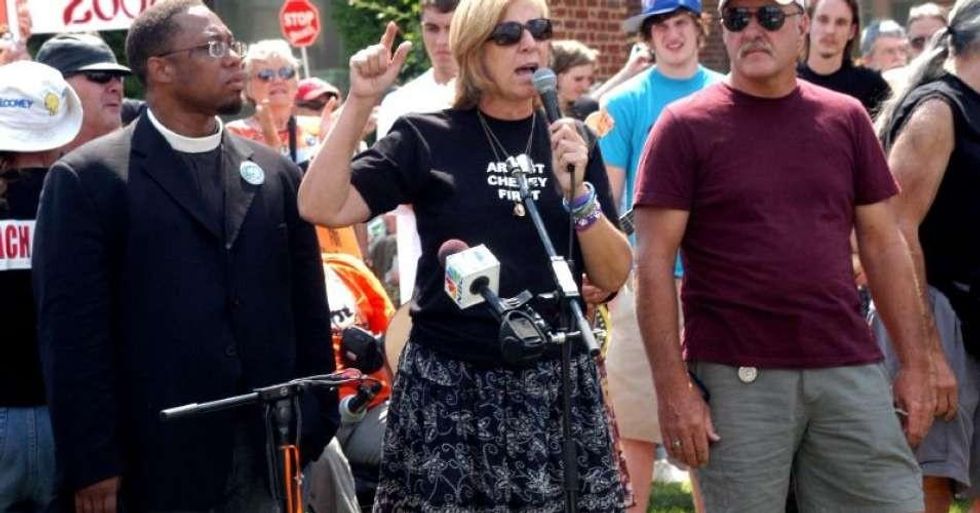
One of the most recognizable Iraq War critics of the Bush era weighed in this week on President Donald Trump's widely-criticized interactions with Gold Star families in recent days--arguing that while Trump's attacks on statements made by the widow of Sgt. La David Johnson were "so insensitive," President George W. Bush's own legacy should not be sanitized.
"Trump has proven himself to be a loose cannon who doesn't seem to have very many social graces. But Bush was no better."--Cindy Sheehan
Cindy Sheehan, the mother of Army soldier Casey Sheehan, who was killed in action in 2004, argued in an interview with the Daily Beast that Bush's military policies were just as harmful as Trump's, if not more so.
"Trump has proven himself to be a loose cannon who doesn't seem to have very many social graces," Sheehan said. "But Bush was no better. I wish the conversation was about the barbarism of war and, in this instance, why are there special ops forces in Niger? Where is the movement to oppose U.S. wars, instead of liberal handwringing over botched messages of condolence?"
Her comments come as Bush's record of initiating wars in Iraq and Afghanistan, in which hundreds of thousands of people were killed, has been whitewashed by many who have favorably contrasted Bush with Trump.
Sheehan became well-known for camping out near Bush's ranch in Texas for over a month, in an effort to get him to meet with her to discuss her objections to the Iraq War and U.S. military policy, after her son's death. Bush addressed her protest by saying he offered his "sympathy" but that leaving Iraq was out of the question; he never met with Sheehan.
Sheehan called into question the country's support of Gold Star families--support that is offered to families who express their grief but not necessarily to those who loudly criticize the very policies that put their loved ones in harm's way.
"I feel like we Gold Star mothers, or families are honored as long as we expound the company line: as long as we take our Gold Star pins and just grieve in silence," said Sheehan. "My grief was exploited by Democrats and Republican alike to score political points and win elections. And the wars I swore to stop are still going, and have expanded dramatically. It makes me sad all the way around. People are still dying and that's completely unacceptable."
How best to show respect for the U.S. troops killed in Iraq and Afghanistan and for their families on Memorial Day? Simple: Avoid euphemisms like "the fallen" and expose the lies about what a great idea it was to start those wars and then to "surge" tens of thousands of more troops into those fools' errands.
First, let's be clear on at least this much: the 4,500 U.S. troops killed in Iraq - so far - and the 2,350 killed in Afghanistan - so far - did not "fall." They were wasted on no-win battlefields by politicians and generals - cheered on by neocon pundits and mainstream "journalists" - almost none of whom gave a rat's patootie about the real-life-and-death troops. They were throwaway soldiers.
And, as for the "successful surges," they were just P.R. devices to buy some "decent intervals" for the architects of these wars and their boosters to get space between themselves and the disastrous endings while pretending that those defeats were really "victories squandered" - all at the "acceptable" price of about 1,000 dead U.S. soldiers each and many times that in dead Iraqis and Afghans.
Memorial Day should be a time for honesty about what enabled the killing and maiming of so many U.S. troops in Iraq and Afghanistan. Presidents George W. Bush and Barack Obama and the senior military brass simply took full advantage of a poverty draft that gives upper-class sons and daughters the equivalent of exemptions, vaccinating them against the disease of war.
What drives me up the wall is the oft-heard, dismissive comment about troop casualties from well-heeled Americans: "Well, they volunteered, didn't they?" Under the universal draft in effect during Vietnam, far fewer were immune from service, even though the well-connected could still game the system to avoid serving. Vice Presidents Dick Cheney and Joe Biden, for example, each managed to pile up five exemptions. This means, of course, that they brought zero military experience to the job; and this, in turn, may explain a whole lot -- particularly given their bosses' own lack of military experience.
The grim truth is that many of the creme de la creme of today's Official Washington don't know many military grunts, at least not intimately as close family or friends. They may bump into some on the campaign trail or in an airport and mumble something like, "thank you for your service." But these sons and daughters of working-class communities from America's cities and heartland are mostly abstractions to the powerful, exclamation points at the end of some ideological debate demonstrating which speaker is "tougher," who's more ready to use military force, who will come out on top during a talk show appearance or at a think-tank conference or on the floor of Congress.
Sharing the Burden?
We should be honest about this reality, especially on Memorial Day. Pretending that the burden of war has been equitably shared, and - worse still - that those killed died for a "noble cause," as President George W. Bush likes to claim, does no honor to the thousands of U.S. troops killed and the tens of thousands maimed. It dishonors them. Worse, it all too often succeeds in infantilizing bereaved family members who cannot bring themselves to believe their government lied.
Who can blame parents for preferring to live the fiction that their sons and daughters were heroes who wittingly and willingly made the "ultimate sacrifice," dying for a "noble cause," especially when this fiction is frequently foisted on them by well-meaning but naive clergy at funerals. For many it is impossible to live with the reality that a son or daughter died in vain. Far easier to buy into the official story and to leave clergy unchallenged as they gild the lilies around coffins and gravesites.
Not so for some courageous parents - Cindy Sheehan, for example, whose son Casey Sheehan was killed on April 4, 2004, in the Baghdad suburb of Sadr City. Cindy demonstrated uncommon grit when she led hundreds of friends to Crawford to lay siege to the Texas White House during the summer of 2005 trying to get President Bush to explain what "noble cause" Casey died for. She never got an answer. There is none.
But there are very few, like Cindy Sheehan, able to overcome a natural human resistance to the thought that their sons and daughters died for a lie - and then to challenge that lie. These few stalwarts make themselves face this harsh reality, the knowledge that the children whom they raised and sacrificed so much for were, in turn, sacrificed on the altar of political expediency, that their precious children were bit players in some ideological fantasy or pawns in a game of career maneuvering.
Former Secretary of State Henry Kissinger is said to have described the military disdainfully as "just dumb stupid animals to be used as pawns in foreign policy." Whether or not those were his exact words, his policies and behavior certainly betrayed that attitude. It certainly seems to have prevailed among top American-flag-on-lapel-wearing officials of the Bush and Obama administrations, including armchair and field-chair generals whose sense of decency is blinded by the prospect of a shiny new star on their shoulders, if they just follow orders and send young soldiers into battle.
This bitter truth should raise its ugly head on Memorial Day but rarely does. It can be gleaned only with great difficulty from the mainstream media, since the media honchos continue to play an indispensable role in the smoke-and-mirrors dishonesty that hides their own guilt in helping Establishment Washington push "the fallen" from life to death.
We must judge the actions of our political and military leaders not by the pious words they will utter Monday in mourning those who "fell" far from the generals' cushy safe seats in the Pentagon or somewhat closer to the comfy beds in air-conditioned field headquarters where a lucky general might be comforted in the arms of an admiring and enterprising biographer.
Many of the high-and-mighty delivering the approved speeches on Monday will glibly refer to and mourn "the fallen." None are likely to mention the culpable policymakers and complicit generals who added to the fresh graves at Arlington National Cemetery and around the country.
Words, after all, are cheap; words about "the fallen" are dirt cheap - especially from the lips of politicians and pundits with no personal experience of war. The families of those sacrificed in Iraq and Afghanistan should not have to bear that indignity.
'Successful Surges'
The so-called "surges" of troops into Iraq and Afghanistan were particularly gross examples of the way our soldiers have been played as pawns. Since the usual suspects are again coming out the woodwork of neocon think tanks to press for yet another "surge" in Iraq, some historical perspective should help.
Take, for example, the well-known - and speciously glorified - first "surge;" the one Bush resorted to in sending over 30,000 additional troops into Iraq in early 2007; and the not-to-be-outdone Obama "surge" of 30,000 into Afghanistan in early 2010. These marches of folly were the direct result of decisions by George W. Bush and Barack Obama to prioritize political expediency over the lives of U.S. troops.
Taking cynical advantage of the poverty draft, they let foot soldiers pay the "ultimate" price. That price was 1,000 U.S. troops killed in each of the two "surges."
And the results? The returns are in. The bloody chaos these days in Iraq and the faltering war in Afghanistan were entirely predictable. They were indeed predicted by those of us able to spread some truth around via the Internet, while being mostly blacklisted by the fawning corporate media.
Yet, because the "successful surge" myth was so beloved in Official Washington, saving some face for the politicians and pundits who embraced and spread the lies that justified and sustained especially the Iraq War, the myth has become something of a touchstone for everyone aspiring to higher office or seeking a higher-paying gig in the mainstream media.
Campaigning Wednesday in New Hampshire, presidential aspirant Jeb Bush gave a short history lesson about his big brother's attack on Iraq. Referring to the so-called Islamic State, Bush said, "ISIS didn't exist when my brother was president. Al-Qaeda in Iraq was wiped out ... the surge created a fragile but stable Iraq. ..."
We've dealt with the details of the Iraq "surge" myth before - both before and after it was carried out. [See, for instance, Consortiumnews.com's "Reviving the Successful Surge Myth"; "Gen. Keane on Iran Attack"; "Robert Gates: As Bad as Rumsfeld?"; and "Troop Surge Seen as Another Mistake."]
But suffice it to say that Jeb Bush is distorting the history and should be ashamed. The truth is that al-Qaeda did not exist in Iraq before his brother launched an unprovoked invasion in 2003. "Al-Qaeda in Iraq" arose as a direct result of Bush's war and occupation. Amid the bloody chaos, AQI's leader, a Jordanian named Abu Musab al-Zarqawi, pioneered a particularly brutal form of terrorism, relishing videotaped decapitation of prisoners.
Zarqawi was eventually hunted down and killed not during the celebrated "surge" but in June 2006, months before Bush's "surge" began. The so-called Sunni Awakening, essentially the buying off of many Sunni tribal leaders, also predated the "surge." And the relative reduction in the Iraq War's slaughter after the 2007 "surge" was mostly the result of the ethnic cleansing of Baghdad from a predominantly Sunni to a Shia city, tearing the fabric of Baghdad in two, and creating physical space that made it more difficult for the two bitter enemies to attack each other. In addition, Iran used its influence with the Shia to rein in their extremely violent militias.
Though weakened by Zarqawi's death and the Sunni Awakening, AQI did not disappear, as Jeb Bush would like you to believe. It remained active and - when Saudi Arabia and the Sunni gulf states took aim at the secular regime of Bashar al-Assad in Syria - AQI joined with other al-Qaeda affiliates, such as the Nusra Front, to spread their horrors across Syria. AQI rebranded itself "the Islamic State of Iraq and Syria" or simply "the Islamic State."
The Islamic State split off from al-Qaeda over strategy but the various jihadist armies, including al-Qaeda's Nusra Front, have now seized wide swaths of territory in Syria -- and the Islamic State has returned with a vengeance to Iraq, grabbing major cities such as Mosul and Ramadi.
Jeb Bush doesn't like to unspool all this history. He and other Iraq War backers prefer to pretend that the "surge" in Iraq had won the war and Obama threw the "victory" away by following through on George W. Bush's withdrawal agreement with Maliki.
But the current crisis in Syria and Iraq is among the fateful consequences of the U.S./UK attack 12 years ago and particularly of the "surge" of 2007, which contributed greatly to Sunni-Shia violence, the opposite of what George W. Bush professed was the objective of the "surge," to enable Iraq's religious sects to reconcile.
Reconciliation, however, always took a back seat to the real purpose of the "surge" - buying time so Bush and Cheney could slip out of Washington in 2009 without having an obvious military defeat hanging around their necks and putting a huge stain on their legacies.
The political manipulation of the Iraq "surge" allowed Bush, Cheney and their allies to reframe the historical debate and shift the blame for the defeat onto Obama, recognizing that 1,000 more dead U.S. soldiers was a small price to pay for protecting the "Bush brand." Now, Bush's younger brother can cheerily march off to the campaign trail for 2016 pointing to the carcass of the Iraqi albatross hung around Obama's shoulders.
Rout at Ramadi
Last weekend, less than a year after U.S.-trained and -equipped Iraqi forces ran away from the northern Iraqi city of Mosul, leaving the area and lots of U.S. arms and equipment to ISIS, something similar happened at Ramadi, the capital of the western province of Anbar. Despite heavy U.S. air strikes on ISIS, American-backed Iraqi security forces fled Ramadi, which is only 70 miles west of Baghdad, after a lightning assault by ISIS forces.
The ability of ISIS to strike just about everywhere in the area is reminiscent of the Tet offensive of January-February 1968 in Vietnam, which persuaded President Lyndon Johnson that that particular war was unwinnable. If there are materials left over in Saigon for reinforcing helicopter landing pads on the tops of buildings, it is not too early to bring them to Baghdad's Green Zone, on the chance that U.S. embassy buildings may have a call for such materials in the not-too-distant future.
The headlong Iraqi government retreat from Ramadi had scarcely ended on Sunday when Sen. John McCain, R-Arizona, described the fall of the city as "terribly significant" - which is correct - adding that more U.S. troops may be needed - which is insane. His appeal for more troops neatly fits one proverbial definition of insanity (attributed or misattributed to Albert Einstein): "doing the same thing over and over again [like every eight years?] but expecting different results."
By Wednesday, as Jeb Bush was singing the praises of his brother's "surge" in Iraq, McCain and his Senate colleague Lindsey Graham were publicly calling for a new "surge" of U.S. troops into Iraq. The senators urged President Obama to do what George W. Bush did in 2007 - replace the U.S. military leadership and dispatch additional troops to Iraq.
But Washington Post pundit David Ignatius, even though a fan of the earlier two surges, is not yet on board for this one. In a column published also on Wednesday, Ignatius warned that Washington should not abandon its current strategy:
"This is still Iraq's war, not America's. But President Barack Obama must reassure Prime Minister Haider al-Abadi that the U.S. has his back -- and at the same time give him a reality check: If al-Abadi and his Shiite allies don't do more to empower Sunnis, his country will splinter. Ramadi is a precursor -- of either a turnaround by al-Abadi's forces, or an Iraqi defeat."
Ignatius's urgent tone is warranted. But what he suggests is precisely what the U.S. made a lame attempt to do with then-Prime Minister Maliki in early 2007. Yet, President Bush squandered U.S. leverage by sending 30,000 troops to show he "had Maliki's back," freeing Maliki to accelerate his attempts to marginalize, rather than accommodate, Sunni interests.
Perhaps Ignatius now remembers how the "surge" he championed in 2007 greatly exacerbated tensions between Shia and Sunni contributing to the chaos now prevailing in Iraq and spreading across Syria and elsewhere. But Ignatius is well connected and a bellwether; if he ends up advocating another "surge," take shelter.
Keane and Kagan Ask For a Mulligan
The architects of Bush's 2007 "surge" of 30,000 troops into Iraq, former Army General Jack Keane and American Enterprise Institute neocon strategist Frederick Kagan, in testimony Thursday to the Senate Armed Services Committee, warned strongly that, without a "surge" of some 15,000 to 20,000 U.S. troops, ISIS will win in Iraq.
"We are losing this war," warned Keane, who previously served as Vice Chief of Staff of the Army. "ISIS is on the offense, with the ability to attack at will, anyplace, anytime. ... Air power will not defeat ISIS." Keane stressed that the U.S. and its allies have "no ground force, which is the defeat mechanism."
Not given to understatement, Kagan called ISIS "one of the most evil organizations that has ever existed. ... This is not a group that maybe we can negotiate with down the road someday. This is a group that is committed to the destruction of everything decent in the world." He called for "15-20,000 U.S. troops on the ground to provide the necessary enablers, advisers and so forth," and added: "Anything less than that is simply unserious."
(By the way, Frederick Kagan is the brother of neocon-star Robert Kagan, whose Project for the New American Century began pushing for the invasion of Iraq in 1998 and finally got its way in 2003. Robert Kagan is the husband of Assistant Secretary of State for European AffairsVictoria Nuland, who oversaw the 2014 coup that brought "regime change" and bloody chaos to Ukraine. The Ukraine crisis also prompted Robert Kagan to urge a major increase in U.S. military spending. [For details, see Consortiumnews.com's "A Family Business of Perpetual War."] )
What is perhaps most striking, however, is the casualness with which the likes of Frederick Kagan, Jack Keane, and other Iraq War enthusiasts advocate dispatching tens of thousands of U.S. soldiers to fight and die in what would almost certainly be another futile undertaking. You might even wonder why people like Kagan are invited to testify before Congress given their abysmal records.
But that would miss the true charm of the Iraq "surge" in 2007 and its significance in salvaging the reputations of folks like Kagan, not to mention George W. Bush and Dick Cheney. From their perspective, the "surge" was a great success. Bush and Cheney could swagger from the West Wing into the western sunset on Jan. 20, 2009.
As author Steve Coll has put it, "The decision [to surge] at a minimum guaranteed that his [Bush's] presidency would not end with a defeat in history's eyes. By committing to the surge [the President] was certain to at least achieve a stalemate."
According to Bob Woodward, Bush told key Republicans in late 2005 that he would not withdraw from Iraq, "even if Laura and [first-dog] Barney are the only ones supporting me." Woodward made it clear that Bush was well aware in fall 2006 that the U.S. was losing. Suddenly, with some fancy footwork, it became Laura, Barney - and new Defense Secretary Robert Gates and Gen. David Petraeus along with 30,000 more U.S. soldiers making sure that the short-term fix was in.
The fact that about 1,000 U.S. soldiers returned in caskets was the principal price paid for that short-term "surge" fix. Their "ultimate sacrifice" will be mourned by their friends, families and countrymen on Memorial Day even as many of the same politicians and pundits will be casually pontificating about dispatching more young men and women as cannon fodder into the same misguided war.
It has been difficult drafting this downer, this historical counter-narrative, on the eve of Memorial Day. It seems to me necessary, though, to expose the dramatis personae who played such key roles in getting more and more people killed. Sad to say, none of the high officials mentioned here, as well as those on the relevant Congressional committees, are affected in any immediate way by the carnage in Ramadi, Tikrit or outside the gate to the Green Zone in Baghdad.
And perhaps that's one of the key points here. It is not most of us, but rather our soldiers and the soldiers and civilians of Iraq, Afghanistan and God knows where else who are Lazarus at the gate. And, as Benjamin Franklin once said, "Justice will not be served until those who are unaffected are as outraged as those who are."
March 19 marks two gloomy anniversaries: the 12th anniversary of US invasion of Iraq and the 5th anniversary of the NATO intervention in Libya. Both overthrew Arab dictators; both left the local people in such horrific straits that many of them look back with nostalgia to the days of Saddam Hussein and Muammar Qaddafi.
I was in Iraq with a dozen of my CODEPINK colleagues a month before the US invasion in 2003. While we found a country wracked by 13 years of draconian Western sanctions and a people scared to openly criticize Saddam Hussein, we also found a middle class country with an extremely well-educated population where women made up the majority of university students and participated in all aspects of public life.
I'll never forget my first conversation with an Iraqi woman in Baghdad, Eman Khammas. "Oh, you're from the United States," she remarked in perfect English. "Who is your favorite black woman poet? Do you like Nikki Giovanni or June Jordan or Alice Walker?" Taken aback, I asked how she knew about these women. "I studied them when I was doing my English degree at the University of Baghdad," she replied somewhat condescendingly, as if that were common knowledge.
Today Khammas and her family are refugees, as are millions of Iraqis who were forced to flee the violence unleashed by "Operation Iraqi Freedom." By 2007, the United Nations High Commissioner for Refugees said that the number of people fleeing Iraq reached 2 million and that within Iraq there were an estimated 1.7 million internally displaced people. With the civil war raging today, that number has only increased, as have deaths. An academic study published in 2013 found that nearly half a million Iraqis had died from war-related causes since the US-led invasion in 2003.
While military contractors made out like bandits, US taxpayers wasted $1.7 trillion dollars on the Iraq war, money that could have funded healthcare and education here at home. American families lost 4,488 of their loved ones, with tens of thousands of veterans suffering from PTSD and other war-related maladies.
Yes, the US overthrew Saddam Hussein, but it also destroyed the nation's infrastructure and tore asunder the societal fabric. By disbanding the entire Iraqi military and bureaucracy, and supporting a sectarian Shia government, the US created a power vacuum -- a space for ISIS to seize power. ISIS currently controls a huge swath of Iraq, some 13,000 square miles, and wreaks havoc on the predominantly Shia'a population by carrying out ethnic cleansing, taking women as slaves, beheading children, and displacing entire communities.
Libya is a similarly tragic tale. When the peaceful protests against Muammar Gaddafi were met with government violence, an armed rebellion emerged that called for military help from the West. With NATO's help in this "humanitarian intervention," Gaddafi was overthrown in October 2011. A summary of the intervention in the prestigious journal Foreign Affairs concluded: "By any measure, NATO succeeded in Libya. It saved tens of thousands of lives from almost certain destruction. It conducted an air campaign of unparalleled precision, which, although not perfect, greatly minimized collateral damage. It enabled the Libyan opposition to overthrow one of the world's longest-ruling dictators. And it accomplished all of this without a single allied casualty and at a cost -- $1.1 billion for the United States and several billion dollars overall -- that was a fraction of that spent on previous interventions in the Balkans, Afghanistan, and Iraq."
Today, Libya is considered a "failed state" run by extremist militias and two opposing governments vying for power. Ex-rebel commanders, former exiles, Islamists, tribal leaders are all fighting for control, leaving no authoritative government or legitimate institutions.
Before the "liberation," Libya was the richest country in Africa. It provided all Libyans with free healthcare and education. Today Libyans have almost no functioning public services, with daily blackouts and water shortages.
On the anniversaries of these two epic failures in Iraq and Libya, anti-war activists are gathering for four days of actions from March 18-21. They will protest the past interventions, the present-day US participation in wars in the Middle East and the possibility of a new war with Iran. "As people are being killed by the Empire every day, billions of dollars that could be used for education, housing, healthcare, and sustainable and clean forms of energy are being poured into these Imperial wars for the profit of a few and the heartache of many," said Spring Rising organizer Cindy Sheehan, a mother whose son was killed in Iraq.
The activities include a "spring cleaning of Congress," where activists will march into the offices of the most hawkish members of Congress, dusting off the cobwebs of war and the fingerprints of military contractors. They'll take a bus tour of warmakers and their enablers, including the Pentagon, the FBI, the lobby group AIPAC and the right-wing American Enterprise Institute. The gathering will culminate at a rally at the White House on Saturday, March 21.
*****
In an interview with VICE news, for the first time President Obama admitted that ISIS was a "direct outgrowth of al-Qaida in Iraq that grew out of our invasion." He called it an example of "unintended consequences." But his conclusion that we should "aim before we shoot" was off the mark. A more accurate conclusion is that we shouldn't shoot at all, we shouldn't invade other people's countries and try to socially engineer their societies to ally with our economic interests.
On our trip to Iraq under Saddam Hussein in 2003, in hushed voices, a group of women told us that they wanted to be freed from the oppressive regime they were living under. But with the US invasion pending, they pleaded with us, "Go home and tell your government that our liberation will not come on the wings of US bombs or from the barrels of US guns. Go home and tell your government that we will liberate ourselves." If only our leaders would listen.
There were 8,920,000 military veterans in the United States as of last June, according to the Department of Veterans Affairs. Sometime last Sunday or Monday, hours before Veterans Day began, that number dropped by one, when Tomas Young died at home in Seattle, with his wife by his side. He was one of many soldiers who were sent to Iraq and were grievously injured there.
The public may know more about Tomas Young than about most veterans, thanks to the remarkable documentary "Body of War," directed and produced by legendary talk-show host Phil Donahue and filmmaker Ellen Spiro. His journey, his struggle and now his death follow an arc along the tragic U.S. wars and occupations in this post-9/11 world.
Like so many, Tomas was inspired to join the military after Sept. 11. He was surprised to learn, though, that he would be deployed not to Afghanistan, but to Iraq. On April 4, 2004, five days after Tomas arrived in Baghdad, he was shot in the spine, paralyzing him from the chest down. The injury rendered him a paraplegic, causing a cascade of additional complications. His breathing was labored. His body's capacity to regulate temperature was impaired, occasionally requiring that he wear an ice-pack vest. Despite the enormous challenges, Tomas summoned tremendous strength and embarked on a path of antiwar activism.
During the summer of 2005, he joined the grieving mother-turned-peace-activist Cindy Sheehan at Camp Casey, the protest camp in Crawford, Texas, not far from the ranch of then-President George W. Bush. Cindy named the encampment after her dead son, Casey, killed on the same day in the same city--Sadr City--where Tomas was shot. Cindy Sheehan stood in protest outside Bush's retreat while he vacationed there, and the protest grew and grew. Tomas joined Iraq Veterans Against the War, and served on its board of directors.
In 2008, I spoke with Tomas. He directed a comment to then-Vice President Dick Cheney: "From one of those soldiers who volunteered to go to Afghanistan after Sept. 11, which was where the evidence said we needed to go, to [Cheney], the master of the college deferment in Vietnam: Many of us volunteered with patriotic feelings in our heart, only to see them subverted and bastardized by the administration and sent into the wrong country."
"Body of War" depicts the personal cost of war. In one of the most moving scenes in the film, Young meets Sen. Robert Byrd, the longest-serving senator, with the most votes cast in Senate history (more than 18,000). Byrd said his "no" vote on the Iraq war resolution was the most important of his life. Young helps him read the names of the 23 senators who voted against the war resolution. Byrd reflects: "The immortal 23. Our founders would be so proud." Turning to Young, he says: "Thank you for your service. Man, you've made a great sacrifice. You served your country well." Young replies, "As have you, sir."
The release of "Body of War" propelled Tomas into the limelight, as the country became embroiled in the hot summer and the 2008 presidential elections. It was then that a blood clot lodged in his arm, causing severe complications. He lost most of the use of his arms, and suffered diminished ability to speak. He never lost his deep commitment to peace, or his hope that those responsible for the war would be held accountable.
In February 2013, appearing before an audience of "Body of War" in Litchfield, Conn., via video stream, he shocked the audience by telling them that he intended to end his own life by stopping eating.
He was still in his hometown of Kansas City, Mo., with his wife, Claudia Cuellar. Tomas was battling extreme, chronic pain, and as Claudia told us after his death, he found some relief from marijuana, which is illegal in Kansas and Missouri. So they moved to Oregon, where medical marijuana is legal. Unfortunately, Claudia felt the Veterans Affairs hospital in Portland did not support his use of marijuana, and punitively reduced his prescription pain medications in response. Seeking a safe, compassionate place for Tomas, they moved to Seattle, another place with legal medical (and now, recreational) marijuana. Tomas and Claudia felt the VA dragged its heels, leaving them to ration his pain pills.
It was in the midst of this ordeal that Claudia found Tomas, last Monday morning, lying in deep silence. He was dead.
Eighteen months earlier, he had written an open letter to George W. Bush and Dick Cheney. He ended the letter: "My day of reckoning is upon me. Yours will come. I hope you will be put on trial. But mostly I hope, for your sakes, that you find the moral courage to face what you have done to me and to many, many others who deserved to live. I hope that before your time on earth ends, as mine is now ending, you will find the strength of character to stand before the American public and the world, and in particular the Iraqi people, and beg for forgiveness."
May Tomas Young, who fought so hard for peace in life, now rest in peace.
Denis Moynihan contributed research to this column.
As violence in Iraq escalates and hawks beat the drums of war, people on the ground in Iraq and across the U.S. are urging the Obama administration: don't go down the same path of military intervention that created the current crisis.
Public Opinion vs. War Hawks
According to a poll released Tuesday, 74 percent of people in the U.S. are against sending combat troops into Iraq. Rather than allowing that overwhelming opinion to shape the narrative, corporate media has given platform to the same hawkish voices who called for the 2003 invasion of Iraq.
Among the vocal proponents of using U.S. military might are Senators John McCain and Lindsey Graham. The two issued a statement last week calling for "U.S. air strikes, among other military and intelligence actions and additional support for our Iraqi partners."
"We reject US intervention and protest President Obama's inappropriate speech in which he expressed concern over oil and not over people."
--Falah Alwan, Federation of Workers Councils and Unions in Iraq
In an op-ed published Tuesday, The Nation's Katrina vanden Heuval asked, "Can someone explain to me why the media still solicit advice about the crisis in Iraq from Sen. John McCain (R-Ariz.)? Or Sen. Lindsey Graham (R-S.C.)? How many times does the Beltway hawk caucus get to be wrong before we recognize that maybe, just maybe, its members don't know what they're talking about?"
Emerging Calls Against War
Not receiving as much media attention are the calls to halt military intervention--by the U.S. or any party--that will claim further lives and further shred Iraqi society.
Congresswoman Barbara Lee (D-CA), who issued the only congressional vote against the 2001 Authorization for Use of Military Force and has been an outspoken critic of the Iraq War since before it started, issued a statement on Friday, which read, in part:
The ongoing crisis in Iraq is the tragic product of President George W. Bush's unnecessary and unjust 2003 invasion. The response must not be more military action, but a political process led by the Iraqis and representative of all Iraqis.
As the President has so eloquently stated, our military cannot solve all crises. The future of Iraq is in the hands of the Iraqi people.
The U.S. must continue to pursue international and regional engagement, recognition of human rights and political reforms in order to promote the long term national stability and the reconciliation necessary to address this complex problem.
"Those of us who were there know first hand that US military solutions in Iraq do not serve the interests of the Iraqi people." --Iraq Veterans Against the War
Speaking to Democracy Now! on Friday, Sami Rasouli, founder and director of the Muslim Peacemaker Teams in Iraq, stated:
I think [the U.S.] should leave [Iraq], not to intervene, end the war in Afghanistan, and pull out their forces, and let the Arabs and the countries of the area solve their problem.
Peace activist Cindy Sheehan, whose son was killed while serving in the Iraq war, wrote:
The USA's allegiance to Empire and absolute devotion to war is hurting everyone, even the jingoists who proclaim, "support the troops," loudly while vets are dying waiting to get health services from the V.A.
Bottom-line, we should stop stoking the flames of Empire with the fuel of our own flesh and blood.
Iraqi-American political analyst Raed Jarrar told Democracy Now! on Monday:
We have heard so many different words describing U.S. military interventions in Iraq and the region. And whatever you name it, I think, from the Iraqi perspective, this will be yet another example of a U.S. military strike on Iraq that will not be a part of the solution. The U.S. has been bombing Iraq since 1991, so it's been 13 years of bombings, bombardments, or like 23 years if you count all of the years of the sanctions. And none of these campaigns were ever a part of a solution. The U.S. has historically been a part of the problem. So I think if the U.S. were to attack Iraq yet again, this will add another layer of complexity. It will make the situation inside Iraq worse, and it will threaten the U.S. interests in the region and the world, because the U.S. will become an active participant in this very bloody conflict.
"The response must not be more military action, but a political process led by the Iraqis and representative of all Iraqis."
--Congresswoman Barbara LeeFalah Alwan, President of the Federation of Workers Councils and Unions in Iraq, wrote in an op-ed published at Jadaliyya that "the will of the Iraqi people remains ignored." He continues:
We reject US intervention and protest President Obama's inappropriate speech in which he expressed concern over oil and not over people. We also stand firmly against the brazen meddling of Iran.
We stand against the intervention of Gulf regimes and their funding of armed groups, especially Saudi Arabia and Qatar.
We reject Nouri al-Maliki's sectarian and reactionary policies.
We also reject armed terrorist gangs and militias' control of Mosul and other cities. We agree with and support the demands of people in these cities against discrimination and sectarianism.
Finally, we reject the interference of the religious institution and its call for indiscriminate warfare.
We aim to stand with those who represent the interests of the people and to empower them in the face of this dangerous and reactionary attack. We call for a clear international position to curb the deteriorating situation as well as regional interference, and to support the people of Iraq.
As Sami Ramadani, a senior lecturer in sociology at London Metropolitan University, wrote in an op-ed for the Guardian, the U.S. played a key role in stoking the sectarian divides that are fueling the current conflict:
The most serious sectarian and ethnic tensions in Iraq's modern history followed the 2003 US-led occupation, which faced massive popular opposition and resistance. The US had its own divide-and-rule policy, promoting Iraqi organisations founded on religion, ethnicity, nationality or sect rather than politics. Many senior officers in the newly formed Iraqi army came from these organisations and Saddam's army. This was exacerbated three years ago, when sectarian groups in Syria were backed by the US, Turkey, Saudi Arabia and Qatar.
Call for Action
Iraqi civil society group Organization of Women's Freedom in Iraq (OWFI) has put out call for donations to assist emergency efforts to relocate people residing in their women's shelters. According to a statement by MADRE, which is partnering on the effort, the funds will go to efforts to "provide emergency relocation, food and shelter to the women in the safe houses." Yanar Mohammed, president of OWFI, recently stated, "This sudden turn of events is devastating. What we need to do now is protect ourselves and our sisters."
"Beyond security, well being comes from housing, healthcare, and vibrant community." --War Resisters League
CODEPINK is urging people across the United States to contact President Obama and demand "no more weapons shipments, no airstrikes, no US troops." Win Without War has put out a similar call urging supporters, "Tell President Obama: Don't Bomb Iraq!" Numerous organizations are circulating petitions opposing another U.S. war in Iraq, including Credo and Just Foreign Policy.
Some have taken to the streets, joining CODE PINK in an emergency rally on Monday in front of the White House:
Organizations of military communities, including Iraq Veterans Against the War, Veterans for Peace, and Military Families Speak Out, are planning a joint press conference and statement on Thursday.
IVAW released a statement Tuesday declaring:
Many of our members deployed to Iraq during the recent US occupation. Those of us who were there know first hand that US military solutions in Iraq do not serve the interests of the Iraqi people. We advocate for the self-determination of all people, in this case the people of Iraq. Any solution to this crisis must come from them.
A statement from the War Resisters League urges "NO to continued war in Iraq!":
The solution has already begun in the difficult and powerful work of common survival, healing, connecting, rebuilding, and dreaming that conditions the lives of many Iraqis and grows hope for a future beyond war. Beyond security, well being comes from housing, healthcare, and vibrant community. Liberation from violence and fear grows from equality and democracy.
To limit our action to the terms and timelines dictated by war-makers is a trap. To be part of the solution we must deepen our solidarity with people whose work leads us beyond the cynical terms of what we are told is possible, instead we must heed the urgency behind their insistence in realizing the world we need.
________________________________
Editor's note: The artist's essay that follows accompanies the 'online unveiling'--exclusive to Common Dreams--of Shetterly's latest painting in his "Americans Who Tell the Truth" portrait series, presenting those who have courageously engaged in the social, environmental, or economic issues of their time.
Editor's note: The artist's essay that follows accompanies the 'online unveiling'--exclusive to Common Dreams--of Shetterly's latest painting in his "Americans Who Tell the Truth" portrait series, presenting those who have courageously engaged in the social, environmental, or economic issues of their time. This painting of political activist Kevin Zeeseis his latest portrait of those who have dedicated their life to organizing and agitating in the name of the common good. Posters of this portrait and others are now available at the artist's website.
To explain why I painted Kevin Zeese as part of the Americans Who Tell the Truth portrait project I want to tell two stories that would seem to have nothing to do with Kevin.
The first involves hearing Rev, Joseph Lowery, the great civil rights activist, speak at Camp Casey in Crawford, Texas in April of 2006 -- seven years before I had even heard of Kevin. Camp Casey was established in 2005 to support Cindy Sheehan's heroic struggle, as she camped in a ditch outside President George W. Bush's Crawford ranch, demanding that the president come out and explain to her what "noble cause" her son Casey had died for in Iraq. People came from all over the US to support Cindy. The President refused to appear. It's a sad day when a leader responsible for war cannot tell a grieving parent why her sacrifice was necessary.
The encampment grew and grew, becoming a nexus of anti-war activity, networking, community building, and activist education. A stage had been built at one end of a huge circus tent for speakers & musicians. Over the few days I was there, I heard Cindy speak, as well as Diane Wilson, Ann Wright, Robert Jensen, Eliza Gilkyson, and Rev. Lowery.
When Lowery rose to speak the large crowd gave him a standing ovation before he even began. The applause-- out of appreciation for his making the effort to come there--went on and on. Finally he said, "Sit down, sit down, or I'll take up a collection." And then he said, "But, if this ain't a church, I don't know what is." And he went on, "I'm 84 years old. I'm concerned about the soul of America. It's never been as imperiled as it is today... And the same people who are the war mongers are the sexists, the racists, the homophobes, and the destroyers of the environment. There are forces in this country trying to re-define America in their elitist image... They are theocrats, but their god is the god of wealth and consumption!"
Rev. Lowery called on all of us to understand that we had to unite all our individual causes because we had a common enemy and the only way to have enough political strength to defeat the enemy was together.
The reason I tell this story is because the political left is still divided, still fragmented with each fragment rallied around its single banner and, as a result, failing to build significant constituencies. Kevin Zeese, though, is an activist who personifies that necessary collaborative spirit. Not only does he rail against factionalization, but he joins together diverse causes with his exuberant, eclectic energy. Ever since high school when he was engaged with the anti-Vietnam war effort, civil rights and women's issues he has understood how important it is to join forces. Zeese says, "The reality is that the 'rule of money' rather than rule by the people ensures a government that puts profits before the necessities of the people and protection of the planet. By recognizing how our issues are connected we can build solidarity across issues, a critical step in building a mass movement that cannot be ignored."
Some of you will be aware that it was Kevin Zeese, a co-founder of Occupy Washington, DC, who established the encampment in the past few weeks outside the FCC in protest of the privatization of the internet.
The other story begins much further back than Camp Casey. And it begins in fiction. In Boris Pasternak's novel, Doctor Zhivago, about the Russian Revolution and the years of repression following it there is a character named Strelnikov. This man becomes an ideological monster, a terrible object lesson in the danger of forfeiting one's humanity for the righteousness of a cause. Strelnikov believes the ends justify the means, and in his case this means killing everyone he can who is not ideologically pure. His brutality proves what Martin Luther King, Jr., said about the ends being inherent in the means. Strelnikov's politically fundamentalist anger finally leads to his own self destruction. One would have liked to remind Strelnikov of Emma Goldman's famous statement, "If I can't dance, I don't want to be part of your revolution." The insistence of political purity at the expense of joy leaves us all embittered and meaningless. I tell this story in the context of Kevin Zeese because of his love of life, his commitment to pursuing justice as a means to happiness, and his insistence that the pursuit must also be joyful. The means are the ends.
Another activist aspect of Kevin Zeese that I find so appealing is his taking the long view, a view not populated by a continuum of single leaders with big egos but by a multiplicity of community minded people encouraging each other's joint leadership. He says, "...what we're working on will not be resolved in my lifetime. Part of my job is to help others become their own powerful force that will continue the work after we're gone...Economic democracy and system-wide political change are multi-decade challenges. We are working for major transformations, and that takes time."
I scratched this quote into Kevin's portrait: "To achieve economic, environmental and social justice requires a mass movement that follows a two prong strategy of resistance and creation. It is not sufficient to protest the destructive rule of money; we must also create alternative systems that put people and the planet before profits and show we can replace the existing failed system."
George W. Bush
George W. Bush Presidential Center
PO Box 560887
Dallas, Texas, 57356
Dear Mr. Bush:
Dear Mr. Bush:
A few days ago I received a personalized letter from your Presidential Center which included a solicitation card for donations that actually provided words for my reply. They included "I'm honored to help tell the story of the Bush Presidency" and "I'm thrilled that the Bush Institute is advancing timeless principles and practical solutions to the challenges facing our world." (Below were categories of "tax-deductible contributions" starting with $25 and going upward.)
Did you mean the "timeless principles" that drove you and Mr. Cheney to invade the country of Iraq which, contrary to your fabrications, deceptions and cover-ups, never threatened the United States? Nor could Iraq [under its dictator and his dilapidated military] threaten its far more powerful neighbors, even if the Iraqi regime wanted to do so.
Today, Iraq remains a country (roughly the size and population of Texas) you destroyed, a country where over a million Iraqis, including many children and infants (remember Fallujah?) lost their lives, millions more were sickened or injured, and millions more were forced to become refugees, including most of the Iraqi Christians. Iraq is a country rife with sectarian strife that your prolonged invasion provoked into what is now open warfare. Iraq is a country where al-Qaeda is spreading with explosions taking 20, 30, 40, 50 or 60 lives per day. Just this week, it was reported that the U.S. has sent Hellfire air-to-ground missiles to Iraq's air force to be used against encampments of "the country's branch of al-Qaeda." There was no al-Qaeda in Iraq before your invasion. Al-Qaeda and Saddam Hussein were mortal enemies.
The Bush/Cheney sociocide of Iraq, together with the loss of tens of thousands of U.S. soldiers' lives, countless injuries and illnesses, registers, with the passage of time, no recognition by you that you did anything wrong nor have you accepted responsibility for the illegality of your military actions without a Congressional declaration of war. You even turned your back on Iraqis who worked with U.S. military occupation forces as drivers, translators etc. at great risk to themselves and their families and were desperately requesting visas to the U.S., often with the backing of U.S. military personnel. Your administration allowed fewer Iraqis into the U.S. than did Sweden in that same period and far, far fewer than Vietnamese refugees coming to the U.S. during the nineteen seventies.
When you were a candidate, I called you a corporation running for the Presidency masquerading as a human being. In time you turned a metaphor into a reality. As a corporation, you express no remorse, no shame, no compassion and a resistance to admit anything other than that you have done nothing wrong.
Day after day Iraqis, including children, continue to die or suffer terribly. When the paraplegic, U.S. army veteran, Tomas Young, wrote you last year seeking some kind of recognition that many things went horribly criminal for many American soldiers and Iraqis, you did not deign to reply, as you did not deign to reply to Cindy Sheehan, who lost her son, Casey, in Iraq. As you said, "the interesting thing about being the president" is that you "don't feel like [you] owe anybody an explanation." As a former President, nothing has changed as you make very lucrative speeches before business groups and, remarkably, ask Americans for money to support your "continued work in public service."
Pollsters have said that they believe a majority of Iraqis would say that life today is worse for them than under the brutal dictatorship of Saddam Hussein. They would also say George W. Bush left Iraq worse off than when he entered it, despite the U.S. led sanctions prior to 2003 that took so many lives of Iraqi children and damaged the health of so many civilian families.
Your national security advisor, Condoleezza Rice, said publically in 2012 that while "the arc of history" may well turn out better for post-invasion Iraq than the present day violent chaos, she did "take personal responsibility" for the casualties and the wreckage. Do you?
Can you, at the very least, publically urge the federal government to admit more civilian Iraqis, who served in the U.S. military occupation, to this country to escape the retaliation that has been visited on their similarly-situated colleagues? Isn't that the minimum you can do to very slightly lessen the multiple, massive blowbacks that your reckless military policies have caused? It was your own anti-terrorism White House adviser, Richard Clarke, who wrote in his book, Against All Enemies: Inside America's War on Terror, soon after leaving his post, that the U.S. played right into Osama bin Laden's hands by invading Iraq.
Are you privately pondering what your invasion of Iraq did to the Iraqis and American military families, the economy and to the spread of al-Qaeda attacks in numerous countries?
Sincerely yours,
P.S. I am enclosing as a contribution in kind to your presidential center library the book Rogue Nation: American Unilateralism and the Failure of Good Intentions by Clyde Prestowitz (2003) whom I'm sure you know. Note the positive remark on the back cover by General Wesley Clark.
Tomas Young was in the fifth day of his first deployment to Iraq when he was struck by a sniper's bullet in Baghdad's Sadr City. The single bullet paralyzed him from the chest down, and changed his life forever. Now, nine years later, at the age of 33, Tomas has decided to end his life.
Tomas was the subject of the award-winning documentary "Body of War," made by legendary TV talk-show host Phil Donahue and Ellen Spiro. The 2007 film follows Tomas' rehabilitation, struggles with his injuries and his political awakening to become one of the most prominent anti-war U.S. veterans of the invasion and occupation of Iraq. He was first moved to action by the efforts of Cindy Sheehan to speak with President George W. Bush while he was on vacation at his so-called ranch in Crawford, Texas. Sheehan's son, Casey, was killed in Baghdad, on the same day that Tomas was shot. She wanted to ask Pres. Bush, "For what noble cause did my son die?"
I asked Tomas if anything would change his mind about his decision to end his life. "No," he said, adding that if he were not in such intense, constant pain, then he would not be taking this course. "We wouldn't be having this conversation," he said.
"I fought as hard as I could to keep young men and women away from military service. I fought as hard as I could to keep another me from coming back to Iraq. That is what I want to be remembered for."
This week, Tomas released a letter titled "The Last Letter: A Message to George W. Bush and Dick Cheney From a Dying Veteran."
In it, Tomas wrote, "You may evade justice but in our eyes you are each guilty of egregious war crimes, of plunder and, finally, of murder, including the murder of thousands of young Americans--my fellow veterans--whose future you stole."
Phil Donahue has stayed in touch with Tomas for years since making "Body of War." Donahue told me the making of the film was a "spiritual experience ... a chapter of our lives." He says he understands Tomas' decision: "Four years after being shot in Sadr City, he sustained a pulmonary embolism. So he struggles now to speak, although you can understand him. He has difficulty grasping silverware, his opposable thumbs are at a serious deficit ... so he has to be fed. When he and his wife, Claudia, have gone out to dinner, she would look for a corner of the restaurant, so when she fed him, they wouldn't be stared at. He now has pressure sores, with exposed bone. He recently had a colostomy, so he has a bag on the side of his body. He is fed through a tube, and every other commercial he sees on television is about food. It is beyond awful what Tomas has sustained. He now lies immobile, in a dark bedroom in Kansas City, dutifully cared for by his wife, Claudia, who has been with him for five years."
He added: "Throughout this whole ordeal, I have been with him often enough to know, he wanted to live. That is what makes it extra sad. He wanted to live. He has fought back against every setback, from the inadequate treatment at the Veterans Administration, to his own PTSD. Now the situation is so dire, that no one who is close to him can claim to not understand: He has given up."
Donahue reflected: "When I look down on this young man, all I can think of is President Bush saying, 'Bring 'em on.' There is almost no remorse. Everybody's hiding. Richard Perle doesn't get around much anymore. Cheney is speaking for six-figure fees. I don't know where Wolfowitz is. Bush is behind a well-secured home."
Tomas recently appeared via video call from his home in Kansas City, Mo., before a group in Ridgefield, Conn., where Phil Donahue screened "Body of War" and asked Tomas questions. It was at this February event that Tomas publicly announced his intention to die. When asked how he wants to be remembered, Tomas Young replied: "That I fought as hard as I could to keep young men and women away from military service. I fought as hard as I could to keep another me from coming back to Iraq. That is what I want to be remembered for."
Denis Moynihan contributed research to this column.
KANSAS CITY, Mo.--I flew to Kansas City last week to see Tomas Young. Young was paralyzed in Iraq in 2004. He is now receiving hospice care at his home. I knew him by reputation and the movie documentary "Body of War." He was one of the first veterans to publicly oppose the war in Iraq.
KANSAS CITY, Mo.--I flew to Kansas City last week to see Tomas Young. Young was paralyzed in Iraq in 2004. He is now receiving hospice care at his home. I knew him by reputation and the movie documentary "Body of War." He was one of the first veterans to publicly oppose the war in Iraq. He fought as long and as hard as he could against the war that crippled him, until his physical deterioration caught up with him.
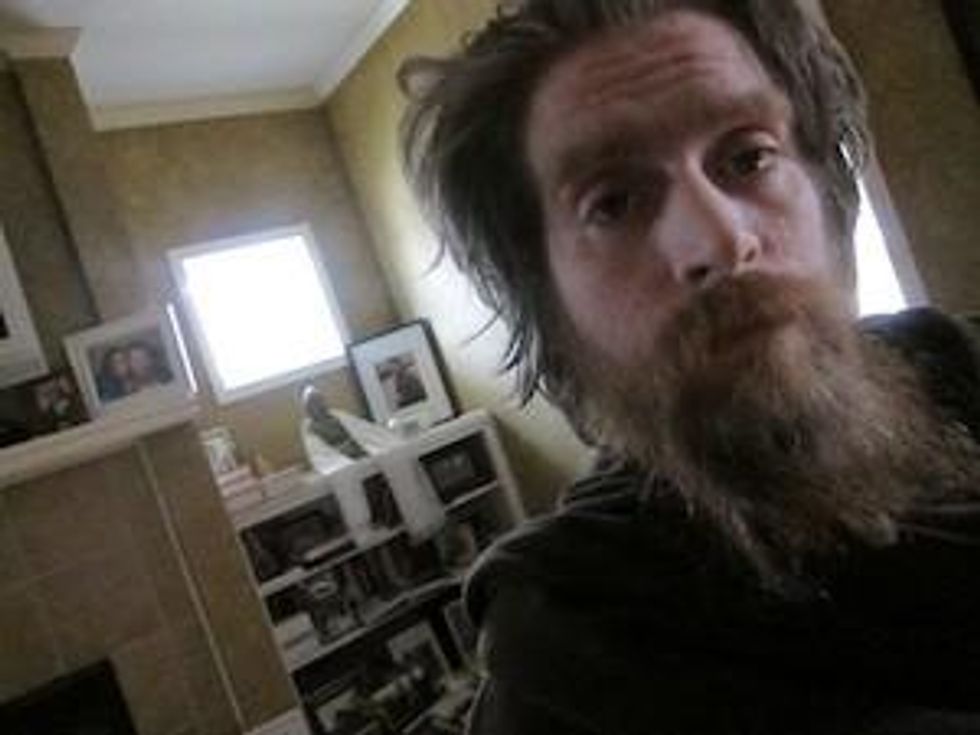
"I had been toying with the idea of suicide for a long time because I had become helpless," he told me in his small house on the Kansas City outskirts where he intends to die. "I couldn't dress myself. People have to help me with the most rudimentary of things. I decided I did not want to go through life like that anymore. The pain, the frustration. ..."
He stopped abruptly and called his wife. "Claudia, can I get some water?" She opened a bottle of water, took a swig so it would not spill when he sipped and handed it to him.
"I felt at the end of my rope," the 33-year-old Army veteran went on. "I made the decision to go on hospice care, to stop feeding and fade away. This way, instead of committing the conventional suicide and I am out of the picture, people have a way to stop by or call and say their goodbyes. I felt this was a fairer way to treat people than to just go out with a note. After the anoxic brain injury in 2008 [a complication that Young suffered] I lost a lot of dexterity and strength in my upper body. So I wouldn't be able to shoot myself or even open the pill bottle to give myself an overdose. The only way I could think of doing it was to have Claudia open the pill bottle for me, but I didn't want her implicated."
"After you made that decision how did you feel?" I asked.
"I felt relieved," he answered. "I finally saw an end to this four-and-a-half-year fight. If I were in the same condition I was in during the filming of 'Body of War,' in a manual chair, able to feed and dress myself and transfer from my bed to the wheelchair, you and I would not be having this discussion. I can't even watch the movie anymore because it makes me sad to see how I was, compared to how I am. ... Viewing the deterioration, I decided it was best to go out now rather than regress more."
Young will die for our sins. He will die for a war that should never have been fought. He will die for the lies of politicians. He will die for war profiteers. He will die for the careers of generals. He will die for a cheerleader press. He will die for a complacent public that made war possible. He bore all this upon his body. He was crucified. And there are hundreds of thousands of other crucified bodies like his in Baghdad and Kandahar and Peshawar and Walter Reed medical center. Mangled bodies and corpses, broken dreams, unending grief, betrayal, corporate profit, these are the true products of war. Tomas Young is the face of war they do not want you to see.
Young will die for our sins. He will die for a war that should never have been fought. He will die for the lies of politicians. He will die for war profiteers. He will die for the careers of generals. He will die for a cheerleader press. He will die for a complacent public that made war possible. He bore all this upon his body. He was crucified.
On April 4, 2004, Young was crammed into the back of a two-and-a-half-ton Army truck with 20 other soldiers in Sadr City, Iraq. Insurgents opened fire on the truck from above. "It was like shooting ducks in a barrel," he said. A bullet from an AK-47 severed his spinal column. A second bullet shattered his knee. At first he did not know he had been shot. He felt woozy. He tried to pick up his M16. He couldn't lift his rifle from the truck bed. That was when he knew something was terribly wrong.
"I tried to say 'I'm going to be paralyzed, someone shoot me right now,' but there was only a hoarse whisper that came out because my lungs had collapsed," he said. "I knew the damage. I wanted to be taken out of my misery."
His squad leader, Staff Sgt. Robert Miltenberger, bent over and told him he would be all right. A few years later Young would see a clip of Miltenberger weeping as he recounted the story of how he had lied to Young.
"I tried to contact him," said Young, whose long red hair and flowing beard make him look like a biblical prophet. "I can't find him. I want to tell him it is OK."
Young had been in Iraq five days. It was his first deployment. After being wounded he was sent to an Army hospital in Kuwait, and although his legs, now useless, lay straight in front of him he felt as if he was still sitting cross-legged on the floor of the truck. That sensation lasted for about three weeks. It was an odd and painful initiation into his life as a paraplegic. His body, from then on, would play tricks on him.
He was transferred from Kuwait to the U.S. military hospital at Landstuhl, Germany, and then to Walter Reed, in Washington, D.C. He asked if he could meet Ralph Nader, and Nader visited him in the hospital with Phil Donahue. Donahue, who had been fired by MSNBC a year earlier for speaking out against the war, would go on, with Ellen Spiro, to make the 2007 film "Body of War," a brutally honest account of Young's daily struggle with his physical and emotional scars of war. In the documentary, he suffers dizzy spells that force him to lower his head into his hands. He wears frozen gel inserts in a cooling jacket because he cannot control his body temperature. He struggles to find a solution to his erectile dysfunction. He downs fistfuls of medications--carbamazepine, for nerve pain; coumadin, a blood thinner; tizanidine, an anti-spasm medication; gabapentin, another nerve pain medication, bupropion, an antidepressant; omeprazole, for morning nausea; and morphine. His mother has to insert a catheter into his penis. He joins Cindy Sheehan at Camp Casey in Crawford, Texas, to protest with Iraq Veterans Against the War. His first wife leaves him.
"You know, you see a guy who's paralyzed and in a wheelchair and you think he's just in a wheelchair," he says in "Body of War." "You don't think about the, you know, the stuff inside that's paralyzed. I can't cough because my stomach muscles are paralyzed, so I can't work up the full coughing energy. I'm more susceptible to urinary tract infections, and there's a great big erection sidebar to this whole story."
In early March 2008 a blood clot in his right arm--the arm that bears a color tattoo of a character from Maurice Sendak's "Where the Wild Things Are"--caused his arm to swell. He was taken to the Kansas City Veterans Affairs hospital, where he was given the blood thinner coumadin before being released. One month later, the VA took him off coumadin and soon afterward the clot migrated to one of his lungs. He suffered a massive pulmonary embolism and fell into a coma. When he awoke from the coma in the hospital he could barely speak. He had lost most of his upper-body mobility and short-term memory, and his speech was slurred significantly.
It was then that he began to experience debilitating pain in his abdomen. The hospital would not give him narcotics because such drugs slow digestion, making it harder for the bowels to function. Young could digest only soup and Jell-O. In November, in a desperate bid to halt the pain, he had his colon removed. He was fitted with a colostomy bag. The pain disappeared for a few days and then came roaring back. He could not hold down food, even pureed food, because his stomach opening had shrunk. The doctors dilated his stomach. He could eat only soup and oatmeal. Three weeks ago he had his stomach stretched again. And that was enough.
"I will go off the feeding [tube] after me and my wife's anniversary," April 20, the date on which he married Claudia in 2012. "I was married once before. It didn't end well. It was a non-amicable divorce. At first I thought I would [just] wait for my brother and his wife, my niece and my grandparents to visit me, but the one thing I will miss most in my life is my wife. I want to spend a little more time with her. I want to spend a full year with someone without the problems that plagued my previous [marriage]. I don't know how long it will take when I stop eating. If it takes too long I may take steps to quicken my departure. I have saved a bottle of liquid morphine. I can down that at one time with all my sleeping medication."
Young's room is painted a midnight blue and has a large cutout of Batman on one wall. He loved the superhero as a child because "he was a regular person who had a horrible thing happen to him and wanted to save society."
Young joined the Army immediately after 9/11 to go to Afghanistan and hunt down the people behind the attacks. He did not oppose the Afghanistan war. "In fact, if I had been injured in Afghanistan, there would be no 'Body of War' movie to begin with," he said. But he never understood the call to invade Iraq. "When the Japanese attacked Pearl Harbor we didn't invade China just because they looked the same," he said.
He became increasingly depressed about his impending deployment to Iraq when he was in basic training at Fort Benning, Ga. He asked the battalion doctor for antidepressants. The doctor said he had to meet first with the unit's chaplain, who told him, "I think you will be happier when you get over to Iraq and start killing Iraqis."
"I was dumbstruck by his response," Young said.
He has not decided what will be done with his ashes. He flirted with the idea of having them plowed into ground where marijuana would be planted but then wondered if anyone would want to smoke the crop. He knows there will be no clergy at the memorial service held after his death. "It will just be people reminiscing over my life," he said.
"I spend a lot of time sitting here in my bedroom, watching TV or sleeping," he said. "I have found--I don't know if it is the result of my decision or not--[it is] equally hard to be alone or to be around people. This includes my wife. I am rarely happy. Maybe it is because when I am alone all I have with me are my thoughts, and my mind is a very hazardous place to go. When I am around people I feel as if I have to put on a facade of being the happy little soldier."
He listens, when he is well enough, to audiobooks with Claudia. Among them have been Al Franken's satirical book "Lies and the Lying Liars Who Tell Them" and Michael Moore's "The Official Fahrenheit 9/11 Reader." He was a voracious reader but can no longer turn the pages of a book. He finds some solace in the French film "The Intouchables," about a paraplegic and his caregiver, and "The Sessions," a film based on an essay by the paralyzed poet Mark O'Brien.
Young, when he was in a wheelchair, found that many people behaved as if he was mentally disabled, or not even there. When he was being fitted for a tuxedo for a friend's wedding the salesman turned to his mother and asked her in front of him whether he could wear the company's shoes.
"I look at the TV through the lens of his eyes and can see he is invisible," said Claudia, standing in the living room as her husband rested in the bedroom. An array of books on death, the afterlife and dying are spread out around her. "No one is sick [on television]. No one is disabled. No one faces death. Dying in America is a very lonely business."
"If I had known then what I know now," Young said, "I would not have gone into the military. But I was 22, working various menial jobs, waiting tables, [working] in the copy department of an OfficeMax. My life was going nowhere. Sept. 11 happened. I saw us being attacked. I wanted to respond. I signed up two days later. I wanted to be a combat journalist. I thought the military would help me out of my financial rut. I thought I could use the GI Bill to go to school."
Young is not the first young man to be lured into war by the false sirens of glory and honor and then callously discarded by the war makers. His story has been told many times. It is the story of Hector in "The Iliad." It is the story of Joe Bonham, the protagonist in Dalton Trumbo's 1939 novel "Johnny Got His Gun," whose arms, legs and face are blown away by an artillery shell, leaving him trapped in the inert remains of his body.
Bonham ruminates in the novel: "Inside me I'm screaming, nobody pays any attention. If I had arms, I could kill myself. If I had legs, I could run away. If I had a voice, I could talk and be some kind of company for myself. I could yell for help, but nobody would help me."
For Young, the war, the wound, the paralysis, the wheelchair, the anti-war demonstrations, the wife who left him and the one who didn't, the embolism, the loss of motor control, the slurred speech, the colostomy, the IV line for narcotics implanted in his chest, the open bed sores that expose his bones, the despair--the crushing despair--the decision to die, have come down to a girl. Aleksus, his only niece. She will not remember her uncle. But he lies in his dimly lit room, painkillers flowing into his broken body, and he thinks of her. He does not know exactly when he will die. But it must be before her second birthday, in June. He will not mar that day with his death.
And though he is an atheist, though he believes that there is nothing after death--that, as he says, "the body is like a toy that runs out of batteries, only there are no replacements"--his final act honors the promise of Aleksus' life. As he spoke to me softly of this child--it hurts, even now, he said, to know she will grow up without him--I wondered, sitting next to him on his bed, if he saw it, the glory of it, his final bow not before the specter of his death but the sanctity of her life. The resurrection.
Boston police have been caught red-handed spying on citizens engaged in lawful, protest activities. Documents and surveillance videos show local law enforcement routinely monitoring demonstrations and "internal dynamics" of activists groups, even if there is no indication of criminal activity.
The ACLU cites a specific report detailing an anti-war rally at a congregational church featuring the late Boston University Professor Howard Zinn, former city councilor Felix D. Arroyo and war activist Cindy Sheehan. The document was categorized under the label: "Criminal Act: Groups-Extremist."
According to a press release from the ACLU:
The documents reveal that officers assigned to the Boston Police Department's regional domestic spying center, the Boston Regional Intelligence Center (BRIC), file so-called "intelligence reports" mischaracterizing peaceful groups such as Veterans for Peace, United for Justice with Peace and CodePink as "extremists," and peaceful protests as domestic "homeland security" threats and civil disturbances.
"The collection of information by BPD contributes to Homeland Security fusion centers storing of details on constitutionally-protected activities being engaged in by citizens", writes Kevin Gosztola for Firedoglake. The officers are said to monitor activities such as "protestors plans to 'pass out fliers promoting their cause,'" and document communication "between officers from BRIC and the Metro DC Intelligence Section during which the officials discuss how many activists from the Northeast attended a Washington, DC peace rally."
"Spying on church groups and peaceful, non-violent, political gatherings violates civil liberties, wastes scarce police resources and doesn't keep us safe," said Carol Rose, Executive Director of the ACLU of Massachusetts.
After the BPD initially refused public requests to see their surveillance files, the documents were turned over the to ACLU and National Lawyer's Guild (NLG) when the organizations sued for access on behalf of local peace groups and activists. The files had been retained for years, violating federal regulations that reports must be purged in 90 days if they are not connected with criminal or terrorist activity.
"We are becoming a country with characteristics typically seen in the most undemocratic states--where police and other law enforcement forces assume unlimited powers over the people," said Urszula Masny-Latos, Executive Director of the National Lawyers Guild.
This comes on the heels of a recent Senate subcommittee report that found regional fusion centers had not "produced useful intelligence to support federal counterterrorism efforts" and, instead, amassed documentation described as "oftentimes shoddy, rarely timely, sometimes endangering citizens' civil liberties and Privacy Act protections."
Along with their report, the ACLU released a video in which they feature individuals who were either targeted or are part of groups that appeared in the "intelligence reports." They discuss the threatening nature of this surveillance and the growing reluctance and fear against taking part in lawful, first amendment protest.