

SUBSCRIBE TO OUR FREE NEWSLETTER
Daily news & progressive opinion—funded by the people, not the corporations—delivered straight to your inbox.
5
#000000
#FFFFFF
To donate by check, phone, or other method, see our More Ways to Give page.
Based on billions of weather readings from satellites, ships, aircraft, and weather stations, the report found that, for the first time in recorded history, global temperatures over a three-year period have exceeded the critical threshold of 1.5°C above preindustrial levels.
At current rates of heating, the report found, the Earth could surpass the Paris Climate Accord’s target of 1.5°C on a long-term basis by 2030, more than a decade sooner than scientists' projection when nations negotiated the pledge to reduce emissions back in 2015.
“Atmospheric data from 2025 paints a clear picture: Human activity remains the dominant driver of the exceptional temperatures we are observing,” said Laurence Rouil, the director of Copernicus’ Atmosphere Monitoring Service. “Atmospheric greenhouse gases have steadily increased over the last 10 years.”
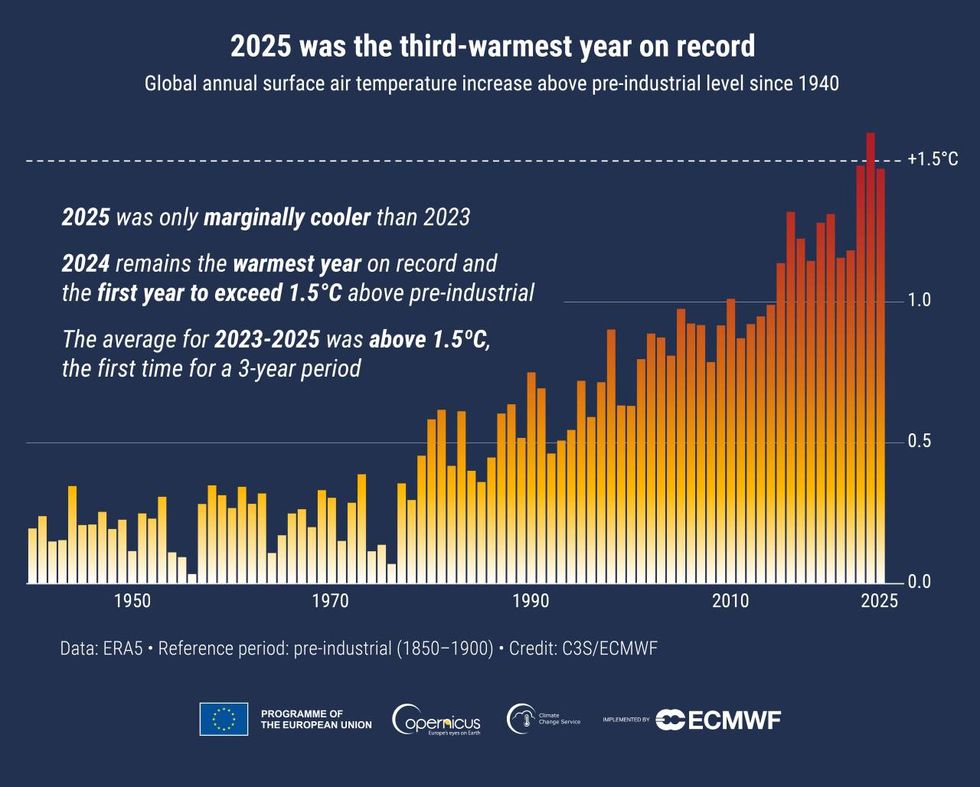 (Graphic from the Copernicus Climate Change Service)
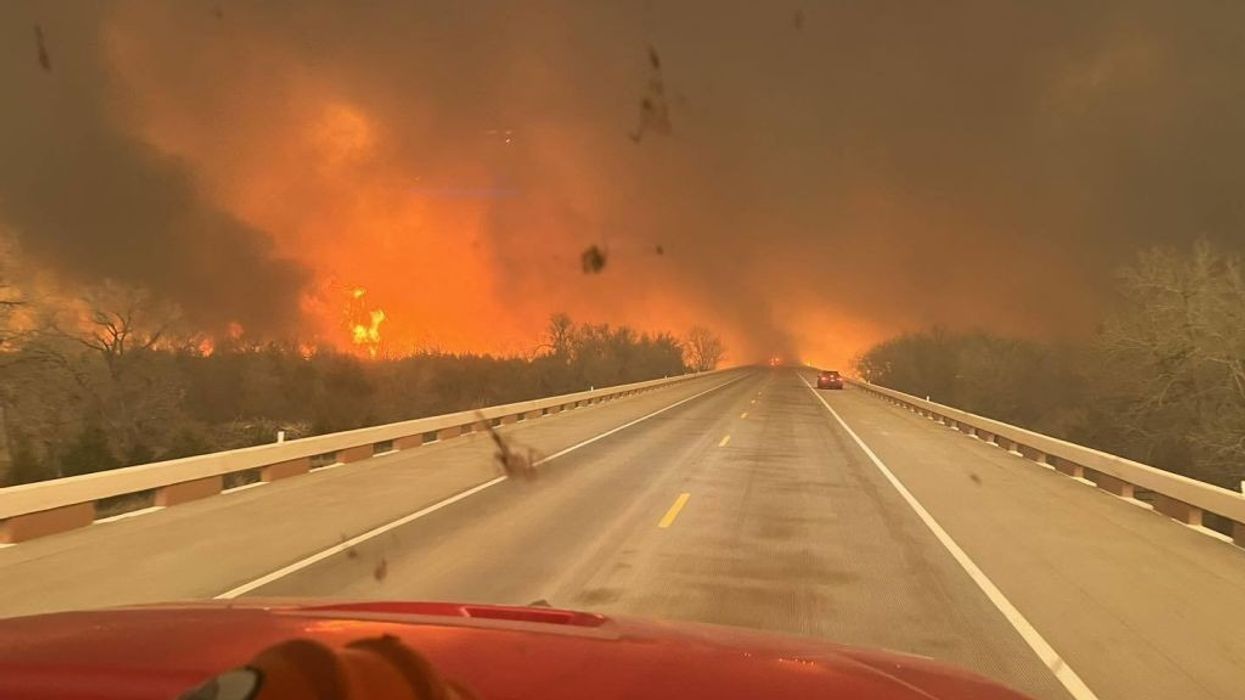
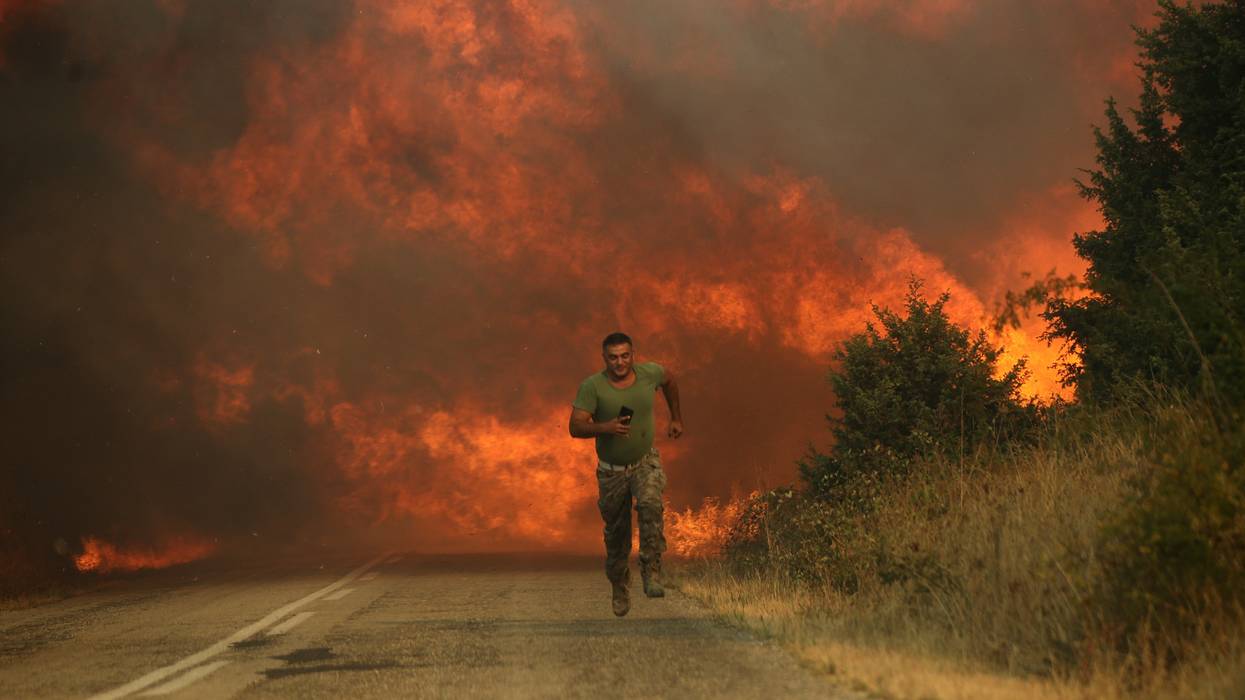
As with previous years, 2025 was marked by a series of disasters fueled by rising temperatures: From a historic heatwaves that killed an estimated 24,000 people in Europe, to typhoons across Asia that displaced millions, to the wildfires that ravaged the Los Angeles area roughly a year ago and were one of a record 23 disasters in the US that exceeded more than a billion dollars in damage.
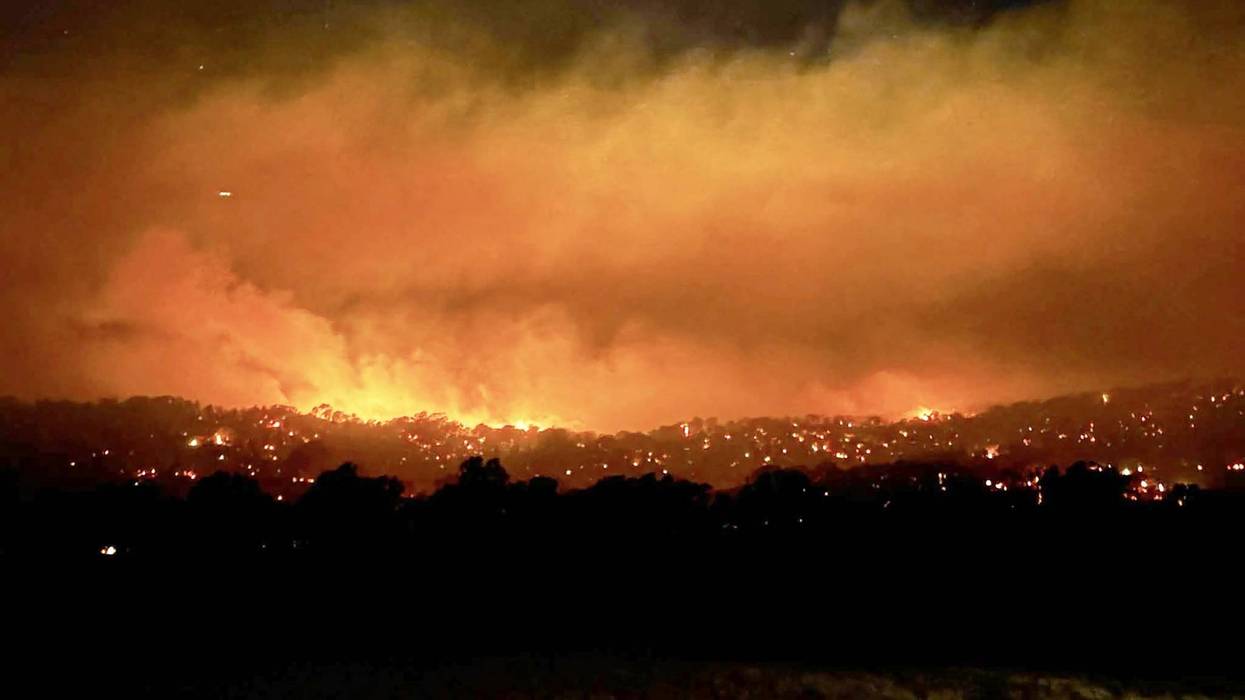
The Copernicus report was released as Australia suffered what DW News called possibly its "first megafire of the climate change age" in Victoria, which had charred over 350,000 hectares (more than 864,000 acres) of land as of Sunday and forced thousands to flee their homes.
(Video: Sky News Australia)
"Extreme weather isn’t rare anymore—it’s driving up food prices, insurance premiums, water shortages, and upending daily life across the globe," said Savio Carvalho, the managing director for campaigns and networks for the climate activist group 350. "Governments know fossil fuels are the cause of climate breakdown, yet they keep stalling on the transition. We don’t have the luxury of wasting time or taking side paths—we are running out of time."
The past year was marked by yet more disappointment for those hoping to see collective global action to reduce carbon emissions.
The most glaring setbacks occurred in the United States—the globe's largest historic polluter—where President Donald Trump has virtually halted renewable energy expansion, pushed to crank up fossil fuel extraction, and sought to end the "endangerment finding" that allows carbon emissions to be regulated on the basis of their harm to the climate.
But even in the absence of Trump, the past year's global climate summit in Brazil, COP30, once again fell well short of a cohesive international action plan, ending with no global agreement to wind down the use of oil, gas, and coal. Eighty nations failed to submit global emissions pledges, and many of those that did failed to make commitments that would likely bend the global temperature curve in a favorable direction.
Where scientists once urged nations to take swift action in the hope of passing the 1.5°C tipping point, Carlo Buontempo, the director of Copernicus, said following Wednesday's report that "we are bound to pass it."
He said, "The choice we now have is how to best manage the inevitable overshoot and its consequences on societies and natural systems."
But an overshoot is intolerable to many on the front lines of the crisis.
"In the Pacific, climate disasters are costing us billions of dollars in recovery and rebuilding," said Fenton Lutunatabua, 350's program manager for the Pacific and Caribbean. "A world beyond 1.5°C would devastate our resources even more."
"Entire villages in Fiji are being uprooted and relocated, losing connection to traditional lands and fishing grounds," he added. "Atoll nations like Tuvalu and the Marshall Islands are grappling with both adaptation and addressing the reality of potential forced migration. To give up on 1.5°C is to say that any of these realities is acceptable."
In Indonesia, where unprecedented flash floods in November killed 1,100 people, Suriadi Darmoko, an activist in Bali who is suing his government following an International Court of Justice ruling allowing states to be held legally accountable over climate harms, agreed that complacency is not an option.
“Entire communities are still buried in mud. Thousands of families are still grieving and struggling to have their basic needs met. We refuse to be treated as mere climate disaster victims," he said. "Our leaders have kept the world hooked on fossil fuels even as they knew decades ago it would lead to such tragedies."
Carvalho, too, rejected the notion that extreme warming is something the Earth must accept. Despite setbacks to collective action, 2025 also saw certain actors on the global stage make great strides toward a renewable future.
In large part due to massive investments by China, renewable sources generated more power worldwide than coal for the first time, and solar energy generation grew by 31% in the first half of the year, outpacing demand growth.
"We need to do what’s right now: a global phase out of fossil fuels is urgent," said Carvalho. "We already have the renewable energy solutions we need—what’s missing is the political will. We can prevent the worst if we act now."


"NASA and NOAA's global temperature report confirms what billions of people around the world experienced last year; we are facing a climate crisis," declared Bill Nelson, NASA's administrator. "From extreme heat, to wildfires, to rising sea levels, we can see our Earth is changing."
"It's driven primarily by our fossil fuel emissions, and we're seeing the impacts in heatwaves, intense rainfall, and coastal flooding."
NASA, whose records date back to 1880, found that Earth's average surface temperature last year was about 1.2°C above the average for the agency's baseline period, which is 1951-1980, and 1.4°C above the late 19th-century average.
"Every month from June through December 2023 came in as the hottest month on record. July ranked as the hottest month ever recorded," NASA noted in an article explaining last year's record heat, which addresses greenhouse gases, the El Niño Southern Oscillation (ENSO), warming oceans, decreasing aerosols, and an undersea volcanic eruption.
"The exceptional warming that we're experiencing is not something we've seen before in human history," emphasized Gavin Schmidt, director of NASA's Goddard Institute for Space Studies. "It's driven primarily by our fossil fuel emissions, and we're seeing the impacts in heatwaves, intense rainfall, and coastal flooding."
NOAA, which has a climate record back to 1850, similarly found that the average land and ocean surface temperature last year was 1.18°C above the 20th century and 1.35°C above the preindustrial average, or 1850-1900. Sarah Kapnick, the agency's chief scientist, said that "after seeing the 2023 climate analysis, I have to pause and say that the findings are astounding."
"Not only was 2023 the warmest year in NOAA's 174-year climate record—it was the warmest by far," she highlighted. "A warming planet means we need to be prepared for the impacts of climate change that are happening here and now, like extreme weather events that become both more frequent and severe."
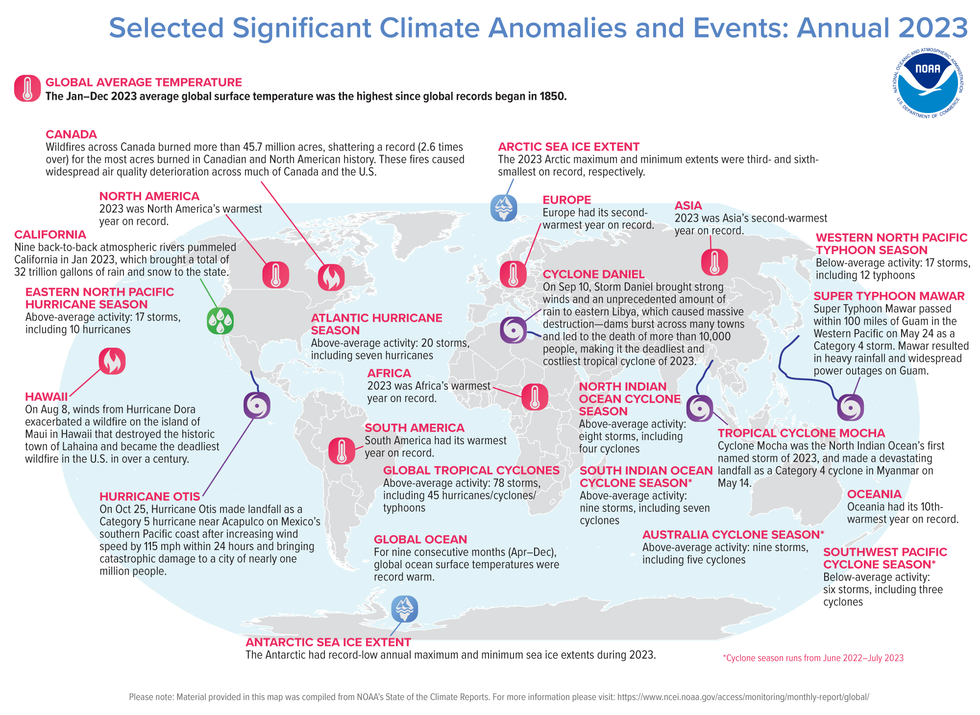
Both agencies found that the 10 hottest years in their records have all been in the past decade. NOAA pointed out that there is a one-in-three chance that this year will be even warmer than 2023, and a 99% chance that 2024 will be among the five hottest years.
"We will continue to see records broken and extreme events grow until emissions go to zero," Kapnick warned. "Government policy can address both emissions, but also actions to reduce climate impacts by building resilience."
NASA and NOAA's findings are in line with not only scientists' predictions amid extreme conditions last year but also data released Tuesday by the European Union's Copernicus Climate Change Service and Friday by the United Kingdom's Met Office—which has records back to 1850 and found that the global average temperature for 2023 was 1.46°C above the preindustrial baseline.
"It is striking that the temperature record for 2023 has broken the previous record set in 2016 by so much because the main effect of the current El Niño will come in 2024," said Adam Scaife, a principal fellow at the U.K. agency. "Consistent with this, the Met Office's 2024 temperature forecast shows this year has strong potential to be another record-breaking year."
El Niño and La Niña are the warm and cool phases of the climate phenomenon ENSO in the Pacific Ocean. As Common Dreams reported Thursday, a study published in Advances in Atmospheric Sciences found that 2023 was the hottest year on record for the world's oceans, which capture an estimated 91% of excess heat from greenhouse gases.
Government scientists were not the only ones who responded with alarm to the new climate data this week. Kristina Dahl, a principal climate scientist at the Union of Concerned Scientists, said Friday, "The latest data confirms heartbreaking and unprecedented scientific truths: The last decade has been the hottest in human history while heat-trapping emissions are continuing to rise."
"During this consequential decade, nations across the globe must swiftly reduce their heat-trapping emissions and enact widespread climate adaptation policies to limit the devastating climate harms and the toll they take on humans and ecosystems," she stressed, noting the "unrelenting onslaught of climate impacts" communities have already ensured. "Continuing to make only incremental policy changes will further jeopardize the safety of people around the world, especially those on the frontlines of the climate crisis."
Dahl argued that "as the largest historical emitter of global carbon emissions and the wealthiest nation, the United States has a moral imperative to lead on aggressive climate action. The science is clear: Transformative and comprehensive climate action, including a rapid transition away from fossil fuels and investments in resilience, are essential to ensure a livable future for generations to come."
"It's time for U.S. policymakers to place the needs of people over ill-gotten corporate profits by resisting and rejecting the potent allure of greenwashing narratives and false solutions that the fossil fuel industry has long pushed upon elected officials."
"Fortunately, the United States already has proven technologies to do this, including energy efficiency, renewable energy, and energy storage, at its fingertips," she added. "It's time for U.S. policymakers to place the needs of people over ill-gotten corporate profits by resisting and rejecting the potent allure of greenwashing narratives and false solutions that the fossil fuel industry has long pushed upon elected officials."
While making historic progress on climate during his first term, U.S. President Joe Biden has also faced criticism from scientists and campaigners for backing some false solutions, enabling more fossil fuel projects, and skipping COP28, the United Nations climate summit held late last year.
Global scientists called COP28—which was led by an oil CEO in the United Arab Emirates—a "tragedy for the planet" because its final agreement did not endorse a phaseout of fossil fuels, and have already expressed concerns about COP29, given host country Azerbaijan's recent announcement that the upcoming conference will also be overseen by an oil executive.
The Japan Meteorological Agency (JMA) said in a statement that the average temperature in the month of September in that country was nearly 5° F higher than the September averages recorded 1991-2020. To be exact, the average was 2.66°C or 4.78° F higher.
Remember that this is an average, including mountains and valleys up and down the islands and including both daytime and nighttime. Such a large departure from the previous averages for the month is astonishing for scientists. You don’t expect basic facts like the weather in Japan in September suddenly to deviate by such a large number. Kyodo reports that a JMA spokesperson said, “We can’t believe just how high temperatures got. It became a record-breaking phenomenon after multiple factors overlapped on top of climate change.” The person meant that climate change underlay the spike in temperatures, but that other factors supercharged the heat, including a high pressure system to Japan’s south and the beginning of an El Nino year in the Pacific.
The JMA had already observed of this summer, “the average temperature for the Sea of Japan side of eastern and western Japan in early August was . . . the highest ever. From July 16 to August 23, 106 of 915 observation stations in Japan saw record-high maximum temperatures. The national average surface temperature over summer was the highest since records began in 1898.”
Likewise in Europe, records keep falling. Meteo-France reports that September 2023 is the hottest September ever measured in mainland France since 1900, with an average temperature substantially higher than normal. In the middle of the country, the average temperature was 21.1 °C to 21.5°C [about 70°- 70.7° F], which puts it in the category of hottest since 1900, ahead of 1949 and 1961, which had also been unusually hot. It was between 6.3° F and about 6.5° F higher than the averages in 1991-2020. In some parts of France it was fully 7.2° F higher than the previous averages.
Meteo-France’s chart shows just how big a jump we saw:
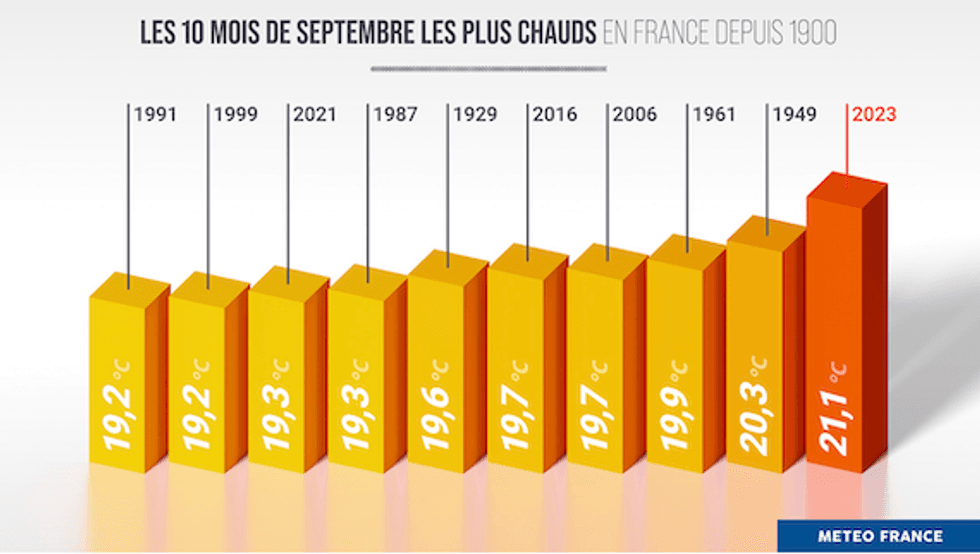
France 24 points out that “Average temperatures in France have been exceeding monthly norms consistently for almost two years.” A two-year-old toddler in Paris has never experienced a month that wasn’t hotter than the late 20th century averages. A whole new generation is coming, not Gen Z but Gen HOT.
Germany’s Deutscher Wetterdienst reported September to be full of “enormous anomalies” because of a persistent high pressure system, producing a string of unrelievedly sunny days and a lack of rainfall. Summer just rolled on relentlessly, refusing to give way to autumn, as the average temperature through September rose to be 4°C [7.2° F] too hot. The average temperature for the month was about 63° F. According to its website, “The extraordinary temperatures in this year’s record September in Germany are further proof that we are in the middle of climate change,” says Tobias Fuchs, Head of the Climate and Environment Division at the DWD.”
In the north German lowlands you had a remarkably high number of hot days with highs of 86° F.
Even cooler England, where the weather was merely in the pleasant 60s F., was nevertheless hotter than it had ever been recorded to be for this month. Back when I was a graduate student in the 1980s I went to Britain in September. and it was cool. I was coming from Los Angeles, so I noticed. I remember thinking the beginning of October was like winter. In 1971-2000 the mean temperature for September in the UK was 13.6°C [56.5° F.].
For September of this year, the UK Met Office says, “England and Wales had their respective warmest September on record according to mean temperature. England’s provisional figure of 16.7°C [62° F] topped the previous record of 16.5°C set in 2006. Wales’ 15.6°C also beat its 2006 figure of 15.2°C.” And the averages don’t tell the whole story. Heathrow Airport recorded a high of 32.7 °C (90.9 °F) on September 9, the hottest day of the year so far.
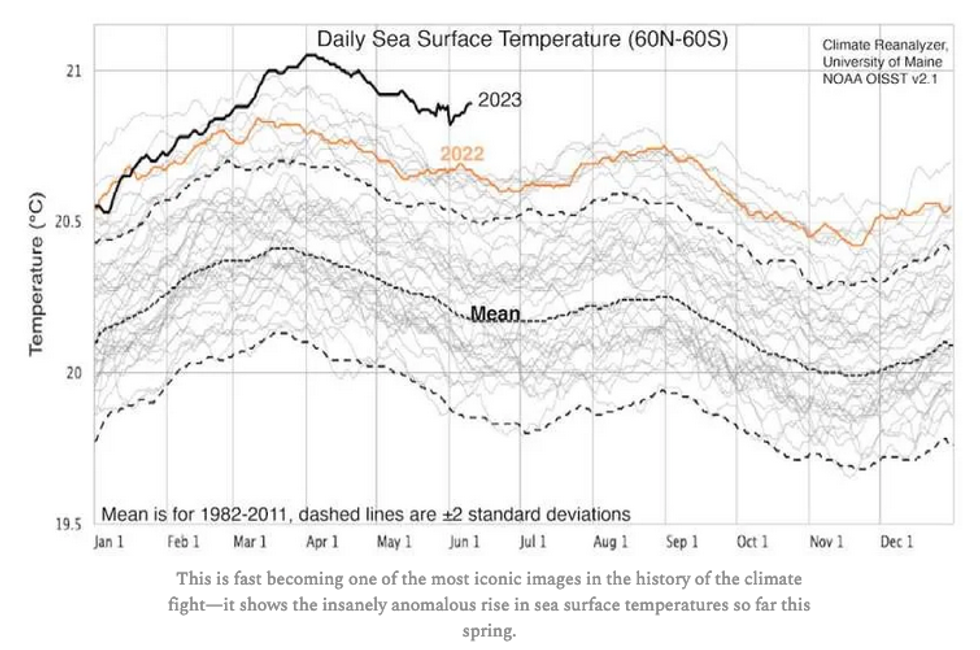
Scott Dance at WaPo reports that the average global temperature for September broke previous records by fully half a degree Celsius, which is unprecedented during the over a century we’ve been recording global temperatures scientifically. You basically had a second July instead of a September.
He quotes climate scientist Zeke Hausfather as calling the September temperature spike “absolutely gobsmackingly bananas.”

For instance:
Taken together—and I could go on listing examples of this backlash for many paragraphs—these instances make clear that Big Oil, on the sugar high from the record profits that their pal Vladimir Putin produced for them in the last year, has no intention of shifting their business model. They are going to burn baby burn—they have stopped taking whatever meds they felt they had to swallow in the years between the Paris and Glasgow climate conference. At best, they mumble about ‘abatement,’ which in practice means things like the carbon dioxide injection wells proposed for Louisiana, and opposed by groups like Deep South Center for Environmental Justice. (Environmental justice organizations last week provided a powerful statement on the national wave of plans for carbon sequestration). All of this is absurd window-dressing, and it’s designed to keep the shareholders from having to deal with the fact that we now possess the ability to make clean energy from the sun and wind, and to do it more cheaply than burning hydrocarbons.
I think the chaos that this rapid rise in temperature is sure to unleash may be the last slap across the face we get while there’s still time to really make a difference in how hot the planet gets.
UN Secretary General Antonio Guterres—alongside Greta Thunberg the loudest climate voice on the planet—gave a truly signal speech today, in which he got to the heart of the matter:
“Fossil fuel industry transition plans must be transformation plans, that chart a company’s move to clean energy – and away from a product incompatible withhuman survival. Otherwise, they are just proposals to become more efficient planet-wreckers.”
Guterres is paying close attention to the political debates in the U.S. (Imagine if we had, say, a president willing to speak this clearly):
Fossil fuel companies must also cease and desist influence peddling and legal threats designed to knee-cap progress. I am thinking particularly of recent attempts to subvert net zero alliances, invoking anti-trust legislation.
And he called for an “Acceleration Agenda.”
We will get a chance to support that agenda in September, during so-called “Climate Week” in New York. A coalition of groups is tonight announcing plans for a massive march in Manhattan that week—it’s not too late to join in on the launch call. There’s real history here: the world’s first huge climate march was in 2014 in New York, when 400,000 people turned out, including the Secretary General of the UN. That helped pave the way for the Paris climate accords: as President Obama said shortly afterwards, “Our citizens keep marching. We cannot pretend we do not hear them. We have to answer the call.”
As I said earlier, I think the chaos that this rapid rise in temperature is sure to unleash may be the last slap across the face we get while there’s still time to really make a difference in how hot the planet gets. See you in New York in September.