SUBSCRIBE TO OUR FREE NEWSLETTER
Daily news & progressive opinion—funded by the people, not the corporations—delivered straight to your inbox.
5
#000000
#FFFFFF
To donate by check, phone, or other method, see our More Ways to Give page.
Daily news & progressive opinion—funded by the people, not the corporations—delivered straight to your inbox.
"Big Oil’s climate lies are the most consequential and harmful corporate deception campaign in history."
The US Supreme Court on Monday agreed to hear a case that could effectively crush efforts to hold the fossil fuel industry accountable for the climate crisis.
As reported by the New York Times, the court has agreed to hear arguments related to a petition filed by ExxonMobil and Canadian energy firm Suncor related to a 2018 lawsuit by the city of Boulder, Colorado that seeks financial damages from the companies for their role in causing global climate change.
The Times report noted that dozens of similar lawsuits have been filed by states and municipalities over the last decade, and they generally seek money from energy firms to help mitigate or repair damage done by extreme weather exacerbated by the climate crisis.
According to the Associated Press, attorneys for the energy companies are petitioning to have the case moved from state courts to federal courts that have in the past dismissed similar complaints.
“The use of state law to address global climate change represents a serious threat to one of our nation’s most critical sectors,” the attorneys claimed.
The Supreme Court's decision to hear the case comes months after the Colorado Supreme Court ruled that Boulder's lawsuit could initiate the discovery process and move toward a trial.
In an interview with the Colorado Sun, Boulder County Commissioner Ashley Stolzmann said that the city wasn't backing down from its efforts make the fossil fuel industry pay for the damage it's done.
"The oil companies have tried every avenue to delay our climate accountability case or move it to an out-of-state court system,” said Stolzmann. “As everyone continues to face rising costs that put budgets under pressure, we must hold oil companies accountable for the significant harm they’ve caused our communities."
Richard Wiles, president of the Center for Climate Integrity, said that the merits of the Boulder lawsuit are clear, regardless of the Supreme Court's intervention.
"Big Oil’s climate lies are the most consequential and harmful corporate deception campaign in history," Wiles said, "and the communities paying the price for that deception deserve to put these companies on trial. Exxon’s desperation to escape accountability does not change the evidence of their wrongdoing or the law that lower courts agree is on Boulder’s side."
Alyssa Johl, vice president of legal and general counsel at the Center for Climate Integrity, said the Supreme Court should simply affirm lower court rulings stating that "communities like Boulder have the right to seek accountability in their state courts when corporations have knowingly caused local harms."
"With Maine's lawsuit, the demands that Big Oil faces accountability for decades of climate lies are growing louder and more powerful," said Richard Wiles, president of the Center for Climate Integrity.
Maine on Tuesday joined a group of eight other U.S. states that have sued major oil and gas companies for deceiving the public about their products' role in the climate crisis.
Maine Attorney General Aaron Frey's office announced that he has filed a suit in state court against Exxon, Shell, Chevron, BP, Sunoco, and the American Petroleum Institute.
Frey's suit accuses the companies of knowing about the potentially catastrophic consequences of continued dependence on fossil fuels for decades, thanks to companies' internal research, but that the defendants undertook a disinformation campaign to discredit the scientific consensus on climate change, delay a transition to a green energy economy, and sow doubt in the public's mind about the impact of burning fossil fuels.
"The state seeks to hold the defendants accountable for failing to warn Mainers and concealing their knowledge about the devastating consequences of the increasing use of fossil fuels on Maine's people, economy, and environment. This conduct has resulted in enormous financial burdens, public health impacts, property damage, and other harms across Maine as a result of extreme weather, sea-level rise, and warmer temperatures," according to the release from Frey's office.
"For over half a century, these companies chose to fuel profits instead of following their science to prevent what are now likely irreversible, catastrophic climate effects," Frey said in a statement. "In so doing, they burdened the state and our citizens with the consequences of their greed and deception."
Frey's lawsuit asks the court to require the companies pay for both "past and future climate harms caused by the defendants" and ensure that the companies end their "ongoing deception" in the state. The state is demanding a jury trial and numerous forms of relief, including penalties and disgorgement of profits, according to the release.
Frey is the 11th attorney general (including the District of Columbia and Puerto Rico), to take such a legal move. More than 20 states, tribes, cities and counties have so far pursued similar climate deception lawsuits to date, according the Maine attorney general's office. Earlier this fall, California's attorney general filed a lawsuit against ExxonMobil, alleging that the company falsely touted chemical recycling as a solution to the plastics crisis.
A September report from Oil Change International and Zero Carbon Analytics found that the number of climate cases brought against fossil fuel corporations—many of which center on climate damages, misleading advertising about fossil fuels, or failure to reduce emissions in line with legal agreements—has been ticking upward since the 2015 Paris climate accords.
Richard Wiles, president of the Center for Climate Integrity, whose organization helps communities hold fossil fuel companies accountable, applauded the move.
" Big Oil companies have lied for decades about the catastrophic harm they knew their products would cause, and now Maine has joined a growing wave of communities across the U.S. that are demanding accountability," said Wiles. "These polluters continue to fuel the climate crisis and lie about it to protect their profits. It’s only right that Big Oil companies pay their fair share of the damage their deception has caused. With Maine's lawsuit, the demands that Big Oil faces accountability for decades of climate lies are growing louder and more powerful."
"Courts across the country keep rejecting Big Oil's attempts to escape justice for their climate deception," said one advocate.
Advocates celebrated Monday after a Boulder, Colorado judge rejected attempts by ExxonMobil and Suncor Energy subsidiaries to dismiss a landmark lawsuit that seeks damages for the harms the fossil fuel companies have inflicted on the climate and local communities.
The lawsuit, brought in 2018 by the city and county of Boulder, argues that mounting climate costs "should be shared by the Suncor and Exxon defendants because they knowingly and substantially contributed to the climate crisis by producing, promoting, and selling a substantial portion of the fossil fuels that are causing and exacerbating climate change, while concealing and misrepresenting the dangers associated with their intended use."
Colorado Public Radio noted Monday that the lawsuit "cites the 2010 Fourmile Canyon fire and 2013 floods as examples of climate disasters in Boulder County."
"The case was filed before the Marshall fire swept through the area in the winter of 2021, incinerating more than 1,000 homes and causing more than $2 billion in damage in what is now considered the most destructive wildfire in state history," the outlet observed.
The legal challenge seeks relief under a Colorado consumer protection law and other local statutes, accusing the corporations of public and private nuisance, trespass, unjust enrichment, and civil conspiracy.
In an 81-page decision, Boulder County District Court Judge Robert Gunning rejected the Exxon and Suncor subsidiaries' claim that the state court lacked jurisdiction and concluded that "the public nuisance, private nuisance, trespass, conspiracy, and unjust enrichment claims may proceed against ExxonMobil, Suncor Energy, and Suncor Sales."
Ashley Stolzmann, Boulder County's commissioner, said Monday that the decision "reaffirms our stance: We are suffering from the impacts and heavy costs of the climate crisis, right here, right now."
"Today, we take a meaningful step towards accountability and ensuring our voices and hardships are acknowledged," Stolzmann added.
"The people of Boulder are now one crucial step closer to having their day in court to hold Exxon and Suncor accountable for their climate lies and the massive damages they've caused."
Monday's ruling represents the latest blow Exxon and Suncor have suffered during the yearslong legal battle. Last year, the U.S. Supreme Court rejected the companies' attempt to move the case to federal court.
"Since the beginning, defendants have been arguing against a case we did not plead," said Sean Powers, a senior attorney with EarthRights International, which is representing the plaintiffs.
"Plaintiffs are not trying to litigate a solution to the climate crisis, they are seeking redress for harms they have suffered and will continue to suffer," Powers continued. "The only conduct at issue is defendants' own: what they knew, when they knew it, and what they did with that knowledge."
Boulder is among the dozens of local governments that have sued oil and gas companies in recent years, aiming to hold the industry accountable for severely damaging the climate and deceiving the public about the dangers of its extractive business model.
Exxon has known for decades about the link between burning fossil fuels and planetary warming and has worked to cast doubt on the science as it continues to drill in the face of worsening climate extremes across the globe.
"The people of Boulder are now one crucial step closer to having their day in court to hold Exxon and Suncor accountable for their climate lies and the massive damages they've caused," Richard Wiles, president of the Center for Climate Integrity, said Monday. "Courts across the country keep rejecting Big Oil's attempts to escape justice for their climate deception, and sooner or later these companies will have to explain the evidence of their misconduct to a jury."
"These oil companies knew their products were dangerous, yet they did nothing to mitigate those dangers or warn any of us about them, for decades," said the chairwoman of the Shoalwater Bay Indian Tribe.
Two Indigenous tribes in Washington state said Wednesday that they intend to force several oil giants "to help pay for the high costs of surviving the catastrophe caused by the climate crisis," as they filed lawsuits in the state's largest trial court.
The Makah Indian Tribe and Shoalwater Bay Indian Tribe filed two separate complaints in King County Superior Court against ExxonMobil, Shell, Chevron, BP, ConocoPhillips, and Phillips 66, saying the defendants must be held "accountable for their deceptive and unfair conduct, and pay for the damage their deceptive conduct has caused and will cause for decades to come."
The lawsuits—among dozens filed against Big Oil since 2017—detail the extent to which the companies have long known that their fossil fuel extraction would drive planetary heating and the resulting sea-level rise, extreme weather, public health crises, and other impacts of the climate crisis, which now costs the U.S. roughly $150 billion per year just in damages from hurricanes and other weather disasters.
"We are seeing the effects of the climate crisis on our people, our land, and our resources. The costs and consequences to us are overwhelming," said Timothy Greene Sr., chairman of the Makah Tribal Council. "We intend to hold these companies accountable for hiding the truth about climate change and the effects of burning fossil fuels."
"We are facing hundreds of millions of dollars in costs to relocate our community to higher ground and protect our people, our property, and our heritage. These companies need to be held accountable for that."
Newly uncovered documents revealed earlier this year that scientists at Shell warned executives of the climate impact of the company's products in the 1980s, and an analysis published in Science in January showed that 63-83% of the global warming projections documented by Exxon scientists between 1977 and 2003 were accurate.
"These oil companies knew their products were dangerous, yet they did nothing to mitigate those dangers or warn any of us about them, for decades," said Charlene Nelson, chairwoman of the Shoalwater Bay tribe. "Now we are facing hundreds of millions of dollars in costs to relocate our community to higher ground and protect our people, our property, and our heritage. These companies need to be held accountable for that."
The tribes said in their complaints that they are "particularly vulnerable" to rising sea levels because their reservations are adjacent to the Pacific Ocean, and they have already incurred "significant costs" as they try to mitigate its risk by preparing to build and move housing and government buildings to higher ground.
The tribes accused the companies of creating a "public nuisance" and violating Washington's Products Liability Act by misrepresenting and intentionally concealing the risks involved in their fossil fuel extraction activities. They asked the court for jury trials and requested that the court order the companies to fund "an abatement fund to be managed by the tribe[s] to remediate and adapt [their] Reservation lands, natural resources, and infrastructure."
"Our analysis shows that ExxonMobil's own data contradicted its public statements, which included exaggerating uncertainties, criticizing climate models, mythologizing global cooling, and feigning ignorance," said lead author Geoffrey Supran.
"This is the nail in the coffin of ExxonMobil's claims that it has been falsely accused of climate malfeasance."
That's what University of Miami associate professor Geoffrey Supran said about a peer-reviewed study on the fossil fuel giant's global warming projections published Thursday in the journal Science, which he began work on as a Harvard University research fellow.
"Our analysis shows that ExxonMobil's own data contradicted its public statements, which included exaggerating uncertainties, criticizing climate models, mythologizing global cooling, and feigning ignorance about when—or if—human-caused global warming would be measurable, all while staying silent on the threat of stranded fossil fuel assets," said Supran, the study's lead author.
Exxon—and the fossil fuel industry overall—has faced scrutiny from campaigners, journalists, lawmakers, and scientists for spending decades hugely profiting off of its planet-wrecking products while spreading climate misinformation.
The new study from Supran, Harvard professor Naomi Oreskes, and University of Potsdam professor Stefan Rahmstorf—who is also a researcher at the Potsdam Institute for Climate Impact Research—comes as policymakers worldwide continue to allow major corporations to cash in on fossil fuels, despite the increasingly devastating impacts of heating the planet.
Supran and Oreskes have previously published peer-reviewed research on the "discrepancy between what ExxonMobil's scientists and executives discussed about climate change privately and in academic circles, and what it presented to the general public," confirming the findings from 2015 reports by Inside Climate News and The Los Angeles Times.
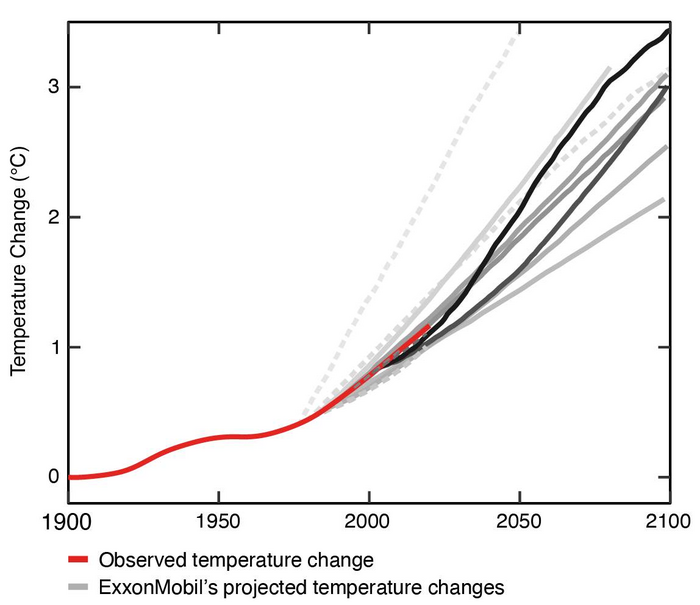
For their latest study, the pair and Rahmstorf analyzed all known global warming projections documented and modeled by Exxon scientists between 1977 and 2003. The researchers found that 63-83% of the company's projections were accurate.
"ExxonMobil's average projected warming was 0.20° ± 0.04°C per decade, which is, within uncertainty, the same as that of independent academic and government projections published between 1970 and 2007," the publication states.
The study includes the following graphic, which shows Exxon scientists' projections from internal documents and peer-reviewed publications for the review period in gray along with historically observed temperature change in red.
The company's science was "actually astonishing" in its precision and accuracy—but so was its "hypocrisy because so much of the ExxonMobil disinformation for so many years... was the claim that climate models weren't reliable," Oreskes told The Associated Press.
In a statement to AP and other media outlets, Exxon spokesperson Todd Spitler said that "this issue has come up several times in recent years and, in each case, our answer is the same: Those who talk about how 'Exxon Knew' are wrong in their conclusions."
"Some have sought to misrepresent facts and ExxonMobil's position on climate science, and its support for effective policy solutions, by recasting well-intended, internal policy debates as an attempted company disinformation campaign," he said. "ExxonMobil's understanding of climate science has developed along with that of the broader scientific community."
Meanwhile, climate advocates and experts echoed the points made by the study's authors.
"A fossil fuel company? Putting profits over people? We're shocked. This is shocking news," Earthjustice sardonically tweeted.
"In all seriousness, this is an outrage," the group added. "Exxon has had fairly accurate data on climate change for decades... and buried it. Instead, it has been fervently and publicly contradicting its own research to preserve its profit."
As The Guardian reported:Climate scientists said the new study highlighted an important chapter in the struggle to address the climate crisis. "It is very unfortunate that the company not only did not heed the implied risks from this information, but rather chose to endorse nonscientific ideas instead to delay action, likely in an effort to make more money," said Natalie Mahowald, a climate scientist at Cornell University.
Mahowald said the delays in action aided by Exxon had "profound implications" because earlier investments in wind and solar could have averted current and future climate disasters. "If we include impacts from air pollution and climate change, their actions likely impacted thousands to millions of people adversely," she added.
Drew Shindell, a climate scientist at Duke University, said the new study was a "detailed, robust analysis" and that Exxon's misleading public comments about the climate crisis were "especially brazen" given their scientists' involvement in work with outside researchers in assessing global heating. Shindell said it was hard to conclude that Exxon's scientists were any better at this than outside scientists, however.
"The harm caused by Exxon has been huge," University of Michigan professor Jonathan Overpeck told the AP. "They knew that fossil fuels, including oil and natural gas, would greatly alter the planet's climate in ways that would be costly in terms of lives, human suffering, and economic impacts. And yet, despite this understanding they choose to publicly downplay the problem of climate change and the dangers it poses to people and the planet."
Alyssa Johl, vice president of legal at the Center for Climate Integrity, said that "this quantitative assessment puts a fine point on the fact that Exxon knew with incredible precision that the burning of their fossil fuel products would result in temperature increases and severe climate harms in the 2000s and beyond."
"They pretty much nailed these predictions with incredible accuracy. That cannot be refuted at this point," Johl added, suggesting that the research could bolster climate liability lawsuits filed by dozens of U.S. states and municipalities against ExxonMobil and other fossil fuel companies for driving the global emergency.
"There are two very important pieces to the puzzle that need to be established and proven in these cases: the fact that oil and gas companies had longstanding knowledge of the causes and consequences of climate change, and that rather than disclose that information, they actively concealed and denied it," she said. "This analysis shows once again that Exxon knew."
As Fossil Free Media director Jamie Henn put it: "This is exactly like Big Tobacco companies knowing that cigarettes caused cancer but lying about it anyway. Exxon knew they were causing catastrophic damage and buried the truth. Time to make them pay."
Exxon posted a staggering $19.7 billion in profits in the third quarter of 2022 as consumers continued to face high energy costs.
Fresh off posting the highest quarterly profit in its history, the U.S.-based fossil fuel giant ExxonMobil sued the European Union on Wednesday in an attempt to stop the bloc from imposing its recently approved windfall tax targeting major oil and gas companies.
The Financial Times, which first reported the new lawsuit, noted that the challenge takes aim at the European Council's "legal authority to impose the new tax—a power historically reserved for sovereign countries—and its use of emergency powers to secure member states' approval for the measure."
"The new tax is due to take effect from December 31 and will apply a levy of at least 33% on any taxable profits in 2022-23 that are 20% or more above average profits between 2018 and 2021," the newspaper explained.
In a statement, Exxon spokesperson Casey Norton insisted the company recognizes that sky-high energy costs are "weighing heavily on families and businesses" but claimed the tax would "undermine investor confidence, discourage investment, and increase reliance on imported energy."
Reuters reported Wednesday that Exxon's chief financial officer has estimated the E.U.'s windfall tax could cost the corporation around $2 billion through the end of next year—a fraction of the company's 2022 profits.
Approved in late September amid a mounting cost-of-living crisis across Europe, the windfall tax was presented as an effort to generate additional revenue to "provide financial support to households and companies" struggling with high energy costs. Oil and gas companies like Exxon have been accused of exploiting global energy market chaos spurred by Russia's war on Ukraine to hike prices and pad their bottom lines.
In late October, Exxon announced it brought in $19.7 billion in profits from July to September, its largest-ever quarterly haul. The company also announced it would raise its dividend and expand its share buyback program, rewarding wealthy investors as consumers continue to face elevated prices at the pump.
According to a recent filing, Exxon has also been rewarding its top executives, boosting the annual salary of CEO Darren Woods from $1.70 million to $1.88 million for the coming year.
The chief economist at the global investment bank UBS, the world's largest wealth manager, argued in an op-ed for the Financial Times on Wednesday that inflation in the United States "is more a product of profits than wages" and criticized Federal Reserve Chair Jerome Powell for refusing to acknowledge that fact as he plows ahead with massive interest rate hikes.
"Powell's public remarks offer little insight into how he expects higher rates to tame inflation," Paul Donovan of UBS Global Wealth Management wrote just ahead of the Fed's latest interest rate increase of 75 basis points. "This is the current inflation story. Companies have passed higher costs on to customers. But they have also taken advantage of circumstances to expand profit margins. The broadening of inflation beyond commodity prices is more profit margin expansion than wage cost pressures."
"Even a major bank's chief economist now admits that corporations are price gouging under the guise of inflation."
"Despite negative real wages, consumers have carried on consuming," Donovan added. "Consumers seem to be buying stories that seem to justify price increases, but which really serve as cover for profit margin expansion... This unconventional inflation means higher unemployment and lower wages are not the only possible cure for it. Policy has more routes to lower inflation if the cause is about profits."
Thus far, though, the Powell-led Federal Reserve has primarily used interest rate increases in its as-yet unsuccessful effort to bring down inflation, even as critics warn that such an approach harms workers and risks a devastating recession without tackling the primary drivers of price increases.
At his Wednesday press conference, Powell once again conceded that rate hikes "don't directly affect for the most part food and energy prices," two major sources of inflation dictated by profit-seeking corporations such as Exxon, Chevron, and PepsiCo.
"We increased prices at the beginning of the fourth quarter based on what we knew at that point," Pepsi's chief financial officer said on the company's earnings call last month. "And going forward, with the investments that we've made in brands, I still think we're capable of taking whatever pricing we need."
During his public appearance Wednesday, Powell wasn't asked a single question about the role corporate profiteering has played in causing high inflation even as executives boast about their enormous pricing power.
Progressive advocates and economists who have been spotlighting corporate America's inflationary profiteering for months seized on Donovan's Financial Times op-ed as further evidence that their data-driven argument is gradually piercing the mainstream, even as Powell ignores it.
"Even a major bank's chief economist now admits that corporations are price gouging under the guise of inflation," the American Economic Liberties Project tweeted Thursday.
Christian Hallum, tax justice lead at Oxfam International, added that "skyrocketing profits are to blame for inflation, according to the chief economist at UBS Global Wealth Management."
"Maybe we should tax windfall profits instead of trying to create unemployment through interest rate hikes?" Hallum suggested.
Along with many others, I've spent the last four years urging JPMorgan Chase to stop providing financial services to the fossil fuel industry. It's been no easy task. Since the Paris Agreement was signed, Chase has loaned more than $317 billion to the fossil fuel industry--33% more than any other bank on the planet. Want to build a massive new tar sands pipeline? JPMorgan is your bank. What to build a vast new coal mine? Just give Chase CEO Jamie Dimon a call, he's your man.
In the climate fight, Lee Raymond is the ultimate Bond villain. As the CEO of ExxonMobil, he was the chief architect of a decades-long disinformation campaign to discredit climate science and brainwash Americans into questioning the reality of climate change.In years of campaigning against JPMorgan, activists have tried a lot of tactics--from filing shareholder resolutions to shutting down streets outside of their headquarters. But last year, the campaign took a new twist. For the first time, it got personal.
In the climate fight, Lee Raymond is the ultimate Bond villain. As the CEO of ExxonMobil, he was the chief architect of a decades-long disinformation campaign to discredit climate science and brainwash Americans into questioning the reality of climate change. For more than thirty years, he was also a lead figure on JPMorgan Chase's board.
Last year, a broad coalition of groups (many of whom are a part of the Stop the Money Pipeline coalition) launched a campaign to oust Lee Raymond from Chase's board. And they won. Just a few months after major investors joined with activists in calling for Raymond to get the boot, he was gone for good.
Now, an investor advocacy group, Majority Action, has released a list of 30 corporate directors who are obstacles to climate progress--directors who should be voted out of positions of power to make way for people who are more climate literate.
Not every one of those directors is a supervillain like Lee Raymond. Some of them are just everyday members of the 1%--the majority of them are wealthy, white men and all of them have a long track record of putting profits above all else.
The Chairman of Wells Fargo's board, Charles Noski, is a case in point. Noski hasn't spent a significant portion of his career consorting with climate deniers. Yet, under Noski's leadership, Wells Fargo has re-established itself as the world's largest funder of fracking, doubled down on backing Line 3, and loaned billions to coal, oil, and gas companies. That alone is reason enough that he should be removed as the head of Wells Fargo's board; he's already proven himself incapable of leading a major corporation in the time of climate crisis.
While recognizing Morgan Stanley's newly announced commitment to reach net-zero financed emissions by 2050 as a historic step forward, climate campaigners highlighted that it is still among the top 12 fossil fuel financing banks in the world and demanded details about how such a goal might actually be met as well as more ambitious action.
"We'd like to hear less about what banks are committed to achieving 30 years from now and more about what they're doing today to address the climate crisis unfolding all around us," Amy Gray, co-coordinator of the Stop the Money Pipeline coalition, said Monday is response to the news. "As long as Morgan Stanley invests in companies like Exxon, Chevron, and Shell, they're investing in disasters like wildfires, hurricanes, and floods."
The coalition--made up of climate, youth, and Indigenous groups--came together in January to launch a campaign urging banks, insurers, and asset managers cut ties with companies that are destroying the planet. Morgan Stanley, according a Rainforest Action Network (RAN) report on banking and the climate crisis published earlier this year, has poured nearly $92 billion into the fossil fuel industry since the Paris agreement was signed in 2015.
As a member of the coalition, 350.org North America director Tamara Toles O'Laughlin said Monday that "Morgan Stanley's announcement is a step in the right direction--for a decade ago. As a major in finance and securities and a driver of funds toward environmental devastation, we expected action beyond rhetoric. This is not it. As the West burns and storms line up in the Atlantic, today's actions are late and little."
" Climate change is one of the most complex and interconnected issues of our time," Morgan Stanley chief sustainability Audrey Choi said Monday. "Morgan Stanley believes we have an important role to play in facilitating the transition to a low-carbon future, and we are proud to embark on this journey."
Though lacking in detail, Morgan Stanley's net-zero announcement made it the first major American bank to make such a commitment. The reaction from climate advocates resembled earlier this year, when Morgan Stanley became the first major U.S. bank to join the Partnership for Carbon Accounting Financials (PCAF).
Paddy McCull of RAN welcomed the bank's latest move as well as its decision to measure and disclose its climate footprint with the PCAF methodology, but also said that "we look forward to Morgan Stanley quickly putting meat on this bare-bones commitment by using the Principles for Paris-Aligned Financial Institutions, and in particular by setting an interim target to halve its emissions by 2030."
The principles (pdf) were released last week by dozens of climate and human rights groups, including 350.org, Amazon Watch, RAN, and Sierra Club.
"Given the inadequacy of Morgan Stanley's current sustainability policies, a commitment to net zero will require a complete policy overall," said Amazon Watch's Moira Birss. "As just one example, Morgan Stanley's current policy specifically allows for controlled burning as a practice in agribusiness, despite the fact that controlled burning is the primary cause of the fires currently destroying the Amazon rainforest--one of the most important ecosystems for climate stability."
Reaching the bank's goals and respecting groups' principles requires "an immediate end to financing for fossil fuel expansion and deforestation, and a plan to phase out financing for fossil fuels overall, while respecting human rights," McCull explained.
"It also means making clear that Morgan Stanley does not intend to hit 'net zero' by using shady carbon accounting schemes like forest offsets or large-scale reliance on untested technologies like carbon capture and storage," he said. "The spotlight is now on Morgan Stanley's Wall Street peers, which have higher fossil fuel financing footprints, to make commitments that align with the Paris agreement and the need to keep climate change under 1.5degC."
Sierra Club senior campaign representative Ben Cushing concurred that "Morgan Stanley's commitment to achieve net-zero financed emissions by 2050 is an important step forward that sets a new bar for other major U.S. banks to follow, but also needs to be followed up with critical next steps for actually getting there."
Urging other banks to follow suit, Lila Holzman of As You Sow declared, "Morgan Stanley's actions show that committing to net zero is good business."
Author and climate activist Bill McKibben welcomed Friday evening what he called "a milestone moment in the history of climate action" after JPMorgan Chase announced it was ousting former Exxon Mobil CEO Lee Raymond from his longtime leadership position on the bank's board of directors.
"A truly huge win today," McKibben said in an earlier tweet. "Power is starting to shift."
The change was revealed in new SEC filing documents in which JPMorgan touts its "focus on refreshment" that includes having a new lead independent director by the end of this summer.
Raymond, who's earned the monikers "the Darth Vader of global warming wars" and "America's #1 climate denier," was a target of the Stop the Money Pipeline climate coalition, which urged the bank's biggest shareholders to vote Raymond off the board entirely when they meet later this month.
Their demand was buoyed by New York City Comptroller Scott M. Stringer.
"On Earth Day last week, we launched a campaign urging JPMorgan Chase & Co shareholders to vote against the re-election of Lee Raymond to the board, based on his role as lead 'independent' director, long tenure on the board, and ties to fossil fuels," Stringer said in a statement Friday.
Raymond's removal as independent leader of the board marks "a tremendous victory for shareholders and for the planet," Stringer said, adding that it stands to "ensure improved oversight of the board and the company's long-term strategy when it comes to transitioning to a low carbon economy."
"But our work does not stop here," he continued. "JPMorgan has been the largest global lender and underwriter to the fossil fuel sector, providing $269 billion in financing to fossil fuel expansion from 2016 to 2019. The company needs to move away from financing the dirty fossil fuels of the past and toward the big, strategic clean energy investments of the future. There must be no place for a climate change denier and former Exxon CEO on JPMorgan's board."
Eli Kasargod-Staub, executive director of shareholder advocacy organization Majority Action, concurred.
"Shareholders have demanded that JPMorgan Chase be held accountable for its failure to address the systemic risks presented by climate change, and the announcement to remove Raymond from the lead independent director position is a clear victory for long-term shareholder value and the mitigation of climate risk," said Kasargod-Staub.
But, he stressed, "JPMorgan Chase shareholders will be best served when Raymond is removed from the board entirely."