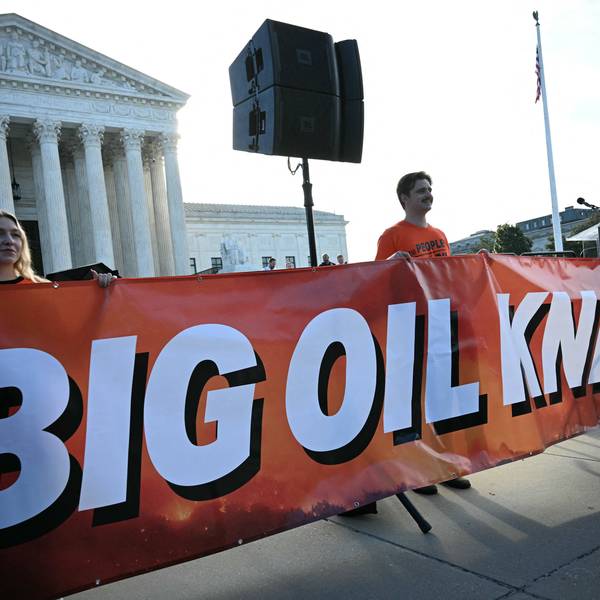

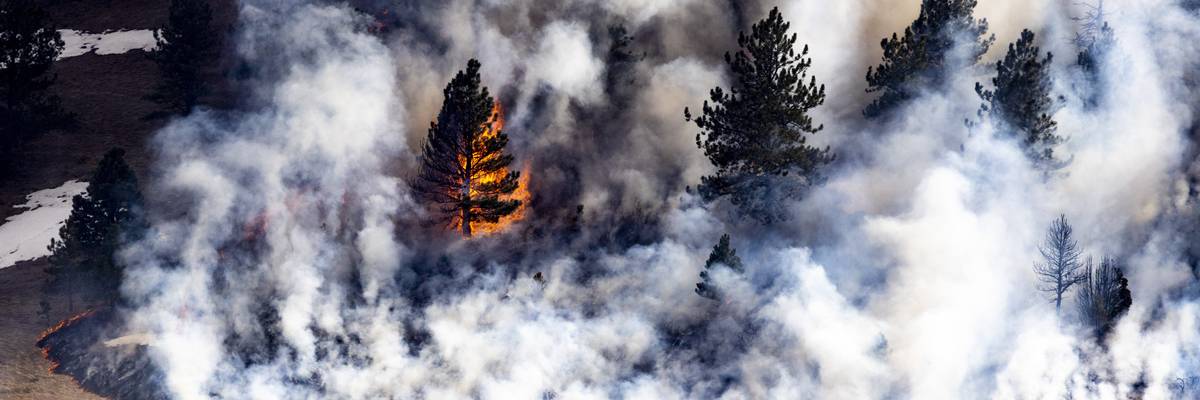
A tree goes up in flames as a fire burns on March 26, 2022 in Boulder, Colorado.
Colorado Judge Rejects Exxon, Suncor Attempt to Kill Landmark Climate Lawsuit
"Courts across the country keep rejecting Big Oil's attempts to escape justice for their climate deception," said one advocate.
Advocates celebrated Monday after a Boulder, Colorado judge rejected attempts by ExxonMobil and Suncor Energy subsidiaries to dismiss a landmark lawsuit that seeks damages for the harms the fossil fuel companies have inflicted on the climate and local communities.
The lawsuit, brought in 2018 by the city and county of Boulder, argues that mounting climate costs "should be shared by the Suncor and Exxon defendants because they knowingly and substantially contributed to the climate crisis by producing, promoting, and selling a substantial portion of the fossil fuels that are causing and exacerbating climate change, while concealing and misrepresenting the dangers associated with their intended use."
Colorado Public Radio noted Monday that the lawsuit "cites the 2010 Fourmile Canyon fire and 2013 floods as examples of climate disasters in Boulder County."
"The case was filed before the Marshall fire swept through the area in the winter of 2021, incinerating more than 1,000 homes and causing more than $2 billion in damage in what is now considered the most destructive wildfire in state history," the outlet observed.
The legal challenge seeks relief under a Colorado consumer protection law and other local statutes, accusing the corporations of public and private nuisance, trespass, unjust enrichment, and civil conspiracy.
In an 81-page decision, Boulder County District Court Judge Robert Gunning rejected the Exxon and Suncor subsidiaries' claim that the state court lacked jurisdiction and concluded that "the public nuisance, private nuisance, trespass, conspiracy, and unjust enrichment claims may proceed against ExxonMobil, Suncor Energy, and Suncor Sales."
Ashley Stolzmann, Boulder County's commissioner, said Monday that the decision "reaffirms our stance: We are suffering from the impacts and heavy costs of the climate crisis, right here, right now."
"Today, we take a meaningful step towards accountability and ensuring our voices and hardships are acknowledged," Stolzmann added.
"The people of Boulder are now one crucial step closer to having their day in court to hold Exxon and Suncor accountable for their climate lies and the massive damages they've caused."
Monday's ruling represents the latest blow Exxon and Suncor have suffered during the yearslong legal battle. Last year, the U.S. Supreme Court rejected the companies' attempt to move the case to federal court.
"Since the beginning, defendants have been arguing against a case we did not plead," said Sean Powers, a senior attorney with EarthRights International, which is representing the plaintiffs.
"Plaintiffs are not trying to litigate a solution to the climate crisis, they are seeking redress for harms they have suffered and will continue to suffer," Powers continued. "The only conduct at issue is defendants' own: what they knew, when they knew it, and what they did with that knowledge."
Boulder is among the dozens of local governments that have sued oil and gas companies in recent years, aiming to hold the industry accountable for severely damaging the climate and deceiving the public about the dangers of its extractive business model.
Exxon has known for decades about the link between burning fossil fuels and planetary warming and has worked to cast doubt on the science as it continues to drill in the face of worsening climate extremes across the globe.
"The people of Boulder are now one crucial step closer to having their day in court to hold Exxon and Suncor accountable for their climate lies and the massive damages they've caused," Richard Wiles, president of the Center for Climate Integrity, said Monday. "Courts across the country keep rejecting Big Oil's attempts to escape justice for their climate deception, and sooner or later these companies will have to explain the evidence of their misconduct to a jury."
We are at a crossroads
This country and this world are at a monumental crossroads. US voters have an opportunity to beat back the forces of fascism and confront the billionaires who are rigging the economy, our media system, and our democracy, making it increasingly impossible for ordinary people to get by. We’re not just talking about the election. We’re talking about what must be done once these fascist elements are vanquished from power. We need a bolder set of solutions than what either major party has so far been willing to offer and a working-class movement ready to fight like hell for it. Trump didn't emerge from nowhere. The conditions that fueled MAGA authoritarianism were created by decades of radical neoliberal economic policies and a corrupt political system dominated by corporate interests. They slashed taxes on the super-rich, promising that the benefits would trickle down. They said giveaways to the corporate titans would make life more affordable for the rest of us. It was all bullshit. And when a bitter, betrayed populace searches for someone to blame, right-wing demagogues have little trouble finding scapegoats. People know when they're being lied to, but you won't hear any of this from the corporate media. Only independent journalism—powered and funded by people who believe in building a better world—can deliver truly trustworthy daily news. Our Fall Campaign is underway, and we need your help. To power our newsroom through the rest of the year, we need to raise $125,000 by midnight on October 31. So if you share our vision, please contribute whatever you can to sustain our work. |
Advocates celebrated Monday after a Boulder, Colorado judge rejected attempts by ExxonMobil and Suncor Energy subsidiaries to dismiss a landmark lawsuit that seeks damages for the harms the fossil fuel companies have inflicted on the climate and local communities.
The lawsuit, brought in 2018 by the city and county of Boulder, argues that mounting climate costs "should be shared by the Suncor and Exxon defendants because they knowingly and substantially contributed to the climate crisis by producing, promoting, and selling a substantial portion of the fossil fuels that are causing and exacerbating climate change, while concealing and misrepresenting the dangers associated with their intended use."
Colorado Public Radio noted Monday that the lawsuit "cites the 2010 Fourmile Canyon fire and 2013 floods as examples of climate disasters in Boulder County."
"The case was filed before the Marshall fire swept through the area in the winter of 2021, incinerating more than 1,000 homes and causing more than $2 billion in damage in what is now considered the most destructive wildfire in state history," the outlet observed.
The legal challenge seeks relief under a Colorado consumer protection law and other local statutes, accusing the corporations of public and private nuisance, trespass, unjust enrichment, and civil conspiracy.
In an 81-page decision, Boulder County District Court Judge Robert Gunning rejected the Exxon and Suncor subsidiaries' claim that the state court lacked jurisdiction and concluded that "the public nuisance, private nuisance, trespass, conspiracy, and unjust enrichment claims may proceed against ExxonMobil, Suncor Energy, and Suncor Sales."
Ashley Stolzmann, Boulder County's commissioner, said Monday that the decision "reaffirms our stance: We are suffering from the impacts and heavy costs of the climate crisis, right here, right now."
"Today, we take a meaningful step towards accountability and ensuring our voices and hardships are acknowledged," Stolzmann added.
"The people of Boulder are now one crucial step closer to having their day in court to hold Exxon and Suncor accountable for their climate lies and the massive damages they've caused."
Monday's ruling represents the latest blow Exxon and Suncor have suffered during the yearslong legal battle. Last year, the U.S. Supreme Court rejected the companies' attempt to move the case to federal court.
"Since the beginning, defendants have been arguing against a case we did not plead," said Sean Powers, a senior attorney with EarthRights International, which is representing the plaintiffs.
"Plaintiffs are not trying to litigate a solution to the climate crisis, they are seeking redress for harms they have suffered and will continue to suffer," Powers continued. "The only conduct at issue is defendants' own: what they knew, when they knew it, and what they did with that knowledge."
Boulder is among the dozens of local governments that have sued oil and gas companies in recent years, aiming to hold the industry accountable for severely damaging the climate and deceiving the public about the dangers of its extractive business model.
Exxon has known for decades about the link between burning fossil fuels and planetary warming and has worked to cast doubt on the science as it continues to drill in the face of worsening climate extremes across the globe.
"The people of Boulder are now one crucial step closer to having their day in court to hold Exxon and Suncor accountable for their climate lies and the massive damages they've caused," Richard Wiles, president of the Center for Climate Integrity, said Monday. "Courts across the country keep rejecting Big Oil's attempts to escape justice for their climate deception, and sooner or later these companies will have to explain the evidence of their misconduct to a jury."