SUBSCRIBE TO OUR FREE NEWSLETTER
Daily news & progressive opinion—funded by the people, not the corporations—delivered straight to your inbox.
5
#000000
#FFFFFF
To donate by check, phone, or other method, see our More Ways to Give page.

Daily news & progressive opinion—funded by the people, not the corporations—delivered straight to your inbox.
“The federal government cannot build secret dossiers on people because they exercise their First Amendment right to peacefully observe, document, or criticize its actions," said the head of Democracy Forward.
A coalition of privacy and civil liberties advocates filed a federal lawsuit Friday accusing the Trump administration of secretly collecting and keeping personal information about people who monitor US Immigration and Customs Enforcement operations, arguing that the practice violates federal privacy law and threatens constitutionally protected speech and association.
The lawsuit—filed in the US District Court for the District of Columbia—was brought by individuals and advocacy groups represented by Democracy Forward.
The plaintiffs—the Electronic Privacy Information Center (EPIC) and legal observers Nicole Cleland, Jacquelyn Ivey, and Anna Walker—argued that the US Department of Homeland Security (DHS), US Immigration and Customs Enforcement (ICE), and other federal agencies created and maintained databases of people who observed, documented, or protested immigration enforcement activities without providing notification or safeguards, as required under the Privacy Act of 1974.
That law was passed after the exposure of illegal government surveillance, including longtime former Federal Bureau of Investigation Director J. Edgar Hoover's infamous COINTELPRO program, under which the FBI, in addition to conducting unlawful spying, funded and armed murderous far-right militants to terrorize anti-Vietnam War protesters, anti-nuclear weapons activists, civil rights leaders including Martin Luther King, Jr., and other leftists.
“The federal government cannot build secret dossiers on people because they exercise their First Amendment right to peacefully observe, document, or criticize its actions," Democracy Forward president and CEO Skye Perryman said in a statement announcing the lawsuit. "That is exactly the kind of government surveillance Congress sought to prevent when it enacted the Privacy Act after some of the darkest chapters in our nation’s history."
The lawsuit accuses the Trump administration of collecting the names, photographs, vehicle information and license plate numbers, social media accounts, and other identifying information about legal observers, volunteers, journalists, clergy, and community members engaged in First Amendment-protected activities during the government's deadly anti-immigrant crackdown.
"When the Department of Homeland Security dramatically ratcheted up its immigration enforcement, people across the country—of all ages and backgrounds—did what anyone is supposed to do when they disagree with government action: They exercised their First Amendment rights," the suit states. "They peacefully protested. And, as matters here, they observed and recorded how law enforcement agents acted in public."
DHS is using facial recognition technology, body cameras, license plates, mobile devices, and other surveillance tools to identify, track, and punish people who legally observe immigration enforcement in public. This is a clear violation of the Privacy Act. We’ll see them in court.
[image or embed]
— Democracy Forward (@democracyforward.org) July 24, 2026 at 10:36 AM
"In response, DHS decided to record the Americans who were peacefully observing its agents, adopting a secret Protester Surveillance Policy enabling its agents to first collect records on Americans engaging in First Amendment exercise and then maintain them in DHS systems, where they can be used to retaliate against those Americans," the complaint continues.
"Beginning sometime in 2025, DHS deployed a dragnet of drones, bodycams, face-scanning apps, license plate scanners, and camera phones to, as one memo instructed, 'capture all images, license plates, identifications, and general information on hotels, agitators, protestors, etc., so we can capture it all in one consolidated form,'" the document notes.
"DHS agents have not been shy about gathering this information or its purpose," the plaintiffs contended. "In Maine, DHS agents told multiple observers that they were being added to a database of 'domestic terrorists.' In Chicago, agents routinely used facial irecognition scans on members of the public."
"In Minneapolis, observers simply watching agents on public streets have been led by those agents to their own houses, despite never having interacted with an agent—a practice so common that it has been named 'being driven home by ICE,'" the suit says. "And across the country, DHS agents have approached observers and addressed them by their full names, even though those observers never identified themselves to the agents or showed them any form of identification."
"As a result of its Protester Surveillance Policy, DHS has recorded and retaliated against each individual plaintiff," the filing alleges. "It’s bad enough that DHS publicly collected information on Americans engaged in lawful First Amendment exercise. But worse, DHS also decided to maintain the information in one or more of its systems, enabling it to later retaliate against observers and protestors—including by canceling Trusted Traveler status," which includes Transportation Security Administration Pre-Check and Global Entry.
The plaintiffs are asking the court to declare the DHS surveillance policy unlawful, end it, and ban the agency from continuing to collect and keep records of individuals’ protected First Amendment activities.
“Now more than ever, those of us who have the privilege to speak out have a responsibility to defend the rights of everyone in our communities,” Walker said in a statement. “When people are punished for exercising their First Amendment rights, we begin losing the democratic principles that protect all of us. Every American should be alarmed by retaliatory action against one’s free speech."
Cleland said: “I believe government accountability starts with transparency. People should be free to peacefully observe and document what their government does in public without worrying they’ll be tracked or retaliated against. This case is about protecting that right for everyone.”
EPIC deputy director John Davisson warned, “When our government compiles secret dossiers on everyday people for exercising their constitutional rights, it sends a chilling message: If you speak up, watch your back."
"If every protest, every recording, every act of dissent opens us up to surveillance and retribution, privacy and free speech are at risk of collapse," he added. "But the laws of this nation don’t permit that, and we won’t either.”
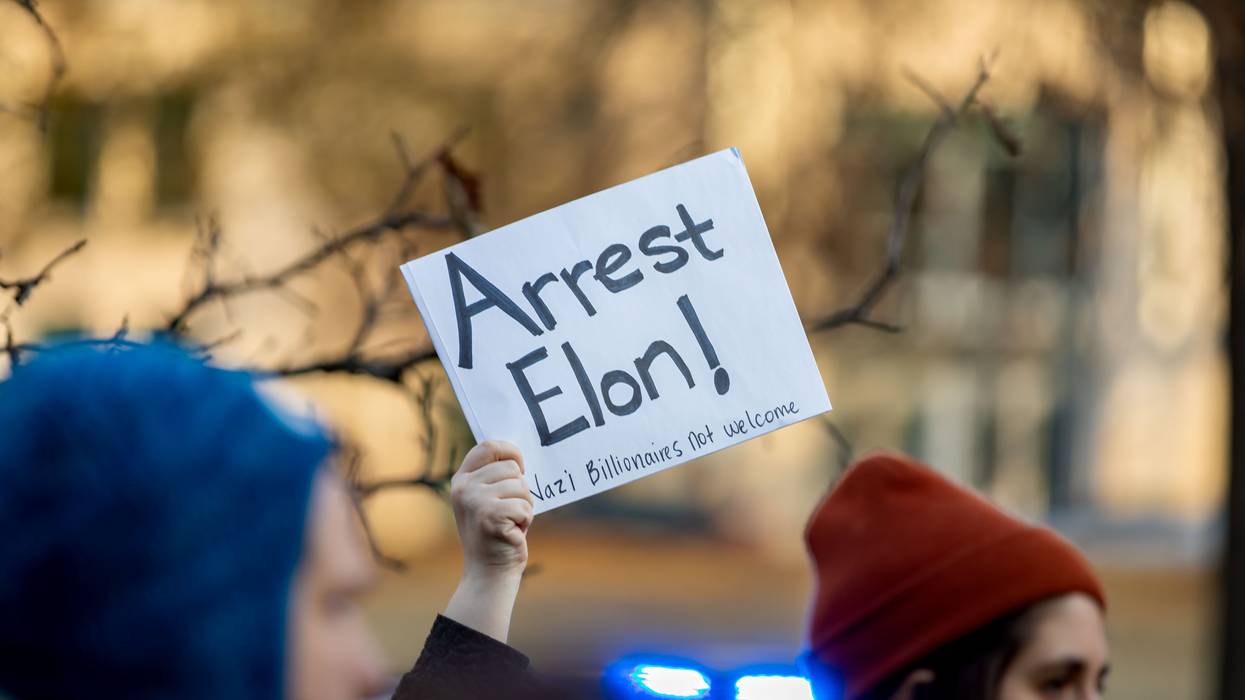
With their many mistakes, Musk and his team have left themselves vulnerable to the sorts of lawsuits being filed by public-interest groups and state attorneys general.
On February 10, the Electronic Privacy Information Center, or EPIC, filed suit for damages against the Trump-Musk-DOGE cartel. The lawsuit, which EPIC filed before the U.S. District Court for the Eastern District of Virginia, calls for damages on behalf of tens of millions of government workers and Americans resulting from the administration’s illegal breach of personal privacy and its threat to national security.
“These basic security failures have resulted in the unlawful disclosure of personal data—including social security numbers and tax information,” reads the complaint.
EPIC is claiming the data incursion—among many other violations—is illegal under the Privacy Act of 1974. “Plaintiffs have a constitutional right to the privacy of their information… Defendants have violated and continue to violate that right by unlawfully disclosing extremely personal information about plaintiffs and millions of others to unchecked actors in violation of law,” the complaint states.
The courts (and hopefully Congress) are catching up to public opinion, which has taken a drastic turn since Musk began violating the privacy rights of millions of people.
EPIC urges the court to compel defendants to “delete all unlawfully obtained, disclosed, or accessed personally identifiable information from systems or devices on which they were not present on January 19, 2025.” It calls on the court to award plaintiffs statutory and punitive damages “in the amount of $1,000 per each act of unauthorized inspection and disclosure.” That’s a sum that could add up to trillions of dollars in damages given the scope of DOGE’s breach.
The law is catching up to Elon Musk. The EPIC suit is just one of many that have been filed since U.S. President Donald Trump was sworn in and Musk and his DOGE crew infiltrated several key federal agencies and their extensive public records.
On February 7, a federal judge issued an emergency temporary restraining order (TRO) against DOGE after 19 state attorneys general filed a complaint also alleging that DOGE had violated the Privacy Act of 1974 and other laws. The TRO blocks Musk et al. from accessing Treasury systems and requires they destroy any material downloaded.
On filing their case for the TRO, New York State Attorney General Letitia James said: “President Trump does not have the power to give away Americans’ private information to anyone he chooses, and he cannot cut federal payments approved by Congress. Musk and DOGE have no authority to access Americans’ private information and some of our country’s most sensitive data.”
During a Free Press webinar held prior to EPIC’s filing, the organization’s chief litigator, John Davisson, called the DOGE incursion into federal agencies like the Department of Treasury “the largest and most consequential breach of personal information in U.S. history.” To make matters worse, Davisson noted, “it’s being led by malign, unaccountable forces from both without and within the government.”
Public Citizen co-president Lisa Gilbert led the very first suit against Trump’s second administration. Since then, the organization has filed several other suits against the Trump White House and its operatives, with most focused on pushing back against the DOGE power grab. “What really stands out is the corruption implicit in Musk being at the helm,” Gilbert said during the Free Press webinar. A Public Citizen report from October found that three of Musk’s businesses—SpaceX, Tesla, and X—face at least 11 criminal and civil investigations at the federal level.
“The biggest risk of all is the risk to democratic governance,” said Davisson. “The folks involved here—these bandits, these hijackers—have correctly assessed that the systems in federal agencies are critical levers for how they carry out the functions Congress has assigned.” Davisson added that the massive DOGE data breach empowers Musk’s unaccountable team “to exert all sorts of pressure on federal employees and people at large on people they disagree with politically and that is something we should be very, very worried about.”
The groundbreaking reporting of WIRED’s Vittoria Elliott has exposed the relatively inexperienced team of techies that has accompanied Musk into these federal agencies to access massive troves of personal data. “One of the biggest issues is the lack of transparency,” she said during the webinar. “We don’t know what systems they’re accessing. We’re not given transparency about their roles… The consequences of [Musk’s team] getting it wrong are so dire for so many people.”
One of the things that stands out to Davisson is just how many mistakes DOGE has made since it began its work. Musk and his team have left themselves vulnerable to the sorts of lawsuits being filed by EPIC, Public Citizen, and state attorneys general, he said. “They’ve aggravated a lot of stakeholders; they’re in the process of aggravating the courts. They’ve embarrassed themselves in many ways; they’ve drawn the eye of the public. I think in many ways they have already sown the seeds of their downfall.”
Congress has reportedly been inundated with calls from people who are deeply unhappy about Musk’s raid on government agencies. “It is a deluge on DOGE,” Sen. Tina Smith (D–Minn.) told The Washington Post. “Truly our office has gotten more phone calls on Elon Musk and what the heck he’s doing mucking around in federal government than I think anything we’ve gotten in years… People are really angry.”
People must share their concerns with their lawmakers and call on Congress to act against the incursions. But that’s just a start.
“There is broad public dislike for Musk,” Davisson said during Monday’s webinar. “And we should continue to find ways to leverage that... This is going to require many small—sometimes unsatisfying—actions by a lot of different people in a lot of different places. This assault on democracy is vulnerable to that.”
There are productive places to channel outrage, said Gilbert. “There have been some really effective engagements and protests and people are ginning up for the next phase of resistance... There are some places where we can win things,” she added, pointing to the upcoming budget fight in Congress.
“There’s a battle to be had, where everyone's senators and members matter,” she said. “Knowing that and knowing that there are places where constituents can weigh in hopefully changes the calculus a little bit when folks are feeling like there’s nothing they can do.”
And indeed Musk may be popular among the extremist MAGA crowd, but voters in general aren’t on board with the DOGE team’s privacy violations. A new Hart Research survey indicates that his popularity is in rapid decline as people learn more about his efforts to compromise our data.
The Economist/YouGov conducted a poll finding that the billionaire is falling out of favor with voters, including Republicans, who say in increasing numbers that they want him to have little-to-no influence over the way the government conducts its business.
The wins against DOGE are just the beginning, Davisson said. The legal strategy is “going to be important for staying grounded through what is going to be a very long and difficult fight. So I encourage everyone to celebrate the wins when they come.”
The courts (and hopefully Congress) are catching up to public opinion, which has taken a drastic turn since Musk began violating the privacy rights of millions of people. With continued public pressure and legal challenges, it’s possible DOGE’s days may be numbered.
"As FANFSA and the 702 reauthorization move to the Senate, lawmakers in that chamber need to take a stand for the rights of people in the United States," said one advocate.
While applauding the U.S. House of Representatives' bipartisan passage of a bill to ensure that "law enforcement and intelligence agencies can't do an end-run around the Constitution by buying information from data brokers" on Wednesday, privacy advocates highlighted that Congress is trying to extend and expand a long-abused government spying program.
The House voted 219-199 for Fourth Amendment Is Not For Sale Act (FANFSA), which won support from 96 Democrats and 123 Republicans, including the lead sponsor, Rep. Warren Davidson (R-Ohio). Named for the constitutional amendment that protects against unreasonable searches and seizures, H.R. 4639 would close what campaigners call the data broker loophole.
"The privacy violations that flow from law enforcement entities circumventing the Fourth Amendment undermine civil liberties, free expression, and our ability to control what happens to our data," said Free Press Action policy counsel Jenna Ruddock. "These impacts affect everyone who uses digital platforms that extract our personal information any time we open a browser or visit social media and other websites—even when we go to events like demonstrations and other places with our phones revealing our locations."
"We're grateful that the House passed these vital and popular protections," she added. "The bill would prevent flagrant abuses of our privacy by government authorities in league with unscrupulous third-party data brokers. Making this legislation into law with Senate passage too would be a decisive and long-overdue action against government misuse of this clandestine business sector that traffics in our personal data for profit."
Wednesday's vote followed the House sending the Reforming Intelligence and Securing America Act to the Senate. H.R. 7888 would reauthorize Section 702 of the Foreign Intelligence Surveillance Act (FISA), which allows for warrantless spying on noncitizens abroad but also sweeps up Americans' data.
The House notably included an amendment forcing a wide range of individuals and businesses to cooperate with government spying operations but rejected an amendment that would have added a warrant requirement to the bill, which the Senate could vote on as soon as Thursday.
Noting those decisions on the FISA reauthorization legislation, Ruddock stressed that "today's vote is a victory but follows a recent loss and ongoing threat as that Section 702 bill moves to the Senate this week too."
"As FANFSA and the 702 reauthorization move to the Senate, lawmakers in that chamber need to take a stand for the rights of people in the United States," she argued. "That means passing FANFSA and reforming Section 702 authority—and prioritizing everyone's First and Fourth Amendment rights."
Jeramie Scott, senior counsel and director of the Electronic Privacy Information Center's Project on Surveillance Oversight, also praised the House's FANFSA passage on Wednesday.
"The passage of the Fourth Amendment Is Not For Sale underscores the extent to which reining in abusive warrantless surveillance is a bipartisan issue," Scott said. "We urge the Senate to take up this measure and close the data broker loophole."
Kia Hamadanchy, senior policy counsel at ACLU, similarly said Wednesday that "the bipartisan passage of this bill is a flashing warning sign to the government that if it wants our data, it must get a warrant."
Hamadanchy added that "we hope this vote puts a fire under the Senate to protect their constituents and rein in the government's warrantless surveillance of Americans, once and for all."
Sen. Ron Wyden (D-Ore.), a critic of the pending 702 bill and FANFSA's lead sponsor in the upper chamber, called the the House's Wednesday vote "a huge win for privacy" and said that "now it's time for the Senate to follow suit."
The SAFE Act "would make critical reforms to stop persistent abuse" and is "meticulously designed to account for operational needs," said one advocate.
Just weeks away from the expiration of a U.S. government surveillance power with a history of abuse, a bipartisan group of senators unveiled a reauthorization bill welcomed by rights groups who have long demanded reforms.
Congress and U.S. President Joe Biden last year temporarily extended Section 702 of the Foreign Intelligence Surveillance Act (FISA), which permits warrantless surveillance targeting noncitizens located outside the United States, to allow for ongoing discussions of possible changes opposed by the intelligence community and its allies on Capitol Hill.
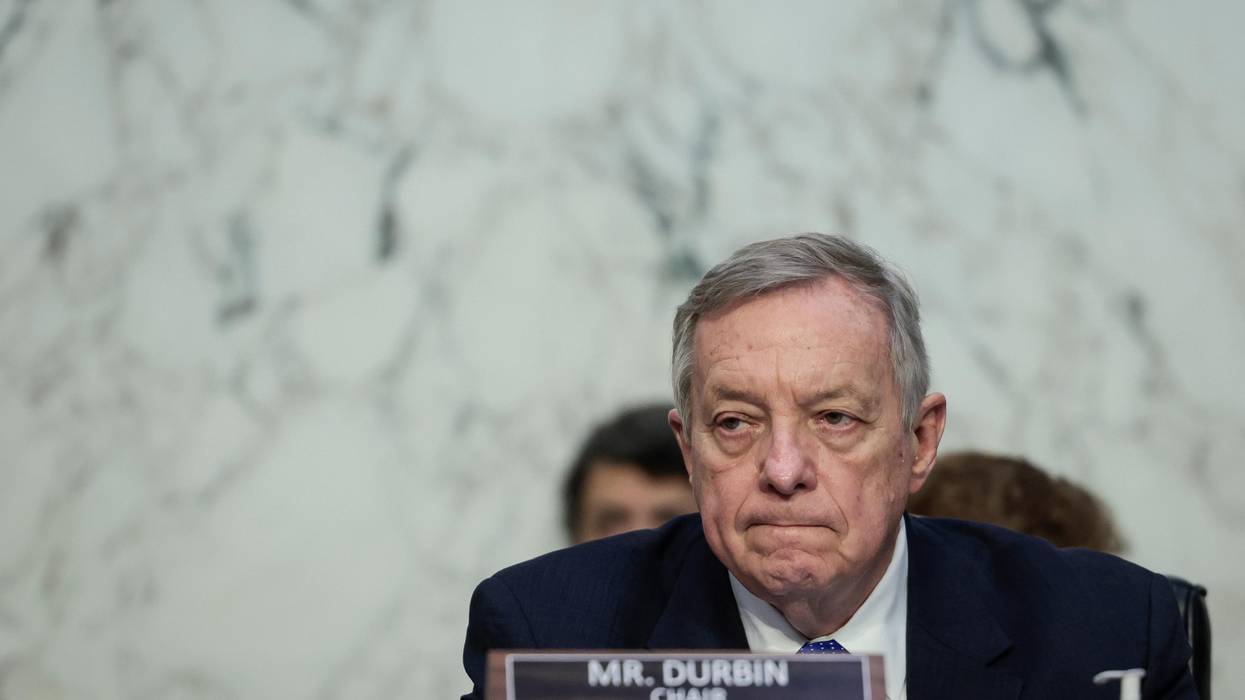
"There is little doubt that Section 702 is a valuable national security tool. However, while only foreigners overseas may be targeted, the program sweeps in massive amounts of Americans' communications, which may be searched without a warrant," Senate Majority Whip Dick Durbin (D-Ill.) noted Thursday.
Durbin, who also chairs the Senate Judiciary Committee, and Sen. Mike Lee (R-Utah) are leading the Security and Freedom Enhancement (SAFE) Act with support from 11 other senators who have backed reform efforts in response to rampant abuse, particularly by the Federal Bureau of Investigation (FBI).
"The documented abuses under FISA should provoke outrage from anyone who values the Fourth Amendment rights of American citizens," said Lee. "From warrantless searches targeting journalists, political commentators, and campaign donors to monitoring sitting members of Congress, these actions reveal a blatant disregard for individual liberties."
After noting that "even after implementing compliance measures, the FBI still conducted more than 200,000 warrantless searches of Americans' communications in just one year—more than 500 warrantless searches per day," Durbin framed the SAFE Act as "a sensible, bipartisan path forward on reauthorizing Section 702 with meaningful reforms."
With the April 19 sunset of Section 702 of the Foreign Intelligence Surveillance Act approaching, I'm announcing a bipartisan compromise bill that protects Americans from foreign threats and from warrantless government surveillance. WATCH: https://t.co/3ELLO7O7YN
— Senator Dick Durbin (@SenatorDurbin) March 14, 2024
Specifically, the bill would require agencies to "obtain a FISA Title I order or a warrant before accessing the contents of Americans' communications collected under Section 702—but not before running queries," the sponsors explained. It also includes additional layers of internal supervision for queries involving Americans and would close the data broker loophole, among other provisions.
"Sen. Durbin and Lee have carefully crafted a bipartisan compromise bill," said ACLU senior policy counsel Kia Hamadanchy. "While this legislation does not include every reform civil liberties groups have been pushing for, it does include meaningful changes that will rein in the government's warrantless surveillance of Americans and help ensure that our privacy is protected. The Senate should take up this bill immediately."
Demand Progress policy director Sean Vitka agreed. While also noting that it doesn't have everything rights advocates wanted, he said that "the SAFE Act is a major development in the ongoing fight to rein in warrantless government surveillance of people in the United States."
"We commend Sen. Durbin and Lee for their leadership," Vitka added, stressing that "an overwhelming number of Americans from across the political spectrum want Congress to seize this once-in-a-generation moment and get this done."
Jeramie Scott, senior counsel and director of the Electronic Privacy Information Center's Project on Surveillance Oversight, similarly praised the pair for crafting the bill, which he said "takes a pragmatic, measured approach to reform that draws upon a wide range of proposals" to offer "a clear path forward to reauthorizing Section 702 while ensuring that our rights are protected."
Jake Laperruque, deputy director of the Center for Democracy & Technology's Security and Surveillance Project, also celebrated that the bill "would make critical reforms to stop persistent abuse" and is "meticulously designed to account for operational needs."
"We're just a few weeks away from the expiration of FISA 702—it's time for congressional leadership to stop stalling and allow a vote on these critical reforms," Laperruque declared.
The SAFE Act comes just days after Wired revealed that U.S. House Permanent Select Committee on Intelligence Chair Mike Turner (R-Ohio) privately tried using peaceful protests at the home of Senate Majority Leader Chuck Schumer (D-N.Y.) as proof of the need to block long-demanded reforms to Section 702.
Turner notably already faced calls to resign after he announced that his panel had provided members of Congress with "information concerning a serious national security threat," which news outlets reported was that Russia has made progress on a space-based nuclear weapon to target U.S. satellites.
Amid that controversy—which was widely seen as a ploy to force the reauthorization without reforms—House Speaker Mike Johnson (R-La.) abruptly delayed action on Section 702 in February. However, the Republican leader told Politico on Thursday that "the current plan is to run FISA as a standalone the week after Easter."
"If any lawmakers were still on the fence and waiting for a smoking gun, THIS IS IT," said one advocate of reforming Section 702.
Privacy advocates issued fresh calls for changes to a historically abused U.S. spying program on Tuesday after Wired reported that a top Republican congressman privately tried using peaceful protests as proof of the need to block long-demanded reforms.
"If you care about the First Amendment, please stop everything and read this Wired article," Elizabeth Goitein, senior director of the Brennan Center for Justice's Liberty & National Security Program, said on social media, sharing the piece.
Wired's Dell Cameron obtained a pair of presentation slides and spoke with multiple GOP staffers who attended a December 11 meeting with Rep. Mike Turner, the Ohio Republican who chairs the House Permanent Select Committee on Intelligence (HPSCI).
"This is ice in the heart of our democracy."
The meeting was about competing legislation to reauthorize Section 702 of the Foreign Intelligence Surveillance Act (FISA), which allows warrantless surveillance targeting noncitizens located outside the United States to acquire foreign intelligence information, but also sweeps up Americans' data—and has been misused, particularly by the Federal Bureau of Investigation. One of the bills would require the FBI to get a warrant before accessing U.S. citizens' communications.
Turner—who opposes the bill with that and other reforms—reportedly displayed the slides about 15 minutes into the meeting, which latest over an hour. The first shows a photo of opponents of Israel's genocidal U.S.-backed war on the Gaza Strip protesting outside the Brooklyn residence of Senate Majority Leader Chuck Schumer (D-N.Y.). It does not note that the October 13 action was organized by Jewish Voice for Peace.
The second slide features a social media post from Washington Free Beacon staff writer Matthew Foldi that contains misinformation suggesting Hamas—which governs Gaza and is designated as a terrorist group by the U.S. government—was tied to a November demonstration at the Democratic leader's residence. The slides do not make clear that they were different events.
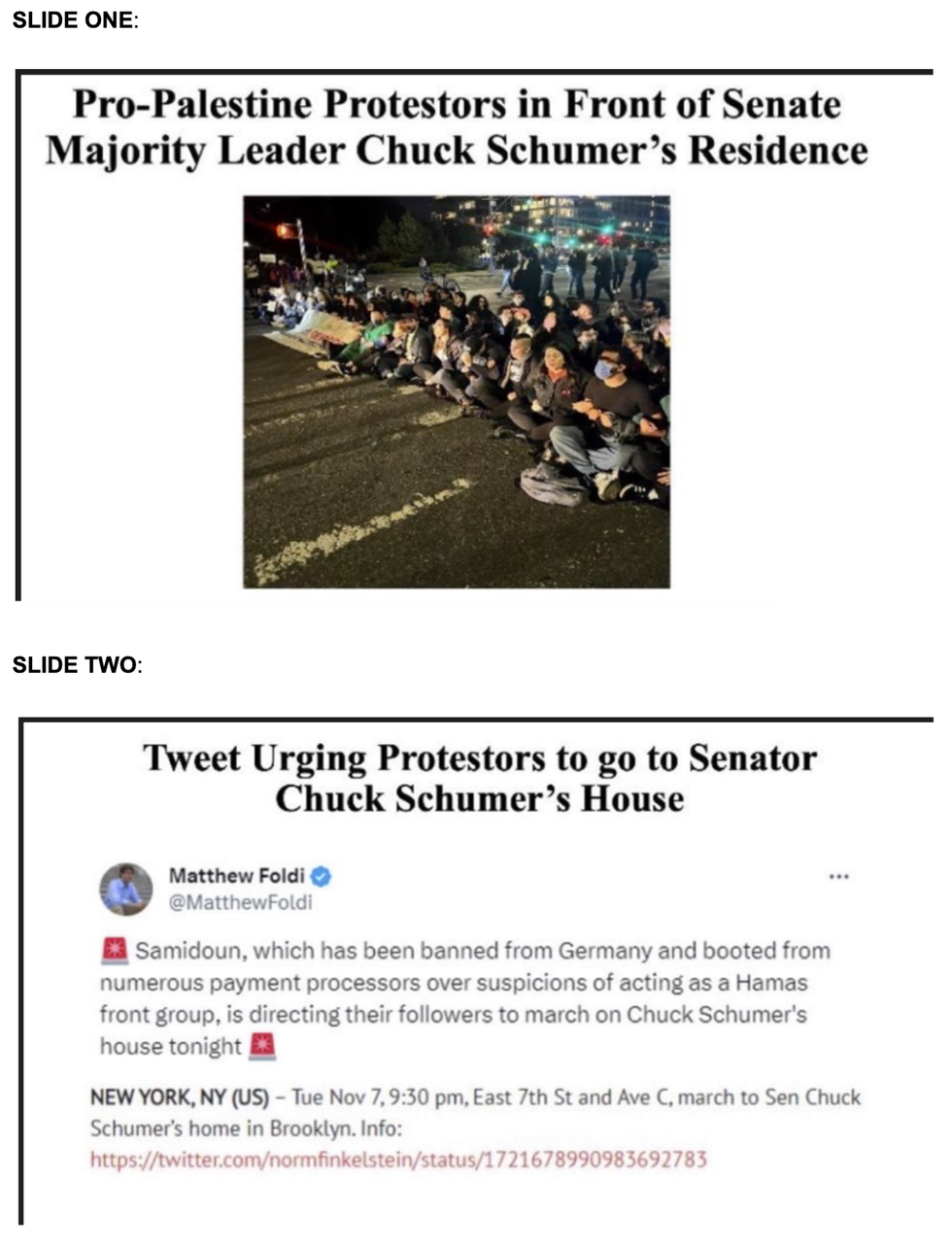
"At the outset of the presentation, he's running through slides, making his case for why 702 reauthorization is needed," one senior Republican aide told Wired about Turner's presentation. "Then he throws up that photo. The framing was: 'Here are protesters outside of Chuck Schumer's house. We need to be able to use 702 to query these people.'"
As Cameron detailed:
Jeff Naft, the HPSCI spokesperson, says the purpose of the slides was to illustrate that, even if the protesters did have ties to Hamas, they would "not be subject to surveillance" under the 702 program. "702 is not used to target protestors," he says. "702 is used on foreign terrorist organizations, like Hamas. Chairman Turner's presentation was a distinction exercise to explain the difference between a U.S. person and Hamas."
Wired's sources, who are not authorized to discuss closed-door briefings and requested anonymity to do so, describe this as a conflation of two separate issues—a tactic, they say, that has become commonplace in the debate over the program's future. "Yes, it's true, you cannot 'target' protesters under 702," one aide, a legislative director for a Republican lawmaker, says. "But that doesn't mean the FBI doesn't still have the power to access those emails or listen to their calls if it wants."
In response to Wired's reporting, Goitein—who was quoted in the piece—said on social media that "if any lawmakers were still on the fence and waiting for a smoking gun, THIS IS IT. Turner has made the stakes crystal clear. A vote to reauthorize Section 702 without a warrant requirement is a vote to allow the FBI to keep tabs on protesters exercising [First Amendment] rights."
"HPSCI leaders are reportedly trying to persuade congressional leaders to slip a Section 702 reauthorization into one of the upcoming funding bills," she pointed out. "Lawmakers must be given the opportunity to vote on Section 702 reforms, including a warrant requirement and other critical protections for Americans' civil liberties. Our First Amendment rights depend on it."
House Speaker Mike Johnson (R-La.) abruptly delayed action on Section 702 last month after Turner announced that the HPSCI had provided members of Congress with "information concerning a serious national security threat," which news outlets reported was that Russia has made alarming progress on a space-based nuclear weapon designed to target U.S. satellites. Critics called it a ploy by the chair to force through the spying program and demanded his immediate resignation.
Among the groups that pressured Turner to step down last month was Demand Progress, a longtime supporter of Section 702 reforms whose policy director, Sean Vitka, was also quoted in Wired's piece and issued a statement about the "disturbing" revelations.
"This is ice in the heart of our democracy," Vitka said. "Americans' right to protest is sacred, and all the more critical given the political volatility 2024 is certain to produce. As intelligence agencies and congressional intelligence committees mislead the public about what's at stake in this fight for privacy, Chairman Turner has been secretly selling his colleagues on backdoor searches of Americans as a way to help the FBI spy on protesters without so much as a court order."
Calling for "a forceful response" from Schumer, Johnson, and House Minority Leader Hakeem Jeffries (D-N.Y.), he argued that "Congress must stop letting the House Intelligence Committee dictate its agenda by secretly vetoing any meaningful reform. In the coming weeks, Congress has the opportunity to enact meaningful privacy protections that would protect protesters and all people in the United States from warrantless surveillance, specifically by closing the backdoor search and data broker loopholes."
"This discussion is one more example of why Congress must pass a warrant requirement to ensure that these searches are not subject to abuse."
Jeramie Scott, senior counsel and director of the Electronic Privacy Information Center, also weighed in on the reporting.
"Americans exercising their constitutional right to protest have a right to be free from warrantless surveillance. There should be no suggestion that foreign intelligence authorities can be used to target protestors; that would be counter to our core American values," Scott said. "This discussion is one more example of why Congress must pass a warrant requirement to ensure that these searches are not subject to abuse."
Kia Hamadanchy, senior policy counsel at ACLU, similarly demanded action, saying that "in the United States, a political leader's disagreement with the views of a protest movement does not give the government license to investigate those protesters, and Chairman Turner knows that."
"It is clear our leaders view the ability to conduct warrantless searches based on vague and unfounded claims of foreign influence as a feature of the program—not a bug," he added. "That's precisely why Congress must not reauthorize Section 702 without the fundamental reforms needed to prevent these egregious abuses."
This post has been updated with comment from the ACLU.
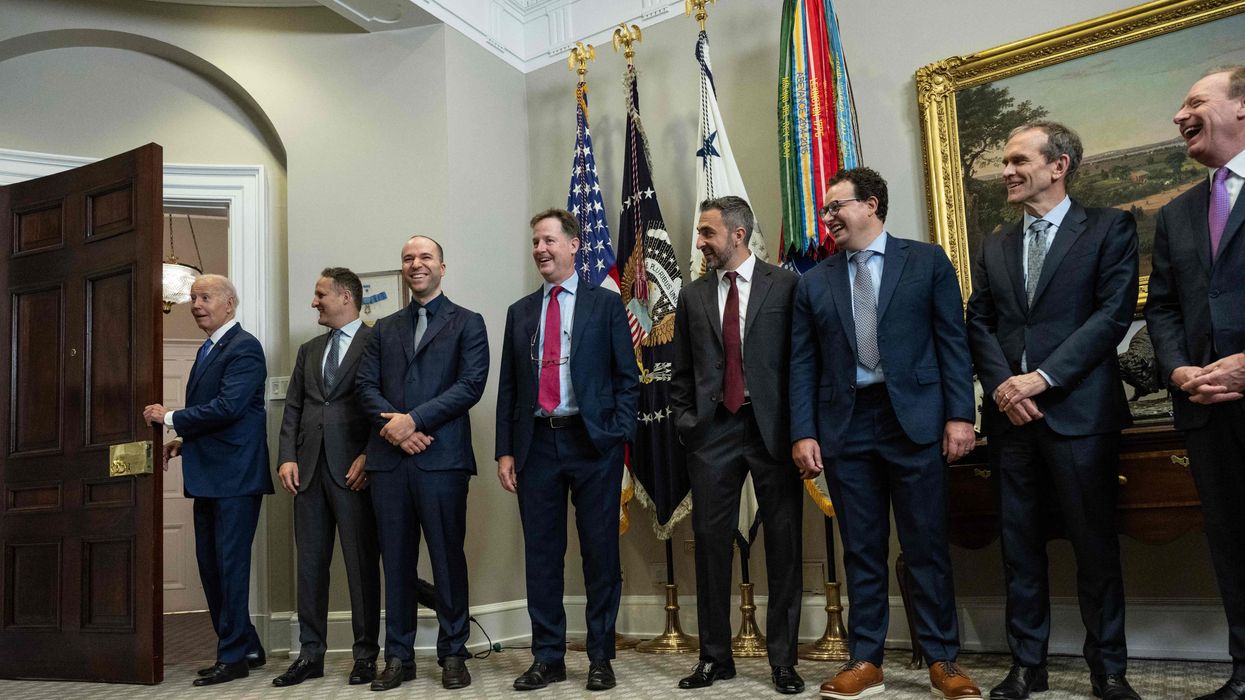
Advocacy groups and experts are pressuring Congress and federal regulators to "put meaningful, enforceable guardrails in place."
Amid rising global fears about the dangers of artificial intelligence, campaigners and experts applauded U.S. President Joe Biden's administration on Friday for securing voluntary risk management commitments from seven leading AI companies while also emphasizing the need for much more from lawmakers and regulators.
"I'm very happy to see this modest, but necessary, step on the way to proper governance of AI. It is all voluntary at this stage, yet good to get these norms agreed. Hopefully it is a step on a much longer path," said Toby Ord, a senior research fellow at the U.K.'s University of Oxford and author of The Precipice: Existential Risk and the Future of Humanity.
Rob Reich, a faculty associate director at Stanford University's Institute for Human-Centered Artificial Intelligence, tweeted that "this is a big step forward for AI governance," and it is "great to see" Amazon, Anthropic, Google, Inflection, Meta, Microsoft, and OpenAI "coordinating on baseline norms of responsible AI development."
"We need enforceable accountability measures and requirements to roll out AI responsibly and mitigate the risks and potential harms to individuals, including bias and discrimination."
Alexandra Reeve Givens, CEO of the Center for Democracy & Technology (CDT), called the announcement "a welcome step toward promoting trustworthy and secure AI systems."
"Red team testing, information sharing, and transparency around risks are all essential elements of achieving AI safety," Reeve Givens said. "The commitment to develop mechanisms to disclose to users when content is AI-generated offers the potential to reduce fraud and mis- and disinformation."
"These voluntary undertakings are only a first step. We need enforceable accountability measures and requirements to roll out AI responsibly and mitigate the risks and potential harms to individuals, including bias and discrimination," she stressed. "CDT looks forward to continuing to work with the administration and Congress in putting these safeguards in place."
Caitriona Fitzgerald, deputy director at the Electronic Privacy Information Center (EPIC), had a similar response.
"While EPIC appreciates the Biden administration's use of its authorities to place safeguards on the use of artificial intelligence, we both agree that voluntary commitments are not enough when it comes to Big Tech," she said. "Congress and federal regulators must put meaningful, enforceable guardrails in place to ensure the use of AI is fair, transparent, and protects individuals' privacy and civil rights."
Biden brought together leaders from the companies to announce eight commitments that the White House said "underscore three principles that must be fundamental to the future of AI: safety, security, and trust."
As the White House outlined, the firms are pledging to:
"There is much more work underway," according to a White House fact sheet, which says the "administration is currently developing an executive order and will pursue bipartisan legislation to help America lead the way in responsible innovation."
Brown University computer and data science professor Suresh Venkatasubramania, a former Biden tech adviser who helped co-author the administration's Blueprint for an AI Bill of Rights, said in a series of tweets about the Friday agreement that "on process, there's good stuff here," but "on content, it's a bit of a mixed bag."
While recognizing the need for additional action, Venkatasubramania also said that voluntary efforts help show that "adding guardrails in the development of public-facing systems isn't the end of the world or even the end of innovation."
The White House fact sheet says that "as we advance this agenda at home, the administration will work with allies and partners to establish a strong international framework to govern the development and use of AI. It has already consulted on the voluntary commitments with Australia, Brazil, Canada, Chile, France, Germany, India, Israel, Italy, Japan, Kenya, Mexico, the Netherlands, New Zealand, Nigeria, the Philippines, Singapore, South Korea, the UAE, and the U.K."
Gabriela Zanfir-Fortuna of the Future of Privacy Forum pointed out that the European Union was not listed as a partner.
As Common Dreams reported last month, the European Parliament passed a draft law that would strictly regulate the use of artificial intelligence, and now, members of the legislative body are negotiating a final version with the E.U.'s executive institutions.
The fact sheet adds that "the United States seeks to ensure that these commitments support and complement Japan's leadership of the G7 Hiroshima Process—as a critical forum for developing shared principles for the governance of AI—as well as the United Kingdom's leadership in hosting a Summit on AI Safety, and India's leadership as chair of the Global Partnership on AI."
Noting that portion of the document, Zanfir-Fortuna tweeted: "What is missing from the list? The Council of Europe's ongoing process to adopt an international agreement on AI."