

SUBSCRIBE TO OUR FREE NEWSLETTER
Daily news & progressive opinion—funded by the people, not the corporations—delivered straight to your inbox.
5
#000000
#FFFFFF
To donate by check, phone, or other method, see our More Ways to Give page.
Daily news & progressive opinion—funded by the people, not the corporations—delivered straight to your inbox.
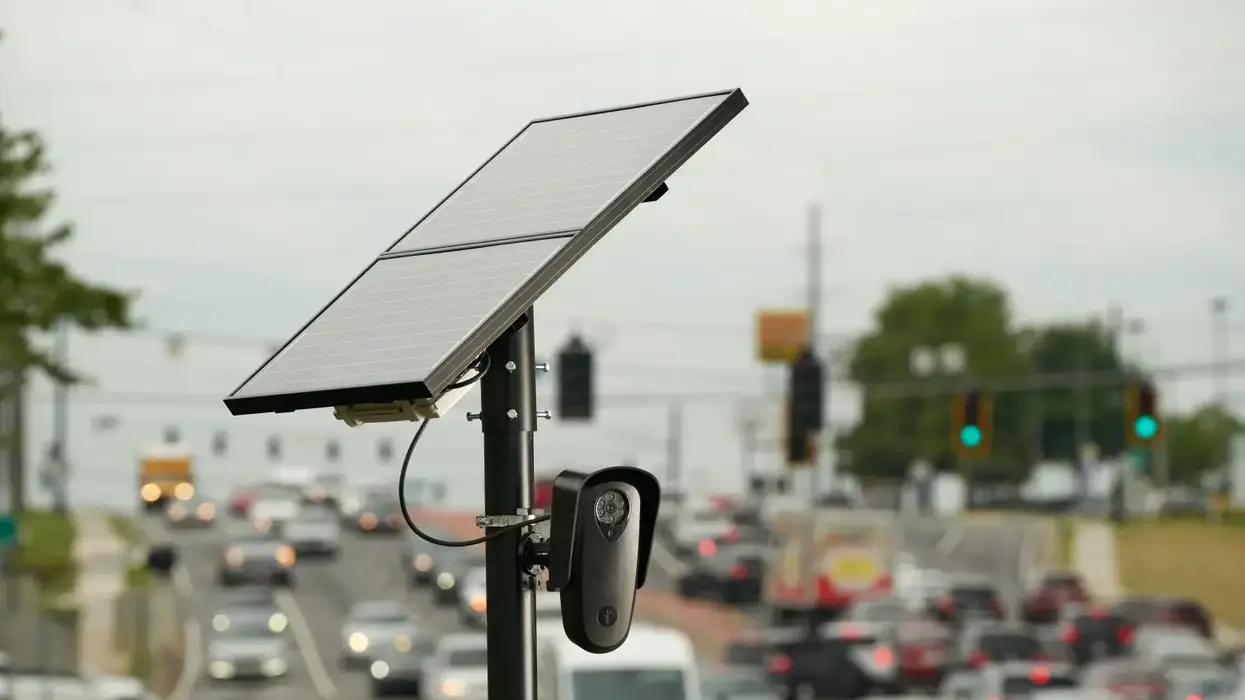
Police have used Flock cameras to stalk their exes, track abortion patients, and spy on protesters—among other abuses.
A new database launched Wednesday that details more than 100 cases of alleged abuse by law enforcement officers using Flock Safety's nationwide camera network is adding fresh urgency to the growing backlash against automated license plate readers.
The database, published by the Institute for Justice (IJ)—a libertarian nonprofit public interest law firm based in Arlington, Virginia—documents "romantic stalking, wrongful stops and detentions, non-law enforcement use, and other types of misconduct."
"Automated license plate readers (ALPRs) were sold to American communities as a targeted tool for catching car thieves and finding missing people," IJ said in an introduction to the database. "What they actually purchased has grown into something far broader and more frightening: an AI-powered network of cameras that photograph and log the movement of every driver who passes, whether or not they are suspected of any crime."
"Companies like Flock Safety have now blanketed thousands of communities with ALPRs, quietly assembling powerful mass surveillance systems that can reconstruct where people have been, when, and how often, all without a warrant," the institute continued. "This dragnet surveillance threatens the freedoms the Fourth Amendment was adopted to protect. These concerns aren’t just abstractions: Every day, innocent people are harmed by officials’ abuse and misuse of these ALPRs."
"When the government can track the everyday movements of ordinary people—to their jobs, their churches, their doctors, their protests—it holds a kind of power over private life that the Constitution does not allow," IJ added.
Among the cases highlighted in the database are those of a Florida sheriff's deputy who allegedly used an ALPR to track and pull over a woman after seeing her at a television shoot, a Texas deputy who reportedly searched tens of thousands of Flock cameras while trying to locate a woman who had allegedly obtained a medication abortion, and a Georgia police chief who reportedly tracked his former girlfriend and her teenage daughter hundreds of times.
The database's authors warn that even those 100-plus cases may represent only a fraction of the actual misconduct. Officers often provide vague explanations when searching ALPR databases, making systematic detection of abuse difficult. In one case in Norfolk, Virginia, for example, IJ found that three generic search terms accounted for nearly one-third of roughly 230,000 searches over two years. One officer repeatedly entered “la la la la” as a justification without apparently attracting scrutiny.
Growing public angst over ALPRs is increasingly transcending partisan lines. As Common Dreams reported last month, the backlash has prompted dozens of communities to cancel or reject Flock contracts. According to Ban Flock Cameras, 82 contracts across 28 states had been terminated between August 2021 and May 2026, including 39 cancellations during the first five months of this year alone.
"It's my professional opinion that Flock is a dystopian violation of our rights," Ohio State University professor Viet Trinh said Monday during a public safety audit in Columbus.
"What I mean by that is that it inverts the very nature of how police are supposed to function," he explained. "So in traditional investigations, a crime is supposed to happen first, and then detectives are supposed to identify a list of plausible suspects, and then those suspects are placed under investigation."
"But under Flock, we are all—everybody in this room, every day, every time we get into our cars—we are all under investigation at all times for all crimes," Trinh continued. "Then, when a crime actually does occur, the police have a list of pre-investigated suspects. That's you, that's me, that's everybody in this room who gets in a car, that's everybody in this city."
"So today in Columbus, our constitutional rights—especially our Fourth Amendment rights—are flagrantly violated every single day as a matter of regular government policy," he asserted.
Trinh contended that Flock "is not a tool for investigating crimes, and that misnomer has apparently bamboozled several people in this room."
"Flock is, at its very foundation, a tool for investigating pre-crimes," he stressed. "Not crimes, but pre-crimes."
"So others in this room have implied that we can reform Flock, we can have Flock and preserve our civil liberties, we can make this technology work for us," Trinh noted, adding that "it is not a technology that can be made righteous."
"On this matter, we cannot and we can never have our cake and eat it too," the professor added. "To believe otherwise is hubris."
Trump is more than willing to risk your rights and privileges for the sake of the America he desires. For a petty narcissist obsessed with revenge, section 702 of FISA is another dangerous and powerful tool for furthering his authoritarian agenda.
On April 17, Congress voted to pass a brief 10-day extension of section 702 of the Foreign Intelligence Surveillance Act, or FISA. This sets the new expiration date for April 30, 2026.
Section 702 was added to FISA in 2008 with a provision that requires Congress to periodically reauthorize it. The measure allows national security agencies like the National Security Agency (NSA), Federal Bureau of Investigation (FBI), and Central Intelligence Agency (CIA) to collect and monitor—without a warrant—any electronic communications sent to and from non-US persons “reasonably believed to be located” outside the US. Notably, Americans who send messages to people abroad may likewise have their data surveilled.
Law enforcement agencies have consistently abused this loophole to spy on US citizens in clear violation of their Fourth Amendment rights. The Brennan Center for Justice reports that, in recent years, the government has conducted warrantless “searches for the communications of 141 Black Lives Matter protesters; 19,000 donors to a congressional campaign; members of Congress; multiple US government officials, political commentators, and journalists; and tens of thousands of Americans engaged in ‘civil unrest.’”
Even President Donald Trump alleges being a victim of these “backdoor searches.” Ahead of the last renewal vote in April 2024, Trump posted on Truth Social, “KILL FISA, IT WAS ILLEGALLY USED AGAINST ME, AND MANY OTHERS. THEY SPIED ON MY CAMPAIGN!!! DJT.”
The Trump administration perfectly encapsulates the dangers that section 702 presents to the American public and the wider international community. Far from preventing terrorism, section 702 enables it.
Since returning to the White House, however, his tone has notably shifted. On April 15, Trump posted that Republicans must “UNIFY” to pass a “clean extension of FISA 702.” He continues, “While parts of FISA were illegally and unfortunately used against me in the Democrats’ disgraceful Witch Hunt and Attack in the RUSSIA, RUSSIA, RUSSIA Hoax, and perhaps would be used against me in the future, I am willing to risk the giving up of my Rights and Privileges as a Citizen for our Great Military and Country!”
Trump’s strong endorsement of section 702 is unsurprising. His administration has actively worked to undermine the rights and protections the Constitution guarantees. This includes: (i) subpoenaing social media sites to turn over the personal data of users who have criticized Immigration and Customs Enforcement; (ii) actively exploring a proposal to detain US citizens and deport them to prisons in El Salvador; (iii) violating states’ rights by threatening to cut funding to sanctuary cities as well as commandeering state and local officials to do the federal government’s bidding; (iv) working to disenfranchise voters via the election-rigging SAVE America Act; and (v) his administration’s efforts to restrict birthright citizenship, among many other examples.
Trump is more than willing to risk your rights and privileges for the sake of the America he desires. For a petty narcissist obsessed with revenge, section 702 is another dangerous and powerful tool for furthering his authoritarian agenda.
Already, Trump is actively exploiting section 702 to advance his illegal wars. On April 14, he posted, “Our Military desperately needs FISA 702, and it is one of the reasons we have had such tremendous SUCCESS on the battlefield, both in Venezuela and Iran.” These ‘successes’—or more accurately, war crimes and violations of international law—include kidnapping Venezuelan President Nicolás Maduro; assassinating Iran’s Ayatollah Ali Khamenei; and inciting a reckless war of choice that has seen the US and Israel deliberately target schools, hospitals, and residential buildings.
The Trump administration perfectly encapsulates the dangers that section 702 presents to the American public and the wider international community. Far from preventing terrorism, section 702 enables it.
To be clear, however, the reasons for ending section 702 go beyond the Trump administration. First, the measure undermines the very rationale for FISA. FISA was enacted in 1978 following the revelations of widespread warrantless surveillance under the Nixon administration. This included not only the infamous Watergate scandal, but also spying on anti-war protesters and civil rights activists under the guise that they were linked to foreign communist groups. FISA requires intelligence agencies to obtain authorization for electronic surveillance and other investigative actions. It also establishes the FISA court to oversee requests for surveillance warrants.
Section 702 bypasses these safeguards. Once the government collects a target’s data, the FBI and other agencies can search through it to find Americans’ phone calls, text messages, and emails without a warrant or approval from the FISA court. Section 702 allows the government to engage in the very kinds of Nixonian abuses FISA was designed to prevent.
Keeping in line with Trump’s interests, Johnson’s proposal would permit the federal government to continue its assault against the American public and the global community unimpeded.
In fact, section 702 originally grew out of a secret warrantless surveillance program authorized by the Bush administration following the 9/11 attacks. The New York Times exposed the Terrorism Surveillance Program (TSP) to the public in 2005, triggering a wave of lawsuits. In 2006, Judge Anna Diggs Taylor ruled that TSP violated FISA and the Constitution. Despite this, as the American Civil Liberties Union notes, “Congress weakened FISA in 2007 and then again in 2008 to permit the warrantless wiretapping that the law had previously prohibited.” Instead of shutting down Bush’s unconstitutional program, Congress effectively codified it.
Second, and relatedly, section 702 cannot be meaningfully reformed precisely because the measure is antithetical to FISA itself. In 2023, amid another FISA renewal debate, then-FBI director Christopher Wray told Congress that he was “especially concerned” about a proposal that would require the government to obtain a warrant or court order before accessing information obtained using section 702. He remarked that, “A warrant requirement would amount to a de facto ban, because query applications either would not meet the legal standard to win court approval; or because, when the standard could be met, it would be so only after the expenditure of scarce resources, the submission and review of a lengthy legal filing, and the passage of significant time.”
This makes sense. After all, the entire point of section 702 is to authorize a warrantless surveillance program. A warrant requirement would effectively render it useless.
More modest attempts at reform have been proposed and even implemented. The 2024 Reforming Intelligence and Securing America Act (RISAA), for instance, introduced a few provisions aimed at restricting backdoor searches. Yet, within a few months, the FBI was already violating those new requirements. While the Office of the Director of National Intelligence (ODNI) contends that RISAA has led to a steep decline in backdoor searches, the reality is that the FBI failed to track all such queries in 2024 and 2025. Whether RISAA has had any real impact is thus unknown. That said, even if a decline occurred, RISAA—and similar proposals—would still have failed at solving the fundamental problem: prohibiting warrantless government surveillance and mass data collection.
This is the dilemma reformists face: A warrant requirement is a “de facto ban,” but any other form of restrictions will, at best, only lessen the number of people whose constitutional rights are violated.
The proposed three-year extension unveiled by Speaker of the House Mike Johnson (R-La.) on April 23 is no better. It includes minimal new oversight and penalties for abusing the spy program, but no warrant requirements. As Senator Ron Wyden (D-Ore.) remarked: “Instead of ending warrantless surveillance or creating more transparency about government spying, this bill only requires a few more Trump administration officials to check a box. That always leads to more abuses, not less.” Keeping in line with Trump’s interests, Johnson’s proposal would permit the federal government to continue its assault against the American public and the global community unimpeded.
Third, while Trump and the CIA make sweeping claims about the terror attacks that section 702 has prevented, there is little publicly available evidence to support this. According to the Cato Institute, there is only one well-documented, independently corroborated case of section 702 preventing a terrorist attack on American soil: the 2009 New York subway bombing plot. In that case, section 702 was used by the NSA to track an exchange between an al-Qaeda courier and Najibullah Zazi, who was living in the US. The NSA passed this information to the FBI, which identified Zazi and disrupted the attack before it took place. Importantly, however, the NSA allegedly received the courier’s foreign email address from the government’s British Intelligence partners. At best then, this success was a byproduct of productive intelligence sharing between allies. Rather than proving the necessity of section 702, this incident underscores how Trump’s inane attacks against key US allies undermine our national security.
Congress should end section 702 and shift their focus to implementing more meaningful guardrails and oversight to FISA. At a time when constitutional rights are under unprecedented threat, Congress must act in the best interest of the public. While there’s still time, I urge everyone to contact their representatives and express their opposition to extending section 702.
"FISA 702 has been abused in shocking ways," said one campaigner. "If Congress genuinely cares about surveillance abuse, weaponization, and 'lawfare,' it needs to rein in this warrantless surveillance power."
Privacy advocates are backing a bipartisan bill introduced in the US Senate this week that's intended to protect Americans from warrantless government surveillance.
Sens. Dick Durbin (D-Ill.) and Mike Lee (R-Utah) unveiled the Security and Freedom Enhancement (SAFE) Act on Monday, in the wake of Politico reporting that President Donald Trump's White House "is quietly pushing for a key spy authority to be extended as is into 2027, according to five people granted anonymity to discuss the private talks."
There have long been arguments on Capitol Hill and beyond over Section 702 of the Foreign Intelligence Surveillance Act (FISA), which empowers the federal government to surveil electronic communications without a warrant. The law only allows for targeting foreigners outside the United States to acquire foreign intelligence information, but Americans' data is also collected.
Despite such arguments, Congress reauthorized Section 702 nearly two years ago, under then-President Joe Biden. That decision is set to expire on April 20, setting up a new battle over the spying power—hence the bill's introduction this week.
Under Durbin and Lee's proposal, the authority would be extended another two years, but government agencies must obtain a FISA Title I order or a warrant before accessing Americans' communications. As the pair noted in a statement, it also "closes the 'data broker loophole' that intelligence and law enforcement agencies use to buy their way around the Fourth Amendment" to the US Constitution, which bars unreasonable searches and seizures and details requirements for issuing warrants.
"Section 702 is a valuable tool to help keep our nation safe," said Durbin. "However, it's being used to conduct thousands of warrantless searches of Americans' private communications. That's unacceptable. Our bipartisan SAFE Act is a commonsense solution to continue protecting our country from foreign threats—while safeguarding Americans' civil liberties and privacy."
In a Tuesday statement welcoming the legislation, Demand Progress senior policy adviser Hajar Hammado highlighted that "right now, the government can freely troll through your private emails and texts swept up in 702 collections and this power has been abused to spy on everyday Americans, journalists, and even members of Congress."
"No government, whether it's run by Donald Trump and Stephen Miller or Joe Biden, should be able to do this," argued Hammado. According to Politico, Miller, the White House deputy chief of staff for policy and homeland security adviser, "is a leading advocate" for extending Section 702.
Hammado stressed that "the SAFE Act is a bipartisan solution to this problem, and all members of Congress should not support reauthorization without these critical reforms. We thank Sens. Lee and Durbin for their leadership on this bill and for modeling how Republicans and Democrats can come together to stop oppressive government overreach."
Jake Laperruque, deputy director of the Center for Democracy & Technology's Security & Surveillance project, also endorsed the bill in a Tuesday statement.
"FISA 702 has been abused in shocking ways," said Laperruque. "The FBI has misused it to snoop on protesters, lawmakers, journalists, judges, and campaign donors. If Congress genuinely cares about surveillance abuse, weaponization, and 'lawfare,' it needs to rein in this warrantless surveillance power."
"The SAFE Act includes bold FISA reforms, creates strong guardrails against surveillance misconduct, and has been meticulously crafted to protect national security," he continued. "With less than 10 weeks until FISA 702 expires, Congress should take up reform legislation quickly. Kicking the can on FISA would be a dereliction of duty."
A CDT-led coalition of privacy advocates across the political spectrum recently identified these as the four key issues to address in FISA reform. The SAFE Act effectively takes on all of them. With just SEVEN weeks until FISA 702 expires, we hope Congress will quickly take up this vital bill.
[image or embed]
— Jake Laperruque (@jakelaperruque.bsky.social) February 24, 2026 at 12:22 PM
Republicans have a narrow majority in both chambers of Congress but, due to Senate rules, generally need some Democratic support to send legislation to Trump's desk. However, the GOP could also run into trouble on this issue in the House of Representatives. As Politico pointed out last week:
Ultimately, there's no easy path to pass a clean extension in the House. One of the people with knowledge of the discussions said GOP leaders are "going to have a problem" trying to unite Republicans behind a special "rule" allowing for an up-or-down floor vote on a clean extension, which are typically party-line affairs.
But Republicans also believe that with Trump in office, a number of Democrats who previously supported leaving Section 702 intact will now support putting more fetters on intelligence agencies—making the alternative route, a two-thirds-majority bipartisan vote under suspension of the rules, all but impossible.
The latest Section 702 fight comes as Trump is under fire for his rising authoritarianism, from invasions of US cities targeting immigrants to his sweeping assault on First Amendment rights, including reported federal watch lists to track and categorize US citizens—especially activists and protesters—as "domestic terrorists."
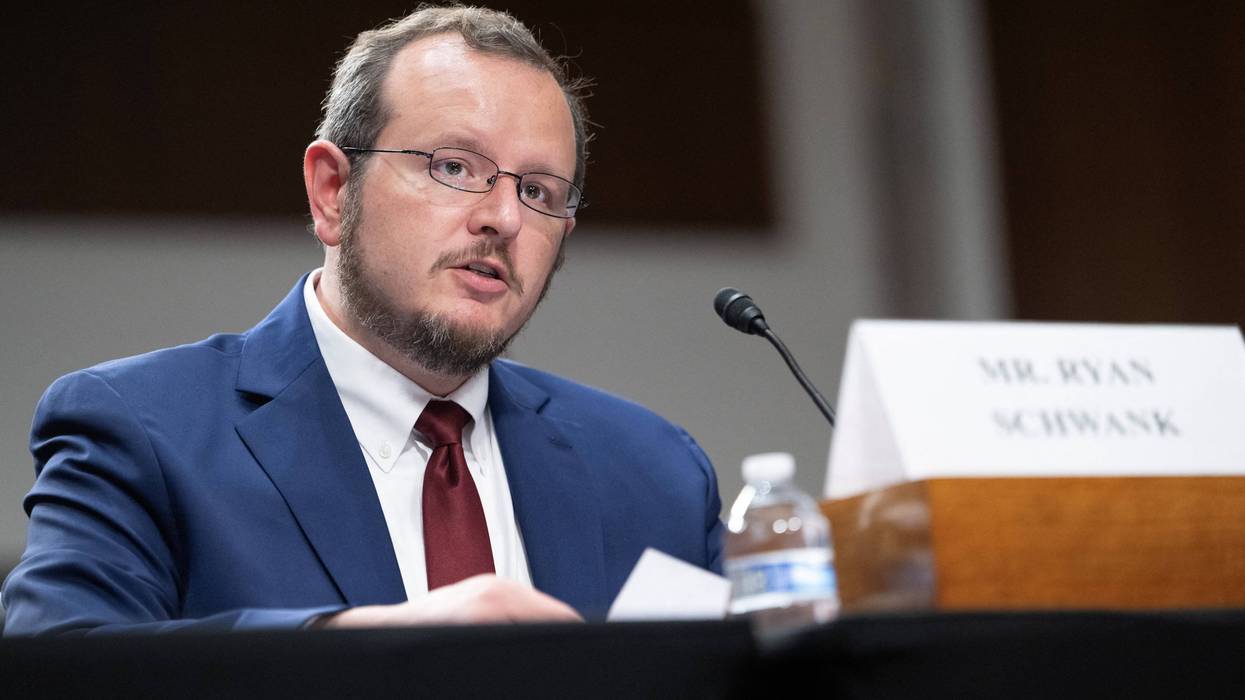
"Never in my career had I ever received such a blatantly unlawful order," said Ryan Schwank, who blew the whistle last month on a "secretive" ICE memo directing agents to enter homes without judicial warrants.
US Immigration and Customs Enforcement is "lying to Congress and the American people" and directing new recruits to "violate the Constitution," according to a whistleblower who testified on Capitol Hill Monday.
Ryan Schwank, a former ICE lawyer who worked at the federal government’s law enforcement training academy, stepped down from his post last week after submitting a whistleblower complaint about an agency policy directing agents to enter homes and arrest people without a judge's warrant.
"I swore an oath to uphold the Constitution," Schwank said at a joint forum on ICE's constitutional violations hosted by Senate and House Democrats. "I followed that oath for four-and-a-half years, working side by side with ICE officers. And I followed it when I resigned on February 13, 2026, a little over a week ago, so I could speak to you today."
He had joined ICE in 2021 as a senior lawyer for the agency, tasked with advising agents on immigration laws and the Constitution. In September 2025, amid President Donald Trump's "surge" in recruitment to carry out his "mass deportation" crusade, Schwank became an instructor for new recruits at the ICE Academy at the Federal Law Enforcement Training Center in Georgia.
"On my first day," Schwank said, "I received secretive orders to teach new cadets to violate the Constitution by entering homes without a judicial warrant."
Schwank said he was “instructed to read and return a memo" that claimed ICE agents had this power in the presence of his supervisor. “Before I was shown this memo, my supervisor warned me that two previous ICE instructors had been dismissed because they questioned senior ICE management over the legality of the memo.”
That memo, which was sent to US Department of Homeland Security (DHS) officials in May, was revealed to the Senate last month through a whistleblower disclosure by Schwank and another official whose identity has not yet been made public.
“The acting ICE director authorized the very conduct that DHS—in 2025 legal training materials—has called ‘the chief evil against which the wording of the Fourth Amendment is directed’—that is, ‘physical entry of the home’ without consent or a proper warrant,” Schwank said.
His testimony confirms previous reporting from the Associated Press, which found that these orders were distributed in a highly unusual way: DHS officials like Schwank were shown the memo before being required to return it to their supervisors and relay the information verbally to new recruits without showing them the directive.
Under this new directive, the whistleblower report said “newly hired ICE agents—many of whom do not have a law enforcement background—are now being directed to rely solely on” an administrative warrant drafted and signed by an ICE official to enter homes and make arrests.
“No court has ever found that any law enforcement has this type of authority to enter homes without a judicial warrant under such circumstances,” said David Kligerman, the senior vice president and special counsel for Whistleblower Aid, the group that sent the disclosure to Congress.
“Never in my career had I ever received such a blatantly unlawful order—nor one conveyed in such a troubling manner,” Schwank said on Monday. “I was being shown this memo in secret by a supervisor who made sure that I understood that disobedience could cost me my job. ICE is teaching cadets to violate the Constitution, and they were attempting to cloak it in secrecy.”
Schwank also said that top ICE and DHS officials were deceiving Congress and the public when they claimed that the new officers and agents brought on as part of the agency's hiring spree were receiving the same basic training as in the past, even as agency syllabi showed that their training hours had been slashed by about 40%.
Testifying before Congress earlier this month, ICE's acting director, Todd Lyons, said that while hours have been cut, “The meat of the training was never removed."
"This is a lie,” Schwank said. “ICE made the program shorter, and they removed so many essential parts that what remains is a dangerous husk. No reasonable person would believe a training program suddenly cut nearly in half could meet the minimum legal requirements.”
The Trump administration has said the reduction of ICE training by more than 240 hours was mostly the result of eliminating Spanish-language classes.
However, according to dozens of pages of internal documents released by Senate Democrats, which were reviewed by the New York Times, the agency's February syllabus had also eliminated classes about the proper use of force, handling the property of detainees, filling out paperwork alleging someone is in the United States without authorization, taking a "victim-centered approach," and "integrity awareness training."
The number of exams agents must take has also been drastically reduced, from 25 in 2021 down to just nine. Some of the exams no longer required are ones on "Judgment Pistol Shooting” and “Determine Removability,” which the Times said was "a reference to how agents decide if people they encounter have legal status in the United States."
Schwank’s testimony comes after immigration agents shot and killed three United States citizens in recent weeks, causing heightened scrutiny of ICE and other DHS agencies. Since Trump's second inauguration on January 20, at least 32 people have been shot by agents, resulting in nine deaths.
In areas where ICE has been surged, such as Minnesota—which was swarmed by around 3,000 agents late last year—numerous instances have been documented of what appear to be uses of unnecessary force, racial profiling, and violations of constitutional rights.
“I am here because I am duty-bound to report the legally required training program at the ICE academy is deficient, defective, and broken,” Schwank said. “Deficient training can and will get people killed... It can and will lead to unlawful arrests, violations of constitutional rights, and fundamental loss of public trust in law enforcement.”
Schwank's testimony came as a partial shutdown of DHS entered its second week, after Democrats refused to fund the agency without significant reforms to ICE, including requirements that they obtain judicial warrants and carry out their duties without masks.
Sen. Richard Blumenthal (D-Conn.), who chaired Monday's panel, said he hopes Schwank's testimony will encourage other whistleblowers to come forward.
“We know about the Trump administration’s decimation of training for immigration officers and its secret policy to shred your Constitutional rights because of the brave Americans who are speaking out today,” Blumenthal said. “They are coming to Congress because we have the responsibility to not only bear witness to these crimes, but to do something to make sure they don’t happen again.”
“To anyone else who is repulsed by what you’re seeing or what authorities are asking you to do, please know that you can make a real difference by coming forward," he added. "You’ll meet a moral imperative. Our door is open, we are here for you when you are ready, and we will do everything within our power to protect your rights.”
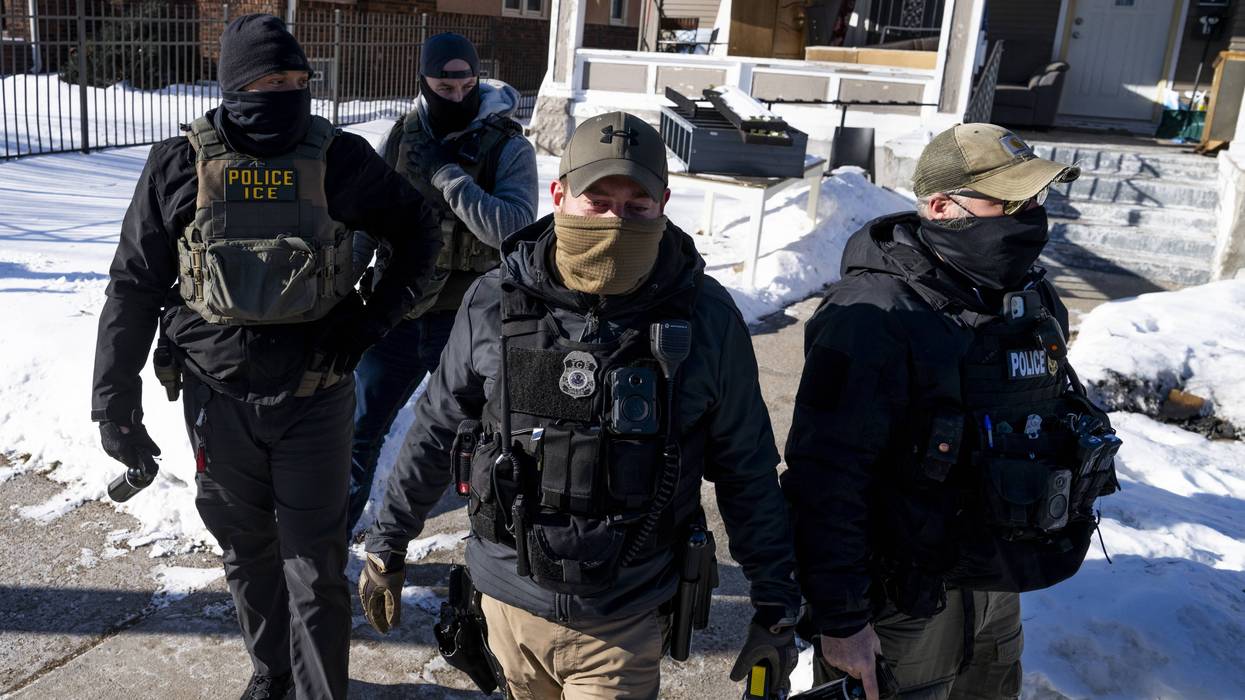
"This memo bends over backwards to say that ICE agents have nothing but green lights to make an arrest without even a supervisor’s approval," said one former ICE official.
An internal legal memo obtained by the New York Times reveals that federal immigration enforcement agents are claiming broad new powers to carry out warrantless arrests.
The Times reported on Friday that the memo, which was signed by US Immigration and Customs Enforcement (ICE) Acting Director Todd Lyons, "expands the ability of lower-level ICE agents to carry out sweeps rounding up people they encounter and suspect are undocumented immigrants, rather than targeted enforcement operations in which they set out, warrant in hand, to arrest a specific person."
In the past, agents have been granted the power to carry out warrantless arrests only in situations where they believe a suspected undocumented immigrant is a "flight risk" who is unlikely to comply with obligations such as appearing at court hearings.
However, the memo declares this standard to be “unreasoned” and “incorrect,” saying that agents should feel free to carry out arrests so long as the suspect is "unlikely to be located at the scene of the encounter or another clearly identifiable location once an administrative warrant is obtained."
Scott Shuchart, former head of policy at ICE under President Joe Biden, told the Times that the memo appears to open the door to give the agency incredibly broad arrest powers.
"This memo bends over backwards," Shuchart said, "to say that ICE agents have nothing but green lights to make an arrest without even a supervisor’s approval."
Claire Trickler-McNulty, former senior adviser at ICE during the Biden administration, said the memo's language was so broad that "it would cover essentially anyone they want to arrest without a warrant, making the general premise of ever getting a warrant pointless."
Aaron Reichlin-Melnick, senior fellow at the American Immigration Council, noted in a social media post that the memo appears to be a way for ICE to "get around an increasing number of court orders requiring [US Department of Homeland Security] to follow the plain words of the law which says administrative warrantless arrests are only for people 'likely to escape.'"
The memo broadens the terms, Reichlin-Melnick added, so that "anyone who refuses to wait for a warrant to be issued" is deemed "likely to escape."
Stanford University political scientist Tom Clark questioned the validity of the memo, which appears to directly conflict with the Fourth Amendment of the US Constitution, which requires search warrants as a protection against "unreasonable searches and seizures."
"So, here’s how the law works," he wrote. "People on whom it imposes constraints don’t get to just write themselves a memo saying they don’t have to follow the law. Maybe I’ll write myself a memo saying that I don’t have to pay my taxes this year."
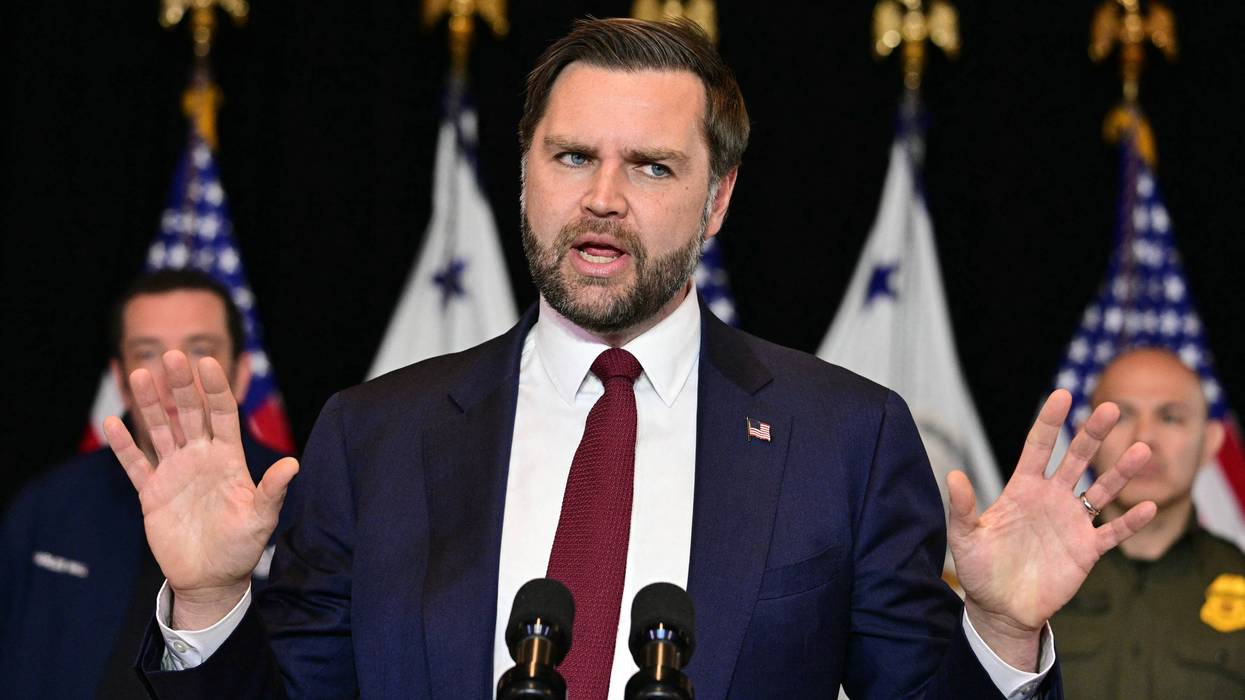
Vance claimed he never said agents had "absolute immunity," that the government was investigating the shooting of Renee Good, and that ICE agents weren't entering homes without judges' warrants. None of it was true.
Vice President JD Vance is being called out by legal experts and other critics who say he lied voluminously on Thursday in response to questions about his past claims that immigration agents enjoyed “absolute immunity,” about whether they are now illegally entering residences without warrants, and about the shooting of Renee Good.
Vance was peppered with questions during a press conference after meeting with Immigration and Customs Enforcement (ICE) agents in Minneapolis, where their conduct has been met with growing backlash in recent weeks, following the shooting of Good on January 7 by agent Jonathan Ross and other violent and unconstitutional actions that have been documented since.
Shortly after the shooting, in a rush to clear Ross of any wrongdoing, Vance made the highly dubious claim that because Ross was "a federal law enforcement official engaging in federal law enforcement action,” he is therefore "protected by absolute immunity."
Legal scholars immediately called out the concept of "absolute immunity" as a fiction that does not refer to any recognized statute.
But despite those remarks having been widely publicized just weeks ago, when asked about them again on Thursday, Vance pretended he never made such a claim.
"No, I didn't say—and I don't think any other official within the Trump administration said that officers who engaged in wrongdoing would enjoy immunity. That's absurd," he said. "What I did say is that when federal law enforcement officers violate the law, that is typically something that federal officials would look into."
"But of course we're going to investigate these things," Vance continued. "We're investigating the Renee Good shooting. But we're investigating them in a way that respects people's rights and ensures that if somebody did something wrong, yes, they're going to face disciplinary action. But we're not going to judge them in the court of public opinion."
In reality, the administration repeatedly said it is not pursuing a criminal investigation into Ross. According to a report from the Washington Post earlier this week, the FBI opened an initial probe into the shooting, and an agent in Minnesota found that "sufficient grounds" existed to open a civil rights probe into Ross, but DOJ officials chose not to pursue it.
Deputy Attorney General Todd Blanche confirmed last week that the DOJ was not investigating the case. “We don’t just go out and investigate every time an officer is forced to defend himself against somebody putting his life in danger. We never do,” he said.
Meanwhile, the Trump administration's officials have repeatedly "judged" the case in the court of public opinion by routinely making statements justifying the shooting, with Vance himself praising Ross for "doing his job" and others in the administration referring to Good as a "domestic terrorist."
While it is not investigating Ross for shooting Good, the DOJ is reportedly investigating Good's widow, Becca Good, over the couple's involvement in monitoring and protesting ICE's actions in Minneapolis, which prompted six federal prosecutors with the DOJ to resign in outrage last week.
Xochitl Hinojosa, a former head of public affairs at the DOJ, found Vance's claim that the shooting was being investigated to be in total contradiction to everything else the administration has said about the case.
"Todd Blanche says no criminal civil rights investigation into the shooting of Renee Good. Vance says today they are investigating the incident," she said. "So who exactly is investigating the incident? Because this would normally be the DOJ or the FBI."
While those claims were self-evidently false, legal scholars noted a more "pernicious" lie by Vance in response to a question about a report earlier this week that ICE had issued a memo allowing agents to forcibly enter homes without a judge's warrant, which has been described as a violation of the Fourth Amendment of the US Constitution.
Asked if the memo, which was first reported on by the Associated Press, violated the Constitution, Vance responded that the story was "missing a whole lot of context" and that what ICE and other agencies proposed was that "we can get administrative warrants to enforce administrative immigration law."
"Nobody is talking about doing immigration enforcement without a warrant. We're talking about different types of warrants that exist in our system," Vance went on. "Typically, in the immigration system, those are handled by administrative law judges. So we're talking about getting warrants from those administrative law judges... That's very consistent with the practice of American law."
Rob Doar, a Minnesota-based criminal defense and civil rights attorney, said that Vance had gotten "just about everything wrong" in his explanation.
"Immigration judges are not [administrative law judges]. They don’t issue warrants," Doar said. "ICE 'administrative warrants' are signed by ICE officers, not judges. They do not authorize home entry. Only a judicial warrant does."
Ryan Goodman, a law professor at New York University and the co-editor-in-chief of Just Security said it was a case of "pernicious wordplay by Vance."
The Department of Homeland Security "is doing immigration enforcement in people's homes without a judicial warrant," he said. "Our system—the Fourth Amendment—requires a judicial warrant."
Joe Mastrosimone, a law professor at Washburn University in Kansas, was amazed that a lawyer of Vance's pedigree could be so inaccurate.
"Good Lord," he wrote on social media. "Did JD Vance actually attend and graduate from Yale Law School? He seems to be a really bad lawyer... This is really basic stuff."
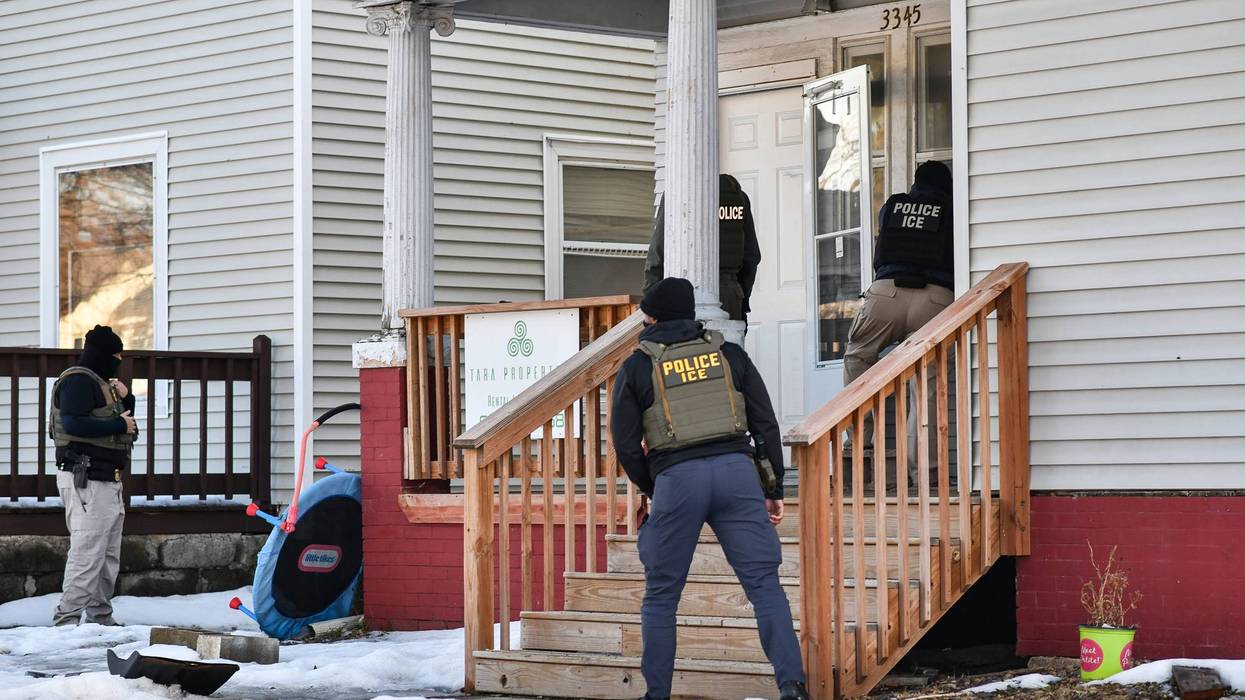
"Every American should be terrified by this secret ICE policy authorizing its agents to kick down your door and storm into your home," said Sen. Richard Blumenthal, demanding congressional hearings.
"The United States government is looking for ways around that pesky Fourth Amendment," an investigative journalist said of Wednesday reporting by the Associated Press on an internal US Immigration and Customs Enforcement memo claiming that ICE agents can forcibly enter a private residence without a judicial warrant, consent, or an emergency.
The Fourth Amendment to the US Constitution states, "The right of the people to be secure in their persons, houses, papers, and effects, against unreasonable searches and seizures, shall not be violated, and no warrants shall issue, but upon probable cause, supported by oath or affirmation, and particularly describing the place to be searched, and the persons or things to be seized."
ICE's May 12 memo, part of a whistleblower disclosure obtained by the AP, says that "although the US Department of Homeland Security (DHS) has not historically relied on administrative warrants alone to arrest aliens subject to final orders of removal in their place of residence, the DHS Office of the General Counsel has recently determined that the US Constitution, the Immigration and Nationality Act, and the immigration regulations do not prohibit relying on administrative warrants for this purpose."
The January 7 disclosure was sent to the US Senate by the group Whistleblower Aid, which is "keeping the whistleblowers' identities anonymous even from oversight investigators," according to the document. It notes that despite being addressed to "All ICE Personnel," the seemingly unconstitutional memo "has not been formally distributed to all personnel."
Instead, it "has been provided to select DHS officials who are then directed to verbally brief the new policy for action. Those supervisors then show the memo to some employees, like our clients, and direct them to read the memo and return it to the supervisor," the disclosure details. "Newly hired ICE agents—many of whom do not have a law enforcement background—are now being directed to rely solely on" an administrative warrant drafted and signed by an ICE official to enter homes and make arrests.
Yeah, why could anyone think that ICE fits the description of the Gestapo?apnews.com/article/ice-...
[image or embed]
— Dan Sohege (@danielsohege.bsky.social) January 21, 2026 at 4:48 PM
Asked about the May 12 memo, signed by acting ICE Director Todd Lyons, Homeland Security spokesperson Tricia McLaughlin told the AP that everyone DHS serves with an administrative warrant has already had "full due process and a final order of removal," and the US Supreme Court and Congress have "recognized the propriety of administrative warrants in cases of immigration enforcement."
However, as Whistleblower Aid senior vice president and special counsel David Kligerman stressed in a Wednesday statement, "no court has ever found that ICE agents have such legal authority to enter homes without a judicial warrant."
"This administration's secretive policy advocates conduct that the Supreme Court has described as 'the chief evil against which the wording of the Fourth Amendment is directed'—that is the warrantless physical entry of a home," he noted. "This is precisely what the Fourth Amendment was created to prevent."
"If ICE believes that this policy is consistent with the law, why not publicize it?" he asked. "Perhaps they've hidden it precisely because it cannot withstand legal scrutiny. Policies which impact fundamental constitutional rights, particularly one which the Supreme Court has called the greatest of equals among the Bill of Rights, should be discussed openly with the American people. It cannot be undone by hidden policy memos."
They just make up bullshit, bad-faith legal theories, do what they want until a court stops them, then lather, rinse, and repeat. In the meantime, they get to terrorize people. And nothing will happen to any of those responsible.Our courts are not equipped to deal with this.
[image or embed]
— Radley Balko (@radleybalko.bsky.social) January 21, 2026 at 5:14 PM
Other lawyers, journalists, and critics responded similarly to the AP's reporting on social media. Alejandra Caraballo of the Harvard Law Cyberlaw Clinic declared that "the Fourth Amendment literally exists to prevent this."
Bradley P. Moss, an attorney specializing in litigation related to national security, federal employment, and security clearance law, said, "Remember when the Fourth Amendment was still a thing?"
American Immigration Council senior fellow Aaron Reichlin-Melnick wrote: "It has been accepted for generations that the only thing which can authorize agents to break into your home is a warrant signed by a judge. No wonder ICE hid this memo!"
"This is the Trump administration trashing the Fourth Amendment to the Constitution in pursuit of its mass deportation agenda," he continued, highlighting a footnote that suggests "they won't even rule out authorizing home invasions with no judicial warrant for people not even ordered removed!"
"In short, this secret memo explains SO MUCH of what we've been seeing over the last months, including this raid of a home in Minneapolis where ICE officers presented no judicial warrant before breaking in the door," he said. "Turns out they were secretly told they don't need one!"
While Reichlin-Melnick shared photos of a scene in which armed immigration agents used a battering ram to enter a Minneapolis home and arrest a Liberian man, federal agents also recently broke down the door of a residence in neighboring Saint Paul, Minnesota, and arrested ChongLy "Scott" Thao, a US citizen who was later freed.
The AP reporting and responses to the leaked memo came as the Trump administration on Wednesday surged immigration agents to Maine for what it dubbed "Operation Catch of the Day," mirroring the federal deployment to not only Minnesota—where ICE officer Jonathan Ross fatally shot Renee Good, a US citizen, in her vehicle earlier this month—but also Illinois and California.
US Sen. Richard Blumenthal (D-Conn.), ranking member of the Permanent Subcommittee on Investigations, opened an inquiry into reports of unconstitutional detentions of US citizens by immigration agents in October and on Wednesday demanded answers about the new whistleblower disclosure.
Blumenthal sent lists of questions and requests for records to Lyons and US Homeland Security Secretary Kristi Noem as well as Benjamin C. Huffman, director of the Federal Law Enforcement Training Centers. The senator also wrote to Senate Committee on Homeland Security and Governmental Affairs Chair Rand Paul (R-Ky.) and Judiciary Committee Chair Chuck Grassley (R-Iowa), urging them to call the ICE and DHS leaders to testify before their panels.
"Every American should be terrified by this secret ICE policy authorizing its agents to kick down your door and storm into your home," Blumenthal said in a statement. "It is a legally and morally abhorrent policy that exemplifies the kinds of dangerous, disgraceful abuses America is seeing in real time."
"In our democracy, with vanishingly rare exceptions, the government is barred from breaking into your home without a judge giving a green light," he continued. "Government agents have no right to ransack your bedroom or terrorize your kids on a whim or personal desire. I am deeply grateful to brave whistleblowers who have come forward and put the rights of their fellow Americans first."
"My Republican colleagues who claim to value personal rights against government overreach now have an opportunity and obligation to prove that rhetoric is real," the senator added. "They must hold hearings and join me in demanding the Trump administration answer for this lawless policy."
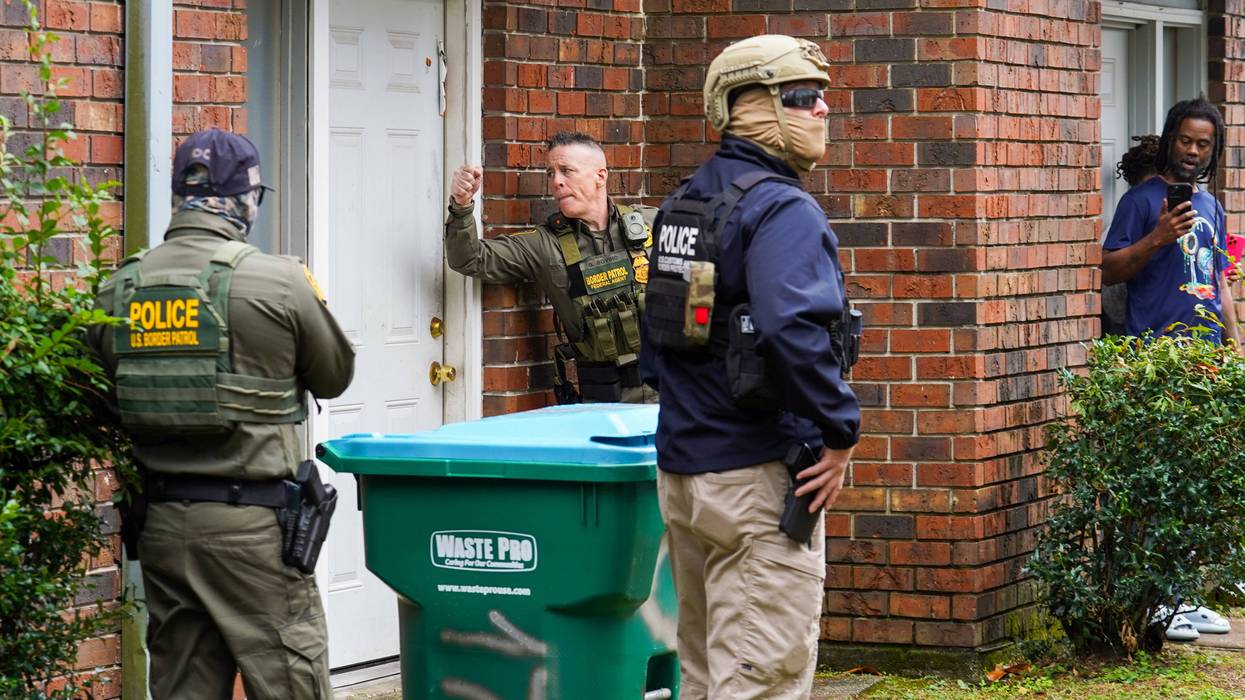
"This is starting to look disturbingly like Germany in the 1930s."
Just hours after an Immigration and Customs Enforcement officer shot and killed an unarmed US citizen in Minneapolis on Wednesday, Vice President JD Vance said the agency would soon be going "door to door" across the country to escalate the Trump administration's mass deportation crusade in the coming year.
In an interview on Fox News with host Jesse Watters, Vance boasted that during Trump's first year back in power, the administration had gotten "2.5 million illegal aliens out" of the country, "without any of the really big marquee things that we've been working on."
Notably, only about 600,000 of these have been through formal deportations, while the rest have been through what the White House claims are "self-deportations." Despite claims to the contrary, the vast majority of those detained by ICE have had no criminal records. Many have been legal residents, green card holders, and asylum seekers following the legal process.
ICE’s budget is expected to triple in 2026 following the passage of Republican budget legislation last year that has allowed it to launch what it calls a “wartime recruitment” strategy, hiring as many as 10,000 new officers with minimal training. Last week, the Washington Post reported that the agency had earmarked $100 million toward online recruitment advertisements, meant to draw in “people who have attended UFC fights, listened to patriotic podcasts, or shown an interest in guns and tactical gear.”
Vance continued, "I think we're going to see those [deportation] numbers ramp up as we get more and more people online and working for ICE, going door to door and making sure that if you're an illegal alien, you've got to get out of this country, and if you want to come back, apply through the proper channels."
Vance’s comments came shortly after news broke that an ICE agent had fatally shot 37-year-old Renee Nicole Good, a Minneapolis resident and widowed mother of three children, as she attempted to drive away from the scene in her car. Good was at the scene as a legal observer following a surge of more than 2,000 ICE agents to the city.
The Trump administration has stood by the ICE shooter and described Good as a "domestic terrorist" who attempted to run over the agent in her car. But video evidence contradicts this claim, showing Good attempting to pivot her car away from the agents and only accelerating the vehicle after shots were fired, while the agent walked away from the incident unharmed.
Especially in light of the extrajudicial killing of an American citizen who was legally observing agents, Vance’s comments about ICE going “door to door” to homes in the coming year sounded ominous to many.
"Door to door?" asked one incredulous social media user. "The Fourth Amendment still exists. This is starting to look disturbingly like Germany in the 1930s."
"Under the Fourth Amendment, federal agents are generally not allowed to stop someone unless they have good reason to suspect that they are breaking laws," explained Jesse Franzblau, the associate director of policy at the National Immigrant Justice Center, during a House Homeland Security Committee hearing in November. "Yet a growing number of people, many of them Latinx, have reported being targeted, harassed, and detained by ICE and CBP agents solely because of their race."
The Supreme Court has repeatedly reaffirmed that Fourth Amendment protections are strongest in the home, where the government is required to obtain a judicial warrant before entering private residences. However, in many cases, ICE has flouted these rules when carrying out arrests.
"Whether you’re left or right, the thought of living in an America where the government goes 'door to door,' and that those words actually came out of the vice president of the United States’ mouth, should worry you deeply," said Simon Samano, an editor at USA Today.
The Trump administration has increasingly promoted the idea of using ICE to target American citizens. The administration has pledged to strip citizenship from as many as 200 naturalized citizens per month in 2026, a tenfold increase from previous years. Trump and his allies have suggested using denaturalization to kick out some of his top critics, including the Somali-born Rep. Ilhan Omar (D-Minn.) and New York City's first Muslim mayor, Zohran Mamdani.
Last week, a post by the Department of Homeland Security (DHS), which oversees ICE, glorified the idea of Trump carrying out "100 million deportations," which, if realized, would necessitate the stripping of citizenship from tens of millions of naturalized and US-born citizens. According to a YouGov poll published last week, the majority of Republican voters support the idea of deporting over a fourth of the country.
In October, ProPublica reported that at least 170 US citizens had been wrongly detained in immigration custody since Trump returned to office last January. Meanwhile, Gregory Bovino, the commander at large of the Border Patrol, has previously suggested that US citizens must be prepared to prove their citizenship at a moment's notice if stopped by immigration agents.
Yet on Wednesday, even after an agent shot a US citizen in cold blood, Homeland Security Secretary Kristi Noem, clad in an oversized cowboy hat, assured the public that “anyone who is a citizen of this country or is here legally has nothing to fear.”
Hours after Good was shot, another group of agents, including Bovino, were filmed demanding the identification of another driver, a Somali man who said he was an Uber driver waiting to pick up a passenger at the Minneapolis airport, asking him to prove his US citizenship.
One of the agents was heard telling the man he did not believe he was a US citizen because "I can hear you don’t have the same accent as me.”

Trump is aping King George III in attacking constitutional restraints on unreasonable searches and seizures.
Suppose the police want to get illegal drugs off the streets, and they believe Black and brown people most likely to be carrying and selling drugs.
One way the cops could go about suppressing drugs would be stopping most of the Black and brown people on the streets (at gunpoint, since drug dealers might be armed); lean them up against a wall; frisk them; and search their pockets, wallets, and hand bags. They could also force their way into every house on the street to search for drugs.
The great majority of people frightened, humiliated, and invaded wouldn’t be criminals. But the police would likely seize some drugs and arrest some dealers.
Can they do that?
The United States Constitution affords a clear answer: No.
The assault in Chicago was what the Framers of our Constitution feared and what they hoped our Bill of Rights could thwart. But a Constitution is not self defending.
The Fourth Amendment to the Constitution provides, “The right of the people to be secure in their persons, houses, papers, and effects, against unreasonable searches and seizures, shall not be violated...”
And further: “No Warrants shall issue, but upon probable cause, supported by Oath or affirmation, and particularly describing the place to be searched, and the persons or things to be seized.”
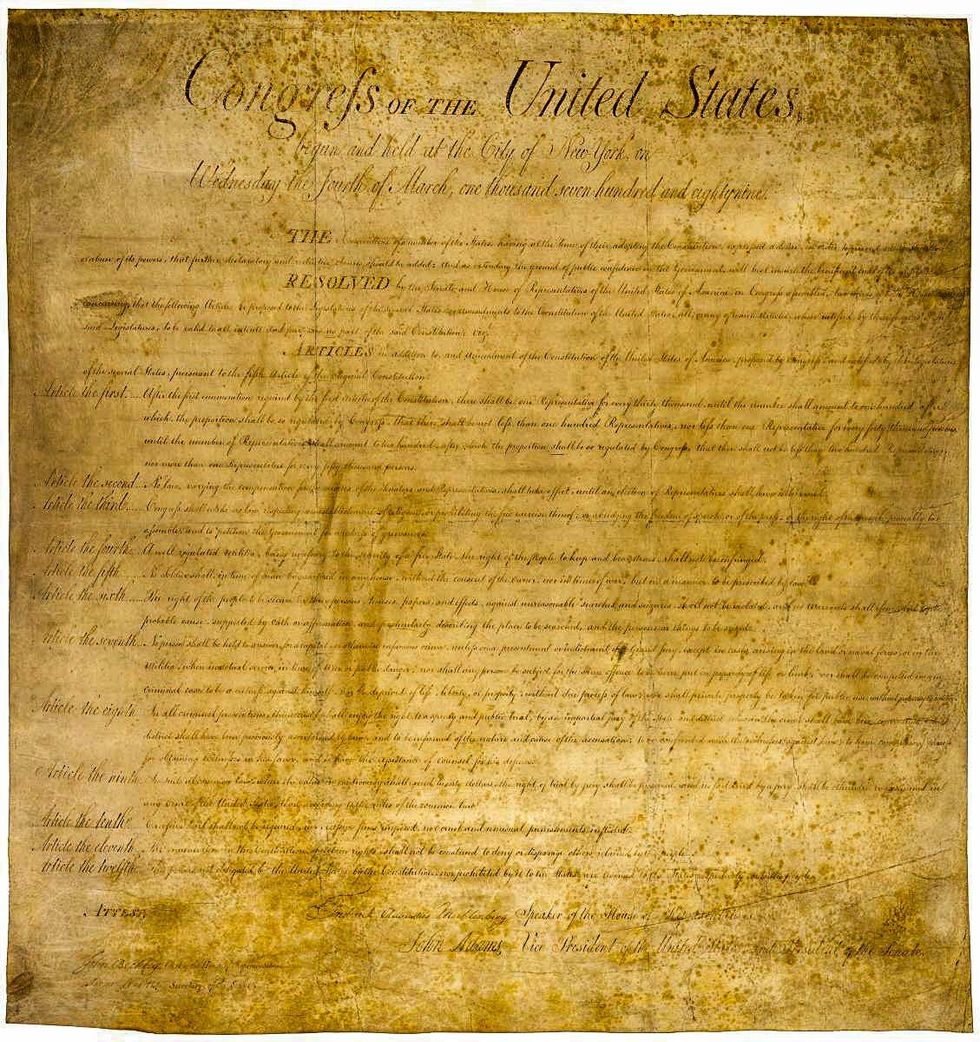 The Joint Resolution of Congress that sent the Bill of Rights to the states in 1789 is shown.
This means you’ve got a right to be left alone unless the police present evidence showing that there’s a strong chance you’ve committed a crime, and a judge issues a warrant.
How’s the Fourth Amendment doing these days?
Not too well. For years, right-wingers attacked these rights as “technicalities” for freeing criminals when the cops ignored the Fourth. But those who wrote our Constitution knew alleged crime could be an excuse for abuses, and they valued security from searches and seizures highly. Indeed, the King of England’s defilement of such rights was “one of the driving forces behind the American Revolution itself,” the Supreme Court has explained.
“The Fourth Amendment was the founding generation’s response” to supposed law enforcement “which allowed British officers to rummage through homes in an unrestrained search for evidence of criminal activity."
The abuses that provoked the American Revolution are no longer ancient history. In the name of fighting “chaos” and an imaginary crime wave, President Donald Trump has launched a broad assault on the Fourth Amendment as part of substituting a Trump-loyal, federal, militarized force for local civilian control of law enforcement.
Trump has openly proclaimed his militaristic intentions, threatening, “Chicago about to find out why it’s called the Department of WAR.” Immigration and Customs Enforcement (ICE) commandos conducted a military assault on a five-story apartment building in Chicago. There was no attempt to persuade a judge that anyone—let alone everyone in the building—was likely a criminal, and no judge issued any warrants.
ICE agents dropped from Black Hawk helicopters onto the roof of the building. Then, as reported by Time magazine, “agents worked their way through the building, kicking down doors and throwing flash bang grenades, rounding up adults and screaming children alike, detaining them in zip-ties.”
The ICE agents seized everyone in the building. They pointed guns in the faces of citizens, handcuffed them and held them for hours. “Photos of the aftermath,” reported Time, “show toys and shoes littering the apartment hallways that were left in the chaos as people were pulled from their beds.”
Trump’s excuses for militarization are falsehoods. For example, a Trump-appointed federal judge recently held that Trump’s claim that Portland, Oregon, was “war ravaged” was “simply untethered to the facts.”
In his September 30 speech to 800 generals and admirals, Trump asserted, “America is under invasion from within” and signaled his intent to “use some of these dangerous cities as training grounds for our military.” The Chicago apartment building action occurred the same day, and may be a model of the “training” Trump favors.
 A painting of King George III is shown. (Painting by Allan Ramsay)
In recent months a series of national demonstrations have embodied the theme, “No Kings!” Aptly so.
One of the complaints listed against King George III in the Declaration of Independence, and a reason for separating from England, was: “He has affected to render the Military independent of and superior to the Civil power.”
The assault in Chicago was what the Framers of our Constitution feared and what they hoped our Bill of Rights could thwart. But a Constitution is not self defending.
As Trump muses over an unconstitutional third term (“A lot of people want me to do it”), uses the summary execution of alleged drug smugglers as a model of military power, and invokes pretend uprisings to justify federalizing the National Guard, the danger is real and imminent. But we defeated a King in 1783 and—if we all recognize the danger and are prepared to stand up for our democracy—we can do it again.

The public must be vigilant about those who claim vigilance as a mandate without bounds. A republic cannot outsource its conscience to machines and contractors.
The feed has eyes. What you share to stay connected now feeds one of the world’s largest surveillance machines. This isn’t paranoia, it’s policy. You do not need to speak to be seen. Every word you read, every post you linger on, every silence you leave behind is measured and stored. The watchers need no warrant—only your attention.
Each post, like, and photograph you share enters a room you cannot see. The visible audience, friends and followers, is only the front row. Behind them sit analysts, contractors, and automated systems that harvest words at scale. Over the last decade, the federal security apparatus has turned public social media into a continuous stream of open-source intelligence. What began as episodic checks for imminent threats matured into standing watch floors, shared databases, and automated scoring systems that never sleep. The rationale is familiar: national security, fraud prevention, situational awareness. The reality is starker: Everyday conversation now runs through a mesh of government and corporate surveillance that treats public speech, and the behavior around it, as raw material.
You do not need to speak to be seen. The act of being online is enough. Every scroll, pause, and click is recorded, analyzed, and translated into behavioral data. Algorithms study not only what we share but what we read and ignore, and how long our eyes linger. Silence becomes signal, and absence becomes information. The watchers often need no warrant for public content or purchased metadata, only your connection. In this architecture of observation, even passivity is participation.
This did not happen all at once. It arrived through privacy impact assessments, procurement notices, and contracts that layered capability upon capability. The Department of Homeland Security (DHS) built watch centers to monitor incidents. Immigration and Customs Enforcement folded social content into investigative suites that already pull from commercial dossiers. Customs and Border Protection (CBP) linked open posts to location data bought from brokers. The FBI refined its triage flows for threats flagged by platforms. The Department of Defense and the National Security Agency fused foreign collection and information operations with real-time analytics.
Little of this resembles a traditional wiretap, yet the effect is broader because the systems harvest not just speech but the measurable traces of attention. Most of it rests on the claim that publicly available information is fair game. The law has not caught up with the scale or speed of the tools. The culture has not caught up either.
The next turn of the wheel is underway. Immigration and Customs Enforcement plans two round-the-clock social media hubs, one in Vermont and one in California, staffed by private contractors for continuous scanning and rapid referral to Enforcement and Removal Operations. The target turnaround for urgent leads is 30 minutes. That is not investigation after suspicion. That is suspicion manufactured at industrial speed. The new programs remain at the request-for-information stage, yet align with an unmistakable trend. Surveillance shifts from ad hoc to ambient, from a hand search to machine triage, from situational awareness to an enforcement pipeline that links a post to a doorstep.
The line between looking and profiling thins because the input is no longer just what we say but what our attention patterns imply.
Artificial intelligence makes the expansion feel inevitable. Algorithms digest millions of posts per hour. They perform sentiment analysis, entity extraction, facial matching, and network mapping. They learn from the telemetry that follows a user: time on page, scroll depth, replay of a clip, the cadence of a feed. They correlate a pseudonymous handle with a résumé, a family photo, and a travel record. Data brokers fill in addresses, vehicles, and associates. What once took weeks now takes minutes. Scale is the selling point. It is also the danger. Misclassification travels as fast as truth, and error at scale becomes a kind of policy.
George Orwell warned that “to see what is in front of one’s nose needs a constant struggle.” The struggle today is to see how platform design, optimized for engagement, creates the very data that fuels surveillance. Engagement generates signals, signals invite monitoring, and monitoring, once normalized, reshapes speech and behavior. A feed that measures both speech and engagement patterns maps our concerns as readily as our views.
Defenders of the current model say agencies only view public content. That reassurance misses the point. Public is not the same as harmless. Aggregation transforms meaning. When the government buys location histories from data brokers, then overlays them with social content, it tracks lives without ever crossing a courthouse threshold. CBP has done so with products like Venntel and Babel Street, as documented in privacy assessments and Freedom of Information Act releases. A phone that appears at a protest can be matched to a home, a workplace, a network of friends, and an online persona that vents frustration in a late-night post. Add behavioral traces from passive use, where someone lingers and what they never click, and the portrait grows intimate enough to feel like surveillance inside the mind.
The FBI’s posture has evolved as well, particularly after January 6. Government Accountability Office reviews describe changes to how the bureau receives and acts on platform tips, along with persistent questions about the balance between public safety and overreach. The lesson is not that monitoring never helps. The lesson is that systems built for crisis have a way of becoming permanent, especially when they are fed by constant behavioral data that never stops arriving. Permanence demands stronger rules than we currently have.
Meanwhile, the DHS Privacy Office continues to publish assessments for publicly available social media monitoring and situational awareness. These documents describe scope and mitigations, and they reveal how far the concept has stretched. As geospatial, behavioral, and predictive analytics enter the toolkit, awareness becomes analysis, and analysis becomes anticipation. The line between looking and profiling thins because the input is no longer just what we say but what our attention patterns imply.
The First Amendment restrains the state from punishing lawful speech. It does not prevent the state from watching speech at scale, nor does it account for the scoring of attention. That gap produces a chilling effect that is hard to measure yet easy to feel. People who believe they are watched temper their words and their reading. They avoid organizing, and they avoid reading what might be misunderstood. This is not melodrama. It is basic social psychology. Those who already live closer to the line feel the pressure first: immigrants, religious and ethnic minorities, journalists, activists. Because enforcement databases are not neutral, they reproduce historical biases unless aggressively corrected.
Error is not theoretical. Facial recognition has misidentified innocent people. Network analysis has flagged friends and relatives who shared nothing but proximity. A meme or a lyric, stripped of context, can be scored as a threat. Behavioral profiles amplify risk because passivity can be interpreted as intent when reduced to metrics. The human fail-safe does not always work because human judgment is shaped by the authority of data. When an algorithm says possible risk, the cost of ignoring it feels higher than the cost of quietly adding a name to a file. What begins as prudence ends as normalization. What begins as a passive trace ends as a profile.
Fourth Amendment doctrine still leans on the idea that what we expose to the public is unprotected. That formulation collapses when the observer is a system that never forgets and draws inferences from attention as well as expression. Carpenter v. United States recognized a version of this problem for cell-site records, yet the holding has not been extended to the government purchase of similar data from brokers or to the bulk ingestion of content that individuals intend for limited audiences. First Amendment jurisprudence condemns overt retaliation against speakers. It has little to say about surveillance programs that corrode participation, including the act of reading, without ever bringing a case to court. Due process requires notice and an opportunity to contest. There is no notice when the flag is silent and the consequences are dispersed across a dozen small harms, each one deniable. There is no docket for the weight assigned to your pauses.
Wendell Phillips wrote, “Eternal vigilance is the price of liberty.” The line is often used to defend surveillance. It reads differently from the other side of the glass. The public must be vigilant about those who claim vigilance as a mandate without bounds. A republic cannot outsource its conscience to machines and contractors.
You cannot solve a policy failure with personal hygiene, but you can buy time. Treat every post as a public record that might be copied, scraped, and stored. Remove precise locations from images. Turn off facial tagging and minimize connections between accounts. Separate roles. If you organize, separate that work from family and professional identities with different emails, phone numbers, and sign ins. Use two-factor authentication everywhere. Prefer end-to-end encrypted tools like Signal for sensitive conversations. Scrub photo metadata before upload. Search your own name and handles in a private browser, then request removal from data-broker sites. Build a small circle that helps one another keep settings tight and recognize phishing and social engineering. These habits are not retreat. They are discipline.
The right to be unobserved is not a luxury. It is the quiet foundation of every other liberty.
Adopt the same care for reading as for posting. Log out when you can, block third-party trackers, limit platform time, and assume that dwell time and scroll depth are being recorded. Adjust feed settings to avoid autoplay and personalized tracking where possible. Use privacy-respecting browsers and extensions that reduce passive telemetry. Small frictions slow the flow of behavioral data that feeds automated suspicion.
Push outward as well. Read the transparency reports that platforms publish. They reveal how often governments request data and how often companies comply. Support groups that litigate and legislate for restraint, including the Electronic Frontier Foundation, the Brennan Center for Justice, and the Center for Democracy and Technology. Demand specific reforms: warrant requirements for government purchase of location and browsing data, public inventories of social media monitoring contracts and tools, independent audits of watch centers with accuracy and bias metrics, and accessible avenues for redress when the system gets it wrong. Insist on disclosure of passive telemetry collection and retention, not only subpoenas for content.
The digital commons was built on a promise of connection. Surveillance bends that commons toward control. It does so quietly, through dashboards and metrics that reward extraction of both speech and attention. The remedy begins with naming what has happened, then insisting that the rules match the power of the tools. A healthy public sphere allows risk. It tolerates anger and error. It places human judgment above automated suspicion. It restores the burden of proof to the state. It recognizes that attention is speech by another name, and that freedom requires privacy in attention as well as privacy in voice.
You do not need to disappear to stay free. You need clarity, patience, and a stubborn loyalty to truth in a time that rewards distraction. The watchers will say the threat leaves no choice, that vigilance demands vision turned outward. History says freedom depends on the courage to look inward first. The digital world was built as a commons, a place to connect and create, yet it is becoming a hall of mirrors where every glance becomes a record and every silence a signal. Freedom will not survive by accident. It must be practiced—one mindful post, one untracked thought, one refusal to mistake visibility for worth. The right to be unobserved is not a luxury. It is the quiet foundation of every other liberty. Guard even the silence, for in the end it may be the only voice that still belongs to you.