

SUBSCRIBE TO OUR FREE NEWSLETTER
Daily news & progressive opinion—funded by the people, not the corporations—delivered straight to your inbox.
5
#000000
#FFFFFF
To donate by check, phone, or other method, see our More Ways to Give page.
Daily news & progressive opinion—funded by the people, not the corporations—delivered straight to your inbox.

If men are part of the pregnancy equation, and they are, then they must also be part of the solution by advocating for abortion rights and taking shared responsibility for contraception.
There is a dangerous myth embedded in the fight for reproductive justice: that the battle is solely about women, or even solely about those who can become pregnant. It is not. It is equally about men, especially those who hold power, and perhaps more critically, those who choose not to use it, because silence, in this moment, is not neutral. It is consequential.
Across the United States, reproductive rights are being dismantled by legislative bodies that remain overwhelmingly male. Men still make up roughly 73% of Congress, while some state legislatures, particularly those passing the most restrictive abortion bans, exceed 80% male representation. The result is accelerating policy built on distance: lawmakers regulating bodies they will never inhabit, consequences they will never personally endure.
As educator and activist Jackson Katz has long argued in his work, including his TED Talk “Violence Against Women, It’s a Men’s Issue,” gender-based injustices are too often framed as “women’s issues,” allowing men to disengage. Katz argues that the silence of men who consider themselves allies is itself part of the system that allows harm to continue. In the context of reproductive rights, that silence has had profound consequences.
And yet, there is a growing body of work challenging exactly this imbalance, calling attention to the role men play not just in policy, but in pregnancy itself. In Ejaculate Responsibly, author Gabrielle Blair reframes the abortion debate with striking clarity as an advocate for condoms and vasectomies; she says, “Women are expected to practice and learn how to use birth control, I don’t think it’s unrealistic to ask men to learn how to use their birth control options.” The premise is simple but often ignored: Pregnancy does not occur without male participation, and yet responsibility overwhelmingly falls on those who become pregnant.
This Father’s Day, men have a choice: to continue benefiting from silence and distance, or to finally recognize reproductive justice as their fight too.
Blair further notes that men are fertile continuously and capable of causing multiple pregnancies, while women and other people who can become pregnant have limited reproductive windows. Yet public policy overwhelmingly regulates the latter, not the former.
At the ground level, the Women’s Reproductive Rights Assistance Project (WRRAP) knows the human impact. Funding abortion care from coast to coast and working with more than 700 clinics nationwide, WRRAP supports thousands of patients each year, many navigating financial hardship, domestic instability, or complete abandonment by their partners.
WRRAP’s experience consistently reflects a painful pattern: Patients are often left carrying the financial burden alone after disclosing a pregnancy. Costs related to transportation, childcare, lodging, lost wages, and medical care frequently fall entirely on the pregnant person, even though pregnancy itself involves two people.
This is where the conversation about men must deepen, because while men are part of every pregnancy, they are often absent from its consequences. For WRRAP, 69% of patients have had their partner abandon them, placing the financial burden on the patient.
What would it look like if that changed? What if men were held financially accountable for pregnancies from the moment they occur, including the cost of abortion care? What if responsibility extended to ensuring that the pregnant person had the resources to make the decision that is right for them?
It is a question that exposes a fundamental inequity. The current system allows men, whether lawmakers or partners, to exert influence without bearing equivalent responsibility. They can legislate restrictions without experiencing the outcomes. They can disengage from pregnancies without absorbing the costs. And when they do neither, when they simply remain silent, the system continues unchecked.
The political reality is impossible to ignore. Since the fall of Roe v. Wade, more than 1,500 politicians, overwhelmingly male, have supported abortion bans or severe restrictions.
Meanwhile, public opinion data from Pew Research Center show that a majority of men support legal abortion access in at least some circumstances. Yet support in polling has not translated into sustained advocacy, organizing, or political pressure.
Katz’s work emphasizes that change requires more than awareness, it requires action. Men must see themselves not as peripheral to this issue, but as central to it. They must challenge harmful narratives in their own circles, advocate for policies that protect access, and support organizations like WRRAP doing the work.
Because reproductive justice is not just about access to care, it is about who bears the burden. Right now, that burden falls disproportionately on pregnant people: those navigating financial instability, healthcare barriers, social stigma, and abandonment, often without support.
If men are part of the equation, and they are, then they must also be part of the solution. Not quietly. Not passively. But visibly, vocally, and materially invested in the fight for reproductive justice.
This Father’s Day, men have a choice: to continue benefiting from silence and distance, or to finally recognize reproductive justice as their fight too through advocacy, accountability, and even shared responsibility for preventing pregnancy, including vasectomies.
This piece was provided by American Forum.
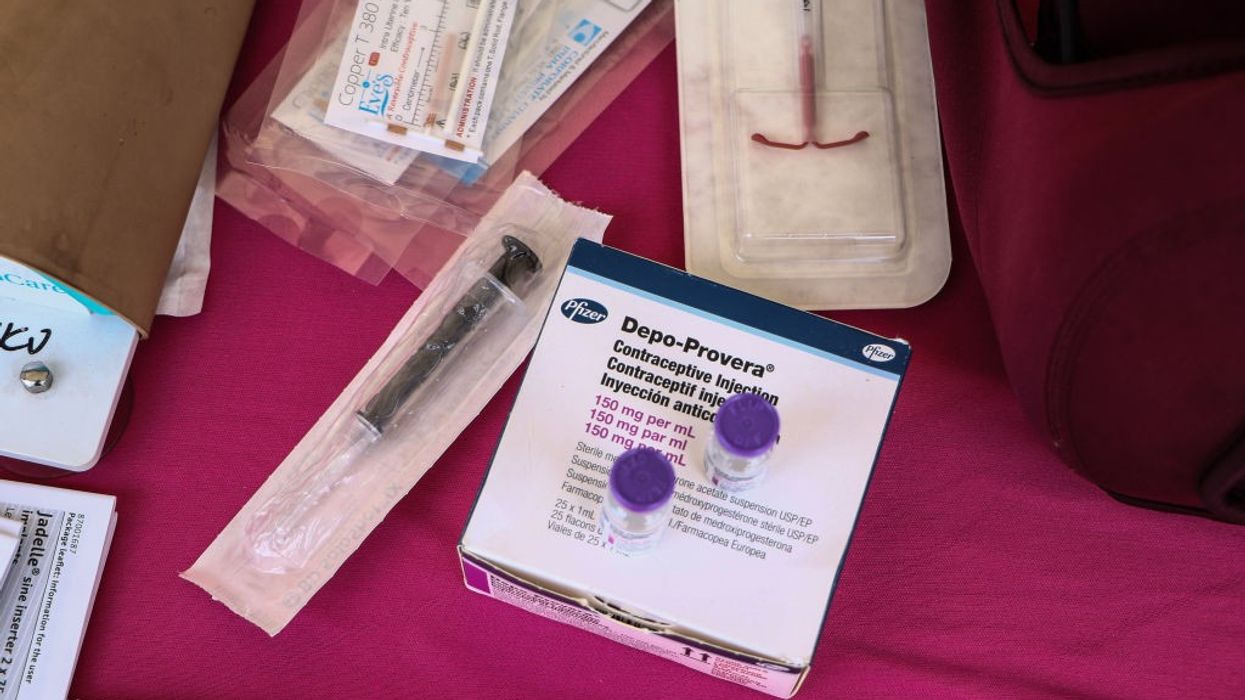
The CEO of Doctors Without Borders USA accused the Trump administration of being "willing to burn birth control and let food supplies rot... to push a political agenda."
International humanitarian assistance organization Doctors Without Borders on Thursday hammered the Trump administration's plan to destroy nearly $10 million of contraceptives that are badly needed throughout the world.
As The Guardian reported late last week, the Trump administration has decided to destroy $9.7 million worth of contraceptives that had been set to be delivered overseas as part of the foreign aid programs that it has been working to shut down.
"The contraceptives are primarily long-acting, such as IUDs and birth control implants, and were almost certainly intended for women in Africa, according to two senior congressional aides, one of whom visited a warehouse in Belgium that housed the contraceptives," wrote The Guardian. "It is not clear to the aides whether the destruction has already been carried out, but said they had been told that it was set to occur by the end of July."
In a statement condemning the decision, Doctors Without Borders described the Trump administration's actions as "callous waste that puts the health and lives of women and girls at risk."
"Contraceptives are essential and lifesaving health products," Avril Benoît, CEO of Doctors Without Borders USA, said. "[Doctors Without Borders] has seen firsthand the positive health benefits when women and girls can freely make their own health decisions by choosing to prevent or delay pregnancy—and the dangerous consequences when they cannot. The U.S. government's decision to incinerate millions of dollars' worth of contraceptives is an intentionally reckless and harmful act against women and girls everywhere."
Benoît accused the U.S. government of "manufacturing" the crisis by showing itself "willing to burn birth control and let food supplies rot, risking people's health and lives to push a political agenda."
The destruction of the contraceptives is part of the Trump administration's efforts to shut down the U.S. Agency for International Development (USAID), an agency established in 1961 under President John Kennedy that was intended to build American diplomatic power and goodwill across the world during the Cold War with the Soviet Union.
The decision to wind down USAID and other foreign aid programs has already had dire humanitarian consequences around the world.
A recent report from UNAIDS, the United Nations agency dedicated to combating the spread of HIV around the globe, warned that the Trump administration's drastic reduction of foreign aid funding to the United States President's Emergency Plan For AIDS Relief (PEPFAR) has been a "systemic shock" to organizations trying to stop the spread of HIV. The report estimates that if American funding for HIV prevention collapses entirely, it would result in 6 million additional infections and 4 million additional deaths over the next four years alone.
"This is not just a funding gap—it's a ticking time bomb," said Winnie Byanyima, executive director of UNAIDS. "We have seen services vanish overnight. Health workers have been sent home. And people—especially children and key populations—are being pushed out of care."

"If you think it's absurd to regulate men, then you should think it's equally absurd to regulate women," said the author of an Ohio bill, who is also an OB-GYN.
Faced with relentless Republican attacks on reproductive freedom including efforts to give embryos and fetuses legal rights from the moment of conception, Democratic lawmakers in two states have recently introduced legislation that would ban men from ejaculating for purposes other than making babies, with some exceptions.
Last month, Mississippi state Sen. Bradford Blackmon (D-21) introduced S.B. 2319, the Contraception Begins at Erection Act, which would "make it unlawful for a person to discharge genetic material (sperm) without the intent to fertilize an embryo, effectively criminalizing certain male reproductive behaviors," according to an official artificial intelligence summary of the proposal. The bill—which died in committee last week—contains exceptions for "genetic material donated or sold to a facility for future embryo fertilization, and genetic material discharged using a contraceptive method intended to prevent fertilization."
"If you're going to penalize someone for an unwanted pregnancy, why not penalize the person who is also responsible for the pregnancy?"
"All across the country, especially here in Mississippi, the vast majority of bills relating to contraception and/or abortion focus on the woman's role when men are 50% of the equation," Blackmon explained, according to NBC News. "This bill highlights that fact and brings the man's role into the conversation. People can get up in arms and call it absurd but I can't say that bothers me."
Meanwhile in Ohio, state Reps. Dr. Anita Somani (D-11) and Tristan Rader (D-13) have introduced their own Contraception Begins at Erection Act, which would fine violators $10,000 per unauthorized discharge, with exceptions for when contraception is used during sex, or in cases of masturbation, and sex between members of the LGBTQ+ community.
"If you're going to penalize someone for an unwanted pregnancy, why not penalize the person who is also responsible for the pregnancy?" Somani, who is also a licensed OB-GYN, asked in an Ohio Capital Journal article published Sunday. "You don't get pregnant on your own."
Every Sperm is sacred! #equalrights #reproductiverights
[image or embed]
— Anita Somani District 8 OH ( @anitamd.bsky.social) February 4, 2025 at 5:19 PM
Responding to Republicans who have called her bill "absurd," Somani said, "If you think it's absurd to regulate men, then you should think it's equally absurd to regulate women."
While observers have questioned the seriousness of these bills—and with Somani and others giving nods to a famous number in Monty Python's 1983 black comedy The Meaning of Life—they come at a nadir for reproductive freedom in the United States.
Since the right-wing U.S. Supreme Courtcanceled half a century of federal abortion rights in the 2022 Dobbs v. Jackson Women's Health Organization ruling, a dozen states including Mississippi have also passed near-total abortion bans, while numerous other states have enacted restrictions on the procedure.
Eight states have also enacted or proposed restrictions on access to contraception, according to the Guttmacher Institute. Last year, Senate Republicans blocked consideration of the Right to Contraception Act. Republican President Donald Trump has signaled support for federal restrictions on contraception, and far-right U.S. Supreme Court Justice Clarence Thomas has suggested that the tribunal "should reconsider" past rulings upholding the right to birth control.
In Ohio, voters decisively enshrined abortion rights in the state constitution via a 2023 ballot measure. Nevertheless, anti-abortion activists haven't given up—Republican activist Austin Beigel told the Capital Journal that GOP lawmakers are preparing to introduce legislation for a total abortion ban in the coming weeks.
"It just says human life begins at conception," he explained. "Therefore, all the protections that are offered to other people under the state law are also offered to the pre-born."
This isn't the first time that semi-satirical legislation has been introduced to highlight the hypocrisy of banning women from controlling their bodies. In 2019, a Democratic state lawmaker in Georgia introduced a "Testicular Bill of Rights" that would, among other things, have required men to get permission from their sexual partners before obtaining erectile dysfunction medication and enacted a 24-hour "waiting period" for men who want to buy porn or sex toys.
"As Trump and his radical Republican allies restrict women's reproductive healthcare, today's action by the Biden-Harris administration shows there is a different path," said Sen. Ron Wyden.
U.S. Vice President Kamala Harris, the Democratic presidential candidate, suggested Monday that the Biden administration's newly proposed rule to expand access to over-the-counter birth control is the latest policy that underscores the stakes for reproductive justice in the 2024 election.
"While we fight to protect and expand healthcare, extremist so-called leaders are attacking reproductive freedom at every turn," said Harris.
The vice president was referring to a new rule under the Affordable Care Act (ACA) proposed by the administration to require insurers to cover all over-the-counter birth control, including the nonprescription birth control pill approved last year, emergency contraception, condoms, and spermicides.
The ACA requires health plans to cover contraception without copayments for patients, but the rule only applies to prescription birth control.
After the Food and Drug Administration approved Opill, a nonprescription birth control pill, last year, reproductive rights advocates and Democrats in Congress called on the Biden administration to make sure the pill would "meet its potential and be truly accessible."
"Federal departments must ensure that it is covered without cost-sharing and without the need for a prescription as a condition of coverage," said 48 Senate Democrats in a letter.
The Biden administration said that if the rule is finalized, it would expand access to 52 million women of reproductive age who have private health insurance.
"We should not forget that Republicans have consistently sought to undermine access to contraception and far-right extremists have even sought to limit access or even ban basic forms of contraception—this threat to our healthcare is real and serious."
"Birth control—and any kind of contraception—is just basic healthcare, and it should be covered and easy to get," said Sen. Patty Murray (D-Wash.), who authored the Affordability Is Access Act to require insurers to fully cover over-the-counter birth control. "Women in America should not have to jump through hoops to make sure insurance is covering their basic reproductive healthcare needs."
"We should not forget that Republicans have consistently sought to undermine access to contraception and far-right extremists have even sought to limit access or even ban basic forms of contraception—this threat to our healthcare is real and serious," added Murray. "While Republicans continue to attack standard and necessary forms of healthcare, Democrats will continue to fight to expand access to contraception and lower healthcare costs for everyone."
When Roe v. Wade was overturned in 2022 by the right-wing majority on the U.S. Supreme Court—stacked with justices appointed by former President Donald Trump, now the Republican presidential nominee—Justice Clarence Thomas said the court's finding that the "right to privacy" did not extend to abortion care could also be used to overturn a 1965 case that affirmed married couples had a right to use contraception.
Senate Republicans earlier this year blocked consideration of the Right to Contraception Act, and Trump has suggested he supports restrictions on birth control.
"As Trump and his radical Republican allies restrict women's reproductive healthcare, today's action by the Biden-Harris administration shows there is a different path: expanded access and lower costs for women's healthcare," said Sen. Ron Wyden (D-Ore.) Monday. "I'm all in on the effort to ensure Americans across the country can get the reproductive healthcare they need without worrying about cost or prosecution by ideological crusaders."
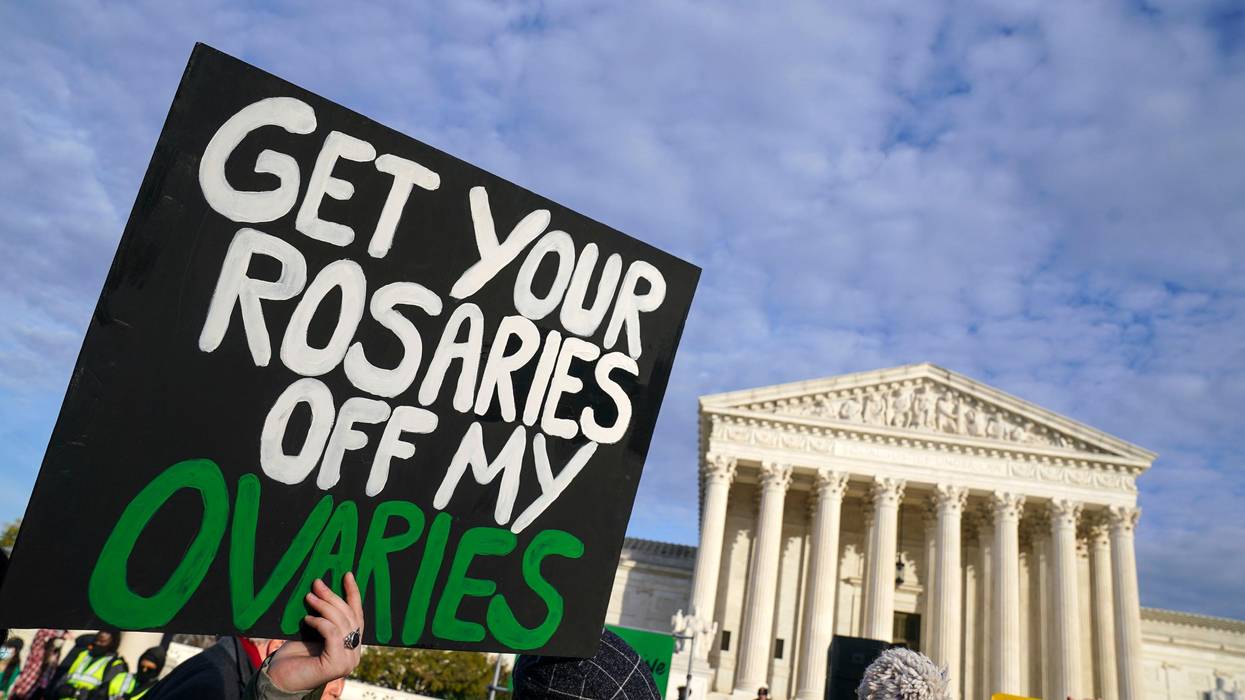
The MAGA movement led by Donald Trump is coming after contraception, abortion, and no-fault divorce.
One of the highlights, or maybe lowlights, of this commencement season, happened at Benedictine College in Kansas, where Kansas City Chiefs player Harrison Butker made some unforgettable comments that quickly went viral.
Addressing women graduates, he said they were being told a “diabolical lie” about pursuing their dreams of a career, and that “the majority” of them would find their true purpose as wives and stay-at-home moms.
Butker is a kicker for the Chiefs, and women in the audience, who presumably had worked hard and paid a lot in tuition, could be forgiven if they felt like they were getting kicked around in that moment.
Americans are already losing our rights. We don’t like it. We’re deeply concerned about losing more of them.
But is Butker just one dude with some backward ideas? Is he just a fanboy for the “tradwife” craze happening on social media? (As some observers posit, it’s men, not women, who are the real audience for that content anyway.)
And why should we care what one pro athlete at one small college graduation says?
Because there’s too much evidence that Butker is not alone. His views are emblematic of not just one cultural attitude but a policy agenda that could be coming to a legislature—or even a White House—near you.
One of the best-known and most vocal antifeminists today is Nick Fuentes, who famously once said women should not work, vote, or be educated, and should wear veils in church. Fuentes has dined with Donald Trump, and his America First movement aims to infiltrate GOP infrastructure from the local level up.
Fuentes is an extremist among extremists. But he’s part of an increasingly vocal contingent promoting a vision of the past in which marriage was always between a man and a woman, where women always stayed home and cared for kids, and men always were breadwinners. In this idyllic past, there was practically no crime, domestic violence, or substance abuse.
And that’s the real “diabolical lie.”
Not only was that never how the world worked, but it was also a fantasy that caused desperation and pain for millions of people.
Another lie? That the social problems we have today are caused by the “breakup” of the so-called traditional family, which was set in motion by contraception, abortion, and no-fault divorce.
So now, the MAGA movement headed by Donald Trump is going after all those things.
Just days ago, Virginia Gov. Glenn Youngkin (R) vetoed a bill to protect access to contraception. The bill was considered an important test by advocates hoping to protect contraception in other states.
At the federal level, House Republicanshave twice blocked a national Right to Contraception Act, which would have codified the right to access birth control.
Meanwhile, Donald Trumpis trying to walk back remarks he made saying he was “looking at” the issue of restricting access to contraceptives.
Perhaps most ominously, Supreme Court Justice Clarence Thomas has written that the court should revisit its decision establishing a right to contraception, as well as its rulings affirming same-sex marriage and relationships.
He did that at the same time the Supreme Court packed by Trump handed down its decision overturning Roe v. Wade, upending 50 years of legal abortion nationwide and setting the stage for a rash of state-level abortion bans.
Divorce is on the table, too. A number of MAGA politicians want to turn back the clock to the days before no-fault divorce, including several members of Congress and former presidential candidate Vivek Ramaswamy, now a Trump campaign surrogate.
So while some argue that Butker should be ignored, that he’s just one ultrareligious guy giving a speech at an ultrareligious college, there’s a reason that his remarks struck a nerve among so many.
Americans are already losing our rights. We don’t like it. We’re deeply concerned about losing more of them.
And that’s legitimate. Donald Trump, a former president whose administration rolled back civil and human rights, is running again. His legacy is felt every day, including at the Supreme Court, which continues its cascade of harmful decisions.
There’s a good chance a second Trump term, run according to a Project 2025 blueprint that prescribes a “biblical” worldview to guide the federal government, would be worse.
So yes, in this environment it’s hard to shrug it off when you hear remarks like Butker’s. There are far too many people seeking power who think just like him.

"Donald Trump has repeatedly promised that state Republicans will have a blank check to pass extreme laws attacking every facet of reproductive care," one critic noted.
Reproductive freedom continues to dominate this year's contest for the White House and former U.S. President Donald Trump made clear Tuesday morning that his election would threaten access to not only abortion care but also contraceptives—even though the Republican later tried to walk back his remarks.
"Do you support any restrictions on a person's right to contraception?" Jon Delano at the Pittsburgh station KDKA asked Trump, who is expected to face Democratic President Joe Biden in November.
Trump responded: "We're looking at that, and I'm going to have a policy on that very shortly, and I think it's something that you'll find interesting... You will find it, I think, very smart. I think it's a smart decision. But we'll be releasing it very soon."
After Delano pointed out that Trump's response suggests he may support some restrictions, such as on the morning-after pill, the GOP candidate said that "things really do have a lot to do with the states, and some states are gonna have different policies than others. But I'm coming out, within a week or so, with a very comprehensive policy."
Politico reported that Trump's campaign didn't respond to its request for comment and "KDKA declined to confirm... when the interview was recorded, but the Biden campaign released video of the exchange on Tuesday."
After the video started garnering attention, Trump said on his social media platform: "I HAVE NEVER, AND WILL NEVER ADVOCATE IMPOSING RESTRICTIONS ON BIRTH CONTROL, or other contraceptives. This is a Democrat fabricated lie, MISINFORMATION/DISINFORMATION, because they have nothing else to run on except FAILURE, POVERTY, AND DEATH. I DO NOT SUPPORT A BAN ON BIRTH CONTROL, AND NEITHER WILL THE REPUBLICAN PARTY!"
Trump has attempted to campaign on both sides of the reproductive freedom fight. Sometimes he has highlighted his role reversing the landmark abortion rights ruling Roe v. Wade: He appointed three of the six right-wing U.S. Supreme Court justices behind the majority opinion in Dobbs v. Jackson Women's Health Organization.
Since that 2022 decision, the GOP has ramped up attacks on abortion rights, enacting total bans in 14 states and signaling support for federal restrictions. At times, Trump has tried to distance himself from laws he recognizes as a political risk while also saying last month that he would let states monitor pregnancies and prosecute anyone who violates an abortion ban.
Many warn Republicans won't stop at abortion. Jill Filipovic reported Monday for Time that "the obvious question is, what's next? Is contraception access also on the line? Many activists, lawyers, historians, and politicians who favor abortion rights and contraception access say yes."
The progressive advocacy group Stand Up America said Tuesday that "in the past few days, Trump floated the idea of a three-term presidency, posted a video calling for a 'unified Reich' if reelected, and said he's looking at restricting access to birth control. Take his words seriously. Trump is a major threat to our freedoms and democracy."
Democrats are seizing opportunites to spotlight Republican attacks on reproductive freedom in campaign messages.
Noting Trump's comments to KDKA, Sarafina Chitika, a spokesperson for Biden and Vice President Kamala Harris' campaign, said Tuesday that "women across the country are already suffering from Donald Trump's post-Roe nightmare, and if he wins a second term, it's clear he wants to go even further by restricting access to birth control and emergency contraceptives."
"It's not enough for Trump that women's lives are being put at risk, doctors are being threatened with jail time, and extreme bans are being enacted with no exceptions for rape or incest. He wants to rip away our freedom to access birth control too," Chitika added. "While Trump works overtime to roll back the clock and rip away women's freedoms, President Biden and Vice President Harris are fighting nonstop to protect access to birth control and women's right to make their own personal healthcare decisions."
The Democratic Legislative Campaign Committee (DLCC), which works to elect party members at the state level, also responded to Trump's interview with Delano.
"In 2024, the battle for power in the states has never been more crucial. Donald Trump has repeatedly promised that state Republicans will have a blank check to pass extreme laws attacking every facet of reproductive care, from undermining contraception and birth control access to denying abortion care," said DLCC national press secretary Sam Paisley. "To fully stop Trump's MAGA agenda, we must invest in building Democratic power in the states."
"State elections this year will determine the future of reproductive rights, and it has never been more important to elect Democratic majorities to state legislatures who will champion our rights, not legislate them away. This is our best defense against MAGA extremists hellbent on dragging states into the past," Paisley argued. "The DLCC is rallying to build Democratic power across the country, especially as we reach this crisis point around the fight for fundamental freedoms. It is no exaggeration to say this is the most important year in state legislative history."
In addition to supporting candidates at all levels who will defend and expand reproductive freedom, abortion rights advocates are working to advance ballot measures that will safeguard access to care in states including Arizona, Florida, Montana, and Nevada.
"Trump's strategy is clear: Sow chaos and uncertainty on his unpopular positions and ride a wave of misinformation back to the White House. One day he hints at draconian policies, the next he might backtrack, but his core intent remains the same," said Indivisible chief campaigns officer Sarah Dohl. "He is a textbook narcissist who prioritizes his interests over the freedom of the American people.
"In contrast, Joe Biden has consistently promised to protect our reproductive rights," she added. "He is committed to signing federal abortion protections into law and vetoing any national abortion ban. From Arizona to Florida and beyond, Indivisible will make sure every voter knows exactly where Trump stands when they head to the ballot box in November—because our health, our choices, and our freedom are on the line."
This post has been updated with comment from Indivisible.

Legalizing Opill won’t undo the ongoing GOP assault on reproductive freedom, but it could be a vital lifeline
A federal advisory committee has unanimously recommended that the Food and Drug Administration allow the sale of Opill, an over-the-counter birth control pill.
Coming amid a widespread assault on reproductive health care, this could be a game-changer.
Margery Gass, an advisory committee member and an emerita professor of medicine at the University of Cincinnati, told The Washington Post: “I think this represents a landmark in our history of women’s health.”
“I think this represents a landmark in our history of women’s health.”
The expected legalization of Opill is a step toward bringing the United States up to international standards—currently such pills are available in more than 100 countries worldwide. It’s also great news for women’s economic independence.
By making the purchase of a contraceptive pill as easy and affordable as a trip to the drug store, birth control can become more accessible to those who are uninsured or underinsured, who can’t get an OB-GYN appointment, or who live in areas where Republican officials have all but eliminated reproductive health clinics.
Many studies show the impact of birth control on women’s livelihoods. A report by Planned Parenthood concluded: “Being able to get the pill before age 21 has been found to be the most influential factor in enabling women already in college to stay in college.”
The Institute for Women’s Policy Research reviewed the available evidence and found that prescription birth control pills have helped women stay out of poverty, attend college and graduate in higher numbers, and earn more at work.
It’s no wonder that a massive majority of women surveyed were in favor of an over-the-counter pill being available in the U.S.—77% of women aged 18 to 49 said as much in a Kaiser Family Foundation survey last fall.
Legalizing an over-the-counter contraceptive pill won’t undo the ongoing GOP assault on reproductive freedom, of course. But it could be a vital lifeline with that assault accelerating as Republicans court the support of fanatical anti-abortion groups.
How fanatical are they?
One organization peddling flat-out lies in order to pave the way for ending access to contraception is Pulse Life Advocates. The group’s website makes claims that are so preposterous, they veer on comical—such as “contraception increases likelihood of divorce” and “contraception kills babies.”
These same zealots want the GOP to attack access to prescription birth control pills, as well as Plan B, the “morning-after” pill. The popularity of such pills offers little political protection—a majority of Americans have continued to support access to abortion even as Republican politicians have eroded it.
If the anti-abortionists were truly interested in protecting fetal cells, contraceptive pills would help ensure such cells were not generated in the first place.
But of course, the ultimate agenda—usually couched in faux concern for women’s health—is to control women. Indeed, Pulse Life Advocates sees the birth control pill as akin to couples saying, “We want the physical pleasure of sex, but we want control.”
Um, yes. Wanting control over one’s body is a fundamental tenet of democracy. The anti-abortionists and their antiquated views on birth control represent medievalism, not modernity.
Last year, Mother Jones magazine quoted an anti-abortion activist who called birth control “unbiblical and harmful to women’s bodies.” By the numbers, pregnancy is far more harmful to women’s bodies, education, careers, wages, and overall well-being than abortion or contraception.
For those who choose to have children in spite of the disadvantages—people like me—the risks are worth the rewards. But the critical factor is choice.
"Every day we wait is another day longer where barriers remain in place, preventing people from getting access to the contraceptive care they want and need," said one leading OTC birth control advocacy coalition.
Reproductive rights groups on Wednesday called on the Food and Drug Administration to approve a birth control pill for over-the-counter use "without any further delay" after an advisory panel unanimously recommended permitting use of the medication without a prescription—two decades after advocates first began campaigning on the issue.
A joint advisory committee voted 17-0 in favor of offering OPill, which was first approved for prescription use 50 years ago, without a prescription after hearing from public health analysts and scientists. Concerns that some FDA scientists raised about patients failing to take birth control correctly unless they were provided the pills by a medical professional were outweighed by the benefits, the panel found.
"The panel expresses confidence in the effectiveness, not only in the general population of females, but also in adolescent populations and those with limited literacy," Maria Coyle, chairwoman of the committee, told The New York Times. "The panel seems very comfortable with the limited number of risks from the medication itself."
The Free the Pill Coalition, a campaign started by the global advocacy group Ibis Reproductive Health which has pushed for over-the-counter (OTC) birth control, said the recommendation itself was a "landmark achievement for reproductive justice" and expressed hope that the panel's decision would result in swift approval by the FDA.
"Every day we wait is another day longer where barriers remain in place, preventing people from getting access to the contraceptive care they want and need," said the group. "It's past time for an OTC birth control pill that's fully covered by insurance, affordable, and available to people of all ages."
U.S. Rep. Ayanna Pressley (D-Mass.) also called on the FDA to take the advice of the panel "without delay," calling the recommendation "a major step forward in our fight to affirm folks' right to make decisions about their body, when to start a family, and their future."
The Free the Pill Coalition and other groups say OTC dispensing of birth control pills will increase access for people who have logistical or financial barriers to regularly seeing a doctor for a prescription.
Some FDA scientists told the panel that data from HRA Pharma raised concerns about whether people with certain medical conditions that contraindicate the use of OPill would follow warnings if the pill was available over-the-counter, and whether adolescents and people with limited literacy would follow the directions carefully enough to take the pill each day at the same time.
Author and MSNBC contributor Dr. Uché Blackstock called those concerns "quite paternalistic."
"Given the technology available, alternative ways can be developed to help deliver instructions," tweeted Blackstock.
Contrary to those claims, said Dr. Raegan McDonald-Mosley of the contraceptive advocacy group Power to Decide, "the committee followed the scientific evidence and paved the way for a massive breakthrough in access to birth control."
"As a practicing OB-GYN, I am confident that my patients do not need a visit with me to safely and effectively use the birth control pills they need," said McDonald-Mosley. "Requiring prescriptions and provider visits places unnecessary barriers to accessing reproductive health care, especially for those in contraceptive deserts—counties without a single clinic that provides the full range of contraceptive methods. In such areas, people have to travel further just to visit a provider to get their birth control, which means they need to take even more time off work or arrange for more childcare. Allowing OTC access for the pill would help eliminate these unnecessary barriers and increase access to reproductive health across the country."
Crediting the "tireless advocates, including the Free the Pill Coalition," with pressuring the FDA panel to take a significant step toward approving non-prescription use of OPill, NARAL Pro-Choice America said the decision is "not only historic—it is simply the right thing to do," particularly as abortion rights are under attack by right-wing lawmakers across the country.
"As reproductive freedom in our country faces an unprecedented crisis," said the group, "expanding access to proven, safe, and effective contraception has never been more important."
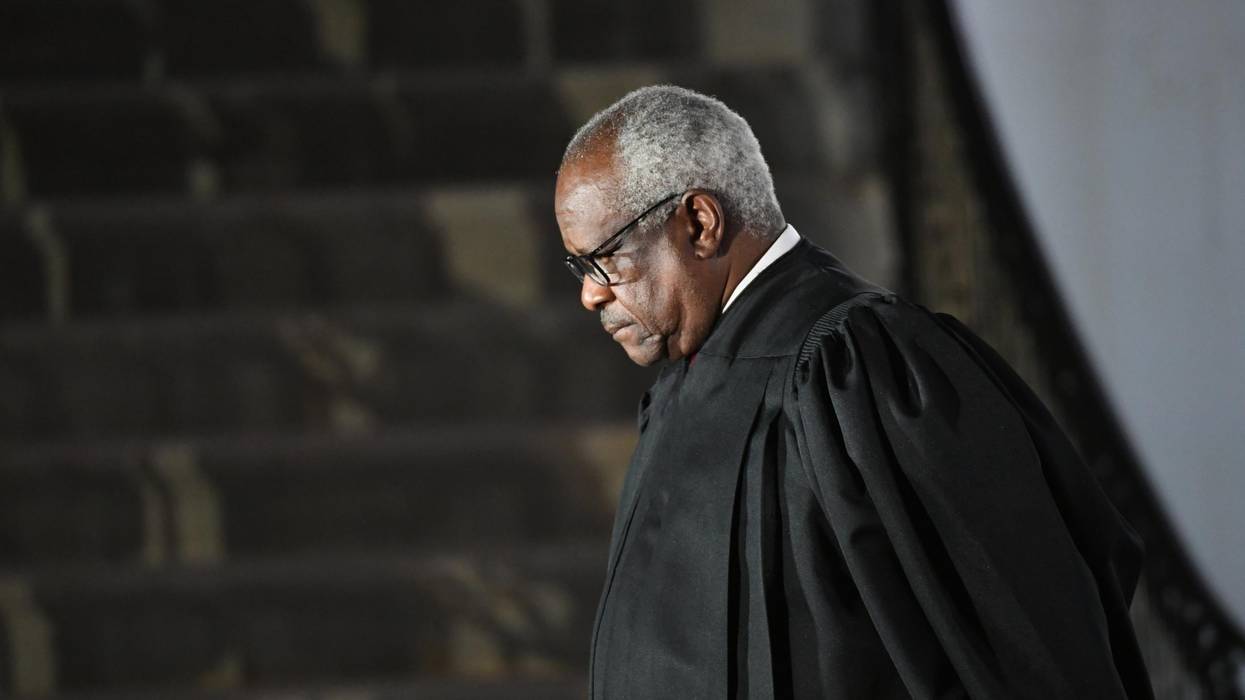
U.S. Supreme Court Justice Clarence Thomas made clear in his concurring opinion regarding the overturning of Roe v. Wade that the high court has no intention of stopping its rollback of Americans' rights, naming cases that centered on marriage equality and the right to obtain contraception as previous rulings that should be revisited.
"This Supreme Court is out of touch with the American people and increasingly suffers a legitimacy crisis."
"It does not end at abortion. Republicans will not stop until they have stripped away every freedom they can't load with bullets," said MoveOn Executive Director Rahna Epting, referring to this week's ruling by the Supreme Court's right-wing majority that New York's restrictions on carrying concealed weapons were unconstitutional.
In his concurrence, quoting Justice Samuel Alito's opinion, Thomas wrote, "I agree that 'nothing in [the court's] opinion should be understood to cast doubt on precedents that do not concern abortion.'"
"For that reason," Thomas wrote, "in future cases, we should reconsider all of the Court's substantive due process precedents, including Griswold, Lawrence, and Obergefell."
The 1965 Griswold v. Connecticut ruling affirmed that the government cannot interfere in people's procurement of contraceptives, while Lawrence v. Texas in 2003 overturned a Texas law which had effectively made sexual relationships between people of the same sex illegal in the state. Obergefell v. Hodges, decided in 2015, affirmed that same-sex couples can legally marry.
Like the court's decision in Dobbs v. Jackson Women's Health Organization on Friday, the overruling of the decisions listed by Thomas would be deeply unpopular with the American public.
That is unlikely to stop the right-wing majority from overturning those rulings, said Rep. Pramila Jayapal (D-Wash.), chair of the Congressional Progressive Caucus.
"It is clear he and the court's majority have no respect for other precedents that have been won in recent decades," said Jayapal. "This Supreme Court is out of touch with the American people and increasingly suffers a legitimacy crisis."
The three liberal justices who dissented against the ruling denounced Alito's claim that the decision would not have an effect on other rights previously protected by the court.
"They are all part of the same constitutional fabric, protecting autonomous decision-making over the most personal of life decisions," the dissent reads. "The lone rationale for what the majority does today is that the right to elect an abortion is not 'deeply rooted in history.'"
Justices Elena Kagan, Sonia Sotomayor, and Stephen Breyer added:
The same could be said, though, of most of the rights the majority claims it is not tampering with... So one of two things must be true. Either the majority does not really believe in its own reasoning. Or if it does, all rights that have no history stretching back to the mid-19th century are insecure. Either the mass of the majority's opinion is hypocrisy, or additional constitutional rights are under threat. It is one or the other.
Economist Umair Haque said the ruling handed down Friday was "just the beginning, sadly, of the theocratic fascist project reaching its culmination in earnest now."
As progressives called for legislative and executive action to codify the right to abortion care into federal law, attorney and Democratic U.S. House candidate Suraj Patel called on Congress to "move now" to ensure the right to contraception, same-sex relationships, and marriage equality are protected.
"Congress has that power right now. Hold the vote," said Patel. "For 50 years Republicans told us their playbook, they attacked Roe at the edges, we didn't codify it. Let's not be naive and not anticipate what's coming."

Illustrating the potential consequences if Republicans fulfill their threat to defund Planned Parenthood nationwide, a new study shows that when Texas slashed state funding for family planning clinics in 2011, the abortion rate among teenagers in the state increased.
"This certainly isn't the way to have fewer abortions."
--Dr. Diane Horvath-Cosper, Physicians for Reproductive Health
The Texas state legislature launched a series of attacks on reproductive rights, beginning in 2011, when it cut funding for family planning services by 67 percent and restructured the way it allocates the remaining funds. These measures closed more than 80 clinics, including 11 Planned Parenthood clinics. One of the purported goals, said Republican backers, was to decrease abortion rates. As then-governor Rick Perry said: "We will continue to pass laws to ensure abortions are as rare as possible under existing law."
However, according to the new study, the state's funding cuts had the opposite effect--with the state's teen abortion rate rising by an average of more than three percent over three years in the wake of slashed funds and shuttered clinics.
The study, which will be published in the Journal of Health Economics, was conducted by economics professor Analisa Packham, now based at Miami University. In addition to the increased abortion rates, Packham also found that the state's teen birth rate grew by approximately 3.4 percent in the four years after the cuts, concentrated in counties with high poverty rates.
Packham's findings are especially troubling when compared with national numbers. The Centers for Disease Control has documented decreasing rates of teen pregnancies on a national level, and the national abortion rate is at its lowest level since the Roe v Wade decision in 1973.
"This certainly isn't the way to have fewer abortions," Dr. Diane Horvath-Cosper, an OB-GYN and advocate with Physicians for Reproductive Health but not involved with the study, told the Huffington Post. "The abortion rates nationally have decreased and are at a historic low. So for Texans to see an increase in adolescent abortions is really telling--it seemed to have followed the national trend until these clinics were defunded."
Family planning clinics such as Planned Parenthood provide free or affordable services that typically include contraception, testing for sexually transmitted diseases, and counseling services. However, the organization has been under attack from conservatives seeking to curtail women's abortion rights and access to reproductive care. Eliminating Planned Parenthood in Texas, as Packham notes in the study, was a main goal of state lawmakers who passed funding cuts:
One reason behind defunding Planned Parenthood is that although centers that receive public funding are not legally allowed to provide abortion services, publicly funded Planned Parenthood clinics are affiliated with abortion providers. State rules define abortion clinic "affiliation" as any clinic that shares an organizational name with an entity that performs abortions elsewhere. Proponents of policies to defund Planned Parenthood argue that public money can be distributed across clinics in the same organization and can indirectly fund abortions, despite the fact that shifting funds is illegal and all family planning services at publicly funded clinics are billed separately.
Nevertheless, based on their affiliation with abortion clinics, Texas Planned Parenthood centers that provide only contraception services, STD screening and other women's health services were a primary target for 2011 funding cuts.
As a presidential candidate, last year, Donald Trump vowed to defund Planned Parenthood at the national level, adding to a long series of statements and failed attempts by GOP lawmakers--including Vice President Mike Pence, who is said to have started the Republican war against Planned Parenthood when, as a congressman, he sponsored the first bill to defund the organization in 2007. The Senate's current health care bill explicitly targets Planned Parenthood and would prevent the group from receiving Medicaid funding for at least one year. Planned Parenthood, which operates more than 600 clinics nationwide and serves an estimated 2.4 million people annually, receives about $550 million annually in federal funding.
In addition to the risk that the nation could see increases in teen pregnancies and abortions if Planned Parenthood loses its federal funding, low-income women would be disproportionately affected. As Alana Romain wrote for Romper:
Perhaps one of the most frustrating aspects of the debate about Planned Parenthood though is the fact that the organization provides much-needed health care services, but that is often overshadowed by the fact that it also happens to offer abortion services. The reality though is that the bulk of the care Planned Parenthood clinics provide actually includes important reproductive health care services that have nothing to do with abortion at all (think prenatal care, cancer screenings, STD tests, and access to contraception). What's more is that millions of Americans--especially those who are low-income or who have other barriers to health care access--rely on those services, and if the clinics are defunded, they will be at risk of being left without a provider.
That's especially concerning given that the implication that public funds somehow already currently fund abortions at Planned Parenthood clinics (or any other clinic, for that matter) is flat-out wrong: according to Quartz, health clinics have never been able to use federal funds for abortions since Title X was first enacted in 1976. And given the fact that Planned Parenthood is a major health care provider for many low-income Americans--Medicaid patients make up more than half of Planned Parenthood's client load, according to The Washington Post--it seems that the only thing the bill will actually accomplish will be making it harder for already-marginalized individuals to get the necessary (and sometimes life-saving) health care they need.
Planned Parenthood estimates that each year, its clinics provide: