

SUBSCRIBE TO OUR FREE NEWSLETTER
Daily news & progressive opinion—funded by the people, not the corporations—delivered straight to your inbox.
5
#000000
#FFFFFF
To donate by check, phone, or other method, see our More Ways to Give page.
Daily news & progressive opinion—funded by the people, not the corporations—delivered straight to your inbox.
Recently an elderly gentleman asked me about my opinion on NPR and PBS, knowing of my vigorous support in the nineteen sixties for these alternatives to commercial radio and television stations.
Here is my response:
Congress created NPR and PBS to provide serious programming, without any advertisements, for the American people. Former media executive Fred Friendly and others worried that the commercial stations were not meeting the 1934 Communications Act requirement that they operate for the "public interest, convenience and necessity."
In 1961, before a shocked convention of broadcasters, the new chairman of the Federal Communications Commission (FCC), Newton Minow called commercial television "a vast wasteland."
Over the decades, NPR and PBS have produced some good programming - original features (among the best coming from Boston affiliate WGBH) and interviews. NPR has the largest radio audience in the country. David Brancaccio, the bright host of Marketplace Morning Report, has a daily listening audience of 11 million.
However, over the years, without regular critiques by liberal and progressive groups, both NPR and PBS have bent to the continual right-wing antagonism in Congress that decreased public budgets. PBS started to allow advertisements (called "support for x station or x PBS network program comes from y corporation.") These ads have become more frequent and can be as long as 15 seconds.
During the 8am to 9am hour WAMC, Albany recently aired 28 such "support from..." commercials. That is almost one "ad" every two minutes!
The omnipresence of the ads hour after hour has irritated many NPR listeners around the country. By way of comparison, a major commercial station in Hartford - WTIC - clocked 18 advertisements in that 8am hourly slot - albeit they were longer than the NPR ones.
They invite guests on air who ideologically oppose public broadcasting--that's fine, but then they minimize the appearances by leading progressives.
It seems that NPR and PBS, often by their omissions and slants, bend over backward in order not to offend right-wing lobbies and corporations. They invite guests on air who ideologically oppose public broadcasting - that's fine, but then they minimize the appearances by leading progressives.
Occasionally, I speak with the NPR and PBS Ombudsmen. The purpose of the ombudsman is to maintain proper standards and ethics as well as to consider audience complaints. A while back, an NPR Ombudsman volunteered to me that NPR was giving far more time to representatives of conservative evangelical groups than to representatives of liberal religious organizations.
Charlie Rose on PBS had many more CEOs on his program than civic leaders. During a rare appearance by me on his show with Jim Hightower and William Greider in 1998, the audience reaction was robust. The response from around the country was so pronounced that in an internal e-mail, that was inadvertently sent to my office, a Rose staffer complained that we might have been encouraging the positive response. Absurd and false, but revealing nonetheless.
Rose, by the way, set the stage for PBS and NPR by interviewing his two favorite reporters again and again instead of active specialists or scholars in various fields. For example, Judy Woodruff, the ultra-cautious, exclusionary anchor of the "News Hour," interviewed reporters on complex tax legislation instead of authentic experts such as the long-time director of the well-regarded Citizens for Tax Justice, Robert McIntyre, often invited by her predecessors.
In 2016 we convened for eight days in the largest gathering of civic leaders, doers, and thinkers of more reforms and redirections ever brought together. They made over 160 presentations in Constitution Hall (see breakingthroughpower.org). Although we advanced this remarkable Superbowl of Civic Action directly to NPR and PBS producers, their reporters never showed up. Certainly, they have not treated right-wing conventions in Washington, D.C. in that manner.
There are other practices of public broadcasting and its syndicated talk shows, that its audiences should know about to understand how much broader coverage they have been denied. One is that the amount of time devoted to music and entertainment pieces goes well beyond the intent of the legislators who created NPR and PBS (both created by the Public Broadcasting Act of 1967). Members of Congress knew that entertainment was adequately taken care of by the thousands of commercial stations.
Moreover, even commercial network radio would not use its weekday 6pm hour for music, as one NPR station does in Washington, D.C. Nor does commercial network TV news in the evening start their programs with several advertisements, as does PBS's The NewsHour and Kai Ryssdal's jazzy, drumbeat, breathless NPR evening show - Marketplace.
Recently, I discovered another woeful transformation. Wondering why I could not get calls back from the state-wide NPR stations in Minnesota and Wisconsin, I sent them written complaints. These stations had venerable programs that used to interview me and other civic leaders on consumer, environment, and corporate crime topics.
Minnesota Public Radio politely wrote back, regretting that they had not called me back and explained that they now adjust their programming to react or expand on "what is in the national conversation." Since Trump et al. command the heights (or the depths) of the news agenda, very important subjects, conditions and activities not part of this frenzied news feed are relegated to far less frequent attention.
These are just a few of the issues that should be analyzed by print journalists who cover the media full time, such as the estimable Margaret Sullivan of the Washington Post, formerly the "public editor" of The New York Times. But then, she also doesn't return my calls.
The slide toward commercialism and amiable stupefaction will continue on PBS and NPR until enough people review public broadcast's history, raise their expectation levels consistent with why PBS and NPR were created, and insist on adequate public funding (a truly modest amount compared to giant corporate subsidies by taxpayers). These redirections would enable public broadcasting to fulfill better its serious statutory public interest missions.
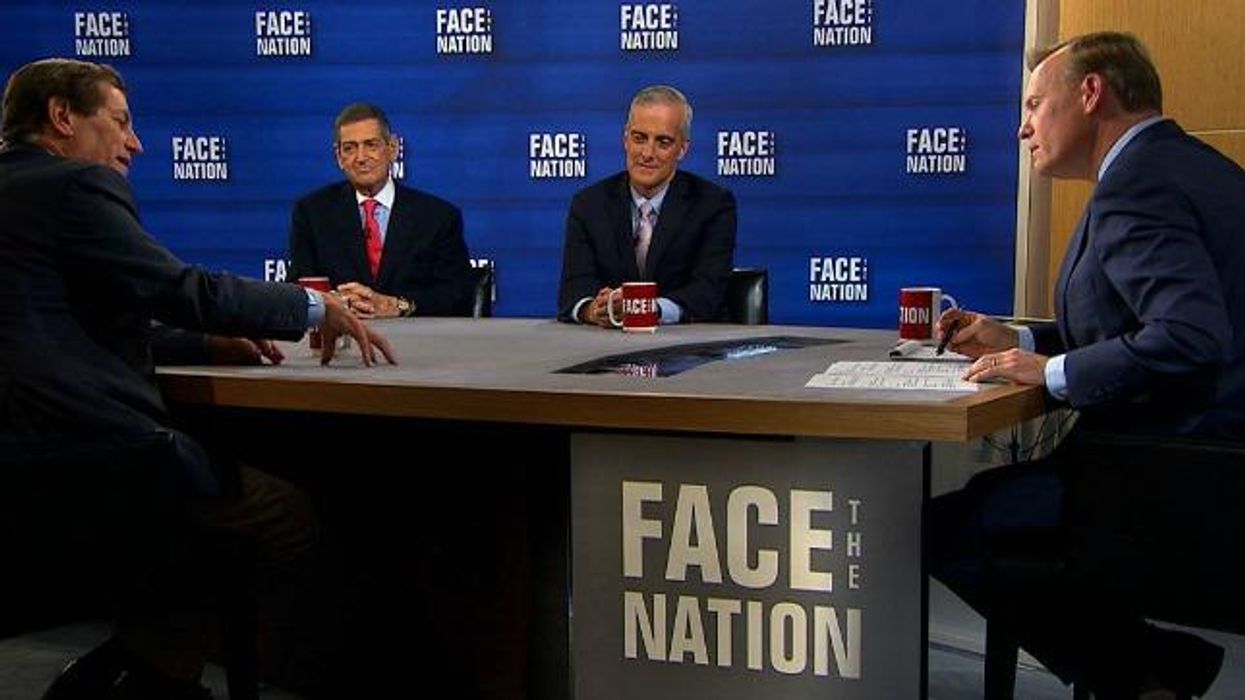
Ever wonder how the television, radio and newspaper people select whom they are going to interview or get quotes from when they are reporting the news or producing a feature? I do. What I've learned is that they go to guests that are connected with the established powers--such as think tanks in Washington, D.C. that work on "the military industrial complex" policy (to borrow President Eisenhower's words) and somehow lean toward more war mongering (e.g. NPR and the U.S.-Iran relationship) or backing more weapon systems (such as a new nuclear bomb arsenal and more F-35s and air craft carriers).
You won't be hearing from MIT Professor Emeritus Ted Postal on the chronic failures of the anti-ballistic missile program (spending $13 billion this coming year).
Whether it is NPR, PBS, the network news programs, the Sunday news interview shows and too often the New York Times, Washington Post, Associated Press and the Wall Street Journal their interviewees are the defenders of the status quo or those with corporatists' viewpoints.
These news outlets seem oblivious to the blatant economic conflicts of interest inherent in groups such as the Heritage Foundation, the American Enterprise Institute and professors who moonlight with corporations. These interviewees have economic and ideological axes to grind that are not disclosed to the general viewers, listeners and readers, when they are merely described as "experts."
There are real experts and specialists, with no axe to grind, who are so ignored by the media that they have almost become nonpersons, despite their past proven records of achievements for the public interest, and for the people's well-being.
Here are some examples of experienced people whose veracity and honesty you can take to the press and media outlets:
Some of the above were featured in the mass media years ago; others have been relegated to the shadows of our public news and features for almost their entire careers. The slanted selections by media gatekeepers are getting worse. Increasingly, TV and radio anchors interview their own reporters, not experts like Robert McIntyre, lawyer and founder of the highly regarded Citizens for Tax Justice. Too often the Sunday network TV political shows tap into the same stable of Washington pundits and commentators.
Readers and viewers can make their own lists of media-excluded, knowledgeable persons, be they at the local, state or national levels. On our public airwaves, after the FCC repealed the "Fairness Doctrine" in 1987, bloviators such as Rush Limbaugh, Sean Hannity and Mark Levin, completely dominate our airtime with their corporatist and hate-filled soliloquies. These "champions" of the free market have no problem using the public airwaves free of charge. As owners of the public airwaves and buyers of print journalism, let's demand higher standards for experts in journalism. Let's demand that the media seek out people who know their facts and work in the people's interest and give them airtime.

Raising concerns about possible ethics violations and corruption, the Paradise Papers revealed two top members of the Trump administration, Commerce Secretary Wilbur Ross and Secretary of State Rex Tillerson, have ties to tax havens, and that during Ross's confirmation hearing, he failed to disclose business dealings with Russians who are directly connected to Russian President Vladimir Putin.
The Paradise Papers are a trove of more than 13 million leaked documents, published Sunday, detailing tax avoidance and shady deals among some of the world's richest individuals and multinational companies. The documents include decades of corporate records from the offshore law firm Appleby. They were obtained by a German newspaper and shared with journalists associated with the International Consortium of Investigative Journalists (ICIJ) and other media organizations.
The files show that while Tillerson, the former CEO of fossil fuel giant ExxonMobil, directed a Bermuda-based joint venture that conducted gas and oil operations in Yemen, Ross still holds stake in a shipping company that is partially owned by Putin's son-in-law and "a Russian tycoon sanctioned by the U.S. Treasury Department as a member of Putin's inner circle."
The revelations have raised concerns among lawmakers and ethics experts.
The watchdog group Common Cause has called on the Commerce Department's inspector general to launch a full investigation into Ross's offshore investments. The group's president Karen Hobert Flynn said Monday, "These latest revelations are part of a disturbing pattern of Trump administration officials seeking to hide their links to Russian business interests and members of Vladimir Putin's inner circle."
The records and related reports come less than a week after it was revealed that the first federal charges were filed in the ongoing investigation into whether the Trump administration colluded with the Russian government to influence the 2016 presidential election.
Richard Painter, who served as the ethics chief under former President George W. Bush and is currently vice chairman of Citizens for Responsibility and Ethics in Washington (CREW), said, "It's a very, very troubling situation."
In an episode of the Center for Investigative Reporting's Reveal podcast published Sunday, Painter explained, "If United States government officials have offshore entities, it may be very difficult to detect payments from foreign governments or sovereign wealth funds, and profits from dealings with those entities that are a violation of the Constitution."
"We want good relations with China and Russia," Painter added, "but we don't want our senior government officials dealing with large companies in those other countries at the same time as they're holding positions of trust in the United States government."
In the late 1990s, before rising to the position of CEO, Tillerson served as president of Exxon Yemen as well as director of Marib Upstream Services Company, which was incorporated in Bermuda in 1997. Marib Upstream Services' partners included the state-owned Yemen Gas Company and a company owned by ExxonMobil and the Texas-based Hunt Oil, which was run by Tillerson's close friend Ray Hunt.
The Guardian, which received access to the records, reports ExxonMobil and Hunt Oil "ran a $5bn venture to export 61m barrels of natural gas a year from fields in Marib, western Yemen. Hunt had discovered the fields in the mid-1980s and brought in ExxonMobil to help develop them."
"Yemen later moved to nationalize the gas-drilling operation, banishing the ExxonMobil-Hunt firm when its 20-year exploration contract expired in 2005," the Guardian notes. "The Texans claimed they were entitled to an extension and sued Yemen for $1.6bn. The case was arbitrated at the International Chamber of Commerce, where Yemen prevailed."
The records reveal the details of just one instance of ExxonMobil operating subsidiaries in tax havens. Last year, Citizens for Tax Justice released a report (pdf) that found while Tillerson served as ExxonMobil's CEO, the company's 35 tax haven subsidiaries held an estimated $51 billion offshore.
This case is similar to one detailed in documents leaked late last year--shortly before Tillerson became the United States' top diplomat. Those records divulged that in 1998, Tillerson directed ExxonMobil's Russian subsidary, which was based in the Bahamas, a well known tax haven. The revelation elevated concerns about Tillerson's commitment to U.S. interests and his ties to the Russian government and Putin, who bestowed upon him an Order of Friendship in 2013.
Ross helps to guide U.S. trade and manufacturing policies--including sanctions--as head of the Department of Commerce. When he was nominated, the billionaire investor vowed in an ethics filing that he would divest from 80 companies and partnerships, while keeping his stake in nine others that held assets in "real estate financing and mortgage lending" and "transoceanic shipping."
Though the assests were not specified at the time, the leaked records reportedly reveal that Ross retained his stake in the shipping company Navigator Holdings, which is incorporated in the Marshall Islands and counts among its biggest customers Sibur, a Russian gas and petrochemical company.
Using information from the files, the BBC mapped Ross's relationship to Navigator and Sibur, the company shareholders' ties to Putin.
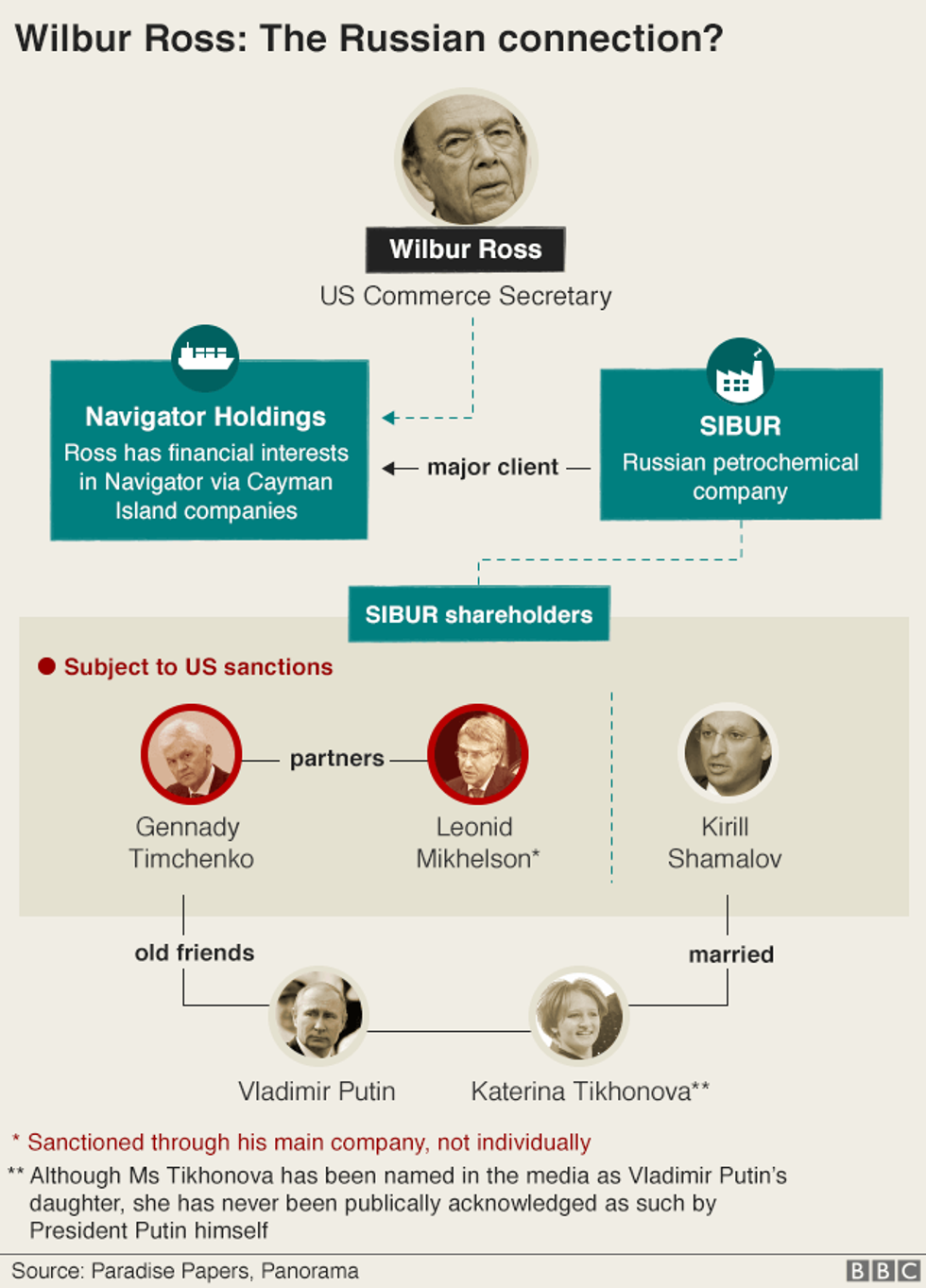
Ross told the BBC that he's never met the Sibur shareholders and that because the U.S. has not sanctioned Sibur, "there's nothing whatsoever improper about Navigator having a relationship with Sibur." A Commerce Department spokesperson told ICIJ reporters that Ross "recuses himself from any matters focused on transoceanic shipping vessels, but has been generally supportive of the administration's sanctions."
Ross and Tillerson were among several of U.S. President Donald Trump's advisers, cabinet members, and donors who, according to the leaked records, used offshore tax havens to conduct business. While the Guardian published a report describing how several wealthy individuals with connections to the U.S. president have utilized tax havens, ICIJ illustrated 13 influencers' ties to Trump with an interactive:

While the world's richest stash trillions away for themselves, outlandish levels of inequality are increasing the suffering of the poor and hamstringing the global community's ability to address humanity's most pressing concerns.
"We are witnessing some of the greatest challenges the world has ever seen, without the global commitment to deliver change."
--Saad Alfarargi, U.N. Human Rights CouncilThat is the picture painted when pairing new research that shows an estimated $8 trillion--or more than 10 percent of global gross domestic product (GDP)--was stashed in offshore tax havens as of 2015 with a new report by a UN human rights expert that warns impoverished people are "paying a heavy price" for what he calls "negative global trends," including climate change, financial schemes, and privatization programs that "have their harshest impacts on the poorest sections of society."
"People are feeling the impact of the global financial and economic crisis, the energy and climate crisis, and an increasing number of natural disasters," said recently appointed special rapporteur on the right to development, Saad Alfarargi. "Add to that the new global pandemics, corruption, the privatization of public services, austerity, and the aging of the global population, including in developing countries, and the effect is a harsh and worsening impact on the poor."
In his first report to the U.N. Human Rights Council, Alfarargi raises alarms about global trends he has identified as threats to the "right to development," and expresses concern about the "rise of nationalistic tendencies and the related trend to move away from international solidarity and cooperation."
"We are witnessing some of the greatest challenges the world has ever seen, without the global commitment to deliver change," he concludes. "People in developing countries are paying a heavy price for global actions beyond their control."
Meanwhile, according to two papers by economists Annette Alstadsaeter, Niels Johannesen, Gabriel Zucman, the world's superrich are hiding trillions of dollars in tax havens, exacerbating global inequality.
Analyzing the Panama Papers and other leaked documents about tax havens, the researchers looked only at liquid offshore bank deposits--meaning these estimates do not even include investments in equities and real estate.
They found that "accounting for offshore assets increases the level and the rise of top wealth shares seen in tax data, but the magnitude of the effect varies across countries."
"Despite the more prevalent use of tax havens by continental European countries," they write, "we find that wealth is much more concentrated in the United States. In fact, the top 0.01 percent wealth share in the U.S. is as high as in early 20th century Europe." As Business Insider notes, "For the history fans, that's before most of the continent was democratic and right before two world wars. U.S. inequality is now about the same levels where it stood during the Great Depression."
While the researchers plan to use their methodology to develop more accurate estimates of wealth inequality within nations--and acknowledge "offshore wealth is likely to have major implications for the concentration of wealth in many of the world's developing countries"--it's also worth noting that wealthy nations, such as the United States, put tax revenue toward foreign aid, meaning that while tax evasion impacts inequality within nations, there are also global consequences.
"The hard fact is that the U.S. tax code incentivizes tax haven abuse by allowing companies to indefinitely defer taxes on offshore profits until they are 'repatriated.'"
--Matthew Gardner, Institute on Taxation and Economic Policy
A study published last year by U.S. PIRG Education Fund, Citizens for Tax Justice, and the Institute on Taxation and Economic Policy (ITEP) found that 73 percent of Fortune 500 companies used tax havens in 2015, which amounted to $2.5 trillion in offshore profits, or about $717.8 billion in taxes that would have gone to the U.S. government.
That's more than $700 billion that could have gone into government programs to provide assistance to not only to Americans, but also to people in developing nations, through foreign aid. And, as Poncie Rutsch noted in a 2015 NPR piece about U.S. aid, "The U.S. is pretty generous...until you consider how much money it has."
When the Fortune 500 study was published, Matthew Gardner of ITEP pointed to loose government restrictions as a root cause of tax evasion among U.S.-based individuals and corporations.
"The hard fact is that the U.S. tax code incentivizes tax haven abuse by allowing companies to indefinitely defer taxes on offshore profits until they are 'repatriated,'" Gardner said. "The only way to end this kind of tax avoidance is by closing the loopholes in the tax code that enable it."
Troubling tax rules, however, are far from contained to U.S. A 2016 Oxfam report identified the top 15 nations with policies that facilitate tax dodging, and thus "are starving countries of billions of dollars needed to tackle poverty and inequality," as Common Dreams previously reported.
Oxfam researchers estimated that because of corporate tax havens, developing nations lose $100 billion per year, which they say "is more than enough to provide an education for all of the 124 million children currently out of school, and to pay for health interventions that could save the lives of six million children."
The political theater that passes for serious policy debate is about to run into an unfortunate reality as Donald Trump's budget plan comes face to face with its arch-nemesis: arithmetic.
It's impossible to cut taxes, increase spending, and balance the budget. That's not political bluster. That's math.
Throughout the campaign and since, Trump promised to invest in infrastructure, pass an enormous tax cut, boost military spending, cut "waste, fraud, and abuse," and protect Social Security and Medicare -- and, of course, balance the budget.
This rhetoric has been remarkably effective, the presidential equivalent of offering free ponies for everyone -- but even less practical.
Working in Trump's favor, however, is that many Americans believe things about the federal budget that are simply not true. There's a lot of misinformation out there.
A survey of Fox News viewers from 2013 showed nearly half believed most federal debt could be eliminated by "cutting waste and fraud." It can't.
Out of a nearly $4 trillion annual federal budget, about $3.4 trillion is spent on things that either can't be cut or Trump has promised he doesn't want to cut. This includes Social Security, Medicare, military spending, and interest on the national debt.
That leaves just over half a trillion dollars to cover all non-military discretionary spending. It's a lot of money, to be sure, but a small proportion of overall spending. This is the part Trump is proposing to cut.
What's included in this side of the budget?
To name just a few things: The benefits that help veterans get back on their feet after getting wounded. The nutrition assistance that helps babies born to low-income mothers. The science research that will mitigate the next infectious disease outbreak (remember Zika?).
The list could go on for paragraphs, each a small line item on a big budget list, but each incredibly important to enabling a happy, healthy life in modern society.
Cutting programs the public depends on in an effort (real or imagined) to balance the budget isn't new. Austerity has been in the air in the United States since Reagan and has taken Europe by storm, too. It's the justification behind cutting programs that help the poor while passing tax cuts that exclusively benefit the rich.
It is, in short, part of a remarkably effective effort to redistribute wealth -- upwards.
Consider, for example, Trump's tax plan.
If the president were serious about balancing the budget, he'd be quite concerned about how much money the Internal Revenue Service collected each year. He'd know if that number went down, it would reduce the effectiveness of his spending cuts.
He is, to put it politely, not concerned about this.
As the Citizens for Tax Justice, a D.C.-based research group, points out, Trump's tax plan nearly exclusively benefits the wealthy while raising the taxes of low- and moderate-income families. The budgetary impacts of his tax cuts total about a half trillion dollars a year -- the same amount as the entire non-discretionary, non-military federal budget.
In other words, Trump's tax plan is a proverbial one-handed middle finger to the working class. And his spending cuts represent his other hand making the same gesture.
While repeated rhetorical distractions may succeed in sidetracking his audience, Trump can't use his impressive oratory skills to overcome basic mathematics.
Undercutting President Donald Trump's assertion that U.S. corporate taxes are too high--the justification for his and Republican leaders' pitches to lower the business tax rate--a new report finds that many profitable American companies pay far less than the 35 percent often cited by lobbyists and GOP officials.
"For years, corporate lobbyists have claimed that they can't be competitive because the corporate tax rate is too high. They have a receptive audience for those complaints in the current Congress and Trump administration, but it doesn't make these claims any less false."
--Robert McIntyre, Citizens for Tax Justice
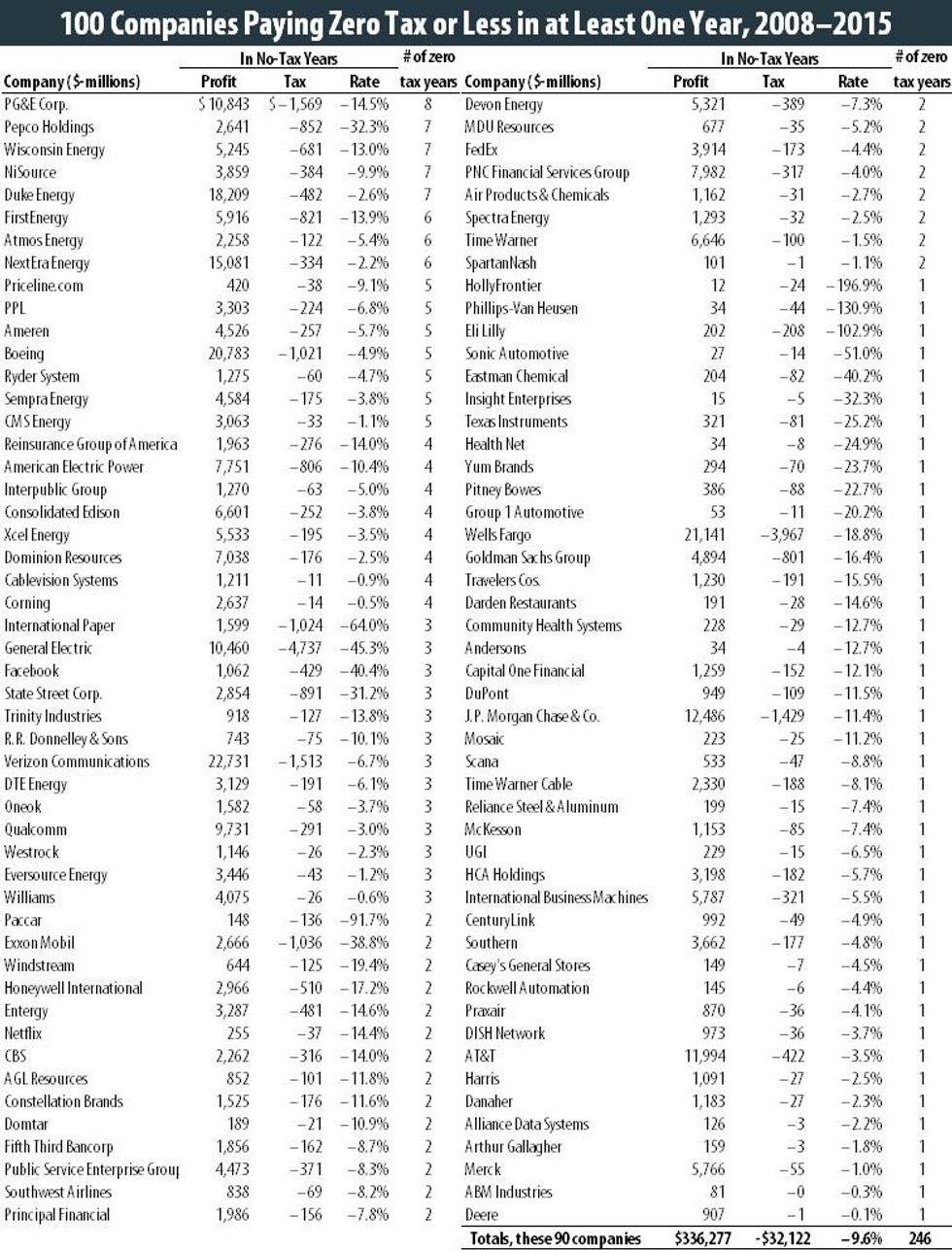
In fact, the analysis reveals, 18 of the country's most profitable corporations paid nothing in taxes between 2008 and 2015, and fully 100 companies enjoyed at least one year in which their federal income tax was zero or less.
"This study is a long-term, unprecedented examination of corporation taxes paid--or not paid--by the nation's biggest, most profitable firms," said Matthew Gardner, a senior fellow at the Institute for Taxation and Economic Policy (ITEP) and lead author of the report. "It reveals that many of the big corporations that are lobbying for a lower corporate tax rate to be more 'competitive' already pay substantially less than the 35 percent statutory rate."
Indeed, added Robert McIntyre, a co-author of the report and director of ITEP sister organization Citizens for Tax Justice (CTJ): "For years, corporate lobbyists have claimed that they can't be competitive because the corporate tax rate is too high. They have a receptive audience for those complaints in the current Congress and Trump administration, but it doesn't make these claims any less false."
The ITEP report, entitled The 35 Percent Corporate Tax Myth, additionally found:
The study looked only at companies that were consistently profitable over the eight-year period of 2008-2015. "By leaving out corporations that had losses (which means they wouldn't pay any tax), this report provides a straightforward picture of average effective tax rates paid by our nation's biggest and consistently profitable companies," the authors explained.
Such low tax payments were made possible by "copious loopholes in the tax code," the report said, including deferred payments on profits stashed offshore; the ability to write off executive stock options; and industry-specific tax subsidies that effectively function as tax breaks.
Spring-boarding off the report, Sens. Bernie Sanders (I-Vt.) and Brian Schatz (D-Hawaii) on Thursday introduced a bill in the Senate to eliminate tax breaks that encourage corporations to shift jobs and profits offshore and tax the $2.4 trillion that American firms currently hold in such tax havens at the full corporate rate of 35 percent. Rep. Jan Schakowsky (D-Ill.) introduced a companion bill in the House.
"Instead of giving a $550 billion tax break to corporate tax dodgers as President Trump has proposed," Sanders said in a statement, "our legislation will raise at least $1 trillion in new revenue over the next decade."
And while such reforms as the ones laid out in the lawmakers' Corporate Tax Dodging Prevention Act (pdf) are the ones that would actually make the U.S. tax code fairer, ITEP's Gardner expressed his fear that "when Congress engages on tax reform later this year, our leaders will prioritize damaging cuts in corporate tax rates while giving short shrift to needed loophole-closing reforms."
"[T]hese priorities are backwards," he said. "The starting point should be ending harmful corporate giveaways and requiring all profitable corporations to pay their fair share."
Donald Trump's latest tax proposals would give the biggest windfalls to the richest households in the U.S. and raise the debt by $20.9 trillion by 2036, according to a new analysis by the nonpartisan Urban-Brookings Tax Policy Center (TPC).
The Republican presidential nominee would cut taxes by $6.2 trillion over the next decade, with 47 percent of all cuts next year going to the top 1 percent, the analysis found. By contrast, TPC found, Democratic nominee Hillary Clinton's plan would increase revenue by a net $1.4 trillion over the next decade, and nearly all tax hikes would go to the richest 1 percent, with low- and middle-income families seeing "small increases" in after-tax income.
And while the tax cuts in Trump's latest proposal are not as high as in his previous plans, they favor rich households and burden lower-income ones even more than the $9.5 trillion in cuts he proposed last year.
Under Clinton's plan, the top 1 percent would pay an average of $117,760 in 2017, while the top .01 percent would see an average tax jump of $805,250.
TPC director Leonard Burman called the two candidates' plans "mirror images" in an interview with Forbes reporter Janet Novack.
Novack adds: "Clinton's plan also takes aim at certain groups of wealthy folks. It closes the 'carried interest' loophole that reduces taxes for hedge fund and private equity managers and limits 'like kind' exchanges, which allow real estate developers and investors to defer capital gains taxes, in some cases indefinitely. (It's hard to say how that would affect Trump, since he hasn't released his tax returns; a leaked 1995 Trump return showing a $916 million tax loss suggests he may have paid no income taxes for nearly 20 years without needing the like-kind break.)"
Citizens for Tax Justice (CTJ) also recently released its analyses of Clinton's and Trump's tax plans, coming to similar conclusions. CTJ director Bob McIntyre said of the Republican nominee's proposal at the time, "To be sure, Trump's latest tax plan costs less than the initial deficit-inflating tax proposal that he laid out earlier this year. But this new tax plan is in the same spirit as Trump's initial proposal. He would cut taxes for the rich, cut taxes for businesses, provide miniscule tax cuts for lower-income groups, and then claim it's a populist plan that helps working families."
A new report released Tuesday reveals how "U.S.-based multinational corporations are allowed to play by a different set of rules than small and domestic businesses or individuals when it comes to paying taxes"--to the tune of more than $100 billion every year.
The analysis from the U.S. PIRG Education Fund, Citizens for Tax Justice, and the Institute on Taxation and Economic Policy finds that in 2015, more than 73 percent of Fortune 500 companies maintained subsidiaries in offshore tax havens, including top offenders Apple, Citigroup, Nike, Pfizer, PepsiCo, and Goldman Sachs. By doing so, the corporations are avoiding up to $717.8 billion in U.S. taxes, total.
"Corporate tax dodging may be legal, but it's certainly not good for everyday taxpayers and responsible small businesses."
--Michelle Surka, US PIRG
And it's all legal, according to the U.S. tax code.
"Companies can avoid paying taxes by booking profits to a tax haven because U.S. tax laws allow them to defer paying U.S. taxes on profits that they report are earned abroad until they 'repatriate' the money to the United States," explains the report, entitled Offshore Shell Games (pdf). "Many U.S. companies game this system by using loopholes that allow them to disguise profits earned in the U.S. as 'foreign' profits earned by subsidiaries in a tax haven."
However, said Michelle Surka, advocate with U.S. PIRG, "Corporate tax dodging may be legal, but it's certainly not good for everyday taxpayers and responsible small businesses."
"It disadvantages small businesses that don't have scores of tax lawyers, creates an economic environment that favors accounting tricks over innovation, and real productivity, and forces the rest of us to foot the bill," she said.
And that's especially unfair, the report charges, given that "[t]he profits earned by these companies generally depend on access to America's largest-in-the-world consumer market, a well-educated workforce trained by our school systems, strong private-property rights enforced by our court system, and American roads and rail to bring products to market."
The report concludes by urging Congress reform the corporate tax code--an effort for which the groups see international momentum--by ending incentives to shift profits overseas and closing the most egregious tax loopholes.
Offshore Shell Games comes just days after revelations about Republican presidential nominee Donald Trump's tax dodging drew condemnations of a tax code built for the wealthy.
"There's been a lot of talk this week about how the tax system is rigged and this report is Exhibit A," said Clark Gascoigne, deputy director of the Financial Accountability and Corporate Transparency (FACT) Coalition, of which the report authors are all a part. "By shifting their profits to tax havens, the largest U.S. companies have been able to avoid more than $700 billion in taxes. These loopholes simply aren't available to average taxpayers and small businesses, who can't afford to hire the lawyers and accountants to move money through shell companies created in tax havens."
Apple's $14.5 billion E.U. tax bill--plus its promises to "repatriate at least some of the billions of dollars of cash it holds offshore as early as next year," as the Wall Street Journal reported Thursday--merely provide more evidence that the U.S. corporate tax code must be reformed, progressive observers and tax fairness groups said this week.
"The European Commission action is a chastening reminder to U.S. policymakers that our tax system has enabled much of the tax-dodging antics in which Apple and hundreds of other corporations have engaged," Matt Gardner of Citizens for Tax Justice's research arm said Tuesday in response to the news that the tech giant had been ordered to pay as much as EUR13 billion ($14.5 billion) in back taxes due to an illegal tax break granted by the Irish government.
"Congress needs to close the deferral tax loophole that creates the opportunities for this massive profit shifting by Apple and dozens of other U.S. multinationals," Americans for Tax Fairness (ATF) executive director Frank Clemente added.
"Over the next 10 years," he said, "the deferral tax loophole will allow corporations to avoid paying about $1.3 trillion in U.S. taxes they owe on profits held offshore until those profits are repatriated to the U.S. If the loophole is closed, corporations would have no incentive to transfer profits offshore and stash them in tax havens."
"Now it is time for the U.S. Treasury Department to follow suit and investigate Apple's profit shifting and tax dodging," ATF and SumOfUs declare in a petition that bore more than 18,000 signatures as of Thursday afternoon.
However, not only are Apple and Ireland opposing the ruling, as Common Dreams reported, but U.S. lawmakers and Treasury Department officials are expressing outrage, too--and not at Apple for its tax avoidance, either.
In fact, Alan Rappeport wrote at the New York Times, most lawmakers and business groups "defended Apple by arguing that the European Union was overstepping its authority and reinterpreting international tax law to unfairly penalize the company."
Indeed, wrote Robert Reich on Wednesday, "rather than congratulate Europe for standing up to Apple, official Washington is outraged."
The European Commission ruling, Reich said, appears to be "adding fuel to the demand Apple and other giant U.S. global corporations have been making, that the United States slash taxes on corporations that move their overseas earnings back to the United States."
As the New York Times reported Thursday:
In the past, Apple has dangled the prospect of bringing back its cash, if American authorities offered a tax break. Mr. [Tim] Cook, in the interview on Thursday, did not say whether the so-called repatriation of such funds would hinge on changes to American tax law.
If so, Reich argued, it'll be a rip-off.
"A study by the National Bureau of Economic Research found that 92 percent of the repatriated cash was used to pay for dividends, share buybacks, or executive bonuses," he noted.
And Campaign for America's Future blogger Isaiah Poole wrote last year:
The last time corporations got a repatriation tax holiday in exchange for the promise to use the profits in job-creating investments, in 2004, corporations instead ended up using the money brought back into the country to boost shareholder dividends and buy back stock (which drives up stock prices and, often, the compensation of CEOs).
Bottom line, said Clemente this week: "We do not need any sweetheart deals negotiated between Congress and corporate lobbyists to cut the amount of money these tax-dodging corporations owe the American people."
As the U.S. election season proceeds, there is controversy, confusion, consternation, and sometimes recrimination. Below, in a question and answer format, we present our views on these matters, hoping to contribute to the discussion.
1. Who are Donald Trump and Hillary Clinton?
Trump is a narcissistic, violent, lying, racist, misogynistic, ultra-nationalist bully. He says whatever he calculates will best promote himself. Is he a racist thug? Yes. Does he advocate total state control on behalf of private owners? Not yet. Is he a Mussolini in the making? Maybe.
Hillary Clinton is a leading representative of the neoliberal wing of the capitalist class and has helped move the Democratic Party from New Deal liberalism to pro-corporate liberalism. She is beholden to wealth and power and Sanders was correct to call her the candidate of Wall Street.
Yet as horrible as adherence to wealth and power is, it is unclear why many people see Clinton as massively worse than Obama or her husband, say. Clinton was one of the more liberal Democrats in the Senate, yet some progressives claim they prefer Reagan or even Trump over her. Perhaps these people are first discovering the horrors hiding behind fuzzy Democratic Party rhetoric. Or perhaps they are first directly experiencing the massive obstacle to fundamental change that is our corporate system, and their fury at that system is directed at Clinton alone rather than at her but also more widely.
2. How does the Democratic platform compare with the Republican platform and should we care?
That party platforms and campaign promises are routinely violated is undeniable. Yet, even so, specific campaign pledges are often kept and members of Congress often vote in accord with their party platforms. The key determinant, though, is whether political pressure is brought to bear to compel compliance.
This year, the Sanders forces had substantial input into the Democratic platform. They didn't get the language they sought on a bunch of issues, and on some (especially Palestine), they got nothing. But the document is still one of the most progressive in Party history:
Contrast that with the GOP platform, one of the most reactionary in history, which calls for a wall across the Mexican border, no amnesties, treating illegal immigrants as a major source of violent crimes; no abortions, even in cases of rape or women's health; abolishing tenure; abstinence-only sex education; repealing the Affordable Care Act; characterizing coal as a "clean" energy source; a gay rights section that the Log Cabin Republicans called "the most anti-LGBT platform in the party's 162-year history"; ending the Attorney General's "campaign of harassment against police forces"; condemning the Supreme Court's erosion of the death penalty; and eliminating the federal minimum wage.
Both platforms reflect a fundamental commitment to capitalist values. Nonetheless the differences they reveal in the two parties and the two likely emerging administrations would have significant human consequences.
3. But given Clinton's connections to the energy industry, aren't the differences between Clinton and Trump on climate only cosmetic?
Clinton and the Democratic Party platform recognize climate change as an "urgent threat" and commit to addressing it. Clinton says she will "install half a billion solar panels by the end of her first term, cut tax subsidies to oil and gas companies," and "deliver on the pledge President Obama made at the Paris climate conference--without relying on climate deniers in Congress to pass new legislation." She will "reduce greenhouse gas emissions by up to 30 percent in 2025 relative to 2005 levels...."
The words "up to" are disturbing, but compare them with Trump, who considers climate change a hoax, or with the Republican platform which proposes "to shift responsibility for environmental regulation from the federal bureaucracy to the states" and "to transform the EPA into an independent bipartisan commission." They reject "both the Kyoto Protocol and the Paris Agreement," and refer to the "illusion of an environmental crisis." They want to revive the Keystone pipeline.
Some ask why it matters whether we are killed immediately or more slowly. What matters is that the longer timeline offered by the Clinton policies gives us time to build a movement able to win the environmental policies we really need.
If Trump wins and seeks to abolish the EPA, abrogate the Clean Power Plan, and scuttle the Paris Climate Agreement, climate activists will certainly oppose him. But that is the point. To have Trump in office means next year's organizing will be fighting to prevent or undo horrendous backsliding instead of seeking positive new gains.
4. Given Clinton and the Democrats' support for "free trade agreements," would Trump be better for American workers than Clinton?
Technological change and the industrialization of the Third World will inevitably affect employment in the United States. The left insists that the costs of those shifts be shared as fairly and as democratically as possible. What's objectionable about TPP and the other "free trade agreements" is not that they promote trade, but that they give too much power and benefit to corporations and that they are not accompanied by domestic policies that equitably redistribute the costs and benefits.
Trump has not put forward any policies that would address the redistribution problem. Blocking TPP, but then pursuing other policies that shift income upward will not help the non-college-educated working class victims of globalization.
On the minimum wage, Trump recently took "three different positions ... in less than 30 seconds," but the most generous of them was two-thirds of what the Democratic Party platform calls for (an increase to $15 an hour over time, pegged to inflation). The Republican platform sees the minimum wage as "an issue that should be handled at the state and local level," calls for the repeal of the Davis-Bacon law, which mandates the payment of prevailing wages on federally-funded construction projects, and supports anti-union Right to Work laws.
On tax policy, Citizens for Tax Justice commented: "Trump's tax plan would represent an unprecedented shift of income to the wealthy, while taking away substantial income and public services from the overwhelming majority of Americans."
The tax provisions in the GOP platform, said Citizens for Tax Justice, "would exacerbate the dual problems of rising inequality and continuous annual federal budget deficits with tax cuts that essentially put more money into the pockets of wealthy people and corporations and reduce federal revenues."
The Republican Platform also opposes the Dodd-Frank regulations, and especially the Consumer Financial Protection Bureau. Trump himself told the New York Times that he prefers using non-union labor.
In contrast, Democrats offer modest steps to address inequality: make the rich pay their fair share of taxes ("In terms of tax justice," observed Citizens for Tax Justice, "this year's Democratic platform is one of the party's most progressive in modern history"), make it easier to form unions, raise the minimum wage, and oppose Right to Work laws.
The rich have a decisive role in Clinton's Democratic Party, but even limited differences between the parties will translate into significant differences in people's lives.
5. How would Trump and Clinton differ on court appointments? Does it even matter?
The next President will likely make four Supreme Court appointments who will adjudicate for decades. When Trump says he will choose justices in the image of Antonin Scalia, we can assume he will. Some of Bill Clinton and Obama's nominees have been centrist but have voted with the liberal bloc on many crucial close decisions.
Decisions on immigration, reproductive rights, affirmative action, LGBTQ rights, voting rights, campaign financing, and corporate power all matter, and so different appointments to the Court matter too. Social movements, of course, are needed to generate real change, but the more reactionary the Court, the tougher their job.
6. Is Clinton more likely to pursue war than Trump?
Bernie Sanders rightly criticized Clinton's 2002 vote for the Iraq war. But despite Trump's claims, there's no evidence he opposed that war before it began. His one documented pre-war opinion was his answer to a September 2002 question from Howard Stern on whether he supported going to war. He replied "Yeah, I guess so." In 2011 Trump told an interviewer that smart people said the Iraq war was about taking over the oil, but "unfortunately, Bush didn't have that in mind."
Trump also supported the 2011 campaign to depose Qaddafi in Libya -- though he criticized U.S. policy on the grounds that support for the rebels should have been conditioned on their agreeing to give us 50 percent of their oil.
Clinton has hawkish inclinations and a hawkish record, and has surrounded herself with hawkish advisers (including neocons like Robert Kagan). She worked to undermine democracy in Honduras and pursued provocative policies toward Russia. The jingoism at the Democratic Convention was repulsive, but familiar. However, Trump's America Firstism is not pacifism. He's called for sending 30,000 troops to fight ISIS (and won't rule out the use of nuclear weapons against them). He wants bombing that kills the family members of ISIS members (noting that Obama has been fighting a very "politically-correct" war), waterboarding and worse, and he favors barring Muslims.
Trump proposes a 45 percent punitive tariff on China that will surely exacerbate tensions with that major power, and says he wants to bolster U.S. military forces in the tense South China Sea to give the United States a stronger bargaining position.
Clinton may or may not ignore the terms of the Iran nuclear deal and use sanctions to try to extract further concessions from Iran. Trump has said his "number-one priority is to dismantle the disastrous deal with Iran." The Republican platform says they don't recognize the agreement as binding.
Trump has called for building up the U.S. military and accused Obama of allowing the U.S. nuclear arsenal to "atrophy." "The Trump doctrine is simple," declared The Donald. "It's strength. It's strength. Nobody is going to mess with us. Our military will be made stronger."
In April 2016, Trump warned that, "Our military is depleted, and we're asking our generals and military leaders to worry about global warming. We will spend what we need to rebuild our military. It is the cheapest investment we can make. We will develop, build, and purchase the best equipment known to mankind. Our military dominance must be unquestioned."
Obama proposed a trillion dollar nuclear modernization program. Clinton submissively said she had to look into the matter, but now the Democratic platform urges "work to reduce excessive spending on nuclear weapons-related programs that are projected to cost $1 trillion."
The GOP platform, on the other hand, echoes Trump's claim that Obama and Clinton have weakened the U.S. military. It denounces them for neglecting U.S. strategic weapons, for signing an inappropriate arms control agreement with Russia, and for moving to normalize relations with Cuba.
Some on the left have been delighted at the fact that Trump has seemed to question several of the mainstays of U.S. foreign policy, especially its non-proliferation policy and the NATO alliance. But telling Japan, South Korea, and Saudi Arabia that the United States is no longer going to bear the expense of their defense and that it would be fine if they wanted to acquire nuclear weapons is precisely the sort of policy that could lead to out-of-control nuclear arms races in East Asia and the Middle East. And saying he might not defend one of the new Baltic NATO members until he had checked whether they had "fulfilled their obligations to us" is not a peace policy but the replacement of a provocative military alliance with a gun-for-hire arrangement.
And doesn't having a racist megalomaniac's hand on the nuclear trigger present a real danger?
7. Is Clinton terrible on Palestine? What about Trump?
Although the Democratic Party platform did adopt some of Bernie's positions on important issues, on Israel-Palestine the document refused to condemn the occupation, condemn the settlements, or call for any pressure on Israel to move toward peace. In conformity to Hillary's promise to Israel-apologist billionaire Haim Saban, the platform even says the Party will "oppose any effort to delegitimize Israel, including at the United Nations or through the Boycott, Divestment, and Sanctions Movement."
The platform pays lip service to the two-state solution, but by saying it must be "negotiated directly by the parties," it is essentially saying that Washington will apply zero pressure to bring that solution about (and will guarantee Israel's "qualitative military edge").
As awful as this Democratic platform section is, the Republican's is even worse. It does not even pretend to support a two-state solution, explicitly rejecting the view that Israel is an occupier. The word Palestinian does not appear in the entire document -- except for one clause demanding that the United States immediately halt funding to the UN's climate body because it grants Palestinians membership as a state. It calls for "no daylight between America and Israel" and guarantees Israel a qualitative military edge. It recognizes "Jerusalem as the eternal and indivisible capital of the Jewish state" and calls for the American embassy to be moved there. It denounces the Boycott, Divestment, and Sanctions movement as anti-Semitic and calls for legislation to prevent the boycotting of Israel or "the Israeli-controlled territories."
In February 2016, Trump said that the United States should remain "neutral" between Israel and the Palestinians so as to be in a position to broker a deal between the two sides. But he quickly withdrew that, saying that "Palestinians must come to the table knowing that the bond between the United States and Israel is absolutely, totally unbreakable," that he would move the U.S. embassy to "the eternal capital of the Jewish people," Jerusalem, and that Hillary Clinton and Obama had "treated Israel very, very badly."
In May 2016, Trump went even further, declaring that Israel should just "keep moving forward" in building settlements in the occupied territories. U.S. pressure on Israel to stop settlement expansion -- which Washington used to call illegal -- has generally been non-existent, but this is the first time a presidential candidate has urged them to build more. Trump has been endorsed by billionaire Sheldon Adelson, a leading supporter of Israel's right-wing government, who says he believes that Trump "will be good for Israel."
Both parties' positions on Israel-Palestine are terrible, with Trump's being more so. But this is an example of how one can press on issues before and after the election, totally independent of how one votes in November. Many groups supporting Palestinian rights were out in the streets during the Democratic Convention trying to appeal to the strong sentiment among rank-and-file Democrats who are far more progressive on this issue than are the Party leaders. They were working and will continue to work on changing the conversation on Palestine, quite apart from those ten minutes in November.
8. Does the fact that Clinton is a woman matter?
Yes, a woman becoming president is an undeniable step forward, and, other things equal, it should be enough to decide one's vote. But of course other things are never equal.
If Trump was a woman, and Clinton a man, and everything else was unchanged, that one positive for Ms. Trump would not override her incredible negatives. Or consider Sanders versus Clinton. Clinton being a woman was certainly a factor in her favor, but not remotely enough to sway most progressives toward supporting her over Sanders -- and rightly so.
That said, the effects of having a woman president will be profound for young girls and women -- and for young boys, too.
And of course, on the other side of the issue, it isn't just that Trump isn't a woman. It is that he is incredibly misogynist and in office would cause feminists to have to battle violent reaction rather than pursue liberation.
9. Does it matter for future activism whether Clinton or Trump becomes President?
Yes, in two main ways. First, in reacting to protests Trump would be far more aggressive than Clinton and encourage local police to be far more repressive. Indeed, Trump would implicitly, and maybe even explicitly, welcome citizen vigilantes to violently repress resistance in a throwback to the days of the "hard hat riots" against anti-war protestors in 1970, or even to KKK tactics against anti-racist organizers.
Second, imagine it is Election Day plus one. You wake up. Clinton won. Sanders is building a new organization called "Our Revolution." Movements are eager to pursue positive aims they have been elaborating. There is no honeymoon for Hillary, there is activism for society. The focus of protest is government, the two parties, and corporations. The overriding concern is attaining positive gains and moving toward implementing Sanders' policies and then more.
Or, you wake up, Trump won. Racism surges. Sexism explodes. People of good will are shell-shocked. Movements scramble to find voice and form to oppose a drastic shift rightward. Activists prepare to battle to preserve what with Clinton in office they would have been trying to transcend. The focus of protest is Trump, his policies, and repression. Positive aspirations are back-burnered by the urgency to prevent gruesome reaction and even fascistic violence. The overriding concern is survival, repelling reaction, and getting back to what is remembered as the relative sanity of Obama/Clinton.
10. But couldn't a victory of the greater evil hasten progressive change?
Going backward to go forward makes sense when retreat leads to a short cut to leap ahead. But a path forward from a Trump-led society would lead right back through some Democrat, maybe even Clinton herself. It would entail four, eight, or more years delay, and also the massive pain that a Trump administration would impose on people, not to mention the delay in addressing global warming and all that that might mean.
Has any labor organizer ever wished owners would cut salaries or worsen conditions so that labor can leap forward? Has any anti-war organizer, feminist organizer, anti-racist organizer, or other organizer called upon the establishment to make things much worse in order to arrive at much better? Of course not, and for good reason.
11. But didn't the neoliberal Democratic Party pave the way for Trump, and wouldn't having more liberals in office now mean more "Trumps" later?
Yes, Democratic Party policies, particularly paying little attention to the declining income, feelings of alienation, horrendous health care, and even the plummeting lifespan of white working people, have been central to Trump's rise, as has the Democrat's unwillingness to actually comprehend and relate to working class issues in a remotely sincere fashion.
And yes, having Clinton in office with no effective opposition to force better policies and develop lasting movements, could lead to a still worse and still more effective "Trump" running in the future, particularly if Clinton wins via a campaign that effectively ignores white workers and really all workers as workers, leaving them feeling even more estranged and angry than now.
But who proposes that scenario? And why should we expect it? If Clinton wins she will immediately confront not only an electorate and especially an activist community that will fight for change, but even inside her own Party a seriously divided base with much and perhaps even most of it leaning at least somewhat left, including toward developing working class ties and program.
On the other hand, if Trump wins, he will operate in a Party that backs his most aggressive choices, is utterly disdainful of all opposition, and is also hell bent on delivering a worse "Trump" later.
Regarding its operational lesson, and perhaps even the stakes we face, it is relevant to note that Hitler surely arose from the terrible failures of the German capitalist and social democratic parties to deal with the Depression, but that doesn't mean it was sensible for progressives to refuse an alliance with the social democrats to stop Hitler.
12. What is Trump's appeal to white working class people? How might it best be addressed?
Trump appeals to illegitimate racist and sexist fears, but also appeals to legitimate though misdirected concerns about severely worsening life conditions.
Republicans cater to owners and try to win over workers with lies, posturing, fear of terror, and racism/sexism. Democrats serve owners but cater to what might be called the professional class, and try to modestly accommodate workers to gain their votes.
Not believing campaign speeches, people often vote for who they feel understands their situation better. But if many of Trump's working class supporters are not supporting him because they want him and others like him to get even more rich at working people's expense, if they are not supporting him because he is a real estate tycoon, if they are not supporting him literally because he is abominably racist and sexist, then perhaps they are supporting him because he appears to them unafraid to say what he thinks. He is not polished and academic. He talks straight. He does not appear to be the kind of person who looks down on workers and who day to day constantly exerts direct power over them.
If so, progressives need to speak directly to Trump's supporters, respecting their pain and anger and providing real but also believable policy answers to their concerns.
13. Who are the Greens, and Jill Stein? And does a higher vote tally for them aid social change?
Greens are progressives and leftists who believe in the desirability of creating a powerful third party in the U.S. as part of the process of winning a new society. They are polling at 3-5 percentage points nationally. They have won some local elections, though their main emphasis has been on presidential elections. Jill Stein is their likely candidate for President.
A higher vote tally for Greens would reveal support and support typically garners more support because momentum matters.
Further, of those who vote Green, some will join the Greens, and then work for them, and that will help their development.
Finally, reaching 15 percent in the polls gets Stein a seat in the coming debates, 5 percent gets federal matching funds, and attaining various state-wide tallies helps ballot access in the future.
14. What does strategic lesser evil voting mean?
Strategic lesser evil voting means you vote in light of the implications of your choice for the future. It means you look not only at the short and long-term consequences for human well-being of each candidate winning, but also at the likelihood of each candidate winning.
Strategic lesser evil voting means looking at the likely overall benefit and harms of casting your vote in a particular state for Clinton versus the overall benefit and harm of casting your vote in that state for a third party candidate with no chance of winning. If polling shows a close race between Clinton and Trump, then a small number of additional votes for Clinton could mean the difference between which of the two candidates gets all the state's electoral votes. On the other hand, if polls show that the race is not close, then a strategic lesser evil voter can vote for the Greens or other third party with no negative cost at all.
But what is the positive impact on the Green Party, say, of Green supporters voting for Clinton in contested states? If the Greens were to put all their energies into safe-state campaigning, they could win nearly as many overall votes as otherwise, especially since they wouldn't lose the support of safe-state voters who considered an all-states campaign irresponsible. But even if the Greens lost some votes by declining to campaign for presidential votes in contested states, the impact of these lost presidential votes would be quite modest. Greens who vote for Clinton would emerge from the voting booth with the same views they would have had had their state been safe and had they voted for Stein, and they could work just as hard for Green positions in either case. And Trump would have lost -- or, in the horrible event he won, Greens would not be called the cause of it, with disastrous results for the Party.
So even ignoring implications of a Trump victory for the country and the world, Greens would at most be marginally hurt by promoting a safe state strategy, and might even benefit from doing so. And, of course, we should not ignore implications for others, in any event.
15. But if we're always committed to lesser evil voting, won't that mean we're always going to be voting for a reactionary capitalist party and that therefore the development of an alternative will be impossible?
If all we do is vote every four years, then no matter how we vote, we will never get much change. What is crucial is whether we build sufficiently effective movements to generate sufficient support for change to carry a really worthy candidate into contention, and then to victory, whether in a mainstream party, like Sanders nearly achieved, or in a third party. And what determines that is overwhelmingly what we are doing other than voting, like the work of Occupy, Black Lives Matter, and other projects that over the past years have paved the way for Sanders, but also on whether our periodic voting creates conditions more or less conducive to progress, and on whether our third party work locally creates a steadily enlarging base.
In this election, progressives and leftists who follow strategic lesser evil voting will be free in nearly all states, we hope, to vote for third parties because those states will be uncontested. In contested states, their lesser evil vote for Clinton will further the prospects for Greens by contributing to stopping Trump.
In contrast, if progressives in contested states reject voting for Clinton and Trump wins, they would have unintentionally impeded prospects for Green gains and consigned people to four years of Trump.
16. Why blame those who vote for third party candidates in swing states for a Trump victory? Isn't that the argument used to tar Nader voters for Bush's win in 2000? Was it correct then?
Suppose it comes down to Florida. Suppose we know, as Election Day dawns, that whoever wins Florida becomes President because every other state is clearly in one column or the other. The polls show Florida could go either way. If in this situation a person, or especially a social group, movement, or organization abstains, votes for a third party, or votes for a write-in candidate, those are votes lopped off Clinton's potential total. If some group does that, and it swings the final tally to Trump, then it is impossible to deny that the group's choice had the predictable consequence of giving the election to Trump. Had they chosen differently, Trump would have lost.
In Florida in 2000, Bush beat Gore by 537 votes. Nader got 97,000 votes. Therefore, with all else equal, if only 538 Nader voters had voted instead for Gore, Gore would have won all 25 of Florida's electoral votes and would have won the electoral vote 291 to 246. It is true, of course, that without Republican shenanigans during the Florida vote count, Gore would have won the state. It is also true that had Gore run a better campaign, he would have won the very close election. Also, if they hadn't voted for Nader, some Green voters might not have voted at all and some might even have voted for Bush. But still, despite all this, any 538 Nader voters in Florida could have prevented Bush from becoming president. And had Nader urged them to do just that, while he campaigned elsewhere, and in Florida they worked to prepare to carry on after the election against Gore, then Gore would have won, and the Greens would also have been vastly better off.
17. Don't we need to build an alternative to the two-party duopoly?
Yes, of course we do, but activism that aims to transform society, rather than simply eliminate a horrible turn toward reaction, will be far more likely to happen with Clinton in office than with Trump.
Ensuring that Trump loses by voting for Clinton in contested states while voting for Stein, or whoever, in safe states, builds for an alternative to the two-party duopoly both by supporting a possible alternative right now in uncontested states, and also by warding off a massive impediment to that alternative for the coming four years, in contested states.
18. But doesn't advocating lesser evil voting mean one doesn't care about the long term and that one is, as some commentators have suggested, a running dog lackey of imperialism?
We don't feel like we are running dog lackeys of imperialism. We propose and favor full revolutionary alternatives to existing political and economic systems. Yet we also think voting for Clinton in contested states will help block Trump's horrible agenda and also improve the prospects for greater activism to come.
We have the lesser evil inclination in this election not because we are suddenly inexplicably beholden to the powers and institutions we have fought for decades, or because we have lost our nerve, or our way, but because we have for all our adult lives sought and will keep on seeking long term transformation of our society. We simply see that in our country's current circumstance, lesser evil voting in contested states aids seeking change against wealth and power.
19. Does refusing to vote Clinton even in contested states mean one doesn't care about the well-being of constituencies that will suffer more under Trump than under Clinton?
In rare cases, perhaps some callousness plays a role, but far more often refusing to vote for Clinton even in contested states means that one is furious at the Democrats for playing dirty with Bernie, that one hates what Clinton stands for, that one hates what Clinton and her administration will be inclined to do in office, that one feels a tremendous urgency to transcend not just neoliberal policies, but the whole political, economic, and social system we currently endure, and that one just doesn't want to and would indeed feel sick to the core to pull a lever that seemingly ratifies all that one despises.
The problem is, even with all these fully warranted and admirable feelings causing one's refusal, the refusal itself could elect Trump and unleash even worse outcomes than those we oppose on many, many people, and arguably on the whole species.
Does anyone believe a progressive, leftist, or revolutionary who pulls the lever for Clinton in a contested state must in any way suffer diminished ability to fight on? Why can't we hold our nose, cast our vote, and then go right back to struggling for a new society? Why can't we stop Trump and also build new political, organizational, and movement alternatives?
20. But isn't voting for Clinton a slippery slope. First you resolve to vote for her, then you don't want to criticize her before the election (for fear you'll help the greater evil), then you tone down your criticism of her after the election (because you'll be helping some greater evil defeat her four years later)...
We all like to feel good about ourselves and we all at times rationalize our choices. But even so, this trajectory is not inevitable. We can vote for Clinton while indicating we do not support her and that we will oppose her, and we can then do just that.
Indeed, if the overwhelming message of leftists in talks and writing in the coming weeks is that we should vote strategically and also fight on, it is hard to see why pulling the lever for Clinton in a contested state, of which there will hopefully be few or even none, should interfere with that voter becoming one of Clinton's most steadfast and effective opponents, or with that voter becoming one of the Green Party's most steadfast and effective supporters and participants.
21. Aren't you asking Greens to be inactive until November 8, thereby cutting their momentum?
No, not at all. Campaign in most states for president, for local offices, and for issues, and in swing states campaign for local offices and for issues. The idea that foregoing voting for Stein in contested states means doing nothing there downplays the importance of local activities and campaigns.
22. But I want to vote my conscience.
So do we. Why isn't accounting for the impact of our choice on the well-being of others and on future organizing prospects part of voting our consciences?
23. But isn't it harmful to vote based on fear rather than positive program?
It would be great if we had nothing to fear and the only question before us was which of various progressive programs we wanted to adopt. But how can we not be fearful of climate catastrophe or nuclear war or mass deportations or racist violence?
Regrettably, we need to focus on both offense and defense: advancing positive programs while, by our 10-minute vote in swing states, we block our most feared outcomes.
24. But Trump's not going to win...
Pundits on the left and elsewhere have consistently underestimated Trump in this campaign. Today Clinton is ahead in the polls, but it is reckless to assume that her victory is a foregone conclusion.
In any event, the odds of Trump winning has no bearing on the call to vote for Clinton only where it might matter. If, in early November, it is clear that Trump has no chance of winning, then one can vote for a third party everywhere. If it is clear that some state that was previously considered up for grabs was now decisively in one column or another, voters there could likewise vote for a third party.
25. What is most important, post election? Is it left unity? Is it who is president? Is it what new organizations and activism we have put in place to go forward?
All three are important.
Efforts at change in the United States cannot succeed, long or short term, unless all who favor these ends work together in a spirit of mutual aid. So we need left unity and we have to be trying for it, not assaulting one another, even as we seek other gains as well.
Aside from affecting many people's lives today, who is president empowers various views, establishes context, and also affects government responses to dissent. Do activists have to fight against policies that seek to move us back in time, or can activists focus on positive aspirations linked to long term aims? Does dissent try to reduce magnified repression or eliminate familiar repression?
Change depends on the levels of activism and organization we have in place to fight for it, and that in turn depends on the extent to which we develop organization and activism as opposed to only immersing ourselves in seeking vote tallies. So, while trying to generate unity, and while expanding popular support, and while trying to avoid a Trump presidency, we need to also build new organizations that can sustain activism in the years ahead.
26. But didn't Bernie Sanders behave like a "sheep-dog," trying to herd all left voters into the Democratic Party corral?
If Sanders was a sheepdog, then all his supporters are sheep. What a strange way to characterize those one hopes will be engines of social change. But luckily we don't feel herded, do you?
Sanders wants Clinton to beat Trump. So do we. Sanders wants various changes in the Democratic Party's rules and methods. We would like to have those changes too. Sanders says he wants much more, and we do too.
But Sanders has gone another step. He is creating an organization. It is not called Young Democrats or Super Democrats or Democratic Allies. It is called "Our Revolution." What will the structure, policies, and program of the organization be? We don't know, but hopefully it will mature into a participatory force fighting for Bernie's program, and for much beyond that as well.
Sanders has said from the day he began his campaign that what matters to winning change is on-going dissent, demonstrations, and organizing in the street through and beyond Election Day. And now he is adding that organization matters, too.
The purported blemish many now point to regarding Sanders, is that he has said we have to stop Trump which means we have to elect Clinton. But that is consistent with the rest of his message and enhances it as soon as we realize that for us it can mean voting for Clinton where necessary to beat Trump, but opposing her objectionable policies everywhere until we have replaced her administration with much better, and then opposing that administration too, until we have a new system.
In fact, Sanders brought many new people into politics and was able to reach millions of people that third parties have for decades been unable to reach. There is no reason to suppose that those of his supporters who are now going to vote for Clinton have been duped into doing so. They may have been attracted to Sanders in the first place because he offered a plausible path to substantial social change without risking a reactionary outcome. They may well agree with strategic lesser evil voting.
Would it have been better, not least in combatting Trump, if Sanders had come to the convention and said something like, "Hillary Clinton's agenda is not all that I wanted and I don't believe a Clinton Administration will bring us liberty and justice, but I am absolutely convinced, without an inkling of doubt, that having Hillary Clinton in the Oval Office will do far less harm to working people, minorities, women, the environment, and international relations, and will provide a far better context for winning further gains than having Donald Trump there. For that reason, I want Hillary Clinton to become the next President and I intend to campaign as hard as I can in every contested state to urge my supporters to vote Clinton in those states, and then to join me and our new organization, Our Revolution, to agitate, militate, and organize against the new Clinton administration and on behalf of working people, women, black people, brown people, LGBT people, and really all but the oligarchs and potentates who run our society and profit from our labors."?
Perhaps that would have been better (we think so), but it did not happen.
27. What then can we sensibly say about Sanders' role in all that has unfolded? Why didn't he run for President as a Green, with Stein as his Vice President?
Sanders' role has been consistent and, relative to anything that anyone might plausibly have anticipated, far more successful than other efforts we might name. Sanders ran as a Democrat for the outreach and visibility it would facilitate, which it certainly did.
We can only guess at Sanders' decision not to accept the Green invitation to run on their ticket once he could no longer get the Democratic Party nomination. But we hope that if Sanders had thought that he and the Greens might have won, then he would have run. But if he thought, as we guess was the case, that it might have only meant his getting 10 percent or perhaps 15 percent and Trump winning, then we assume he concluded that the risk of running wasn't worth it. The downside was too great, the upside too limited. The better path, we assume he decided, was to get Trump removed from the field by a Clinton victory, and then proceed with the struggle.
28. What might a person seeking a real revolution in U.S. institutions do at a time like this? What ought such a person not do?
There are countless possible answers as to what one might usefully do in these times. Try to preserve and enlarge the momentum that has developed largely from the Sanders campaign, while also trying to ensure that Trump loses. Work toward creating new organization. Work toward developing and creating revolutionary vision and consistent program feeding into that vision. Support diverse movements and seek to mutually align them into larger endeavors.
As to what not to do, of course that too has many answers, but the most germane might be -- don't escalate time-bound differences into hostile disputes and then into dismissals of allies and potential allies.
This article was originally published at ZNet.