

SUBSCRIBE TO OUR FREE NEWSLETTER
Daily news & progressive opinion—funded by the people, not the corporations—delivered straight to your inbox.
5
#000000
#FFFFFF
To donate by check, phone, or other method, see our More Ways to Give page.
Daily news & progressive opinion—funded by the people, not the corporations—delivered straight to your inbox.
Christian nationalism is reshaping the moral language of US foreign policy and endangering pluralist democracy.
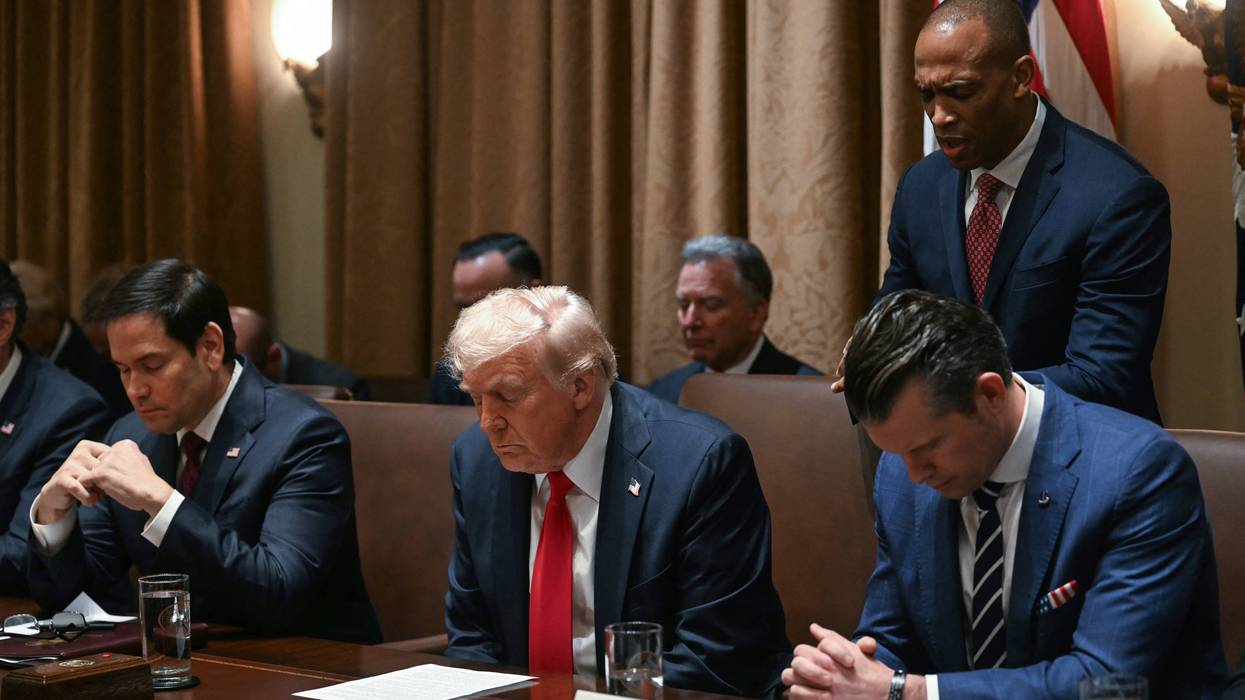
Less than a week after American bombs started to drop on Iran in late February, evangelical pastors famously gathered in the Oval Office to lay hands on a president unilaterally executing a war. It remains an emblematic moment, one of the more clarifying silhouettes of our political mood now sweeping through digital spaces.
That image and many more like it circulated instantly around the country and the world lifting the veil of a bigger story that's gone under-reported: Christian nationalism reshaping the moral language of US foreign policy and endangering pluralist democracy, as the Oval Office is transformed into a quasi-liturgical space in which war is cast as divine sanction, one that is specifically hostile to American Muslims in important ways.
The consecration of a president by a covey of clergy (eyes closed and heads bowed) in the heart of a secular and multicultural democracy illuminates a political culture in which narrow religious narratives are permitted to exert greater influence on how foreign conflicts are imagined and justified in the American public sphere. In our current context, Iran is cast not simply as a strategic adversary but as an apocalyptic antagonist that must be defeated because it is God’s plan. In other words, a major geopolitical event is refashioned into a scriptural caricature that prefigures war in the presumed theater of Armageddon.
What is hardly considered in our context at home is the domestic consequence of that caricature. The United States is not an evangelical nation, despite the bloated conceits of mega-churches, maudlin politicians, and rock star preachers. It is a pluralistic one—home to millions of Catholics, mainline Protestants, Muslims, Jews, Sikhs, Buddhists, Hindus, and nonbelievers. When a specific strand of evangelical eschatology is invited to run the theological grammar of American foreign policy, it shapes how Washington thinks about Iran, a Muslim country; and it also messages how Washington may think about the millions of American Muslims who share a religious tradition with the country being bombed and caricatured. The revival of Crusade-like language among those at the apex of American political and military authority thickens the margins of already marginalized and vulnerable communities. The San Diego mosque shooting, undoubtedly horrific, was one of several indicators of the rise of Islamophobia since the start of the US-Israeli war on Iran.
An administration that reaches any agreement or capitulation with Iran must contend with a powerful domestic constituency for whom any settlement carries the implicit suggestion that the prophetic script was wrong.
These observations are not a call to police theological conviction. But those steering American power toward a militant democracy owe the public transparency about how directly end-times rhetoric about the Muslim world is shaping the foreign policy of a government that still boasts about its pluralism. It should also reckon with the domestic costs of the language of demonization, which places at great risk on the mosques and neighborhoods of American cities and towns.
This dynamic is precarious not merely because of the literalist theology itself but because of its digital velocity. Christian Zionist eschatology has interpreted Middle Eastern events through biblical end-times prophecy for decades; spread through pews, big tents, publishing houses, radio ministries, and cable television. What has changed is the infrastructure of mediation. Images that are dense with symbolism, such as those of evangelical pastors pressing their hands on a president whom they know is irreligious, traverse the globe, crossing denominational boundaries and reaching international audiences instantly.
Free of the guardrails of moral premises, algorithms now act as transnational religious authorities made not of flesh and intellect but of unseen codes, engineered to decide which images and voices are amplified and which are left behind. Algorithmic power does not operate with corrections—no scholarly review or denominational pushback. Its only function is to maximize attention. The meta-platform effect reinforces the frame that American power and divine providence are aligned, and that Iran and the larger Muslim world stand in opposition to both.
Evangelical militancy circulating through algorithmic feeds that reaches tens of millions is structural in a precise sense: Digital scale generates not merely larger audiences but a self-righteous zealotry that feeds on an epistemic apparition—rationales for war and self-defense narratives that present themselves as a well-reasoned, evidence-based mandate.
An administration that reaches any agreement or capitulation with Iran must contend with a powerful domestic constituency for whom any settlement carries the implicit suggestion that the prophetic script was wrong and that the prayers of the pastors who laid hands on the president spectacularly failed—an extraordinary sacred cost with no secular equivalent.
That cost is borne not only by strategists calculating political survival, but by every American citizen whose religious identity, ancestry, and moral convictions place them outside the religious consensus that currently holds the room and exposes their communities and institutions to the kinetic costs of pernicious public discourses.
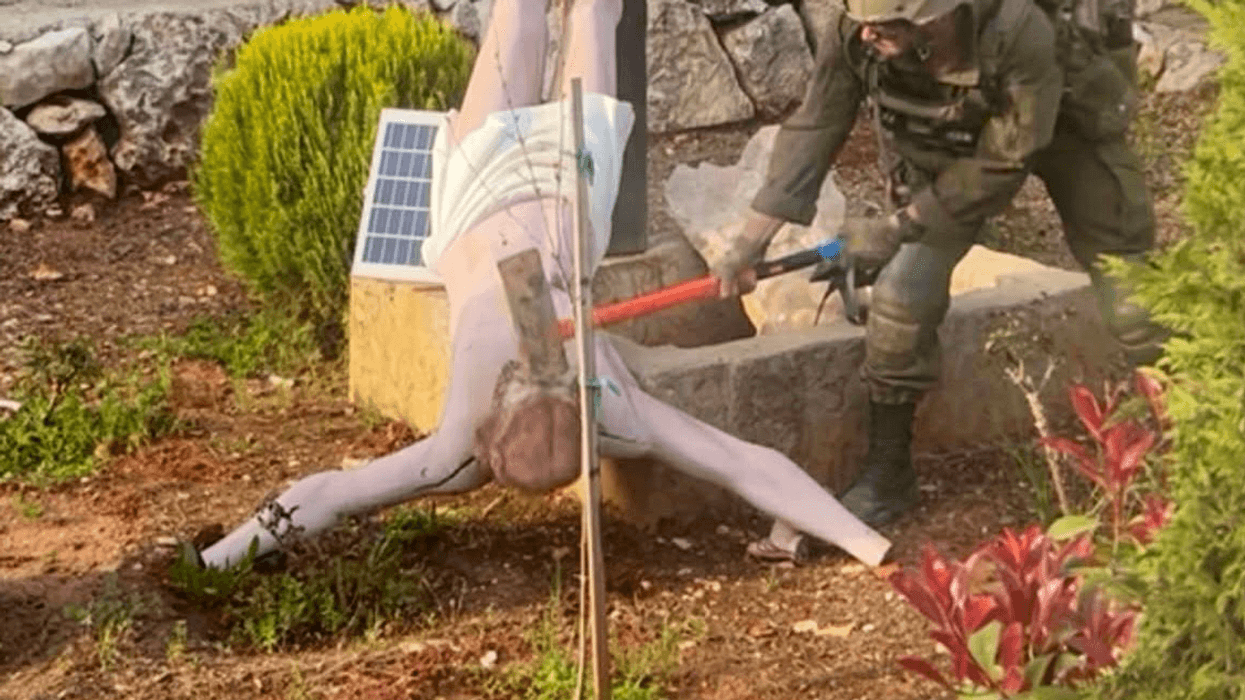
An Israeli soldier brings a hammer to the face of Christ in a Lebanese Christian village after spending long enough in a world where the sacred things of subjugated people are available for whatever use he finds amusing.
On April 19, 2026, an image circulated of an Israeli soldier standing before a statue of Jesus Christ in Debel, a Maronite Christian village in southern Lebanon, bringing a hammer down upon the sacred face while another soldier recorded him. The image spread within hours because it seemed to compress a moral education into one gesture.
Tucker Carlson was furious. So was a segment of the American right that has, for years, supplied the political and theological conditions that produced this soldier. That is the story the image tells, if you are willing to read it past the shock.
Since October 7, 2023, Israeli soldiers have assembled one of the most extensive self-incriminating records in the history of modern warfare. They posted thousands of videos to Instagram, TikTok, and Facebook under their own names—soldiers posing with Palestinian women's underwear in the ruins of their homes, filming the humiliation of detainees, torching food supplies, demolishing houses while comrades cheered. The Israel Defense Forces chief of staff eventually issued a communiqué instructing troops to stop filming what he called "revenge videos." That such an instruction had to be issued is the revelation.
A soldier films his contempt after the contempt has been sanctioned. He brings a hammer to the face of Christ in a Lebanese Christian village after spending long enough in a world where the sacred things of subjugated people are available for whatever use he finds amusing. The camera reveals how comfortable the contempt has already become.
Here is Islamophobia in one of its oldest disguises: Muslim injury must first pass through a Christian icon before Christian power agrees to see a wound.
That comfort has been built over decades, through laws and habits that operate below the threshold of outrage. Palestinian life under Israeli rule is managed through permits withheld without explanation, military courts where the accused often faces a sealed file in place of evidence, and detention orders renewed in six-month increments until time joins the punishment. At Sde Teiman, a desert detention facility established after October 7, five soldiers were charged in February 2025 with beating a Palestinian prisoner, breaking his ribs, puncturing a lung, and causing a perforated rectum. When the soldiers were arrested, far-right members of Israeli Prime Minister Benjamin Netanyahu's coalition stormed military facilities in protest. The defense minister called the prosecution a blood libel. In March 2026, Israel's top military lawyer dropped all charges. Netanyahu declared that Israel must spare its "heroic fighters."
The United Nations special rapporteur found in March 2026 that torture had become a structural feature of the ongoing genocide, extending from prisons into bombardment, starvation, forced displacement, and the terror of soldiers and settlers. B'Tselem has described Israel's prison system as a network of torture camps for Palestinians.
The same contempt moves through sacred space. Gaza's only Catholic church was struck by Israeli fire in July 2025, killing three people. In February 2026, during Ramadan, Israeli settlers vandalized and set fire to a mosque near Nablus, spray-painting insults against the Prophet Muhammad. The Palestinian Ministry of Religious Affairs said settlers had attacked 45 mosques in the West Bank in the previous year. Israeli authorities condemned the incident and promised a search—which is how impunity often speaks when it wishes to sound like law.
The deeper scandal lies in the moral conditioning of recognition. A violated Muslim sanctity can be treated as a security matter, a disputed incident, another complication in a place supposedly fated to brutality. Then a soldier raises a hammer against Christ, and men who had tolerated the pulverizing of Gaza discover that their theology has been disturbed. Here is Islamophobia in one of its oldest disguises: Muslim injury must first pass through a Christian icon before Christian power agrees to see a wound.
Tucker Carlson weeps for the statue in a world his own political allies helped construct. Mike Huckabee, the United States ambassador to Israel, told a television audience in February 2026 that it would be "fine" if Israel took over the entire Middle East. He had already stated that there is "really no such thing as a Palestinian." He is a Christian who calls on the Bible. The president he serves stood beside Netanyahu in February 2025 and announced that the United States would "take over" Gaza and that its 2 million inhabitants should "go to other countries." The United Nations said this constituted ethnic cleansing.
The United States has been a co-author of this order—replenishing the arsenal, shielding Israel at the Security Council, resisting the jurisdiction of international courts, treating Palestinian death as a cost to be managed after the weapons have done their work. In March 2026, the administration bypassed congressional review to approve a $650 million bomb sale to Israel, invoking emergency authority while Palestinians were still living under ruins made by earlier emergencies.
Christian Zionist theology has blessed this map from the beginning: a map in which Palestinian land, Lebanese land, and Syrian land can be folded into sacred entitlement. That theology sanctifies the conditions, the army carries them out, and supremacist politics rewards the result. The soldier with the hammer grew inside that order. He filmed himself because he believed the record would survive as proof of victory.
What struck the statue was already striking everything else. The violence became visible to a new audience. A conscience that required the face of Christ as its activation point had been choosing all along.
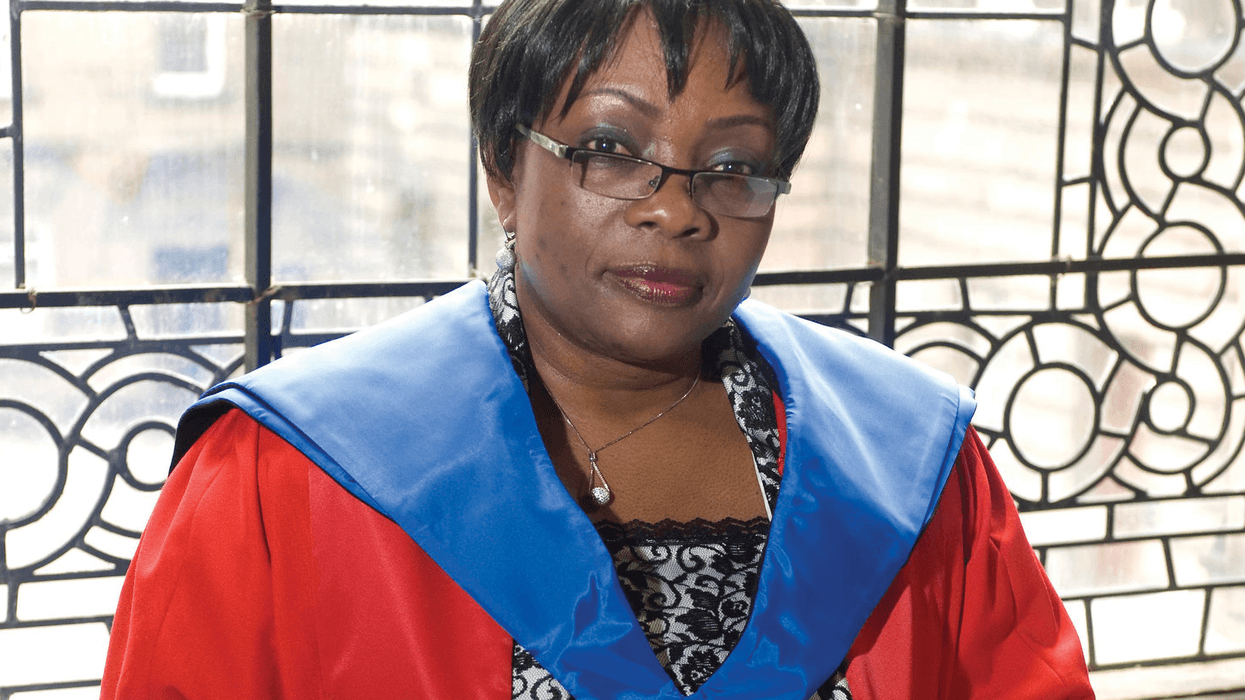
International Court of Justice Vice President Julia Sebutinde recently told members of her church in Uganda that "the Lord is counting on me to stand on the side of Israel."
A global legal advocacy group on Monday called on the International Court of Justice in The Hague to "immediately remove" ICJ Vice President Julia Sebutinde from the ongoing Gaza genocide case following the publication of remarks in which the judge said that God wants her to support Israel.
Santiago Canton, secretary general of the Geneva-based International Commission of Jurists, sent a letter to ICJ President Justice Yuji Iwasawa citing an article published by the Ugandan newspaper Daily Monitor, which reported that Sebutinde delivered remarks on August 10 at Watoto Church in Kampala.
Sebutinde discussed the ICJ's January 26, 2024 issuance of six provisional measures, including orders for Israel to do everything possible to prevent genocidal acts, ensure that humanitarian aid reaches Gazans, and preserve evidence of Israeli crimes committed in the strip. The Ugandan was the sole member of the 17-judge panel to vote against all six measures.
"There are now about 30 countries against Israel," Sebutinde said. "The Lord is counting on me to stand on the side of Israel. The whole world was against Israel, including my country."
Indeed, in January 2024 the Ugandan government issued a statement clarifying that Sebutinde's votes were her "individual and independent opinion" and did "not in any way reflect the position of the government of the Republic of Uganda."
Sebutinde told members of her church—which gained international infamy as its pastor pushed for the current nationwide law punishing "aggravated homosexuality" with a death sentence—that Israel's annihilation and starvation of Gaza is a sign of the biblical "End Times," a period of great suffering followed by the "second coming" of Jesus Christ, a climactic battle between the forces of good and evil, and God's judgment of all people living and dead.
Many Christian Zionists believe that the restoration of Israel as a nation—which occurred in 1948, largely via the ethnic cleansing of Arabs from Palestine—is a prerequisite for Christ's "return."
"I have a very strong conviction that we are in the End Times," Sebutinde told Watoto's congregation. "The signs are being shown in the Middle East. I want to be on the right side of history. I am convinced that time is running out. I would encourage you to follow developments in Israel. I am humbled that God has allowed me to be a part of the last days."
Canton's letter states: "Should it be confirmed that these are accurate quotes of her remarks, the International Commission of Jurists considers that Vice President Sebutinde's continued role in the context of ongoing proceedings before the court, such as South Africa v. Israel, and at least any other proceedings concerning Israel or the state of Palestine, would be profoundly damaging to the court's impartiality, propriety, and integrity, or to perceptions thereof, as well as to the to public confidence in the court."
"These remarks raise serious concerns as to whether her decisions were taken solely on the basis of facts and in accordance with the law, but rather may have also been taken under 'improper influences,' specifically her religious and political beliefs regarding
Israel and the purported approaching of 'End Times,'" the letter continues.
"While the vice president certainly enjoys the right to freedom of expression, this right is not absolute, and there are certain limitations on the right that are particularly applicable to members of the judiciary," Canton stressed. "I therefore respectfully urge you and the court to conduct an investigation into these allegations, and if substantiated, undertake remedial actions."
"In the interim," he added, "I would request that you act to immediately remove Vice President Sebutinde from participating further in proceedings in the South Africa v. Israel case."
Canton's letter follows similar calls by the Arab Organization for Human Rights in the UK, the Council on American Islamic Relations (CAIR), and international jurists including Kenneth Roth, the former head of Human Rights Watch—one of a growing number of organizations accusing Israel of genocide in Gaza—who urged Sebutinde to recuse herself from the ICJ case.
Michael Becker, a professor at Trinity College Dublin's School of Law and former ICJ associate legal officer, told Middle East Eye that "it is never a good idea for an ICJ judge to share their own views on a pending case in a public forum."
"It is worse to suggest that your position is to be 'on the side' of a specific party to the case," he added.
Sebutinde has also come under fire for apparently plagiarizing much of her dissenting opinion in the ICJ's July 2024 advisory opinion that Israel's occupation of Palestine, including Gaza, is an illegal form of apartheid that must end as soon as possible.
South Africa filed its genocide case against Israel in December 2023 and subsequently submitted thousands of pages of evidence including alleged statements of genocidal intent by prominent Israelis including Prime Minister Benjamin Netanyahu, a fugitive from the International Criminal Court wanted for alleged war crimes and crimes against humanity, including murder and forced starvation.
More than two dozen nations and regional blocs are supporting South Africa's case, which is not expected to produce a ruling for years.
Israel's 690-day assault and siege on Gaza have left at least 230,000 Palestinians dead, maimed, or missing. Israeli forces are ramping up Operation Gideon's Chariots 2, a campaign to conquer, occupy, and ethnically cleanse Palestinians from Gaza amid a growing famine that has killed hundreds of people, many of them children.
The ICJ has issued a series of orders for Israel to prevent genocidal acts, stop attacking the southern city of Rafah, and allow the unimpeded flow of humanitarian aid into Gaza. Israel is accused of ignoring all of these orders, and has reportedly proposed building a concentration camp over the ruins of Rafah to house ethnically cleansed Palestinians.
Jews are made safer by working with others for a world that works for everyone. Jewish safety must be grounded in calls for collective liberation, not defense of a murderous regime.
This is a very strange time to be Jewish. There is much talk about a rise in antisemitism, but all around me I see people doing things in the name of protecting Jews—such as dismissing criticism of Israel as antisemitic—that are likely to make us less rather than more safe in this world. The very notion of Jewish safety has been weaponized by people who are objectively enemies of the Jewish people.
Jewish safety matters for Jews, and it should matter for everyone. Jews have often played the role of being canaries in the coalmine of political health. A society that is safe for Jews is more likely to be safe for everyone than one that isn’t. Jews are made safer by working with others for a world that works for everyone. Jewish safety must be grounded in calls for collective liberation.
Many of the mainstream organizations that purport to speak for Jews work actively to make the case that criticism of Israel is a form of antisemitism and to punish those who work to separate those things. It is difficult to know the extent of antisemitism because this conflation skews the data.
Many mainstream Jewish organizations continue to fight to get institutions to adopt the International Holocaust Remembrance Alliance (IHRA) definition of antisemitism. The IHRA definition, in its fine print, defines criticism of Israel as antisemitism. In 2021, when Silicon Valley Hillel tried to get the student government of De Anza College, where I teach, to adopt the IHRA definition of antisemitism, students organized and beat it back. In the process many Jewish people came to speak in favor of us adopting the definition and accused opponents of antisemitism. Through similar struggles throughout the country, the IHRA definition has been adopted widely, and it is now federal policy.
The conflation of criticisms of Israel with antisemitism makes Jews less safe.
The state of Israel is bombing and intentionally targeting civilians in Gaza. Over 60,000 defenseless people have been killed. People are dying of starvation. People are being killed as they line up for food. These actions are clearly violations of international law and the rules of war. Speaking out against these horrific crimes should be expected of all people of conscience. Many of us raised with calls of “never again” feel compelled to speak out in the name of our Jewish values. And yet our voices are often shut down by other Jews. Many mainstream Jewish organizations continue to actively target those who speak out against these atrocities, and they often do so with charges of antisemitism.
The conflation of criticisms of Israel with antisemitism makes Jews less safe. It associates all of us with the acts of a murderous regime. It obscures and confuses the very real and rising antisemitism associated with white supremacy. It leaves us without powerful mainstream voices to act on our behalf.
There are many good reasons why people support the state of Israel. Many Jews are deeply attached to Israel because of real lived family ties. Many feel that Israel was founded to keep Jews safe. And yet many people support Israel because it is a pro-Western outpost in a Middle East that is largely not aligned with Western imperial interests. Those motivations for supporting Israel are often opposed to broad notions of human rights and respect for national sovereignty. and so are not aligned with the kinds of policies that would make the world safer for Jewish people.
Even worse, are those who support Israel out of adherence to a deeply antisemitic theology. Christians United for Israel (CUFI) claims 10 million members and describes itself as “the foremost Christian organization educating and empowering millions of Americans to speak and act with one voice in defense of Israel and the Jewish people.” They say their goal is to “oppose antisemitism and stand with the Jewish people.”
Its leader, John Hagee, argues that Jews must inhabit all of the biblical Holy Land and rebuild the temple in Jerusalem in order to bring about the return of Jesus and the end-of-days apocalypse. At that time, Jews will either convert or be condemned to damnation. In other words: Jews are a means to a Christian end, and not a people to be valued for ourselves. The U.S. Ambassador to Israel, Mike Huckabee, is a follower of this antisemitic theology.
In Alameda County in California, local residents have been organizing to get the board of supervisors to pass an ethical investment policy. This policy would outlaw investing in companies that do business with human rights abusers. Politicians’ in-boxes were flooded with letters opposing the divestment, on the basis that a policy that disallowed investment in companies that engaged in human rights abuses, might disallow investments in companies doing business with Israel. It turns out that the flood of email was coming from outside the county, and indeed from outside the state. The main group organizing opposition to the Alameda County divestment was CUFI.
It makes us less safe as Jews when we ally ourselves with antisemitic voices simply because those voices support the state of Israel.
In 2024, the Heritage Foundation, which gave us Project 2025, launched Project Esther. It calls for a systematic campaign against protest in favor of Palestinian rights and opposition to the ongoing massacre in Gaza. It attempts to link criticism of Israel with support for terrorism.
Project Esther is part of the right-wing assault on freedom of speech and the right to protest. While masquerading as a pro-Jewish project, Project Esther actually has very little Jewish support. The project makes opportunistic use of the concept of Jewish safety for a deeply right- wing political project.
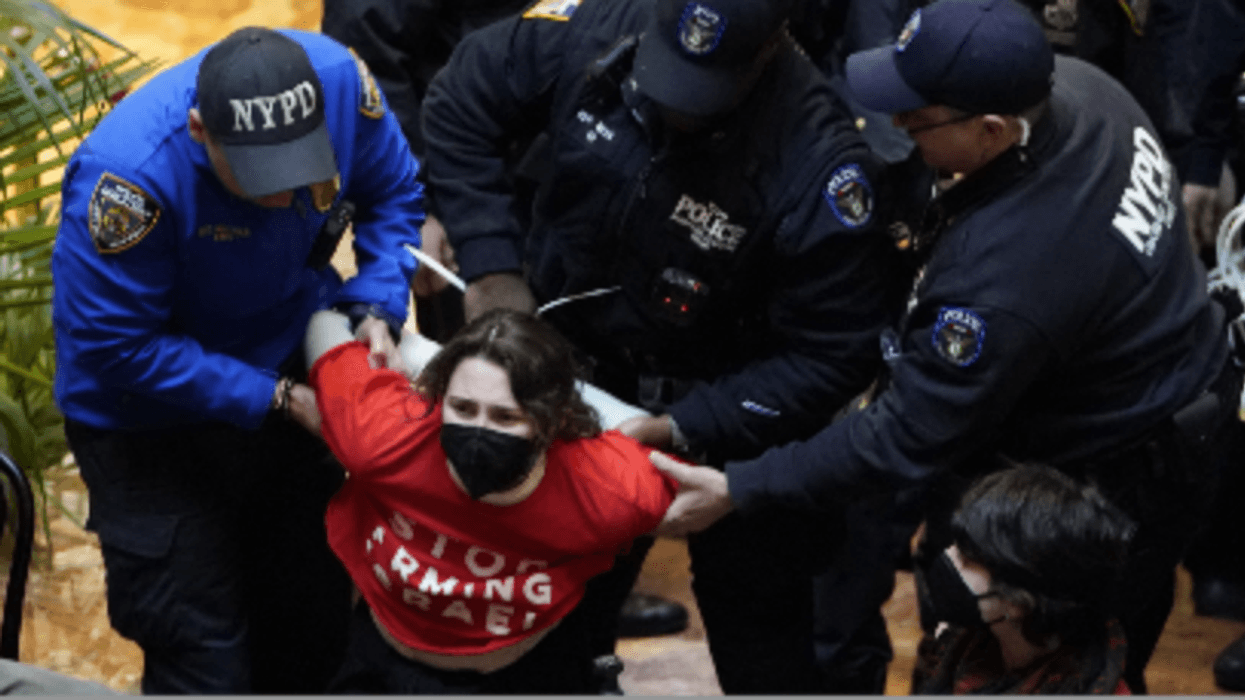
Having Jews persecuted for peaceful protest is not “good for the Jews.”
Sometimes it is difficult to understand what interests the current chaotic administration is serving. Its electoral strength comes from appealing to a sense of grievance among people struggling to make it in a difficult economy. The big money that helped the administration get elected comes from two sectors of the business class: the fossil fuel industry and the technology industry. Unlike the rest of business, those two sectors were not well served by the dominant neoliberal consensus. And so, they have appealed to people’s grievances to win popular support for unpopular policies. Those economic interests are served by shutting down protest and free speech.
Efforts to shut down the right to resist, and to shut down free speech on campus, in order to bolster an authoritarian government that acts in the interests of the fossil fuel and tech oligarchies, are not good for our democratic institutions and they are not good for Jewish people. We should not let them do those things in our names.
It is hard to say that you are working for Jewish safety when you are asking that Jewish students who speak out against the genocide in Gaza be thrown out of school. It is hard to say you are working for Jewish safety when you engage in policies that harm Jewish faculty and staff.
As one of very few Jewish faculty at my college, I was recently under a formal investigation for antisemitism. The accusation was part of a round of condemnation that began when my office invited a Jewish speaker to campus to speak about October 7 and the attack on Gaza. The event was critical of both Hamas and of the Israeli government.
Having Jews persecuted for peaceful protest is not “good for the Jews.” As with people from any group, Jewish people should be safe to express our opinions. Fighting for our rights to be safe—no matter what our opinions—needs to be part of the agenda for Jewish safety.
In California, mainstream Jewish organizations are pushing a bill through the legislature, AB715, which purports to make Jews safe by appointing a commission on antisemitism. The bill also would make it easier to punish teachers who teach things that are pro-Palestinian or critical of Israel. It would open pathways for the IHRA definition of antisemitism to be used, and so could help to conflate criticism of Israel with antisemitism.
Many of those opposing the bill, including Jewish Voice for Peace, have argued that putting antisemitism out as a separate and privileged form of oppression makes Jews less safe. There is, of course, antisemitism in California schools, just as there is anti-Black racism. The state of California and its schools have many policies in place that can be used to challenge discrimination. Those policies can already be used to fight antisemitism. More can, and should, be done to fight all forms of oppression experienced by California’s schoolchildren. But separating antisemitism from other forms of oppression, and giving it a privileged place, undermines the solidarity Jews have with other fights for liberation. That solidarity is crucial for increasing Jewish safety.
Given that mainstream Jewish organizations continue to vehemently insist on conflating criticism of Israel with antisemitism; given that Israel’s most powerful supporters in the U.S. right now are active antisemites; given the alignment of the state of Israel with right-wing forces that want to shut down rights to protest and free speech, including those of Jews; it is hard to see how supporting the government of Israel will make us safe.
Calls for the liberation of all people are deep in Jewish culture and theology. We thrive in societies that are pluralist and tolerant. We are often the consciences of society. We often feel it in our bones when danger is coming before others are even aware that the winds of destruction are starting to blow. It is a part of our cultural DNA to speak out and fight for justice. Many of us are willing to take risks to fight those evils because we know that when we all stand up, pogroms are less likely to happen.
Making the world safe for Jews is something that is good for everyone. We need to stay in alignment with those deeper values of justice and a world that works for all. We need to insist that we increase Jewish safety when we work for collective liberation.
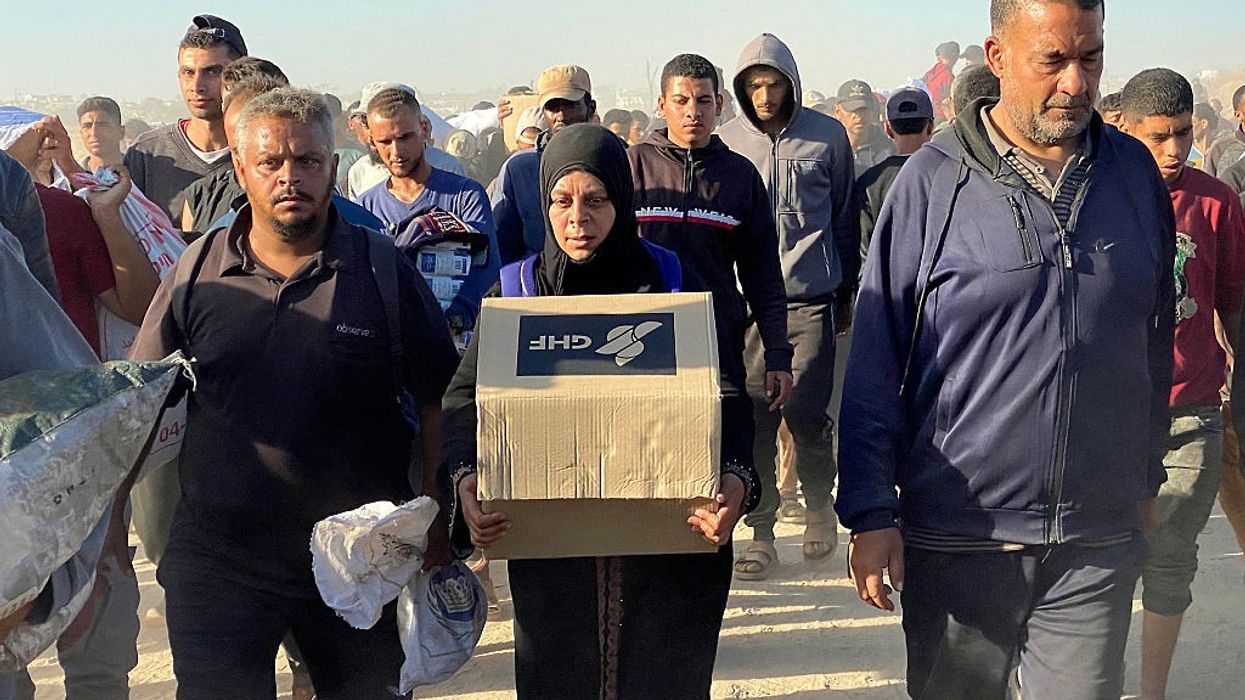
The GHF offers a gospel of charity with one hand while authorizing sniper fire with the other.
When Rev. Dr. Johnnie Moore, a Trump-aligned Christian Zionist, was selected to lead the Gaza Humanitarian Foundation, the appointment was framed as a mission of mercy. In reality, it was a calculated move reflecting a theology that sanctifies suffering and weaponizes aid to serve empire.
The GHF is a United States and Israeli-backed entity, established in February 2025 under the guise of delivering emergency food, water, and medicine to a population devastated by bombs and blockades—bombs dropped and blockades enforced by the very governments funding the aid. GHF bypasses United Nations infrastructure and funnels resources through fortified "aid hubs" surrounded by biometric scanners, militarized checkpoints, and private American security contractors. Global humanitarian leaders have widely condemned GHF, and its initial executive director, former U.S. Marine Jake Wood, resigned in May, stating that GHF could not meet "humanitarian principles of humanity, neutrality, impartiality, and independence."
What appears to be humanitarian relief is a choreographed catastrophe. Since the GHF launch, over 400 Palestinians have been killed and thousands injured while attempting to access aid. One U.S security contractor described the chaos in Zeteo: metal lanes collapsed under pressure as desperate civilians were funneled into kill zones. "What we—these American companies and contract personnel—are doing is directly leading to more pain, suffering, and death for the Palestinians in Gaza," he said. The Israeli military is not-so-secretly embedded in GHF operations. U.S contractors shared radio communications with Israel Defense Forces (IDF) units, with snipers and tanks operating within earshot. The contractor added, "I would not be surprised if the aid was delivered at night deliberately, given it would then draw people out, at which point they could be fired on as combatants, even though they weren't."
Christian Zionism claims to stand with Israel, but in practice, it turns both Jewish and Palestinian lives into pawns in violent political theology that demands blood to feel righteous.
Israeli newspaper Haaretz recently published a military whistleblower report confirming that Israeli soldiers were ordered to shoot directly at unarmed Palestinians waiting at designated humanitarian aid sites—the very places GHF celebrates as sites of successful distribution. One IDF soldier told Haaretz: "It's a killing field. Where I was stationed, between 1 and 5 people were killed every day. They're treated like a hostile force—no crowd-control measures, no tear gas—just live fire with everything imaginable: heavy machine guns, grenade launchers, mortars… I'm not aware of a single instance of return fire. There's no enemy, no weapons." The parallel testimonies of American contractors and Israeli soldiers expose a coordinated structure of lethal control masquerading as compassion. Aid becomes ambush. Flour becomes bait. Mercy becomes a mechanism of surveillance and control.
Yet Moore, in a Fox News op-ed, paints a different picture: one of flawless logistics and divine providence. While Moore boasts of "Over 7 million meals were delivered… no trucks seized, no aid diverted, no violence at distribution sites," Palestinians were being trampled in fenced lanes and shot while reaching for flour, tea bags, and lentils, all requiring water that Palestinians do not have. While he cites spontaneous gratitude from the Gazans, his account includes no mention of the casualties, the gunfire, the biometric surveillance, or the private contractors earning up to $1,000 per day to "protect" food distribution, despite having no training in humanitarian law or weapons discipline.
This narrative, where Christian Zionist leaders claim victory while erasing the suffering caused by their own policies, is part of a carefully crafted theological strategy. My seminary thesis, Bad Theology as a Social Determinant of Health, argues that theologies built on white supremacy—like Christian Nationalism and Christian Zionism—transform faith into a political force that legitimizes structural violence by driving policy; justifying oppression; and becoming a cause of disease, displacement, and death. In this worldview, the modern state of Israel is a divine actor in prophecy, Palestinians are obstacles to redemption, and every military escalation is recast as sacred inevitability. So when global outrage over mass starvation in Gaza grew too loud to ignore, the GHF emerged—not as a bridge to recovery, but as a theater of benevolence. Israeli Finance Minister Bezalel Smotrich made the logic plain when he said that aid was allowed only as a prerequisite for "international legitimacy to conduct this war." In other words, humanitarianism becomes camouflage, and aid is required to sustain the optics of righteousness while the siege continues.
The brazenness of this theological complicity has only been intensified. Even before Israel's bombing campaign against Iran began, Christian Zionist leaders were at the forefront of urging escalation, framing regional war as a necessary prelude to prophetic fulfillment. Once the Iran-Israel war began, they did not grieve the violence—they celebrated it. Mike Huckabee, a longtime evangelical ally of President Donald Trump and now the U.S. ambassador to Israel, proclaimed on social media that Trump was spared from assassination to fulfill God's plan in the region. In this worldview, every missile launched and every city bombed becomes a step in a divine script. Christian Zionist leaders are not bystanders to this destruction but are its interpreters and enablers.
Christian Zionism does not just erase Palestinian life. It instrumentalizes Jewish death. It claims to defend Israel while advancing a theology in which the majority of Jews are expected to die in a coming apocalypse. As Stephen Sizer documents in Christian Zionism: Roadmap to Armageddon?, evangelical writers describe the Rapture as "the time of Israel's greatest bloodbath" and "a holocaust in which at least 750 million people will perish." This is not solidarity—it is eschatological antisemitism, cloaked in prophecy and wrapped in the American flag.
These beliefs have long shaped U.S. policy. Sizer notes that during the Reagan administration, figures such as Jerry Falwell and Pat Robertson were invited to the White House to interpret events in the Middle East through the lens of the Book of Revelation. Israeli Prime Minister Menachem Begin reportedly called Falwell before President Ronald Reagan to brief him on the 1981 bombing of Iraq's nuclear reactor. In 1982, after the Sabra and Shatila massacres in Lebanon, Falwell falsely insisted, "The Israelis were not involved." When Israeli Prime Minister Benjamin Netanyahu visited Washington in 1998, his first stop was not a meeting with President Bill Clinton—it was with Jerry Falwell. This is why the resume of Johnnie Moore is no surprise: former spokesman for Falwell's Liberty University, participant in Trump's evangelical advisory board, and a carbon copy of Huckabee, known for his infamous quote, "There's really no such thing as a Palestinian."
The GHF is not a bridge to recovery, but a theological rehearsal, a performance of control and consecrated theater. It asks us to witness a catastrophe and call it the fulfillment of prophecy. To baptize privatized militarism and call it salvation. To offer a gospel of charity with one hand while authorizing sniper fire with the other.
Christian Zionism claims to stand with Israel, but in practice, it turns both Jewish and Palestinian lives into pawns in violent political theology that demands blood to feel righteous. Its leaders speak the language of salvation while sanctioning policies that produce siege, displacement, and death. Johnnie Moore and others like him do not save lives—they provide spiritual cover for systems that end them. The Gaza Humanitarian Foundation is not a deviation from this logic; it embodies it.
As theologian Reverend Dr. Munther Isaac reminds us, Christ is under the rubble—and the church put him there. Will Christians continue to preach biblical literalism that demands a body count? Will Christians let prophecy justify annihilation? The one Christians claim to follow—a Palestinian Jew—was crucified by empire. Yet, Christian Zionism is insistent on crucifying Palestinians and Jews again and again.
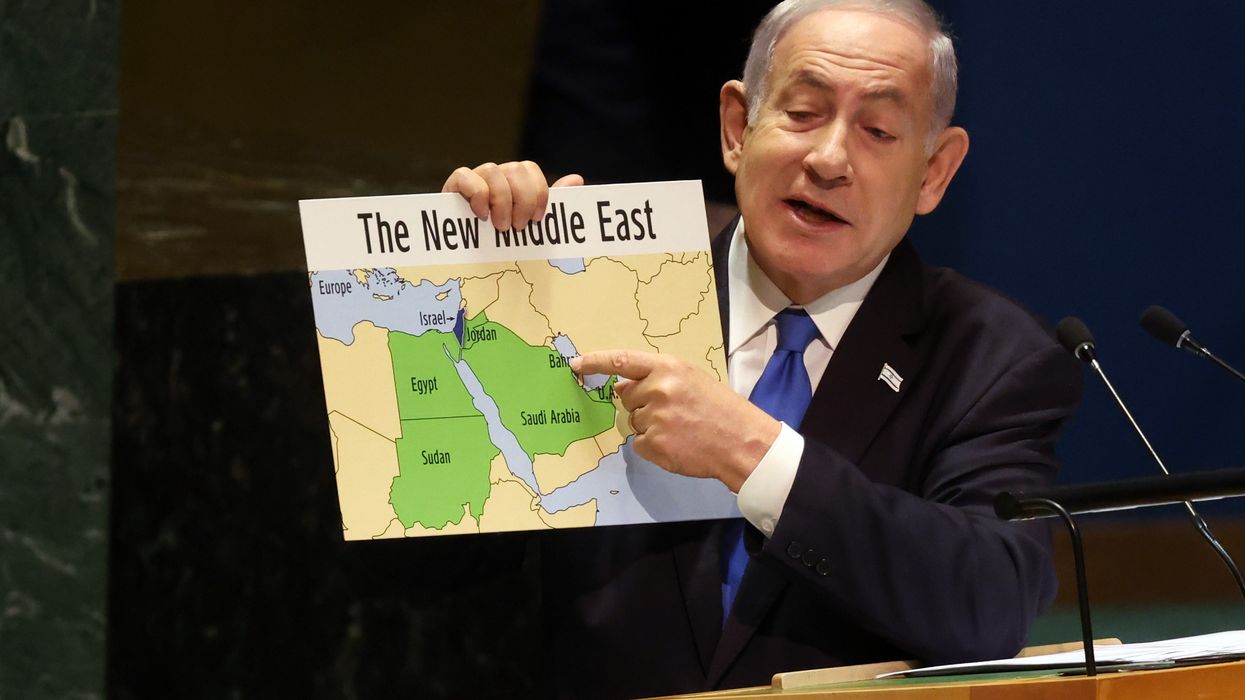
Religious nationalism may be soaring in Israel, but that’s not the trend in America.
“You must ‘remember what Amalek has done to you,” Israeli Prime Minister Benjamin Netanyahu admonished on October 28, announcing the “second phase,” a ground invasion, of Israel’s war in Gaza.
Amalek, in the Tanakh (Hebrew Bible), is a nation that ambushed the Israelites making their way to the Promised Land. Following the attack, which the Israelites were able to beat back, God instructed that they must never forget and must wage an eternal war until no trace of Amalek’s existence remains. Generations later, King Saul killed all but the Amalekite king, whose descendent, Haman, generations after that, in the story of Purim, plotted to kill all the Jews in Persia.
Netanyahu is notoriously secular in his private life. But, ever the shrewd politician, scripture is his language of choice to sell his war to Jewish supremacists in Israel and right-wing Evangelicals in the United States.
The victims of Hamas’ vile October 7 attack come from what is referred to as the “Gaza envelope.” Heavy with kibbutzim (intentional collectives, traditionally based around agriculture), its residents are known for being secular and left-leaning.
Asked if losing his parents in Hamas’s terror attack had affected his political views, Maoz Inon, pleaded not for revenge but a reassessment of basing security “on military might.”
Netanyahu is notoriously secular in his private life. But, ever the shrewd politician, scripture is his language of choice to sell his war to Jewish supremacists in Israel and right-wing Evangelicals in the United States.
Likewise, Yotam Kipnis, in eulogizing for his father, said “We will not stay silent while the cannons roar, and we won’t forget that Dad loved peace. He wasn’t willing to serve in the territories. Do not write my father’s name on a missile, he wouldn’t have wanted that.”
Tom Godo, whose son lived and died in Kibbutz Kissufim, blamed the Netanyahu administration: “The fingers that pulled the trigger and murdered, the hands that held the knives that stabbed and beheaded and slashed were the loyal and determined emissaries of the accursed, messianic and corrupt government [of Israel].”
Even after spending 16 days as a hostage in Gaza, eighty-five-year-old peace activist Yocheved Lifshitz retained her belief in reconciliation. Upon being transferred to the Red Cross, she took the hand of her Hamas handler and bade him “Shalom,” (peace).
It’s not the families of those murdered on October 7, nor the families of the hostages who have been sleeping in tents outside the military headquarters in Tel Aviv demanding all Palestinian political prisoners be released in exchange for their loved ones Netanyahu is invoking Amalek to, but the ideological descendants of Kach.
The religious-nationalist Kach party was founded in 1971 by Brooklyn-born Rabbi Meir Kahane who argued for “the immediate transfer of the Arabs,” whom he referred to as “dogs.” In 1984, the one time his party secured a single seat in the Knesset, Kahane introduced legislation to ban all Jewish-Gentile marriages and sexual relations and revoke the Israeli citizenship of non-Jews.
The Kach party was so violently racist that it was prohibited from running in Israel’s next election, banned entirely in 1994, and defined as a terrorist organization by the U.S. State Department.
In what could be perceived as another iteration of Amalek, in 2019, Kahane follower Itamar Ben Gvir formed the Jewish Power party, an ideological offshoot of Kach. Merging with other far-right fundamentalist parties to form Religious Zionism in 2022, they won the third-largest share of Israel’s parliament seats. This is the audience Netanyahu is addressing, but not only them.
On October 8, the International Christian Embassy Jerusalem (ICEJ), which claims to represent millions, sent out an email stating that Hamas’ attack, “was not launched due to grievances over the Israeli ‘occupation’ or any real dangers to the al-Aqsa mosque.” Rather, it was driven by the ancient “Spirit of Amalek.”
On October 24, Christians United for Israel, which boasts a membership of over 10 million, raised $25 million in a single night in support of Israel (they raised and donated $100 million over the week). Standing beside CUFI’s Pastor John Hagee, who in 2008 referred to Hitler as a “hunter” sent by God “to help Jews reach the promised land,” was Israeli Ambassador to Israel Gilan Erdad.
Given their belief that when enough Jews have populated their modern state, the apocalypse will come, and “a sea of [Jewish and Muslim] human blood" will fill the land, it’s hard to think of Evangelical Zionist support for Israel as a heartfelt commitment to the protection of the Jewish people. Despite that, amid declining Jewish-American support for Israel, especially among young Jews, Israel has for years been courting Evangelical support. However, polls are finding the support of young Evangelicals is also rapidly declining, dropping from 75% to 34% between 2018 and 2021.
Religious nationalism may be soaring in Israel, but that’s not the trend in America. Some people of faith, like Adam Strater, the senior Jewish educator for Georgia Hillels, are even reclaiming the story of Amalek as a model for Jews to reject “the evil impulse,” described in the Zohar (3:160a) and “make the moral choice to reorient the tradition towards a shared sense of solidarity, and ultimately, liberation.” Given the rapidly climbing toll of death in Gaza—over 10,000 people killed already—these changes could not be more welcome or come soon enough.