

SUBSCRIBE TO OUR FREE NEWSLETTER
Daily news & progressive opinion—funded by the people, not the corporations—delivered straight to your inbox.
5
#000000
#FFFFFF
To donate by check, phone, or other method, see our More Ways to Give page.
Daily news & progressive opinion—funded by the people, not the corporations—delivered straight to your inbox.
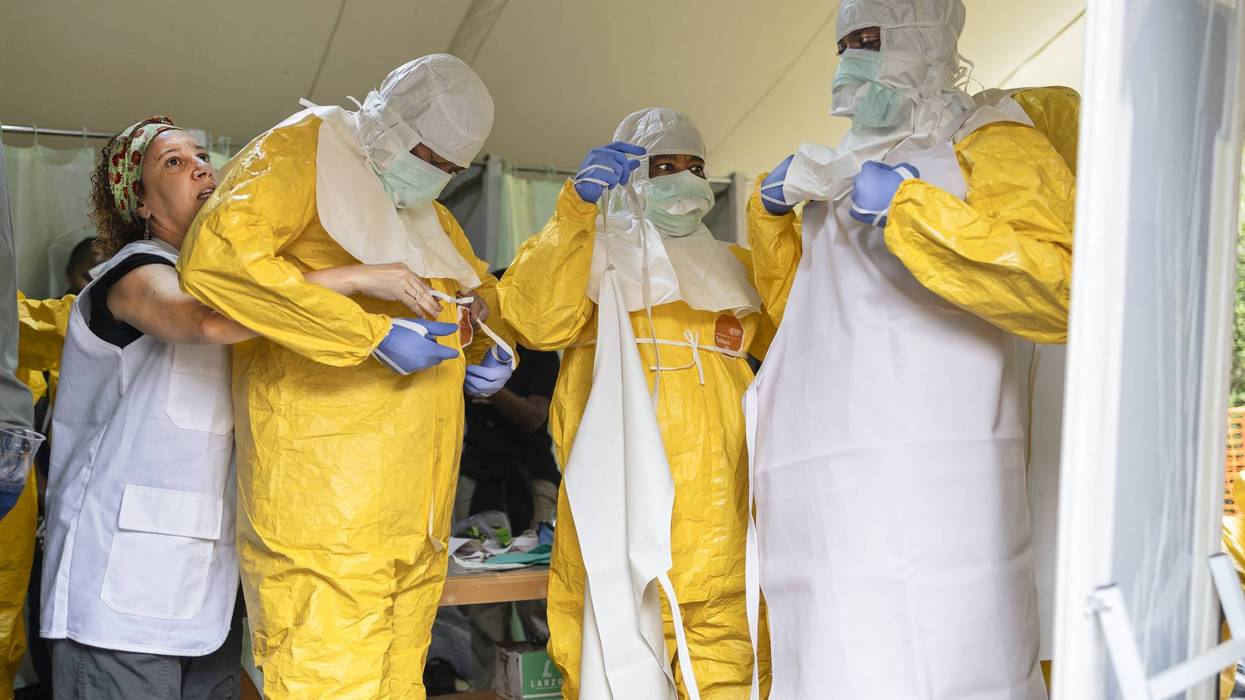
"The scale of the outbreak is at least two to four times the number of cases that we have found," said WHO emergencies director Chikwe Ihekweazu.
The Ebola outbreak sweeping the Democratic Republic of Congo is the fastest-growing ever, the World Health Organization warned Tuesday, as a shortage of funding, strained health infrastructure, and a strike by frontline medical workers threaten efforts to contain the deadly virus.
“We've seen the fastest growth in a single month since the outbreak started, and of all the Ebola outbreaks that we have managed,” WHO Health Emergencies Program executive director Dr. Chikwe Ihekweazu told reporters in Geneva. “Over the last few days, we've seen some of the highest numbers of new infections in a single day."
“A few days ago, we saw over 80 cases confirmed in a single day,” he added.
Experts are particularly alarmed that the majority of new infections—roughly 80%—are coming from what the WHO called “unknown chains of transmission."
“You have to imagine that this is a fire,” Ihekweazu said. “There's something driving the fire in its heart, and it's also expanding at the same time.”
The WHO said that 95% of all new Ebola cases are in Ituri province, where the outbreak started in May, but the virus is now spreading to two new provinces, Haut-Uele and Tshopo.
The Ebola virus causes widespread and often catastrophic damage to the body’s blood vessels, immune system, and organs and typically kills between 25% and 90% of infected people, depending upon the strain of the virus and quality of available medical care.
Democratic Republic of Congo (DRC) government figures show nearly 2,000 confirmed infections and more than 700 deaths, but WHO officials say the true scale could be two to four times higher because many infections and deaths are going undetected.
Wessam Mankoula, an epidemiologist with the Africa Centers for Disease Control and Prevention in Ethiopia, noted during a press briefing last week that 112 healthcare workers have been infected with Ebola in DRC, 32 of whom have died.
There have also been around 20 Ebola infections and at least two deaths during the current outbreak in neighboring Uganda.
“Perhaps the most alarming finding is that many newly reported cases are individuals who died in their communities, without ever reaching a health facility and receiving care," Ihekweazu said.
There is some good news, with Ihekweazu noting that "treatment capacity now exceeds 700 beds and continues to increase each week; laboratory capacity has expanded dramatically... and contact follow-up rates are approaching 80%."
However, frontline health workers at an Ebola treatment at Rwampara General Hospital in Ituri province have gone on strike over unpaid salaries and bonuses, poor working conditions, and shortages of protective equipment.
Congolese Health Minister Roger Kamba assured workers that the government has "the means to sort this out."
Critics say US President Donald Trump’s ideologically driven decision to withdraw the US from the WHO, his administration’s dismantling of the US Agency for International Development (USAID), and reduced funding for the US Centers for Disease Control and Prevention’s global public health efforts have also adversely affected the response to the current Ebola epidemic, compared with 2014 and 2019 outbreaks.
The current Ebola outbreak comes in a region already ravaged by armed conflict, displacement, and other challenges. Health officials stress that getting a grip on the outbreak will require not only medical intervention but also rebuilding trust with communities rife with fear and misinformation, and ensuring health workers are paid and protected.
"This outbreak requires resources that match the scale of the challenges that we are facing," Ihekweazu stressed Tuesday. "And this is not a burden DRC can be allowed to carry alone."