SUBSCRIBE TO OUR FREE NEWSLETTER
Daily news & progressive opinion—funded by the people, not the corporations—delivered straight to your inbox.
5
#000000
#FFFFFF
To donate by check, phone, or other method, see our More Ways to Give page.


Daily news & progressive opinion—funded by the people, not the corporations—delivered straight to your inbox.
One critic called the move "an unprecedented abandonment of the Department of Justice's responsibility to enforce civil rights laws and protect communities from unlawful police abuse."
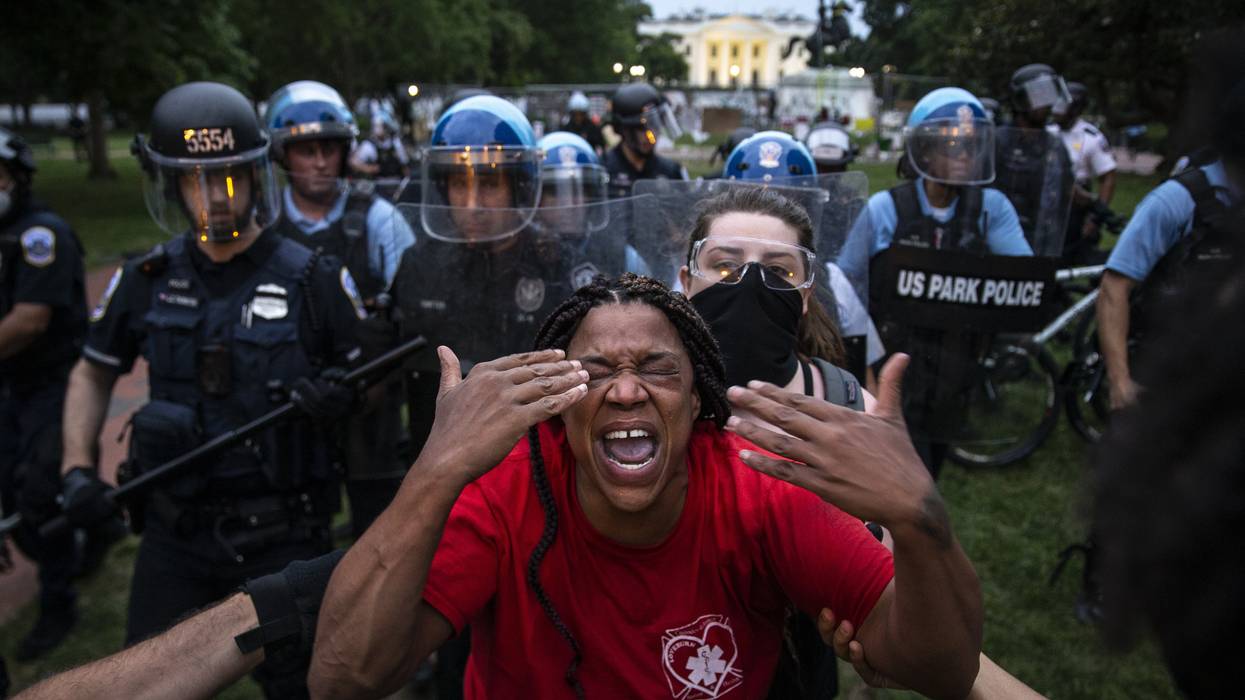
Racial justice advocates decried Wednesday's announcement by the U.S. Department of Justice that it will end law enforcement reform and accountability efforts, including the Biden administration's agreements with the cities of Minneapolis and Louisville—a move that came just days before the fifth anniversary of George Floyd's murder by a Minneapolis cop.
The Department of Justice's (DOJ) Civil Rights Division said it is dropping lawsuits against the Minneapolis and Louisville police departments and ending pending consent decrees—court-enforceable agreements under which law enforcement agencies commit to reform—with the two cities. The deals, which have been submitted to judges for approval, have been held up in federal court as the Trump administration has sought to block their implementation.
The Civil Rights Division said it "will also be closing its investigations into, and retracting the Biden administration's findings of constitutional violations on the part of," the Louisiana State Police and police departments in Phoenix; Memphis; Oklahoma City; Trenton, New Jersey; and Mount Vernon, New York.
To “disappear” DOJ findings like this is the most disturbing and disgraceful part. A key advantage of DOJ pattern & practice investigations is that DOJ has the resources to absorb the cost of generating the findings that indiv civ rights groups suing police depts find onerous & often prohibitive.
[image or embed]
— Sherrilyn Ifill ( @sifill.bsky.social) May 21, 2025 at 8:02 AM
Civil rights lawyer Benjamin Crump, who represents the families of George Floyd—murdered by then-Minneapolis police officer Derek Chauvin on May 25, 2020—and Breoanna Taylor, who was killed earlier that year by Louisville police, called the DOJ announcement a "slap in the face."
"Just days before the fifth anniversary of George Floyd's murder—a moment that galvanized a global movement for justice—the U.S. Department of Justice has chosen to turn its back on the very communities it pledged to protect," Crump said in a statement Wednesday.
"By walking away from consent decrees in Minneapolis and Louisville, and closing its investigation into the Memphis Police Department while retracting findings of serious constitutional violations, the DOJ is not just rolling back reform, it is attempting to erase truth and contradicting the very principles for which justice stands," he asserted.
"These consent decrees and investigations were not symbolic gestures, they were lifelines for communities crying out for change, rooted in years of organizing, suffering, and advocacy," Crump continued, adding that the DOJ's moves "will only deepen the divide between law enforcement and the people they are sworn to protect and serve."
Congresswoman Jasmine Crockett (D-Texas) lamented the DOJ move and accused the Trump administration of acting "like Breonna Taylor and George Floyd's lives didn't mean a damn thing."
Democratic Minneapolis Mayor Jacob Frey said his city would proceed with reforms despite the DOJ's announcement, while questioning the move's timing.
"The Trump administration is a mess. It is predictable that they would move for a dismissal the very same week that George Floyd was murdered five years ago," he said. "What this shows is that all [President] Donald Trump really cares about is political theater."
The DOJ claimed the Biden administration falsely accused the Minneapolis and Louisville police departments of "widespread patterns of unconstitutional policing practices by wrongly equating statistical disparities with intentional discrimination and heavily relying on flawed methodologies and incomplete data."
"These sweeping consent decrees would have imposed years of micromanagement of local police departments by federal courts and expensive independent monitors, and potentially hundreds of millions of dollars of compliance costs, without a legally or factually adequate basis for doing so," the agency argued.
Assistant Attorney General Harmeet Dhillon—the conspiracy theorist who heads the Civil Rights Division despite, or perhaps because of, her troubled history of working against voting, reproductive, LGBTQ+, and other civil rights—said in a statement Wednesday that her agency is ending the Biden administration's "failed experiment of handcuffing local leaders and police departments with factually unjustified consent decrees."
"Overbroad police consent decrees divest local control of policing from communities where it belongs, turning that power over to unelected and unaccountable bureaucrats, often with an anti-police agenda," Dhillon added.
"DOJ's actions today amount to a public declaration that law enforcement agencies are above the law."
Legal Defense Fund director of strategic initiatives Jin Hee Lee called the DOJ announcement "an unprecedented abandonment of the Department of Justice's responsibility to enforce civil rights laws and protect communities from unlawful police abuse."
Lee said the DOJ investigations that led to the consent decrees "revealed a litany of systemic harms to community members, whom officers are sworn to protect—from wanton violence and sexual misconduct to unlawful stops, searches, and arrests, and racially discriminatory policing."
"By abandoning its obligation to pursue legal remedies that would stem this unlawful conduct, DOJ necessarily condones it," Lee added. "DOJ's actions today amount to a public declaration that law enforcement agencies are above the law."
NAACP president Derrick Johnson said on social media, "It's no surprise that Trump's Department of Coverups and Vengeance isn't seeking justice."
"It's been five years, and police reform legislation still hasn't passed in Congress, and police departments still haven't been held accountable," Johnson added, referring to Floyd's murder. "Five years."
Furthermore, speculation is growing over the prospect of Trump pardoning Chauvin. Addressing the possibility, Democratic Minnesota Gov. Tim Walzsaid earlier this week that "if Chauvin's federal conviction is pardoned, he will still have to serve the remainder of his 22-and-a-half-year state prison sentence for murder and manslaughter."
Opponents vowed to fight the Trump administration's civil rights pushback.
"Let me be clear: We will not give up," Crump said. "This movement will not be swayed or deterred by fickle politics. It is anchored in the irrefutable truth that Black lives matter, and that justice should not depend on who is in power."
"Reform isn't what we need! 'Reform' means more money for the killer cop industry that will never erase its origins out of slave patrols," asserted Black Lives Matter.
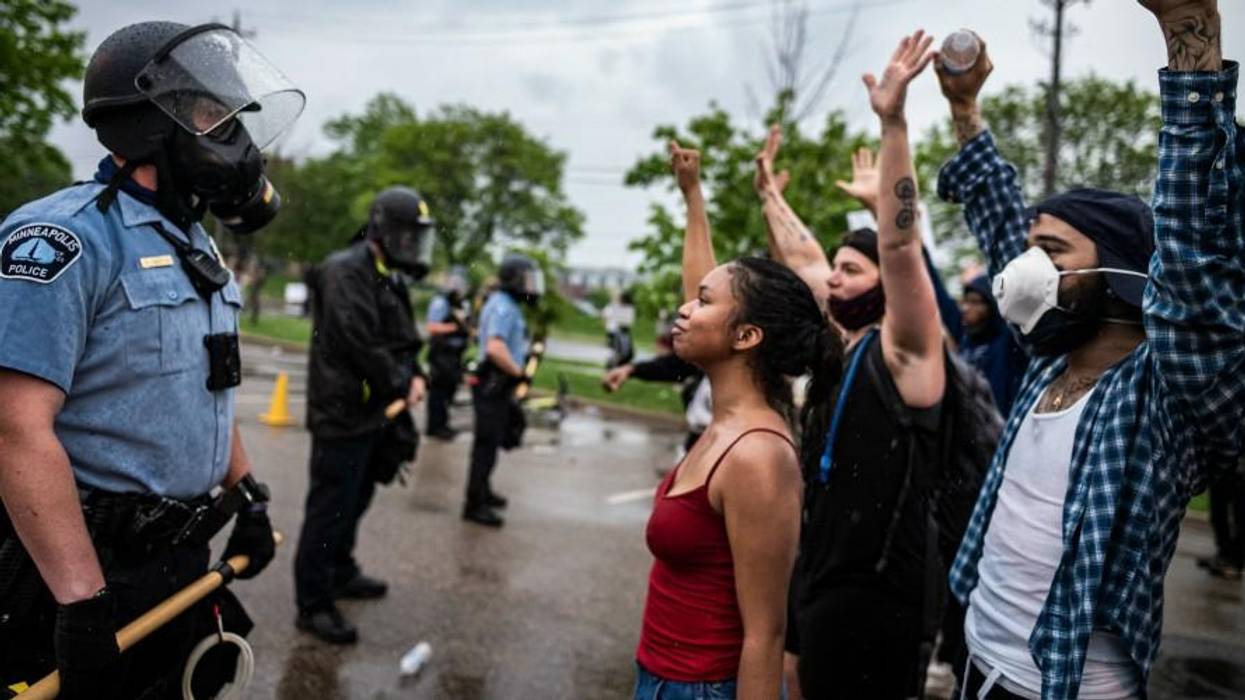
Racial justice defenders on Friday said the Department of Justice probe of the Minneapolis Police Department—which detailed a pattern of excessive violence, racism, and civil rights violations—underscores the need for deep systemic transformation of U.S. policing.
The DOJ's 89-page
report—the result of an investigation launched in the wake of the May 2020 murder of George Floyd by Minneapolis police officer Derek Chauvin—found that, as many community members have said for decades, the MPD and Minnesota's largest city "engage in a pattern or practice of conduct in violation of the U.S. Constitution and federal law."
"Our investigation showed that MPD officers routinely use excessive force, often when no force is necessary. We found that MPD officers often use unreasonable force (including deadly force) to obtain immediate compliance with orders, often forgoing meaningful de-escalation tactics and instead using force to subdue people," the report states. "MPD's pattern or practice of using excessive force violates the law."
The DOJ probe found that MPD:
"We also found persistent deficiencies in MPD's accountability systems, training, supervision, and officer wellness programs, which contribute to the violations of the Constitution and federal law," the report states.
Responding to the investigation, Black Lives Matter tweeted: "Reform isn't what we need! 'Reform' means more money for the killer cop industry that will never erase its origins out of slave patrols. Defund the police. Then we abolish."
Award-winning filmmaker and Twin Cities community artist D.A. Bullock lamented "the absolute folly of dedicating all our resources toward carceral systems that do not work."
"[You] don't fund or bolster the executioner to prevent the murder," he argued on Twitter.
John Thompson, a former Democratic Minnesota state lawmaker from St. Paul, said at a community press conference after the report's release that "we've been here before. Everything they've told you... we've said it before out of our own mouths, only to be ridiculed and called race-baiters."
"I can only speak as a Black man, because I've been a Black man my whole life. Black men died at the hands of the Minneapolis Police Department... We're talking about Black men dying," added Thompson, who was friends with Philado Castile, a Black man shot dead in his car in 2017 by an officer in the Minneapolis suburb of Falcon Heights.
"We steady keep pumping money into public safety but the public is not safe," he contended.
The DOJ probe found that between 2020 and 2022 MPD officers stopped Black people at 7.8 times the rate of white people, and Indigenous people 10 times as often as whites, with the disparity in searches even worse.
"MPD searches people during stops involving Black people at 12.8 times the per capita rate at which it searches people during stops involving white people. MPD searches people during stops involving Native Americans at 19.7 times the rate for white people," the report notes.
Furthermore, the report highlights a pattern of "needlessly harsh treatment of youth," including an incident in which "an MPD officer drew his gun and arrested an unarmed Black teen for allegedly taking a $5 burrito without paying," pinning the child to the hood of a car and prompting witnessed to call 911 "to report the teen was being accosted by a 'wacko who has a gun.'"
A section of the DOJ report on MPD's illegal attacks on protesters and journalists states:
MPD officers regularly retaliate against members of the press—particularly by using force. For example... on May 30, 2020, officers encountered journalists who were sheltering at a gas station. An officer... approached a journalist who was filming, holding up his press credential, and shouting, "I'm press!" The officer forcefully pushed the journalist's head to the pavement. As he lay on the ground, the journalist held up his press credential. In response, an MPD sergeant pepper sprayed him directly in his face, then walked away.
The DOJ said Minneapolis and the MPD have agreed "in principle" to a consent decree, a plan for reform enforced by a federal court.
"George Floyd's death had an irrevocable impact on his family, on the Minneapolis community, on our country, and on the world," U.S. Attorney General Merrick Garland said in a statement. "The patterns and practices of conduct the Justice Department observed during our investigation are deeply disturbing. They erode the community's trust in law enforcement. And they made what happened to George Floyd possible."
"Today, we have completed our investigation, but this is only the first step," Garland added. "We will continue to work with the city and the MPD toward ensuring that MPD officers have the support and resources they need to do their jobs effectively and lawfully as we work together toward meaningful and durable reform."
The report contains 28 recommendations in eight categories: use of force, identifying and reducing racial disparities, protecting First Amendment rights, responding to people with behavioral health issues, accountability, transparency, training, and wellness.
The ACLU of Minnesota—which has filed three lawsuits over the unconstitutional MPD practices referenced in the DOJ report—said it hopes the city will agree to include all of DOJ's recommendations in the forthcoming consent decree.
"The findings of the DOJ's investigation into the Minneapolis Police Department are troubling, and sadly not surprising," ACLU of Minnesota executive director Deepinder Mayell said in a statement. "Minneapolis residents—especially Black and Indigenous people, and people with behavioral health disabilities—have long been victim to excessive force and discriminatory treatment at the hands of MPD."
"Police have treated the people and the First Amendment with blatant disrespect by assaulting protesters and journalists," Mayell added. "We hope the coming consent decree finally helps create a community where all people are safe, and police follow the law."
U.S. Rep. Ilhan Omar (D-Minn.) said in a statement that "this is a dark day for our city."
“These findings are shocking, but sadly, not surprising," Omar continued. "What's worse, the report finds that many of the violations—such as the widespread failure to report race and gender in stops— increased after George Floyd's murder in 2020."
"As a Black woman living in Minneapolis, I have experienced some of these violations firsthand," she said.
"What's worse, the report finds that many of the violations—such as the widespread failure to report race and gender in stops— increased after George Floyd's murder in 2020."
Omar argued that "we must demand a public safety system built on data and trust, not fear and racism. We must recognize that we cannot prosecute and incarcerate our way to sustainable public safety, that building that trust requires that we address the system that allows racial discrimination—from the disproportionate arrest and incarceration rates Black and Brown people face, to the marijuana laws that criminalize Black and Brown people."
"We need to act at the federal level, including by passing my Amir Locke End Deadly No Knock Warrants Act, my package of bills making police violence against protesters a federal crime (among other provisions), and the George Floyd Justice in Policing Act," the congresswoman added. "And most of all, we must build a police force that is well-trained, held accountable by its leadership, and follows the highest standards of ethics and conduct."
In response to the DOJ report, Minneapolis Police Chief Brian O'Hara
vowed that "we will change the narrative around policing in this city. Out of the darkness and trauma that our residents and our police officers have experienced over the last three years, we will emerge as a beacon of light for the rest of the world."
Civil rights attorneys Benjamin Crump, Antonio Romanucci, and Jeff Storms—members of George Floyd's legal team who now represent relatives of Amir Locke, a Black man shot dead by MPD officers executing a February 2022 "no-knock" warrant for another man—released a statement that said in part:
Unfortunately, our legal team remains skeptical about Minneapolis' commitment to change and accountability. We are deeply concerned that while city leaders appear to be cooperating with the DOJ directives to create change, the city is doing the opposite, and vigorously defending the conduct of the officers who shot and killed Amir Locke.
"Despite the city's public face of wanting reform to stop the needless deaths of young Brown and Black Minneapolis residents, the city continues to mount aggressive defenses on behalf of the officers and police department they agree requires federal consent reforms," the trio added. "This continued refusal to police from within is a textbook example of why the federal government must police the Minneapolis police."

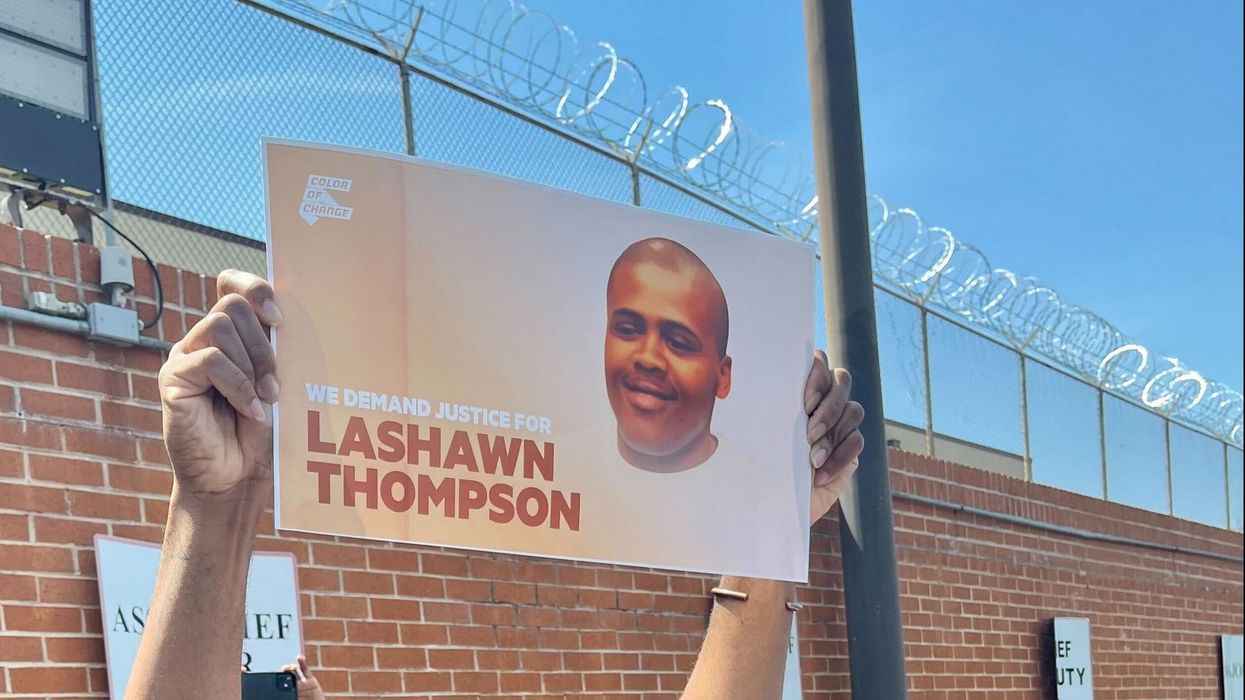
"We want to thank Colin Kaepernick for helping this family get to the truth and soon," said civil rights lawyer Benjamin Crump, who is representing relatives of Lashawn Thompson.
Civil rights attorney Benjamin Crump on Thursday said that former NFL quarterback and racial justice activist Colin Kaepernick will pay for an independent autopsy for Lashawn Thompson, a mentally ill man who died last September in a filthy, insect-infested cell in an overcrowded Atlanta jail.
Crump spoke at a rally and news conference outside the Fulton County Jail, where Thompson, who was arrested last June for alleged misdemeanor simple battery, was held for three months before his death.
"We want to thank Colin Kaepernick for helping this family get to the truth and soon," Crump said, flanked by Thompson's relatives.
"What happened to Lashawn Thompson is a human rights violation," the attorney added. "If we don't ask the questions and we don't get the answers and we don't get to the truth, then next time it could be your loved one. This isn't just about Lashawn Thompson. This is about every citizen in Fulton County, Georgia."
Thompson, who suffered from mental health issues, was diagnosed with schizophrenia and transferred to the jail's psychiatric wing. According to jail records, on September 13 an officer saw Thompson slumped over in his cell, which was so dirty that a staff member who entered it wore protective gear. Inside, Thompson lay dead with his eyes open, his body covered with what Crump said were over 1,000 insect bites. Thompson was 35 years old.
Jail records show that medical and correctional staff repeatedly noted—and voiced concerns about—Thompson's deteriorating health but did not help him.
"They literally watched his health decline until he died," Michael Harper, another attorney representing Thompson's family, said in a statement.
Harper asserted that Thompson "was found dead in a filthy jail cell after being eaten alive by insects and bed bugs."
An official autopsy could not determine the cause of Thompson's death but noted an "extremely severe" insect infestation on his body.
"Can you imagine him screaming and him hollering, saying 'They biting, they biting' and nobody come," Thompson's aunt, Mamie Norman, said at Thursday's rally. "Nobody. Nobody. I still have no understanding until y'all find out what happened to him."
A report obtained last year from NaphCare—an institutional healthcare services contractor repeatedly accused of neglect—revealed widespread medical negligence in Fulton County Jail's mental health unit, where more than 90% of inmates were so severely malnourished that they developed cachexia, a wasting syndrome often associated with diseases like advanced cancer or AIDS.
Additionally, "100% of inmates" in the unit "had either lice, scabies, or both."
Fulton County Sheriff Pat Labat—who called Thompson's death "absolutely unconscionable"—earlier this week asked for and received the resignation of three top jail officials, including Chief Jailer John Jackson.
"It's clear to me that it's time, past time, to clean house," Labat said in a statement on Monday.
An October 2022 investigation by The Atlanta Journal-Constitution revealed that a record number of inmates are dying in Georgia's five largest county jails, and that Fulton County Jail has led the state in such deaths since 2009.
Overcrowding and understaffing plague the facility, where around half of the more than 3,000 inmates have not been charged with any crime. Labat admitted that more than 400 inmates were sleeping on the floor because of overcrowding.
"The type of infestations that contributed to Mr. Thompson's death are going to be a recurring problem in a jail where hundreds of detainees do not have cells and have to sleep on the floor," the sheriff said on Thursday.
Sakira Cook, vice president of campaigns, policy, and government at the racial justice group Color of Change, said Thursday in a statement that "like Lashawn Thompson, countless individuals are currently enduring completely inhumane conditions at the severely overcrowded Fulton County Jail—often waiting for months at a time for frequently minor offenses and small amounts of cash bail."
"This must end. Despite years of scrutiny, the neglect and inhumane conditions within the jail have persisted, with little to no meaningful changes in prosecutorial practices or conditions," Cook added. "The current dark reality of mass incarceration is not accidental, but rather the consequence of intentional policies crafted by a dominant white culture that perpetuates and profits from the suppression of Black individuals through the jailing system."
On Thursday, U.S. Sen. Jon Ossoff (D-Ga.), who chairs the Senate Human Rights Subcommittee, announced the launch of an inquiry into conditions of incarceration in Georgia and nationwide. Previous Ossoff-led probes of U.S. carceral conditions revealed nearly 1,000 uncounted deaths, widespread sexual crimes, corruption, abuse, and misconduct at prisons and jails across the nation.
According to the Sentencing Project, an advocacy group, there are nearly 2 million people locked up in U.S. prisons and jails—a 500% increase over the past 40 years and more than any other country in the world, by far.
"The video must be that bad," said law professor Sherrilyn Ifill. "But fired does not prevent rehiring elsewhere, and charged does not mean convicted. But more important than all, none of this brings back Tyre Nichols."
Five Memphis, Tennessee police officers who were fired for what their chief called a "heinous, reckless, and inhumane" attack on a Black motorist who died three days after a traffic stop were booked and charged Thursday with crimes including second-degree murder.
Former Memphis Police Department (MPD) officers Tadarrius Bean, Demetrius Haley, Justin Smith, Emmitt Martin III, and Desmond Mills Jr—who are all Black—were charged with crimes including second-degree murder, aggravated assault-acting in concert, aggravated kidnapping, official misconduct, and official oppression, according to court records.
Speaking at a Thursday news conference announcing the charges, Tennessee Bureau of Investigation Director David B. Rausch described the five officers' actions as "absolutely appalling."
"We are here to pursue truth and justice, realizing that we should not be here," said Rausch. "Simply put, this should not have happened. I'm sickened by what I saw."
On Wednesday night, Memphis Police Chief C.J. Davis lamented the "horrific circumstances" of Nichols' death. Calling the victim's arrest a "failing of basic humanity," Davis vowed her department would "find truth in the tragic loss."
Nichols died on January 10 from cardiac arrest and kidney failure three days after Memphis officers pulled his vehicle over at around 8:30 pm on January 7. MPD claimed there were two "confrontations" between officers and Nichols, who allegedly ran away before being violently arrested. Complaining of shortness of breath, Nichols was rushed to St. Francis Hospital in critical condition.
All five officers were fired on January 20 after they "were found to be directly responsible for the physical abuse of Mr. Nichols," Davis explained. Two firefighters were also terminated in connection with the attack.
Earlier this month, U.S. Attorney Kevin Ritz—working with the FBI's Memphis Field Office and the U.S. Justice Department—launched a civil rights investigation into the case.
According to the Memphis Commercial Appeal, some of the officers involved belonged to an MPD unit called SCORPION, which stands for Street Crimes Operation to Restore Peace in Our Neighborhoods.
In 2016, a federal civil rights complaint was filed against Haley, alleging that he and other officers strip-searched an inmate at a penal farm and beat him until he blacked out, WHBQ reported.
Antonio Romanucci, an attorney representing Nichols' family, said Monday after viewing police bodycam footage of the attack on the 29-year-old father: "He was a human piñata for those police officers. It was unadulterated, unabashed, nonstop beating of this young boy for three minutes."
Civil rights attorney Benjamin Crump, who is also representing Nichols' relatives, compared the footage to the 1991 beating of Rodney King by Los Angeles Police Department officers.
"What we saw, regrettably, reminded us of the Rodney King video," Crump said Monday. "But, unlike Rodney King, Tyre didn't survive."'
The Shelby County District Attorney's Office said earlier this week that it will likely release footage of the incident at 6:00 pm local time Friday.
"Yet again, we're seeing evidence of what happens to Black and Brown people from simple traffic stops," Crump contended. "You should not be killed because of a simple traffic stop."
"And we have to say to America: How you would treat our white brothers and sisters when you have a traffic stop with them, well, treat us Black and Brown citizens the same way," he added.
On Monday, Nichols' mother, RowVaughn Wells, called her son a "gentle soul."
"Tyre was a beautiful person. He loved to skateboard. He loved to take pictures. He liked to go see the sunset. And most of all, he loved his mother and he loved his son," she said.
Speaking of the fired officers, Wells added: "Those five men—their families are heartbroken as well. They hurt a lot of people when they did this. I don't understand why they had to do this to my son."
Tyre Nichols' mother on violent confrontationwww.youtube.com
Some civil rights leaders called on Congress to take action to prevent such incidents.
"It is only right that the Memphis Police Department takes the necessary additional steps to hold these officers accountable for their role in ripping apart a family and traumatizing a community. However, this is far from what justice looks like. Justice looks like the 535 members of Congress taking the time to turn their 'thoughts and prayers' into action and change," said NAACP president and CEO Derrick Johnson in response to Thursday's charges.
Johnson added:
Congress: Do something. By failing to write a piece of legislation, you're writing another obituary. By failing to pass the legislation, you're passing on your sworn duty to protect the people. We know just how much all of you will be thinking and praying upon the release of the video, you don't need to mention it. Instead, tell us what you're going to do about it. Tell us what you're going to do to honor Tyre Nichols. Tell us what you're going to do to show his family, his loving son, and this entire nation, that his life was not lost in vain. We can name all the victims of police violence, but we can't name a single law you have passed to address it.
The George Floyd Justice in Policing Act—named after the unarmed Black man murdered by Minneapolis police in May 2020—was introduced by then-Rep. Karen Bass (D-Calif.) in February 2021. The proposed legislation, which, among other reforms, would have banned police chokeholds and ended so-called qualified immunity for officers, passed the following month by a mostly party-line vote of 220-212. However, the bill failed to pass the Senate.
"DeSantis decided to deny the potentially life-changing class and effectively censor the freedom of our education and shield us from the truths of our ancestors," said prospective plaintiff Elijah Edwards.
Three high school students represented by attorney Benjamin Crump are planning to sue Republican Florida Gov. Ron DeSantis for rejecting a new high school Advanced Placement African-American studies course, the prominent civil rights lawyer said Wednesday.
As Common Dreams reported last week, DeSantis rejected the pilot course in AP African-American studies being tested by the College Board—the organization behind the SAT exam—as he believes it "lacks educational value" and violates the state's Stop WOKE Act by promoting critical race theory (CRT). There is little to no evidence that CRT—a graduate-level academic discipline examining systemic racism—is being taught in any K-12 school in Florida, or anywhere in the United States.
"Are we really okay with Ron DeSantis deciding what's acceptable for America's students across the country about Black history?"
"We are here to give notice to Gov. DeSantis that if he does not negotiate with the College Board to allow AP African-American studies to be taught in the classrooms across the state of Florida, that these three young people will be the lead plaintiffs in a historic lawsuit," Crump said during a Wednesday press conference at the state Capitol in Tallahassee, referring to students Elijah Edwards, Victoria McQueen, and Juliette Heckman.
Victoria McQueen, a junior at Leon High School in Tallahassee, said that "there are many gaps in American history regarding the African-American population. The implementation of an AP African-American history class will fill in those gaps."
"Stealing the right for students to gather knowledge on a history that many want to know about because it's a political agenda goes to show that some don't want... the horrors this country has done to African-Americans to finally come to light," she added.
In Florida, those "horrors" include the centuries-long experiences of slavery and Jim Crow, including 20th-century atrocities like the Ocoee and Rosewood massacres and lynchings like the Newberry Six —events that shaped the state's modern history.
Another one of the students, high school sophomore Elijah Edwards, said that "Gov. DeSantis decided to deny the potentially life-changing class and effectively censor the freedom of our education and shield us from the truths of our ancestors."
"I thought here in this country, we believe in the free exchange of ideas, not the suppression of it," he added.
Also present at the press conference were Florida House Minority Leader Fentrice Driskell (D-63), Florida Legislative Black Caucus Chairwoman Dianne Hart (D-61), state Sen. Shevrin Jones (D-35), American Federation of Teachers secretary-treasurer Fedrick Ingram, and National Black Justice Coalition executive director David Johns.
"By rejecting the African-American history pilot program, Ron DeSantis clearly demonstrated he wants to dictate whose story does and doesn't belong," said Driskell.
She continued:
He wants to control what our kids can learn based on politics, not on sound policy. He repeatedly attacks the First Amendment rights of Floridians with books being banned from libraries and classrooms and now throwing his weight against this AP African-American history course. He is undermining the rights of parents and students to make the best decisions for themselves. He wants to say that I don't belong. He wants to say you don't belong... But we are here to tell him, we are America. Governor, Black history is American history and you are on the wrong side of history.
Acknowledging that the course "will be altered and resubmitted and most likely they'll be able to make enough changes for the governor to approve it," Driskell asked, "but at what cost? Are we really okay with Ron DeSantis deciding what's acceptable for America's students across the country about Black history?"
"Accurately teaching our history is not political until others make it so," Driskell asserted. "How is political to talk about the struggles we've endured? How is political to talk about and to remember our history?"
"The truth is the truth; you can't change it, it simply is," she added. "But if you try to sugarcoat it, if you refuse to teach it accurately, then the truth can be suppressed, it can be diminished, and if we're not vigilant, it can even be erased."
The governor also signed a law requiring "media experts" to ensure that all books in Florida classrooms are "free of pornography," are "appropriate for the age level and group," and contain no "unsolicited theories that may lead to student indoctrination." Violators face felony charges, leading some teachers to cover or remove books from their classroom libraries for fear of running afoul of the law.
DeSantis stridently touts himself as a champion of "freedom."
"Together we have made Florida the freest state in these United States," he said during his 2022 State of the State address. "While so many around the country have consigned the people's rights to the graveyard, Florida has stood as freedom's vanguard."