SUBSCRIBE TO OUR FREE NEWSLETTER
Daily news & progressive opinion—funded by the people, not the corporations—delivered straight to your inbox.
5
#000000
#FFFFFF
To donate by check, phone, or other method, see our More Ways to Give page.
Daily news & progressive opinion—funded by the people, not the corporations—delivered straight to your inbox.
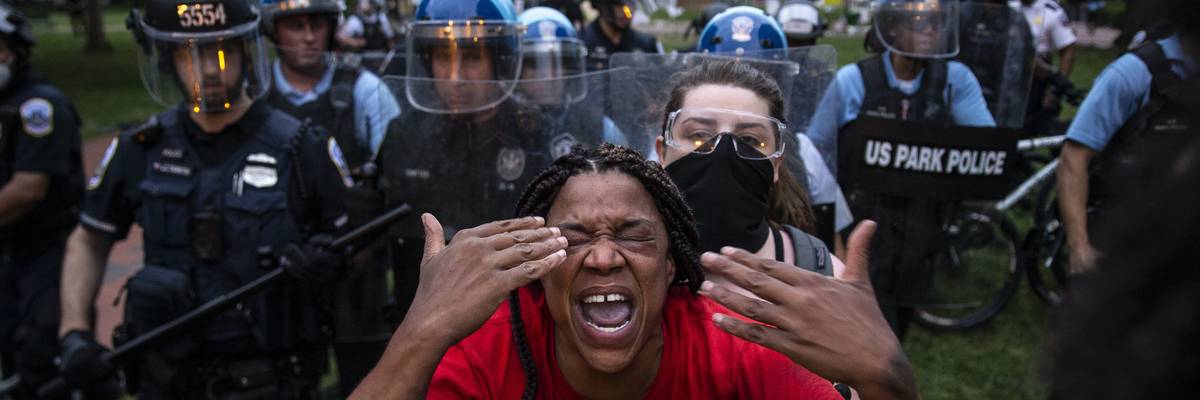
A woman reacts to being hit with pepper spray by officers during a June 22, 2020 protest in Washington, D.C. against the murder of George Floyd and other police killings of unarmed Black people.
One critic called the move "an unprecedented abandonment of the Department of Justice's responsibility to enforce civil rights laws and protect communities from unlawful police abuse."
Racial justice advocates decried Wednesday's announcement by the U.S. Department of Justice that it will end law enforcement reform and accountability efforts, including the Biden administration's agreements with the cities of Minneapolis and Louisville—a move that came just days before the fifth anniversary of George Floyd's murder by a Minneapolis cop.
The Department of Justice's (DOJ) Civil Rights Division said it is dropping lawsuits against the Minneapolis and Louisville police departments and ending pending consent decrees—court-enforceable agreements under which law enforcement agencies commit to reform—with the two cities. The deals, which have been submitted to judges for approval, have been held up in federal court as the Trump administration has sought to block their implementation.
The Civil Rights Division said it "will also be closing its investigations into, and retracting the Biden administration's findings of constitutional violations on the part of," the Louisiana State Police and police departments in Phoenix; Memphis; Oklahoma City; Trenton, New Jersey; and Mount Vernon, New York.
To “disappear” DOJ findings like this is the most disturbing and disgraceful part. A key advantage of DOJ pattern & practice investigations is that DOJ has the resources to absorb the cost of generating the findings that indiv civ rights groups suing police depts find onerous & often prohibitive.
[image or embed]
— Sherrilyn Ifill ( @sifill.bsky.social) May 21, 2025 at 8:02 AM
Civil rights lawyer Benjamin Crump, who represents the families of George Floyd—murdered by then-Minneapolis police officer Derek Chauvin on May 25, 2020—and Breoanna Taylor, who was killed earlier that year by Louisville police, called the DOJ announcement a "slap in the face."
"Just days before the fifth anniversary of George Floyd's murder—a moment that galvanized a global movement for justice—the U.S. Department of Justice has chosen to turn its back on the very communities it pledged to protect," Crump said in a statement Wednesday.
"By walking away from consent decrees in Minneapolis and Louisville, and closing its investigation into the Memphis Police Department while retracting findings of serious constitutional violations, the DOJ is not just rolling back reform, it is attempting to erase truth and contradicting the very principles for which justice stands," he asserted.
"These consent decrees and investigations were not symbolic gestures, they were lifelines for communities crying out for change, rooted in years of organizing, suffering, and advocacy," Crump continued, adding that the DOJ's moves "will only deepen the divide between law enforcement and the people they are sworn to protect and serve."
Congresswoman Jasmine Crockett (D-Texas) lamented the DOJ move and accused the Trump administration of acting "like Breonna Taylor and George Floyd's lives didn't mean a damn thing."
Democratic Minneapolis Mayor Jacob Frey said his city would proceed with reforms despite the DOJ's announcement, while questioning the move's timing.
"The Trump administration is a mess. It is predictable that they would move for a dismissal the very same week that George Floyd was murdered five years ago," he said. "What this shows is that all [President] Donald Trump really cares about is political theater."
The DOJ claimed the Biden administration falsely accused the Minneapolis and Louisville police departments of "widespread patterns of unconstitutional policing practices by wrongly equating statistical disparities with intentional discrimination and heavily relying on flawed methodologies and incomplete data."
"These sweeping consent decrees would have imposed years of micromanagement of local police departments by federal courts and expensive independent monitors, and potentially hundreds of millions of dollars of compliance costs, without a legally or factually adequate basis for doing so," the agency argued.
Assistant Attorney General Harmeet Dhillon—the conspiracy theorist who heads the Civil Rights Division despite, or perhaps because of, her troubled history of working against voting, reproductive, LGBTQ+, and other civil rights—said in a statement Wednesday that her agency is ending the Biden administration's "failed experiment of handcuffing local leaders and police departments with factually unjustified consent decrees."
"Overbroad police consent decrees divest local control of policing from communities where it belongs, turning that power over to unelected and unaccountable bureaucrats, often with an anti-police agenda," Dhillon added.
"DOJ's actions today amount to a public declaration that law enforcement agencies are above the law."
Legal Defense Fund director of strategic initiatives Jin Hee Lee called the DOJ announcement "an unprecedented abandonment of the Department of Justice's responsibility to enforce civil rights laws and protect communities from unlawful police abuse."
Lee said the DOJ investigations that led to the consent decrees "revealed a litany of systemic harms to community members, whom officers are sworn to protect—from wanton violence and sexual misconduct to unlawful stops, searches, and arrests, and racially discriminatory policing."
"By abandoning its obligation to pursue legal remedies that would stem this unlawful conduct, DOJ necessarily condones it," Lee added. "DOJ's actions today amount to a public declaration that law enforcement agencies are above the law."
NAACP president Derrick Johnson said on social media, "It's no surprise that Trump's Department of Coverups and Vengeance isn't seeking justice."
"It's been five years, and police reform legislation still hasn't passed in Congress, and police departments still haven't been held accountable," Johnson added, referring to Floyd's murder. "Five years."
Furthermore, speculation is growing over the prospect of Trump pardoning Chauvin. Addressing the possibility, Democratic Minnesota Gov. Tim Walzsaid earlier this week that "if Chauvin's federal conviction is pardoned, he will still have to serve the remainder of his 22-and-a-half-year state prison sentence for murder and manslaughter."
Opponents vowed to fight the Trump administration's civil rights pushback.
"Let me be clear: We will not give up," Crump said. "This movement will not be swayed or deterred by fickle politics. It is anchored in the irrefutable truth that Black lives matter, and that justice should not depend on who is in power."
Dear Common Dreams reader, It’s been nearly 30 years since I co-founded Common Dreams with my late wife, Lina Newhouser. We had the radical notion that journalism should serve the public good, not corporate profits. It was clear to us from the outset what it would take to build such a project. No paid advertisements. No corporate sponsors. No millionaire publisher telling us what to think or do. Many people said we wouldn't last a year, but we proved those doubters wrong. Together with a tremendous team of journalists and dedicated staff, we built an independent media outlet free from the constraints of profits and corporate control. Our mission has always been simple: To inform. To inspire. To ignite change for the common good. Building Common Dreams was not easy. Our survival was never guaranteed. When you take on the most powerful forces—Wall Street greed, fossil fuel industry destruction, Big Tech lobbyists, and uber-rich oligarchs who have spent billions upon billions rigging the economy and democracy in their favor—the only bulwark you have is supporters who believe in your work. But here’s the urgent message from me today. It's never been this bad out there. And it's never been this hard to keep us going. At the very moment Common Dreams is most needed, the threats we face are intensifying. We need your support now more than ever. We don't accept corporate advertising and never will. We don't have a paywall because we don't think people should be blocked from critical news based on their ability to pay. Everything we do is funded by the donations of readers like you. When everyone does the little they can afford, we are strong. But if that support retreats or dries up, so do we. Will you donate now to make sure Common Dreams not only survives but thrives? —Craig Brown, Co-founder |
Racial justice advocates decried Wednesday's announcement by the U.S. Department of Justice that it will end law enforcement reform and accountability efforts, including the Biden administration's agreements with the cities of Minneapolis and Louisville—a move that came just days before the fifth anniversary of George Floyd's murder by a Minneapolis cop.
The Department of Justice's (DOJ) Civil Rights Division said it is dropping lawsuits against the Minneapolis and Louisville police departments and ending pending consent decrees—court-enforceable agreements under which law enforcement agencies commit to reform—with the two cities. The deals, which have been submitted to judges for approval, have been held up in federal court as the Trump administration has sought to block their implementation.
The Civil Rights Division said it "will also be closing its investigations into, and retracting the Biden administration's findings of constitutional violations on the part of," the Louisiana State Police and police departments in Phoenix; Memphis; Oklahoma City; Trenton, New Jersey; and Mount Vernon, New York.
To “disappear” DOJ findings like this is the most disturbing and disgraceful part. A key advantage of DOJ pattern & practice investigations is that DOJ has the resources to absorb the cost of generating the findings that indiv civ rights groups suing police depts find onerous & often prohibitive.
[image or embed]
— Sherrilyn Ifill ( @sifill.bsky.social) May 21, 2025 at 8:02 AM
Civil rights lawyer Benjamin Crump, who represents the families of George Floyd—murdered by then-Minneapolis police officer Derek Chauvin on May 25, 2020—and Breoanna Taylor, who was killed earlier that year by Louisville police, called the DOJ announcement a "slap in the face."
"Just days before the fifth anniversary of George Floyd's murder—a moment that galvanized a global movement for justice—the U.S. Department of Justice has chosen to turn its back on the very communities it pledged to protect," Crump said in a statement Wednesday.
"By walking away from consent decrees in Minneapolis and Louisville, and closing its investigation into the Memphis Police Department while retracting findings of serious constitutional violations, the DOJ is not just rolling back reform, it is attempting to erase truth and contradicting the very principles for which justice stands," he asserted.
"These consent decrees and investigations were not symbolic gestures, they were lifelines for communities crying out for change, rooted in years of organizing, suffering, and advocacy," Crump continued, adding that the DOJ's moves "will only deepen the divide between law enforcement and the people they are sworn to protect and serve."
Congresswoman Jasmine Crockett (D-Texas) lamented the DOJ move and accused the Trump administration of acting "like Breonna Taylor and George Floyd's lives didn't mean a damn thing."
Democratic Minneapolis Mayor Jacob Frey said his city would proceed with reforms despite the DOJ's announcement, while questioning the move's timing.
"The Trump administration is a mess. It is predictable that they would move for a dismissal the very same week that George Floyd was murdered five years ago," he said. "What this shows is that all [President] Donald Trump really cares about is political theater."
The DOJ claimed the Biden administration falsely accused the Minneapolis and Louisville police departments of "widespread patterns of unconstitutional policing practices by wrongly equating statistical disparities with intentional discrimination and heavily relying on flawed methodologies and incomplete data."
"These sweeping consent decrees would have imposed years of micromanagement of local police departments by federal courts and expensive independent monitors, and potentially hundreds of millions of dollars of compliance costs, without a legally or factually adequate basis for doing so," the agency argued.
Assistant Attorney General Harmeet Dhillon—the conspiracy theorist who heads the Civil Rights Division despite, or perhaps because of, her troubled history of working against voting, reproductive, LGBTQ+, and other civil rights—said in a statement Wednesday that her agency is ending the Biden administration's "failed experiment of handcuffing local leaders and police departments with factually unjustified consent decrees."
"Overbroad police consent decrees divest local control of policing from communities where it belongs, turning that power over to unelected and unaccountable bureaucrats, often with an anti-police agenda," Dhillon added.
"DOJ's actions today amount to a public declaration that law enforcement agencies are above the law."
Legal Defense Fund director of strategic initiatives Jin Hee Lee called the DOJ announcement "an unprecedented abandonment of the Department of Justice's responsibility to enforce civil rights laws and protect communities from unlawful police abuse."
Lee said the DOJ investigations that led to the consent decrees "revealed a litany of systemic harms to community members, whom officers are sworn to protect—from wanton violence and sexual misconduct to unlawful stops, searches, and arrests, and racially discriminatory policing."
"By abandoning its obligation to pursue legal remedies that would stem this unlawful conduct, DOJ necessarily condones it," Lee added. "DOJ's actions today amount to a public declaration that law enforcement agencies are above the law."
NAACP president Derrick Johnson said on social media, "It's no surprise that Trump's Department of Coverups and Vengeance isn't seeking justice."
"It's been five years, and police reform legislation still hasn't passed in Congress, and police departments still haven't been held accountable," Johnson added, referring to Floyd's murder. "Five years."
Furthermore, speculation is growing over the prospect of Trump pardoning Chauvin. Addressing the possibility, Democratic Minnesota Gov. Tim Walzsaid earlier this week that "if Chauvin's federal conviction is pardoned, he will still have to serve the remainder of his 22-and-a-half-year state prison sentence for murder and manslaughter."
Opponents vowed to fight the Trump administration's civil rights pushback.
"Let me be clear: We will not give up," Crump said. "This movement will not be swayed or deterred by fickle politics. It is anchored in the irrefutable truth that Black lives matter, and that justice should not depend on who is in power."
Racial justice advocates decried Wednesday's announcement by the U.S. Department of Justice that it will end law enforcement reform and accountability efforts, including the Biden administration's agreements with the cities of Minneapolis and Louisville—a move that came just days before the fifth anniversary of George Floyd's murder by a Minneapolis cop.
The Department of Justice's (DOJ) Civil Rights Division said it is dropping lawsuits against the Minneapolis and Louisville police departments and ending pending consent decrees—court-enforceable agreements under which law enforcement agencies commit to reform—with the two cities. The deals, which have been submitted to judges for approval, have been held up in federal court as the Trump administration has sought to block their implementation.
The Civil Rights Division said it "will also be closing its investigations into, and retracting the Biden administration's findings of constitutional violations on the part of," the Louisiana State Police and police departments in Phoenix; Memphis; Oklahoma City; Trenton, New Jersey; and Mount Vernon, New York.
To “disappear” DOJ findings like this is the most disturbing and disgraceful part. A key advantage of DOJ pattern & practice investigations is that DOJ has the resources to absorb the cost of generating the findings that indiv civ rights groups suing police depts find onerous & often prohibitive.
[image or embed]
— Sherrilyn Ifill ( @sifill.bsky.social) May 21, 2025 at 8:02 AM
Civil rights lawyer Benjamin Crump, who represents the families of George Floyd—murdered by then-Minneapolis police officer Derek Chauvin on May 25, 2020—and Breoanna Taylor, who was killed earlier that year by Louisville police, called the DOJ announcement a "slap in the face."
"Just days before the fifth anniversary of George Floyd's murder—a moment that galvanized a global movement for justice—the U.S. Department of Justice has chosen to turn its back on the very communities it pledged to protect," Crump said in a statement Wednesday.
"By walking away from consent decrees in Minneapolis and Louisville, and closing its investigation into the Memphis Police Department while retracting findings of serious constitutional violations, the DOJ is not just rolling back reform, it is attempting to erase truth and contradicting the very principles for which justice stands," he asserted.
"These consent decrees and investigations were not symbolic gestures, they were lifelines for communities crying out for change, rooted in years of organizing, suffering, and advocacy," Crump continued, adding that the DOJ's moves "will only deepen the divide between law enforcement and the people they are sworn to protect and serve."
Congresswoman Jasmine Crockett (D-Texas) lamented the DOJ move and accused the Trump administration of acting "like Breonna Taylor and George Floyd's lives didn't mean a damn thing."
Democratic Minneapolis Mayor Jacob Frey said his city would proceed with reforms despite the DOJ's announcement, while questioning the move's timing.
"The Trump administration is a mess. It is predictable that they would move for a dismissal the very same week that George Floyd was murdered five years ago," he said. "What this shows is that all [President] Donald Trump really cares about is political theater."
The DOJ claimed the Biden administration falsely accused the Minneapolis and Louisville police departments of "widespread patterns of unconstitutional policing practices by wrongly equating statistical disparities with intentional discrimination and heavily relying on flawed methodologies and incomplete data."
"These sweeping consent decrees would have imposed years of micromanagement of local police departments by federal courts and expensive independent monitors, and potentially hundreds of millions of dollars of compliance costs, without a legally or factually adequate basis for doing so," the agency argued.
Assistant Attorney General Harmeet Dhillon—the conspiracy theorist who heads the Civil Rights Division despite, or perhaps because of, her troubled history of working against voting, reproductive, LGBTQ+, and other civil rights—said in a statement Wednesday that her agency is ending the Biden administration's "failed experiment of handcuffing local leaders and police departments with factually unjustified consent decrees."
"Overbroad police consent decrees divest local control of policing from communities where it belongs, turning that power over to unelected and unaccountable bureaucrats, often with an anti-police agenda," Dhillon added.
"DOJ's actions today amount to a public declaration that law enforcement agencies are above the law."
Legal Defense Fund director of strategic initiatives Jin Hee Lee called the DOJ announcement "an unprecedented abandonment of the Department of Justice's responsibility to enforce civil rights laws and protect communities from unlawful police abuse."
Lee said the DOJ investigations that led to the consent decrees "revealed a litany of systemic harms to community members, whom officers are sworn to protect—from wanton violence and sexual misconduct to unlawful stops, searches, and arrests, and racially discriminatory policing."
"By abandoning its obligation to pursue legal remedies that would stem this unlawful conduct, DOJ necessarily condones it," Lee added. "DOJ's actions today amount to a public declaration that law enforcement agencies are above the law."
NAACP president Derrick Johnson said on social media, "It's no surprise that Trump's Department of Coverups and Vengeance isn't seeking justice."
"It's been five years, and police reform legislation still hasn't passed in Congress, and police departments still haven't been held accountable," Johnson added, referring to Floyd's murder. "Five years."
Furthermore, speculation is growing over the prospect of Trump pardoning Chauvin. Addressing the possibility, Democratic Minnesota Gov. Tim Walzsaid earlier this week that "if Chauvin's federal conviction is pardoned, he will still have to serve the remainder of his 22-and-a-half-year state prison sentence for murder and manslaughter."
Opponents vowed to fight the Trump administration's civil rights pushback.
"Let me be clear: We will not give up," Crump said. "This movement will not be swayed or deterred by fickle politics. It is anchored in the irrefutable truth that Black lives matter, and that justice should not depend on who is in power."