
SUBSCRIBE TO OUR FREE NEWSLETTER
Daily news & progressive opinion—funded by the people, not the corporations—delivered straight to your inbox.
5
#000000
#FFFFFF
To donate by check, phone, or other method, see our More Ways to Give page.


Daily news & progressive opinion—funded by the people, not the corporations—delivered straight to your inbox.
"This growing unseen and unacknowledged banking crisis is going to become visible soon as the climate-related disasters and losses pile up and insurance companies continue to go bankrupt."
Insurance companies bankrupted by climate disasters are the "canaries in the coal mine" portending "a much worse banking crisis," and regulators must act with urgency to avert financial crashes and costly bailouts, a report published Wednesday warned.
Amid increasingly frequent and severe fires, flooding, hurricanes, tornadoes, landslides, and hail storms across the U.S., "it's no surprise that there is a great deal of attention on the burgeoning crisis among insurance companies and their insured individuals and businesses," says the report, which was published by the financial reform advocacy group Better Markets.
"The U.S. property and casualty industry suffered losses of $5 billion in 2021, which ballooned to losses of $26.5 billion in 2022," Better Markets notes. "There have already been 15 confirmed weather/climate disaster events with losses exceeding $1 billion each in the U.S. as of August 8, 2023, with losses almost certain to exceed 2022."
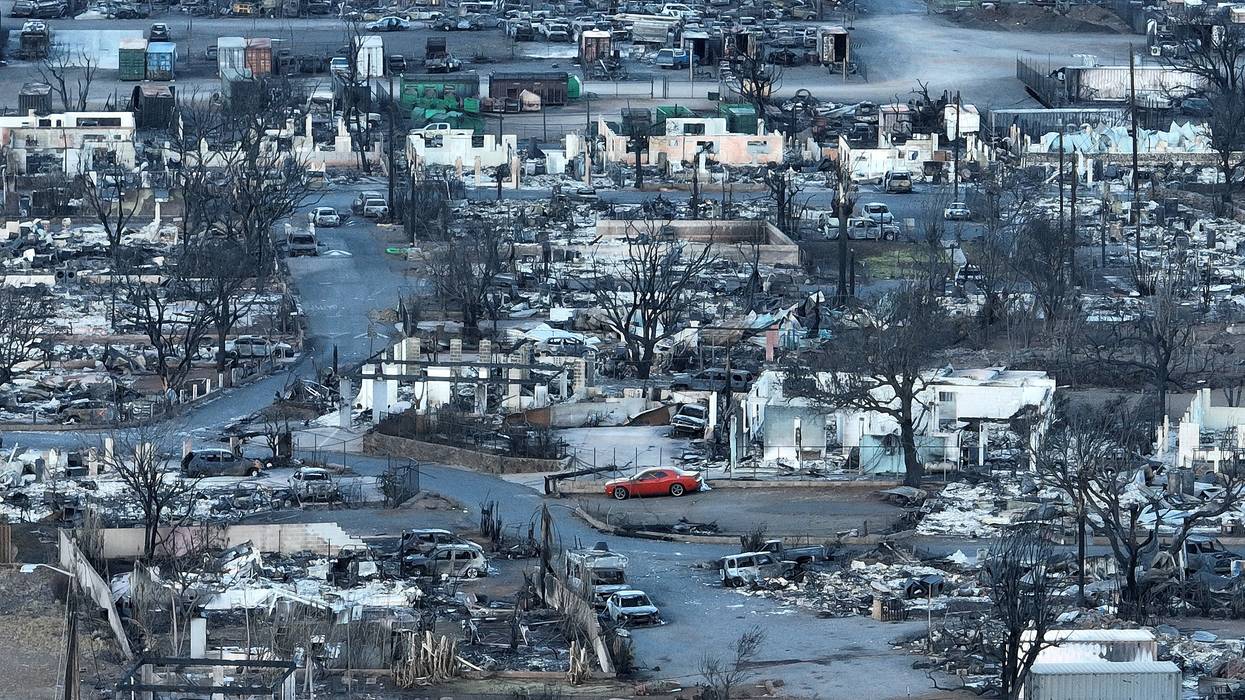
That tally notably does not include the Hawaiian island of Maui, where a wildfire spread by hurricane-force winds leveled Lahaina, killing at least 115 people and causing an estimated $5.52 billion in damage.
"The number of insurance companies going bankrupt, withdrawing from states, limiting coverage, and significantly raising premiums is increasing by the day," the publication continues. "In addition, the reinsurance market, which is key for insuring major climate events, is facing a reduced investor demand, which is going to decrease coverage while increasing costs even more."
"However, this isn't just a crisis for insurance companies and their customers," Better Markets stresses. "The ongoing and worsening insurance crisis is the leading edge of a coming banking and financial crisis."
According to the report:
While climate risk is tragic for homeowners and problematic for insurance companies, it is exponentially worse for banks and the financial system. That's because insurance companies limiting their losses do not eliminate the losses entirely; they merely shift losses to other entities like banks which have large and increasingly concentrated portfolios of loans and other credit instruments to those now uninsured or underinsured real estate properties and businesses. When the inevitable climate disasters occur, those exposures will quickly become realized losses, potentially at levels that will cause banks to collapse, and possibly ignite a credit contraction, precipitate contagion, and result in a banking crisis if not a financial crash.
"There's a major untold story behind the unprecedented climate disasters pummeling the country and capturing the headlines: Today's climate crisis is tomorrow's banking crisis," said report author and Better Markets CEO Dennis Kelleher, who criticized federal regulators' lack of action.
"The Financial Stability Oversight Council (FSOC) and banking regulators' response thus far have been grossly inadequate and inconsistent with the material climate risks bearing down on banks and the financial system," he argued. "For example, the FSOC member agencies were called on just two years ago to bolster the financial system's resilience to climate-related financial risks. Yet, since then, the actions have been slow and half-hearted."
"This growing unseen and unacknowledged banking crisis is going to become visible soon as the climate-related disasters and losses pile up and insurance companies continue to go bankrupt and stop insuring homes, businesses, cars, and other bank assets in state after state," Kelleher warned.
"Just as insurance companies are acting to limit their losses, the FSOC and other banking and financial regulators must require banks and financial firms to assess their exposure to those losses and have an action plan to mitigate them before they materialize and cause banking crisis," he added. "Climate disasters are bad enough; a banking disaster on top of that will make everything much worse."
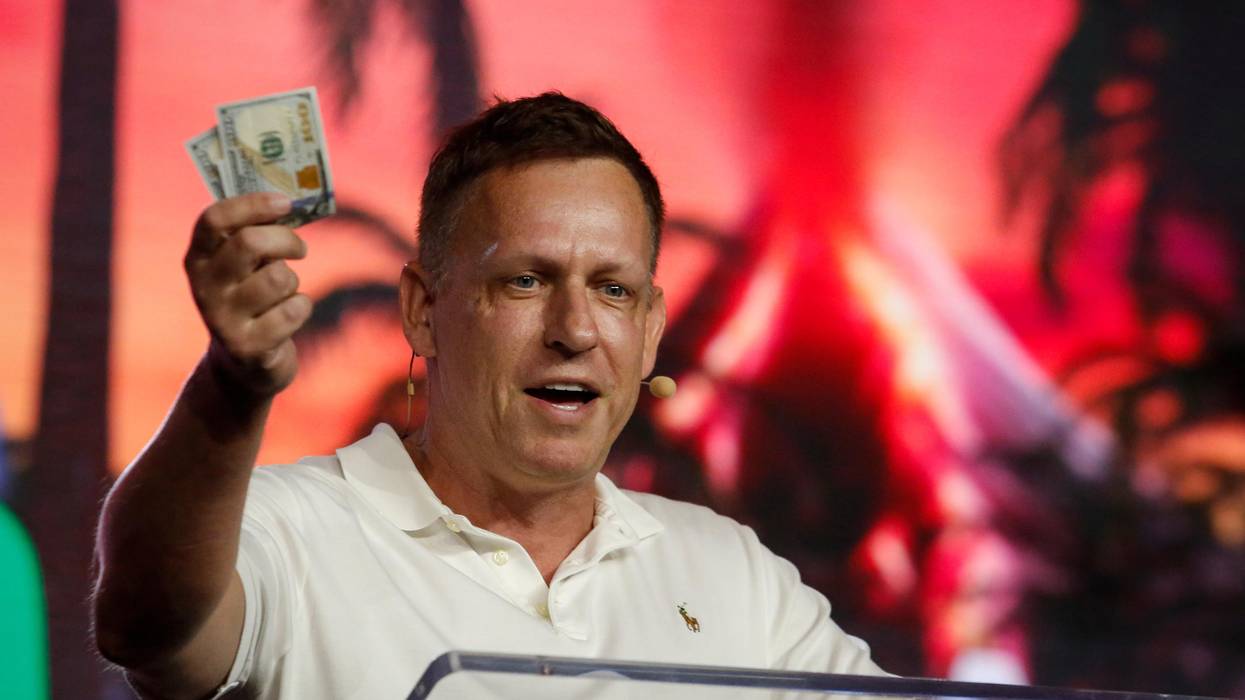
Ultra-rich individuals like Peter Thiel are a key part of the anti-democracy movement, of which Trump is the informal leader.
What connects the two biggest stories now dominating the news — Donald Trump’s likely arrest and the Fed’s bailouts of shaky banks?
Start with multi-billionaire Peter Thiel, and follow the money.
You may recall that in 2016, Thiel spoke at the Republican National Convention to make the case for why Trump should be the next president of the United States.
In the midterm elections of 2022, Thiel donated $15 million to the Republican Ohio senatorial primary campaign of JD Vance, who alleged that the 2020 election was stolen and that Biden’s immigration policy meant “more Democrat voters pouring into this country.”
Thiel also donated at least $10 million to the Arizona Republican Senate primary race of Blake Masters, who also claimed Trump won the 2020 election and who admires Lee Kuan Yew, the authoritarian founder of modern Singapore.
Masters lost. But thanks to Thiel’s munificence, Vance is now in the U.S. Senate.
Thiel and other wealthy self-described “libertarians” want Trump to be re-elected president in 2024. I’ll get to the reason in a moment.
Some $50 million of Thiel’s own money was still stuck in the bank. Then, guess what? Thiel and other rich depositors got bailed out by the Fed.
Charges of hypocrisy have been leveled at Thiel and other wealthy depositors who claim to be libertarians but were rescued by the government.
There was nothing hypocritical about it. Thiel and others like him aren’t really opposed to government, per se. They’re opposed to democracy. They prefer an oligarchy — a government controlled by super-wealthy people like themselves.
***
Thiel is part of the anti-democracy movement, of which Trump is the informal leader.
Their antipathy to democracy comes from the same fear that the extremely wealthy have always harbored about democracy — that a majority could vote to take away their money. That fear has been heightened by the fact that more and more of the nation’s wealth is going to the top, combined with demographic trends showing the majority of voters becoming less economically secure, more non-white, and politically left.
Thiel and his ilk see in Trump an authoritarian strongman who won’t allow a majority to take away their wealth. In December 2017, Trump and his Republican allies in Congress engineered a giant tax cut for the super-rich and the companies in which they invest. Many believe that a second Trump administration, backed by a Republican Congress, will cut their taxes even further.
They also support the Fed. Like most of the world’s central banks, the Fed is removed from democratic accountability, out of fear that financial markets otherwise won’t trust them to do unpopular things like bailing out banks or controlling inflation by slowing economies and causing millions to lose their jobs. The Fed is run largely by bankers. You might say it’s part of America’s oligarchy.
A few years ago, Thiel wrote that “I no longer believe that freedom and democracy are compatible.” Presumably he was referring to the freedom of oligarchs like himself to be unconstrained by taxes and regulations. In this narrow sense, he’s correct: Oligarchy is incompatible with democracy. Nor is oligarchy compatible with the freedom of the rest of us.
Thiel and others like him want to return to an era when American oligarchs had freer reign. In that same essay, Thiel wrote:
The 1920s were the last decade in American history during which one could be genuinely optimistic about politics. Since 1920, the vast increase in welfare beneficiaries and the extension of the franchise to women — two constituencies that are notoriously tough for libertarians — have rendered the notion of “capitalist democracy” into an oxymoron.
But if “capitalist democracy” has become an oxymoron, it’s not due to excessive public assistance or because women got the right to vote. It’s because billionaire capitalists like Thiel are undermining democracy with giant campaign donations to authoritarian candidates.
I’m old enough to remember a former generation of wealthy Republicans who backed candidates like Barry Goldwater. They called themselves “conservatives” because they wanted to conserve American institutions. But Thiel and his fellow billionaires in the anti-democracy movement don’t want to conserve anything — at least anything that came after the 1920s, including Social Security, civil rights, and even women’s right to vote (except for the Federal Reserve’s bailouts for the rich and its ability to draft average workers into fighting inflation).
The 1920s marked the last gasp of the Gilded Age, when the richest Americans siphoned off so much of the nation’s wealth that the rest of America had to go deep into debt to maintain their standard of living and sustain overall demand for the goods and services the nation produced. When that debt bubble burst in 1929, we got the Great Depression.
It was also the decade when Benito Mussolini and Adolf Hitler emerged to create the worst threats to freedom and democracy the modern world had ever witnessed.
One economist slammed the Fed for "protecting wealthy venture capitalists and startup CEOs" while showing "little concern for the millions of people who could lose their jobs."
Federal Reserve policymakers convened Tuesday for a two-day meeting that will culminate in a decision with major implications for the U.S. and global economies, which have been jarred by recent banking sector chaos and growing fears of a broader financial crisis.
The Fed is widely, though not universally, expected to raise interest rates by 25 basis points on Wednesday despite concerns that the central bank's tightening of monetary policy over the past year is at least partially responsible for the collapse of Silicon Valley Bank (SVB), a top lender to tech startups and venture capital firms.
Rakeen Mabud, chief economist at the Groundwork Collaborative, warned Tuesday that another rate increase would be a huge mistake with potentially devastating consequences that will fall most heavily on vulnerable workers.
The Fed's own projections indicate that millions of additional U.S. workers could face unemployment by the end of the year as the central bank continues to raise borrowing costs and tamp down economic demand.
"While the Federal Reserve wasted no time protecting wealthy venture capitalists and startup CEOs last weekend, it has shown little concern for the millions of people who could lose their jobs as a result of its aggressive rate hikes," said Mabud, who argued another rate hike would "be the straw that breaks the camel's back, sending our economy into a painful—and completely avoidable—recession."
"After the SVB fiasco," Mabud added, Fed Chair Jerome Powell "should not touch rate hikes with a ten-foot pole."
Josh Bivens, chief economist at the Economic Policy Institute, also called for a pause, arguing Monday that the case for halting rate hikes was clear even before SVB failed earlier this month, given recent signs that inflation and wages are cooling substantially.
"It is a genuine problem that interest rate hikes of nearly 5% in a year cause this much distress in the financial sector, indicating a clear failure of bank management and supervision," wrote Bivens, who noted that banks typically benefit from higher interest rates.
"These failures should be addressed going forward," Bivens continued. "But they exist today and the fallout of them clearly provides another argument for standing pat on further rate increases."
"Higher rates reduce inflation only by creating financial crises that crash the economy."
The Fed's policy meeting comes as it is facing mounting criticism over its role in the collapse of SVB and Signature Bank, with lawmakers and experts pointing to the central bank's rollback of post-financial crisis regulations that imposed tougher liquidity requirements on financial institutions with between $50 billion and $250 billion in assets.
"The Federal Reserve is irreparably broken and can no longer be trusted to go it alone on monetary policy," Lindsay Owens, the executive director of the Groundwork Collaborative, said last week. "As Congress works to re-regulate mid-size banks after the misguided 2018 rollbacks... they should also address the rot at the Fed."
In concert with the U.S. Treasury Department and other central banks, the Fed has worked to stem the fallout from the recent bank failures by launching liquidity operations and new lending programs aimed at backstopping the financial industry at home and abroad.
But experts have cautioned that the Fed's efforts to shore up the banking system will be undermined by further interest rate increases, which have proven to be a destabilizing force.
"The Fed has never managed to engineer a soft landing," Yeva Nersisyan, associate professor of economics at Franklin & Marshall College, and L. Randall Wray, professor of economics and senior scholar at the Levy Economics Institute of Bard College, wrote in an op-ed for The Hill late last week.
"The reason is simple: higher rates reduce inflation only by creating financial crises that crash the economy," Nersisyan and Wray explained. "After more than a decade of near-zero interest rates, the Fed hiked rates extremely quickly—by 400 basis points (4 percentage points). All balance sheets that had been built during the period of low rates immediately became toxic."
"What is missing from the debates over monetary policy today is the understanding that the Fed was not established to control inflation," they continued. "It was created to prevent financial crises by acting as a lender of last resort in times of distress. Indeed, that's exactly what the Fed is doing now—opening up its lending facilities to banks in need. But rather than focus on maintaining financial stability, the Fed has become obsessed with controlling inflation, something it cannot really do without causing either a recession or a financial crisis (or both)."
"Put on the crash helmets," the pair concluded. "It's going to be a bumpy landing."
Dodd-Frank includes Wall Street pay restrictions that could've held executives like SVB's Greg Becker accountable for their dangerous short-sightedness. But regulators consistently fail to implement this part of the law.
Greg Becker, the deposed chief executive of Silicon Valley Bank, is facing growing demands to cough up the millions of dollars he raked in from stock sales soon before the bank’s sudden demise.
On March 17, the White House called on Congress to pass legislation to claw back compensation, including gains from stock sales, from Becker and other executives at SVB, as well as at Signature Bank SBNY.
Greg Becker, the deposed chief executive of SVB, is facing growing demands to cough up the millions of dollars he raked in from stock sales soon before the bank’s sudden demise.
On March 17, the White House called on Congress to pass legislation to claw back compensation, including gains from stock sales, from Becker and other executives at SVB, as well as at Signature Bank SBNY .
President Joe Biden’s statement came on top of demands by Sen. Elizabeth Warren, Rep. Ro Khanna, and other officials that the disgraced SVB CEO voluntarily fork over compensation pocketed before the bank’s collapse, particularly the $3.6 million he garnered from a stock sale in late February.
For Becker, digging into his own pockets to help cover the costs of his disastrous mismanagement would be the moral thing to do. But under current law, he faces no such legal obligation.
The 2002 Sarbanes-Oxley act, adopted in response to the Enron collapse, allows clawbacks of executive bonuses if a company is caught cooking its books. The 2010 Dodd-Frank financial reform law goes a bit further to require repayment of bonuses at the largest banks when they are based on erroneous financial statements.
Since neither of these existing clawback law seems to apply to SVB’s case, Becker could get off scot-free while shareholders are wiped out and the federal government backstops $175 billion in deposits.
It didn’t have to be this way. Dodd-Frank includes Wall Street pay restrictions that could’ve held Becker accountable for his dangerous short-sightedness — and might have even helped prevent the bank’s collapse. But regulators consistently fail to implement this part of the law.
How might these restrictions have altered the Silicon Valley Bank story?
The relevant provisions in Dodd-Frank, Section 956, prohibit Wall Street pay that encourages “inappropriate risk.” As I and others have argued for many years, regulators tasked with implementing this law could require Wall Street executives to set aside a significant portion of their compensation for 10 years to cover the costs of any misconduct fines against their bank — or the costs of a solvency crisis like SVB’s.
Former New York Federal Reserve Bank President William Dudley first proposed such collective funds in 2014, arguing they would help change Wall Street’s dangerously risky culture by making executives pay personally for the costs of their own recklessness.
Had such rules been enforced, this past week Becker would’ve had no choice but to forfeit a large chunk of the compensation he accumulated over the past decade.
Regulators also could use the Dodd-Frank provisions to crack down on forms of executive compensation that encourage recklessness, including stock options and stock grants tied to return on equity.
According to the bipartisan 2011 Financial Crisis Inquiry Commission, these pay structures create “incentives to increase both risk and leverage, which could lead to larger jumps in a company’s stock price.”
With regulators failing to do their job, that’s exactly how it turned out at SVB. The board loaded up Becker’s compensation packages with stock-based pay and he pursued risky strategies, overly relying on a single, volatile industry — technology — and then locking up cash from largely uninsured deposits in long-term bonds, without preparing for interest rate hikes.
Becker’s strategies drove SVB’s stock price into the stratosphere in the years leading up to the collapse, and he cashed in while the going was good. Between 2019 and 2022, according to company proxy statements, Becker pocketed $58 million just in payouts from options and stock grants — not including salary and cash bonuses.
His largest payday came in 2021 when SVB stock was trading as high as $700 per share. That year Becker cashed in $19 million in options and $6.7 million in stock grants he’d received in the mid-2010s when the stock was only worth about $100 per share.
The failures of SVB and Signature Bank are far from the only examples of excessive financial risk-taking since the 2008 crash, as Public Citizen has extensively documented.
New Wall Street accountability legislation covering a broad range of reforms, from higher capital standards to more equitable deposit insurance, should be a no-brainer. Will this divided Congress take it on? Unlikely.
But financial regulators don’t have to wait for Capitol Hill to enforce pay restrictions that have been in the law since 2010. The Biden administration should seize this moment to change the incentives for banking executives. For too long, Wall Street recklessness has generated huge windfalls for the rich and huge costs for the rest of us.
The recent failures of Silicon Valley and Signature banks and chaos in other corners of the banking sector definitely provide a new twist to this debate.
The debate over the Federal Reserve’s proper course of action for the rest of 2023 was getting a little stagnant in recent months. The argument centered on whether inflation’s persistence was really a sign of an overheated economy that still needed cooling or if it was due to stubbornly large—but dampening—ripples stemming from the huge pandemic and war shocks of previous years. The recent failures of Silicon Valley and Signature banks and chaos in other corners of the banking sector definitely provide a new twist to this debate.
My view on what the Fed should do now in the wake of banking failures is relatively straight-forward:
The January consumer price index (CPI) data came in uncomfortably hot after months of good readings. The February CPI data showed a largely sideways movement in inflation. Worse, revisions to 2022 CPI data showed more disinflation in mid-2022 and less in late 2022—providing slightly weaker evidence of consistent disinflation over the course of the year.
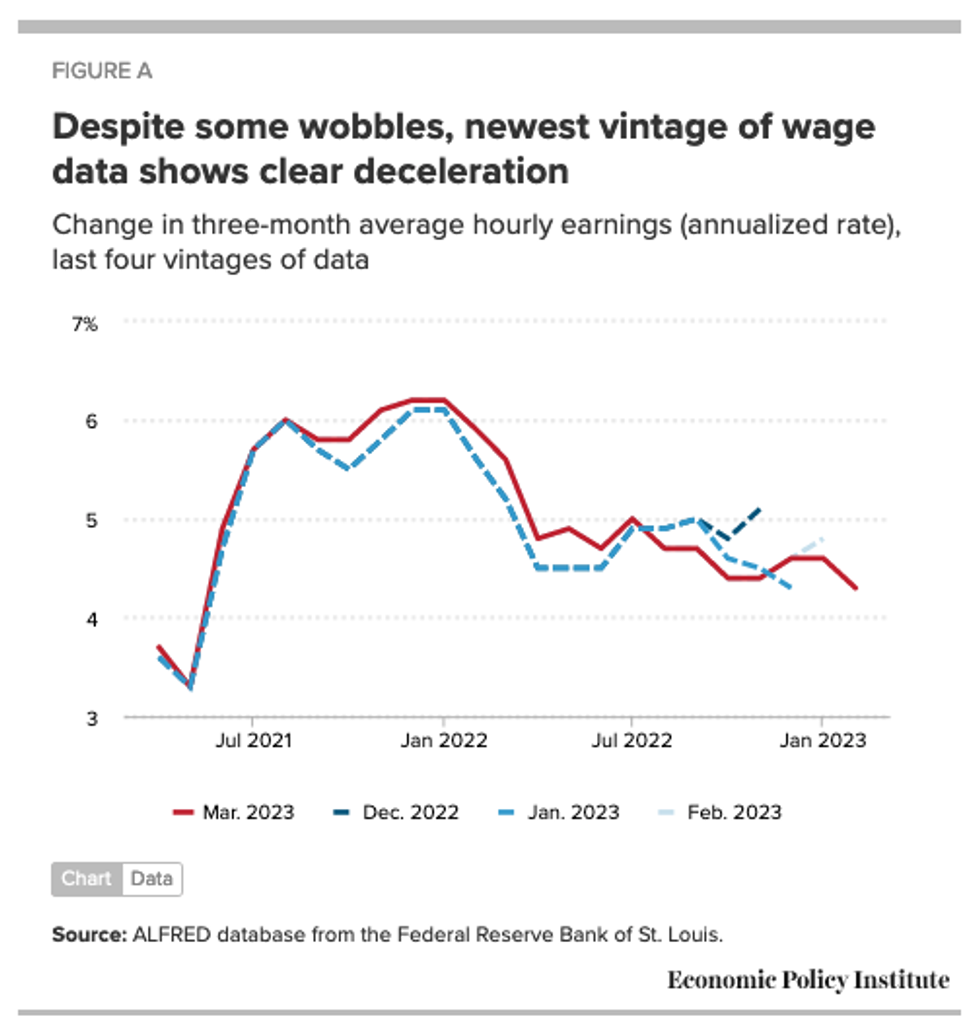
However, nominal wage growth—what many have called a “supercore” measure of inflation—has consistently cooled over the course of 2022 and early 2023. Occasionally a single month of data has shown an uptick of wage growth and concerns are raised, but new data then show continued cooling. Figure A below shows annualized rates of wage growth for the latest three months relative to the prior three months. It shows these rates of wage growth for the initial releases of this data from December 2022 to March 2023. While wage growth blipped up in the December 2022 and February 2023 reports, the most recent report shows a clear pattern of consistent nominal wage deceleration.
This deceleration of nominal wage growth should be near-dispositive for arguments about the proper path of interest rates. If the Fed is insistent on 2% price inflation in the long run, this implies that nominal wages can grow at this 2% inflation rate plus the rate of productivity growth, which we will take as 1.5%. This 3.5% wage growth target, however, assumes no increase in the share of total income accruing to labor rather than capital. Given the large decline in labor’s share of income so far in the pandemic-driven business cycle, this means that several years of wage growth as high as 4.5% could be sustained while still seeing price inflation at the Fed’s 2% target. Nominal wage growth (as shown in Figure A) has been running at or below 4.5% for several months now. In short, wage growth is now running where it should be given the state of the business cycle and the Fed’s 2% inflation target—meaning the Fed should stand pat on any further interest rate hikes.
Besides the fact that current wage growth is consistent with the Fed’s inflation target on the cost side, the rapid normalization of nominal wage growth should also lead to rapid normalization of nominal aggregate demand. Essentially, if overheated demand is not being buoyed by above-target wage growth, it is hard to see how it could continue. The allegedly excess fiscal boost from the American Rescue Plan (and even the “excess savings” banked from this aid) is long gone. Financial and housing markets have lost significant value in recent months. Without excess wage growth, any excess of demand growth is unlikely to be sustained.
The failures of SVB and Signature banks and the associated increased stress in the banking sector are far more likely to reduce economy-wide demand in coming months than to increase it. As lending standards tighten and risk premiums rise for private lending, both consumer spending and business investment are likely to be curtailed. In short, whatever your estimate of the path of demand over the next year before SVB’s failure, your estimate now should be significantly lower. This has been recently acknowledged explicitly by the president of the Federal Reserve Bank of Boston, Eric Rosengren, who noted: “Financial crises create demand destruction. Banks reduce credit availability, consumers hold off large purchases, businesses defer spending. Interest rates should pause until the degree of demand destruction can be evaluated.”
There has been a recent debate in macroeconomic circles about the lags of monetary policy. Traditionally, these lags were thought to be “long and variable.” This would mean that a large part of the contractionary effect of the interest rate increases undertaken in 2022 and earlier this year had yet to hit the economy and would slow growth going forward even if the Fed stopped raising rates today. A newly fashionable view argues that these lags are shorter in today’s economy, meaning that the full contractionary effect of recent rate increases had already been absorbed by the economy and that a pause in rate-hiking would implicitly provide a substantial spur to demand growth. Whatever the outcome of this debate in normal times, the SVB failures clearly show that fallout from past rate increases is ongoing.
If one was worried that macroeconomic overheating remained a problem in the U.S. economy and was a key driver of inflation, the pressure to stop raising rates imposed by recent banking stress is extremely troubling. From this point of view, the recent banking stresses are demanding the Federal Reserve sacrifice efforts to cool the economy to control inflation in favor of the needs of financial stability.
It is especially perverse that increasing interest rates has appeared to throw much of the banking system into chaos. It is extremely well-documented that bank profitability is higher when interest rates are higher. However, it seems that banks cannot even make the transition to a new interest rate regime that would be highly favorable for them without substantial turmoil.
For all these reasons, if one was an inflation hawk who thought interest rates needed to be raised further, the imperative to stop raising rates now based on stresses in the banking system is an extremely dangerous development. And, in fact, even if one did not think that rates needed to be raised further in order to contain inflation, it’s still a bad thing that our financial system has become so fragile that raising rates causes these kinds of tremors. Even if I don’t think the economy needs higher interest rates today, there may be a future where higher interest rates would benefit the economy—and it would be very bad if macroeconomic stabilization options were held hostage to a fragile financial system.
These considerations argue strongly for improved regulatory and supervisory actions moving forward. The rollback of Dodd-Frank regulations in 2018 was a terrible step backwards in this regard. Further, the Federal Reserve rolled back regulatory safeguards even further than the 2018 law made necessary. Today’s hawks (and those like me who want to preserve the option of raising interest rates at some point in the future) should be among the most strident proponents for tightening these regulatory standards back up, and for holding the Fed accountable for supervisory failures.
But for now, the banking system is fragile and recent rate hikes have put stress on the system (as maddening as all of this is). This fragility is likely to cool the economy in coming months. Given this, any reasonable estimate of where interest rates should have gone in 2023 made before the SVB collapse should be marked down since.
The latest debacle in the financial system will likely worsen stagflation and possibly tip the U.S. and Europe into recession.
The banking crisis that hit Silicon Valley Bank (SVB) last week has spread. We recall with a shudder two recent financial contagions: the 1997 Asian Financial Crisis, which led to a deep Asian recession, and the 2008 Great Recession, which led to a global downturn. The new banking crisis hits a world economy already disrupted by pandemic, war, sanctions, geopolitical tensions, and climate shocks.
At the root of the current banking crisis is the tightening of monetary conditions by the Fed and the European Central Bank (ECB) after years of expansionary monetary policy. In recent years, both the Fed and ECB held interest rates near zero and flooded the economy with liquidity, especially in response to the pandemic. Easy money resulted in inflation in 2022, and both central banks are now tightening monetary policy and raising interest rates to staunch inflation.
Banks like SVB take in short-term deposits and use the deposits to make long-term investments.
The banks pay interest on the deposits and aim for higher returns on the long-term investments. When the central banks raise short-term interest rates, rates paid on deposits may exceed the earnings on long-term investments. In that case, the banks’ earnings and capital fall. Banks may need to raise more capital to stay safe and in operation. In extreme cases, some banks may fail.
Even a solvent bank may fail if depositors panic and suddenly try to withdraw their deposits, an event known as a bank run. Each depositor dashes to withdraw deposits ahead of the other depositors. Since the bank’s assets are tied up in long-term investments, the bank lacks the liquidity to provide ready cash to the panicked depositors. SVP succumbed to such a bank run and was quickly taken over by the US Government.
Bank runs are a standard risk but can be avoided in three ways. First, banks should keep enough capital to absorb losses. Second, in the event of a bank run, central banks should provide banks with emergency liquidity, thereby ending the panic. Third, government deposit insurance should calm depositors.
All three mechanisms may have failed in the case of SVB. First, SVB apparently allowed its balance sheet to become seriously impaired, and regulators did not react in time. Second, for unclear reasons, US regulators closed SVB rather than provide emergency central bank liquidity. Third, US deposit insurance guaranteed deposits only up to $US 250,000, and so did not stop a run by large depositors. After the run, US regulators announced they would guarantee all deposits.
The immediate question is whether SVB’s failure is the start of a more general bank crisis. The rise of market interest rates caused by Fed and ECB tightening has impaired other banks as well. Now that a banking crisis has occurred, panics by depositors are more likely.
Future bank runs can be avoided if the world’s central banks provide ample liquidity to banks facing runs. The Swiss central bank provided a loan to Credit Suisse for exactly this reason. The Federal Reserve has provided $152 billion in new lending to US banks in recent days.
Emergency lending, however, partly offsets the central banks’ efforts to control inflation. Central banks are in a quandary. By pushing up interest rates, they make bank runs more likely. If they keep interest rates too low, however, inflationary pressures are likely to persist.
The central banks will try to have it both ways: higher interest rates plus emergency liquidity, if needed. This is the right approach but comes with costs. The US and European economies were already experiencing stagflation: high inflation and slowing growth. The banking crisis will worsen the stagflation and possibly tip the US and Europe into recession.
Some of the stagflation was the consequence of COVID-19, which induced the central banks to pump in massive liquidity in 2020, causing inflation in 2022. Some of the stagflation is the result of shocks caused by long-term climate change. Climate shocks could become worse this year if a new El Niño develops in the Pacific, as scientists say is increasingly likely.
Yet stagflation has also been intensified by economic disruptions caused by the Ukraine War, US and EU sanctions against Russia, and rising tensions between the US and China. These geopolitical factors have disrupted the world economy by hitting supply chains, pushing up costs and prices while hindering output.
We should regard diplomacy as a key macroeconomic tool. If diplomacy is used to end the Ukraine War, phase out the costly sanctions on Russia, and reduce tensions between the US and China, not only will the world be much safer, but stagflation will also be eased. Peace and cooperation are the best remedies to rising economic risks.
"We cannot continue down the road of more socialism for the rich and rugged individualism for everyone else," said the U.S. Senator from Vermont.
Sen. Bernie Sanders on Sunday night called for a full repeal of the 2018 banking deregulations signed into law by former President Donald Trump and declared that "now is not the time for taxpayers bail out Silicon Valley Bank"—the California bank that collapsed Friday.
On Sunday evening, the U.S. Treasury Department, Federal Reserve, and Federal Deposit Insurance Corporation (FDIC) issued a joint statement outlining a plan to make all deposits for Silicon Valley Bank as well as Signature Bank, which was shuttered by New York regulators earlier in the day, available to costumers Monday morning.
In his statement, Sanders said, "If there is a bailout of Silicon Valley Bank, it must be 100 percent financed by Wall Street and large financial institutions. We cannot continue down the road of more socialism for the rich and rugged individualism for everyone else. Let us have the courage to stand up to Wall Street, repeal the disastrous 2018 bank deregulation law, break up too big to fail banks and address the needs of working families, not the risky bets of vulture capitalists."
The statement the Fed, Treasury, and FDIC noted that "no losses" associated with the rescue plan "will be borne by the taxpayer," though the extraordinary intervention—the largest of its kind since the 2008 financial collapse—is still seen by many economists and financial experts, even if bank investors and debt holders are not protected, as a "bailout" for the financial industry only made possible by taxpayers.
"Let us have the courage to stand up to Wall Street, repeal the disastrous 2018 bank deregulation law, break up too big to fail banks and address the needs of working families, not the risky bets of vulture capitalists."
Warren Gunnels, longtime staffer and top advisor to Sanders, made the connection between venture capitalists clamoring for a speedy government intervention to save the banking sector from a wider shock and the same kind of people who have adamantly opposed financial relief for the struggling middle- and working-class Americans:
As the Washington Post reports, "The decision by Treasury to backstop all deposits at SVB and Signature — not just those up to $250,000 that are insured under federal law — rested on a judgment that it was necessary to avoid a wider 'systemic' meltdown. The move will likely ignite a political firestorm over the decision to protect the assets of tech firms, venture capitalists, and other rich people in California."
In 2018, as Sen. Mike Crapo's (R-Idaho) Economic Growth, Regulatory Relief, and Consumer Protection Act was making its way through Congress, Sanders took to the floor of the U.S. Senate to oppose the bill, warning of exactly this kind of economic disaster if the deregulation was approved:
"Let's be clear," Sanders said Sunday night in his statement. "The failure of Silicon Valley Bank is a direct result of an absurd 2018 bank deregulation bill signed by Donald Trump that I strongly opposed. Five years ago, the Republican Director of the Congressional Budget Office released a report finding that this legislation would 'increase the likelihood that a large financial firm with assets of between $100 billion and $250 billion would fail.'"
"Unfortunately," he added, "that is precisely what happened."
On Monday, Lindsey Owens, executive directive of the progressive economic watchdog Groundwork Collaborative, focused on the additional lending facility made available to the bank customers and said the latest actions expose a deep "rot" within the Federal Reserve—especially as the central bank squeezes workers with increasingly higher interest rates, hikes that played at least a part in the banks' failures.
"This weekend, the Federal Reserve moved mountains to protect wealthy venture capitalists from the fallout of its aggressive interest rate hikes," said Owens. " Today, the Fed will return to its core work of pushing hardworking Americans out on the street to meet its inflation goals."
Such a set of policies, said Owens, shows the Fed "is irreparably broken and can no longer be trusted to go it alone on monetary policy. As Congress works to re-regulate mid-size banks after the misguided 2018 rollbacks that set this weekend's crisis in motion, they should also address the rot at the Fed."
In a statement on Sunday ahead of the government's rescue plan announcement, Matt Stoller, research director for the American Economic Liberties Project, made the case against any taxpayer bailout for SVB.
"Silicon Valley Bank was a badly managed and corrupt institution that entangled itself with powerful actors in the technology industry," Stoller argued. "The operative question government regulators are now facing is whether to use taxpayer funds to bail out the depositors from the failures of SVB's management."
But a full bailout, Stoller warned, "will only encourage other large regional banks to take similar risks in the future, just as Silicon Valley Bank did."
While bank investors and executives will not be included in the emergency actions announced on Sunday, Rep. Ro Khanna, the California Democrat who represents Silicon Valley, applauded the actions taken by Treasury to keep depositors whole.
Among his constituents impacted by the bank's collapse, he said, were "non-profit leaders, small business owners, start-up founders, and impacted employees of small businesses."
While expressly arguing that government intervention "should not and need not ... cost taxpayers a dime" during a news interview Sunday morning, Khanna later applauded the government plan while echoing Sanders' call for a reversal of the deregulation that led to the current crisis.
"I am glad that the Department of Treasury listened and moved to protect workers, the innovation pipeline, and the economy at large," Khanna said. "But the work doesn't end here. We've known since 2008 that stronger regulations are needed to prevent exactly this type of crisis. Congress must come together to reverse the deregulation policies that were put in place under Trump to avert future instability.”