

SUBSCRIBE TO OUR FREE NEWSLETTER
Daily news & progressive opinion—funded by the people, not the corporations—delivered straight to your inbox.
5
#000000
#FFFFFF
To donate by check, phone, or other method, see our More Ways to Give page.
Daily news & progressive opinion—funded by the people, not the corporations—delivered straight to your inbox.
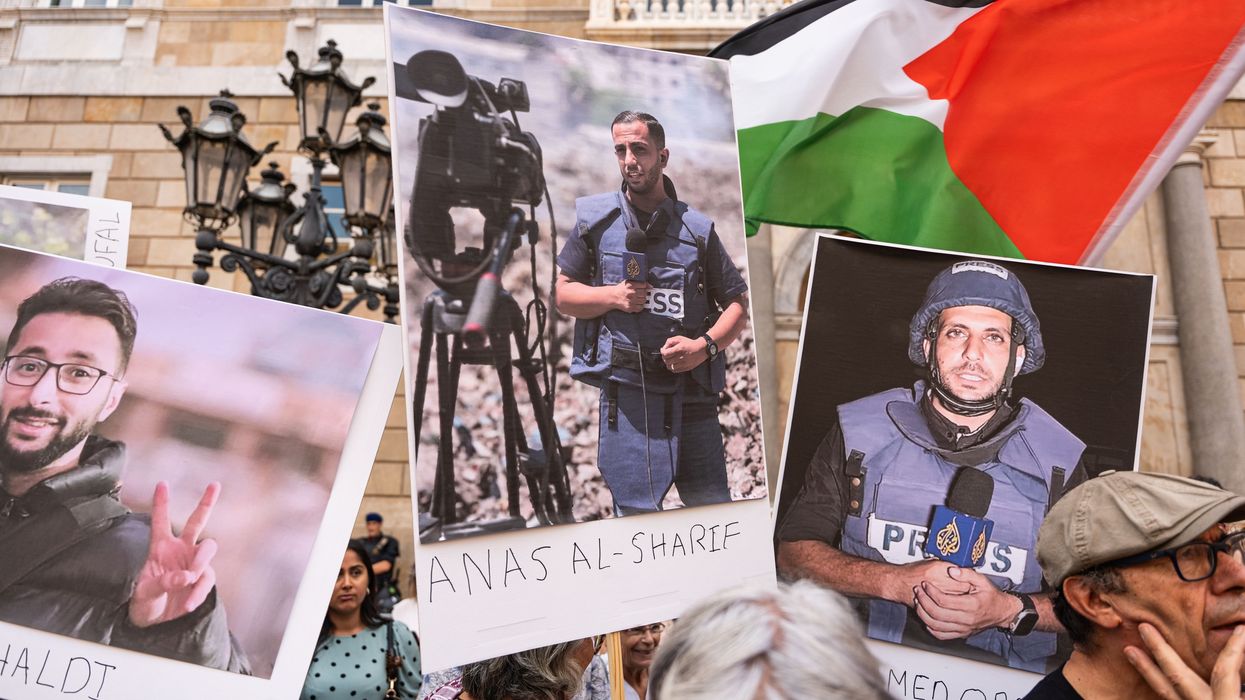
Nearly half of the worldwide reporters who lost their lives on the job this year were killed by the Israel Defense Forces in Gaza, according to Reporters Without Borders.
The report released Tuesday by the global press freedom group Reporters Without Borders provides an accounting of the killing of dozens of journalists across the globe in 2025, but nearly half of the people whose deaths are included were killed by the same group: the Israel Defense Forces.
For the third year running, as Israel's attacks on Gaza and the West Bank continue despite a ceasefire agreement reached in October in Gaza, the country was named as the top killer of journalists and media workers, having killed at least 29 Palestinian reporters this year.
Out of 67 reporters killed while doing their jobs in the past year, 43% were killed in Gaza by the IDF—called "the worst enemy of journalists" in 2025.
"Journalists do not just die—they are killed," said Reporters Without Borders, also known by its French name, Reporters sans Frontières (RSF), as it released its 2025 Round-up. "The number of murdered journalists has risen again, due to the criminal practices of military groups—both regular and paramilitary—and organized crime."
In 2025, the number of journalists killed on the job rose by one compared to 2024.
#RSFRoundUp 2025: Journalists don't die, they are killed. In 2025, the number of journalists killed rose once more.Let's continue to count, name, denounce, investigate, and ensure that justice is done. Impunity must never prevail.Watch our #RSFRoundUp2025 ⬇️
[image or embed]
— RSF (@rsf.org) December 9, 2025 at 3:10 AM
The government of Israeli Prime Minister Benjamin Netanyahu was named in RSF's report as one of the world's "Press Freedom Predators," along with Myanmar's State Security and Peace Commission—the country's de facto military government—and the Jalisco New Generation Cartel in Mexico, where at least three journalists were killed this year while they were covering drug trafficking in areas where the cartel is influential.
In the case of Netanyahu's government, reads the report "the Israeli army has carried out a massacre—unprecedented in recent
history—of the Palestinian press. To justify its crimes, the Israeli military has mounted a global propaganda campaign to spread baseless accusations that portray Palestinian journalists as terrorists."
The 29 reporters killed in Gaza this year are among more than 200 journalists killed by the IDF since it began its assault on the exclave in October 2023 in retaliation for a Hamas-led attack. According to RSF, 65 of those killed were "murdered due to their profession," and others were killed in military attacks.
The report notes the "particularly harrowing case" of two strikes that targeted a building in the al-Nasser medical complex which was "known to house a workspace for journalists" on August 25.
Reuters photographer Hossam al-Masri was killed in the first strike, and a second strike eight minutes later killed Mariam Abu Dagga of the Independent Arabia and the Associated Press, freelancer Moaz Abu Taha, and Al Jazeera photograher Mohamad Salama.
The journalists had been covering rescue operations and the impacts of other airstrikes. They were killed two weeks after an IDF strike killed five other Al Jazeera reporters and an independent journalist while they were in their tent outside al-Shifa Hospital in Gaza City.
Israel claimed one of the reporters, Anas al-Sharif, was "the head of a Hamas terrorist cell"—an allegation that was denied in independent assessments by United Nations experts, the New York-based Committee to Protect Journalists, and RSF.
The killing of the reporters and dozens of others around the world, said RSF director general Thibaut Bruttin on Tuesday, "is where the hatred of journalists leads!"
"They weren’t collateral victims," said Bruttin. "They were killed, targeted for their work. It is perfectly legitimate to criticize the media—criticism should serve as a catalyst for change that ensures the survival of the free press, a public good. But it must never descend into hatred of journalists, which is largely born out of—or deliberately stoked by—the tactics of armed forces and criminal organizations."
Palestine was named as by far the most dangerous place in the world for journalists this year, while Mexico was identified as the second-most dangerous, with nine reporters killed despite "commitments" President Claudia Sheinbaum made to RSF.
The journalists "covered local news, exposed organized crime and its links to politicians, and had received explicit death threats," reported RSF. "One of them, Calletano de Jesus Guerrero, was even under government protection when he was murdered."
Bruttin warned that "the failure of international organizations that are no longer able to ensure journalists’ right to protection in armed conflicts is the consequence of a global decline in the courage of governments, which should be implementing protective public policies."
Three journalists were killed in Ukraine in one month, targeted by Russian drone attacks even as they wore helmets and bulletproof vests that clearly identified them as members of the press. Two reporters were killed in Bangladesh in apparent retaliation for their reporting on crimes.
The report also notes that 503 journalists are detained around the world, with Israel the second-biggest jailer of foreign journalists after Russia. Twenty Palestinian reporters are currently detained by Israel, including 16 who were arrested over the past two years in the West Bank and Gaza. Just three—Alaa al-Sarraj, Emad Zakaria Badr al-Ifranji, and Shady Abu Sedo—where released as part of the ceasefire agreement in October after having been "unlawfully arrested by Israeli forces" in Gaza.
"It is our responsibility to stand alongside those who uphold our collective right to reliable information. We owe them that," wrote Bruttin. "As key witnesses to history, journalists have gradually become collateral victims, inconvenient observers, bargaining chips, pawns in diplomatic games, men and women to be eliminated. Let us be wary of false notions about reporters: No one gives their life for journalism—it is taken from them."

Ideas are not tied to specific individuals, and resilience and resistance are a culture, not a job title.
The killing of seven Palestinian journalists and media workers in Gaza on August 10 has prompted verbal condemnations, yet has inspired little to no substantive action. This has become the predictable and horrifying trajectory of the international community's response to the ongoing Israeli genocide.
By eliminating Palestinian journalists like Anas al-Sharif and Mohammed Qraiqeh, Israel has made a sinister statement that the genocide will spare no one. According to the monitoring website Shireen.ps, Israel has killed nearly 270 journalists since October 2023.
More journalists are likely to die covering the genocide of their own people in Gaza, especially since Israel has manufactured a convenient and easily deployed narrative that every Gazan journalist is simply a "terrorist." This is the same cruel logic offered by numerous Israeli officials in the past, including Israeli President Isaac Herzog, who declared that "an entire nation" in Gaza "is responsible" for not having rebelled against Hamas, effectively stating that there are no innocent people in Gaza.
This Israeli discourse, which dehumanizes entire populations based on a vicious logic, is frequently repeated by officials who fear no accountability. Even Israeli diplomats, whose job in theory is to improve their country's image internationally, frequently engage in this brutal ritual. In comments made in January 2024, Israeli ambassador to the United Kingdom, Tzipi Hotovely, callously argued that "every school, every mosque, every second house has access to tunnels," implying that all of Gaza is a valid military target.
With foreign media forbidden from operating in the strip per Israeli orders, the Gazan intellectual rose to the occasion and, in the course of two years, managed to reverse most of Zionism's gains over the past century.
This cruelty of language would be easily dismissed as mere rhetoric, except that Israel has, in fact, according to Euro-Med Human Rights Monitor reports, destroyed over 70% of Gaza's infrastructure.
While extremist language is often used by politicians around the world, it is rare for the extremism of the language to so precisely mirror the extremism of the action itself. This makes Israeli political discourse a uniquely dangerous phenomenon.
There can be no military justification for the wholesale annihilation of an entire region. Yet again, the Israelis are not shying away from providing the political discourse that explains this unprecedented destruction. Former Knesset member Moshe Feiglin chillingly said, last May, that "every child, every baby in Gaza is an enemy… not a single Gazan child will be left there."
But for the systematic destruction of a whole nation to succeed, it must include the deliberate targeting of its scientists, doctors, intellectuals, journalists, artists, and poets. While children and women remain the largest categories of victims, many of those killed in deliberate assassinations appear to be targeted specifically to disorient Palestinian society, deprive it of societal leadership, and render the process of rebuilding Gaza impossible.
These figures powerfully illustrate this point: According to a report released by the United Nations Office for the Coordination of Humanitarian Affairs, based on the latest satellite damage assessment conducted in July, 97% of Gaza's educational facilities have been affected, with 91% in need of major repairs or full reconstruction. Additionally, hundreds of teachers and thousands of students have been killed.
But why is Israel so intent on killing those responsible for intellectual production? The answer is twofold: one unique to Gaza, and the other unique to the nature of Israel's founding ideology, Zionism.
First, regarding Gaza: Since the Nakba in 1948, Palestinian society in Gaza has invested heavily in education, seeing it as a crucial tool for liberation and self-determination. Early footage shows classrooms being held in tents and open spaces, a testament to this community's tenacious pursuit of knowledge. This focus on education transformed the strip into a regional hub for intellectual and cultural production, despite poorly funded UN Relief and Works Agency for Palestinian Refugees in the Near East schools. Israel's campaign of destruction is a deliberate attempt to erase this generational achievement, a practice known as scholasticide, and Gaza is the most deliberate example of this horrific act.
Second, regarding Zionism: For many years, we were led to believe that Zionism was winning the intellectual war due to the cleverness and refinement of Israeli propaganda, or hasbara. The prevailing narrative, particularly in the Arab world, was that Palestinians and Arabs were simply no match for the savvy Israeli and pro-Israeli public relations machine in Western media. This created a sense of intellectual inferiority, masking the true reason for the imbalance.
Israel was able to "win" in mainstream media discourse due to the intentional marginalization and demonization of Palestinian and pro-Palestinian voices. The latter had no chance of fighting back simply because they were not allowed to, and were instead labeled as "terrorist sympathizers" and the like. Even the late, world-renowned Palestinian scholar Edward Said was called a "Nazi" by the extremist, now-banned Jewish Defense League, who went so far as to set the beloved professor's university office on fire.
Gaza, however, represented a major problem. With foreign media forbidden from operating in the strip per Israeli orders, the Gazan intellectual rose to the occasion and, in the course of two years, managed to reverse most of Zionism's gains over the past century. This forced Israel into a desperate race against time to remove as many Palestinian journalists, intellectuals, academics, and even social media influencers from the scene as quickly as possible—thus, the war on the Palestinian thinker.
The Israeli logic, however, is destined to fail, as ideas are not tied to specific individuals, and resilience and resistance are a culture, not a job title. Gaza shall once more emerge, not only as the culturally thriving place it has always been, but as the cornerstone of a new liberation discourse that is set to inspire the globe regarding the power of intellect to stand firm, to fight for what is right, and to live with purpose for a higher cause.
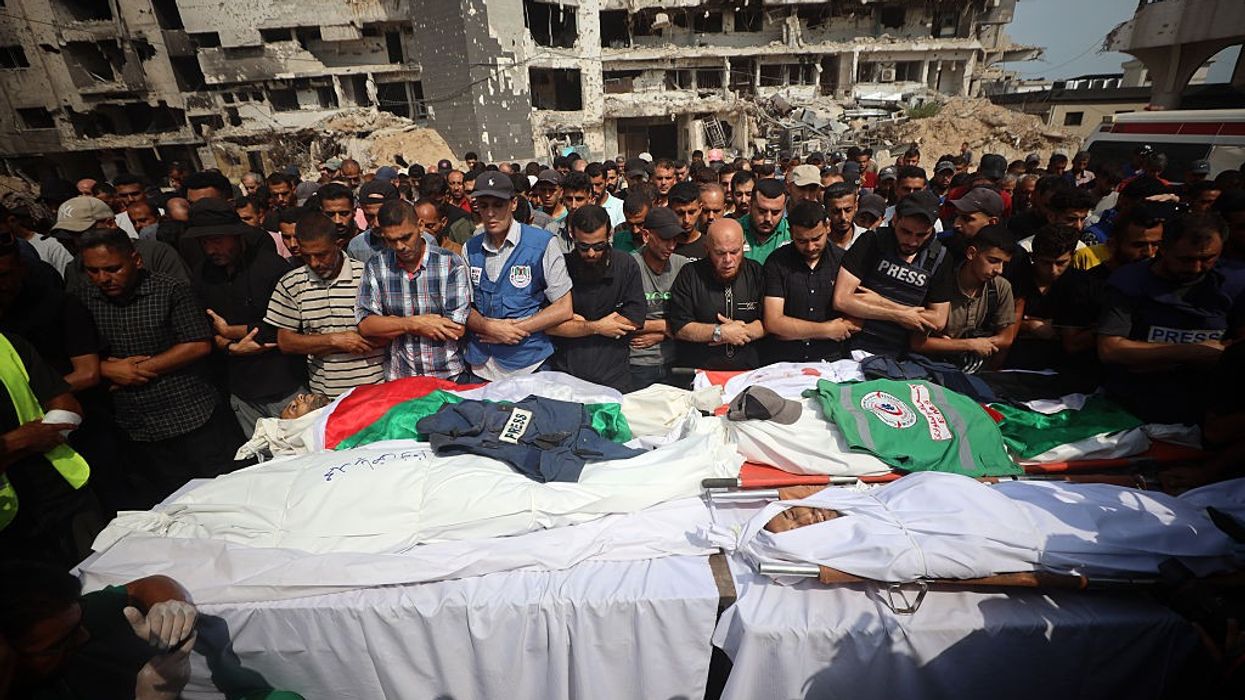
"It is hard to see," said the head of the Committee to Protect Journalists, "if Israel can wipe out an entire news crew without the international community so much as batting an eye, what will stop further attacks on reporters."
Nearly two years into Israel's assault on Gaza, the Israel Defense Forces' killing of six journalists this week provoked worldwide outrage—but a leading press freedom advocate said Wednesday that the slaughter of the Palestinian reporters can "hardly" be called surprising, considering the international community's refusal to stop Israel from killing hundreds of journalists and tens of thousands of other civilians in Gaza since October 2023.
Israel claimed without evidence that Anas al-Sharif, a prominent Al Jazeera journalist who was killed in an airstrike Sunday along with four of his colleagues at the network and a freelance reporter, was the leader of a Hamas cell—an allegation Al Jazeera, the United Nations, and rights groups vehemently denied.
Jodie Ginsberg, CEO of the Committee to Protect Journalists, wrote in The Guardian that al-Sharif was one of at least 26 Palestinian reporters that Israel has admitted to deliberately targeting while presenting "no independently verifiable evidence" that they were militants or involved in hostilities in any way.
Israel did not publish the "current intelligence" it claimed to have showing al-Sharif was a Hamas operative, and Ginsberg outlined how the IDF appeared to target al-Sharif after he drew attention to the starvation of Palestinians—which human rights groups and experts have said is the direct result of Israel's near-total blockade on humanitarian aid.
"The Committee to Protect Journalists had seen this playbook from Israel before: a pattern in which journalists are accused by Israel of being terrorists with no credible evidence," wrote Ginsberg, noting the CPJ demanded al-Sharif's protection last month as Israel's attacks intensified.
The five other journalists who were killed when the IDF struck a press tent in Gaza City were not accused of being militants.
The IDF "has not said what crime it believes the others have committed that would justify killing them," wrote Ginsberg. "The laws of war are clear: Journalists are civilians. To target them deliberately in war is to commit a war crime."
"It is hardly surprising that Israel believes it can get away with murder. In the two decades preceding October, Israeli forces killed 20 journalists."
Just as weapons have continued flowing from the United States and other Western countries to Israel despite its killing of at least 242 Palestinian journalists and more than 61,000 other civilians since October 2023, Ginsberg noted, Israel had reason to believe it could target reporters even before the IDF began its current assault on Gaza.
"It is hardly surprising that Israel believes it can get away with murder," wrote Ginsberg. "In the two decades preceding October, Israeli forces killed 20 journalists. No one has ever been held accountable for any of those deaths, including that of the Al Jazeera journalist Shireen Abu Akleh, whose killing in 2022 sent shock waves through the region."
The reaction to the killing of the six journalists this week from the Trump administration—the largest international funder of the Israeli military—and the corporate media in the U.S. has exemplified what Ginsberg called the global community's "woeful" response to the slaughter of journalists by Israel, which has long boasted of its supposed status as a bastion of press freedom in the Middle East.
As Middle East Eye reported Tuesday, at the first U.S. State Department briefing since al-Sharif and his colleagues were killed, spokesperson Tammy Bruce said the airstrike targeting journalists was a legitimate attack by "a nation fighting a war" and repeated Israel's unsubstantiated claims about al-Sharif.
"I will remind you again that we're dealing with a complicated, horrible situation," she told a reporter from Al Jazeera Arabic. "We refer you to Israel. Israel has released evidence al-Sharif was part of Hamas and was supportive of the Hamas attack on October 7. They're the ones who have the evidence."
A CNN anchor also echoed Israel's allegations of terrorism in an interview with Foreign Press Association president Ian Williams, prompting the press freedom advocate to issue a reminder that—even if Israel's claims were true—journalists are civilians under international law, regardless of their political beliefs and affiliations.
"Frankly, I don't care whether al-Sharif was in Hamas or not," said Williams. "We don't kill journalists for being Republicans or Democrats or, in Britain, Labour Party."
Ginsberg warned that even "our own journalism community" across the world has thus far failed reporters in Gaza—now the deadliest war for journalists that CPJ has ever documented—compared to how it has approached other conflicts.
"Whereas the Committee to Protect Journalists received significant offers of support and solidarity when journalists were being killed in Ukraine at the start of Russia's full-scale invasion, the reaction from international media over the killings of our journalist colleagues in Gaza at the start of the war was muted at best," said Ginsberg.
International condemnation has "grown more vocal" following the killing of al-Sharif and his colleagues, including Mohammed Qreiqeh, Ibrahim Zaher, Mohammed Noufal, Moamen Aliwa, and Mohammad al-Khaldi, said Ginsberg.
"But it is hard to see," she said, "if Israel can wipe out an entire news crew without the international community so much as batting an eye, what will stop further attacks on reporters."
Three U.N. experts on Tuesday demanded an immediate independent investigation into the journalists' killing, saying that a refusal from Israel to allow such a probe would "reconfirm its own culpability and cover-up of the genocide."
"Journalism is not terrorism. Israel has provided no credible evidence of the latter against any of the journalists that it has targeted and killed with impunity," said the experts, including Francesca Albanese, the special rapporteur on the situation of human rights in the Palestinian territory occupied since 1967.
"These are acts of an arrogant army that believes itself to be impune, no matter the gravity of the crimes it commits," they said. "The impunity must end. The states that continue to support Israel must now place tough sanctions against its government in order to end the killings, the atrocities, and the mass starvation."
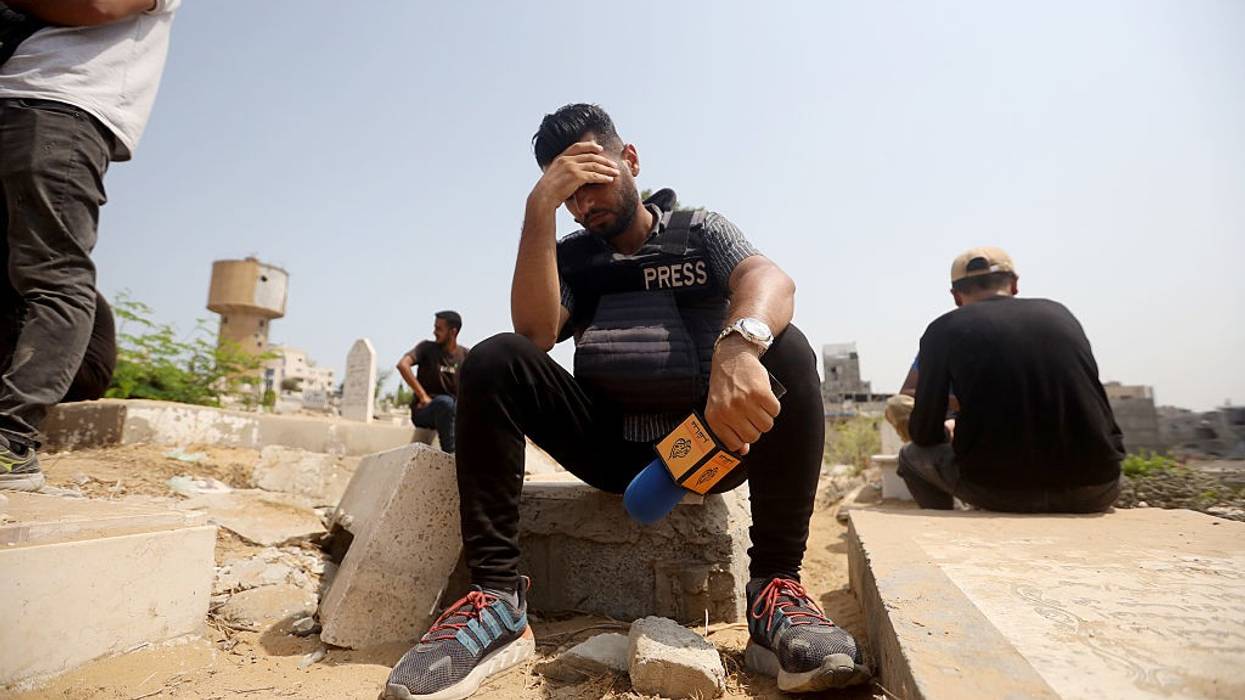
The Israeli missile that hit Al Jazeera’s tent targeted more than five people; it struck at the principle that the public has a right to know and at the belief that truth should outlive the men and women who report it.
On the night of August 10, 2025, the air over Gaza City hung heavy with dust and the steady thrum of generators. In a modest press tent pitched outside the bomb-scarred shell of al-Shifa Hospital, Al Jazeera’s last reporting team in the city worked with the quiet urgency of people who knew each second could be their last chance to bear witness. Cameras waited on tripods. Laptops glowed on folding tables. There were no sandbags or armed guards, only the visible markings of the press, meant to signal protection under the laws of war.
Al Jazeera, a Qatar-based global news network, has kept a permanent presence in Gaza for years, often reporting from places other international media could not reach. The network has long faced hostility from Israeli officials, who have accused it of bias and threatened to shutter its Jerusalem bureau. Al Jazeera has rejected these accusations, pointing to its record of reporting from all sides of the conflict. During this war, with foreign reporters barred from entering without Israeli military escort, its local Palestinian journalists became one of the few remaining sources of independent, on-the-ground coverage from inside the enclave. Their reports, footage, and interviews were carried not only to millions of viewers across the Arab-speaking world but also by major global outlets.
Inside the tent sat Anas al-Sharif, Mohammed Qreiqeh, Ibrahim Zaher, Mohammed Noufal, and Moamen Aliwa. Minutes later, an Israeli missile struck the tent. The Israeli military admitted targeting the site, alleging al-Sharif was a Hamas cell leader. No independent evidence has confirmed that claim. Al Jazeera stated that this was a targeted assassination.
The blast did more than tear through canvas and steel. It silenced the final independent voices still reporting from Gaza City. When you kill the witness, you kill the story. And when the story dies, accountability dies with it. This was not an isolated tragedy. It was part of a pattern that, measured across the war, has made Gaza the deadliest place on Earth for journalists in the modern record.
The deliberate killing of multiple journalists from a single, reputable newsroom is not without precedent. Each time it happens, it marks a rupture in the global record. In 1975, the Balibo Five were executed in East Timor to prevent them from reporting on Indonesia’s invasion. In 2009, the Maguindanao Massacre claimed 32 reporters in the Philippines, the largest single-day killing of journalists in history, as a warning to all who might challenge local power. In 2012, American correspondent Marie Colvin was killed when Syrian forces shelled a known media center in Homs. In Nazi Germany and under Stalin’s Soviet Union, many journalists were imprisoned, exiled, or executed for defying the state narrative, their deaths folded into broader purges and wartime atrocities. The tent strike in Gaza now stands in this grim lineage, a calculated act to silence witnesses and send a message to the world that there are places you will not be allowed to see.
The Committee to Protect Journalists (CPJ) reports at least 192 journalist deaths since October 7, 2023: 184 Palestinian, 2 Israeli, and 6 Lebanese, as of August 11, 2025. The International Federation of Journalists (IFJ) counts at least 195 media workers killed. Gaza’s Government Media Office claims 238, while the Costs of War Project at Brown University documents about 232 through late March 2025. These totals vary depending on whether the counts include foreign correspondents, media support staff, or missing journalists presumed dead.
Even the lowest confirmed total makes this the deadliest conflict for journalists in CPJ’s record, surpassing all others in speed and density of loss. From October 7, 2023, through August 11, 2025, an average of about 8 to 9 journalists per month have been killed, totaling 192 deaths. For comparison, during the entire U.S. war in Iraq, which lasted more than eight years, CPJ recorded 204 journalists and media workers killed. Both figures are from CPJ’s database, using the same definitions for journalists and media workers. Each number is a human being with a family, colleagues, and a record of truths that now stops mid-sentence. The IFJ estimates that more than 10% of Gaza’s entire journalist corps has been killed.
Such a pattern does not happen by accident. The scale and pace of these deaths suggest an intentional effort to remove those who can create an independent record of the war.
The first casualty is often the truth. In Gaza, it is the truth tellers. These deaths are not the inevitable byproduct of a chaotic battlefield. They result from deliberate decisions to remove those most capable of documenting events and holding perpetrators to account.
The pattern is well known: Eliminate independent eyes, leaving only the account sanctioned by those in power, seal off the site, and eliminate evidence until only the official version remains. This is not only about shaping opinion in the moment. In war crimes tribunals, journalistic photographs, videos, and testimonies have been used as evidence, making those who capture them a direct threat to impunity. United Nations Special Rapporteur Irene Khan has said that attacks on journalists fit into a global pattern of repression that undermines democracy. In Gaza, this sequence is already well underway.
If those with the cameras are gone, who decides what the rest of us see?
The press corps’ decimation forms the outer wall of a larger project. Human rights groups warn that this campaign seeks the political and demographic erasure of the 5.4 million Palestinians in Gaza and the West Bank, with displacement, imprisonment, and disenfranchisement on a mass scale. The methods are familiar: trap communities in “no exit” zones, dismantle life-sustaining infrastructure, close borders, and silence those who can bear witness. History shows that when the heart of a people is targeted, the tremors do not stop at its borders. They move outward, altering the lives of kin and communities far beyond the place where the attack began.
History shows what follows when the witnesses are gone. In the Balkans, in Syria, in Myanmar, the absence of independent eyes allowed perpetrators to dictate the record and insist their version was the only truth.
The strike on the al-Shifa tent happened before the last neighborhoods went quiet. In wars where mass displacement or worse is contemplated, silencing independent reporting is often an early operational step. Sarajevo’s television studios were shelled into darkness. In Aleppo, journalists were hunted through the rubble. In Myanmar, reporters documenting the Rohingya crisis were jailed or killed.
The reason rarely changes: Without witnesses, atrocities can be denied, timelines rewritten, and casualty counts reduced to rumor. In that vacuum, truth becomes whatever those in power decide it should be. If those with the cameras are gone, who decides what the rest of us see?
The elimination of journalists is not only about restricting information. It is about shaping the emotional terrain of the conflict. Each killing sends a message to the surviving press that they are not protected and that their work makes them targets. This is psychological warfare, aimed not just at reporters but at the public they serve. When people see that even clearly marked press are attacked, they understand that there is no neutral ground, no shield of visibility.
As more journalists are driven out or silenced, fewer remain to challenge official accounts, leaving entire populations dependent on information filtered through those in power. In Latin America’s “Dirty Wars,” in Sri Lanka’s civil war, and in the Philippines under President Ferdinand Marcos, such tactics were designed to suppress the will to resist by convincing whole communities that their suffering would never be witnessed, much less believed. Gaza’s blackout is not only the removal of documentation; it is the removal of hope that anyone will ever hear the truth.
The same blueprint used to silence the press abroad is already finding footholds within U.S. borders. The United States operates over 200 Immigration and Customs Enforcement (ICE) detention facilities, many with the regimentation and secrecy of military compounds. Policy proposals from the current administration and its allies call for mass deportations, an executive order to curtail birthright citizenship that is now blocked in court, and expansion of detention capacity on military bases.
Journalists who have investigated ICE activities, including deportation operations, workplace raids, and conditions inside its facilities, have frequently faced barriers. Reporters have been denied access, threatened with legal action, or physically removed while trying to document these operations. Some have been blocked from speaking with detainees, filming at detention sites, or covering ICE enforcement actions in the community. CPJ Executive Director Jodie Ginsberg has said that keeping journalists out keeps the truth out. The language used to justify these restrictions, portraying detainees as criminals, threats, or “invaders,” is identical to that used elsewhere to prepare the ground for repression.
What is refined in one arena, whether a detention camp, a protest site, or a conflict zone, does not remain there.
Every time this script is run abroad, it becomes easier to perform at home. This is not hypothetical. At Standing Rock, reporters were arrested and equipment seized. In 2020, journalists covering protests after the murder of George Floyd were injured by rubber bullets, exposed to tear gas, and detained. These incidents limited what the public could see in real time and in some cases allowed authorities to control the only surviving footage or accounts. The method is the same as in other crackdowns: Control the people by controlling what can be seen and said.
The United States is not alone. India has stripped citizenship from Muslims in Assam. Hungary has throttled independent media through legal and regulatory pressure. Egypt detains and silences journalists as a matter of policy. In each case, independent reporting was crippled before mass arrests, disenfranchisement, or expulsions took place. The success of such methods in one state emboldens others to replicate them, creating a cycle in which press repression becomes both normalized and exportable. What is refined in one arena, whether a detention camp, a protest site, or a conflict zone, does not remain there. It is studied, shared, and deployed wherever those in power fear scrutiny.
When the press is killed or silenced, officials often say that war is dangerous and journalists accept the risks. The Geneva Conventions, however, make clear that journalists are civilians who are entitled to protection and that danger does not permit targeting them. Another common defense is to claim that those killed were militants posing as reporters, a label that, once applied, erases legal protections. In Gaza, no independent body has verified the accusations against Anas al-Sharif or his colleagues.
Some insist that Gaza is unique, avoiding comparisons to other situations where states control movement, limit oversight, and erase populations from public life. Others dismiss historical parallels as exaggeration, ignoring that forced displacement, legal nullification, and the silencing of witnesses have long been precursors to atrocities. When criticism of Israeli policy is labeled antisemitic, governance is conflated with identity, and legitimate scrutiny is deflected.
Jewish journalists and Israeli human rights advocates have also criticized these policies, underscoring that opposition is not rooted in prejudice. The rhetoric that frames such criticism as antisemitic is part of the machinery of repression, conditioning the public to excuse the killings and accept the absence of independent reporting.
The missile that hit Al Jazeera’s tent targeted more than five people; it struck at the principle that the public has a right to know and at the belief that truth should outlive the men and women who report it.
If every image, every report, and every interview were filtered through those with something to hide, how would you know what happened? Imagine it is your city where the cameras have gone dark. That a protest you joined, a police raid in your neighborhood, or a natural disaster in your community is unfolding, and the only images that will survive are the ones the authorities approve. Imagine knowing that the people documenting the truth are being hunted, and that without them, your story will vanish into an official silence polished to look like fact.
This is not a thought experiment. The tools and tactics now used against journalists in Gaza, from mass surveillance to targeted suppression, are already here, in our cities, at our borders, in our public spaces. The question is not if they could be turned inward, but when, and against whom.
For Americans who think they are insulated from this logic, the warning is blunt: The systems refined in Gaza do not stay there.
If Gaza’s press corps can be eliminated so quickly while the world looks away, then no war zone, no protest, and no detention center is safe from the same erasure. That is how it starts. You eliminate independent eyes, leave only the account sanctioned by those in power, and then rewrite the story as if they never existed.
To defend journalists is to defend the archive of truth itself, the evidence from which any hope of justice must be built. Without that record, there is only the official version, changed at will, designed to serve those in power. For Americans who think they are insulated from this logic, the warning is blunt: The systems refined in Gaza do not stay there. They adapt. They travel. They are deployed wherever those in power fear exposure.
You can push back. Support independent and at-risk journalists through organizations like the Committee to Protect Journalists, Reporters Without Borders, or local press freedom funds. Demand that your representatives back enforceable protections for journalists at home and abroad. Share the work of those risking their lives to report from Gaza and other conflict zones. Your advocacy, funding, and amplification are part of the fragile chain that keeps future atrocities from being erased.
The press tent outside al-Shifa was a small, temporary structure. The idea behind its destruction was neither small nor temporary. Unless the witness is defended everywhere, we may find no one left to tell our story when it matters most.
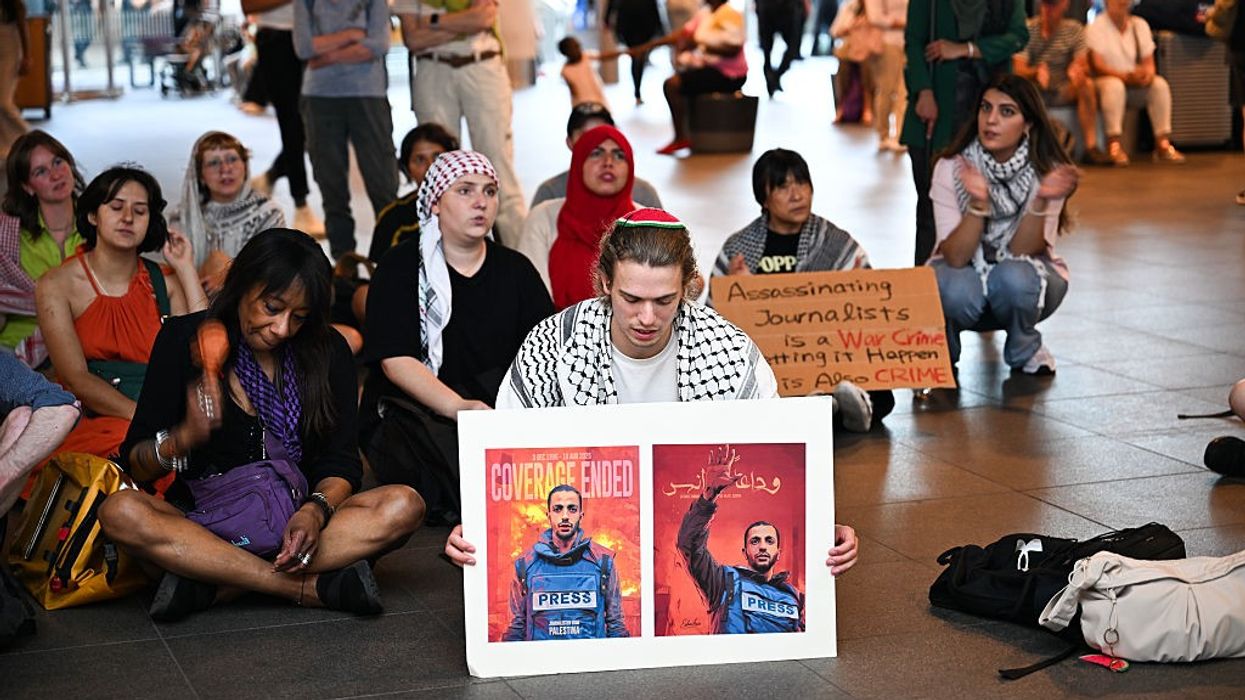
"This massacre and Israel's media blackout strategy, designed to conceal the crimes committed by its army for more than 21 months in the besieged and starving Palestinian enclave, must be stopped immediately."
The international advocacy group Reporters Without Borders on Monday called on the United Nations Security Council to convene an emergency meeting following the massacre of six Palestinian media professionals in an Israeli strike on the Gaza Strip.
Al Jazeera reporters Anas al-Sharif and Mohammed Qreiqeh, camera operators Ibrahim Zaher, Mohammed Noufal, and Moamen Aliwa, and independent journalist Mohammed al-Khaldi were killed Sunday in a targeted Israel Defense Forces (IDF) strike on their tent outside al-Shifa Hospital in Gaza City.
The IDF claimed that al-Sharif—one of the most prominent Palestinian journalists—"was the head of a Hamas terrorist cell," repeating an allegation first made last year. However, independent assessments by United Nations experts, the New York-based Committee to Protect Journalists, and Reporters Without Borders (RSF) concluded that Israel's allegations were unsubstantiated.
Investigative journalist Jeremy Scahill warned last year that the IDF's portrayal of al-Sharif and other Palestinian journalists as Hamas members was "an assassination threat and an attempt to preemptively justify their murder" for showing the world the genocidal realities of Israel's U.S.-backed war.
"Tonight Israel murdered the bravest journalistic hero in Gaza, Anas al-Sharif," Scahill said Sunday on social media. "For nearly two straight years, he documented the genocide of his people with courage and principle. Israel put him on a hit list because of his voice. Shame on this world and all who were silent."
Al Jazeera condemned Sunday's massacre as "a desperate attempt to silence the voices exposing the impending seizure and occupation of Gaza."
RSF issued a statement accusing the IDF of killing the six men "without providing solid evidence" of Hamas affiliation, a "disgraceful tactic" that is "repeatedly used against journalists to cover up war crimes."
The Paris-based nonprofit noted that Israeli forces have "already killed more than 200 media professionals"—including at least 19 Al Jazeera workers and freelancers—since the IDF began its annihilation and siege of Gaza in retaliation for the October 7, 2023 attack led by Hamas.
These include Al Jazeera reporter Ismail al-Ghoul and photographer Rami al-Rifi, who were killed in a targeted strike on the al-Shati refugee camp in July 2024 following an IDF smear campaign alleging without proof that al-Ghoul took part in the October 7 attack. The IDF claimed that al-Ghoul received Hamas military training at a time when he would have been just 10 years old.
"RSF strongly condemns the killing of six media professionals by the Israeli army, once again carried out under the guise of terrorism charges against a journalist," RSF director general Thibaut Bruttin said in a statement. "One of the most famous journalists in the Gaza Strip, Anas al-Sharif, was among those killed."
"This massacre and Israel's media blackout strategy, designed to conceal the crimes committed by its army for more than 21 months in the besieged and starving Palestinian enclave, must be stopped immediately," Bruttin continued. "The international community can no longer turn a blind eye and must react and put an end to this impunity."
"RSF calls on the U.N. Security Council to meet urgently on the basis of Resolution 2222 of 2015 on the protection of journalists in times of armed conflict in order to stop this carnage," he added.
Israel's latest killing of media professionals sparked international condemnation. On Monday, Stéphane Dujarric, a spokesperson for U.N. Secretary-General António Guterres, called for an investigation into the massacre, saying that "journalists and media workers must be respected, they must be protected and they must be allowed to carry out their work freely, free from fear and free from harassment."
Recognizing the possibility that he would become one of the more than 61,500 Palestinians killed by Israeli forces in Gaza since October 2023, al-Sharif, like many Palestinian journalists, prepared a statement to be published in the event of his death.
"This is my will and my final message. If these words reach you, know that Israel has succeeded in killing me and silencing my voice," he wrote. "I urge you not to let chains silence you, nor borders restrain you. Be bridges toward the liberation of the land and its people, until the sun of dignity and freedom rises over our stolen homeland."
"Make my blood a light that illuminates the path of freedom for my people and my family," al-Sharif added.
Since October 2023, RSF has filed four complaints with the International Criminal Court—which last year issued arrest warrants for Israeli Prime Minister Benjamin Netanyahu and former Defense Minister Yoav Gallant for alleged crimes against humanity and war crimes—requesting investigations into IDF killings of journalists in Gaza and accusing Israel of a deliberate "eradication of the Palestinian media."
The six journalists' killings came as Israeli forces prepared to ramp up the Gaza invasion with the stated goal of occupying the entire coastal enclave and ethnically cleansing much of its Palestinian population.
The Gaza Health Ministry said Monday afternoon that at least 69 Palestinians, including at least 10 children and 29 aid-seekers, were killed in the past 24 hours. An IDF strike on Gaza City reportedly killed nine people, including six children. Five more Palestinians also reportedly died of starvation in a burgeoning famine that officials say has claimed at least 222 lives, including 101 children.