SUBSCRIBE TO OUR FREE NEWSLETTER
Daily news & progressive opinion—funded by the people, not the corporations—delivered straight to your inbox.
5
#000000
#FFFFFF
To donate by check, phone, or other method, see our More Ways to Give page.
Daily news & progressive opinion—funded by the people, not the corporations—delivered straight to your inbox.
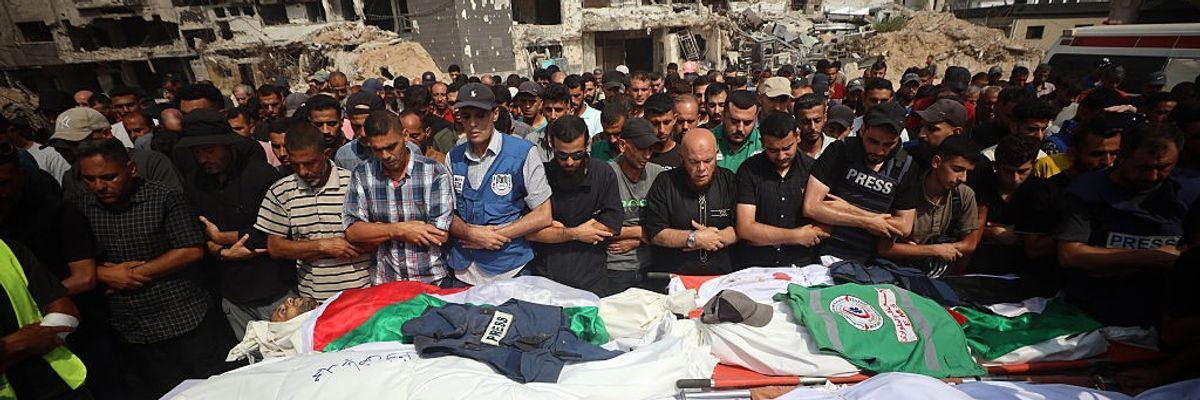
Mourners pray during a group funeral for Palestinians, including journalists and a medic, killed in an overnight Israeli strike, outside the Al-Shifa Hospital in Gaza City, on August 11, 2025.
"It is hard to see," said the head of the Committee to Protect Journalists, "if Israel can wipe out an entire news crew without the international community so much as batting an eye, what will stop further attacks on reporters."
Nearly two years into Israel's assault on Gaza, the Israel Defense Forces' killing of six journalists this week provoked worldwide outrage—but a leading press freedom advocate said Wednesday that the slaughter of the Palestinian reporters can "hardly" be called surprising, considering the international community's refusal to stop Israel from killing hundreds of journalists and tens of thousands of other civilians in Gaza since October 2023.
Israel claimed without evidence that Anas al-Sharif, a prominent Al Jazeera journalist who was killed in an airstrike Sunday along with four of his colleagues at the network and a freelance reporter, was the leader of a Hamas cell—an allegation Al Jazeera, the United Nations, and rights groups vehemently denied.
Jodie Ginsberg, CEO of the Committee to Protect Journalists, wrote in The Guardian that al-Sharif was one of at least 26 Palestinian reporters that Israel has admitted to deliberately targeting while presenting "no independently verifiable evidence" that they were militants or involved in hostilities in any way.
Israel did not publish the "current intelligence" it claimed to have showing al-Sharif was a Hamas operative, and Ginsberg outlined how the IDF appeared to target al-Sharif after he drew attention to the starvation of Palestinians—which human rights groups and experts have said is the direct result of Israel's near-total blockade on humanitarian aid.
"The Committee to Protect Journalists had seen this playbook from Israel before: a pattern in which journalists are accused by Israel of being terrorists with no credible evidence," wrote Ginsberg, noting the CPJ demanded al-Sharif's protection last month as Israel's attacks intensified.
The five other journalists who were killed when the IDF struck a press tent in Gaza City were not accused of being militants.
The IDF "has not said what crime it believes the others have committed that would justify killing them," wrote Ginsberg. "The laws of war are clear: Journalists are civilians. To target them deliberately in war is to commit a war crime."
"It is hardly surprising that Israel believes it can get away with murder. In the two decades preceding October, Israeli forces killed 20 journalists."
Just as weapons have continued flowing from the United States and other Western countries to Israel despite its killing of at least 242 Palestinian journalists and more than 61,000 other civilians since October 2023, Ginsberg noted, Israel had reason to believe it could target reporters even before the IDF began its current assault on Gaza.
"It is hardly surprising that Israel believes it can get away with murder," wrote Ginsberg. "In the two decades preceding October, Israeli forces killed 20 journalists. No one has ever been held accountable for any of those deaths, including that of the Al Jazeera journalist Shireen Abu Akleh, whose killing in 2022 sent shock waves through the region."
The reaction to the killing of the six journalists this week from the Trump administration—the largest international funder of the Israeli military—and the corporate media in the U.S. has exemplified what Ginsberg called the global community's "woeful" response to the slaughter of journalists by Israel, which has long boasted of its supposed status as a bastion of press freedom in the Middle East.
As Middle East Eye reported Tuesday, at the first U.S. State Department briefing since al-Sharif and his colleagues were killed, spokesperson Tammy Bruce said the airstrike targeting journalists was a legitimate attack by "a nation fighting a war" and repeated Israel's unsubstantiated claims about al-Sharif.
"I will remind you again that we're dealing with a complicated, horrible situation," she told a reporter from Al Jazeera Arabic. "We refer you to Israel. Israel has released evidence al-Sharif was part of Hamas and was supportive of the Hamas attack on October 7. They're the ones who have the evidence."
A CNN anchor also echoed Israel's allegations of terrorism in an interview with Foreign Press Association president Ian Williams, prompting the press freedom advocate to issue a reminder that—even if Israel's claims were true—journalists are civilians under international law, regardless of their political beliefs and affiliations.
"Frankly, I don't care whether al-Sharif was in Hamas or not," said Williams. "We don't kill journalists for being Republicans or Democrats or, in Britain, Labour Party."
Ginsberg warned that even "our own journalism community" across the world has thus far failed reporters in Gaza—now the deadliest war for journalists that CPJ has ever documented—compared to how it has approached other conflicts.
"Whereas the Committee to Protect Journalists received significant offers of support and solidarity when journalists were being killed in Ukraine at the start of Russia's full-scale invasion, the reaction from international media over the killings of our journalist colleagues in Gaza at the start of the war was muted at best," said Ginsberg.
International condemnation has "grown more vocal" following the killing of al-Sharif and his colleagues, including Mohammed Qreiqeh, Ibrahim Zaher, Mohammed Noufal, Moamen Aliwa, and Mohammad al-Khaldi, said Ginsberg.
"But it is hard to see," she said, "if Israel can wipe out an entire news crew without the international community so much as batting an eye, what will stop further attacks on reporters."
Three U.N. experts on Tuesday demanded an immediate independent investigation into the journalists' killing, saying that a refusal from Israel to allow such a probe would "reconfirm its own culpability and cover-up of the genocide."
"Journalism is not terrorism. Israel has provided no credible evidence of the latter against any of the journalists that it has targeted and killed with impunity," said the experts, including Francesca Albanese, the special rapporteur on the situation of human rights in the Palestinian territory occupied since 1967.
"These are acts of an arrogant army that believes itself to be impune, no matter the gravity of the crimes it commits," they said. "The impunity must end. The states that continue to support Israel must now place tough sanctions against its government in order to end the killings, the atrocities, and the mass starvation."
Dear Common Dreams reader, It’s been nearly 30 years since I co-founded Common Dreams with my late wife, Lina Newhouser. We had the radical notion that journalism should serve the public good, not corporate profits. It was clear to us from the outset what it would take to build such a project. No paid advertisements. No corporate sponsors. No millionaire publisher telling us what to think or do. Many people said we wouldn't last a year, but we proved those doubters wrong. Together with a tremendous team of journalists and dedicated staff, we built an independent media outlet free from the constraints of profits and corporate control. Our mission has always been simple: To inform. To inspire. To ignite change for the common good. Building Common Dreams was not easy. Our survival was never guaranteed. When you take on the most powerful forces—Wall Street greed, fossil fuel industry destruction, Big Tech lobbyists, and uber-rich oligarchs who have spent billions upon billions rigging the economy and democracy in their favor—the only bulwark you have is supporters who believe in your work. But here’s the urgent message from me today. It's never been this bad out there. And it's never been this hard to keep us going. At the very moment Common Dreams is most needed, the threats we face are intensifying. We need your support now more than ever. We don't accept corporate advertising and never will. We don't have a paywall because we don't think people should be blocked from critical news based on their ability to pay. Everything we do is funded by the donations of readers like you. When everyone does the little they can afford, we are strong. But if that support retreats or dries up, so do we. Will you donate now to make sure Common Dreams not only survives but thrives? —Craig Brown, Co-founder |
Nearly two years into Israel's assault on Gaza, the Israel Defense Forces' killing of six journalists this week provoked worldwide outrage—but a leading press freedom advocate said Wednesday that the slaughter of the Palestinian reporters can "hardly" be called surprising, considering the international community's refusal to stop Israel from killing hundreds of journalists and tens of thousands of other civilians in Gaza since October 2023.
Israel claimed without evidence that Anas al-Sharif, a prominent Al Jazeera journalist who was killed in an airstrike Sunday along with four of his colleagues at the network and a freelance reporter, was the leader of a Hamas cell—an allegation Al Jazeera, the United Nations, and rights groups vehemently denied.
Jodie Ginsberg, CEO of the Committee to Protect Journalists, wrote in The Guardian that al-Sharif was one of at least 26 Palestinian reporters that Israel has admitted to deliberately targeting while presenting "no independently verifiable evidence" that they were militants or involved in hostilities in any way.
Israel did not publish the "current intelligence" it claimed to have showing al-Sharif was a Hamas operative, and Ginsberg outlined how the IDF appeared to target al-Sharif after he drew attention to the starvation of Palestinians—which human rights groups and experts have said is the direct result of Israel's near-total blockade on humanitarian aid.
"The Committee to Protect Journalists had seen this playbook from Israel before: a pattern in which journalists are accused by Israel of being terrorists with no credible evidence," wrote Ginsberg, noting the CPJ demanded al-Sharif's protection last month as Israel's attacks intensified.
The five other journalists who were killed when the IDF struck a press tent in Gaza City were not accused of being militants.
The IDF "has not said what crime it believes the others have committed that would justify killing them," wrote Ginsberg. "The laws of war are clear: Journalists are civilians. To target them deliberately in war is to commit a war crime."
"It is hardly surprising that Israel believes it can get away with murder. In the two decades preceding October, Israeli forces killed 20 journalists."
Just as weapons have continued flowing from the United States and other Western countries to Israel despite its killing of at least 242 Palestinian journalists and more than 61,000 other civilians since October 2023, Ginsberg noted, Israel had reason to believe it could target reporters even before the IDF began its current assault on Gaza.
"It is hardly surprising that Israel believes it can get away with murder," wrote Ginsberg. "In the two decades preceding October, Israeli forces killed 20 journalists. No one has ever been held accountable for any of those deaths, including that of the Al Jazeera journalist Shireen Abu Akleh, whose killing in 2022 sent shock waves through the region."
The reaction to the killing of the six journalists this week from the Trump administration—the largest international funder of the Israeli military—and the corporate media in the U.S. has exemplified what Ginsberg called the global community's "woeful" response to the slaughter of journalists by Israel, which has long boasted of its supposed status as a bastion of press freedom in the Middle East.
As Middle East Eye reported Tuesday, at the first U.S. State Department briefing since al-Sharif and his colleagues were killed, spokesperson Tammy Bruce said the airstrike targeting journalists was a legitimate attack by "a nation fighting a war" and repeated Israel's unsubstantiated claims about al-Sharif.
"I will remind you again that we're dealing with a complicated, horrible situation," she told a reporter from Al Jazeera Arabic. "We refer you to Israel. Israel has released evidence al-Sharif was part of Hamas and was supportive of the Hamas attack on October 7. They're the ones who have the evidence."
A CNN anchor also echoed Israel's allegations of terrorism in an interview with Foreign Press Association president Ian Williams, prompting the press freedom advocate to issue a reminder that—even if Israel's claims were true—journalists are civilians under international law, regardless of their political beliefs and affiliations.
"Frankly, I don't care whether al-Sharif was in Hamas or not," said Williams. "We don't kill journalists for being Republicans or Democrats or, in Britain, Labour Party."
Ginsberg warned that even "our own journalism community" across the world has thus far failed reporters in Gaza—now the deadliest war for journalists that CPJ has ever documented—compared to how it has approached other conflicts.
"Whereas the Committee to Protect Journalists received significant offers of support and solidarity when journalists were being killed in Ukraine at the start of Russia's full-scale invasion, the reaction from international media over the killings of our journalist colleagues in Gaza at the start of the war was muted at best," said Ginsberg.
International condemnation has "grown more vocal" following the killing of al-Sharif and his colleagues, including Mohammed Qreiqeh, Ibrahim Zaher, Mohammed Noufal, Moamen Aliwa, and Mohammad al-Khaldi, said Ginsberg.
"But it is hard to see," she said, "if Israel can wipe out an entire news crew without the international community so much as batting an eye, what will stop further attacks on reporters."
Three U.N. experts on Tuesday demanded an immediate independent investigation into the journalists' killing, saying that a refusal from Israel to allow such a probe would "reconfirm its own culpability and cover-up of the genocide."
"Journalism is not terrorism. Israel has provided no credible evidence of the latter against any of the journalists that it has targeted and killed with impunity," said the experts, including Francesca Albanese, the special rapporteur on the situation of human rights in the Palestinian territory occupied since 1967.
"These are acts of an arrogant army that believes itself to be impune, no matter the gravity of the crimes it commits," they said. "The impunity must end. The states that continue to support Israel must now place tough sanctions against its government in order to end the killings, the atrocities, and the mass starvation."
Nearly two years into Israel's assault on Gaza, the Israel Defense Forces' killing of six journalists this week provoked worldwide outrage—but a leading press freedom advocate said Wednesday that the slaughter of the Palestinian reporters can "hardly" be called surprising, considering the international community's refusal to stop Israel from killing hundreds of journalists and tens of thousands of other civilians in Gaza since October 2023.
Israel claimed without evidence that Anas al-Sharif, a prominent Al Jazeera journalist who was killed in an airstrike Sunday along with four of his colleagues at the network and a freelance reporter, was the leader of a Hamas cell—an allegation Al Jazeera, the United Nations, and rights groups vehemently denied.
Jodie Ginsberg, CEO of the Committee to Protect Journalists, wrote in The Guardian that al-Sharif was one of at least 26 Palestinian reporters that Israel has admitted to deliberately targeting while presenting "no independently verifiable evidence" that they were militants or involved in hostilities in any way.
Israel did not publish the "current intelligence" it claimed to have showing al-Sharif was a Hamas operative, and Ginsberg outlined how the IDF appeared to target al-Sharif after he drew attention to the starvation of Palestinians—which human rights groups and experts have said is the direct result of Israel's near-total blockade on humanitarian aid.
"The Committee to Protect Journalists had seen this playbook from Israel before: a pattern in which journalists are accused by Israel of being terrorists with no credible evidence," wrote Ginsberg, noting the CPJ demanded al-Sharif's protection last month as Israel's attacks intensified.
The five other journalists who were killed when the IDF struck a press tent in Gaza City were not accused of being militants.
The IDF "has not said what crime it believes the others have committed that would justify killing them," wrote Ginsberg. "The laws of war are clear: Journalists are civilians. To target them deliberately in war is to commit a war crime."
"It is hardly surprising that Israel believes it can get away with murder. In the two decades preceding October, Israeli forces killed 20 journalists."
Just as weapons have continued flowing from the United States and other Western countries to Israel despite its killing of at least 242 Palestinian journalists and more than 61,000 other civilians since October 2023, Ginsberg noted, Israel had reason to believe it could target reporters even before the IDF began its current assault on Gaza.
"It is hardly surprising that Israel believes it can get away with murder," wrote Ginsberg. "In the two decades preceding October, Israeli forces killed 20 journalists. No one has ever been held accountable for any of those deaths, including that of the Al Jazeera journalist Shireen Abu Akleh, whose killing in 2022 sent shock waves through the region."
The reaction to the killing of the six journalists this week from the Trump administration—the largest international funder of the Israeli military—and the corporate media in the U.S. has exemplified what Ginsberg called the global community's "woeful" response to the slaughter of journalists by Israel, which has long boasted of its supposed status as a bastion of press freedom in the Middle East.
As Middle East Eye reported Tuesday, at the first U.S. State Department briefing since al-Sharif and his colleagues were killed, spokesperson Tammy Bruce said the airstrike targeting journalists was a legitimate attack by "a nation fighting a war" and repeated Israel's unsubstantiated claims about al-Sharif.
"I will remind you again that we're dealing with a complicated, horrible situation," she told a reporter from Al Jazeera Arabic. "We refer you to Israel. Israel has released evidence al-Sharif was part of Hamas and was supportive of the Hamas attack on October 7. They're the ones who have the evidence."
A CNN anchor also echoed Israel's allegations of terrorism in an interview with Foreign Press Association president Ian Williams, prompting the press freedom advocate to issue a reminder that—even if Israel's claims were true—journalists are civilians under international law, regardless of their political beliefs and affiliations.
"Frankly, I don't care whether al-Sharif was in Hamas or not," said Williams. "We don't kill journalists for being Republicans or Democrats or, in Britain, Labour Party."
Ginsberg warned that even "our own journalism community" across the world has thus far failed reporters in Gaza—now the deadliest war for journalists that CPJ has ever documented—compared to how it has approached other conflicts.
"Whereas the Committee to Protect Journalists received significant offers of support and solidarity when journalists were being killed in Ukraine at the start of Russia's full-scale invasion, the reaction from international media over the killings of our journalist colleagues in Gaza at the start of the war was muted at best," said Ginsberg.
International condemnation has "grown more vocal" following the killing of al-Sharif and his colleagues, including Mohammed Qreiqeh, Ibrahim Zaher, Mohammed Noufal, Moamen Aliwa, and Mohammad al-Khaldi, said Ginsberg.
"But it is hard to see," she said, "if Israel can wipe out an entire news crew without the international community so much as batting an eye, what will stop further attacks on reporters."
Three U.N. experts on Tuesday demanded an immediate independent investigation into the journalists' killing, saying that a refusal from Israel to allow such a probe would "reconfirm its own culpability and cover-up of the genocide."
"Journalism is not terrorism. Israel has provided no credible evidence of the latter against any of the journalists that it has targeted and killed with impunity," said the experts, including Francesca Albanese, the special rapporteur on the situation of human rights in the Palestinian territory occupied since 1967.
"These are acts of an arrogant army that believes itself to be impune, no matter the gravity of the crimes it commits," they said. "The impunity must end. The states that continue to support Israel must now place tough sanctions against its government in order to end the killings, the atrocities, and the mass starvation."