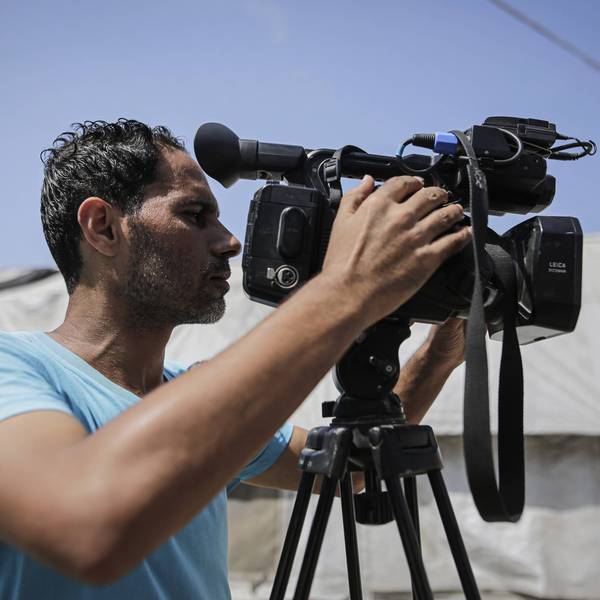
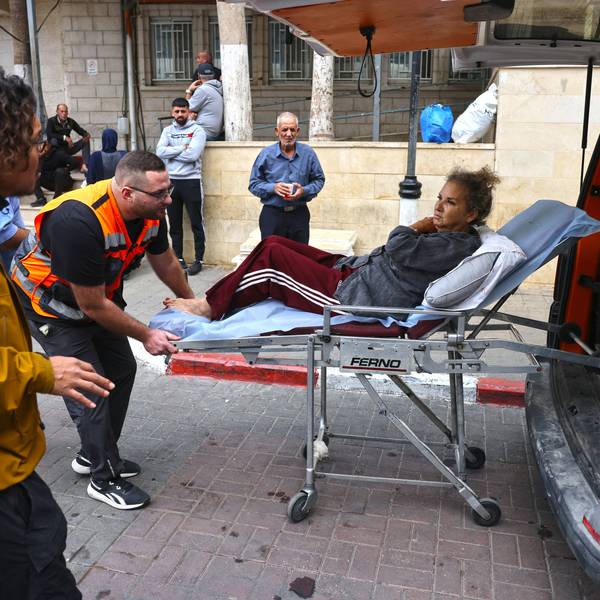
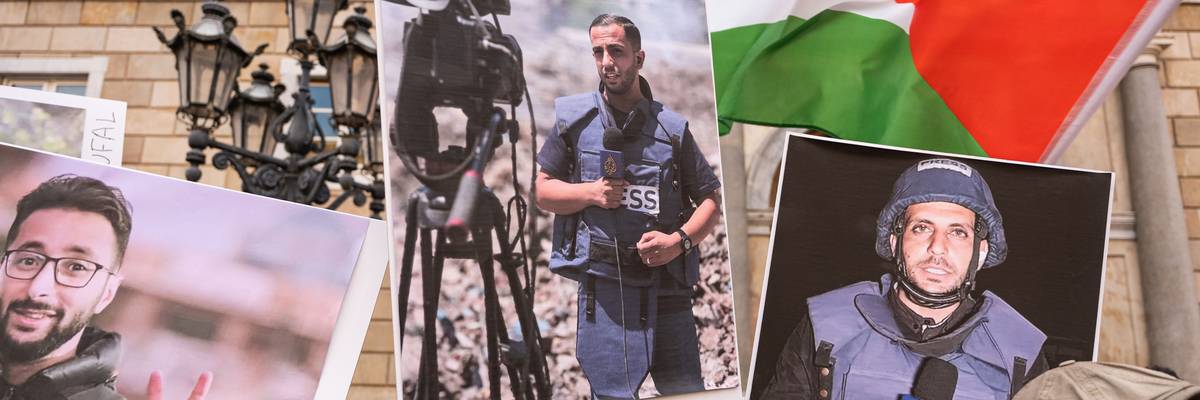
Journalists and media workers in Barcelona protest and express solidarity with the Al Jazeera journalists and cameramen killed in Gaza while resting in their tent, on August 13, 2025. Their names were Anas al-Sharif, Mohammed Qreiqeh, Ibrahim Zaher, Moamen Aliva, and Mohammed Noufal.
Israel Named Leading Killer of Journalists in 2025 for Third Straight Year
Nearly half of the worldwide reporters who lost their lives on the job this year were killed by the Israel Defense Forces in Gaza, according to Reporters Without Borders.
The report released Tuesday by the global press freedom group Reporters Without Borders provides an accounting of the killing of dozens of journalists across the globe in 2025, but nearly half of the people whose deaths are included were killed by the same group: the Israel Defense Forces.
For the third year running, as Israel's attacks on Gaza and the West Bank continue despite a ceasefire agreement reached in October in Gaza, the country was named as the top killer of journalists and media workers, having killed at least 29 Palestinian reporters this year.
Out of 67 reporters killed while doing their jobs in the past year, 43% were killed in Gaza by the IDF—called "the worst enemy of journalists" in 2025.
"Journalists do not just die—they are killed," said Reporters Without Borders, also known by its French name, Reporters sans Frontières (RSF), as it released its 2025 Round-up. "The number of murdered journalists has risen again, due to the criminal practices of military groups—both regular and paramilitary—and organized crime."
In 2025, the number of journalists killed on the job rose by one compared to 2024.
#RSFRoundUp 2025: Journalists don't die, they are killed. In 2025, the number of journalists killed rose once more.Let's continue to count, name, denounce, investigate, and ensure that justice is done. Impunity must never prevail.Watch our #RSFRoundUp2025 ⬇️
[image or embed]
— RSF (@rsf.org) December 9, 2025 at 3:10 AM
The government of Israeli Prime Minister Benjamin Netanyahu was named in RSF's report as one of the world's "Press Freedom Predators," along with Myanmar's State Security and Peace Commission—the country's de facto military government—and the Jalisco New Generation Cartel in Mexico, where at least three journalists were killed this year while they were covering drug trafficking in areas where the cartel is influential.
In the case of Netanyahu's government, reads the report "the Israeli army has carried out a massacre—unprecedented in recent
history—of the Palestinian press. To justify its crimes, the Israeli military has mounted a global propaganda campaign to spread baseless accusations that portray Palestinian journalists as terrorists."
The 29 reporters killed in Gaza this year are among more than 200 journalists killed by the IDF since it began its assault on the exclave in October 2023 in retaliation for a Hamas-led attack. According to RSF, 65 of those killed were "murdered due to their profession," and others were killed in military attacks.
The report notes the "particularly harrowing case" of two strikes that targeted a building in the al-Nasser medical complex which was "known to house a workspace for journalists" on August 25.
Reuters photographer Hossam al-Masri was killed in the first strike, and a second strike eight minutes later killed Mariam Abu Dagga of the Independent Arabia and the Associated Press, freelancer Moaz Abu Taha, and Al Jazeera photograher Mohamad Salama.
The journalists had been covering rescue operations and the impacts of other airstrikes. They were killed two weeks after an IDF strike killed five other Al Jazeera reporters and an independent journalist while they were in their tent outside al-Shifa Hospital in Gaza City.
Israel claimed one of the reporters, Anas al-Sharif, was "the head of a Hamas terrorist cell"—an allegation that was denied in independent assessments by United Nations experts, the New York-based Committee to Protect Journalists, and RSF.
The killing of the reporters and dozens of others around the world, said RSF director general Thibaut Bruttin on Tuesday, "is where the hatred of journalists leads!"
"They weren’t collateral victims," said Bruttin. "They were killed, targeted for their work. It is perfectly legitimate to criticize the media—criticism should serve as a catalyst for change that ensures the survival of the free press, a public good. But it must never descend into hatred of journalists, which is largely born out of—or deliberately stoked by—the tactics of armed forces and criminal organizations."
Palestine was named as by far the most dangerous place in the world for journalists this year, while Mexico was identified as the second-most dangerous, with nine reporters killed despite "commitments" President Claudia Sheinbaum made to RSF.
The journalists "covered local news, exposed organized crime and its links to politicians, and had received explicit death threats," reported RSF. "One of them, Calletano de Jesus Guerrero, was even under government protection when he was murdered."
Bruttin warned that "the failure of international organizations that are no longer able to ensure journalists’ right to protection in armed conflicts is the consequence of a global decline in the courage of governments, which should be implementing protective public policies."
Three journalists were killed in Ukraine in one month, targeted by Russian drone attacks even as they wore helmets and bulletproof vests that clearly identified them as members of the press. Two reporters were killed in Bangladesh in apparent retaliation for their reporting on crimes.
The report also notes that 503 journalists are detained around the world, with Israel the second-biggest jailer of foreign journalists after Russia. Twenty Palestinian reporters are currently detained by Israel, including 16 who were arrested over the past two years in the West Bank and Gaza. Just three—Alaa al-Sarraj, Emad Zakaria Badr al-Ifranji, and Shady Abu Sedo—where released as part of the ceasefire agreement in October after having been "unlawfully arrested by Israeli forces" in Gaza.
"It is our responsibility to stand alongside those who uphold our collective right to reliable information. We owe them that," wrote Bruttin. "As key witnesses to history, journalists have gradually become collateral victims, inconvenient observers, bargaining chips, pawns in diplomatic games, men and women to be eliminated. Let us be wary of false notions about reporters: No one gives their life for journalism—it is taken from them."
We are at a crossroads
This country and this world are at a monumental crossroads. In a few short weeks, US voters will have an opportunity to beat back the forces of fascism and confront the billionaires who are rigging the economy, our media system, and our democracy, making it increasingly impossible for ordinary people to get by. We’re not just talking about the election. We’re talking about what must be done once these fascist elements are vanquished from power. We need a bolder set of solutions than what either major party has so far been willing to offer and a working-class movement ready to fight like hell for it. Trump didn't emerge from nowhere. The conditions that fueled MAGA authoritarianism were created by decades of radical neoliberal economic policies and a corrupt political system dominated by corporate interests. They slashed taxes on the super-rich, promising that the benefits would trickle down. They said giveaways to the corporate titans would make life more affordable for the rest of us. It was all bullshit. And when a bitter, betrayed populace searches for someone to blame, right-wing demagogues have little trouble finding scapegoats. People know when they're being lied to, but you won't hear any of this from the corporate media. Only independent journalism—powered and funded by people who believe in building a better world—can deliver truly trustworthy daily news. Our Fall Campaign is underway, and we need your help. To power our newsroom through the rest of the year, we need to raise $125,000 by midnight on October 31. So if you share our vision, please contribute whatever you can to sustain our work. |
The report released Tuesday by the global press freedom group Reporters Without Borders provides an accounting of the killing of dozens of journalists across the globe in 2025, but nearly half of the people whose deaths are included were killed by the same group: the Israel Defense Forces.
For the third year running, as Israel's attacks on Gaza and the West Bank continue despite a ceasefire agreement reached in October in Gaza, the country was named as the top killer of journalists and media workers, having killed at least 29 Palestinian reporters this year.
Out of 67 reporters killed while doing their jobs in the past year, 43% were killed in Gaza by the IDF—called "the worst enemy of journalists" in 2025.
"Journalists do not just die—they are killed," said Reporters Without Borders, also known by its French name, Reporters sans Frontières (RSF), as it released its 2025 Round-up. "The number of murdered journalists has risen again, due to the criminal practices of military groups—both regular and paramilitary—and organized crime."
In 2025, the number of journalists killed on the job rose by one compared to 2024.
#RSFRoundUp 2025: Journalists don't die, they are killed. In 2025, the number of journalists killed rose once more.Let's continue to count, name, denounce, investigate, and ensure that justice is done. Impunity must never prevail.Watch our #RSFRoundUp2025 ⬇️
[image or embed]
— RSF (@rsf.org) December 9, 2025 at 3:10 AM
The government of Israeli Prime Minister Benjamin Netanyahu was named in RSF's report as one of the world's "Press Freedom Predators," along with Myanmar's State Security and Peace Commission—the country's de facto military government—and the Jalisco New Generation Cartel in Mexico, where at least three journalists were killed this year while they were covering drug trafficking in areas where the cartel is influential.
In the case of Netanyahu's government, reads the report "the Israeli army has carried out a massacre—unprecedented in recent
history—of the Palestinian press. To justify its crimes, the Israeli military has mounted a global propaganda campaign to spread baseless accusations that portray Palestinian journalists as terrorists."
The 29 reporters killed in Gaza this year are among more than 200 journalists killed by the IDF since it began its assault on the exclave in October 2023 in retaliation for a Hamas-led attack. According to RSF, 65 of those killed were "murdered due to their profession," and others were killed in military attacks.
The report notes the "particularly harrowing case" of two strikes that targeted a building in the al-Nasser medical complex which was "known to house a workspace for journalists" on August 25.
Reuters photographer Hossam al-Masri was killed in the first strike, and a second strike eight minutes later killed Mariam Abu Dagga of the Independent Arabia and the Associated Press, freelancer Moaz Abu Taha, and Al Jazeera photograher Mohamad Salama.
The journalists had been covering rescue operations and the impacts of other airstrikes. They were killed two weeks after an IDF strike killed five other Al Jazeera reporters and an independent journalist while they were in their tent outside al-Shifa Hospital in Gaza City.
Israel claimed one of the reporters, Anas al-Sharif, was "the head of a Hamas terrorist cell"—an allegation that was denied in independent assessments by United Nations experts, the New York-based Committee to Protect Journalists, and RSF.
The killing of the reporters and dozens of others around the world, said RSF director general Thibaut Bruttin on Tuesday, "is where the hatred of journalists leads!"
"They weren’t collateral victims," said Bruttin. "They were killed, targeted for their work. It is perfectly legitimate to criticize the media—criticism should serve as a catalyst for change that ensures the survival of the free press, a public good. But it must never descend into hatred of journalists, which is largely born out of—or deliberately stoked by—the tactics of armed forces and criminal organizations."
Palestine was named as by far the most dangerous place in the world for journalists this year, while Mexico was identified as the second-most dangerous, with nine reporters killed despite "commitments" President Claudia Sheinbaum made to RSF.
The journalists "covered local news, exposed organized crime and its links to politicians, and had received explicit death threats," reported RSF. "One of them, Calletano de Jesus Guerrero, was even under government protection when he was murdered."
Bruttin warned that "the failure of international organizations that are no longer able to ensure journalists’ right to protection in armed conflicts is the consequence of a global decline in the courage of governments, which should be implementing protective public policies."
Three journalists were killed in Ukraine in one month, targeted by Russian drone attacks even as they wore helmets and bulletproof vests that clearly identified them as members of the press. Two reporters were killed in Bangladesh in apparent retaliation for their reporting on crimes.
The report also notes that 503 journalists are detained around the world, with Israel the second-biggest jailer of foreign journalists after Russia. Twenty Palestinian reporters are currently detained by Israel, including 16 who were arrested over the past two years in the West Bank and Gaza. Just three—Alaa al-Sarraj, Emad Zakaria Badr al-Ifranji, and Shady Abu Sedo—where released as part of the ceasefire agreement in October after having been "unlawfully arrested by Israeli forces" in Gaza.
"It is our responsibility to stand alongside those who uphold our collective right to reliable information. We owe them that," wrote Bruttin. "As key witnesses to history, journalists have gradually become collateral victims, inconvenient observers, bargaining chips, pawns in diplomatic games, men and women to be eliminated. Let us be wary of false notions about reporters: No one gives their life for journalism—it is taken from them."
- Gaza Journalists Killed by Israel Honored on World Press Freedom Day ›
- 'We'll Come for You Next': Israel Threatened to Kill Teen Journalist in Gaza—Then Did ›
- 'Everything Is Being Crushed': Journalist Hossam Shabat's Last Story Before He Was Killed by Israel ›
- Israel Responsible for Two-Thirds of Journalist Deaths in 2025: Press Freedom Group | Common Dreams ›
The report released Tuesday by the global press freedom group Reporters Without Borders provides an accounting of the killing of dozens of journalists across the globe in 2025, but nearly half of the people whose deaths are included were killed by the same group: the Israel Defense Forces.
For the third year running, as Israel's attacks on Gaza and the West Bank continue despite a ceasefire agreement reached in October in Gaza, the country was named as the top killer of journalists and media workers, having killed at least 29 Palestinian reporters this year.
Out of 67 reporters killed while doing their jobs in the past year, 43% were killed in Gaza by the IDF—called "the worst enemy of journalists" in 2025.
"Journalists do not just die—they are killed," said Reporters Without Borders, also known by its French name, Reporters sans Frontières (RSF), as it released its 2025 Round-up. "The number of murdered journalists has risen again, due to the criminal practices of military groups—both regular and paramilitary—and organized crime."
In 2025, the number of journalists killed on the job rose by one compared to 2024.
#RSFRoundUp 2025: Journalists don't die, they are killed. In 2025, the number of journalists killed rose once more.Let's continue to count, name, denounce, investigate, and ensure that justice is done. Impunity must never prevail.Watch our #RSFRoundUp2025 ⬇️
[image or embed]
— RSF (@rsf.org) December 9, 2025 at 3:10 AM
The government of Israeli Prime Minister Benjamin Netanyahu was named in RSF's report as one of the world's "Press Freedom Predators," along with Myanmar's State Security and Peace Commission—the country's de facto military government—and the Jalisco New Generation Cartel in Mexico, where at least three journalists were killed this year while they were covering drug trafficking in areas where the cartel is influential.
In the case of Netanyahu's government, reads the report "the Israeli army has carried out a massacre—unprecedented in recent
history—of the Palestinian press. To justify its crimes, the Israeli military has mounted a global propaganda campaign to spread baseless accusations that portray Palestinian journalists as terrorists."
The 29 reporters killed in Gaza this year are among more than 200 journalists killed by the IDF since it began its assault on the exclave in October 2023 in retaliation for a Hamas-led attack. According to RSF, 65 of those killed were "murdered due to their profession," and others were killed in military attacks.
The report notes the "particularly harrowing case" of two strikes that targeted a building in the al-Nasser medical complex which was "known to house a workspace for journalists" on August 25.
Reuters photographer Hossam al-Masri was killed in the first strike, and a second strike eight minutes later killed Mariam Abu Dagga of the Independent Arabia and the Associated Press, freelancer Moaz Abu Taha, and Al Jazeera photograher Mohamad Salama.
The journalists had been covering rescue operations and the impacts of other airstrikes. They were killed two weeks after an IDF strike killed five other Al Jazeera reporters and an independent journalist while they were in their tent outside al-Shifa Hospital in Gaza City.
Israel claimed one of the reporters, Anas al-Sharif, was "the head of a Hamas terrorist cell"—an allegation that was denied in independent assessments by United Nations experts, the New York-based Committee to Protect Journalists, and RSF.
The killing of the reporters and dozens of others around the world, said RSF director general Thibaut Bruttin on Tuesday, "is where the hatred of journalists leads!"
"They weren’t collateral victims," said Bruttin. "They were killed, targeted for their work. It is perfectly legitimate to criticize the media—criticism should serve as a catalyst for change that ensures the survival of the free press, a public good. But it must never descend into hatred of journalists, which is largely born out of—or deliberately stoked by—the tactics of armed forces and criminal organizations."
Palestine was named as by far the most dangerous place in the world for journalists this year, while Mexico was identified as the second-most dangerous, with nine reporters killed despite "commitments" President Claudia Sheinbaum made to RSF.
The journalists "covered local news, exposed organized crime and its links to politicians, and had received explicit death threats," reported RSF. "One of them, Calletano de Jesus Guerrero, was even under government protection when he was murdered."
Bruttin warned that "the failure of international organizations that are no longer able to ensure journalists’ right to protection in armed conflicts is the consequence of a global decline in the courage of governments, which should be implementing protective public policies."
Three journalists were killed in Ukraine in one month, targeted by Russian drone attacks even as they wore helmets and bulletproof vests that clearly identified them as members of the press. Two reporters were killed in Bangladesh in apparent retaliation for their reporting on crimes.
The report also notes that 503 journalists are detained around the world, with Israel the second-biggest jailer of foreign journalists after Russia. Twenty Palestinian reporters are currently detained by Israel, including 16 who were arrested over the past two years in the West Bank and Gaza. Just three—Alaa al-Sarraj, Emad Zakaria Badr al-Ifranji, and Shady Abu Sedo—where released as part of the ceasefire agreement in October after having been "unlawfully arrested by Israeli forces" in Gaza.
"It is our responsibility to stand alongside those who uphold our collective right to reliable information. We owe them that," wrote Bruttin. "As key witnesses to history, journalists have gradually become collateral victims, inconvenient observers, bargaining chips, pawns in diplomatic games, men and women to be eliminated. Let us be wary of false notions about reporters: No one gives their life for journalism—it is taken from them."
- Gaza Journalists Killed by Israel Honored on World Press Freedom Day ›
- 'We'll Come for You Next': Israel Threatened to Kill Teen Journalist in Gaza—Then Did ›
- 'Everything Is Being Crushed': Journalist Hossam Shabat's Last Story Before He Was Killed by Israel ›
- Israel Responsible for Two-Thirds of Journalist Deaths in 2025: Press Freedom Group | Common Dreams ›