SUBSCRIBE TO OUR FREE NEWSLETTER
Daily news & progressive opinion—funded by the people, not the corporations—delivered straight to your inbox.
5
#000000
#FFFFFF
To donate by check, phone, or other method, see our More Ways to Give page.
Daily news & progressive opinion—funded by the people, not the corporations—delivered straight to your inbox.
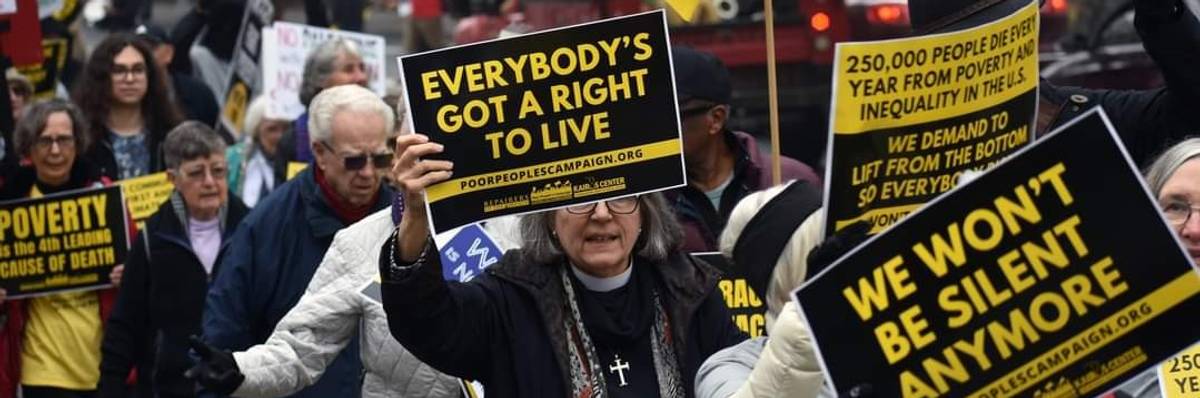
Members of the Poor People’s Campaign march in Georgia.
What we really need is to renew, expand, and cut red tape for those programs that are proven to keep people above water.
Things don’t always work out the way you expect. I’ve gotten to mix with celebrities and travel to the other side of the world. But I’m also a single mother who’s experienced health crises, homelessness, and food insecurity.
What I’ve learned is we need public policies that look out for people no matter where they live, what they look like, or how much money they have.
I’m from Georgia, where Tyler Perry headquarters his media empire. I went to college to study theater and film and started getting roles as an extra on Perry’s productions. I was eventually hired as a casting assistant.
When it comes to people who struggle financially, some say it’s our fault—that we’re lazy, weak, that we deserve to be poor. It’s not true.
I felt that I was going somewhere. But then I began to get seizures, and my kidneys malfunctioned. The doctors thought it was likely lupus and fibromyalgia. I couldn’t continue to work—and on top of that, I was pregnant with my first child.
After my child was born, I began taking medication, felt better for a while, and worked toward becoming a teacher. I even got a job teaching English in China. But when my child’s father threatened to sue for custody if I brought our daughter to be with me, I had to give that up and return to Georgia.
When it comes to people who struggle financially, some say it’s our fault—that we’re lazy, weak, that we deserve to be poor. It’s not true—I’m a strong, hard-working, well-educated survivor. But when you’re a single mother with serious health issues, you quickly run out of options for jobs that pay well.
I’m hardly alone. According to the Poor People’s Campaign, there are 140 million poor and low-income people in this country—including about 4.5 million here in Georgia. In fact, we’re about 43% of the population both in the state and nationally.
To meet our basic needs, a household with two adults and two children needs to earn over $23 an hour. But Georgia’s minimum wage is just $7.25. At this wage, I’d have to work 116 hours a week just to afford a modest two-bedroom apartment. (There are only 168 hours in an entire week.)
That’s why the safety net is so important.
Thankfully, I was able to access the Supplemental Nutrition Assistance Program (SNAP, also known as “food stamps”) and Medicaid, which were lifelines. During the pandemic, the expanded Child Tax Credit also allowed me to meet my family’s needs—and even save a little.
But as pandemic programs wound down, I lost those expanded Child Tax Credit payments, our extra SNAP benefits, and nearly our health coverage too thanks to onerous read tape, even though we qualify for Medicaid.
Last year, after being on the waiting list for two years for a Section 8 housing voucher, I was finally able to start the process of getting a place to live. But even now there are layers of approval that can take months to complete. I’m still waiting.
In times like these, neighbors look out for each other. But there’s only so much people can do on their own. With the need so high here in Georgia, the food banks have less to share—and what they do have is primarily dried beans and old bread.
What we really need is to renew, expand, and cut red tape for those safety net programs that are proven to keep people above water. And we need to work together to get it.
I received a flyer about a meeting of the Georgia Chapter of the Poor People’s Campaign and I attended. I felt so empowered that I’m now one of the Tri-Chairs for the Georgia Chapter.
I’m helping to see that the nearly 2.5 million poor and low-income voters here make it to the polls to back candidates who support a living wage, a healthy safety net, and other policies to help us meet our families’ basic needs.
I hope you’ll join where you live. Together we’ll make a difference.
Dear Common Dreams reader, It’s been nearly 30 years since I co-founded Common Dreams with my late wife, Lina Newhouser. We had the radical notion that journalism should serve the public good, not corporate profits. It was clear to us from the outset what it would take to build such a project. No paid advertisements. No corporate sponsors. No millionaire publisher telling us what to think or do. Many people said we wouldn't last a year, but we proved those doubters wrong. Together with a tremendous team of journalists and dedicated staff, we built an independent media outlet free from the constraints of profits and corporate control. Our mission has always been simple: To inform. To inspire. To ignite change for the common good. Building Common Dreams was not easy. Our survival was never guaranteed. When you take on the most powerful forces—Wall Street greed, fossil fuel industry destruction, Big Tech lobbyists, and uber-rich oligarchs who have spent billions upon billions rigging the economy and democracy in their favor—the only bulwark you have is supporters who believe in your work. But here’s the urgent message from me today. It's never been this bad out there. And it's never been this hard to keep us going. At the very moment Common Dreams is most needed, the threats we face are intensifying. We need your support now more than ever. We don't accept corporate advertising and never will. We don't have a paywall because we don't think people should be blocked from critical news based on their ability to pay. Everything we do is funded by the donations of readers like you. When everyone does the little they can afford, we are strong. But if that support retreats or dries up, so do we. Will you donate now to make sure Common Dreams not only survives but thrives? —Craig Brown, Co-founder |
Things don’t always work out the way you expect. I’ve gotten to mix with celebrities and travel to the other side of the world. But I’m also a single mother who’s experienced health crises, homelessness, and food insecurity.
What I’ve learned is we need public policies that look out for people no matter where they live, what they look like, or how much money they have.
I’m from Georgia, where Tyler Perry headquarters his media empire. I went to college to study theater and film and started getting roles as an extra on Perry’s productions. I was eventually hired as a casting assistant.
When it comes to people who struggle financially, some say it’s our fault—that we’re lazy, weak, that we deserve to be poor. It’s not true.
I felt that I was going somewhere. But then I began to get seizures, and my kidneys malfunctioned. The doctors thought it was likely lupus and fibromyalgia. I couldn’t continue to work—and on top of that, I was pregnant with my first child.
After my child was born, I began taking medication, felt better for a while, and worked toward becoming a teacher. I even got a job teaching English in China. But when my child’s father threatened to sue for custody if I brought our daughter to be with me, I had to give that up and return to Georgia.
When it comes to people who struggle financially, some say it’s our fault—that we’re lazy, weak, that we deserve to be poor. It’s not true—I’m a strong, hard-working, well-educated survivor. But when you’re a single mother with serious health issues, you quickly run out of options for jobs that pay well.
I’m hardly alone. According to the Poor People’s Campaign, there are 140 million poor and low-income people in this country—including about 4.5 million here in Georgia. In fact, we’re about 43% of the population both in the state and nationally.
To meet our basic needs, a household with two adults and two children needs to earn over $23 an hour. But Georgia’s minimum wage is just $7.25. At this wage, I’d have to work 116 hours a week just to afford a modest two-bedroom apartment. (There are only 168 hours in an entire week.)
That’s why the safety net is so important.
Thankfully, I was able to access the Supplemental Nutrition Assistance Program (SNAP, also known as “food stamps”) and Medicaid, which were lifelines. During the pandemic, the expanded Child Tax Credit also allowed me to meet my family’s needs—and even save a little.
But as pandemic programs wound down, I lost those expanded Child Tax Credit payments, our extra SNAP benefits, and nearly our health coverage too thanks to onerous read tape, even though we qualify for Medicaid.
Last year, after being on the waiting list for two years for a Section 8 housing voucher, I was finally able to start the process of getting a place to live. But even now there are layers of approval that can take months to complete. I’m still waiting.
In times like these, neighbors look out for each other. But there’s only so much people can do on their own. With the need so high here in Georgia, the food banks have less to share—and what they do have is primarily dried beans and old bread.
What we really need is to renew, expand, and cut red tape for those safety net programs that are proven to keep people above water. And we need to work together to get it.
I received a flyer about a meeting of the Georgia Chapter of the Poor People’s Campaign and I attended. I felt so empowered that I’m now one of the Tri-Chairs for the Georgia Chapter.
I’m helping to see that the nearly 2.5 million poor and low-income voters here make it to the polls to back candidates who support a living wage, a healthy safety net, and other policies to help us meet our families’ basic needs.
I hope you’ll join where you live. Together we’ll make a difference.
Things don’t always work out the way you expect. I’ve gotten to mix with celebrities and travel to the other side of the world. But I’m also a single mother who’s experienced health crises, homelessness, and food insecurity.
What I’ve learned is we need public policies that look out for people no matter where they live, what they look like, or how much money they have.
I’m from Georgia, where Tyler Perry headquarters his media empire. I went to college to study theater and film and started getting roles as an extra on Perry’s productions. I was eventually hired as a casting assistant.
When it comes to people who struggle financially, some say it’s our fault—that we’re lazy, weak, that we deserve to be poor. It’s not true.
I felt that I was going somewhere. But then I began to get seizures, and my kidneys malfunctioned. The doctors thought it was likely lupus and fibromyalgia. I couldn’t continue to work—and on top of that, I was pregnant with my first child.
After my child was born, I began taking medication, felt better for a while, and worked toward becoming a teacher. I even got a job teaching English in China. But when my child’s father threatened to sue for custody if I brought our daughter to be with me, I had to give that up and return to Georgia.
When it comes to people who struggle financially, some say it’s our fault—that we’re lazy, weak, that we deserve to be poor. It’s not true—I’m a strong, hard-working, well-educated survivor. But when you’re a single mother with serious health issues, you quickly run out of options for jobs that pay well.
I’m hardly alone. According to the Poor People’s Campaign, there are 140 million poor and low-income people in this country—including about 4.5 million here in Georgia. In fact, we’re about 43% of the population both in the state and nationally.
To meet our basic needs, a household with two adults and two children needs to earn over $23 an hour. But Georgia’s minimum wage is just $7.25. At this wage, I’d have to work 116 hours a week just to afford a modest two-bedroom apartment. (There are only 168 hours in an entire week.)
That’s why the safety net is so important.
Thankfully, I was able to access the Supplemental Nutrition Assistance Program (SNAP, also known as “food stamps”) and Medicaid, which were lifelines. During the pandemic, the expanded Child Tax Credit also allowed me to meet my family’s needs—and even save a little.
But as pandemic programs wound down, I lost those expanded Child Tax Credit payments, our extra SNAP benefits, and nearly our health coverage too thanks to onerous read tape, even though we qualify for Medicaid.
Last year, after being on the waiting list for two years for a Section 8 housing voucher, I was finally able to start the process of getting a place to live. But even now there are layers of approval that can take months to complete. I’m still waiting.
In times like these, neighbors look out for each other. But there’s only so much people can do on their own. With the need so high here in Georgia, the food banks have less to share—and what they do have is primarily dried beans and old bread.
What we really need is to renew, expand, and cut red tape for those safety net programs that are proven to keep people above water. And we need to work together to get it.
I received a flyer about a meeting of the Georgia Chapter of the Poor People’s Campaign and I attended. I felt so empowered that I’m now one of the Tri-Chairs for the Georgia Chapter.
I’m helping to see that the nearly 2.5 million poor and low-income voters here make it to the polls to back candidates who support a living wage, a healthy safety net, and other policies to help us meet our families’ basic needs.
I hope you’ll join where you live. Together we’ll make a difference.