SUBSCRIBE TO OUR FREE NEWSLETTER
Daily news & progressive opinion—funded by the people, not the corporations—delivered straight to your inbox.
5
#000000
#FFFFFF
To donate by check, phone, or other method, see our More Ways to Give page.
Daily news & progressive opinion—funded by the people, not the corporations—delivered straight to your inbox.
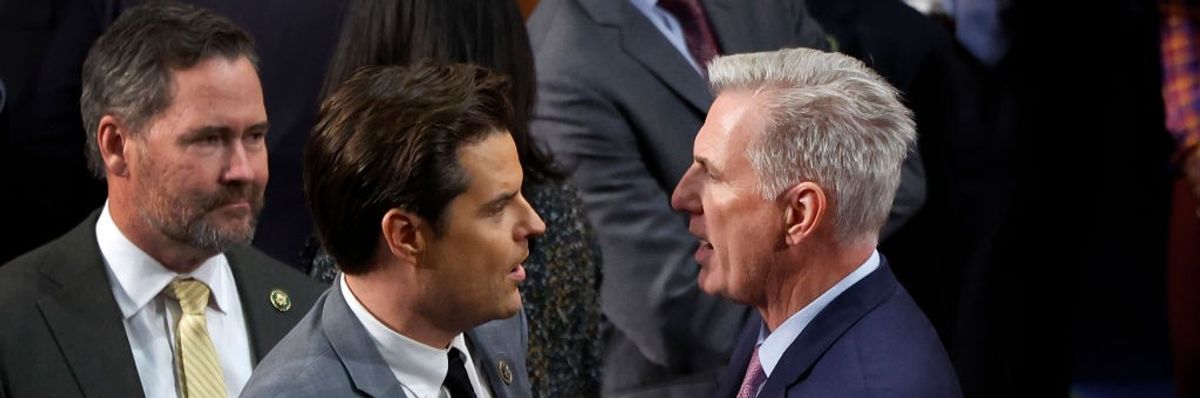
U.S. House Republican Leader Kevin McCarthy (R-Calif.) talks to Rep. Matt Gaetz (R-Fla.) in the House Chamber after Gaetz voted present during the fourth day of voting for Speaker of the House at the U.S. Capitol Building on January 06, 2023 in Washington, DC.
No one who actually wants to reduce the federal deficit should be looking to do that on the backs of the poorest and most vulnerable Americans.
This week, Speaker of the House Kevin McCarthy plans to hold a vote on a bill that would raise the nation’s debt limit, but only in conjunction with extraordinarily steep spending cuts and new barriers to accessing income support programs. This is the next milestone in House Republicans’ attempt to play a game of dangerous political brinkmanship with the U.S. economy, trying to force through harmful and deeply unpopular federal spending cuts in exchange for increasing the debt limit. This approach recklessly flirts with bringing on the economic catastrophe of a government default in the short term.
Speaker McCarthy’s proposal would slash spending across federal programs for the next decade, cutting federal resources for everything from child care programs to environmental protection safeguards. If these deeply unrealistic spending cuts actually came to pass, the human toll would be enormous, and economic growth would be deeply damaged.
The McCarthy proposal also resurfaces a completely inaccurate but alarmingly persistent conservative claim: the idea that government anti-poverty programs are unnecessarily generous, bloated, and are keeping people out of the workforce who should otherwise be supporting themselves entirely through income earned in the labor market. The proposal seeks to severely restrict access to Medicaid health coverage and food stamps by imposing onerous requirements to prove that recipients are working or looking for work. Past evidence about these types of burdensome reporting requirements shows clearly that they will not actually lead to increased employment but will deprive vulnerable families of vital support.
The implicit claim that the U.S. labor market is hobbled by a too-generous welfare state is awfully hard to see in the data. Job growth in 2021 and 2022 hit its highest two-year stretch in the nation’s history. The unemployment rate is currently at a near-historic low. The prime-age employment-to-population ratio hit its highest point in March 2023 in more than 20 years. In general, many low-wage workers have seen the benefits of a tight labor market in the pandemic recovery, as employers have raised wages to attract and retain workers. In short, when jobs are available, workers have rushed to fill them. And while food assistance programs and other safety net supports are a vital lifeline to keep many out of poverty, the benefits are nowhere near enough on their own to fully support the cost of living for many families. Where has the idea come from that there’s an urgent need to address these supposedly too-comfortable benefits keeping people out of the workforce?
The premise of adding more onerous work and reporting requirements is also based on an inaccurate picture of who currently receives federal assistance through these programs. As the Center on Budget and Policy Priorities recently noted, nearly two-thirds of adults with Medicaid already work. Since the early 2000s, many safety net and income support programs have actually shifted toward requiring proof that recipients are also working or looking for work, but the gains of this shift have been near-impossible to see in terms of increased employment. Since 1990, all new investments in safety net spending have gone toward families with at least some labor market earnings. Those who are unable to find or do work under the current requirements are already in extremely difficult circumstances, and taking away the few safety net supports they have available would be economically devastating.
Those who are unable to find or do work under the current requirements are already in extremely difficult circumstances, and taking away the few safety net supports they have available would be economically devastating.
The U.S. safety net is in serious need of reforms, but not because of inaccurate claims that its excess generosity keeps people out of work. Public spending in the United States as a share of GDP is extremely low relative to other rich nations, and we spend far less to fight poverty than other comparatively wealthy countries. Low-income people already spend a ridiculous amount of energy attempting to prove and maintain their eligibility for these modest supports.
Burdensome work reporting requirements are about making the benefits system more sluggish and difficult to access, and do nothing to boost employment. Existing reporting requirements already impose too-high a bureaucratic burden to accessing needed help. Passing these more burdensome requirements being called for by Speaker McCarthy would require people in need of assistance to devote even more of their bandwidth to dealing with forms and make-work bureaucratic tasks, rather than spending that time and energy looking for good work in meaningful and productive ways. The solution should be to reduce the amount of “means-testing” required and to make programs more readily accessible, not to restrict them further.
The biggest problem with the U.S. safety net is that our programs don’t help as many people, or as effectively, as they should.
Further, Speaker McCarthy’s claims that this proposal would put the United States on a path to “fiscal responsibility” and lower inflation are laughable. The biggest driver of deficits for the last 20 years has been a steady trend toward ever-larger tax cuts for corporations and the richest U.S. households. No one who actually wants to reduce the federal deficit should be looking to do that on the backs of the poorest and most vulnerable Americans.
The strongest “incentive” that people have to enter or reenter the workforce already exists—they need income to survive and provide for themselves and their families. If they’re not already working but want to, there is likely a very good reason. Many people simply can’t afford or access quality child care, or quality care for other family members, and need to take on those responsibilities themselves rather than entering the paid workforce. People with disabilities may struggle to find jobs that accommodate their needs appropriately, or that provide adequate health coverage. Many can’t find jobs with the fair and predictable scheduling they need. Others may stay out of the workforce because of a persistent lack of economic opportunities available in their neighborhoods, towns, or cities—a lack of opportunity often caused by systemic public and private disinvestment in communities of color or rural areas.
Any policymaker serious about getting people who want to work into the workforce should be looking to address these problems, rather than taking away lifelines to food and health care.
Dear Common Dreams reader, It’s been nearly 30 years since I co-founded Common Dreams with my late wife, Lina Newhouser. We had the radical notion that journalism should serve the public good, not corporate profits. It was clear to us from the outset what it would take to build such a project. No paid advertisements. No corporate sponsors. No millionaire publisher telling us what to think or do. Many people said we wouldn't last a year, but we proved those doubters wrong. Together with a tremendous team of journalists and dedicated staff, we built an independent media outlet free from the constraints of profits and corporate control. Our mission has always been simple: To inform. To inspire. To ignite change for the common good. Building Common Dreams was not easy. Our survival was never guaranteed. When you take on the most powerful forces—Wall Street greed, fossil fuel industry destruction, Big Tech lobbyists, and uber-rich oligarchs who have spent billions upon billions rigging the economy and democracy in their favor—the only bulwark you have is supporters who believe in your work. But here’s the urgent message from me today. It's never been this bad out there. And it's never been this hard to keep us going. At the very moment Common Dreams is most needed, the threats we face are intensifying. We need your support now more than ever. We don't accept corporate advertising and never will. We don't have a paywall because we don't think people should be blocked from critical news based on their ability to pay. Everything we do is funded by the donations of readers like you. When everyone does the little they can afford, we are strong. But if that support retreats or dries up, so do we. Will you donate now to make sure Common Dreams not only survives but thrives? —Craig Brown, Co-founder |
This week, Speaker of the House Kevin McCarthy plans to hold a vote on a bill that would raise the nation’s debt limit, but only in conjunction with extraordinarily steep spending cuts and new barriers to accessing income support programs. This is the next milestone in House Republicans’ attempt to play a game of dangerous political brinkmanship with the U.S. economy, trying to force through harmful and deeply unpopular federal spending cuts in exchange for increasing the debt limit. This approach recklessly flirts with bringing on the economic catastrophe of a government default in the short term.
Speaker McCarthy’s proposal would slash spending across federal programs for the next decade, cutting federal resources for everything from child care programs to environmental protection safeguards. If these deeply unrealistic spending cuts actually came to pass, the human toll would be enormous, and economic growth would be deeply damaged.
The McCarthy proposal also resurfaces a completely inaccurate but alarmingly persistent conservative claim: the idea that government anti-poverty programs are unnecessarily generous, bloated, and are keeping people out of the workforce who should otherwise be supporting themselves entirely through income earned in the labor market. The proposal seeks to severely restrict access to Medicaid health coverage and food stamps by imposing onerous requirements to prove that recipients are working or looking for work. Past evidence about these types of burdensome reporting requirements shows clearly that they will not actually lead to increased employment but will deprive vulnerable families of vital support.
The implicit claim that the U.S. labor market is hobbled by a too-generous welfare state is awfully hard to see in the data. Job growth in 2021 and 2022 hit its highest two-year stretch in the nation’s history. The unemployment rate is currently at a near-historic low. The prime-age employment-to-population ratio hit its highest point in March 2023 in more than 20 years. In general, many low-wage workers have seen the benefits of a tight labor market in the pandemic recovery, as employers have raised wages to attract and retain workers. In short, when jobs are available, workers have rushed to fill them. And while food assistance programs and other safety net supports are a vital lifeline to keep many out of poverty, the benefits are nowhere near enough on their own to fully support the cost of living for many families. Where has the idea come from that there’s an urgent need to address these supposedly too-comfortable benefits keeping people out of the workforce?
The premise of adding more onerous work and reporting requirements is also based on an inaccurate picture of who currently receives federal assistance through these programs. As the Center on Budget and Policy Priorities recently noted, nearly two-thirds of adults with Medicaid already work. Since the early 2000s, many safety net and income support programs have actually shifted toward requiring proof that recipients are also working or looking for work, but the gains of this shift have been near-impossible to see in terms of increased employment. Since 1990, all new investments in safety net spending have gone toward families with at least some labor market earnings. Those who are unable to find or do work under the current requirements are already in extremely difficult circumstances, and taking away the few safety net supports they have available would be economically devastating.
Those who are unable to find or do work under the current requirements are already in extremely difficult circumstances, and taking away the few safety net supports they have available would be economically devastating.
The U.S. safety net is in serious need of reforms, but not because of inaccurate claims that its excess generosity keeps people out of work. Public spending in the United States as a share of GDP is extremely low relative to other rich nations, and we spend far less to fight poverty than other comparatively wealthy countries. Low-income people already spend a ridiculous amount of energy attempting to prove and maintain their eligibility for these modest supports.
Burdensome work reporting requirements are about making the benefits system more sluggish and difficult to access, and do nothing to boost employment. Existing reporting requirements already impose too-high a bureaucratic burden to accessing needed help. Passing these more burdensome requirements being called for by Speaker McCarthy would require people in need of assistance to devote even more of their bandwidth to dealing with forms and make-work bureaucratic tasks, rather than spending that time and energy looking for good work in meaningful and productive ways. The solution should be to reduce the amount of “means-testing” required and to make programs more readily accessible, not to restrict them further.
The biggest problem with the U.S. safety net is that our programs don’t help as many people, or as effectively, as they should.
Further, Speaker McCarthy’s claims that this proposal would put the United States on a path to “fiscal responsibility” and lower inflation are laughable. The biggest driver of deficits for the last 20 years has been a steady trend toward ever-larger tax cuts for corporations and the richest U.S. households. No one who actually wants to reduce the federal deficit should be looking to do that on the backs of the poorest and most vulnerable Americans.
The strongest “incentive” that people have to enter or reenter the workforce already exists—they need income to survive and provide for themselves and their families. If they’re not already working but want to, there is likely a very good reason. Many people simply can’t afford or access quality child care, or quality care for other family members, and need to take on those responsibilities themselves rather than entering the paid workforce. People with disabilities may struggle to find jobs that accommodate their needs appropriately, or that provide adequate health coverage. Many can’t find jobs with the fair and predictable scheduling they need. Others may stay out of the workforce because of a persistent lack of economic opportunities available in their neighborhoods, towns, or cities—a lack of opportunity often caused by systemic public and private disinvestment in communities of color or rural areas.
Any policymaker serious about getting people who want to work into the workforce should be looking to address these problems, rather than taking away lifelines to food and health care.
This week, Speaker of the House Kevin McCarthy plans to hold a vote on a bill that would raise the nation’s debt limit, but only in conjunction with extraordinarily steep spending cuts and new barriers to accessing income support programs. This is the next milestone in House Republicans’ attempt to play a game of dangerous political brinkmanship with the U.S. economy, trying to force through harmful and deeply unpopular federal spending cuts in exchange for increasing the debt limit. This approach recklessly flirts with bringing on the economic catastrophe of a government default in the short term.
Speaker McCarthy’s proposal would slash spending across federal programs for the next decade, cutting federal resources for everything from child care programs to environmental protection safeguards. If these deeply unrealistic spending cuts actually came to pass, the human toll would be enormous, and economic growth would be deeply damaged.
The McCarthy proposal also resurfaces a completely inaccurate but alarmingly persistent conservative claim: the idea that government anti-poverty programs are unnecessarily generous, bloated, and are keeping people out of the workforce who should otherwise be supporting themselves entirely through income earned in the labor market. The proposal seeks to severely restrict access to Medicaid health coverage and food stamps by imposing onerous requirements to prove that recipients are working or looking for work. Past evidence about these types of burdensome reporting requirements shows clearly that they will not actually lead to increased employment but will deprive vulnerable families of vital support.
The implicit claim that the U.S. labor market is hobbled by a too-generous welfare state is awfully hard to see in the data. Job growth in 2021 and 2022 hit its highest two-year stretch in the nation’s history. The unemployment rate is currently at a near-historic low. The prime-age employment-to-population ratio hit its highest point in March 2023 in more than 20 years. In general, many low-wage workers have seen the benefits of a tight labor market in the pandemic recovery, as employers have raised wages to attract and retain workers. In short, when jobs are available, workers have rushed to fill them. And while food assistance programs and other safety net supports are a vital lifeline to keep many out of poverty, the benefits are nowhere near enough on their own to fully support the cost of living for many families. Where has the idea come from that there’s an urgent need to address these supposedly too-comfortable benefits keeping people out of the workforce?
The premise of adding more onerous work and reporting requirements is also based on an inaccurate picture of who currently receives federal assistance through these programs. As the Center on Budget and Policy Priorities recently noted, nearly two-thirds of adults with Medicaid already work. Since the early 2000s, many safety net and income support programs have actually shifted toward requiring proof that recipients are also working or looking for work, but the gains of this shift have been near-impossible to see in terms of increased employment. Since 1990, all new investments in safety net spending have gone toward families with at least some labor market earnings. Those who are unable to find or do work under the current requirements are already in extremely difficult circumstances, and taking away the few safety net supports they have available would be economically devastating.
Those who are unable to find or do work under the current requirements are already in extremely difficult circumstances, and taking away the few safety net supports they have available would be economically devastating.
The U.S. safety net is in serious need of reforms, but not because of inaccurate claims that its excess generosity keeps people out of work. Public spending in the United States as a share of GDP is extremely low relative to other rich nations, and we spend far less to fight poverty than other comparatively wealthy countries. Low-income people already spend a ridiculous amount of energy attempting to prove and maintain their eligibility for these modest supports.
Burdensome work reporting requirements are about making the benefits system more sluggish and difficult to access, and do nothing to boost employment. Existing reporting requirements already impose too-high a bureaucratic burden to accessing needed help. Passing these more burdensome requirements being called for by Speaker McCarthy would require people in need of assistance to devote even more of their bandwidth to dealing with forms and make-work bureaucratic tasks, rather than spending that time and energy looking for good work in meaningful and productive ways. The solution should be to reduce the amount of “means-testing” required and to make programs more readily accessible, not to restrict them further.
The biggest problem with the U.S. safety net is that our programs don’t help as many people, or as effectively, as they should.
Further, Speaker McCarthy’s claims that this proposal would put the United States on a path to “fiscal responsibility” and lower inflation are laughable. The biggest driver of deficits for the last 20 years has been a steady trend toward ever-larger tax cuts for corporations and the richest U.S. households. No one who actually wants to reduce the federal deficit should be looking to do that on the backs of the poorest and most vulnerable Americans.
The strongest “incentive” that people have to enter or reenter the workforce already exists—they need income to survive and provide for themselves and their families. If they’re not already working but want to, there is likely a very good reason. Many people simply can’t afford or access quality child care, or quality care for other family members, and need to take on those responsibilities themselves rather than entering the paid workforce. People with disabilities may struggle to find jobs that accommodate their needs appropriately, or that provide adequate health coverage. Many can’t find jobs with the fair and predictable scheduling they need. Others may stay out of the workforce because of a persistent lack of economic opportunities available in their neighborhoods, towns, or cities—a lack of opportunity often caused by systemic public and private disinvestment in communities of color or rural areas.
Any policymaker serious about getting people who want to work into the workforce should be looking to address these problems, rather than taking away lifelines to food and health care.