SUBSCRIBE TO OUR FREE NEWSLETTER
Daily news & progressive opinion—funded by the people, not the corporations—delivered straight to your inbox.
5
#000000
#FFFFFF
To donate by check, phone, or other method, see our More Ways to Give page.
Daily news & progressive opinion—funded by the people, not the corporations—delivered straight to your inbox.
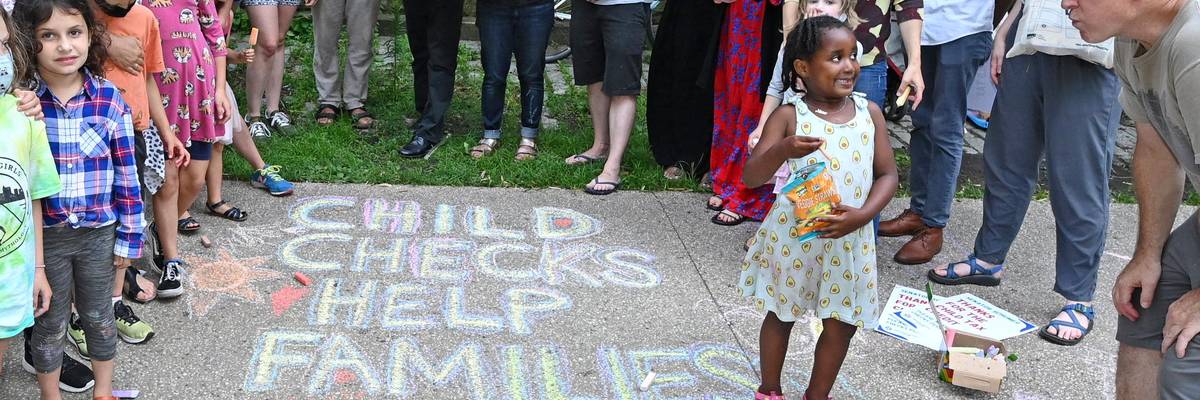
A gathering of parents and children calls for making the Child Tax Credit expansion permanent.
The substantial weakening of welfare state programs that had protected families from economic deprivation in 2021 resulted in poverty increases across all major racial and ethnic groups last year.
Economic relief measures enacted in response to the pandemic strengthened the U.S. social safety net and made a historic dent on poverty in 2021. New Census Bureau data show that the expiration of these key programs caused a significant increase in poverty last year, with the number of children in poverty more than doubling.
Bold policy initiatives such as economic impact/stimulus payments and the expansion of the Child Tax Credit (CTC) helped to shelter millions of people from poverty during a time of social and economic uncertainty at the beginning of the Covid-19 pandemic. For example, the Census Bureau’s most accurate measure of poverty—the Supplemental Poverty Measure—showed that poverty declined by more than 30% between 2019 and 2021, reaching a historic low of 7.8% in 2021. During the same three-year period, child poverty declined by more than half, reaching a historic low of 5.2% in 2021. Importantly, gains during this period were observed across all racial and ethnic groups.
New poverty data for 2022 show that all these gains in poverty reduction have now disappeared. More than 40 million people in 2022 fell below the poverty line, an increase of over 15 million (see Figure A). The substantial weakening of welfare state programs that had protected families from economic deprivation in 2021 resulted in poverty increases across all major racial and ethnic groups last year, further deepening the disadvantages of historically marginalized individuals and families.
Families with children were disproportionately affected by the expiration of the enhanced Child Tax Credit and other relief measures. The supplemental child poverty rate more than doubled between 2021 and 2022, marking a significant regression in child welfare with nearly 9 million children falling below the poverty line. In 2021, the expanded CTC had helped lift close to 3 million children from poverty. In 2022, the expiration of the CTC and other economic security initiatives meant that over 5 million more children were counted as poor relative to the year before. Poverty also continued to affect children of color unevenly, with Black, Hispanic, and American Indian and Alaska Native child poverty rates more than twice as high as their white, non-Hispanic peers.
To isolate the role of government benefits and taxes in reducing poverty, Figure B shows the number of people in poverty on a pre- and post-tax-and-benefit basis. There was essentially no change in overall poverty on a pre-tax basis, with the number of people in poverty hovering between 78.2 to 78.4 million. In contrast, post-tax-and-benefit poverty counts rose sharply between 2021 and 2022, in line with the removal of the expanded CTC and economic impact payments.
Figure B also demonstrates that rising prices played little-to-no role in the large increase in poverty. While high inflation curtailed many families’ incomes in 2022, labor market gains completely offset inflation at the bottom of the income distribution, as household pre-tax incomes through the bottom 30th percentile changed little between 2021 and 2022. Overall pre-tax poverty did not change last year, and poverty only increased using a broader measure of economic hardship that includes post-tax income.
There is also reason to think that the magnitude of the poverty increase was substantially larger than these figures suggest. Census models estimating the mechanical reduction in poverty due to the Child Tax Credit significantly understate the size of payments received by families near poverty thresholds in 2021. As a result, poverty in 2021 may have been lower than we thought, raising the measured magnitude of the poverty increase in 2022.
Although the strong labor market of 2023 will surely help to improve living standards and reduce poverty, it will nevertheless fall short of undoing the damage of letting key social assistance programs expire. Today’s data indicating a sharp increase in 2022 reveal how much poverty the country tolerates is a policy choice.
Dear Common Dreams reader, It’s been nearly 30 years since I co-founded Common Dreams with my late wife, Lina Newhouser. We had the radical notion that journalism should serve the public good, not corporate profits. It was clear to us from the outset what it would take to build such a project. No paid advertisements. No corporate sponsors. No millionaire publisher telling us what to think or do. Many people said we wouldn't last a year, but we proved those doubters wrong. Together with a tremendous team of journalists and dedicated staff, we built an independent media outlet free from the constraints of profits and corporate control. Our mission has always been simple: To inform. To inspire. To ignite change for the common good. Building Common Dreams was not easy. Our survival was never guaranteed. When you take on the most powerful forces—Wall Street greed, fossil fuel industry destruction, Big Tech lobbyists, and uber-rich oligarchs who have spent billions upon billions rigging the economy and democracy in their favor—the only bulwark you have is supporters who believe in your work. But here’s the urgent message from me today. It's never been this bad out there. And it's never been this hard to keep us going. At the very moment Common Dreams is most needed, the threats we face are intensifying. We need your support now more than ever. We don't accept corporate advertising and never will. We don't have a paywall because we don't think people should be blocked from critical news based on their ability to pay. Everything we do is funded by the donations of readers like you. When everyone does the little they can afford, we are strong. But if that support retreats or dries up, so do we. Will you donate now to make sure Common Dreams not only survives but thrives? —Craig Brown, Co-founder |
Economic relief measures enacted in response to the pandemic strengthened the U.S. social safety net and made a historic dent on poverty in 2021. New Census Bureau data show that the expiration of these key programs caused a significant increase in poverty last year, with the number of children in poverty more than doubling.
Bold policy initiatives such as economic impact/stimulus payments and the expansion of the Child Tax Credit (CTC) helped to shelter millions of people from poverty during a time of social and economic uncertainty at the beginning of the Covid-19 pandemic. For example, the Census Bureau’s most accurate measure of poverty—the Supplemental Poverty Measure—showed that poverty declined by more than 30% between 2019 and 2021, reaching a historic low of 7.8% in 2021. During the same three-year period, child poverty declined by more than half, reaching a historic low of 5.2% in 2021. Importantly, gains during this period were observed across all racial and ethnic groups.
New poverty data for 2022 show that all these gains in poverty reduction have now disappeared. More than 40 million people in 2022 fell below the poverty line, an increase of over 15 million (see Figure A). The substantial weakening of welfare state programs that had protected families from economic deprivation in 2021 resulted in poverty increases across all major racial and ethnic groups last year, further deepening the disadvantages of historically marginalized individuals and families.
Families with children were disproportionately affected by the expiration of the enhanced Child Tax Credit and other relief measures. The supplemental child poverty rate more than doubled between 2021 and 2022, marking a significant regression in child welfare with nearly 9 million children falling below the poverty line. In 2021, the expanded CTC had helped lift close to 3 million children from poverty. In 2022, the expiration of the CTC and other economic security initiatives meant that over 5 million more children were counted as poor relative to the year before. Poverty also continued to affect children of color unevenly, with Black, Hispanic, and American Indian and Alaska Native child poverty rates more than twice as high as their white, non-Hispanic peers.
To isolate the role of government benefits and taxes in reducing poverty, Figure B shows the number of people in poverty on a pre- and post-tax-and-benefit basis. There was essentially no change in overall poverty on a pre-tax basis, with the number of people in poverty hovering between 78.2 to 78.4 million. In contrast, post-tax-and-benefit poverty counts rose sharply between 2021 and 2022, in line with the removal of the expanded CTC and economic impact payments.
Figure B also demonstrates that rising prices played little-to-no role in the large increase in poverty. While high inflation curtailed many families’ incomes in 2022, labor market gains completely offset inflation at the bottom of the income distribution, as household pre-tax incomes through the bottom 30th percentile changed little between 2021 and 2022. Overall pre-tax poverty did not change last year, and poverty only increased using a broader measure of economic hardship that includes post-tax income.
There is also reason to think that the magnitude of the poverty increase was substantially larger than these figures suggest. Census models estimating the mechanical reduction in poverty due to the Child Tax Credit significantly understate the size of payments received by families near poverty thresholds in 2021. As a result, poverty in 2021 may have been lower than we thought, raising the measured magnitude of the poverty increase in 2022.
Although the strong labor market of 2023 will surely help to improve living standards and reduce poverty, it will nevertheless fall short of undoing the damage of letting key social assistance programs expire. Today’s data indicating a sharp increase in 2022 reveal how much poverty the country tolerates is a policy choice.
Economic relief measures enacted in response to the pandemic strengthened the U.S. social safety net and made a historic dent on poverty in 2021. New Census Bureau data show that the expiration of these key programs caused a significant increase in poverty last year, with the number of children in poverty more than doubling.
Bold policy initiatives such as economic impact/stimulus payments and the expansion of the Child Tax Credit (CTC) helped to shelter millions of people from poverty during a time of social and economic uncertainty at the beginning of the Covid-19 pandemic. For example, the Census Bureau’s most accurate measure of poverty—the Supplemental Poverty Measure—showed that poverty declined by more than 30% between 2019 and 2021, reaching a historic low of 7.8% in 2021. During the same three-year period, child poverty declined by more than half, reaching a historic low of 5.2% in 2021. Importantly, gains during this period were observed across all racial and ethnic groups.
New poverty data for 2022 show that all these gains in poverty reduction have now disappeared. More than 40 million people in 2022 fell below the poverty line, an increase of over 15 million (see Figure A). The substantial weakening of welfare state programs that had protected families from economic deprivation in 2021 resulted in poverty increases across all major racial and ethnic groups last year, further deepening the disadvantages of historically marginalized individuals and families.
Families with children were disproportionately affected by the expiration of the enhanced Child Tax Credit and other relief measures. The supplemental child poverty rate more than doubled between 2021 and 2022, marking a significant regression in child welfare with nearly 9 million children falling below the poverty line. In 2021, the expanded CTC had helped lift close to 3 million children from poverty. In 2022, the expiration of the CTC and other economic security initiatives meant that over 5 million more children were counted as poor relative to the year before. Poverty also continued to affect children of color unevenly, with Black, Hispanic, and American Indian and Alaska Native child poverty rates more than twice as high as their white, non-Hispanic peers.
To isolate the role of government benefits and taxes in reducing poverty, Figure B shows the number of people in poverty on a pre- and post-tax-and-benefit basis. There was essentially no change in overall poverty on a pre-tax basis, with the number of people in poverty hovering between 78.2 to 78.4 million. In contrast, post-tax-and-benefit poverty counts rose sharply between 2021 and 2022, in line with the removal of the expanded CTC and economic impact payments.
Figure B also demonstrates that rising prices played little-to-no role in the large increase in poverty. While high inflation curtailed many families’ incomes in 2022, labor market gains completely offset inflation at the bottom of the income distribution, as household pre-tax incomes through the bottom 30th percentile changed little between 2021 and 2022. Overall pre-tax poverty did not change last year, and poverty only increased using a broader measure of economic hardship that includes post-tax income.
There is also reason to think that the magnitude of the poverty increase was substantially larger than these figures suggest. Census models estimating the mechanical reduction in poverty due to the Child Tax Credit significantly understate the size of payments received by families near poverty thresholds in 2021. As a result, poverty in 2021 may have been lower than we thought, raising the measured magnitude of the poverty increase in 2022.
Although the strong labor market of 2023 will surely help to improve living standards and reduce poverty, it will nevertheless fall short of undoing the damage of letting key social assistance programs expire. Today’s data indicating a sharp increase in 2022 reveal how much poverty the country tolerates is a policy choice.