
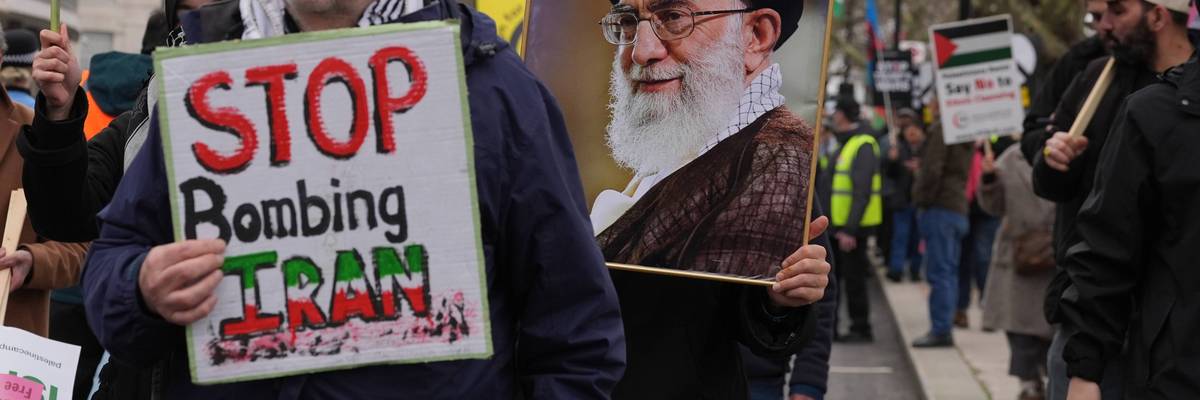
Protesters from the CND, Stop the War, Palestine Solidarity Campaign, Muslim Association of Britain, Palestinian Forum in Britain and Friends of Al-Aqsa, lead a national demonstration to the US Embassy in London on Saturday March 7, 2026 to call for an end to attacks on Iran.
What Is the US Exit Strategy From Its War on Iran?
We must remember: Under international law, aggression is not just another war crime—it is the gravest crime of all. The judges at the Nuremberg Trials called aggression “the supreme international crime,” because it “contains within itself the accumulated evil of the whole.”
The United States has once again launched a war in the Middle East based on false claims about weapons of mass destruction. Like the invasion of Iraq in 2003, the US assault on Iran rests on allegations that international inspectors have already debunked. But beyond the false pretext lies an even more pressing question that few officials in Washington seem willing—or able—to answer: What is the US exit strategy from its war on Iran?
President Trump has justified the attack by claiming that Iran refuses to renounce nuclear weapons. As he prepared to launch the war, Trump repeatedly claimed, “We haven’t heard those secret words: ‘We will never have a nuclear weapon.’” Iran’s foreign minister, Abbas Araghchi, responded by reiterating Iran’s long-standing policy, stating plainly: “Iran will under no circumstances ever develop a nuclear weapon.”
After years of unprecedented inspections, the International Atomic Energy Agency (IAEA) never found evidence that Iran had an active nuclear weapons program. In 2015 the agency declared its investigation complete and subsequently monitored Iran’s compliance with the Joint Comprehensive Plan of Action (JCPOA) nuclear agreement. The IAEA repeatedly confirmed that Iran was abiding by the deal—until the United States under Donald Trump withdrew from the agreement in 2018.
Yet the endless repetition of these disproven allegations by US and Israeli politicians has served as a political pretext for “maximum pressure” economic coercion, escalating threats, and now full-scale illegal aggression against Iran.
Opposition to a war always increases over time as the real-world results become clear to more of the public. Trump has launched this war with only one in five Americans supporting it in the first place...
Under international law, aggression is not just another war crime—it is the gravest crime of all. The judges at the Nuremberg Trials called aggression “the supreme international crime,” because it “contains within itself the accumulated evil of the whole.” Those convicted of launching aggressive war were held responsible for all the horrors that followed. For that reason, the Nuremberg tribunal reserved its harshest punishment—death by hanging—for the defendants convicted of planning and waging aggressive war, while those found guilty only of war crimes or crimes against humanity received lesser sentences.
The wisdom of that distinction is borne out by the horrors taking place in Iran and neighboring countries today. In the first week of the US-Israeli bombing of Iran, they have already destroyed schools and hospitals and killed hundreds of innocent civilians. On March 2nd, President Trump said that the US plans to achieve all its goals in Iran through four or five weeks of this kind of mass slaughter.
At a Pentagon press conference a few hours earlier, Secretary of War Pete Hegseth was vaguer, saying it could take two to six weeks, and later said it could be eight weeks. But the US government is clearly under a number of pressures to end the war within a limited time frame.
First, the United States launched this war with already depleted weapons stockpiles, after expending thousands of bombs and missiles in prolonged campaigns in Yemen and sending unprecedented quantities of weapons to Ukraine, Israel and other allies since 2022.
If the war drags on for more than a few weeks, US forces will begin to run short of air-defense interceptors, cruise missiles, and other critical munitions, with Israeli air defenses expected to face shortages even sooner. The US and Israel are therefore gambling that they can destroy enough of Iran’s missiles before they themselves run out of interceptors needed to stop them.
Yet recent experience suggests this gamble is likely to fail. US bombing campaigns against Ansar Allah (the Houthis) in Yemen under both Biden and Trump failed to eliminate its missile capabilities or reopen the Red Sea to commercial shipping. Iran is a far more formidable opponent—twelve times larger than Houthi-controlled territory in Yemen, with missiles dispersed in hardened facilities across the country and mounted on mobile launchers disguised as civilian trucks. Destroying them all is highly unlikely.
Second, the longer this war drags on, the greater the shock it will deliver to the global economy. Iran has already attacked several oil tankers and closed the Strait of Hormuz, through which a fifth of the world’s oil supply normally passes. Qatar has also halted LNG shipments after Iranian drones struck a major gas facility. This removed nearly 20 percent of the world’s traded natural gas from the market and sent prices in Europe soaring.
The role of the sovereign wealth funds of the Gulf sheikdoms in global finance means that financial markets will be further impacted as they dip into those funds to make up for the lost revenue from the disruption of their oil and gas exports.
At the same time, airlines around the world have suspended flights across much of the Middle East, rerouting aircraft around the conflict zone and stranding thousands of travelers as the war ripples through global commerce. And already, in just the first week of the war, US taxpayers are being asked to shoulder another $50 billion in war spending.
Third, Trump has until now justified his illegal threats and uses of force to Americans, and especially to his MAGA base, by keeping his wars limited in scope and duration and avoiding US casualties. But he risks failing on all those counts in Iran, and reaping a predictable political whirlwind.
A University of Maryland poll at the beginning of February found that only 21% of Americans said they would approve of a US attack on Iran, with 49% opposed. Even among Republicans, only 40% were in favor.
This time, Iran understands that the only way to deter future attacks is to inflict real costs on the US.
US governments are usually able to generate support for their wars in their early stages, with help from corporate media and retired generals linked to the arms industry whom they trot out as military experts. But opposition to a war always increases over time as the real-world results become clear to more of the public. Trump has launched this war with only one in five Americans supporting it in the first place, so he knows he must either create an illusion of success or face a dire political reaction.
To make Trump’s challenge harder, he’s gone to war against a country whose leaders fully understand all these dynamics. Iran has explicitly set out to inflict hundreds of US casualties, and to expand and prolong the war beyond the limits of the US war plan. Iran’s leaders have recognized that their scripted, symbolic response to last year’s 12-day US-Israeli war, with a few fairly harmless strikes on the US Al-Udeid air base in Qatar, was not an effective deterrent to further US-Israeli aggression.
This time, Iran understands that the only way to deter future attacks is to inflict real costs on the US. Iran killed six US troops in action in the first days of the war, has inflicted serious damage on the US 5th Fleet’s base in Bahrain, and destroyed or damaged air defense radar systems at seven US bases.
On the other side, the US and Israel are trying to destroy as many of Iran’s missiles as they can before Iran can use them. As NIAC (the National Iranian-American Council) wrote on March 3rd, “The conflict is increasingly defined by sustainability - missile inventories versus interceptor stocks.”
The course of the war will depend very much on how successful each side is in achieving these goals, as the whole world watches in horror.
Yet in Washington, the most basic strategic questions remain unanswered. At Defense Secretary Pete Hegseth and General Caine’s early-morning press conference on March 2, a reporter asked the questions that should now be on everyone’s mind: “What percentage of Iranian long-strike capabilities are still in the fight? And what is our exit strategy here, and when will it be deployed?”
Hegseth appeared at a loss to answer them. He waffled and eventually fell back on the familiar claim that Iran was trying to build a nuclear weapon—Trump’s recycled weapons-of-mass-destruction narrative from the Iraq war. General Caine sidestepped the question more professionally, offering a technical explanation about the difficulty of completing bomb-damage assessments during ongoing combat.
In Washington, the most basic strategic questions remain unanswered.
But neither Hegseth nor Caine—nor any other US official—has addressed the fundamental question of an exit strategy. Since the United States has not invaded and occupied Iran, there are no US ground forces to withdraw, as there were in Iraq or Afghanistan. If US and Israeli forces begin to run low on weapons, they could simply declare victory, halt the bombing and replenish their arsenals before launching another round of attacks later.
Iran’s strategy appears designed to prevent exactly that outcome—by turning this into a war the United States will not want to repeat. That means inflicting real costs: US casualties, political backlash at home, strained relations with allies, global economic disruption and a further erosion of Washington’s standing in the world.
Even if the US is ready to end the war in a few weeks, Iran may insist on concessions, such as the lifting of illegal sanctions and US withdrawal from bases in the Persian Gulf, before it will end its attacks on increasingly indefensible US bases. Those are terms that we would encourage the US government to accept.
This would be a real exit strategy from war on Iran, not just in order to regroup and launch another bombing campaign when the US and Israel have replenished their weapons stockpiles, but to actually make peace, as Trump keeps saying he wants to do.
Israel and Iran face an existential choice between gradually destroying each other and accepting that they must learn to co-exist in the same region of the world. The United States government must decide which of those choices it will support.
When the current war is over, whatever government is in power in Iran, the United States should work to repair US-Iranian relations, and tell the Israelis that it will not take part in or support renewed Israeli aggression against Iran. That would give the people of Iran a much better chance to build the political system they want than bombing them and imposing coercive sanctions to wreck their economy.
Such a shift in US policy could finally start to unravel the whole web of illegal US and Israeli aggression and occupation that has afflicted, colonized and destabilized the Middle East for so many decades. That would be a form of regime change that people all over the region, and the world, would welcome.
We are at a crossroads
This country and this world are at a monumental crossroads. In a few short weeks, US voters will have an opportunity to beat back the forces of fascism and confront the billionaires who are rigging the economy, our media system, and our democracy, making it increasingly impossible for ordinary people to get by. We’re not just talking about the election. We’re talking about what must be done once these fascist elements are vanquished from power. We need a bolder set of solutions than what either major party has so far been willing to offer and a working-class movement ready to fight like hell for it. Trump didn't emerge from nowhere. The conditions that fueled MAGA authoritarianism were created by decades of radical neoliberal economic policies and a corrupt political system dominated by corporate interests. They slashed taxes on the super-rich, promising that the benefits would trickle down. They said giveaways to the corporate titans would make life more affordable for the rest of us. It was all bullshit. And when a bitter, betrayed populace searches for someone to blame, right-wing demagogues have little trouble finding scapegoats. People know when they're being lied to, but you won't hear any of this from the corporate media. Only independent journalism—powered and funded by people who believe in building a better world—can deliver truly trustworthy daily news. Our Fall Campaign is underway, and we need your help. To power our newsroom through the rest of the year, we need to raise $125,000 by midnight on October 31. So if you share our vision, please contribute whatever you can to sustain our work. |
The United States has once again launched a war in the Middle East based on false claims about weapons of mass destruction. Like the invasion of Iraq in 2003, the US assault on Iran rests on allegations that international inspectors have already debunked. But beyond the false pretext lies an even more pressing question that few officials in Washington seem willing—or able—to answer: What is the US exit strategy from its war on Iran?
President Trump has justified the attack by claiming that Iran refuses to renounce nuclear weapons. As he prepared to launch the war, Trump repeatedly claimed, “We haven’t heard those secret words: ‘We will never have a nuclear weapon.’” Iran’s foreign minister, Abbas Araghchi, responded by reiterating Iran’s long-standing policy, stating plainly: “Iran will under no circumstances ever develop a nuclear weapon.”
After years of unprecedented inspections, the International Atomic Energy Agency (IAEA) never found evidence that Iran had an active nuclear weapons program. In 2015 the agency declared its investigation complete and subsequently monitored Iran’s compliance with the Joint Comprehensive Plan of Action (JCPOA) nuclear agreement. The IAEA repeatedly confirmed that Iran was abiding by the deal—until the United States under Donald Trump withdrew from the agreement in 2018.
Yet the endless repetition of these disproven allegations by US and Israeli politicians has served as a political pretext for “maximum pressure” economic coercion, escalating threats, and now full-scale illegal aggression against Iran.
Opposition to a war always increases over time as the real-world results become clear to more of the public. Trump has launched this war with only one in five Americans supporting it in the first place...
Under international law, aggression is not just another war crime—it is the gravest crime of all. The judges at the Nuremberg Trials called aggression “the supreme international crime,” because it “contains within itself the accumulated evil of the whole.” Those convicted of launching aggressive war were held responsible for all the horrors that followed. For that reason, the Nuremberg tribunal reserved its harshest punishment—death by hanging—for the defendants convicted of planning and waging aggressive war, while those found guilty only of war crimes or crimes against humanity received lesser sentences.
The wisdom of that distinction is borne out by the horrors taking place in Iran and neighboring countries today. In the first week of the US-Israeli bombing of Iran, they have already destroyed schools and hospitals and killed hundreds of innocent civilians. On March 2nd, President Trump said that the US plans to achieve all its goals in Iran through four or five weeks of this kind of mass slaughter.
At a Pentagon press conference a few hours earlier, Secretary of War Pete Hegseth was vaguer, saying it could take two to six weeks, and later said it could be eight weeks. But the US government is clearly under a number of pressures to end the war within a limited time frame.
First, the United States launched this war with already depleted weapons stockpiles, after expending thousands of bombs and missiles in prolonged campaigns in Yemen and sending unprecedented quantities of weapons to Ukraine, Israel and other allies since 2022.
If the war drags on for more than a few weeks, US forces will begin to run short of air-defense interceptors, cruise missiles, and other critical munitions, with Israeli air defenses expected to face shortages even sooner. The US and Israel are therefore gambling that they can destroy enough of Iran’s missiles before they themselves run out of interceptors needed to stop them.
Yet recent experience suggests this gamble is likely to fail. US bombing campaigns against Ansar Allah (the Houthis) in Yemen under both Biden and Trump failed to eliminate its missile capabilities or reopen the Red Sea to commercial shipping. Iran is a far more formidable opponent—twelve times larger than Houthi-controlled territory in Yemen, with missiles dispersed in hardened facilities across the country and mounted on mobile launchers disguised as civilian trucks. Destroying them all is highly unlikely.
Second, the longer this war drags on, the greater the shock it will deliver to the global economy. Iran has already attacked several oil tankers and closed the Strait of Hormuz, through which a fifth of the world’s oil supply normally passes. Qatar has also halted LNG shipments after Iranian drones struck a major gas facility. This removed nearly 20 percent of the world’s traded natural gas from the market and sent prices in Europe soaring.
The role of the sovereign wealth funds of the Gulf sheikdoms in global finance means that financial markets will be further impacted as they dip into those funds to make up for the lost revenue from the disruption of their oil and gas exports.
At the same time, airlines around the world have suspended flights across much of the Middle East, rerouting aircraft around the conflict zone and stranding thousands of travelers as the war ripples through global commerce. And already, in just the first week of the war, US taxpayers are being asked to shoulder another $50 billion in war spending.
Third, Trump has until now justified his illegal threats and uses of force to Americans, and especially to his MAGA base, by keeping his wars limited in scope and duration and avoiding US casualties. But he risks failing on all those counts in Iran, and reaping a predictable political whirlwind.
A University of Maryland poll at the beginning of February found that only 21% of Americans said they would approve of a US attack on Iran, with 49% opposed. Even among Republicans, only 40% were in favor.
This time, Iran understands that the only way to deter future attacks is to inflict real costs on the US.
US governments are usually able to generate support for their wars in their early stages, with help from corporate media and retired generals linked to the arms industry whom they trot out as military experts. But opposition to a war always increases over time as the real-world results become clear to more of the public. Trump has launched this war with only one in five Americans supporting it in the first place, so he knows he must either create an illusion of success or face a dire political reaction.
To make Trump’s challenge harder, he’s gone to war against a country whose leaders fully understand all these dynamics. Iran has explicitly set out to inflict hundreds of US casualties, and to expand and prolong the war beyond the limits of the US war plan. Iran’s leaders have recognized that their scripted, symbolic response to last year’s 12-day US-Israeli war, with a few fairly harmless strikes on the US Al-Udeid air base in Qatar, was not an effective deterrent to further US-Israeli aggression.
This time, Iran understands that the only way to deter future attacks is to inflict real costs on the US. Iran killed six US troops in action in the first days of the war, has inflicted serious damage on the US 5th Fleet’s base in Bahrain, and destroyed or damaged air defense radar systems at seven US bases.
On the other side, the US and Israel are trying to destroy as many of Iran’s missiles as they can before Iran can use them. As NIAC (the National Iranian-American Council) wrote on March 3rd, “The conflict is increasingly defined by sustainability - missile inventories versus interceptor stocks.”
The course of the war will depend very much on how successful each side is in achieving these goals, as the whole world watches in horror.
Yet in Washington, the most basic strategic questions remain unanswered. At Defense Secretary Pete Hegseth and General Caine’s early-morning press conference on March 2, a reporter asked the questions that should now be on everyone’s mind: “What percentage of Iranian long-strike capabilities are still in the fight? And what is our exit strategy here, and when will it be deployed?”
Hegseth appeared at a loss to answer them. He waffled and eventually fell back on the familiar claim that Iran was trying to build a nuclear weapon—Trump’s recycled weapons-of-mass-destruction narrative from the Iraq war. General Caine sidestepped the question more professionally, offering a technical explanation about the difficulty of completing bomb-damage assessments during ongoing combat.
In Washington, the most basic strategic questions remain unanswered.
But neither Hegseth nor Caine—nor any other US official—has addressed the fundamental question of an exit strategy. Since the United States has not invaded and occupied Iran, there are no US ground forces to withdraw, as there were in Iraq or Afghanistan. If US and Israeli forces begin to run low on weapons, they could simply declare victory, halt the bombing and replenish their arsenals before launching another round of attacks later.
Iran’s strategy appears designed to prevent exactly that outcome—by turning this into a war the United States will not want to repeat. That means inflicting real costs: US casualties, political backlash at home, strained relations with allies, global economic disruption and a further erosion of Washington’s standing in the world.
Even if the US is ready to end the war in a few weeks, Iran may insist on concessions, such as the lifting of illegal sanctions and US withdrawal from bases in the Persian Gulf, before it will end its attacks on increasingly indefensible US bases. Those are terms that we would encourage the US government to accept.
This would be a real exit strategy from war on Iran, not just in order to regroup and launch another bombing campaign when the US and Israel have replenished their weapons stockpiles, but to actually make peace, as Trump keeps saying he wants to do.
Israel and Iran face an existential choice between gradually destroying each other and accepting that they must learn to co-exist in the same region of the world. The United States government must decide which of those choices it will support.
When the current war is over, whatever government is in power in Iran, the United States should work to repair US-Iranian relations, and tell the Israelis that it will not take part in or support renewed Israeli aggression against Iran. That would give the people of Iran a much better chance to build the political system they want than bombing them and imposing coercive sanctions to wreck their economy.
Such a shift in US policy could finally start to unravel the whole web of illegal US and Israeli aggression and occupation that has afflicted, colonized and destabilized the Middle East for so many decades. That would be a form of regime change that people all over the region, and the world, would welcome.
The United States has once again launched a war in the Middle East based on false claims about weapons of mass destruction. Like the invasion of Iraq in 2003, the US assault on Iran rests on allegations that international inspectors have already debunked. But beyond the false pretext lies an even more pressing question that few officials in Washington seem willing—or able—to answer: What is the US exit strategy from its war on Iran?
President Trump has justified the attack by claiming that Iran refuses to renounce nuclear weapons. As he prepared to launch the war, Trump repeatedly claimed, “We haven’t heard those secret words: ‘We will never have a nuclear weapon.’” Iran’s foreign minister, Abbas Araghchi, responded by reiterating Iran’s long-standing policy, stating plainly: “Iran will under no circumstances ever develop a nuclear weapon.”
After years of unprecedented inspections, the International Atomic Energy Agency (IAEA) never found evidence that Iran had an active nuclear weapons program. In 2015 the agency declared its investigation complete and subsequently monitored Iran’s compliance with the Joint Comprehensive Plan of Action (JCPOA) nuclear agreement. The IAEA repeatedly confirmed that Iran was abiding by the deal—until the United States under Donald Trump withdrew from the agreement in 2018.
Yet the endless repetition of these disproven allegations by US and Israeli politicians has served as a political pretext for “maximum pressure” economic coercion, escalating threats, and now full-scale illegal aggression against Iran.
Opposition to a war always increases over time as the real-world results become clear to more of the public. Trump has launched this war with only one in five Americans supporting it in the first place...
Under international law, aggression is not just another war crime—it is the gravest crime of all. The judges at the Nuremberg Trials called aggression “the supreme international crime,” because it “contains within itself the accumulated evil of the whole.” Those convicted of launching aggressive war were held responsible for all the horrors that followed. For that reason, the Nuremberg tribunal reserved its harshest punishment—death by hanging—for the defendants convicted of planning and waging aggressive war, while those found guilty only of war crimes or crimes against humanity received lesser sentences.
The wisdom of that distinction is borne out by the horrors taking place in Iran and neighboring countries today. In the first week of the US-Israeli bombing of Iran, they have already destroyed schools and hospitals and killed hundreds of innocent civilians. On March 2nd, President Trump said that the US plans to achieve all its goals in Iran through four or five weeks of this kind of mass slaughter.
At a Pentagon press conference a few hours earlier, Secretary of War Pete Hegseth was vaguer, saying it could take two to six weeks, and later said it could be eight weeks. But the US government is clearly under a number of pressures to end the war within a limited time frame.
First, the United States launched this war with already depleted weapons stockpiles, after expending thousands of bombs and missiles in prolonged campaigns in Yemen and sending unprecedented quantities of weapons to Ukraine, Israel and other allies since 2022.
If the war drags on for more than a few weeks, US forces will begin to run short of air-defense interceptors, cruise missiles, and other critical munitions, with Israeli air defenses expected to face shortages even sooner. The US and Israel are therefore gambling that they can destroy enough of Iran’s missiles before they themselves run out of interceptors needed to stop them.
Yet recent experience suggests this gamble is likely to fail. US bombing campaigns against Ansar Allah (the Houthis) in Yemen under both Biden and Trump failed to eliminate its missile capabilities or reopen the Red Sea to commercial shipping. Iran is a far more formidable opponent—twelve times larger than Houthi-controlled territory in Yemen, with missiles dispersed in hardened facilities across the country and mounted on mobile launchers disguised as civilian trucks. Destroying them all is highly unlikely.
Second, the longer this war drags on, the greater the shock it will deliver to the global economy. Iran has already attacked several oil tankers and closed the Strait of Hormuz, through which a fifth of the world’s oil supply normally passes. Qatar has also halted LNG shipments after Iranian drones struck a major gas facility. This removed nearly 20 percent of the world’s traded natural gas from the market and sent prices in Europe soaring.
The role of the sovereign wealth funds of the Gulf sheikdoms in global finance means that financial markets will be further impacted as they dip into those funds to make up for the lost revenue from the disruption of their oil and gas exports.
At the same time, airlines around the world have suspended flights across much of the Middle East, rerouting aircraft around the conflict zone and stranding thousands of travelers as the war ripples through global commerce. And already, in just the first week of the war, US taxpayers are being asked to shoulder another $50 billion in war spending.
Third, Trump has until now justified his illegal threats and uses of force to Americans, and especially to his MAGA base, by keeping his wars limited in scope and duration and avoiding US casualties. But he risks failing on all those counts in Iran, and reaping a predictable political whirlwind.
A University of Maryland poll at the beginning of February found that only 21% of Americans said they would approve of a US attack on Iran, with 49% opposed. Even among Republicans, only 40% were in favor.
This time, Iran understands that the only way to deter future attacks is to inflict real costs on the US.
US governments are usually able to generate support for their wars in their early stages, with help from corporate media and retired generals linked to the arms industry whom they trot out as military experts. But opposition to a war always increases over time as the real-world results become clear to more of the public. Trump has launched this war with only one in five Americans supporting it in the first place, so he knows he must either create an illusion of success or face a dire political reaction.
To make Trump’s challenge harder, he’s gone to war against a country whose leaders fully understand all these dynamics. Iran has explicitly set out to inflict hundreds of US casualties, and to expand and prolong the war beyond the limits of the US war plan. Iran’s leaders have recognized that their scripted, symbolic response to last year’s 12-day US-Israeli war, with a few fairly harmless strikes on the US Al-Udeid air base in Qatar, was not an effective deterrent to further US-Israeli aggression.
This time, Iran understands that the only way to deter future attacks is to inflict real costs on the US. Iran killed six US troops in action in the first days of the war, has inflicted serious damage on the US 5th Fleet’s base in Bahrain, and destroyed or damaged air defense radar systems at seven US bases.
On the other side, the US and Israel are trying to destroy as many of Iran’s missiles as they can before Iran can use them. As NIAC (the National Iranian-American Council) wrote on March 3rd, “The conflict is increasingly defined by sustainability - missile inventories versus interceptor stocks.”
The course of the war will depend very much on how successful each side is in achieving these goals, as the whole world watches in horror.
Yet in Washington, the most basic strategic questions remain unanswered. At Defense Secretary Pete Hegseth and General Caine’s early-morning press conference on March 2, a reporter asked the questions that should now be on everyone’s mind: “What percentage of Iranian long-strike capabilities are still in the fight? And what is our exit strategy here, and when will it be deployed?”
Hegseth appeared at a loss to answer them. He waffled and eventually fell back on the familiar claim that Iran was trying to build a nuclear weapon—Trump’s recycled weapons-of-mass-destruction narrative from the Iraq war. General Caine sidestepped the question more professionally, offering a technical explanation about the difficulty of completing bomb-damage assessments during ongoing combat.
In Washington, the most basic strategic questions remain unanswered.
But neither Hegseth nor Caine—nor any other US official—has addressed the fundamental question of an exit strategy. Since the United States has not invaded and occupied Iran, there are no US ground forces to withdraw, as there were in Iraq or Afghanistan. If US and Israeli forces begin to run low on weapons, they could simply declare victory, halt the bombing and replenish their arsenals before launching another round of attacks later.
Iran’s strategy appears designed to prevent exactly that outcome—by turning this into a war the United States will not want to repeat. That means inflicting real costs: US casualties, political backlash at home, strained relations with allies, global economic disruption and a further erosion of Washington’s standing in the world.
Even if the US is ready to end the war in a few weeks, Iran may insist on concessions, such as the lifting of illegal sanctions and US withdrawal from bases in the Persian Gulf, before it will end its attacks on increasingly indefensible US bases. Those are terms that we would encourage the US government to accept.
This would be a real exit strategy from war on Iran, not just in order to regroup and launch another bombing campaign when the US and Israel have replenished their weapons stockpiles, but to actually make peace, as Trump keeps saying he wants to do.
Israel and Iran face an existential choice between gradually destroying each other and accepting that they must learn to co-exist in the same region of the world. The United States government must decide which of those choices it will support.
When the current war is over, whatever government is in power in Iran, the United States should work to repair US-Iranian relations, and tell the Israelis that it will not take part in or support renewed Israeli aggression against Iran. That would give the people of Iran a much better chance to build the political system they want than bombing them and imposing coercive sanctions to wreck their economy.
Such a shift in US policy could finally start to unravel the whole web of illegal US and Israeli aggression and occupation that has afflicted, colonized and destabilized the Middle East for so many decades. That would be a form of regime change that people all over the region, and the world, would welcome.