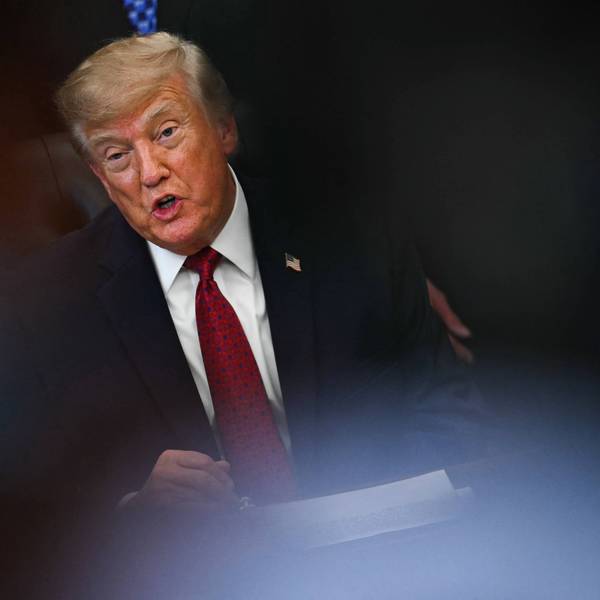

A Department of Homeland Security agent stands guard as protesters demonstrate against raids conducted by the US Immigration and Customs Enforcement outside the DHS office in Charlotte, North Carolina, on November 16, 2025.
What Comes After Trump's Age of Monsters?
A truly progressive vision built around a bold and popular agenda is the only hope the United States has to end the Trumpist nightmare and address the nation's myriad social and economic challenges.
Is Donald Trump the worst president in US history? Is Trumpism just about Trump? What lies ahead after Trump? More of the same or a return to normalcy? Are these two the only alternatives?
In the interview that follows with French-Greek independent journalist and writer Alexandra Boutri, political scientist, political economist, author, and journalist C. J. Polychroniou offers his insights into Trumpism and speculates on what the future may possibly have in store for a nation whose current government has openly embraced neofascism with the intend of reshaping America’s past and starting a new age of authoritarian capitalism. In his view, a truly progressive vision built around a bold and popular agenda is the only hope the United States has to end the Trumpist nightmare and address in turn the nation's myriad social and economic challenges.
Alexandra Boutri: In our last interview, you made abundantly clear that you believe that the United States is not simply headed in the wrong direction but that the Trump administration represents an actual threat to democratic values and norms and to the environment alike and that its policies lack humanity and decency. Would you say then that Donald Trump is the worst president in US history?
C. J. Polychroniou: Since the emergence of the United States as an imperial power in the 1890s, the competition for worst president is quite fierce. So many of them have been outright war criminals and should have been tried for such crimes and crimes against humanity. Not that there weren’t terrible presidents before that period. There are some rather strong parallels between John Adams and Donald Trump. If Trump knows anything about US history, which is extremely doubtful, he must undoubtedly love the Alien and Sedition Acts signed into law by President John Adams in 1798. Among other ghastly things, they criminalized criticism of the president and the federal government. Andrew Jackson was a staunch defender of slavery and pursued genocidal policies against Native Americans. However, Donald Trump was ranked last year in a survey of historians as the worst president in US history. I’ll go along with that for some basic reasons. We are well into the 21st century, yet Trump is keen on destroying everything that has been of mildly progressive political and social nature in the United States. He is attacking the very foundations of democracy and wants to rule like a dictator. He is waging a war on poor people while solidifying the rule of plutocracy. He has returned white supremacy to mainstream politics and made racism once again a legitimate political ideology. His entire agenda is based on ignorance and intimidation, fear and hate. He has called climate change, which is an existential threat, a “con job” and has taken scores of actions that threaten the environment and public health. He is a monster.
Trump did not divide America. He merely reinforced the political, social, and cultural divisions characterizing contemporary American society.
Alexandra Boutri: What is Trumpism? Is it just about Trump?
C. J. Polychroniou: Trump did not discover racism and bigotry, nor did he invent social discontent. He was politically smart enough to realize that the growing discontent in the United State with the status quo can be easily turned into a reactionary movement catering to the interests and needs of the plutocracy with simply promises of a “golden age” for America under his leadership. He tapped into a huge reservoir of anger and resentment over elite rule and privileges but did not offer policies that would identify and tackle the true causes of inequality and injustice in US society. Instead, he demonized and dehumanized immigrants as scapegoats for every social and economic problem. He appealed to people’s worst instincts because he knew that the combination of economic anxiety brought on by over 40 years of brutal neoliberal policies, which were pursued with equal zeal by both Republican and Democratic administrations, and racial resentment could drive white support for him. This is why waging a culture war and polarizing American society have been such key instruments in Trump’s political strategy for power. He is a master manipulator in a society where race, gender, and class are equally important variables. Indeed, neither class alone nor the simple combination of race and gender alone can explain Trump’s rise to power. All three need to be taken into account to make sense of the success of the Trump phenomenon. We should not forget that Trump’s performance on political rallies that he staged were often enough acts stolen from the electoral campaign of Hitler and his Nazi party. We must not close our eyes to the fact that Trump employed the rhetoric of racism and fascism and continues to do so during his second term in the White House, because there is a huge market for it in 21st-century America.
It would be a mistake to think that the Trump phenomenon is an aberration of sorts in US history. Trump’s rise to power is the culmination of the long history of racism, violence, and extremism in US politics and society. The Republican Party has been exploiting racism and extremism for many decades. Exploiting white voters’ fears and prejudices was what the GOP’s “Southern strategy” of the 1960s was all about. In the 1980s, Ronald Reagan established strong links with various extremist and racist forces, links which were strengthened, not repudiated, by George H. W. Bush. So, the rottenness goes long way before Trump. But what Trump did that was so successful was not only to update the “Southern strategy,” which the GOP used to capture more and more Southern seats, but to go even further than the party’s obsession with suburbia. He exploited working-class pain and turned border security into a national issue. On top of that, he led an anti-elitist movement with messages that resonated with many different groups of people, including immigrants and minorities.
All that said, the idea that Trump divided America is something of a rather crude claim. Trump did not divide America. He merely reinforced the political, social, and cultural divisions characterizing contemporary American society. The US is now so politically divided that solving the nation’s massive economic and social problems is a truly Herculean task.
It was “normalcy,” an unsustainable socioeconomic and political order, that gave us Trump and the age of monsters.
Alexandra Boutri: Obviously, Trump won’t be around forever. Do you think his successor can be equally as bad for the country and the world?
C. J. Polychroniou: Look at some of the people around Trump making political noise, and the answer is staring you in the face. JD Vance is most likely the one who will succeed Trump as leader of the MAGA movement. He is, I believe, even more evil than Trump himself. Yes, he is an opportunist and lacks principles, but at the same time makes no effort to hide MAGA’s fascist endgame. His speech at the Munich Security Conference on February 14, 2025, in which he attacked European democracy and expressed full support for far-right, anti-immigration parties, is quite telling of what we should expect of him as Trump’s successor. Trump’s hold on the GOP may weaken while he is still president, but I think it will be very difficult for the Republican Party to break free of Trumpism. Republicans have created and unleashed a monster they cannot control. Can the GOP break up into two parties? Yes, but then it will be finished as a contender for power.
Alexandra Boutri: So you don’t think the prospects are good for return to normalcy in US politics?
C. J. Polychroniou: I suppose that by “return to normalcy” in US politics you have in mind the reestablishment of the norms of the American political tradition. But this is not the way to think about the future. It was “normalcy,” an unsustainable socioeconomic and political order, that gave us Trump and the age of monsters. Following the old path, which is what the Democrats have been doing for the most part since Barack Obama’s presidency, is not a real alternative for a country plagued by huge socioeconomic problems and a system of government where a small number of elites rule. The United States is not a democracy but a plutocracy. Problems like massive economic inequalities, militarism, poverty and low wages, systemic and structural racism, environmental degradation and climate collapse, an unethical and broken healthcare system, collapsing infrastructure, a severe housing crisis, and a scandalous campaign finance system cannot be addressed with a return to normalcy.
The country is in dire need of a truly bold, popular, and progressive agenda. A democratic socialist vision is the only way out, yet I am fully aware of the fact that the country has a long way to go before it can even embrace social democracy, let alone democratic socialism. Yet, Americans are overall in favor of national health insurance and have a favorable view of social safety net programs. The situation is not hopeless, but it requires the birth of a new democratic age, a democracy for the people, not a return to normalcy.
We are at a crossroads
This country and this world are at a monumental crossroads. In a few short weeks, US voters will have an opportunity to beat back the forces of fascism and confront the billionaires who are rigging the economy, our media system, and our democracy, making it increasingly impossible for ordinary people to get by. We’re not just talking about the election. We’re talking about what must be done once these fascist elements are vanquished from power. We need a bolder set of solutions than what either major party has so far been willing to offer and a working-class movement ready to fight like hell for it. Trump didn't emerge from nowhere. The conditions that fueled MAGA authoritarianism were created by decades of radical neoliberal economic policies and a corrupt political system dominated by corporate interests. They slashed taxes on the super-rich, promising that the benefits would trickle down. They said giveaways to the corporate titans would make life more affordable for the rest of us. It was all bullshit. And when a bitter, betrayed populace searches for someone to blame, right-wing demagogues have little trouble finding scapegoats. People know when they're being lied to, but you won't hear any of this from the corporate media. Only independent journalism—powered and funded by people who believe in building a better world—can deliver truly trustworthy daily news. Our Fall Campaign is underway, and we need your help. To power our newsroom through the rest of the year, we need to raise $125,000 by midnight on October 31. So if you share our vision, please contribute whatever you can to sustain our work. |
Is Donald Trump the worst president in US history? Is Trumpism just about Trump? What lies ahead after Trump? More of the same or a return to normalcy? Are these two the only alternatives?
In the interview that follows with French-Greek independent journalist and writer Alexandra Boutri, political scientist, political economist, author, and journalist C. J. Polychroniou offers his insights into Trumpism and speculates on what the future may possibly have in store for a nation whose current government has openly embraced neofascism with the intend of reshaping America’s past and starting a new age of authoritarian capitalism. In his view, a truly progressive vision built around a bold and popular agenda is the only hope the United States has to end the Trumpist nightmare and address in turn the nation's myriad social and economic challenges.
Alexandra Boutri: In our last interview, you made abundantly clear that you believe that the United States is not simply headed in the wrong direction but that the Trump administration represents an actual threat to democratic values and norms and to the environment alike and that its policies lack humanity and decency. Would you say then that Donald Trump is the worst president in US history?
C. J. Polychroniou: Since the emergence of the United States as an imperial power in the 1890s, the competition for worst president is quite fierce. So many of them have been outright war criminals and should have been tried for such crimes and crimes against humanity. Not that there weren’t terrible presidents before that period. There are some rather strong parallels between John Adams and Donald Trump. If Trump knows anything about US history, which is extremely doubtful, he must undoubtedly love the Alien and Sedition Acts signed into law by President John Adams in 1798. Among other ghastly things, they criminalized criticism of the president and the federal government. Andrew Jackson was a staunch defender of slavery and pursued genocidal policies against Native Americans. However, Donald Trump was ranked last year in a survey of historians as the worst president in US history. I’ll go along with that for some basic reasons. We are well into the 21st century, yet Trump is keen on destroying everything that has been of mildly progressive political and social nature in the United States. He is attacking the very foundations of democracy and wants to rule like a dictator. He is waging a war on poor people while solidifying the rule of plutocracy. He has returned white supremacy to mainstream politics and made racism once again a legitimate political ideology. His entire agenda is based on ignorance and intimidation, fear and hate. He has called climate change, which is an existential threat, a “con job” and has taken scores of actions that threaten the environment and public health. He is a monster.
Trump did not divide America. He merely reinforced the political, social, and cultural divisions characterizing contemporary American society.
Alexandra Boutri: What is Trumpism? Is it just about Trump?
C. J. Polychroniou: Trump did not discover racism and bigotry, nor did he invent social discontent. He was politically smart enough to realize that the growing discontent in the United State with the status quo can be easily turned into a reactionary movement catering to the interests and needs of the plutocracy with simply promises of a “golden age” for America under his leadership. He tapped into a huge reservoir of anger and resentment over elite rule and privileges but did not offer policies that would identify and tackle the true causes of inequality and injustice in US society. Instead, he demonized and dehumanized immigrants as scapegoats for every social and economic problem. He appealed to people’s worst instincts because he knew that the combination of economic anxiety brought on by over 40 years of brutal neoliberal policies, which were pursued with equal zeal by both Republican and Democratic administrations, and racial resentment could drive white support for him. This is why waging a culture war and polarizing American society have been such key instruments in Trump’s political strategy for power. He is a master manipulator in a society where race, gender, and class are equally important variables. Indeed, neither class alone nor the simple combination of race and gender alone can explain Trump’s rise to power. All three need to be taken into account to make sense of the success of the Trump phenomenon. We should not forget that Trump’s performance on political rallies that he staged were often enough acts stolen from the electoral campaign of Hitler and his Nazi party. We must not close our eyes to the fact that Trump employed the rhetoric of racism and fascism and continues to do so during his second term in the White House, because there is a huge market for it in 21st-century America.
It would be a mistake to think that the Trump phenomenon is an aberration of sorts in US history. Trump’s rise to power is the culmination of the long history of racism, violence, and extremism in US politics and society. The Republican Party has been exploiting racism and extremism for many decades. Exploiting white voters’ fears and prejudices was what the GOP’s “Southern strategy” of the 1960s was all about. In the 1980s, Ronald Reagan established strong links with various extremist and racist forces, links which were strengthened, not repudiated, by George H. W. Bush. So, the rottenness goes long way before Trump. But what Trump did that was so successful was not only to update the “Southern strategy,” which the GOP used to capture more and more Southern seats, but to go even further than the party’s obsession with suburbia. He exploited working-class pain and turned border security into a national issue. On top of that, he led an anti-elitist movement with messages that resonated with many different groups of people, including immigrants and minorities.
All that said, the idea that Trump divided America is something of a rather crude claim. Trump did not divide America. He merely reinforced the political, social, and cultural divisions characterizing contemporary American society. The US is now so politically divided that solving the nation’s massive economic and social problems is a truly Herculean task.
It was “normalcy,” an unsustainable socioeconomic and political order, that gave us Trump and the age of monsters.
Alexandra Boutri: Obviously, Trump won’t be around forever. Do you think his successor can be equally as bad for the country and the world?
C. J. Polychroniou: Look at some of the people around Trump making political noise, and the answer is staring you in the face. JD Vance is most likely the one who will succeed Trump as leader of the MAGA movement. He is, I believe, even more evil than Trump himself. Yes, he is an opportunist and lacks principles, but at the same time makes no effort to hide MAGA’s fascist endgame. His speech at the Munich Security Conference on February 14, 2025, in which he attacked European democracy and expressed full support for far-right, anti-immigration parties, is quite telling of what we should expect of him as Trump’s successor. Trump’s hold on the GOP may weaken while he is still president, but I think it will be very difficult for the Republican Party to break free of Trumpism. Republicans have created and unleashed a monster they cannot control. Can the GOP break up into two parties? Yes, but then it will be finished as a contender for power.
Alexandra Boutri: So you don’t think the prospects are good for return to normalcy in US politics?
C. J. Polychroniou: I suppose that by “return to normalcy” in US politics you have in mind the reestablishment of the norms of the American political tradition. But this is not the way to think about the future. It was “normalcy,” an unsustainable socioeconomic and political order, that gave us Trump and the age of monsters. Following the old path, which is what the Democrats have been doing for the most part since Barack Obama’s presidency, is not a real alternative for a country plagued by huge socioeconomic problems and a system of government where a small number of elites rule. The United States is not a democracy but a plutocracy. Problems like massive economic inequalities, militarism, poverty and low wages, systemic and structural racism, environmental degradation and climate collapse, an unethical and broken healthcare system, collapsing infrastructure, a severe housing crisis, and a scandalous campaign finance system cannot be addressed with a return to normalcy.
The country is in dire need of a truly bold, popular, and progressive agenda. A democratic socialist vision is the only way out, yet I am fully aware of the fact that the country has a long way to go before it can even embrace social democracy, let alone democratic socialism. Yet, Americans are overall in favor of national health insurance and have a favorable view of social safety net programs. The situation is not hopeless, but it requires the birth of a new democratic age, a democracy for the people, not a return to normalcy.
- The $75 Billion Reason These 5 Corporations Had to Help Fund Trump's Inauguration ›
- Here Comes Trump's Privatization of the Social Security Administration ›
- Vowing to Fight Back, Senate Dems Decry Trump Attack on Liberal-Left Groups ›
- After Trump Deploys Secret Police in Portland, 'Imagine What Happens If He Gets Four More Years' ›
- Opinion | Government by Monsters | Common Dreams ›
- Opinion | Is Trump the 21st Century's Top Jock? | Common Dreams ›
- Opinion | Trump: An Instrument of the Age | Common Dreams ›
- Opinion | Can America Recover From Trump-World? | Common Dreams ›
Is Donald Trump the worst president in US history? Is Trumpism just about Trump? What lies ahead after Trump? More of the same or a return to normalcy? Are these two the only alternatives?
In the interview that follows with French-Greek independent journalist and writer Alexandra Boutri, political scientist, political economist, author, and journalist C. J. Polychroniou offers his insights into Trumpism and speculates on what the future may possibly have in store for a nation whose current government has openly embraced neofascism with the intend of reshaping America’s past and starting a new age of authoritarian capitalism. In his view, a truly progressive vision built around a bold and popular agenda is the only hope the United States has to end the Trumpist nightmare and address in turn the nation's myriad social and economic challenges.
Alexandra Boutri: In our last interview, you made abundantly clear that you believe that the United States is not simply headed in the wrong direction but that the Trump administration represents an actual threat to democratic values and norms and to the environment alike and that its policies lack humanity and decency. Would you say then that Donald Trump is the worst president in US history?
C. J. Polychroniou: Since the emergence of the United States as an imperial power in the 1890s, the competition for worst president is quite fierce. So many of them have been outright war criminals and should have been tried for such crimes and crimes against humanity. Not that there weren’t terrible presidents before that period. There are some rather strong parallels between John Adams and Donald Trump. If Trump knows anything about US history, which is extremely doubtful, he must undoubtedly love the Alien and Sedition Acts signed into law by President John Adams in 1798. Among other ghastly things, they criminalized criticism of the president and the federal government. Andrew Jackson was a staunch defender of slavery and pursued genocidal policies against Native Americans. However, Donald Trump was ranked last year in a survey of historians as the worst president in US history. I’ll go along with that for some basic reasons. We are well into the 21st century, yet Trump is keen on destroying everything that has been of mildly progressive political and social nature in the United States. He is attacking the very foundations of democracy and wants to rule like a dictator. He is waging a war on poor people while solidifying the rule of plutocracy. He has returned white supremacy to mainstream politics and made racism once again a legitimate political ideology. His entire agenda is based on ignorance and intimidation, fear and hate. He has called climate change, which is an existential threat, a “con job” and has taken scores of actions that threaten the environment and public health. He is a monster.
Trump did not divide America. He merely reinforced the political, social, and cultural divisions characterizing contemporary American society.
Alexandra Boutri: What is Trumpism? Is it just about Trump?
C. J. Polychroniou: Trump did not discover racism and bigotry, nor did he invent social discontent. He was politically smart enough to realize that the growing discontent in the United State with the status quo can be easily turned into a reactionary movement catering to the interests and needs of the plutocracy with simply promises of a “golden age” for America under his leadership. He tapped into a huge reservoir of anger and resentment over elite rule and privileges but did not offer policies that would identify and tackle the true causes of inequality and injustice in US society. Instead, he demonized and dehumanized immigrants as scapegoats for every social and economic problem. He appealed to people’s worst instincts because he knew that the combination of economic anxiety brought on by over 40 years of brutal neoliberal policies, which were pursued with equal zeal by both Republican and Democratic administrations, and racial resentment could drive white support for him. This is why waging a culture war and polarizing American society have been such key instruments in Trump’s political strategy for power. He is a master manipulator in a society where race, gender, and class are equally important variables. Indeed, neither class alone nor the simple combination of race and gender alone can explain Trump’s rise to power. All three need to be taken into account to make sense of the success of the Trump phenomenon. We should not forget that Trump’s performance on political rallies that he staged were often enough acts stolen from the electoral campaign of Hitler and his Nazi party. We must not close our eyes to the fact that Trump employed the rhetoric of racism and fascism and continues to do so during his second term in the White House, because there is a huge market for it in 21st-century America.
It would be a mistake to think that the Trump phenomenon is an aberration of sorts in US history. Trump’s rise to power is the culmination of the long history of racism, violence, and extremism in US politics and society. The Republican Party has been exploiting racism and extremism for many decades. Exploiting white voters’ fears and prejudices was what the GOP’s “Southern strategy” of the 1960s was all about. In the 1980s, Ronald Reagan established strong links with various extremist and racist forces, links which were strengthened, not repudiated, by George H. W. Bush. So, the rottenness goes long way before Trump. But what Trump did that was so successful was not only to update the “Southern strategy,” which the GOP used to capture more and more Southern seats, but to go even further than the party’s obsession with suburbia. He exploited working-class pain and turned border security into a national issue. On top of that, he led an anti-elitist movement with messages that resonated with many different groups of people, including immigrants and minorities.
All that said, the idea that Trump divided America is something of a rather crude claim. Trump did not divide America. He merely reinforced the political, social, and cultural divisions characterizing contemporary American society. The US is now so politically divided that solving the nation’s massive economic and social problems is a truly Herculean task.
It was “normalcy,” an unsustainable socioeconomic and political order, that gave us Trump and the age of monsters.
Alexandra Boutri: Obviously, Trump won’t be around forever. Do you think his successor can be equally as bad for the country and the world?
C. J. Polychroniou: Look at some of the people around Trump making political noise, and the answer is staring you in the face. JD Vance is most likely the one who will succeed Trump as leader of the MAGA movement. He is, I believe, even more evil than Trump himself. Yes, he is an opportunist and lacks principles, but at the same time makes no effort to hide MAGA’s fascist endgame. His speech at the Munich Security Conference on February 14, 2025, in which he attacked European democracy and expressed full support for far-right, anti-immigration parties, is quite telling of what we should expect of him as Trump’s successor. Trump’s hold on the GOP may weaken while he is still president, but I think it will be very difficult for the Republican Party to break free of Trumpism. Republicans have created and unleashed a monster they cannot control. Can the GOP break up into two parties? Yes, but then it will be finished as a contender for power.
Alexandra Boutri: So you don’t think the prospects are good for return to normalcy in US politics?
C. J. Polychroniou: I suppose that by “return to normalcy” in US politics you have in mind the reestablishment of the norms of the American political tradition. But this is not the way to think about the future. It was “normalcy,” an unsustainable socioeconomic and political order, that gave us Trump and the age of monsters. Following the old path, which is what the Democrats have been doing for the most part since Barack Obama’s presidency, is not a real alternative for a country plagued by huge socioeconomic problems and a system of government where a small number of elites rule. The United States is not a democracy but a plutocracy. Problems like massive economic inequalities, militarism, poverty and low wages, systemic and structural racism, environmental degradation and climate collapse, an unethical and broken healthcare system, collapsing infrastructure, a severe housing crisis, and a scandalous campaign finance system cannot be addressed with a return to normalcy.
The country is in dire need of a truly bold, popular, and progressive agenda. A democratic socialist vision is the only way out, yet I am fully aware of the fact that the country has a long way to go before it can even embrace social democracy, let alone democratic socialism. Yet, Americans are overall in favor of national health insurance and have a favorable view of social safety net programs. The situation is not hopeless, but it requires the birth of a new democratic age, a democracy for the people, not a return to normalcy.
- The $75 Billion Reason These 5 Corporations Had to Help Fund Trump's Inauguration ›
- Here Comes Trump's Privatization of the Social Security Administration ›
- Vowing to Fight Back, Senate Dems Decry Trump Attack on Liberal-Left Groups ›
- After Trump Deploys Secret Police in Portland, 'Imagine What Happens If He Gets Four More Years' ›
- Opinion | Government by Monsters | Common Dreams ›
- Opinion | Is Trump the 21st Century's Top Jock? | Common Dreams ›
- Opinion | Trump: An Instrument of the Age | Common Dreams ›
- Opinion | Can America Recover From Trump-World? | Common Dreams ›