SUBSCRIBE TO OUR FREE NEWSLETTER
Daily news & progressive opinion—funded by the people, not the corporations—delivered straight to your inbox.
5
#000000
#FFFFFF
To donate by check, phone, or other method, see our More Ways to Give page.
Daily news & progressive opinion—funded by the people, not the corporations—delivered straight to your inbox.
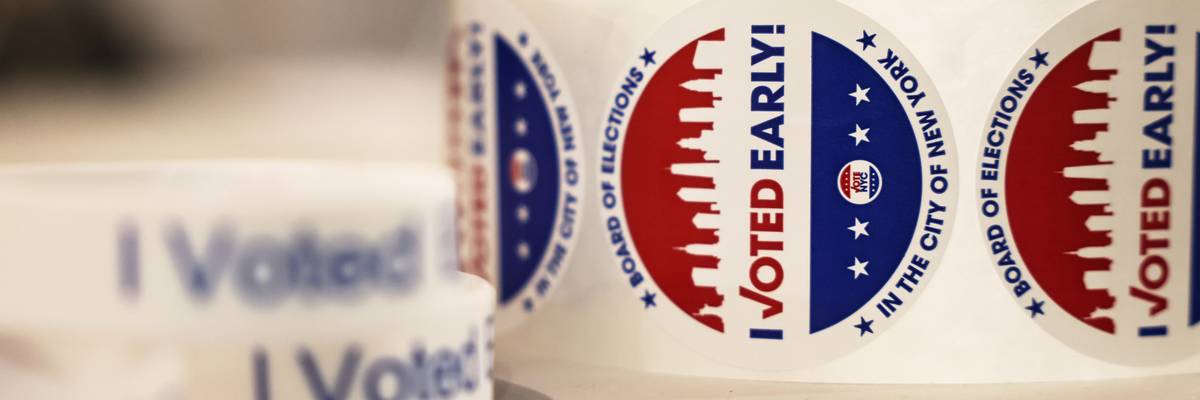
Early voting stickers are seen at an early voting location on June 16, 2021 in the Upper West Side neighborhood of Manhattan in New York City.
There are so many races, and so many heroes. If you can help today, then help.
I had my Vote! shirt on today because Third Act is running through the tape. Our Party Line senior-to-senior outreach moves into final get-out-the-vote mode today; we’ve already passed half a million phone and text contacts, and we are going to keep going till the bitter end, making sure that the folks we’ve IDed actually cast their votes.
It’s important—and it’s also an advanced form of self-soothing, because I find election day hard to deal with. So much rides on the outcome today, more than realistically should. We’ll find out whether or not the fightback against our slide into fascism-with-American-characteristics has begun in earnest; it’ll obviously take more than one election but at this point we have to win them all. Beginning tonight.
I think the reason it feels so fateful is that we’re counting whether there are more open-hearted people voting, or scared-hateful-cramped people. More people who can analyze their own self-interest and also see beyond it, or more people trapped in some ugly algorithmic spiral. I wish it weren’t so starkly good and evil—but after the killings of Alex Pretti and Renee Good (and Joan Guerrero and Victor Diaz and…) it feels pretty inescapably binary. And so we do all we can.
Here, for instance, is a good reminder from Ning Mosberger-Tang to go all the way down the ballot!
This election season, millions of voters have the chance to advance affordability and climate progress by electing pro-clean energy commissioners to their states’ Public Service Commissions or PSCs (also known as Public Utility Commissions or PUCs)—a line at or near the bottom of their ballots. PSCs have enormous power over their states’ energy systems. They authorize the building of new energy infrastructure, set policies for rooftop solar and how its owners are paid, and oversee long-term planning that determines whether state clean energy goals are met. They are also responsible for ensuring utilities charge fair and reasonable prices for electricity.
The donor collaborative that I founded, 1.5°Climate, made strategic fundraising for important PSC races around the country a top priority this year. One of those crucial races is in Georgia. 1.5°Climate’s decision to highlight the Georgia PSC elections was the result of a rigorous analysis that considered the potential climate impact of a positive outcome and pro-clean energy candidates’ chances of winning. Ahead of the special election last year that put clean energy advocate Peter Hubbard in an open seat on the PSC,1.5°Climate raised more than $800,000 from donors around the country for local nonprofit ally Georgia League of Conservation Voters (GCV) to elevate clean energy and affordability issues in the race. After his victory, Hubbard told the Macon Telegraph, “I will work tirelessly to lower utility costs, to bring more clean, reliable energy resources to this state, and to refocus the Commission’s work on the public interest.”
Georgia PSC commissioners are up for election again next week, with five candidates running to fill two open seats. 1.5°Climate is once again bringing its combination of nationwide fundraising and local alliances to the Georgia PSC election, a huge opportunity for climate progress at the state level. Local organizing by Third Act and GCV, with fundraising support from 1.5°Climate–which has already raised an additional $500,000 for GCV this year—are helping to put a pro-clean energy majority on the PSC within reach for the first time in the state’s history.
There are currently nine states with PSC commissioners on the ballot. If you live in one of those states, casting your vote for pro-clean energy candidates might be the most effective step you can take toward climate action this year. In other states, like Nebraska, voters have an opportunity to make a similar impact by voting in pro-clean energy members of local electric utility boards. These boards are the direct decision-makers on crucial questions about local energy infrastructure and electricity rates. So if you still haven’t voted, look to the bottom of your ballot and make sure you fill in the bubble for pro-climate action and pro-affordability leaders of electric utilities or their regulators. It’s our best chance at progressing toward a more secure future for ourselves and future generations this election season.
Here’s another example: Clara Pratt for Arizona Corporation Commission, which is what they call the PUC in that sunniest of all states. Ayana Johnson (and I) interviewed her earlier this fall. But there are so many races, and so many heroes: Justin Pearson, fighting a valiant fight against the mother of all racist gerrymanders in Tennessee, with the data center backlash helping fuel his campaign; Will Lawrence taking his Green New Deal experience to run for Congress in Michigan. On and on.
Thanks to Brad Johnson and Jordan Haedtler, we have a list of the most important state and local climate initiatives on the ballot today. And despite all the efforts at “climate-hushing,” election day actually features pretty prominently in a few high-profile gubernatorial races, as Marcus Baram explains:
Climate surfaces more openly in Alaska’s overlooked governor’s race, where Democrat Jonathan Kreiss-Tomkins has pressed the state to address climate change and said it relies too heavily on natural gas—rare talk from an Alaska politician. Republicans Dave Bronson, Treg Taylor, and Bernadette Wilson are also on the ballot. Nathaniel Stinnett, founder of the Environmental Voter Project, called Kreiss-Tomkins “probably the favorite” but said the race is “extraordinarily close.” In the group’s polling, 21% of likely Alaska voters identified climate as a top-three priority, second only to Maine. “I don’t wanna pretend like this is a climate election,” Stinnett said. “But certainly thousands and perhaps tens of thousands of Alaskans are going to vote with climate change top of mind.”
In Nevada, the main climate focus is water. Republican Gov. Joe Lombardo sued the Trump administration over cuts to the state’s allotment of water from the Colorado River, and Arizona has since joined the suit. Nevada Conservation Voters gave Lombardo a C+ grade, crediting his support of clean energy while faulting his backing of fossil fuel projects. Because Democrats already control both chambers of the legislature, a win by his challenger, Attorney General Aaron Ford, would give the party a trifecta. Stinnett noted that Ford has talked up the clean energy transition in a state that “is kind of like the Saudi Arabia of solar energy, or it can be.”
If you can help today, then help. We’ve been waiting two years to feel something other than dread about our future; today’s the chance. Back to the phones.
This country and this world are at a monumental crossroads. US voters have an opportunity to beat back the forces of fascism and confront the billionaires who are rigging the economy, our media system, and our democracy, making it increasingly impossible for ordinary people to get by. We’re not just talking about the election. We’re talking about what must be done once these fascist elements are vanquished from power. We need a bolder set of solutions than what either major party has so far been willing to offer and a working-class movement ready to fight like hell for it. Trump didn't emerge from nowhere. The conditions that fueled MAGA authoritarianism were created by decades of radical neoliberal economic policies and a corrupt political system dominated by corporate interests. They slashed taxes on the super-rich, promising that the benefits would trickle down. They said giveaways to the corporate titans would make life more affordable for the rest of us. It was all bullshit. And when a bitter, betrayed populace searches for someone to blame, right-wing demagogues have little trouble finding scapegoats. People know when they're being lied to, but you won't hear any of this from the corporate media. Only independent journalism—powered and funded by people who believe in building a better world—can deliver truly trustworthy daily news. If you share our vision, please contribute whatever you can to sustain our work. |
I had my Vote! shirt on today because Third Act is running through the tape. Our Party Line senior-to-senior outreach moves into final get-out-the-vote mode today; we’ve already passed half a million phone and text contacts, and we are going to keep going till the bitter end, making sure that the folks we’ve IDed actually cast their votes.
It’s important—and it’s also an advanced form of self-soothing, because I find election day hard to deal with. So much rides on the outcome today, more than realistically should. We’ll find out whether or not the fightback against our slide into fascism-with-American-characteristics has begun in earnest; it’ll obviously take more than one election but at this point we have to win them all. Beginning tonight.
I think the reason it feels so fateful is that we’re counting whether there are more open-hearted people voting, or scared-hateful-cramped people. More people who can analyze their own self-interest and also see beyond it, or more people trapped in some ugly algorithmic spiral. I wish it weren’t so starkly good and evil—but after the killings of Alex Pretti and Renee Good (and Joan Guerrero and Victor Diaz and…) it feels pretty inescapably binary. And so we do all we can.
Here, for instance, is a good reminder from Ning Mosberger-Tang to go all the way down the ballot!
This election season, millions of voters have the chance to advance affordability and climate progress by electing pro-clean energy commissioners to their states’ Public Service Commissions or PSCs (also known as Public Utility Commissions or PUCs)—a line at or near the bottom of their ballots. PSCs have enormous power over their states’ energy systems. They authorize the building of new energy infrastructure, set policies for rooftop solar and how its owners are paid, and oversee long-term planning that determines whether state clean energy goals are met. They are also responsible for ensuring utilities charge fair and reasonable prices for electricity.
The donor collaborative that I founded, 1.5°Climate, made strategic fundraising for important PSC races around the country a top priority this year. One of those crucial races is in Georgia. 1.5°Climate’s decision to highlight the Georgia PSC elections was the result of a rigorous analysis that considered the potential climate impact of a positive outcome and pro-clean energy candidates’ chances of winning. Ahead of the special election last year that put clean energy advocate Peter Hubbard in an open seat on the PSC,1.5°Climate raised more than $800,000 from donors around the country for local nonprofit ally Georgia League of Conservation Voters (GCV) to elevate clean energy and affordability issues in the race. After his victory, Hubbard told the Macon Telegraph, “I will work tirelessly to lower utility costs, to bring more clean, reliable energy resources to this state, and to refocus the Commission’s work on the public interest.”
Georgia PSC commissioners are up for election again next week, with five candidates running to fill two open seats. 1.5°Climate is once again bringing its combination of nationwide fundraising and local alliances to the Georgia PSC election, a huge opportunity for climate progress at the state level. Local organizing by Third Act and GCV, with fundraising support from 1.5°Climate–which has already raised an additional $500,000 for GCV this year—are helping to put a pro-clean energy majority on the PSC within reach for the first time in the state’s history.
There are currently nine states with PSC commissioners on the ballot. If you live in one of those states, casting your vote for pro-clean energy candidates might be the most effective step you can take toward climate action this year. In other states, like Nebraska, voters have an opportunity to make a similar impact by voting in pro-clean energy members of local electric utility boards. These boards are the direct decision-makers on crucial questions about local energy infrastructure and electricity rates. So if you still haven’t voted, look to the bottom of your ballot and make sure you fill in the bubble for pro-climate action and pro-affordability leaders of electric utilities or their regulators. It’s our best chance at progressing toward a more secure future for ourselves and future generations this election season.
Here’s another example: Clara Pratt for Arizona Corporation Commission, which is what they call the PUC in that sunniest of all states. Ayana Johnson (and I) interviewed her earlier this fall. But there are so many races, and so many heroes: Justin Pearson, fighting a valiant fight against the mother of all racist gerrymanders in Tennessee, with the data center backlash helping fuel his campaign; Will Lawrence taking his Green New Deal experience to run for Congress in Michigan. On and on.
Thanks to Brad Johnson and Jordan Haedtler, we have a list of the most important state and local climate initiatives on the ballot today. And despite all the efforts at “climate-hushing,” election day actually features pretty prominently in a few high-profile gubernatorial races, as Marcus Baram explains:
Climate surfaces more openly in Alaska’s overlooked governor’s race, where Democrat Jonathan Kreiss-Tomkins has pressed the state to address climate change and said it relies too heavily on natural gas—rare talk from an Alaska politician. Republicans Dave Bronson, Treg Taylor, and Bernadette Wilson are also on the ballot. Nathaniel Stinnett, founder of the Environmental Voter Project, called Kreiss-Tomkins “probably the favorite” but said the race is “extraordinarily close.” In the group’s polling, 21% of likely Alaska voters identified climate as a top-three priority, second only to Maine. “I don’t wanna pretend like this is a climate election,” Stinnett said. “But certainly thousands and perhaps tens of thousands of Alaskans are going to vote with climate change top of mind.”
In Nevada, the main climate focus is water. Republican Gov. Joe Lombardo sued the Trump administration over cuts to the state’s allotment of water from the Colorado River, and Arizona has since joined the suit. Nevada Conservation Voters gave Lombardo a C+ grade, crediting his support of clean energy while faulting his backing of fossil fuel projects. Because Democrats already control both chambers of the legislature, a win by his challenger, Attorney General Aaron Ford, would give the party a trifecta. Stinnett noted that Ford has talked up the clean energy transition in a state that “is kind of like the Saudi Arabia of solar energy, or it can be.”
If you can help today, then help. We’ve been waiting two years to feel something other than dread about our future; today’s the chance. Back to the phones.