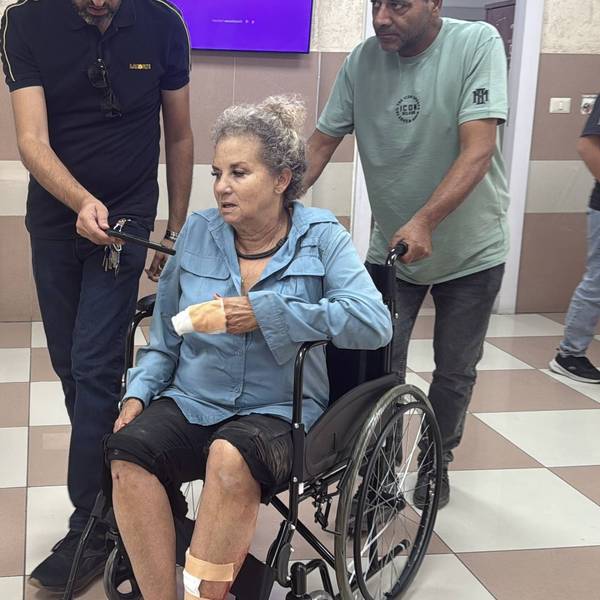
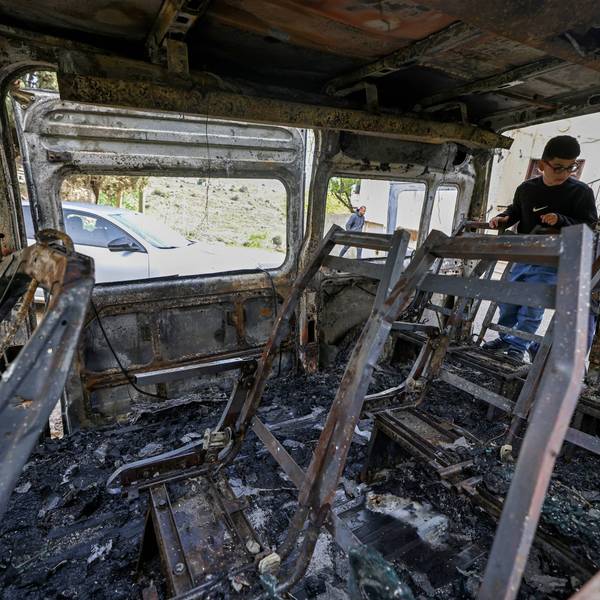
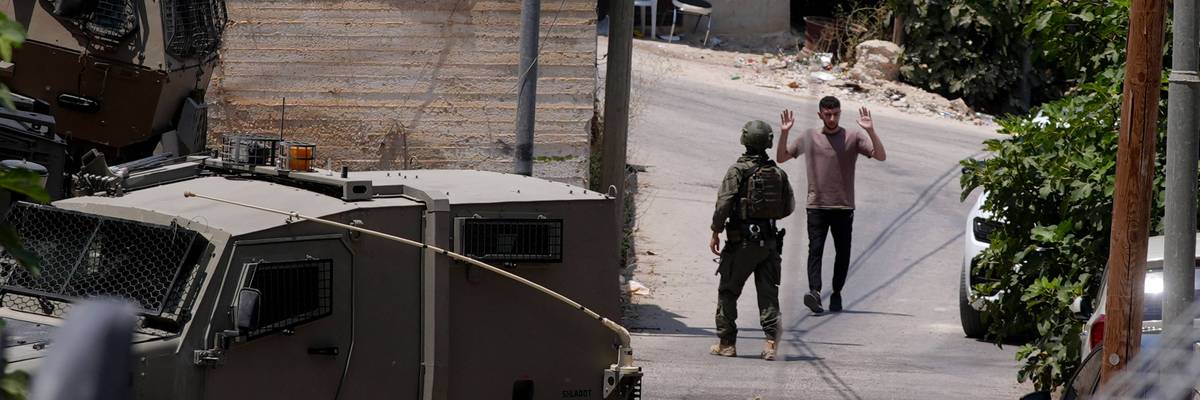
Israeli forces detain dozens of young Palestinians during raids in the town of Tell after sealing all entrances and exits to the town and conducting house-to-house searches in Nablus, West Bank, Palestine on July 25, 2026.
How Village Resistance Disrupted Israel’s West Bank Strategy
The explosion in Tell proved that the status quo of total encirclement, daily humiliation, and existential dispossession is inherently unsustainable.
During a military raid on the small town of Tell, southwest of Nablus, a moment of direct defiance shattered the illusion of total Palestinian submission.
Faced with relentless military incursions, land confiscation, and settler harassment and violence, local villagers and farmers refused to retreat.
In the confrontation that followed, a single Palestinian disarmed an Israeli soldier and opened fire on the invading forces near the illegal Havat Gilad settlement outpost, killing two soldiers and wounding three others.
What followed was the predictable, unyielding fury of the occupation: Israeli forces and state-backed armed settlers immediately launched a series of raids across Tell and neighboring communities, killing four Palestinians, setting fire to homes, and converting residential buildings into field interrogation centers.
The rebellion did not start where standard military analysts expected it to—it ignited in a small farming town among people who decided that fighting back was the only response left to quiet, gradual annihilation.
In a swift collective punishment campaign, Israeli occupation troops detained over 70 Palestinians—including more than 40 in Tell alone—while expanding military incursions into Jenin, Tubas, Tulkarm, Ramallah, Hebron (Al-Khalil), Bethlehem, and Jericho.
Prime Minister Benjamin Netanyahu and Defense Minister Israel Katz promptly ordered a "wide-scale military operation," while United Nations Special Rapporteur Francesca Albanese unequivocally condemned the combined army-settler assaults as "pogroms against defenseless civilians," reiterating calls for an immediate arms embargo and trade sanctions against Israel.
Yet to understand the spark in Tell, one must understand the explosive pressure cooker that the occupied West Bank has become.
Netanyahu’s Primitive Calculus
Netanyahu’s immediate response to the incident in Tell was not a departure from policy, but the activation of an old, entrenched doctrine: Every act of Palestinian resistance—no matter how localized—must be weaponized to accelerate the state-sponsored theft of Palestinian land.
For decades, Israel’s security apparatus has used local resistance as cover to achieve long-standing demographic and territorial ambitions. Under the current far-right coalition, this strategy has reached unprecedented levels of speed and brutality.
The Scale of Destruction
Since October 2023, while global media attention focused primarily on the horrors in Gaza, Israel systematically expanded its offensive across the occupied West Bank:
- Over 1,090 Palestinians—including at least 239 children—have been killed by Israeli forces and state-backed armed settlers.
- Over 6,800 Palestinians have been injured by live ammunition, shrapnel, and physical assaults, with settler attacks alone accounting for a surging majority of recent civilian injuries.
- More than 10,000 Palestinians have been forcibly displaced due to home demolitions, violent settler rampages, and severe access restrictions. Entire Bedouin and rural communities across the South Hebron Hills and the Jordan Valley have been systematically depopulated and cleansed.
- Over 11,000 Palestinians have been swept into detention through military night raids, held under arbitrary administrative detention without charge or trial.
- Under Finance Minister Bezalel Smotrich—who was granted official authority over civilian affairs in the West Bank—the Israeli government declared tens of thousands of dunams of Palestinian territory as "state land," marking the largest continuous land grabs since the Oslo Accords. Concurrently, dozens of illegal settler outposts were retroactively legalized, and thousands of new settlement housing units were advanced.
Strategic Purpose Behind the Escalation
Israel’s systematic campaign in the West Bank serves three distinct political and military objectives for Netanyahu and his cabinet:
- Preempting a Second Front: Israel recognized that if the West Bank rose up in full-scale, organized rebellion while its military was locked in a grueling, unending genocidal campaign in Gaza, containing both entities would prove virtually impossible. Having failed to crush the Palestinian resistance in Gaza despite its overwhelming military force, Israel applied heavy-handed, preemptive violence in the West Bank to terrorize the population into total submission.
- Shielding Netanyahu Through Far-Right Leverage: To survive the internal political fallout of October 7 and his military's failure to achieve its stated war aims, Netanyahu needed to keep his coalition intact. He granted far-right ministers Bezalel Smotrich and Itamar Ben-Gvir absolute freedom to execute their ideological agenda: expanding illegal settlements, annexing Area C, arming settler militias, and repeatedly invading and altering the status quo at the Al-Aqsa Mosque compound in occupied East Jerusalem.
- Masking Failure with Offensive Posturing: Desperate to avoid appearing as a helpless leader trapped in a multi-front war of attrition, Netanyahu used military raids, aerial drone strikes, and armored incursions into West Bank refugee camps (from Jenin and Tulkarm to Nablus) to project an image of strength and control to his right-wing domestic constituency.
Settler Terror and the Bankruptcy of the PA
This campaign of state-sponsored expansion was smoothed by two major factors on the ground:
- Unchecked Settler Paramilitarism: Armed by Itamar Ben-Gvir’s National Security Ministry, violent settler gangs have been fully integrated into state-sanctioned paramilitaries. Settlers launch routine, organized pogroms against Palestinian villages—burning homes, destroying olive groves, stealing livestock, and firing live ammunition at civilians—with the direct protection and active participation of the Israeli military.
- The Subjugation and Inaction of the PA: The Palestinian Authority (PA) has completely abandoned its fundamental duty to protect its people. Rather than formulating a national defense strategy or providing at least symbolic leadership to resist land theft, the PA security forces continued security coordination with the occupation. The PA actively cracked down on local resistance fighters, confiscated weapons, and suppressed public demonstrations, acting as a sub-contracted administrative force managing Palestinian subjugation on Israel's behalf.
Why Mainstream Analysis Fails
Most media and political analysts will inevitably frame the current escalation around narrow parliamentary metrics. They will point to upcoming Israeli elections, arguing that Netanyahu is provoking violence purely to consolidate the far-right vote, satisfy Ben-Gvir and Smotrich, and outflank his political rivals.
International human rights bodies will issue familiar warnings, humanitarian organizations like MSF will voice alarm over raids on medical facilities like Nablus Specialized Hospital, and political blocs like the European Union will issue toothless calls for "all parties to de-escalate."
Meanwhile, the United States government continues to funnel billions of dollars in heavy weaponry to Israel, reinforcing an episode of historical complicity.
What these analyses consistently fail to grasp is the reality of Palestinian agency.
They treat Palestinians as passive victims waiting for international intervention or political shifts in Tel Aviv and Washington. But the explosion in Tell proved that the status quo of total encirclement, daily humiliation, and existential dispossession is inherently unsustainable.
The rebellion did not start where standard military analysts expected it to—it ignited in a small farming town among people who decided that fighting back was the only response left to quiet, gradual annihilation.
The West Bank will not remain silent forever; it will rise at the time and place of its people's choosing, rendering conventional political forecasts useless.
We are at a crossroads
This country and this world are at a monumental crossroads. In a few short weeks, US voters will have an opportunity to beat back the forces of fascism and confront the billionaires who are rigging the economy, our media system, and our democracy, making it increasingly impossible for ordinary people to get by. We’re not just talking about the election. We’re talking about what must be done once these fascist elements are vanquished from power. We need a bolder set of solutions than what either major party has so far been willing to offer and a working-class movement ready to fight like hell for it. Trump didn't emerge from nowhere. The conditions that fueled MAGA authoritarianism were created by decades of radical neoliberal economic policies and a corrupt political system dominated by corporate interests. They slashed taxes on the super-rich, promising that the benefits would trickle down. They said giveaways to the corporate titans would make life more affordable for the rest of us. It was all bullshit. And when a bitter, betrayed populace searches for someone to blame, right-wing demagogues have little trouble finding scapegoats. People know when they're being lied to, but you won't hear any of this from the corporate media. Only independent journalism—powered and funded by people who believe in building a better world—can deliver truly trustworthy daily news. Our Fall Campaign is underway, and we need your help. To power our newsroom through the rest of the year, we need to raise $125,000 by midnight on October 31. So if you share our vision, please contribute whatever you can to sustain our work. |
During a military raid on the small town of Tell, southwest of Nablus, a moment of direct defiance shattered the illusion of total Palestinian submission.
Faced with relentless military incursions, land confiscation, and settler harassment and violence, local villagers and farmers refused to retreat.
In the confrontation that followed, a single Palestinian disarmed an Israeli soldier and opened fire on the invading forces near the illegal Havat Gilad settlement outpost, killing two soldiers and wounding three others.
What followed was the predictable, unyielding fury of the occupation: Israeli forces and state-backed armed settlers immediately launched a series of raids across Tell and neighboring communities, killing four Palestinians, setting fire to homes, and converting residential buildings into field interrogation centers.
The rebellion did not start where standard military analysts expected it to—it ignited in a small farming town among people who decided that fighting back was the only response left to quiet, gradual annihilation.
In a swift collective punishment campaign, Israeli occupation troops detained over 70 Palestinians—including more than 40 in Tell alone—while expanding military incursions into Jenin, Tubas, Tulkarm, Ramallah, Hebron (Al-Khalil), Bethlehem, and Jericho.
Prime Minister Benjamin Netanyahu and Defense Minister Israel Katz promptly ordered a "wide-scale military operation," while United Nations Special Rapporteur Francesca Albanese unequivocally condemned the combined army-settler assaults as "pogroms against defenseless civilians," reiterating calls for an immediate arms embargo and trade sanctions against Israel.
Yet to understand the spark in Tell, one must understand the explosive pressure cooker that the occupied West Bank has become.
Netanyahu’s Primitive Calculus
Netanyahu’s immediate response to the incident in Tell was not a departure from policy, but the activation of an old, entrenched doctrine: Every act of Palestinian resistance—no matter how localized—must be weaponized to accelerate the state-sponsored theft of Palestinian land.
For decades, Israel’s security apparatus has used local resistance as cover to achieve long-standing demographic and territorial ambitions. Under the current far-right coalition, this strategy has reached unprecedented levels of speed and brutality.
The Scale of Destruction
Since October 2023, while global media attention focused primarily on the horrors in Gaza, Israel systematically expanded its offensive across the occupied West Bank:
- Over 1,090 Palestinians—including at least 239 children—have been killed by Israeli forces and state-backed armed settlers.
- Over 6,800 Palestinians have been injured by live ammunition, shrapnel, and physical assaults, with settler attacks alone accounting for a surging majority of recent civilian injuries.
- More than 10,000 Palestinians have been forcibly displaced due to home demolitions, violent settler rampages, and severe access restrictions. Entire Bedouin and rural communities across the South Hebron Hills and the Jordan Valley have been systematically depopulated and cleansed.
- Over 11,000 Palestinians have been swept into detention through military night raids, held under arbitrary administrative detention without charge or trial.
- Under Finance Minister Bezalel Smotrich—who was granted official authority over civilian affairs in the West Bank—the Israeli government declared tens of thousands of dunams of Palestinian territory as "state land," marking the largest continuous land grabs since the Oslo Accords. Concurrently, dozens of illegal settler outposts were retroactively legalized, and thousands of new settlement housing units were advanced.
Strategic Purpose Behind the Escalation
Israel’s systematic campaign in the West Bank serves three distinct political and military objectives for Netanyahu and his cabinet:
- Preempting a Second Front: Israel recognized that if the West Bank rose up in full-scale, organized rebellion while its military was locked in a grueling, unending genocidal campaign in Gaza, containing both entities would prove virtually impossible. Having failed to crush the Palestinian resistance in Gaza despite its overwhelming military force, Israel applied heavy-handed, preemptive violence in the West Bank to terrorize the population into total submission.
- Shielding Netanyahu Through Far-Right Leverage: To survive the internal political fallout of October 7 and his military's failure to achieve its stated war aims, Netanyahu needed to keep his coalition intact. He granted far-right ministers Bezalel Smotrich and Itamar Ben-Gvir absolute freedom to execute their ideological agenda: expanding illegal settlements, annexing Area C, arming settler militias, and repeatedly invading and altering the status quo at the Al-Aqsa Mosque compound in occupied East Jerusalem.
- Masking Failure with Offensive Posturing: Desperate to avoid appearing as a helpless leader trapped in a multi-front war of attrition, Netanyahu used military raids, aerial drone strikes, and armored incursions into West Bank refugee camps (from Jenin and Tulkarm to Nablus) to project an image of strength and control to his right-wing domestic constituency.
Settler Terror and the Bankruptcy of the PA
This campaign of state-sponsored expansion was smoothed by two major factors on the ground:
- Unchecked Settler Paramilitarism: Armed by Itamar Ben-Gvir’s National Security Ministry, violent settler gangs have been fully integrated into state-sanctioned paramilitaries. Settlers launch routine, organized pogroms against Palestinian villages—burning homes, destroying olive groves, stealing livestock, and firing live ammunition at civilians—with the direct protection and active participation of the Israeli military.
- The Subjugation and Inaction of the PA: The Palestinian Authority (PA) has completely abandoned its fundamental duty to protect its people. Rather than formulating a national defense strategy or providing at least symbolic leadership to resist land theft, the PA security forces continued security coordination with the occupation. The PA actively cracked down on local resistance fighters, confiscated weapons, and suppressed public demonstrations, acting as a sub-contracted administrative force managing Palestinian subjugation on Israel's behalf.
Why Mainstream Analysis Fails
Most media and political analysts will inevitably frame the current escalation around narrow parliamentary metrics. They will point to upcoming Israeli elections, arguing that Netanyahu is provoking violence purely to consolidate the far-right vote, satisfy Ben-Gvir and Smotrich, and outflank his political rivals.
International human rights bodies will issue familiar warnings, humanitarian organizations like MSF will voice alarm over raids on medical facilities like Nablus Specialized Hospital, and political blocs like the European Union will issue toothless calls for "all parties to de-escalate."
Meanwhile, the United States government continues to funnel billions of dollars in heavy weaponry to Israel, reinforcing an episode of historical complicity.
What these analyses consistently fail to grasp is the reality of Palestinian agency.
They treat Palestinians as passive victims waiting for international intervention or political shifts in Tel Aviv and Washington. But the explosion in Tell proved that the status quo of total encirclement, daily humiliation, and existential dispossession is inherently unsustainable.
The rebellion did not start where standard military analysts expected it to—it ignited in a small farming town among people who decided that fighting back was the only response left to quiet, gradual annihilation.
The West Bank will not remain silent forever; it will rise at the time and place of its people's choosing, rendering conventional political forecasts useless.
- With All Eyes on Gaza, Israeli Soldiers and Settlers Kill Dozens of West Bank Palestinians ›
- Machine Gun-Toting Israeli Settlers Detain Ro Khanna During Trip to Occupied West Bank ›
- Despite State-Backed Israeli Settler Violence, the Palestinians Will Persevere ›
- As Netanyahu Prepares to Meet Trump, Explosion of Israeli Settler Violence Draws International Condemnation ›
- Smotrich Demands More West Bank Ethnic Cleansing After Deadly Palestinian Resistance ›
- Opinion | Overflowing Bins in Bethlehem Tell a Bigger Story | Common Dreams ›
During a military raid on the small town of Tell, southwest of Nablus, a moment of direct defiance shattered the illusion of total Palestinian submission.
Faced with relentless military incursions, land confiscation, and settler harassment and violence, local villagers and farmers refused to retreat.
In the confrontation that followed, a single Palestinian disarmed an Israeli soldier and opened fire on the invading forces near the illegal Havat Gilad settlement outpost, killing two soldiers and wounding three others.
What followed was the predictable, unyielding fury of the occupation: Israeli forces and state-backed armed settlers immediately launched a series of raids across Tell and neighboring communities, killing four Palestinians, setting fire to homes, and converting residential buildings into field interrogation centers.
The rebellion did not start where standard military analysts expected it to—it ignited in a small farming town among people who decided that fighting back was the only response left to quiet, gradual annihilation.
In a swift collective punishment campaign, Israeli occupation troops detained over 70 Palestinians—including more than 40 in Tell alone—while expanding military incursions into Jenin, Tubas, Tulkarm, Ramallah, Hebron (Al-Khalil), Bethlehem, and Jericho.
Prime Minister Benjamin Netanyahu and Defense Minister Israel Katz promptly ordered a "wide-scale military operation," while United Nations Special Rapporteur Francesca Albanese unequivocally condemned the combined army-settler assaults as "pogroms against defenseless civilians," reiterating calls for an immediate arms embargo and trade sanctions against Israel.
Yet to understand the spark in Tell, one must understand the explosive pressure cooker that the occupied West Bank has become.
Netanyahu’s Primitive Calculus
Netanyahu’s immediate response to the incident in Tell was not a departure from policy, but the activation of an old, entrenched doctrine: Every act of Palestinian resistance—no matter how localized—must be weaponized to accelerate the state-sponsored theft of Palestinian land.
For decades, Israel’s security apparatus has used local resistance as cover to achieve long-standing demographic and territorial ambitions. Under the current far-right coalition, this strategy has reached unprecedented levels of speed and brutality.
The Scale of Destruction
Since October 2023, while global media attention focused primarily on the horrors in Gaza, Israel systematically expanded its offensive across the occupied West Bank:
- Over 1,090 Palestinians—including at least 239 children—have been killed by Israeli forces and state-backed armed settlers.
- Over 6,800 Palestinians have been injured by live ammunition, shrapnel, and physical assaults, with settler attacks alone accounting for a surging majority of recent civilian injuries.
- More than 10,000 Palestinians have been forcibly displaced due to home demolitions, violent settler rampages, and severe access restrictions. Entire Bedouin and rural communities across the South Hebron Hills and the Jordan Valley have been systematically depopulated and cleansed.
- Over 11,000 Palestinians have been swept into detention through military night raids, held under arbitrary administrative detention without charge or trial.
- Under Finance Minister Bezalel Smotrich—who was granted official authority over civilian affairs in the West Bank—the Israeli government declared tens of thousands of dunams of Palestinian territory as "state land," marking the largest continuous land grabs since the Oslo Accords. Concurrently, dozens of illegal settler outposts were retroactively legalized, and thousands of new settlement housing units were advanced.
Strategic Purpose Behind the Escalation
Israel’s systematic campaign in the West Bank serves three distinct political and military objectives for Netanyahu and his cabinet:
- Preempting a Second Front: Israel recognized that if the West Bank rose up in full-scale, organized rebellion while its military was locked in a grueling, unending genocidal campaign in Gaza, containing both entities would prove virtually impossible. Having failed to crush the Palestinian resistance in Gaza despite its overwhelming military force, Israel applied heavy-handed, preemptive violence in the West Bank to terrorize the population into total submission.
- Shielding Netanyahu Through Far-Right Leverage: To survive the internal political fallout of October 7 and his military's failure to achieve its stated war aims, Netanyahu needed to keep his coalition intact. He granted far-right ministers Bezalel Smotrich and Itamar Ben-Gvir absolute freedom to execute their ideological agenda: expanding illegal settlements, annexing Area C, arming settler militias, and repeatedly invading and altering the status quo at the Al-Aqsa Mosque compound in occupied East Jerusalem.
- Masking Failure with Offensive Posturing: Desperate to avoid appearing as a helpless leader trapped in a multi-front war of attrition, Netanyahu used military raids, aerial drone strikes, and armored incursions into West Bank refugee camps (from Jenin and Tulkarm to Nablus) to project an image of strength and control to his right-wing domestic constituency.
Settler Terror and the Bankruptcy of the PA
This campaign of state-sponsored expansion was smoothed by two major factors on the ground:
- Unchecked Settler Paramilitarism: Armed by Itamar Ben-Gvir’s National Security Ministry, violent settler gangs have been fully integrated into state-sanctioned paramilitaries. Settlers launch routine, organized pogroms against Palestinian villages—burning homes, destroying olive groves, stealing livestock, and firing live ammunition at civilians—with the direct protection and active participation of the Israeli military.
- The Subjugation and Inaction of the PA: The Palestinian Authority (PA) has completely abandoned its fundamental duty to protect its people. Rather than formulating a national defense strategy or providing at least symbolic leadership to resist land theft, the PA security forces continued security coordination with the occupation. The PA actively cracked down on local resistance fighters, confiscated weapons, and suppressed public demonstrations, acting as a sub-contracted administrative force managing Palestinian subjugation on Israel's behalf.
Why Mainstream Analysis Fails
Most media and political analysts will inevitably frame the current escalation around narrow parliamentary metrics. They will point to upcoming Israeli elections, arguing that Netanyahu is provoking violence purely to consolidate the far-right vote, satisfy Ben-Gvir and Smotrich, and outflank his political rivals.
International human rights bodies will issue familiar warnings, humanitarian organizations like MSF will voice alarm over raids on medical facilities like Nablus Specialized Hospital, and political blocs like the European Union will issue toothless calls for "all parties to de-escalate."
Meanwhile, the United States government continues to funnel billions of dollars in heavy weaponry to Israel, reinforcing an episode of historical complicity.
What these analyses consistently fail to grasp is the reality of Palestinian agency.
They treat Palestinians as passive victims waiting for international intervention or political shifts in Tel Aviv and Washington. But the explosion in Tell proved that the status quo of total encirclement, daily humiliation, and existential dispossession is inherently unsustainable.
The rebellion did not start where standard military analysts expected it to—it ignited in a small farming town among people who decided that fighting back was the only response left to quiet, gradual annihilation.
The West Bank will not remain silent forever; it will rise at the time and place of its people's choosing, rendering conventional political forecasts useless.
- With All Eyes on Gaza, Israeli Soldiers and Settlers Kill Dozens of West Bank Palestinians ›
- Machine Gun-Toting Israeli Settlers Detain Ro Khanna During Trip to Occupied West Bank ›
- Despite State-Backed Israeli Settler Violence, the Palestinians Will Persevere ›
- As Netanyahu Prepares to Meet Trump, Explosion of Israeli Settler Violence Draws International Condemnation ›
- Smotrich Demands More West Bank Ethnic Cleansing After Deadly Palestinian Resistance ›
- Opinion | Overflowing Bins in Bethlehem Tell a Bigger Story | Common Dreams ›