SUBSCRIBE TO OUR FREE NEWSLETTER
Daily news & progressive opinion—funded by the people, not the corporations—delivered straight to your inbox.
5
#000000
#FFFFFF
To donate by check, phone, or other method, see our More Ways to Give page.
Daily news & progressive opinion—funded by the people, not the corporations—delivered straight to your inbox.
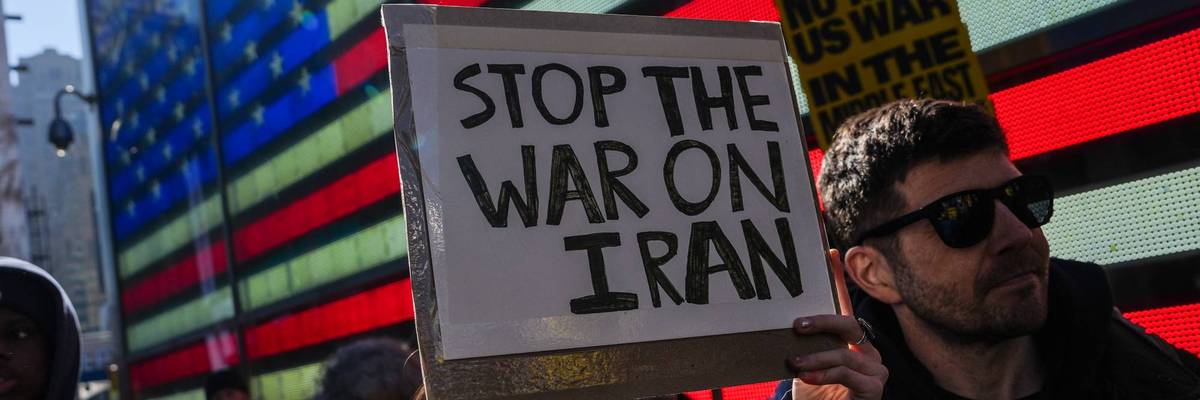
Protesters gather in Times Square as the nation reacts to "major combat operations" in Iran on February 28, 2026 in New York City.
Blaming Israel alone for this catastrophe lets US leaders off the hook for their actions.
The US and Israel have launched a deadly—and spreading war—against Iran. Since the conflict could easily become one of the drawn out and catastrophic wars that President Donald Trump postured against when campaigning, many are asking if Israel dragged Trump into this disaster. But while Israel definitely lobbied the White House to attack Iran—and it is partnering with the US in the war—it did not “drag” the US into it.
The truth is, leaders in the US were all too willing to launch this war on their own. We need to hold them accountable—and to beware of fringe, antisemitic conspiracy theorists who blame Jewish people or institutions for the Trump administration’s own well-documented militarism.
There is no question that Israeli Prime Minister Benjamin Netanyahu and other Israeli leaders pushed the US to join them in attacking Iran.
Both Netanyahu and the Israeli military’s chief of staff visited Washington just weeks before the war. And when asked why the US attacked Iran when it did, US Secretary of State Marco Rubio pointed to Israel’s influence. "We knew that there was going to be an Israeli action,” Rubio said. “We knew that that would precipitate an attack against American forces, and we knew that if we didn’t preemptively go after them before they launched those attacks, we would suffer higher casualties.”
While Netanyahu has been pushing for a war like this, he was not pushing an unwilling or reluctant US government.
More recently, Joe Kent—the director of the National Counterterrorism Center—resigned in opposition to the war, saying that “it is clear that we started this war due to pressure from Israel and its powerful American lobby.”
Most Americans opposed the war before it started, and it has proven divisive among the president’s highest profile MAGA supporters. The White House has been vague and contradictory on why it wanted to attack Iran, what the goals of the war are, and how long it will last.
If Americans do not want the war, and the White House cannot explain it, it is reasonable to conclude that it is driven by some outside force. And given Netanyahu’s long-standing belligerence toward Iran—which he has claimed was an imminent threat for 30 years while positioning himself as the one who could defeat it—and Trump’s closeness with the Israeli leader, the notion that the US has been pulled into Israel’s war is a fair conclusion to draw.
But in addition to the fact that this war is the latest and most extensive example of a global rampage by Trump’s Pentagon, there has been enthusiasm in Washington for decades to attack Iran in particular. And while Netanyahu has been pushing for a war like this, he was not pushing an unwilling or reluctant US government. Blaming Israel for this catastrophe lets US leaders off the hook for their actions.
US hostility toward Iran goes back more than half a century. In 1953, the CIA collaborated with British intelligence and authoritarian Iranian forces to overthrow the democratically elected government of Mohammed Mossadegh—a leader who sought to nationalize Iran’s oil, which the US and United Kingdom saw as a threat. The coup installed Mohammed Reza Pahlavi as Iran’s monarch, and his regime—which was supported and armed by Washington—ruled the country through widespread torture and other severe political repression.
When the Iranian Revolution overthrew Pahlavi’s government in 1979, revolutionaries associated the US government with the old regime and took US embassy staff hostage. The hostage crisis marked a turning point, with Washington adopting a hostile stance against Iran ever since. This has centrally involved US-imposed economic sanctions against Iran, which have devastated generations of Iranians—denying them lifesaving and life-easing medicines and crashing Iran’s currency.
Washington also has a long history of military violence against Iran and its people. The US armed both sides of the horrific Iran-Iraq War of the 1980s, and the US Navy shot down an Iranian civilian airplane in 1988, killing all 290 people onboard. During Trump’s first term, he unilaterally backed the US out of a nuclear agreement—which Iran was fully complying with, according to the United Nation’s nuclear watchdog agency—in favor of what he called the “Maximum Pressure” campaign. This involved deploying US naval ships off the coast of Iran and almost bombing the country in 2019 (Trump called off the attack “10 minutes before” warplanes were supposed to strike). In 2020, as part of the same campaign, Trump assassinated Iranian military and political leader General Qasem Soleimani in Iraq.
In fact, Donald Trump has publicly called for attacking Iran with the military since 1980. In his assaults on Iran during his first and second terms, Trump is following through on long-held desires. But those desires are not his alone—there has been a decades-long drive for war against Iran in a powerful section of Washington’s foreign policy establishment. A popular saying in the Beltway during the US buildup toward invading Iraq in 2003 was “everyone wants to go to Baghdad; real men want to go to Tehran.”
Figures like John Bolton, Trump’s former national security adviser; Mike Waltz, Trump’s current US ambassador to the UN; and Sen. Lindsey Graham (R-SC), who commands a powerful position in the Senate and agitated for this war, all embody Washington’s deeply rooted and powerfully positioned Iran war lobby. When Trump mused in 2020 about destroying Iranian cultural sites with US air strikes in 2020, now Defense Secretary Pete Hegseth said, “I don’t care about Iranian cultural sites.”
These attitudes are not expressions of some manipulation by Israel. They wholly belong to the American men at the helm of Washington’s war machine.
The US also, of course, has a long history of arming Israel and providing cover for the state’s crimes against the Palestinians and many others.
The close strategic relationship between the US and Israel began in 1967, when Israel invaded and occupied the West Bank and Gaza, as well as parts of Egypt, Lebanon, and Syria. The state’s aggression helped the Cold War-driven Pentagon realize its strategic value in fighting against Soviet influence. Since then, the two countries have collaborated militarily in numerous covert and open military operations and full-scale wars. And both presidents Joe Biden and Trump supported Israel’s genocide in Gaza, providing Israel $22 billion in military aid from 2024 to 2025 alone.
The war on Iran is a joint US and Israeli venture. Stopping it requires us to confront the militarism of both countries.
Israel has more power in its relationship with the US than it once did. When the US invaded Iraq in 1991 and Saddam Hussein launched missiles at Israel to draw the country into the war and divide Arab allies of the US, President George H.W. Bush told Israel not to respond. Israel followed orders and held. It is hard to imagine Israel standing down similarly today. But this new level of Israeli power is resulting in greater collaboration between Washington and Tel Aviv, with Washington all too willing to make sure its partner conducts its ever more aggressive actions with impunity.
Today’s war against Iran, now spreading across the region and beyond, reflects decades of close military partnership, escalating to new intensity under the leadership of Benjamin Netanyahu and Donald Trump—who have more in common than their far-right politics. Both leaders face political and legal challenges at home, and both see war as a distraction from those problems.
They also see the opportunity to consolidate Washington and Tel Aviv’s global and regional domination, respectively. Iran remains the most significant challenger to the US and Israel in the Middle East, so Israel certainly didn’t have to “drag” an unwilling US into war against Iran.
Another reason to be careful about the argument that this is “Israel’s war” is that it easily aligns with antisemitic conspiracy theories that suggest that shadowy Jewish institutions are manipulating Washington to act against its interests.
It is not antisemitic to notice or criticize the outsized role that Israel plays in US politics and especially in this war. But the loudest voices arguing that this is a “war for Israel” are of far-right figures like Marjorie Taylor Greene and Tucker Carlson—whose promotion of antisemitism is well known—and now Joe Kent, who previously associated with (and distanced himself from, as his profile in politics grew) antisemites like Nick Fuentes, Paul Gosar, and Greyson Arnold. Their prominence in the conversation demands vigilance and clarity that antisemitism has no place in our emerging anti-war movement.
The war on Iran is a joint US and Israeli venture. Stopping it requires us to confront the militarism of both countries. At a time when officials like Rubio are shrugging off their own responsibility in this catastrophe, the people of this country need to hold them accountable for their actions and stop this war.
Dear Common Dreams reader, It’s been nearly 30 years since I co-founded Common Dreams with my late wife, Lina Newhouser. We had the radical notion that journalism should serve the public good, not corporate profits. It was clear to us from the outset what it would take to build such a project. No paid advertisements. No corporate sponsors. No millionaire publisher telling us what to think or do. Many people said we wouldn't last a year, but we proved those doubters wrong. Together with a tremendous team of journalists and dedicated staff, we built an independent media outlet free from the constraints of profits and corporate control. Our mission has always been simple: To inform. To inspire. To ignite change for the common good. Building Common Dreams was not easy. Our survival was never guaranteed. When you take on the most powerful forces—Wall Street greed, fossil fuel industry destruction, Big Tech lobbyists, and uber-rich oligarchs who have spent billions upon billions rigging the economy and democracy in their favor—the only bulwark you have is supporters who believe in your work. But here’s the urgent message from me today. It's never been this bad out there. And it's never been this hard to keep us going. At the very moment Common Dreams is most needed, the threats we face are intensifying. We need your support now more than ever. We don't accept corporate advertising and never will. We don't have a paywall because we don't think people should be blocked from critical news based on their ability to pay. Everything we do is funded by the donations of readers like you. When everyone does the little they can afford, we are strong. But if that support retreats or dries up, so do we. Will you donate now to make sure Common Dreams not only survives but thrives? —Craig Brown, Co-founder |
The US and Israel have launched a deadly—and spreading war—against Iran. Since the conflict could easily become one of the drawn out and catastrophic wars that President Donald Trump postured against when campaigning, many are asking if Israel dragged Trump into this disaster. But while Israel definitely lobbied the White House to attack Iran—and it is partnering with the US in the war—it did not “drag” the US into it.
The truth is, leaders in the US were all too willing to launch this war on their own. We need to hold them accountable—and to beware of fringe, antisemitic conspiracy theorists who blame Jewish people or institutions for the Trump administration’s own well-documented militarism.
There is no question that Israeli Prime Minister Benjamin Netanyahu and other Israeli leaders pushed the US to join them in attacking Iran.
Both Netanyahu and the Israeli military’s chief of staff visited Washington just weeks before the war. And when asked why the US attacked Iran when it did, US Secretary of State Marco Rubio pointed to Israel’s influence. "We knew that there was going to be an Israeli action,” Rubio said. “We knew that that would precipitate an attack against American forces, and we knew that if we didn’t preemptively go after them before they launched those attacks, we would suffer higher casualties.”
While Netanyahu has been pushing for a war like this, he was not pushing an unwilling or reluctant US government.
More recently, Joe Kent—the director of the National Counterterrorism Center—resigned in opposition to the war, saying that “it is clear that we started this war due to pressure from Israel and its powerful American lobby.”
Most Americans opposed the war before it started, and it has proven divisive among the president’s highest profile MAGA supporters. The White House has been vague and contradictory on why it wanted to attack Iran, what the goals of the war are, and how long it will last.
If Americans do not want the war, and the White House cannot explain it, it is reasonable to conclude that it is driven by some outside force. And given Netanyahu’s long-standing belligerence toward Iran—which he has claimed was an imminent threat for 30 years while positioning himself as the one who could defeat it—and Trump’s closeness with the Israeli leader, the notion that the US has been pulled into Israel’s war is a fair conclusion to draw.
But in addition to the fact that this war is the latest and most extensive example of a global rampage by Trump’s Pentagon, there has been enthusiasm in Washington for decades to attack Iran in particular. And while Netanyahu has been pushing for a war like this, he was not pushing an unwilling or reluctant US government. Blaming Israel for this catastrophe lets US leaders off the hook for their actions.
US hostility toward Iran goes back more than half a century. In 1953, the CIA collaborated with British intelligence and authoritarian Iranian forces to overthrow the democratically elected government of Mohammed Mossadegh—a leader who sought to nationalize Iran’s oil, which the US and United Kingdom saw as a threat. The coup installed Mohammed Reza Pahlavi as Iran’s monarch, and his regime—which was supported and armed by Washington—ruled the country through widespread torture and other severe political repression.
When the Iranian Revolution overthrew Pahlavi’s government in 1979, revolutionaries associated the US government with the old regime and took US embassy staff hostage. The hostage crisis marked a turning point, with Washington adopting a hostile stance against Iran ever since. This has centrally involved US-imposed economic sanctions against Iran, which have devastated generations of Iranians—denying them lifesaving and life-easing medicines and crashing Iran’s currency.
Washington also has a long history of military violence against Iran and its people. The US armed both sides of the horrific Iran-Iraq War of the 1980s, and the US Navy shot down an Iranian civilian airplane in 1988, killing all 290 people onboard. During Trump’s first term, he unilaterally backed the US out of a nuclear agreement—which Iran was fully complying with, according to the United Nation’s nuclear watchdog agency—in favor of what he called the “Maximum Pressure” campaign. This involved deploying US naval ships off the coast of Iran and almost bombing the country in 2019 (Trump called off the attack “10 minutes before” warplanes were supposed to strike). In 2020, as part of the same campaign, Trump assassinated Iranian military and political leader General Qasem Soleimani in Iraq.
In fact, Donald Trump has publicly called for attacking Iran with the military since 1980. In his assaults on Iran during his first and second terms, Trump is following through on long-held desires. But those desires are not his alone—there has been a decades-long drive for war against Iran in a powerful section of Washington’s foreign policy establishment. A popular saying in the Beltway during the US buildup toward invading Iraq in 2003 was “everyone wants to go to Baghdad; real men want to go to Tehran.”
Figures like John Bolton, Trump’s former national security adviser; Mike Waltz, Trump’s current US ambassador to the UN; and Sen. Lindsey Graham (R-SC), who commands a powerful position in the Senate and agitated for this war, all embody Washington’s deeply rooted and powerfully positioned Iran war lobby. When Trump mused in 2020 about destroying Iranian cultural sites with US air strikes in 2020, now Defense Secretary Pete Hegseth said, “I don’t care about Iranian cultural sites.”
These attitudes are not expressions of some manipulation by Israel. They wholly belong to the American men at the helm of Washington’s war machine.
The US also, of course, has a long history of arming Israel and providing cover for the state’s crimes against the Palestinians and many others.
The close strategic relationship between the US and Israel began in 1967, when Israel invaded and occupied the West Bank and Gaza, as well as parts of Egypt, Lebanon, and Syria. The state’s aggression helped the Cold War-driven Pentagon realize its strategic value in fighting against Soviet influence. Since then, the two countries have collaborated militarily in numerous covert and open military operations and full-scale wars. And both presidents Joe Biden and Trump supported Israel’s genocide in Gaza, providing Israel $22 billion in military aid from 2024 to 2025 alone.
The war on Iran is a joint US and Israeli venture. Stopping it requires us to confront the militarism of both countries.
Israel has more power in its relationship with the US than it once did. When the US invaded Iraq in 1991 and Saddam Hussein launched missiles at Israel to draw the country into the war and divide Arab allies of the US, President George H.W. Bush told Israel not to respond. Israel followed orders and held. It is hard to imagine Israel standing down similarly today. But this new level of Israeli power is resulting in greater collaboration between Washington and Tel Aviv, with Washington all too willing to make sure its partner conducts its ever more aggressive actions with impunity.
Today’s war against Iran, now spreading across the region and beyond, reflects decades of close military partnership, escalating to new intensity under the leadership of Benjamin Netanyahu and Donald Trump—who have more in common than their far-right politics. Both leaders face political and legal challenges at home, and both see war as a distraction from those problems.
They also see the opportunity to consolidate Washington and Tel Aviv’s global and regional domination, respectively. Iran remains the most significant challenger to the US and Israel in the Middle East, so Israel certainly didn’t have to “drag” an unwilling US into war against Iran.
Another reason to be careful about the argument that this is “Israel’s war” is that it easily aligns with antisemitic conspiracy theories that suggest that shadowy Jewish institutions are manipulating Washington to act against its interests.
It is not antisemitic to notice or criticize the outsized role that Israel plays in US politics and especially in this war. But the loudest voices arguing that this is a “war for Israel” are of far-right figures like Marjorie Taylor Greene and Tucker Carlson—whose promotion of antisemitism is well known—and now Joe Kent, who previously associated with (and distanced himself from, as his profile in politics grew) antisemites like Nick Fuentes, Paul Gosar, and Greyson Arnold. Their prominence in the conversation demands vigilance and clarity that antisemitism has no place in our emerging anti-war movement.
The war on Iran is a joint US and Israeli venture. Stopping it requires us to confront the militarism of both countries. At a time when officials like Rubio are shrugging off their own responsibility in this catastrophe, the people of this country need to hold them accountable for their actions and stop this war.
The US and Israel have launched a deadly—and spreading war—against Iran. Since the conflict could easily become one of the drawn out and catastrophic wars that President Donald Trump postured against when campaigning, many are asking if Israel dragged Trump into this disaster. But while Israel definitely lobbied the White House to attack Iran—and it is partnering with the US in the war—it did not “drag” the US into it.
The truth is, leaders in the US were all too willing to launch this war on their own. We need to hold them accountable—and to beware of fringe, antisemitic conspiracy theorists who blame Jewish people or institutions for the Trump administration’s own well-documented militarism.
There is no question that Israeli Prime Minister Benjamin Netanyahu and other Israeli leaders pushed the US to join them in attacking Iran.
Both Netanyahu and the Israeli military’s chief of staff visited Washington just weeks before the war. And when asked why the US attacked Iran when it did, US Secretary of State Marco Rubio pointed to Israel’s influence. "We knew that there was going to be an Israeli action,” Rubio said. “We knew that that would precipitate an attack against American forces, and we knew that if we didn’t preemptively go after them before they launched those attacks, we would suffer higher casualties.”
While Netanyahu has been pushing for a war like this, he was not pushing an unwilling or reluctant US government.
More recently, Joe Kent—the director of the National Counterterrorism Center—resigned in opposition to the war, saying that “it is clear that we started this war due to pressure from Israel and its powerful American lobby.”
Most Americans opposed the war before it started, and it has proven divisive among the president’s highest profile MAGA supporters. The White House has been vague and contradictory on why it wanted to attack Iran, what the goals of the war are, and how long it will last.
If Americans do not want the war, and the White House cannot explain it, it is reasonable to conclude that it is driven by some outside force. And given Netanyahu’s long-standing belligerence toward Iran—which he has claimed was an imminent threat for 30 years while positioning himself as the one who could defeat it—and Trump’s closeness with the Israeli leader, the notion that the US has been pulled into Israel’s war is a fair conclusion to draw.
But in addition to the fact that this war is the latest and most extensive example of a global rampage by Trump’s Pentagon, there has been enthusiasm in Washington for decades to attack Iran in particular. And while Netanyahu has been pushing for a war like this, he was not pushing an unwilling or reluctant US government. Blaming Israel for this catastrophe lets US leaders off the hook for their actions.
US hostility toward Iran goes back more than half a century. In 1953, the CIA collaborated with British intelligence and authoritarian Iranian forces to overthrow the democratically elected government of Mohammed Mossadegh—a leader who sought to nationalize Iran’s oil, which the US and United Kingdom saw as a threat. The coup installed Mohammed Reza Pahlavi as Iran’s monarch, and his regime—which was supported and armed by Washington—ruled the country through widespread torture and other severe political repression.
When the Iranian Revolution overthrew Pahlavi’s government in 1979, revolutionaries associated the US government with the old regime and took US embassy staff hostage. The hostage crisis marked a turning point, with Washington adopting a hostile stance against Iran ever since. This has centrally involved US-imposed economic sanctions against Iran, which have devastated generations of Iranians—denying them lifesaving and life-easing medicines and crashing Iran’s currency.
Washington also has a long history of military violence against Iran and its people. The US armed both sides of the horrific Iran-Iraq War of the 1980s, and the US Navy shot down an Iranian civilian airplane in 1988, killing all 290 people onboard. During Trump’s first term, he unilaterally backed the US out of a nuclear agreement—which Iran was fully complying with, according to the United Nation’s nuclear watchdog agency—in favor of what he called the “Maximum Pressure” campaign. This involved deploying US naval ships off the coast of Iran and almost bombing the country in 2019 (Trump called off the attack “10 minutes before” warplanes were supposed to strike). In 2020, as part of the same campaign, Trump assassinated Iranian military and political leader General Qasem Soleimani in Iraq.
In fact, Donald Trump has publicly called for attacking Iran with the military since 1980. In his assaults on Iran during his first and second terms, Trump is following through on long-held desires. But those desires are not his alone—there has been a decades-long drive for war against Iran in a powerful section of Washington’s foreign policy establishment. A popular saying in the Beltway during the US buildup toward invading Iraq in 2003 was “everyone wants to go to Baghdad; real men want to go to Tehran.”
Figures like John Bolton, Trump’s former national security adviser; Mike Waltz, Trump’s current US ambassador to the UN; and Sen. Lindsey Graham (R-SC), who commands a powerful position in the Senate and agitated for this war, all embody Washington’s deeply rooted and powerfully positioned Iran war lobby. When Trump mused in 2020 about destroying Iranian cultural sites with US air strikes in 2020, now Defense Secretary Pete Hegseth said, “I don’t care about Iranian cultural sites.”
These attitudes are not expressions of some manipulation by Israel. They wholly belong to the American men at the helm of Washington’s war machine.
The US also, of course, has a long history of arming Israel and providing cover for the state’s crimes against the Palestinians and many others.
The close strategic relationship between the US and Israel began in 1967, when Israel invaded and occupied the West Bank and Gaza, as well as parts of Egypt, Lebanon, and Syria. The state’s aggression helped the Cold War-driven Pentagon realize its strategic value in fighting against Soviet influence. Since then, the two countries have collaborated militarily in numerous covert and open military operations and full-scale wars. And both presidents Joe Biden and Trump supported Israel’s genocide in Gaza, providing Israel $22 billion in military aid from 2024 to 2025 alone.
The war on Iran is a joint US and Israeli venture. Stopping it requires us to confront the militarism of both countries.
Israel has more power in its relationship with the US than it once did. When the US invaded Iraq in 1991 and Saddam Hussein launched missiles at Israel to draw the country into the war and divide Arab allies of the US, President George H.W. Bush told Israel not to respond. Israel followed orders and held. It is hard to imagine Israel standing down similarly today. But this new level of Israeli power is resulting in greater collaboration between Washington and Tel Aviv, with Washington all too willing to make sure its partner conducts its ever more aggressive actions with impunity.
Today’s war against Iran, now spreading across the region and beyond, reflects decades of close military partnership, escalating to new intensity under the leadership of Benjamin Netanyahu and Donald Trump—who have more in common than their far-right politics. Both leaders face political and legal challenges at home, and both see war as a distraction from those problems.
They also see the opportunity to consolidate Washington and Tel Aviv’s global and regional domination, respectively. Iran remains the most significant challenger to the US and Israel in the Middle East, so Israel certainly didn’t have to “drag” an unwilling US into war against Iran.
Another reason to be careful about the argument that this is “Israel’s war” is that it easily aligns with antisemitic conspiracy theories that suggest that shadowy Jewish institutions are manipulating Washington to act against its interests.
It is not antisemitic to notice or criticize the outsized role that Israel plays in US politics and especially in this war. But the loudest voices arguing that this is a “war for Israel” are of far-right figures like Marjorie Taylor Greene and Tucker Carlson—whose promotion of antisemitism is well known—and now Joe Kent, who previously associated with (and distanced himself from, as his profile in politics grew) antisemites like Nick Fuentes, Paul Gosar, and Greyson Arnold. Their prominence in the conversation demands vigilance and clarity that antisemitism has no place in our emerging anti-war movement.
The war on Iran is a joint US and Israeli venture. Stopping it requires us to confront the militarism of both countries. At a time when officials like Rubio are shrugging off their own responsibility in this catastrophe, the people of this country need to hold them accountable for their actions and stop this war.