SUBSCRIBE TO OUR FREE NEWSLETTER
Daily news & progressive opinion—funded by the people, not the corporations—delivered straight to your inbox.
5
#000000
#FFFFFF
To donate by check, phone, or other method, see our More Ways to Give page.
Daily news & progressive opinion—funded by the people, not the corporations—delivered straight to your inbox.
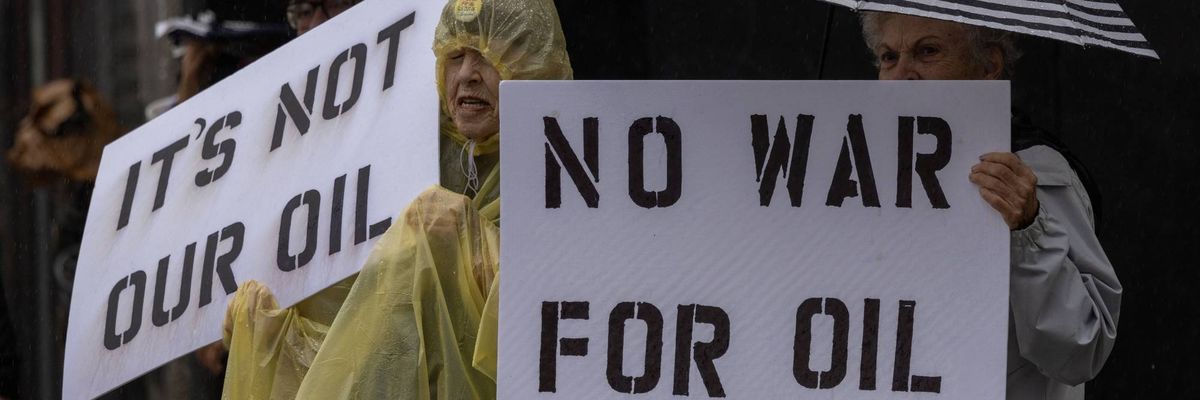
People participate in a 'No War on Venezuela' protest in the rain on January 3, 2026 in Los Angeles, California. The United States invaded Venezuela with a "large-scale strike" this morning and President Nicolás Maduro and his wife were captured by Special Forces and taken to the United States, according to President Trump who also announced that "we will run the country".
Hopefully, the sociopolitical reaction to the US invasion of Venezuela will, instead of deepening our oil dependency, actually contribute to our recovery.
The Trump administration’s extraordinary, illegal attack on Venezuela was always about oil, and now the whole world knows that Mr. Trump lied all along about his real interest in Venezuela. This was not about stopping the flow of dangerous drugs, but was about increasing the flow of the dangerous drug some pushers want to keep us all hooked on—oil.
As such, this seems a good time to reexamine our nation’s destructive addiction to oil.
The first step in recovering from addiction is to tell the truth—admit the addiction, acknowledge its consequences. Yet this is something we still seem unwilling to do with our addiction to oil. Addicts would rather stay high than confront their addiction and commit to recovery.
The truth about oil is that while there are benefits—jobs, energy, government revenue, etc.—there are also enormous long-term risks, impacts and costs. And while government and industry extol the benefits of oil, they remain unwilling to tell the truth about its costs or to aggressively pursue sustainable alternatives.
Some costs are obvious. Oil spills, such as the 1989 Exxon Valdez in Alaska and the 2010 Deepwater Horizon in the Gulf of Mexico, are easily recognizable disasters that attract widespread public condemnation. Many oil-producing areas of the world, such as the Niger Delta, the Caspian Sea, Siberia and the Amazon, continue to suffer from decades of chronic oil spills.
Indeed, the age of oil is ending, but the hard-core oil addicts in government and industry remain unwilling to concede the fact or to embrace a sustainable energy future. Clearly, a lot of damage can and will occur in the waning years of oil.
But the true cost of oil goes far beyond the obvious damage from spills. More gradual, less visible costs of oil include ecological habitat degradation from exploration, production and pipelines; health costs from breathing polluted air; urban sprawl, traffic congestion and deadly accidents in all major cities; and seemingly endless wars fought to secure oil supplies, costing thousands of lives and trillions of dollars.
Climate change from carbon emissions is incurring enormous present and future costs—storm damage, drought, wildfires, lost agricultural productivity, infrastructure damage, climate refugees, disease, forest decline, marine ecosystem collapse, species extinction and lost ecosystem services—already exceeding $1 trillion a year.
Wherever it is produced, there arises a "sociopolitical toxicity" of oil—a significant distortion of economic, social and political systems. Rather than the prosperity promised, oil discoveries around the world often become more curse than blessing, causing social dysfunction, assimilation of indigenous cultures, inflation, decline in traditional exports, corruption, crime and unsustainable growth.
In oil-producing regions of the world—including the US and the states of Alaska, Louisiana, Texas, and North Dakota—governments are "captured" and controlled by oil interests ensuring policies to limit regulation, lower taxation, and to favor increased oil production and demand over development of sustainable low-carbon alternatives. In Alaska, 50 years of oil has distorted and corrupted many elements of government and society, including the state university system and the media.
The addictive power of oil was recognized as early as 1939, when Saudi Arabia's King Abdul Aziz joked: "Do you know what they will find when they reach Mars? They will find Americans out there in the desert hunting for oil."
Former Venezuelan oil minister Juan Pablo Perez Alfonso, a founder of OPEC and once a true believer in the promise of oil, thought differently after he saw the corruption, greed, waste, debt, and decay it caused, and came to call oil "the devil's excrement."
Today, the world uses more than 100 million barrels of oil a day, with the US alone accounting for over 20 million barrels per day. We have already pumped and burned over one trillion barrels, and there may be another trillion barrels of recoverable "conventional" oil left, along with several trillion barrels in unconventional reserves such as tar sands and oil shale formations.
But if we want anything resembling a sustainable future, we simply have to leave most of this oil buried right where it is in the ground and seabed, as the global atmosphere and biosphere cannot handle much more additional carbon without becoming dangerously unstable.
Yet the oil pushers see trillions of dollars just waiting to be dug up and are anxious to get to it regardless of the consequences. There seems no end to their greed and disregard for our planetary environment and common future.
As with any addiction, when the easy stuff is gone and supplies tighten, hard-core addicts become desperate and willing to take more risk to secure the next fix, such as fracking, drilling in the Arctic and deep ocean basin, and invading oil-rich countries.
President George W. Bush stunned the world in his 2006 State of the Union speech, admitting that "we have a serious problem, America is addicted to oil," yet his administration did virtually nothing to wean us from our oil addiction.
Despite candidate Obama's promise to end "the tyranny of oil," and that if he was elected, "the rise of the oceans will begin to slow," as President, Mr. Obama boasted that "We're opening up more than 75 percent of our potential oil resources offshore. We've quadrupled the number of operating rigs to a record high. We've added enough new oil and gas pipeline to encircle the Earth, and then some." US oil production steadily increased throughout the Obama presidency.
And although President Joe Biden repeatedly declared his intention to transition the nation away from fossil fuels in order to combat climate change, US oil production reached record levels during his administration.
The seas continue to rise, and the tyranny of oil continues.
Governments encourage fossil fuel addiction with annual subsidies of some $7 trillion globally, including $760 billion per year in the US in subsidies, tax breaks, and “unpriced externalities.” So much for the “free-market.” These government fossil fuel subsidies artificially depress prices and encourage overconsumption; compete with government spending on health care, education and social services; and keep alternative energy "uncompetitive" – just as the oil pushers want.
Studies have estimated that for every gallon of gasoline we buy at the pump, we are actually paying as much as $14 a gallon in additional "hidden" costs. Yet, we continue to ignore these hidden costs, paying some indirectly through income taxes, while deferring most to future generations. We are tricking ourselves into using "cheap and easy" oil as fast as we can pump it out of the ground.
The 2010 Supreme Court “Citizens United” ruling allowed oil companies and others to pour unlimited funds into oil-friendly candidates and issues, without public disclosure. And millions have been spent on a strategic disinformation campaign (by government and industry) to deceive the public about the real costs of oil.
Clearly, the oil pushers are running the show.
Perhaps the most pernicious cost of oil is that it fueled a dangerous, unsustainable expansion of the ecological footprint of human civilization. With access to artificially "cheap and easy" oil over the past century, human population quadrupled and resource consumption increased many times more, now significantly exceeding Earth's carrying capacity. Without access to fossil carbon, humanity almost certainly would have evolved on a more sustainable trajectory. But by not accounting for its true cost, oil has allowed us to dig ourselves deeper into a dangerous, unsustainable hole. The environmental debt we are accruing is far larger and more consequential than our national financial debt.
The sooner we get to the far side of our troubled oil addiction, the better chance we have at a sustainable future.
It's high time we kicked the oil habit. The full "social cost of carbon" has been estimated at $50 to $200 per ton of CO2, and with global emissions now exceeding 40 billion tons per year, this would amount to $2 trillion to $8 trillion in total damages annually. When we account for these very real costs, sustainable alternatives become competitive and we make more rational choices.
Government needs to correct this self-destructive dynamic by eliminating all fossil fuel subsidies, reducing emissions through regulation, instituting a carbon tax to capture the long-term “hidden” cost of carbon, and applying the former subsidies and carbon tax revenues to support the low-carbon energy transition.
As Sheikh Zaki Yamani, a former Saudi Arabian oil minister, once famously said, "The stone age did not end for lack of stones, and the oil age will end long before the world runs out of oil."
Indeed, the age of oil is ending, but the hard-core oil addicts in government and industry remain unwilling to concede the fact or to embrace a sustainable energy future. Clearly, a lot of damage can and will occur in the waning years of oil.
Hopefully, the sociopolitical reaction to the US invasion of Venezuela will, instead of deepening our oil dependency, actually contribute to our recovery.
The sooner we get to the far side of our troubled oil addiction, the better chance we have at a sustainable future. Then, like most recovering addicts, we will wonder why we didn't get clean sooner.
Dear Common Dreams reader, It’s been nearly 30 years since I co-founded Common Dreams with my late wife, Lina Newhouser. We had the radical notion that journalism should serve the public good, not corporate profits. It was clear to us from the outset what it would take to build such a project. No paid advertisements. No corporate sponsors. No millionaire publisher telling us what to think or do. Many people said we wouldn't last a year, but we proved those doubters wrong. Together with a tremendous team of journalists and dedicated staff, we built an independent media outlet free from the constraints of profits and corporate control. Our mission has always been simple: To inform. To inspire. To ignite change for the common good. Building Common Dreams was not easy. Our survival was never guaranteed. When you take on the most powerful forces—Wall Street greed, fossil fuel industry destruction, Big Tech lobbyists, and uber-rich oligarchs who have spent billions upon billions rigging the economy and democracy in their favor—the only bulwark you have is supporters who believe in your work. But here’s the urgent message from me today. It's never been this bad out there. And it's never been this hard to keep us going. At the very moment Common Dreams is most needed, the threats we face are intensifying. We need your support now more than ever. We don't accept corporate advertising and never will. We don't have a paywall because we don't think people should be blocked from critical news based on their ability to pay. Everything we do is funded by the donations of readers like you. When everyone does the little they can afford, we are strong. But if that support retreats or dries up, so do we. Will you donate now to make sure Common Dreams not only survives but thrives? —Craig Brown, Co-founder |
The Trump administration’s extraordinary, illegal attack on Venezuela was always about oil, and now the whole world knows that Mr. Trump lied all along about his real interest in Venezuela. This was not about stopping the flow of dangerous drugs, but was about increasing the flow of the dangerous drug some pushers want to keep us all hooked on—oil.
As such, this seems a good time to reexamine our nation’s destructive addiction to oil.
The first step in recovering from addiction is to tell the truth—admit the addiction, acknowledge its consequences. Yet this is something we still seem unwilling to do with our addiction to oil. Addicts would rather stay high than confront their addiction and commit to recovery.
The truth about oil is that while there are benefits—jobs, energy, government revenue, etc.—there are also enormous long-term risks, impacts and costs. And while government and industry extol the benefits of oil, they remain unwilling to tell the truth about its costs or to aggressively pursue sustainable alternatives.
Some costs are obvious. Oil spills, such as the 1989 Exxon Valdez in Alaska and the 2010 Deepwater Horizon in the Gulf of Mexico, are easily recognizable disasters that attract widespread public condemnation. Many oil-producing areas of the world, such as the Niger Delta, the Caspian Sea, Siberia and the Amazon, continue to suffer from decades of chronic oil spills.
Indeed, the age of oil is ending, but the hard-core oil addicts in government and industry remain unwilling to concede the fact or to embrace a sustainable energy future. Clearly, a lot of damage can and will occur in the waning years of oil.
But the true cost of oil goes far beyond the obvious damage from spills. More gradual, less visible costs of oil include ecological habitat degradation from exploration, production and pipelines; health costs from breathing polluted air; urban sprawl, traffic congestion and deadly accidents in all major cities; and seemingly endless wars fought to secure oil supplies, costing thousands of lives and trillions of dollars.
Climate change from carbon emissions is incurring enormous present and future costs—storm damage, drought, wildfires, lost agricultural productivity, infrastructure damage, climate refugees, disease, forest decline, marine ecosystem collapse, species extinction and lost ecosystem services—already exceeding $1 trillion a year.
Wherever it is produced, there arises a "sociopolitical toxicity" of oil—a significant distortion of economic, social and political systems. Rather than the prosperity promised, oil discoveries around the world often become more curse than blessing, causing social dysfunction, assimilation of indigenous cultures, inflation, decline in traditional exports, corruption, crime and unsustainable growth.
In oil-producing regions of the world—including the US and the states of Alaska, Louisiana, Texas, and North Dakota—governments are "captured" and controlled by oil interests ensuring policies to limit regulation, lower taxation, and to favor increased oil production and demand over development of sustainable low-carbon alternatives. In Alaska, 50 years of oil has distorted and corrupted many elements of government and society, including the state university system and the media.
The addictive power of oil was recognized as early as 1939, when Saudi Arabia's King Abdul Aziz joked: "Do you know what they will find when they reach Mars? They will find Americans out there in the desert hunting for oil."
Former Venezuelan oil minister Juan Pablo Perez Alfonso, a founder of OPEC and once a true believer in the promise of oil, thought differently after he saw the corruption, greed, waste, debt, and decay it caused, and came to call oil "the devil's excrement."
Today, the world uses more than 100 million barrels of oil a day, with the US alone accounting for over 20 million barrels per day. We have already pumped and burned over one trillion barrels, and there may be another trillion barrels of recoverable "conventional" oil left, along with several trillion barrels in unconventional reserves such as tar sands and oil shale formations.
But if we want anything resembling a sustainable future, we simply have to leave most of this oil buried right where it is in the ground and seabed, as the global atmosphere and biosphere cannot handle much more additional carbon without becoming dangerously unstable.
Yet the oil pushers see trillions of dollars just waiting to be dug up and are anxious to get to it regardless of the consequences. There seems no end to their greed and disregard for our planetary environment and common future.
As with any addiction, when the easy stuff is gone and supplies tighten, hard-core addicts become desperate and willing to take more risk to secure the next fix, such as fracking, drilling in the Arctic and deep ocean basin, and invading oil-rich countries.
President George W. Bush stunned the world in his 2006 State of the Union speech, admitting that "we have a serious problem, America is addicted to oil," yet his administration did virtually nothing to wean us from our oil addiction.
Despite candidate Obama's promise to end "the tyranny of oil," and that if he was elected, "the rise of the oceans will begin to slow," as President, Mr. Obama boasted that "We're opening up more than 75 percent of our potential oil resources offshore. We've quadrupled the number of operating rigs to a record high. We've added enough new oil and gas pipeline to encircle the Earth, and then some." US oil production steadily increased throughout the Obama presidency.
And although President Joe Biden repeatedly declared his intention to transition the nation away from fossil fuels in order to combat climate change, US oil production reached record levels during his administration.
The seas continue to rise, and the tyranny of oil continues.
Governments encourage fossil fuel addiction with annual subsidies of some $7 trillion globally, including $760 billion per year in the US in subsidies, tax breaks, and “unpriced externalities.” So much for the “free-market.” These government fossil fuel subsidies artificially depress prices and encourage overconsumption; compete with government spending on health care, education and social services; and keep alternative energy "uncompetitive" – just as the oil pushers want.
Studies have estimated that for every gallon of gasoline we buy at the pump, we are actually paying as much as $14 a gallon in additional "hidden" costs. Yet, we continue to ignore these hidden costs, paying some indirectly through income taxes, while deferring most to future generations. We are tricking ourselves into using "cheap and easy" oil as fast as we can pump it out of the ground.
The 2010 Supreme Court “Citizens United” ruling allowed oil companies and others to pour unlimited funds into oil-friendly candidates and issues, without public disclosure. And millions have been spent on a strategic disinformation campaign (by government and industry) to deceive the public about the real costs of oil.
Clearly, the oil pushers are running the show.
Perhaps the most pernicious cost of oil is that it fueled a dangerous, unsustainable expansion of the ecological footprint of human civilization. With access to artificially "cheap and easy" oil over the past century, human population quadrupled and resource consumption increased many times more, now significantly exceeding Earth's carrying capacity. Without access to fossil carbon, humanity almost certainly would have evolved on a more sustainable trajectory. But by not accounting for its true cost, oil has allowed us to dig ourselves deeper into a dangerous, unsustainable hole. The environmental debt we are accruing is far larger and more consequential than our national financial debt.
The sooner we get to the far side of our troubled oil addiction, the better chance we have at a sustainable future.
It's high time we kicked the oil habit. The full "social cost of carbon" has been estimated at $50 to $200 per ton of CO2, and with global emissions now exceeding 40 billion tons per year, this would amount to $2 trillion to $8 trillion in total damages annually. When we account for these very real costs, sustainable alternatives become competitive and we make more rational choices.
Government needs to correct this self-destructive dynamic by eliminating all fossil fuel subsidies, reducing emissions through regulation, instituting a carbon tax to capture the long-term “hidden” cost of carbon, and applying the former subsidies and carbon tax revenues to support the low-carbon energy transition.
As Sheikh Zaki Yamani, a former Saudi Arabian oil minister, once famously said, "The stone age did not end for lack of stones, and the oil age will end long before the world runs out of oil."
Indeed, the age of oil is ending, but the hard-core oil addicts in government and industry remain unwilling to concede the fact or to embrace a sustainable energy future. Clearly, a lot of damage can and will occur in the waning years of oil.
Hopefully, the sociopolitical reaction to the US invasion of Venezuela will, instead of deepening our oil dependency, actually contribute to our recovery.
The sooner we get to the far side of our troubled oil addiction, the better chance we have at a sustainable future. Then, like most recovering addicts, we will wonder why we didn't get clean sooner.
The Trump administration’s extraordinary, illegal attack on Venezuela was always about oil, and now the whole world knows that Mr. Trump lied all along about his real interest in Venezuela. This was not about stopping the flow of dangerous drugs, but was about increasing the flow of the dangerous drug some pushers want to keep us all hooked on—oil.
As such, this seems a good time to reexamine our nation’s destructive addiction to oil.
The first step in recovering from addiction is to tell the truth—admit the addiction, acknowledge its consequences. Yet this is something we still seem unwilling to do with our addiction to oil. Addicts would rather stay high than confront their addiction and commit to recovery.
The truth about oil is that while there are benefits—jobs, energy, government revenue, etc.—there are also enormous long-term risks, impacts and costs. And while government and industry extol the benefits of oil, they remain unwilling to tell the truth about its costs or to aggressively pursue sustainable alternatives.
Some costs are obvious. Oil spills, such as the 1989 Exxon Valdez in Alaska and the 2010 Deepwater Horizon in the Gulf of Mexico, are easily recognizable disasters that attract widespread public condemnation. Many oil-producing areas of the world, such as the Niger Delta, the Caspian Sea, Siberia and the Amazon, continue to suffer from decades of chronic oil spills.
Indeed, the age of oil is ending, but the hard-core oil addicts in government and industry remain unwilling to concede the fact or to embrace a sustainable energy future. Clearly, a lot of damage can and will occur in the waning years of oil.
But the true cost of oil goes far beyond the obvious damage from spills. More gradual, less visible costs of oil include ecological habitat degradation from exploration, production and pipelines; health costs from breathing polluted air; urban sprawl, traffic congestion and deadly accidents in all major cities; and seemingly endless wars fought to secure oil supplies, costing thousands of lives and trillions of dollars.
Climate change from carbon emissions is incurring enormous present and future costs—storm damage, drought, wildfires, lost agricultural productivity, infrastructure damage, climate refugees, disease, forest decline, marine ecosystem collapse, species extinction and lost ecosystem services—already exceeding $1 trillion a year.
Wherever it is produced, there arises a "sociopolitical toxicity" of oil—a significant distortion of economic, social and political systems. Rather than the prosperity promised, oil discoveries around the world often become more curse than blessing, causing social dysfunction, assimilation of indigenous cultures, inflation, decline in traditional exports, corruption, crime and unsustainable growth.
In oil-producing regions of the world—including the US and the states of Alaska, Louisiana, Texas, and North Dakota—governments are "captured" and controlled by oil interests ensuring policies to limit regulation, lower taxation, and to favor increased oil production and demand over development of sustainable low-carbon alternatives. In Alaska, 50 years of oil has distorted and corrupted many elements of government and society, including the state university system and the media.
The addictive power of oil was recognized as early as 1939, when Saudi Arabia's King Abdul Aziz joked: "Do you know what they will find when they reach Mars? They will find Americans out there in the desert hunting for oil."
Former Venezuelan oil minister Juan Pablo Perez Alfonso, a founder of OPEC and once a true believer in the promise of oil, thought differently after he saw the corruption, greed, waste, debt, and decay it caused, and came to call oil "the devil's excrement."
Today, the world uses more than 100 million barrels of oil a day, with the US alone accounting for over 20 million barrels per day. We have already pumped and burned over one trillion barrels, and there may be another trillion barrels of recoverable "conventional" oil left, along with several trillion barrels in unconventional reserves such as tar sands and oil shale formations.
But if we want anything resembling a sustainable future, we simply have to leave most of this oil buried right where it is in the ground and seabed, as the global atmosphere and biosphere cannot handle much more additional carbon without becoming dangerously unstable.
Yet the oil pushers see trillions of dollars just waiting to be dug up and are anxious to get to it regardless of the consequences. There seems no end to their greed and disregard for our planetary environment and common future.
As with any addiction, when the easy stuff is gone and supplies tighten, hard-core addicts become desperate and willing to take more risk to secure the next fix, such as fracking, drilling in the Arctic and deep ocean basin, and invading oil-rich countries.
President George W. Bush stunned the world in his 2006 State of the Union speech, admitting that "we have a serious problem, America is addicted to oil," yet his administration did virtually nothing to wean us from our oil addiction.
Despite candidate Obama's promise to end "the tyranny of oil," and that if he was elected, "the rise of the oceans will begin to slow," as President, Mr. Obama boasted that "We're opening up more than 75 percent of our potential oil resources offshore. We've quadrupled the number of operating rigs to a record high. We've added enough new oil and gas pipeline to encircle the Earth, and then some." US oil production steadily increased throughout the Obama presidency.
And although President Joe Biden repeatedly declared his intention to transition the nation away from fossil fuels in order to combat climate change, US oil production reached record levels during his administration.
The seas continue to rise, and the tyranny of oil continues.
Governments encourage fossil fuel addiction with annual subsidies of some $7 trillion globally, including $760 billion per year in the US in subsidies, tax breaks, and “unpriced externalities.” So much for the “free-market.” These government fossil fuel subsidies artificially depress prices and encourage overconsumption; compete with government spending on health care, education and social services; and keep alternative energy "uncompetitive" – just as the oil pushers want.
Studies have estimated that for every gallon of gasoline we buy at the pump, we are actually paying as much as $14 a gallon in additional "hidden" costs. Yet, we continue to ignore these hidden costs, paying some indirectly through income taxes, while deferring most to future generations. We are tricking ourselves into using "cheap and easy" oil as fast as we can pump it out of the ground.
The 2010 Supreme Court “Citizens United” ruling allowed oil companies and others to pour unlimited funds into oil-friendly candidates and issues, without public disclosure. And millions have been spent on a strategic disinformation campaign (by government and industry) to deceive the public about the real costs of oil.
Clearly, the oil pushers are running the show.
Perhaps the most pernicious cost of oil is that it fueled a dangerous, unsustainable expansion of the ecological footprint of human civilization. With access to artificially "cheap and easy" oil over the past century, human population quadrupled and resource consumption increased many times more, now significantly exceeding Earth's carrying capacity. Without access to fossil carbon, humanity almost certainly would have evolved on a more sustainable trajectory. But by not accounting for its true cost, oil has allowed us to dig ourselves deeper into a dangerous, unsustainable hole. The environmental debt we are accruing is far larger and more consequential than our national financial debt.
The sooner we get to the far side of our troubled oil addiction, the better chance we have at a sustainable future.
It's high time we kicked the oil habit. The full "social cost of carbon" has been estimated at $50 to $200 per ton of CO2, and with global emissions now exceeding 40 billion tons per year, this would amount to $2 trillion to $8 trillion in total damages annually. When we account for these very real costs, sustainable alternatives become competitive and we make more rational choices.
Government needs to correct this self-destructive dynamic by eliminating all fossil fuel subsidies, reducing emissions through regulation, instituting a carbon tax to capture the long-term “hidden” cost of carbon, and applying the former subsidies and carbon tax revenues to support the low-carbon energy transition.
As Sheikh Zaki Yamani, a former Saudi Arabian oil minister, once famously said, "The stone age did not end for lack of stones, and the oil age will end long before the world runs out of oil."
Indeed, the age of oil is ending, but the hard-core oil addicts in government and industry remain unwilling to concede the fact or to embrace a sustainable energy future. Clearly, a lot of damage can and will occur in the waning years of oil.
Hopefully, the sociopolitical reaction to the US invasion of Venezuela will, instead of deepening our oil dependency, actually contribute to our recovery.
The sooner we get to the far side of our troubled oil addiction, the better chance we have at a sustainable future. Then, like most recovering addicts, we will wonder why we didn't get clean sooner.