
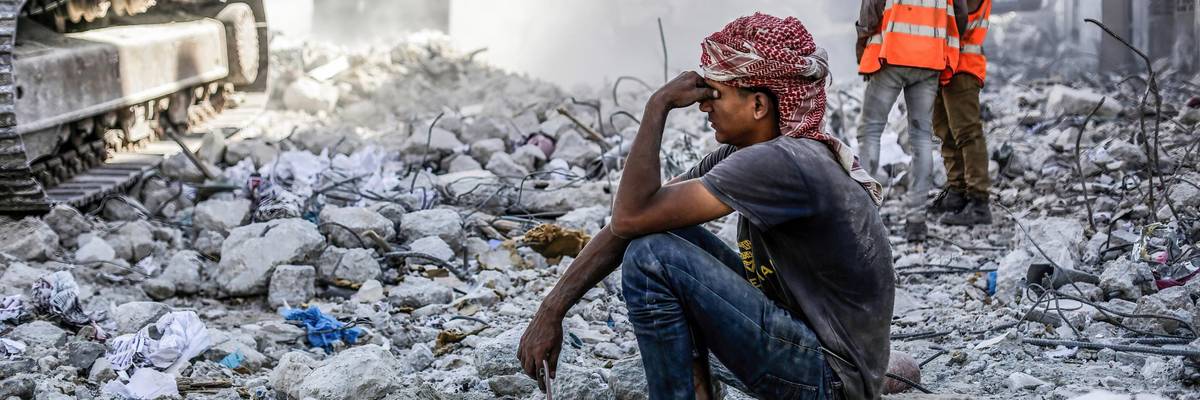
A Palestinian man sits on the rubble of a destroyed house in the Gaza Strip after 11 days of violence in May, 2023.
Calls for a Two-State Solution Provide a Distraction—Not Hope
What does invoking the two-state solution really mean after so many years of neglect, and the ensuing destruction and suffering inflicted on a colonized people? Will it translate into a real shift in U.S. policy?
For many Palestinians, talk of a two-state solution, or any other political resolution to the ongoing colonial conflict, sounds like a luxury given the urgent necessity of saving 2.3 million people in Gaza from Israel’s massive onslaught.
Stopping Israel’s genocidal war is a top priority for the Palestinian people, and for all people of conscience. They have thus received new talk from US President Joe Biden on the two-state illusion as little more than a distraction from the unprecedented atrocities being perpetrated by Israel, with Washington’s backing.
The revived U.S. rhetoric on this subject, framed as a vision to be pursued the day after the genocidal war ends, is conditioned on the achievement of Israel’s military plan to root out Hamas from Gaza, no matter how many civilians are killed or forcibly displaced in the process, or how much devastation is unleashed on the territory.
We are moving from a phase in which the mantra of the two-state solution has been used as cover for Israel’s colonisation of the West Bank and East Jerusalem, to one involving the extermination of Palestinians in Gaza, which has become the world’s biggest open-air concentration camp.
All of this is being justified by the need to remove the purported greatest obstacle to peace.
It is absurd to join together two such contradictory trajectories—one that talks of peace, and another that entails the ongoing process of exterminating a group of people who are supposed to benefit from the peace process.
But such a proposition is by no means unfamiliar within the context of US history, which began with the extermination of the indigenous population and extended to Iraq and Afghanistan by the 21st century. It is by design, based on the assumption that this is an opportune time to go ahead with a plan whose main goal is to guarantee the security of Israel and rebuild Washington’s regional alliances.
Real policy shift?
The American administration, stunned by the “shock and awe”-style Hamas operation, wants to take advantage of the mounting weaknesses of Israeli Prime Minister Benjamin Netanyahu, given his failure to defend his own citizens and to dismantle Hamas, in order to bring Israel and the Palestinian Authority (PA) back to the negotiating table.
But what does invoking the two-state solution really mean after so many years of neglect, and the ensuing destruction and suffering inflicted on a colonized people? Will it translate into a real shift in U.S. policy?
And is the two-state solution still a serious or viable option, given the entrenched settler project in the occupied West Bank and East Jerusalem, and the deepening fanaticism and trend towards fascism exacerbated by the current war? Is Washington’s version of the two-state solution the same one that the Palestinian leadership aspires to, and is the U.S. willing to put real pressure on Israel?
The prevailing atmosphere amid the Gaza war, and the spike in hatred between Palestinians and Israelis, are extremely discouraging. It is difficult to estimate just how much deeper the divide has grown, or whether any talk of a political solution that delivers even a bare minimum of rights to the Palestinian people is even relevant in such times.
Even after the current war ends, the broader conflict will continue so long as there is no just solution
Israeli society will likely emerge from this war with even less willingness to accept any compromise with Palestinians, especially since the Israeli regime has framed the 7 October attack as being disconnected from the grave historical injustices that it has inflicted on Palestinians.
Worse still has been the remobilization of Israeli society, misled into endorsing a blatantly genocidal mindset rooted in Zionist ideology. Israel’s settler-colonial policies dehumanize the Palestinian people, with the erasure of Palestinian culture and history since 1948 viewed as the fulfillment of a divine promise, or a national imperative.
In recent years, parts of Israeli society and mainstream media have become increasingly racist and insensitive to Palestinian suffering. This is why Palestinians have escalated their resistance struggle, despite having to make huge sacrifices. This fight for justice, decolonization, and liberation will never end; this is why Palestinians in Gaza refuse to abandon their homeland, even after 16 years of a cruel Israeli siege.
Biased broker
Even after the current war ends, the broader conflict will continue so long as there is no just solution. When this round of fighting subsides, the diplomacy will begin—but this process will be difficult and prolonged, and a great challenge for Palestinians because the U.S. has never been an unbiased broker.
If Israel succeeds in weakening Hamas and removing it from power in Gaza, as it seeks to do, the U.S. will need to guarantee the replacement of the far-right Israeli government with an administration willing to deal with the PA, which has been acting as a subcontractor for the Israeli occupation.
But it is difficult to foresee a genuine change in Israel’s position on Palestinian rights, amid looming internal strife over a planned judicial overhaul, which will likely be exacerbated after Netanyahu’s massive failure on 7 October. Such a change will come only after continued internal pressure, namely Palestinian and progressive co-resistance, and genuine international pressure.
Palestinians will emerge from this war having endured another horrific humanitarian catastrophe, unprecedented in scale since the 1948 Nakba. Yet, thanks to their resistance and remarkable steadfastness, they will also have made significant gains in terms of support and sympathy for their cause globally - most importantly in Western countries whose governments disgracefully gave full support to Israel’s genocidal war. Israel’s standing in the world has been further undermined, its lies and myths largely demolished.
A new generation has arisen with a new consciousness and knowledge of the justness of the Palestinian cause. This younger generation will continue to question their governments on their failures, imperialism, and complicity with war crimes.
The world is witnessing another wave of grassroots, alternative politics, with a focus on justice, liberation, and equality. Leaders and activists in this ever-expanding global movement see the Palestinian struggle as an extension of their own battles for justice at home.
Palestinians will again find themselves facing the challenge of how to unite and capitalize on these gains. Most Palestinians no longer believe in the two-state solution, as the Zionist regime has repeatedly proven its genocidal, settler-colonial intentions. The slogan “Palestine will be free from the river to the sea” will become an integral part of the Palestinian discourse, and attempts to criminalize it will fail.
This is not a genocidal slogan, but a noble goal that calls for the liberation of Palestinians from brutal apartheid, and the liberation of Israeli society from Zionism—allowing both Palestinians and Jews to live together in an egalitarian entity.
We are at a crossroads
This country and this world are at a monumental crossroads. In a few short weeks, US voters will have an opportunity to beat back the forces of fascism and confront the billionaires who are rigging the economy, our media system, and our democracy, making it increasingly impossible for ordinary people to get by. We’re not just talking about the election. We’re talking about what must be done once these fascist elements are vanquished from power. We need a bolder set of solutions than what either major party has so far been willing to offer and a working-class movement ready to fight like hell for it. Trump didn't emerge from nowhere. The conditions that fueled MAGA authoritarianism were created by decades of radical neoliberal economic policies and a corrupt political system dominated by corporate interests. They slashed taxes on the super-rich, promising that the benefits would trickle down. They said giveaways to the corporate titans would make life more affordable for the rest of us. It was all bullshit. And when a bitter, betrayed populace searches for someone to blame, right-wing demagogues have little trouble finding scapegoats. People know when they're being lied to, but you won't hear any of this from the corporate media. Only independent journalism—powered and funded by people who believe in building a better world—can deliver truly trustworthy daily news. Our Fall Campaign is underway, and we need your help. To power our newsroom through the rest of the year, we need to raise $125,000 by midnight on October 31. So if you share our vision, please contribute whatever you can to sustain our work. |
For many Palestinians, talk of a two-state solution, or any other political resolution to the ongoing colonial conflict, sounds like a luxury given the urgent necessity of saving 2.3 million people in Gaza from Israel’s massive onslaught.
Stopping Israel’s genocidal war is a top priority for the Palestinian people, and for all people of conscience. They have thus received new talk from US President Joe Biden on the two-state illusion as little more than a distraction from the unprecedented atrocities being perpetrated by Israel, with Washington’s backing.
The revived U.S. rhetoric on this subject, framed as a vision to be pursued the day after the genocidal war ends, is conditioned on the achievement of Israel’s military plan to root out Hamas from Gaza, no matter how many civilians are killed or forcibly displaced in the process, or how much devastation is unleashed on the territory.
We are moving from a phase in which the mantra of the two-state solution has been used as cover for Israel’s colonisation of the West Bank and East Jerusalem, to one involving the extermination of Palestinians in Gaza, which has become the world’s biggest open-air concentration camp.
All of this is being justified by the need to remove the purported greatest obstacle to peace.
It is absurd to join together two such contradictory trajectories—one that talks of peace, and another that entails the ongoing process of exterminating a group of people who are supposed to benefit from the peace process.
But such a proposition is by no means unfamiliar within the context of US history, which began with the extermination of the indigenous population and extended to Iraq and Afghanistan by the 21st century. It is by design, based on the assumption that this is an opportune time to go ahead with a plan whose main goal is to guarantee the security of Israel and rebuild Washington’s regional alliances.
Real policy shift?
The American administration, stunned by the “shock and awe”-style Hamas operation, wants to take advantage of the mounting weaknesses of Israeli Prime Minister Benjamin Netanyahu, given his failure to defend his own citizens and to dismantle Hamas, in order to bring Israel and the Palestinian Authority (PA) back to the negotiating table.
But what does invoking the two-state solution really mean after so many years of neglect, and the ensuing destruction and suffering inflicted on a colonized people? Will it translate into a real shift in U.S. policy?
And is the two-state solution still a serious or viable option, given the entrenched settler project in the occupied West Bank and East Jerusalem, and the deepening fanaticism and trend towards fascism exacerbated by the current war? Is Washington’s version of the two-state solution the same one that the Palestinian leadership aspires to, and is the U.S. willing to put real pressure on Israel?
The prevailing atmosphere amid the Gaza war, and the spike in hatred between Palestinians and Israelis, are extremely discouraging. It is difficult to estimate just how much deeper the divide has grown, or whether any talk of a political solution that delivers even a bare minimum of rights to the Palestinian people is even relevant in such times.
Even after the current war ends, the broader conflict will continue so long as there is no just solution
Israeli society will likely emerge from this war with even less willingness to accept any compromise with Palestinians, especially since the Israeli regime has framed the 7 October attack as being disconnected from the grave historical injustices that it has inflicted on Palestinians.
Worse still has been the remobilization of Israeli society, misled into endorsing a blatantly genocidal mindset rooted in Zionist ideology. Israel’s settler-colonial policies dehumanize the Palestinian people, with the erasure of Palestinian culture and history since 1948 viewed as the fulfillment of a divine promise, or a national imperative.
In recent years, parts of Israeli society and mainstream media have become increasingly racist and insensitive to Palestinian suffering. This is why Palestinians have escalated their resistance struggle, despite having to make huge sacrifices. This fight for justice, decolonization, and liberation will never end; this is why Palestinians in Gaza refuse to abandon their homeland, even after 16 years of a cruel Israeli siege.
Biased broker
Even after the current war ends, the broader conflict will continue so long as there is no just solution. When this round of fighting subsides, the diplomacy will begin—but this process will be difficult and prolonged, and a great challenge for Palestinians because the U.S. has never been an unbiased broker.
If Israel succeeds in weakening Hamas and removing it from power in Gaza, as it seeks to do, the U.S. will need to guarantee the replacement of the far-right Israeli government with an administration willing to deal with the PA, which has been acting as a subcontractor for the Israeli occupation.
But it is difficult to foresee a genuine change in Israel’s position on Palestinian rights, amid looming internal strife over a planned judicial overhaul, which will likely be exacerbated after Netanyahu’s massive failure on 7 October. Such a change will come only after continued internal pressure, namely Palestinian and progressive co-resistance, and genuine international pressure.
Palestinians will emerge from this war having endured another horrific humanitarian catastrophe, unprecedented in scale since the 1948 Nakba. Yet, thanks to their resistance and remarkable steadfastness, they will also have made significant gains in terms of support and sympathy for their cause globally - most importantly in Western countries whose governments disgracefully gave full support to Israel’s genocidal war. Israel’s standing in the world has been further undermined, its lies and myths largely demolished.
A new generation has arisen with a new consciousness and knowledge of the justness of the Palestinian cause. This younger generation will continue to question their governments on their failures, imperialism, and complicity with war crimes.
The world is witnessing another wave of grassroots, alternative politics, with a focus on justice, liberation, and equality. Leaders and activists in this ever-expanding global movement see the Palestinian struggle as an extension of their own battles for justice at home.
Palestinians will again find themselves facing the challenge of how to unite and capitalize on these gains. Most Palestinians no longer believe in the two-state solution, as the Zionist regime has repeatedly proven its genocidal, settler-colonial intentions. The slogan “Palestine will be free from the river to the sea” will become an integral part of the Palestinian discourse, and attempts to criminalize it will fail.
This is not a genocidal slogan, but a noble goal that calls for the liberation of Palestinians from brutal apartheid, and the liberation of Israeli society from Zionism—allowing both Palestinians and Jews to live together in an egalitarian entity.
For many Palestinians, talk of a two-state solution, or any other political resolution to the ongoing colonial conflict, sounds like a luxury given the urgent necessity of saving 2.3 million people in Gaza from Israel’s massive onslaught.
Stopping Israel’s genocidal war is a top priority for the Palestinian people, and for all people of conscience. They have thus received new talk from US President Joe Biden on the two-state illusion as little more than a distraction from the unprecedented atrocities being perpetrated by Israel, with Washington’s backing.
The revived U.S. rhetoric on this subject, framed as a vision to be pursued the day after the genocidal war ends, is conditioned on the achievement of Israel’s military plan to root out Hamas from Gaza, no matter how many civilians are killed or forcibly displaced in the process, or how much devastation is unleashed on the territory.
We are moving from a phase in which the mantra of the two-state solution has been used as cover for Israel’s colonisation of the West Bank and East Jerusalem, to one involving the extermination of Palestinians in Gaza, which has become the world’s biggest open-air concentration camp.
All of this is being justified by the need to remove the purported greatest obstacle to peace.
It is absurd to join together two such contradictory trajectories—one that talks of peace, and another that entails the ongoing process of exterminating a group of people who are supposed to benefit from the peace process.
But such a proposition is by no means unfamiliar within the context of US history, which began with the extermination of the indigenous population and extended to Iraq and Afghanistan by the 21st century. It is by design, based on the assumption that this is an opportune time to go ahead with a plan whose main goal is to guarantee the security of Israel and rebuild Washington’s regional alliances.
Real policy shift?
The American administration, stunned by the “shock and awe”-style Hamas operation, wants to take advantage of the mounting weaknesses of Israeli Prime Minister Benjamin Netanyahu, given his failure to defend his own citizens and to dismantle Hamas, in order to bring Israel and the Palestinian Authority (PA) back to the negotiating table.
But what does invoking the two-state solution really mean after so many years of neglect, and the ensuing destruction and suffering inflicted on a colonized people? Will it translate into a real shift in U.S. policy?
And is the two-state solution still a serious or viable option, given the entrenched settler project in the occupied West Bank and East Jerusalem, and the deepening fanaticism and trend towards fascism exacerbated by the current war? Is Washington’s version of the two-state solution the same one that the Palestinian leadership aspires to, and is the U.S. willing to put real pressure on Israel?
The prevailing atmosphere amid the Gaza war, and the spike in hatred between Palestinians and Israelis, are extremely discouraging. It is difficult to estimate just how much deeper the divide has grown, or whether any talk of a political solution that delivers even a bare minimum of rights to the Palestinian people is even relevant in such times.
Even after the current war ends, the broader conflict will continue so long as there is no just solution
Israeli society will likely emerge from this war with even less willingness to accept any compromise with Palestinians, especially since the Israeli regime has framed the 7 October attack as being disconnected from the grave historical injustices that it has inflicted on Palestinians.
Worse still has been the remobilization of Israeli society, misled into endorsing a blatantly genocidal mindset rooted in Zionist ideology. Israel’s settler-colonial policies dehumanize the Palestinian people, with the erasure of Palestinian culture and history since 1948 viewed as the fulfillment of a divine promise, or a national imperative.
In recent years, parts of Israeli society and mainstream media have become increasingly racist and insensitive to Palestinian suffering. This is why Palestinians have escalated their resistance struggle, despite having to make huge sacrifices. This fight for justice, decolonization, and liberation will never end; this is why Palestinians in Gaza refuse to abandon their homeland, even after 16 years of a cruel Israeli siege.
Biased broker
Even after the current war ends, the broader conflict will continue so long as there is no just solution. When this round of fighting subsides, the diplomacy will begin—but this process will be difficult and prolonged, and a great challenge for Palestinians because the U.S. has never been an unbiased broker.
If Israel succeeds in weakening Hamas and removing it from power in Gaza, as it seeks to do, the U.S. will need to guarantee the replacement of the far-right Israeli government with an administration willing to deal with the PA, which has been acting as a subcontractor for the Israeli occupation.
But it is difficult to foresee a genuine change in Israel’s position on Palestinian rights, amid looming internal strife over a planned judicial overhaul, which will likely be exacerbated after Netanyahu’s massive failure on 7 October. Such a change will come only after continued internal pressure, namely Palestinian and progressive co-resistance, and genuine international pressure.
Palestinians will emerge from this war having endured another horrific humanitarian catastrophe, unprecedented in scale since the 1948 Nakba. Yet, thanks to their resistance and remarkable steadfastness, they will also have made significant gains in terms of support and sympathy for their cause globally - most importantly in Western countries whose governments disgracefully gave full support to Israel’s genocidal war. Israel’s standing in the world has been further undermined, its lies and myths largely demolished.
A new generation has arisen with a new consciousness and knowledge of the justness of the Palestinian cause. This younger generation will continue to question their governments on their failures, imperialism, and complicity with war crimes.
The world is witnessing another wave of grassroots, alternative politics, with a focus on justice, liberation, and equality. Leaders and activists in this ever-expanding global movement see the Palestinian struggle as an extension of their own battles for justice at home.
Palestinians will again find themselves facing the challenge of how to unite and capitalize on these gains. Most Palestinians no longer believe in the two-state solution, as the Zionist regime has repeatedly proven its genocidal, settler-colonial intentions. The slogan “Palestine will be free from the river to the sea” will become an integral part of the Palestinian discourse, and attempts to criminalize it will fail.
This is not a genocidal slogan, but a noble goal that calls for the liberation of Palestinians from brutal apartheid, and the liberation of Israeli society from Zionism—allowing both Palestinians and Jews to live together in an egalitarian entity.