SUBSCRIBE TO OUR FREE NEWSLETTER
Daily news & progressive opinion—funded by the people, not the corporations—delivered straight to your inbox.
5
#000000
#FFFFFF
To donate by check, phone, or other method, see our More Ways to Give page.
Daily news & progressive opinion—funded by the people, not the corporations—delivered straight to your inbox.
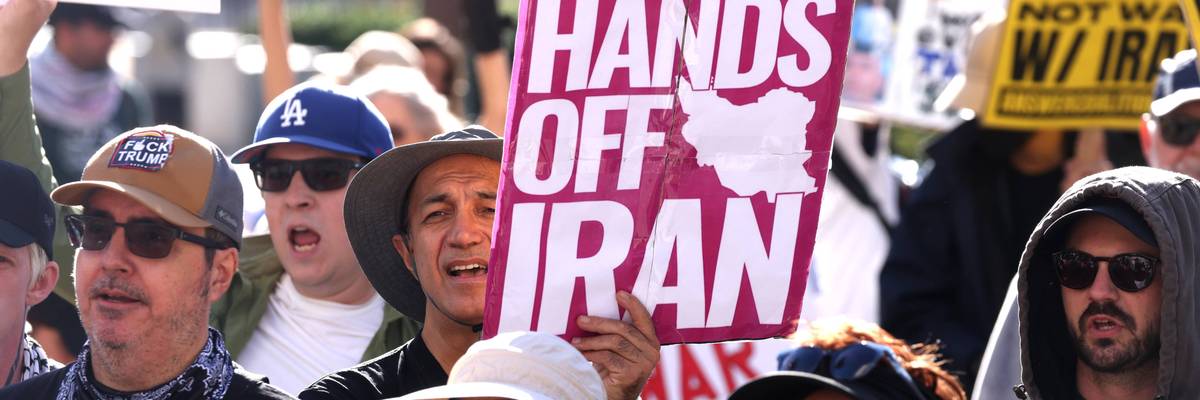
Over 200 people rally and protest the US and Israel war against Iran in front of city Hall in downtown Los Angeles on March 7, 2026.
Washington sold a two-week war with Iran. Now it’s asking Americans to absorb the costs at home.
Washington’s political discourse on the war with Iran took a revealing turn during President Donald Trump’s recent campaign remarks. Having originally sold the confrontation as a rapid, low-cost campaign destined to conclude within weeks, the administration abruptly reset its threshold of acceptable sacrifice. Trump declared that even if Iranian retaliatory strikes were to “take out” Los Angeles or San Diego, such catastrophic damage would remain “a small price” for American security. While the remarks drew immediate backlash across California leadership, the strategic implication runs far deeper. It marks the collapse of the Pentagon’s short-war doctrine, signaling that the conflict’s costs have migrated from West Asia directly to the American homeland.
At the onset of hostilities, the White House’s logic rested on absolute military preeminence. Superior firepower was supposed to impose a swift resolution, sparing Washington an attritional quagmire. But as weeks turned into months, the gap between promise and operational reality became unbridgeable. Rather than compelling capitulation, Washington met Iran’s resilient deterrence and asymmetric depth. Instead of seeing military burdens recede, the administration must now explain to voters why they must shoulder costs never accounted for in initial war plans.
Hawks defend this shift by claiming that conditioning the public for pain signals resolve and escalation dominance. Yet this justification collapses under scrutiny. Effective deterrence requires achievable political aims, not normalizing homeland destruction to obscure planning failures. Far from projecting strength, accepting strikes on major domestic metropolises reveals an inability to dictate terms militarily. It is the posture of an overextended power that has lost escalation control and is retroactively negotiating the price of strategic deadlock with its own electorate.
Dismissing devastation to these hubs as a “small price” reveals the transactional ethos of the ruling elite: Ordinary citizens and domestic infrastructure are treated as war livestock—herded to absorb the fallout of elite adventurism while their safety is traded away for unattainable geopolitical goals.
The dismissal of potential damage to California brings this cynicism into sharp relief. Los Angeles and San Diego are not incidental collateral; they anchor America’s defense architecture. San Diego serves as the premier home port of the Pacific Fleet Surface Navy, housing dozens of combatants and major Marine Corps installations, while Los Angeles anchors the nation’s primary aerospace and defense manufacturing cluster. Dismissing devastation to these hubs as a “small price” reveals the transactional ethos of the ruling elite: Ordinary citizens and domestic infrastructure are treated as war livestock—herded to absorb the fallout of elite adventurism while their safety is traded away for unattainable geopolitical goals.
This domestic vulnerability mirrors Washington’s strategic miscalculation in the Strait of Hormuz. Planners envisioned the waterway as a pressure point where naval coercion would rapidly force compliance. Instead, it became an economic trap. Protracted uncertainty across maritime routes, compounded by crisis-level war-risk insurance surcharges—premiums have surged from 0.10-0.25% of hull and machinery value pre-conflict to 3.5-7.5% per transit—and severe disruptions documented in the US Energy Information Administration’s (EIA) assessments of vital transit chokepoints, turned a tactical blitz into structural inflation. The EIA assumes the strait will remain effectively closed through late May before traffic gradually resumes. The very levers intended to force a rapid settlement have prolonged the conflict, imposing compounding penalties on American consumers.
The crisis extends beyond an elongated timeline; the political logic of the war has been inverted. Initially, military force was justified as a way to avert protracted costs. Today, that framework has become an exercise in retroactive justification. When the White House argues that metropolitan destruction is acceptable against abstract security objectives, the debate ceases to be about preventing the burdens of conflict. It becomes about forcing citizens to accept homeland vulnerability as the price of foreign policy failure.
The central question is no longer simply when Trump can announce that the war is over. The more important question is whether he can explain to the American public the gap between the promise of a “two-week war” and the reality of a protracted crisis. A war that was supposed to end with a rapid victory has instead become a conflict whose continuation requires explanations about fuel prices, the Strait of Hormuz, and even the security of American cities.
This shift exposes an irreconcilable contradiction in official messaging. Trump insists the conflict will end “very soon,” yet simultaneously prepares the public for catastrophic domestic losses. If the war were genuinely nearing a favorable conclusion, preparing the homeland for devastation would be irrational. If the destruction of major cities is a realistic possibility, the promise of a swift, contained campaign was fundamentally illusory. Washington cannot maintain both assertions: one is a fiction, the other an admission of failure.
Where did the two-week war go? The answer lies in Washington’s altered vocabulary: from promising minimal costs to declaring destruction at the heart of America tolerable. When leadership stops preventing the burdens of conflict and instead demands that citizens absorb them at home, the illusion of hegemonic control shatters. The two-week war collapsed against strategic overreach, leaving an administration trying to sell the sacrifice of its own cities as an acceptable price of power.
Dear Common Dreams reader, It’s been nearly 30 years since I co-founded Common Dreams with my late wife, Lina Newhouser. We had the radical notion that journalism should serve the public good, not corporate profits. It was clear to us from the outset what it would take to build such a project. No paid advertisements. No corporate sponsors. No millionaire publisher telling us what to think or do. Many people said we wouldn't last a year, but we proved those doubters wrong. Together with a tremendous team of journalists and dedicated staff, we built an independent media outlet free from the constraints of profits and corporate control. Our mission has always been simple: To inform. To inspire. To ignite change for the common good. Building Common Dreams was not easy. Our survival was never guaranteed. When you take on the most powerful forces—Wall Street greed, fossil fuel industry destruction, Big Tech lobbyists, and uber-rich oligarchs who have spent billions upon billions rigging the economy and democracy in their favor—the only bulwark you have is supporters who believe in your work. But here’s the urgent message from me today. It's never been this bad out there. And it's never been this hard to keep us going. At the very moment Common Dreams is most needed, the threats we face are intensifying. We need your support now more than ever. We don't accept corporate advertising and never will. We don't have a paywall because we don't think people should be blocked from critical news based on their ability to pay. Everything we do is funded by the donations of readers like you. When everyone does the little they can afford, we are strong. But if that support retreats or dries up, so do we. Will you donate now to make sure Common Dreams not only survives but thrives? —Craig Brown, Co-founder |
Washington’s political discourse on the war with Iran took a revealing turn during President Donald Trump’s recent campaign remarks. Having originally sold the confrontation as a rapid, low-cost campaign destined to conclude within weeks, the administration abruptly reset its threshold of acceptable sacrifice. Trump declared that even if Iranian retaliatory strikes were to “take out” Los Angeles or San Diego, such catastrophic damage would remain “a small price” for American security. While the remarks drew immediate backlash across California leadership, the strategic implication runs far deeper. It marks the collapse of the Pentagon’s short-war doctrine, signaling that the conflict’s costs have migrated from West Asia directly to the American homeland.
At the onset of hostilities, the White House’s logic rested on absolute military preeminence. Superior firepower was supposed to impose a swift resolution, sparing Washington an attritional quagmire. But as weeks turned into months, the gap between promise and operational reality became unbridgeable. Rather than compelling capitulation, Washington met Iran’s resilient deterrence and asymmetric depth. Instead of seeing military burdens recede, the administration must now explain to voters why they must shoulder costs never accounted for in initial war plans.
Hawks defend this shift by claiming that conditioning the public for pain signals resolve and escalation dominance. Yet this justification collapses under scrutiny. Effective deterrence requires achievable political aims, not normalizing homeland destruction to obscure planning failures. Far from projecting strength, accepting strikes on major domestic metropolises reveals an inability to dictate terms militarily. It is the posture of an overextended power that has lost escalation control and is retroactively negotiating the price of strategic deadlock with its own electorate.
Dismissing devastation to these hubs as a “small price” reveals the transactional ethos of the ruling elite: Ordinary citizens and domestic infrastructure are treated as war livestock—herded to absorb the fallout of elite adventurism while their safety is traded away for unattainable geopolitical goals.
The dismissal of potential damage to California brings this cynicism into sharp relief. Los Angeles and San Diego are not incidental collateral; they anchor America’s defense architecture. San Diego serves as the premier home port of the Pacific Fleet Surface Navy, housing dozens of combatants and major Marine Corps installations, while Los Angeles anchors the nation’s primary aerospace and defense manufacturing cluster. Dismissing devastation to these hubs as a “small price” reveals the transactional ethos of the ruling elite: Ordinary citizens and domestic infrastructure are treated as war livestock—herded to absorb the fallout of elite adventurism while their safety is traded away for unattainable geopolitical goals.
This domestic vulnerability mirrors Washington’s strategic miscalculation in the Strait of Hormuz. Planners envisioned the waterway as a pressure point where naval coercion would rapidly force compliance. Instead, it became an economic trap. Protracted uncertainty across maritime routes, compounded by crisis-level war-risk insurance surcharges—premiums have surged from 0.10-0.25% of hull and machinery value pre-conflict to 3.5-7.5% per transit—and severe disruptions documented in the US Energy Information Administration’s (EIA) assessments of vital transit chokepoints, turned a tactical blitz into structural inflation. The EIA assumes the strait will remain effectively closed through late May before traffic gradually resumes. The very levers intended to force a rapid settlement have prolonged the conflict, imposing compounding penalties on American consumers.
The crisis extends beyond an elongated timeline; the political logic of the war has been inverted. Initially, military force was justified as a way to avert protracted costs. Today, that framework has become an exercise in retroactive justification. When the White House argues that metropolitan destruction is acceptable against abstract security objectives, the debate ceases to be about preventing the burdens of conflict. It becomes about forcing citizens to accept homeland vulnerability as the price of foreign policy failure.
The central question is no longer simply when Trump can announce that the war is over. The more important question is whether he can explain to the American public the gap between the promise of a “two-week war” and the reality of a protracted crisis. A war that was supposed to end with a rapid victory has instead become a conflict whose continuation requires explanations about fuel prices, the Strait of Hormuz, and even the security of American cities.
This shift exposes an irreconcilable contradiction in official messaging. Trump insists the conflict will end “very soon,” yet simultaneously prepares the public for catastrophic domestic losses. If the war were genuinely nearing a favorable conclusion, preparing the homeland for devastation would be irrational. If the destruction of major cities is a realistic possibility, the promise of a swift, contained campaign was fundamentally illusory. Washington cannot maintain both assertions: one is a fiction, the other an admission of failure.
Where did the two-week war go? The answer lies in Washington’s altered vocabulary: from promising minimal costs to declaring destruction at the heart of America tolerable. When leadership stops preventing the burdens of conflict and instead demands that citizens absorb them at home, the illusion of hegemonic control shatters. The two-week war collapsed against strategic overreach, leaving an administration trying to sell the sacrifice of its own cities as an acceptable price of power.
Washington’s political discourse on the war with Iran took a revealing turn during President Donald Trump’s recent campaign remarks. Having originally sold the confrontation as a rapid, low-cost campaign destined to conclude within weeks, the administration abruptly reset its threshold of acceptable sacrifice. Trump declared that even if Iranian retaliatory strikes were to “take out” Los Angeles or San Diego, such catastrophic damage would remain “a small price” for American security. While the remarks drew immediate backlash across California leadership, the strategic implication runs far deeper. It marks the collapse of the Pentagon’s short-war doctrine, signaling that the conflict’s costs have migrated from West Asia directly to the American homeland.
At the onset of hostilities, the White House’s logic rested on absolute military preeminence. Superior firepower was supposed to impose a swift resolution, sparing Washington an attritional quagmire. But as weeks turned into months, the gap between promise and operational reality became unbridgeable. Rather than compelling capitulation, Washington met Iran’s resilient deterrence and asymmetric depth. Instead of seeing military burdens recede, the administration must now explain to voters why they must shoulder costs never accounted for in initial war plans.
Hawks defend this shift by claiming that conditioning the public for pain signals resolve and escalation dominance. Yet this justification collapses under scrutiny. Effective deterrence requires achievable political aims, not normalizing homeland destruction to obscure planning failures. Far from projecting strength, accepting strikes on major domestic metropolises reveals an inability to dictate terms militarily. It is the posture of an overextended power that has lost escalation control and is retroactively negotiating the price of strategic deadlock with its own electorate.
Dismissing devastation to these hubs as a “small price” reveals the transactional ethos of the ruling elite: Ordinary citizens and domestic infrastructure are treated as war livestock—herded to absorb the fallout of elite adventurism while their safety is traded away for unattainable geopolitical goals.
The dismissal of potential damage to California brings this cynicism into sharp relief. Los Angeles and San Diego are not incidental collateral; they anchor America’s defense architecture. San Diego serves as the premier home port of the Pacific Fleet Surface Navy, housing dozens of combatants and major Marine Corps installations, while Los Angeles anchors the nation’s primary aerospace and defense manufacturing cluster. Dismissing devastation to these hubs as a “small price” reveals the transactional ethos of the ruling elite: Ordinary citizens and domestic infrastructure are treated as war livestock—herded to absorb the fallout of elite adventurism while their safety is traded away for unattainable geopolitical goals.
This domestic vulnerability mirrors Washington’s strategic miscalculation in the Strait of Hormuz. Planners envisioned the waterway as a pressure point where naval coercion would rapidly force compliance. Instead, it became an economic trap. Protracted uncertainty across maritime routes, compounded by crisis-level war-risk insurance surcharges—premiums have surged from 0.10-0.25% of hull and machinery value pre-conflict to 3.5-7.5% per transit—and severe disruptions documented in the US Energy Information Administration’s (EIA) assessments of vital transit chokepoints, turned a tactical blitz into structural inflation. The EIA assumes the strait will remain effectively closed through late May before traffic gradually resumes. The very levers intended to force a rapid settlement have prolonged the conflict, imposing compounding penalties on American consumers.
The crisis extends beyond an elongated timeline; the political logic of the war has been inverted. Initially, military force was justified as a way to avert protracted costs. Today, that framework has become an exercise in retroactive justification. When the White House argues that metropolitan destruction is acceptable against abstract security objectives, the debate ceases to be about preventing the burdens of conflict. It becomes about forcing citizens to accept homeland vulnerability as the price of foreign policy failure.
The central question is no longer simply when Trump can announce that the war is over. The more important question is whether he can explain to the American public the gap between the promise of a “two-week war” and the reality of a protracted crisis. A war that was supposed to end with a rapid victory has instead become a conflict whose continuation requires explanations about fuel prices, the Strait of Hormuz, and even the security of American cities.
This shift exposes an irreconcilable contradiction in official messaging. Trump insists the conflict will end “very soon,” yet simultaneously prepares the public for catastrophic domestic losses. If the war were genuinely nearing a favorable conclusion, preparing the homeland for devastation would be irrational. If the destruction of major cities is a realistic possibility, the promise of a swift, contained campaign was fundamentally illusory. Washington cannot maintain both assertions: one is a fiction, the other an admission of failure.
Where did the two-week war go? The answer lies in Washington’s altered vocabulary: from promising minimal costs to declaring destruction at the heart of America tolerable. When leadership stops preventing the burdens of conflict and instead demands that citizens absorb them at home, the illusion of hegemonic control shatters. The two-week war collapsed against strategic overreach, leaving an administration trying to sell the sacrifice of its own cities as an acceptable price of power.