SUBSCRIBE TO OUR FREE NEWSLETTER
Daily news & progressive opinion—funded by the people, not the corporations—delivered straight to your inbox.
5
#000000
#FFFFFF
To donate by check, phone, or other method, see our More Ways to Give page.
Daily news & progressive opinion—funded by the people, not the corporations—delivered straight to your inbox.
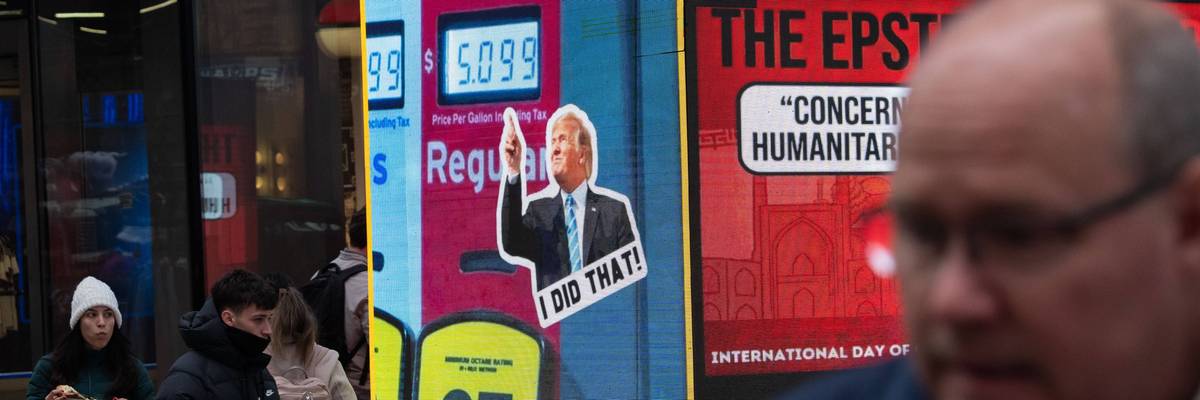
A truck with an image of US President Donald Trump and rising gas prices drives past during a rally for Al Quds Day on March 13, 2026 in New York City.
His reckless attack on Iran will do a hundred times more to promote clean energy worldwide than all the incentives in Biden’s Inflation Reduction Act.
President Donald Trump has an incredibly childish obsession with outdoing his predecessors, who he constantly derides as stupid and corrupt. There is, of course, no evidence for Trump’s charges, like the supposedly terrible economy he inherited from President Joe Biden, but Donald Trump is not a man who feels constrained by reality.
While Trump does everything he can to reverse policies to promote clean energy, overturn trade agreements (including his own), and undermine security pacts, there is one area where Trump looks to substantially outpace the work of his predecessors.
This is in promoting the transition to a non-fossil fuel-based economy. As much as Trump loves oil and coal and seems to relish the prospect of destroying the planet for our kids, his reckless attack on Iran will do a hundred times more to promote clean energy worldwide than all the incentives in Biden’s Inflation Reduction Act.
There is both the direct effect of higher oil and gas prices resulting from the closing of the Straits of Hormuz, but also a more important indirect effect. Trump has shown the world that it is dangerous to rely on imported oil and natural gas as energy sources.
It certainly was not the best way to promote a green transition, but no one can deny that Trump’s war is effective.
This applies not only to imports from the Middle East, which apparently any jerk can shut down on a whim. The risks probably apply even more strongly to reliance on the United States as an exporter, Trump’s preferred outcome.
In his tariff games, Trump showed he can be incredibly arbitrary and capricious. He claimed that countries were “ripping us off” because they sell us stuff. There is nothing resembling logic to Trump’s claim. Do Walmart or Costco rip people off when they buy things from them?
But it gets worse. He imposed 50% tariffs on Brazil’s exports because it prosecuted Trump’s friend for trying to overthrow the government. India also faces 50% tariffs on its exports to the US because its prime minister refused to nominate Trump for a Nobel Peace Prize. And Switzerland got hit with a 39% tariff because Trump didn’t like the way its president talked.
The rest of the world would likely much rather take its risks with countries like Iran and Libya than rely on getting oil and gas from Donald Trump’s America. At least there is usually some logic to when these countries threaten to reduce output or raise prices.
The rise in oil and gas prices following the closure of the Straits is making clean energy far more competitive than was already the case. Even with oil at $60 a barrel, and natural gas correspondingly cheap, the vast majority of electricity coming on line across the globe was renewable. This shift will only accelerate, with oil prices up 70% and natural gas having close to doubled. While prices may fall back some if the Straits are reopened soon, they are unlikely to return to their pre-war levels for several years in almost any circumstances.
And the price of wind and solar energy continues to fall, driven primarily by low-cost Chinese manufacturers. Chinese electric vehicles will also become hugely more popular as a result of Donald Trump’s war. These cars are already cheaper to purchase than comparable traditional cars, and Trump has just added roughly $500 a year to the operating cost of a gas-burning vehicle. Already 60% of the cars sold in China are electric, with EVs holding a comparable share in Europe. The same is the case in many developing countries. The EV share will likely quickly move toward 100% thanks to Trump’s war.
It certainly was not the best way to promote a green transition, but no one can deny that Trump’s war is effective. Who knows how much damage the war will ultimately cause in terms of property destruction, the environment, and lives lost. The latter will include both direct effects from the war and likely much larger indirect effects from higher energy and food prices. But one positive outcome is that we will be moving far more rapidly toward a green economy.
Dear Common Dreams reader, It’s been nearly 30 years since I co-founded Common Dreams with my late wife, Lina Newhouser. We had the radical notion that journalism should serve the public good, not corporate profits. It was clear to us from the outset what it would take to build such a project. No paid advertisements. No corporate sponsors. No millionaire publisher telling us what to think or do. Many people said we wouldn't last a year, but we proved those doubters wrong. Together with a tremendous team of journalists and dedicated staff, we built an independent media outlet free from the constraints of profits and corporate control. Our mission has always been simple: To inform. To inspire. To ignite change for the common good. Building Common Dreams was not easy. Our survival was never guaranteed. When you take on the most powerful forces—Wall Street greed, fossil fuel industry destruction, Big Tech lobbyists, and uber-rich oligarchs who have spent billions upon billions rigging the economy and democracy in their favor—the only bulwark you have is supporters who believe in your work. But here’s the urgent message from me today. It's never been this bad out there. And it's never been this hard to keep us going. At the very moment Common Dreams is most needed, the threats we face are intensifying. We need your support now more than ever. We don't accept corporate advertising and never will. We don't have a paywall because we don't think people should be blocked from critical news based on their ability to pay. Everything we do is funded by the donations of readers like you. When everyone does the little they can afford, we are strong. But if that support retreats or dries up, so do we. Will you donate now to make sure Common Dreams not only survives but thrives? —Craig Brown, Co-founder |
President Donald Trump has an incredibly childish obsession with outdoing his predecessors, who he constantly derides as stupid and corrupt. There is, of course, no evidence for Trump’s charges, like the supposedly terrible economy he inherited from President Joe Biden, but Donald Trump is not a man who feels constrained by reality.
While Trump does everything he can to reverse policies to promote clean energy, overturn trade agreements (including his own), and undermine security pacts, there is one area where Trump looks to substantially outpace the work of his predecessors.
This is in promoting the transition to a non-fossil fuel-based economy. As much as Trump loves oil and coal and seems to relish the prospect of destroying the planet for our kids, his reckless attack on Iran will do a hundred times more to promote clean energy worldwide than all the incentives in Biden’s Inflation Reduction Act.
There is both the direct effect of higher oil and gas prices resulting from the closing of the Straits of Hormuz, but also a more important indirect effect. Trump has shown the world that it is dangerous to rely on imported oil and natural gas as energy sources.
It certainly was not the best way to promote a green transition, but no one can deny that Trump’s war is effective.
This applies not only to imports from the Middle East, which apparently any jerk can shut down on a whim. The risks probably apply even more strongly to reliance on the United States as an exporter, Trump’s preferred outcome.
In his tariff games, Trump showed he can be incredibly arbitrary and capricious. He claimed that countries were “ripping us off” because they sell us stuff. There is nothing resembling logic to Trump’s claim. Do Walmart or Costco rip people off when they buy things from them?
But it gets worse. He imposed 50% tariffs on Brazil’s exports because it prosecuted Trump’s friend for trying to overthrow the government. India also faces 50% tariffs on its exports to the US because its prime minister refused to nominate Trump for a Nobel Peace Prize. And Switzerland got hit with a 39% tariff because Trump didn’t like the way its president talked.
The rest of the world would likely much rather take its risks with countries like Iran and Libya than rely on getting oil and gas from Donald Trump’s America. At least there is usually some logic to when these countries threaten to reduce output or raise prices.
The rise in oil and gas prices following the closure of the Straits is making clean energy far more competitive than was already the case. Even with oil at $60 a barrel, and natural gas correspondingly cheap, the vast majority of electricity coming on line across the globe was renewable. This shift will only accelerate, with oil prices up 70% and natural gas having close to doubled. While prices may fall back some if the Straits are reopened soon, they are unlikely to return to their pre-war levels for several years in almost any circumstances.
And the price of wind and solar energy continues to fall, driven primarily by low-cost Chinese manufacturers. Chinese electric vehicles will also become hugely more popular as a result of Donald Trump’s war. These cars are already cheaper to purchase than comparable traditional cars, and Trump has just added roughly $500 a year to the operating cost of a gas-burning vehicle. Already 60% of the cars sold in China are electric, with EVs holding a comparable share in Europe. The same is the case in many developing countries. The EV share will likely quickly move toward 100% thanks to Trump’s war.
It certainly was not the best way to promote a green transition, but no one can deny that Trump’s war is effective. Who knows how much damage the war will ultimately cause in terms of property destruction, the environment, and lives lost. The latter will include both direct effects from the war and likely much larger indirect effects from higher energy and food prices. But one positive outcome is that we will be moving far more rapidly toward a green economy.
President Donald Trump has an incredibly childish obsession with outdoing his predecessors, who he constantly derides as stupid and corrupt. There is, of course, no evidence for Trump’s charges, like the supposedly terrible economy he inherited from President Joe Biden, but Donald Trump is not a man who feels constrained by reality.
While Trump does everything he can to reverse policies to promote clean energy, overturn trade agreements (including his own), and undermine security pacts, there is one area where Trump looks to substantially outpace the work of his predecessors.
This is in promoting the transition to a non-fossil fuel-based economy. As much as Trump loves oil and coal and seems to relish the prospect of destroying the planet for our kids, his reckless attack on Iran will do a hundred times more to promote clean energy worldwide than all the incentives in Biden’s Inflation Reduction Act.
There is both the direct effect of higher oil and gas prices resulting from the closing of the Straits of Hormuz, but also a more important indirect effect. Trump has shown the world that it is dangerous to rely on imported oil and natural gas as energy sources.
It certainly was not the best way to promote a green transition, but no one can deny that Trump’s war is effective.
This applies not only to imports from the Middle East, which apparently any jerk can shut down on a whim. The risks probably apply even more strongly to reliance on the United States as an exporter, Trump’s preferred outcome.
In his tariff games, Trump showed he can be incredibly arbitrary and capricious. He claimed that countries were “ripping us off” because they sell us stuff. There is nothing resembling logic to Trump’s claim. Do Walmart or Costco rip people off when they buy things from them?
But it gets worse. He imposed 50% tariffs on Brazil’s exports because it prosecuted Trump’s friend for trying to overthrow the government. India also faces 50% tariffs on its exports to the US because its prime minister refused to nominate Trump for a Nobel Peace Prize. And Switzerland got hit with a 39% tariff because Trump didn’t like the way its president talked.
The rest of the world would likely much rather take its risks with countries like Iran and Libya than rely on getting oil and gas from Donald Trump’s America. At least there is usually some logic to when these countries threaten to reduce output or raise prices.
The rise in oil and gas prices following the closure of the Straits is making clean energy far more competitive than was already the case. Even with oil at $60 a barrel, and natural gas correspondingly cheap, the vast majority of electricity coming on line across the globe was renewable. This shift will only accelerate, with oil prices up 70% and natural gas having close to doubled. While prices may fall back some if the Straits are reopened soon, they are unlikely to return to their pre-war levels for several years in almost any circumstances.
And the price of wind and solar energy continues to fall, driven primarily by low-cost Chinese manufacturers. Chinese electric vehicles will also become hugely more popular as a result of Donald Trump’s war. These cars are already cheaper to purchase than comparable traditional cars, and Trump has just added roughly $500 a year to the operating cost of a gas-burning vehicle. Already 60% of the cars sold in China are electric, with EVs holding a comparable share in Europe. The same is the case in many developing countries. The EV share will likely quickly move toward 100% thanks to Trump’s war.
It certainly was not the best way to promote a green transition, but no one can deny that Trump’s war is effective. Who knows how much damage the war will ultimately cause in terms of property destruction, the environment, and lives lost. The latter will include both direct effects from the war and likely much larger indirect effects from higher energy and food prices. But one positive outcome is that we will be moving far more rapidly toward a green economy.