SUBSCRIBE TO OUR FREE NEWSLETTER
Daily news & progressive opinion—funded by the people, not the corporations—delivered straight to your inbox.
5
#000000
#FFFFFF
To donate by check, phone, or other method, see our More Ways to Give page.
As global citizens and world governments struggle to respond appropriately to the clear and present danger of a rapidly warming world, new figures show that the United States under President Donald Trump is going precisely backwards when it comes to meeting its obligation to reduce greenhouse gas pollution.
"This research shows that without taking critical measures to cut fossil-fuel emissions much more drastically, we are locking ourselves into the devastating consequences of climate change, including rising sea levels, more severe hurricanes and storms, wildfires, and more." --May Boeve, 350.orgAs the Washington Post reports on Tuesday:
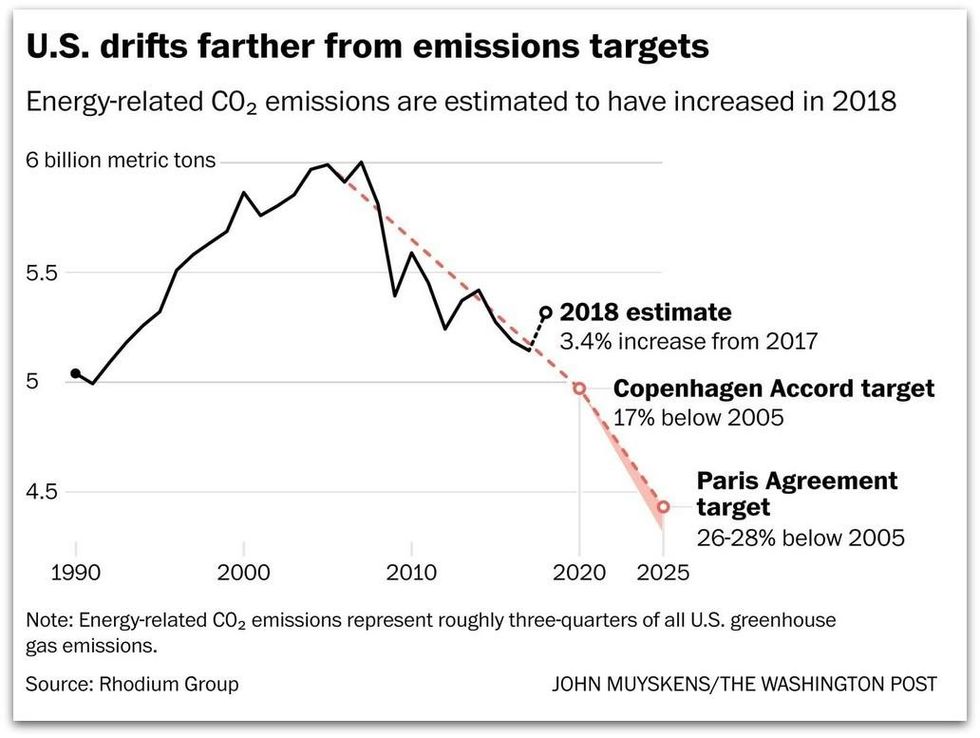
The findings, published Tuesday by the independent economic research firm Rhodium Group, mean that the United States now has a diminishing chance of meeting its pledge under the 2015 Paris climate agreement to dramatically reduce its emissions by 2025.
The findings also underscore how the world's second-largest emitter, once a global leader in pushing for climate action, has all but abandoned efforts to mitigate the effects of a warming world. President Trump has said he plans to officially withdraw the nation from the Paris climate agreement in 2020 and in the meantime has rolled back Obama-era regulations aimed at reducing the country's carbon emissions.
While the rising emissions are directly tied to a surging economy and particular to energy demands over the last several, Trevor Houser, a partner at Rhodium who worked on the study, told the Post that the increase would not have been as dramatic without the Trump administration's rollback of key Obama-era policies designed to confront the climate crisis that the current White House falsely claims does not even exist.
"I don't think you would have seen the same increase," Houser said of the emissions.
According to the Guardian, the jump in 2018 "is the biggest since the bounce back from the recession in 2010. It is the second largest gain in more than two decades." While Trump has ended U.S. support for the U.N.-backed Paris climate agreement, the new figures show just how far the country is now from the original commitment it made when Obama backed the deal in the second term of his presidency.
In response to the report, May Boeve, Executive Director 350.org, lamented the findings.
"There are consequences to government inaction," Boeve said in a statement. "This research shows that without taking critical measures to cut fossil-fuel emissions much more drastically, we are locking ourselves into the devastating consequences of climate change, including rising sea levels, more severe hurricanes and storms, wildfires, and more."
Despite the news, Boeve said her group is as determined as ever to combat the crisis. "We refuse to throw our hands up in defeat, because we know what must be done," she said. "With a new Congress in session, we demand they heed these warnings and step up to act at the scale of the crisis. We need to pass a Green New Deal and hold fossil fuel executives accountable for exacerbating climate change. We need Congress, and elected officials at all levels, to back bold climate policy that creates millions of family sustaining jobs in a just transition off fossil fuels to a 100% renewable economy. We have the solutions, and this is the only way that we can turn this around."
The Rhodium Group does not say it is impossible for the U.S. to meet its initial Paris obligations, the path the achieving those reductions is now going to be all that much harder.
"To meet the Paris Agreement target of a 26-28% reduction from 2005 levels by 2025, the US will need to reduce energy-related CO2 emissions by 2.6% on average over the next seven years -- and faster if declines in other gasses do not keep pace," the report notes. "That's more than twice the pace the US achieved between 2005 and 2017 and significantly faster than any seven-year average in US history. It is certainly feasible, but will likely require a fairly significant change in policy in the very near future and/or extremely favorable market and technological conditions."
As opinion columnist Will Bunch declared: "Thanks Trump."
Update: This story was updated from its original to include comment from 350.org's executive director May Boeve.
As global citizens and world governments struggle to respond appropriately to the clear and present danger of a rapidly warming world, new figures show that the United States under President Donald Trump is going precisely backwards when it comes to meeting its obligation to reduce greenhouse gas pollution.
"This research shows that without taking critical measures to cut fossil-fuel emissions much more drastically, we are locking ourselves into the devastating consequences of climate change, including rising sea levels, more severe hurricanes and storms, wildfires, and more." --May Boeve, 350.orgAs the Washington Post reports on Tuesday:
The findings, published Tuesday by the independent economic research firm Rhodium Group, mean that the United States now has a diminishing chance of meeting its pledge under the 2015 Paris climate agreement to dramatically reduce its emissions by 2025.
The findings also underscore how the world's second-largest emitter, once a global leader in pushing for climate action, has all but abandoned efforts to mitigate the effects of a warming world. President Trump has said he plans to officially withdraw the nation from the Paris climate agreement in 2020 and in the meantime has rolled back Obama-era regulations aimed at reducing the country's carbon emissions.
While the rising emissions are directly tied to a surging economy and particular to energy demands over the last several, Trevor Houser, a partner at Rhodium who worked on the study, told the Post that the increase would not have been as dramatic without the Trump administration's rollback of key Obama-era policies designed to confront the climate crisis that the current White House falsely claims does not even exist.
"I don't think you would have seen the same increase," Houser said of the emissions.
According to the Guardian, the jump in 2018 "is the biggest since the bounce back from the recession in 2010. It is the second largest gain in more than two decades." While Trump has ended U.S. support for the U.N.-backed Paris climate agreement, the new figures show just how far the country is now from the original commitment it made when Obama backed the deal in the second term of his presidency.
In response to the report, May Boeve, Executive Director 350.org, lamented the findings.
"There are consequences to government inaction," Boeve said in a statement. "This research shows that without taking critical measures to cut fossil-fuel emissions much more drastically, we are locking ourselves into the devastating consequences of climate change, including rising sea levels, more severe hurricanes and storms, wildfires, and more."
Despite the news, Boeve said her group is as determined as ever to combat the crisis. "We refuse to throw our hands up in defeat, because we know what must be done," she said. "With a new Congress in session, we demand they heed these warnings and step up to act at the scale of the crisis. We need to pass a Green New Deal and hold fossil fuel executives accountable for exacerbating climate change. We need Congress, and elected officials at all levels, to back bold climate policy that creates millions of family sustaining jobs in a just transition off fossil fuels to a 100% renewable economy. We have the solutions, and this is the only way that we can turn this around."
The Rhodium Group does not say it is impossible for the U.S. to meet its initial Paris obligations, the path the achieving those reductions is now going to be all that much harder.
"To meet the Paris Agreement target of a 26-28% reduction from 2005 levels by 2025, the US will need to reduce energy-related CO2 emissions by 2.6% on average over the next seven years -- and faster if declines in other gasses do not keep pace," the report notes. "That's more than twice the pace the US achieved between 2005 and 2017 and significantly faster than any seven-year average in US history. It is certainly feasible, but will likely require a fairly significant change in policy in the very near future and/or extremely favorable market and technological conditions."
As opinion columnist Will Bunch declared: "Thanks Trump."
Update: This story was updated from its original to include comment from 350.org's executive director May Boeve.
As global citizens and world governments struggle to respond appropriately to the clear and present danger of a rapidly warming world, new figures show that the United States under President Donald Trump is going precisely backwards when it comes to meeting its obligation to reduce greenhouse gas pollution.
"This research shows that without taking critical measures to cut fossil-fuel emissions much more drastically, we are locking ourselves into the devastating consequences of climate change, including rising sea levels, more severe hurricanes and storms, wildfires, and more." --May Boeve, 350.orgAs the Washington Post reports on Tuesday:
The findings, published Tuesday by the independent economic research firm Rhodium Group, mean that the United States now has a diminishing chance of meeting its pledge under the 2015 Paris climate agreement to dramatically reduce its emissions by 2025.
The findings also underscore how the world's second-largest emitter, once a global leader in pushing for climate action, has all but abandoned efforts to mitigate the effects of a warming world. President Trump has said he plans to officially withdraw the nation from the Paris climate agreement in 2020 and in the meantime has rolled back Obama-era regulations aimed at reducing the country's carbon emissions.
While the rising emissions are directly tied to a surging economy and particular to energy demands over the last several, Trevor Houser, a partner at Rhodium who worked on the study, told the Post that the increase would not have been as dramatic without the Trump administration's rollback of key Obama-era policies designed to confront the climate crisis that the current White House falsely claims does not even exist.
"I don't think you would have seen the same increase," Houser said of the emissions.
According to the Guardian, the jump in 2018 "is the biggest since the bounce back from the recession in 2010. It is the second largest gain in more than two decades." While Trump has ended U.S. support for the U.N.-backed Paris climate agreement, the new figures show just how far the country is now from the original commitment it made when Obama backed the deal in the second term of his presidency.
In response to the report, May Boeve, Executive Director 350.org, lamented the findings.
"There are consequences to government inaction," Boeve said in a statement. "This research shows that without taking critical measures to cut fossil-fuel emissions much more drastically, we are locking ourselves into the devastating consequences of climate change, including rising sea levels, more severe hurricanes and storms, wildfires, and more."
Despite the news, Boeve said her group is as determined as ever to combat the crisis. "We refuse to throw our hands up in defeat, because we know what must be done," she said. "With a new Congress in session, we demand they heed these warnings and step up to act at the scale of the crisis. We need to pass a Green New Deal and hold fossil fuel executives accountable for exacerbating climate change. We need Congress, and elected officials at all levels, to back bold climate policy that creates millions of family sustaining jobs in a just transition off fossil fuels to a 100% renewable economy. We have the solutions, and this is the only way that we can turn this around."
The Rhodium Group does not say it is impossible for the U.S. to meet its initial Paris obligations, the path the achieving those reductions is now going to be all that much harder.
"To meet the Paris Agreement target of a 26-28% reduction from 2005 levels by 2025, the US will need to reduce energy-related CO2 emissions by 2.6% on average over the next seven years -- and faster if declines in other gasses do not keep pace," the report notes. "That's more than twice the pace the US achieved between 2005 and 2017 and significantly faster than any seven-year average in US history. It is certainly feasible, but will likely require a fairly significant change in policy in the very near future and/or extremely favorable market and technological conditions."
As opinion columnist Will Bunch declared: "Thanks Trump."
Update: This story was updated from its original to include comment from 350.org's executive director May Boeve.