

SUBSCRIBE TO OUR FREE NEWSLETTER
Daily news & progressive opinion—funded by the people, not the corporations—delivered straight to your inbox.
5
#000000
#FFFFFF
To donate by check, phone, or other method, see our More Ways to Give page.
Daily news & progressive opinion—funded by the people, not the corporations—delivered straight to your inbox.
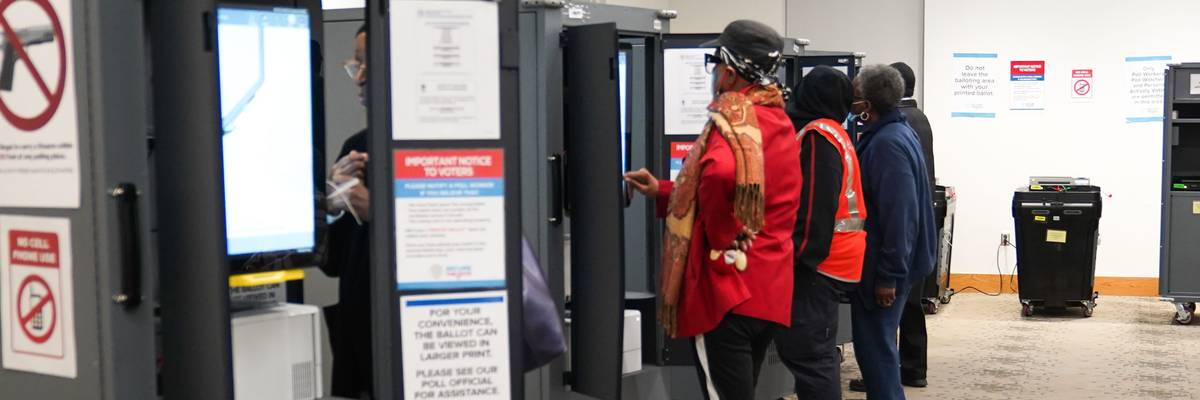
People cast their votes on the first day of early voting in the US presidential election at Metropolitan library on October 15, 2024 in Atlanta, Georgia.
Trump's project is less an effort to reform the electoral system than an attempt to hold it hostage from within its own legal machinery.
In the final days before Congress's summer recess, House Republicans advanced Donald Trump-backed voting restrictions by embedding them in legislation intended to prohibit members of Congress from trading stocks. The legislative tactic reveals the nature of a broader project: using formal legal channels to alter the balance the Constitution establishes among voters, the states, Congress, and institutions of oversight.
American democracy is not a fixed ideal; it is a delicate mechanism sustained by election laws and institutional constraints. For that reason, what Trump and his allies are pursuing under the banner of "election integrity" is not merely a revision of a few administrative procedures. Their proposed legislation would require proof of citizenship when registering to vote and photo identification at the ballot box and, alongside other proposals, would shift power away from voters and toward partisan institutions. That is the central contradiction: using the law as an instrument for hollowing out the spirit of the Constitution. From this perspective, Trump's project is less an effort to reform the electoral system than an attempt to hold it hostage from within its own legal machinery.
The first element of this project is an effort to revive the structural defect in the Electoral Count Act and the role of the vice president by reopening the very ambiguity that turned the transfer of power in 2021 into a national crisis. After January 6, lawmakers from both parties acknowledged that the Electoral Count Act of 1887 was unclear about the vice president's role and the process for objecting to state electoral votes. The Electoral Count Reform Act of 2022 clarified that the vice president's role is purely ceremonial and that the office carries no authority to reject a state's electoral votes. It also raised the threshold for filing an objection from one member of the House and one senator to one-fifth of the members of each chamber.
Trump's political logic draws from the same interpretation that, in 2020, sought to grant the vice president or Congress a role extending beyond the counting of electoral votes. Weakening the 2022 reforms, or interpreting them expansively, would revive the notion that partisan officials may decide the validity of an election result after the votes have been cast—the same ambiguity that brought the peaceful transfer of power to the brink of collapse in 2021.
Allowing a candidate to rewrite the rules of the game in order to shield himself from defeat is not election reform.
The second element is the weaponization of the "independent state legislature theory," an interpretation under which state legislatures would be largely insulated from review by state courts and state constitutions when regulating federal elections. In Moore v. Harper, the Supreme Court rejected the maximalist version of this theory by a 6-3 vote, affirming that state legislatures do not operate outside the legal framework of their own states.
The theory nevertheless remains attractive to Trump's project because it could detach the making of election rules—and, under crisis conditions, the selection of electors—from state-level systems of checks and balances and place that authority in the hands of aligned legislatures. When some of those legislatures do not accurately reflect the popular vote because of gerrymandering, removing gubernatorial and judicial oversight does not strengthen federalism. It concentrates power in a partisan institution.
The third element is the weakening of the Voting Rights Act under the guise of "integrity" through restrictions on voting. Strict identification requirements, voter-roll purges, and limits on absentee voting are justified as safeguards against fraud, but their burden falls more heavily on people with less access to official documents and administrative resources. This raises concerns under the 15th Amendment's prohibition on racial discrimination in voting and the 24th Amendment's ban on imposing a financial cost on the right to vote.
A disparate impact, by itself, is not sufficient to establish a violation. Yet Section 2 of the Voting Rights Act of 1965 prohibits practices that, under the totality of the circumstances, result in the denial or abridgment of voting rights on the basis of race, color, or membership in a language minority. Eliminating voting mechanisms on which low-income communities and minorities depend therefore cannot be justified simply by repeating allegations of fraud—particularly when Trump's sweeping claims of fraud in the 2020 election were not supported by credible evidence. The phrase "Jim Crow 2.0" refers precisely to this reproduction of voter disenfranchisement through modern administrative tools.
The fourth element is federalism in the abstract and the Republican contradiction over states' rights. For decades, the party has placed "states' rights" at the center of its political discourse and has denounced nationwide standards proposed by Democrats, such as the Freedom to Vote Act, as exercises in federal centralization. Yet Trump's project now calls on the federal government to impose stringent restrictions on voter registration and voting while simultaneously granting greater authority to aligned state legislatures.
The Constitution assigns shared roles to the states and Congress in the administration of federal elections. The Elections Clause in Article I gives the states primary authority, while also allowing Congress to alter election regulations. The problem lies in the selective use of this division of power: defending state autonomy when it obstructs the expansion of voting rights, and invoking federal authority when it entrenches restrictions favored by Republicans. This is no longer coherent federalism. It is an instrument for concentrating electoral power.
In the American legal system, elections are not merely political contests; they are legal processes that guarantee the legitimacy of government. The measures Trump presents as electoral cleanup or election integrity—from restricting access to the ballot to expanding the authority of state legislatures and weakening the safeguards adopted after January 6—all move in the same direction: transferring power away from voters and institutions of oversight and toward partisan actors who may determine both the rules and the validity of the result.
Opposition to this project should not be reduced to Democratic fears of losing elections. Defending the states' role in determining the method by which electors are chosen, judicial review, the lawful authority of Congress, and the equal voting rights of citizens means defending the balance that prevents the Constitution from becoming an administrative document placed at the service of one individual. Allowing a candidate to rewrite the rules of the game in order to shield himself from defeat is not election reform. It is the very danger the architects of the American republic sought to contain by dispersing power and constructing a system of mutual checks.
Dear Common Dreams reader, It’s been nearly 30 years since I co-founded Common Dreams with my late wife, Lina Newhouser. We had the radical notion that journalism should serve the public good, not corporate profits. It was clear to us from the outset what it would take to build such a project. No paid advertisements. No corporate sponsors. No millionaire publisher telling us what to think or do. Many people said we wouldn't last a year, but we proved those doubters wrong. Together with a tremendous team of journalists and dedicated staff, we built an independent media outlet free from the constraints of profits and corporate control. Our mission has always been simple: To inform. To inspire. To ignite change for the common good. Building Common Dreams was not easy. Our survival was never guaranteed. When you take on the most powerful forces—Wall Street greed, fossil fuel industry destruction, Big Tech lobbyists, and uber-rich oligarchs who have spent billions upon billions rigging the economy and democracy in their favor—the only bulwark you have is supporters who believe in your work. But here’s the urgent message from me today. It's never been this bad out there. And it's never been this hard to keep us going. At the very moment Common Dreams is most needed, the threats we face are intensifying. We need your support now more than ever. We don't accept corporate advertising and never will. We don't have a paywall because we don't think people should be blocked from critical news based on their ability to pay. Everything we do is funded by the donations of readers like you. When everyone does the little they can afford, we are strong. But if that support retreats or dries up, so do we. Will you donate now to make sure Common Dreams not only survives but thrives? —Craig Brown, Co-founder |
In the final days before Congress's summer recess, House Republicans advanced Donald Trump-backed voting restrictions by embedding them in legislation intended to prohibit members of Congress from trading stocks. The legislative tactic reveals the nature of a broader project: using formal legal channels to alter the balance the Constitution establishes among voters, the states, Congress, and institutions of oversight.
American democracy is not a fixed ideal; it is a delicate mechanism sustained by election laws and institutional constraints. For that reason, what Trump and his allies are pursuing under the banner of "election integrity" is not merely a revision of a few administrative procedures. Their proposed legislation would require proof of citizenship when registering to vote and photo identification at the ballot box and, alongside other proposals, would shift power away from voters and toward partisan institutions. That is the central contradiction: using the law as an instrument for hollowing out the spirit of the Constitution. From this perspective, Trump's project is less an effort to reform the electoral system than an attempt to hold it hostage from within its own legal machinery.
The first element of this project is an effort to revive the structural defect in the Electoral Count Act and the role of the vice president by reopening the very ambiguity that turned the transfer of power in 2021 into a national crisis. After January 6, lawmakers from both parties acknowledged that the Electoral Count Act of 1887 was unclear about the vice president's role and the process for objecting to state electoral votes. The Electoral Count Reform Act of 2022 clarified that the vice president's role is purely ceremonial and that the office carries no authority to reject a state's electoral votes. It also raised the threshold for filing an objection from one member of the House and one senator to one-fifth of the members of each chamber.
Trump's political logic draws from the same interpretation that, in 2020, sought to grant the vice president or Congress a role extending beyond the counting of electoral votes. Weakening the 2022 reforms, or interpreting them expansively, would revive the notion that partisan officials may decide the validity of an election result after the votes have been cast—the same ambiguity that brought the peaceful transfer of power to the brink of collapse in 2021.
Allowing a candidate to rewrite the rules of the game in order to shield himself from defeat is not election reform.
The second element is the weaponization of the "independent state legislature theory," an interpretation under which state legislatures would be largely insulated from review by state courts and state constitutions when regulating federal elections. In Moore v. Harper, the Supreme Court rejected the maximalist version of this theory by a 6-3 vote, affirming that state legislatures do not operate outside the legal framework of their own states.
The theory nevertheless remains attractive to Trump's project because it could detach the making of election rules—and, under crisis conditions, the selection of electors—from state-level systems of checks and balances and place that authority in the hands of aligned legislatures. When some of those legislatures do not accurately reflect the popular vote because of gerrymandering, removing gubernatorial and judicial oversight does not strengthen federalism. It concentrates power in a partisan institution.
The third element is the weakening of the Voting Rights Act under the guise of "integrity" through restrictions on voting. Strict identification requirements, voter-roll purges, and limits on absentee voting are justified as safeguards against fraud, but their burden falls more heavily on people with less access to official documents and administrative resources. This raises concerns under the 15th Amendment's prohibition on racial discrimination in voting and the 24th Amendment's ban on imposing a financial cost on the right to vote.
A disparate impact, by itself, is not sufficient to establish a violation. Yet Section 2 of the Voting Rights Act of 1965 prohibits practices that, under the totality of the circumstances, result in the denial or abridgment of voting rights on the basis of race, color, or membership in a language minority. Eliminating voting mechanisms on which low-income communities and minorities depend therefore cannot be justified simply by repeating allegations of fraud—particularly when Trump's sweeping claims of fraud in the 2020 election were not supported by credible evidence. The phrase "Jim Crow 2.0" refers precisely to this reproduction of voter disenfranchisement through modern administrative tools.
The fourth element is federalism in the abstract and the Republican contradiction over states' rights. For decades, the party has placed "states' rights" at the center of its political discourse and has denounced nationwide standards proposed by Democrats, such as the Freedom to Vote Act, as exercises in federal centralization. Yet Trump's project now calls on the federal government to impose stringent restrictions on voter registration and voting while simultaneously granting greater authority to aligned state legislatures.
The Constitution assigns shared roles to the states and Congress in the administration of federal elections. The Elections Clause in Article I gives the states primary authority, while also allowing Congress to alter election regulations. The problem lies in the selective use of this division of power: defending state autonomy when it obstructs the expansion of voting rights, and invoking federal authority when it entrenches restrictions favored by Republicans. This is no longer coherent federalism. It is an instrument for concentrating electoral power.
In the American legal system, elections are not merely political contests; they are legal processes that guarantee the legitimacy of government. The measures Trump presents as electoral cleanup or election integrity—from restricting access to the ballot to expanding the authority of state legislatures and weakening the safeguards adopted after January 6—all move in the same direction: transferring power away from voters and institutions of oversight and toward partisan actors who may determine both the rules and the validity of the result.
Opposition to this project should not be reduced to Democratic fears of losing elections. Defending the states' role in determining the method by which electors are chosen, judicial review, the lawful authority of Congress, and the equal voting rights of citizens means defending the balance that prevents the Constitution from becoming an administrative document placed at the service of one individual. Allowing a candidate to rewrite the rules of the game in order to shield himself from defeat is not election reform. It is the very danger the architects of the American republic sought to contain by dispersing power and constructing a system of mutual checks.
In the final days before Congress's summer recess, House Republicans advanced Donald Trump-backed voting restrictions by embedding them in legislation intended to prohibit members of Congress from trading stocks. The legislative tactic reveals the nature of a broader project: using formal legal channels to alter the balance the Constitution establishes among voters, the states, Congress, and institutions of oversight.
American democracy is not a fixed ideal; it is a delicate mechanism sustained by election laws and institutional constraints. For that reason, what Trump and his allies are pursuing under the banner of "election integrity" is not merely a revision of a few administrative procedures. Their proposed legislation would require proof of citizenship when registering to vote and photo identification at the ballot box and, alongside other proposals, would shift power away from voters and toward partisan institutions. That is the central contradiction: using the law as an instrument for hollowing out the spirit of the Constitution. From this perspective, Trump's project is less an effort to reform the electoral system than an attempt to hold it hostage from within its own legal machinery.
The first element of this project is an effort to revive the structural defect in the Electoral Count Act and the role of the vice president by reopening the very ambiguity that turned the transfer of power in 2021 into a national crisis. After January 6, lawmakers from both parties acknowledged that the Electoral Count Act of 1887 was unclear about the vice president's role and the process for objecting to state electoral votes. The Electoral Count Reform Act of 2022 clarified that the vice president's role is purely ceremonial and that the office carries no authority to reject a state's electoral votes. It also raised the threshold for filing an objection from one member of the House and one senator to one-fifth of the members of each chamber.
Trump's political logic draws from the same interpretation that, in 2020, sought to grant the vice president or Congress a role extending beyond the counting of electoral votes. Weakening the 2022 reforms, or interpreting them expansively, would revive the notion that partisan officials may decide the validity of an election result after the votes have been cast—the same ambiguity that brought the peaceful transfer of power to the brink of collapse in 2021.
Allowing a candidate to rewrite the rules of the game in order to shield himself from defeat is not election reform.
The second element is the weaponization of the "independent state legislature theory," an interpretation under which state legislatures would be largely insulated from review by state courts and state constitutions when regulating federal elections. In Moore v. Harper, the Supreme Court rejected the maximalist version of this theory by a 6-3 vote, affirming that state legislatures do not operate outside the legal framework of their own states.
The theory nevertheless remains attractive to Trump's project because it could detach the making of election rules—and, under crisis conditions, the selection of electors—from state-level systems of checks and balances and place that authority in the hands of aligned legislatures. When some of those legislatures do not accurately reflect the popular vote because of gerrymandering, removing gubernatorial and judicial oversight does not strengthen federalism. It concentrates power in a partisan institution.
The third element is the weakening of the Voting Rights Act under the guise of "integrity" through restrictions on voting. Strict identification requirements, voter-roll purges, and limits on absentee voting are justified as safeguards against fraud, but their burden falls more heavily on people with less access to official documents and administrative resources. This raises concerns under the 15th Amendment's prohibition on racial discrimination in voting and the 24th Amendment's ban on imposing a financial cost on the right to vote.
A disparate impact, by itself, is not sufficient to establish a violation. Yet Section 2 of the Voting Rights Act of 1965 prohibits practices that, under the totality of the circumstances, result in the denial or abridgment of voting rights on the basis of race, color, or membership in a language minority. Eliminating voting mechanisms on which low-income communities and minorities depend therefore cannot be justified simply by repeating allegations of fraud—particularly when Trump's sweeping claims of fraud in the 2020 election were not supported by credible evidence. The phrase "Jim Crow 2.0" refers precisely to this reproduction of voter disenfranchisement through modern administrative tools.
The fourth element is federalism in the abstract and the Republican contradiction over states' rights. For decades, the party has placed "states' rights" at the center of its political discourse and has denounced nationwide standards proposed by Democrats, such as the Freedom to Vote Act, as exercises in federal centralization. Yet Trump's project now calls on the federal government to impose stringent restrictions on voter registration and voting while simultaneously granting greater authority to aligned state legislatures.
The Constitution assigns shared roles to the states and Congress in the administration of federal elections. The Elections Clause in Article I gives the states primary authority, while also allowing Congress to alter election regulations. The problem lies in the selective use of this division of power: defending state autonomy when it obstructs the expansion of voting rights, and invoking federal authority when it entrenches restrictions favored by Republicans. This is no longer coherent federalism. It is an instrument for concentrating electoral power.
In the American legal system, elections are not merely political contests; they are legal processes that guarantee the legitimacy of government. The measures Trump presents as electoral cleanup or election integrity—from restricting access to the ballot to expanding the authority of state legislatures and weakening the safeguards adopted after January 6—all move in the same direction: transferring power away from voters and institutions of oversight and toward partisan actors who may determine both the rules and the validity of the result.
Opposition to this project should not be reduced to Democratic fears of losing elections. Defending the states' role in determining the method by which electors are chosen, judicial review, the lawful authority of Congress, and the equal voting rights of citizens means defending the balance that prevents the Constitution from becoming an administrative document placed at the service of one individual. Allowing a candidate to rewrite the rules of the game in order to shield himself from defeat is not election reform. It is the very danger the architects of the American republic sought to contain by dispersing power and constructing a system of mutual checks.

