
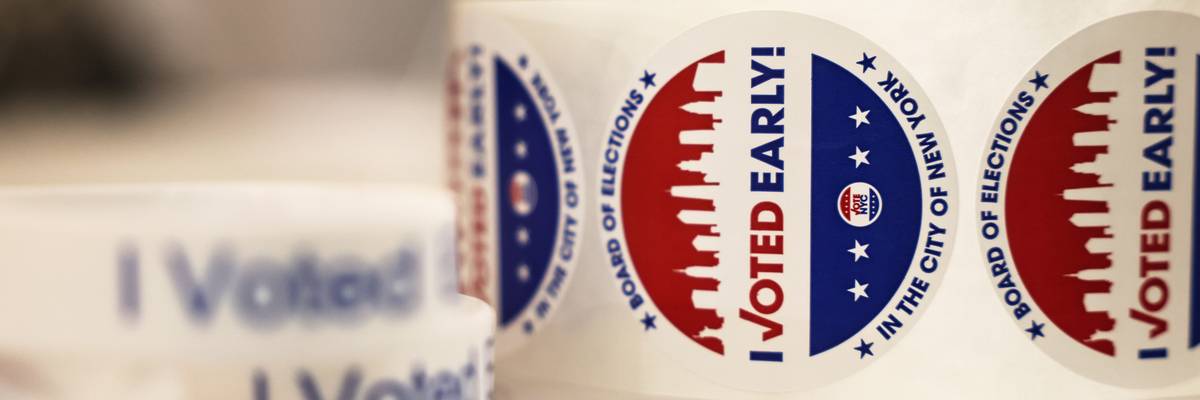
Early voting stickers are seen at an early voting location on June 16, 2021 in the Upper West Side neighborhood of Manhattan in New York City. .
The Trump Admin Teaming Up With Mass Voter Challengers Is a Nightmare for Democracy
Mass voter challenges threaten voters, they swamp overburdened election officials with unnecessary work, and they fuel mistrust in our elections.
In March 2025, two members of the Department of Government Efficiency team communicated with a political advocacy group that was seeking to “find evidence of voter fraud and to overturn election results in certain States.” The group was trying to match Social Security records with copies of voter files that it had acquired. One of the DOGE team members even signed a “voter data agreement” with the group. While it’s still unclear if DOGE members shared any personal Social Security data, the revelation raised a scary prospect: that the federal government might collaborate with election deniers looking to block American voters from the ballot box.
Most states have laws that allow voters to challenge other voters’ eligibility. Baseless mass challenges to hundreds or thousands of voters at a time are a growing problem. They threaten voters. They swamp overburdened election officials with unnecessary work. And they fuel mistrust in our elections.
As my colleague Andrew Garber lays out in a new report, the rise of the election denier movement and technological advances have come together to make mass voter challenges a persistent problem in recent elections. Our research found that at least 185,232 voter challenges were filed in 2024 alone, and that follows hundreds of thousands of challenges filed in the previous two election cycles.
Mass challenges by private citizens add little value because of the work by dedicated and professional election officials to keep the voter rolls clean. In contrast, these challenges rely on shoddy data-matching techniques often designed to confirm wild conspiracy theories.
The reality is that the president has no more power to run our elections than the activists bringing these challenges. So the only way their efforts to undermine our elections will succeed is if voters lose faith in the whole enterprise and stay home this fall.
Until recently, these challengers have been outsider activists. The idea they may now have the support of the federal government sends chills.
The Trump administration’s efforts to support baseless voter challenges go beyond a couple of stooges at DOGE. As we’ve been tracking for months, the Department of Justice (DOJ) has been pressuring states to cough up their voters’ confidential personal data. Like all the Trump administration’s election interference efforts, this pressure campaign has mostly fallen flat, with courts consistently blocking the requests. But 16 states were all too happy to hand over their voters’ data. And when they did, the DOJ asked them to sign a data security agreement that contained an ominous loophole in the protocols for private contractors with whom the department might share voter data. Meanwhile, one of the primary perpetrators of mass challenges in recent years, Rick Richards, creator of a mass challenge software called EagleAI, reportedly met with the DOJ in 2023 to demonstrate the tool. “They like it,” he claimed.
For these reasons and more, Garber predicts that “challenges will continue to be an integral strategy in the playbook to undermine the democratic process” in this year’s elections and beyond.
Promisingly, the Brennan Center’s research also reveals that thanks to the tireless efforts of election workers and federal legal protections, the vast majority of mass challenges do not lead to inappropriate purges of voters from the rolls.
But even small rates of disenfranchisement are a concern, and challenges can confuse or intimidate voters even when they don’t formally block them from voting. And the harms of mass challenges extend much further.
For one thing, they create tremendous burdens on election officials during a time when they should be preparing for the daunting task of running elections. In 2022, in Gwinnett County, Georgia, it took between 5 -10 experienced elections staff working “all day, every day, six days a week” to evaluate the 37,000 challenges filed by just one organization, VoterGA. In the end, not a single ineligible voter was removed as a result of the challenge.
You may be asking yourself: If these mass challenges do nothing to help election officials and only make their jobs more difficult, why do our laws allow them? There must be some good reason why we let Americans challenge their neighbors’ right to vote. Well, no, not really. The answer, as is so often the case when it comes to restrictive voting laws, is racism.
In a separate publication released Tuesday, my colleague Justin Lam lays out the racially discriminatory history of voter challenge laws. They were one of many devices states used to undermine the promise of the 15th Amendment and continue to deny Black people the right to vote. Some of these tools, such as poll taxes and literacy tests, were outlawed in the 1960s. Others, such as felony disenfranchisement and voter challenge laws, survived, perhaps because they were not so closely associated with Jim Crow. But history makes the association clear. As just one example, in 1946, Georgia gubernatorial candidate Eugene Talmadge distributed challenge forms to his supporters and urged them to “disqualify and mark off the voters’ list three-fourths of the Negro vote in this state.” Lam explains that these laws have also been used to successfully suppress the votes of Native, Latino, and Asian American voters.
Modern challenges look a little different. They are often more noteworthy for how incredibly wide a net they cast. Activists challenge everyone to create the illusion of issues with voter rolls. Today’s challengers often seem less concerned with targeting a particular group than they are with advancing conspiracy theories. In Allegheny County, Pennsylvania, a Republican member of the board of elections griped, “I can’t tell you how many hours of my life I’ve wasted trying to debunk” the false narratives of voter challengers.
That official’s complaint hints at the final harm of mass challenges and their true purpose: undermining public faith in elections. Indeed, it makes sense that the Trump administration might be looking to partner with mass challengers. The administration’s election interference campaign has the same goal. The reality is that the president has no more power to run our elections than the activists bringing these challenges. So the only way their efforts to undermine our elections will succeed is if voters lose faith in the whole enterprise and stay home this fall.
Garber’s report ends with a series of policy recommendations for ending mass challenges. We hope lawmakers take them up. But, as with so many other threats to our democracy, perhaps the most important response will come from voters. Check your registration and make a plan to vote. Read and respond to election mail sent by your local officials. Cast your ballot as early as possible. Consider all the options in your state and consider returning your ballot in person or via drop box if you can. Encourage your friends and family to do the same. The more we invest in our democracy, the harder it will be to undermine it.
We are at a crossroads
This country and this world are at a monumental crossroads. In a few short weeks, US voters will have an opportunity to beat back the forces of fascism and confront the billionaires who are rigging the economy, our media system, and our democracy, making it increasingly impossible for ordinary people to get by. We’re not just talking about the election. We’re talking about what must be done once these fascist elements are vanquished from power. We need a bolder set of solutions than what either major party has so far been willing to offer and a working-class movement ready to fight like hell for it. Trump didn't emerge from nowhere. The conditions that fueled MAGA authoritarianism were created by decades of radical neoliberal economic policies and a corrupt political system dominated by corporate interests. They slashed taxes on the super-rich, promising that the benefits would trickle down. They said giveaways to the corporate titans would make life more affordable for the rest of us. It was all bullshit. And when a bitter, betrayed populace searches for someone to blame, right-wing demagogues have little trouble finding scapegoats. People know when they're being lied to, but you won't hear any of this from the corporate media. Only independent journalism—powered and funded by people who believe in building a better world—can deliver truly trustworthy daily news. Our Fall Campaign is underway, and we need your help. To power our newsroom through the rest of the year, we need to raise $125,000 by midnight on October 31. So if you share our vision, please contribute whatever you can to sustain our work. |
In March 2025, two members of the Department of Government Efficiency team communicated with a political advocacy group that was seeking to “find evidence of voter fraud and to overturn election results in certain States.” The group was trying to match Social Security records with copies of voter files that it had acquired. One of the DOGE team members even signed a “voter data agreement” with the group. While it’s still unclear if DOGE members shared any personal Social Security data, the revelation raised a scary prospect: that the federal government might collaborate with election deniers looking to block American voters from the ballot box.
Most states have laws that allow voters to challenge other voters’ eligibility. Baseless mass challenges to hundreds or thousands of voters at a time are a growing problem. They threaten voters. They swamp overburdened election officials with unnecessary work. And they fuel mistrust in our elections.
As my colleague Andrew Garber lays out in a new report, the rise of the election denier movement and technological advances have come together to make mass voter challenges a persistent problem in recent elections. Our research found that at least 185,232 voter challenges were filed in 2024 alone, and that follows hundreds of thousands of challenges filed in the previous two election cycles.
Mass challenges by private citizens add little value because of the work by dedicated and professional election officials to keep the voter rolls clean. In contrast, these challenges rely on shoddy data-matching techniques often designed to confirm wild conspiracy theories.
The reality is that the president has no more power to run our elections than the activists bringing these challenges. So the only way their efforts to undermine our elections will succeed is if voters lose faith in the whole enterprise and stay home this fall.
Until recently, these challengers have been outsider activists. The idea they may now have the support of the federal government sends chills.
The Trump administration’s efforts to support baseless voter challenges go beyond a couple of stooges at DOGE. As we’ve been tracking for months, the Department of Justice (DOJ) has been pressuring states to cough up their voters’ confidential personal data. Like all the Trump administration’s election interference efforts, this pressure campaign has mostly fallen flat, with courts consistently blocking the requests. But 16 states were all too happy to hand over their voters’ data. And when they did, the DOJ asked them to sign a data security agreement that contained an ominous loophole in the protocols for private contractors with whom the department might share voter data. Meanwhile, one of the primary perpetrators of mass challenges in recent years, Rick Richards, creator of a mass challenge software called EagleAI, reportedly met with the DOJ in 2023 to demonstrate the tool. “They like it,” he claimed.
For these reasons and more, Garber predicts that “challenges will continue to be an integral strategy in the playbook to undermine the democratic process” in this year’s elections and beyond.
Promisingly, the Brennan Center’s research also reveals that thanks to the tireless efforts of election workers and federal legal protections, the vast majority of mass challenges do not lead to inappropriate purges of voters from the rolls.
But even small rates of disenfranchisement are a concern, and challenges can confuse or intimidate voters even when they don’t formally block them from voting. And the harms of mass challenges extend much further.
For one thing, they create tremendous burdens on election officials during a time when they should be preparing for the daunting task of running elections. In 2022, in Gwinnett County, Georgia, it took between 5 -10 experienced elections staff working “all day, every day, six days a week” to evaluate the 37,000 challenges filed by just one organization, VoterGA. In the end, not a single ineligible voter was removed as a result of the challenge.
You may be asking yourself: If these mass challenges do nothing to help election officials and only make their jobs more difficult, why do our laws allow them? There must be some good reason why we let Americans challenge their neighbors’ right to vote. Well, no, not really. The answer, as is so often the case when it comes to restrictive voting laws, is racism.
In a separate publication released Tuesday, my colleague Justin Lam lays out the racially discriminatory history of voter challenge laws. They were one of many devices states used to undermine the promise of the 15th Amendment and continue to deny Black people the right to vote. Some of these tools, such as poll taxes and literacy tests, were outlawed in the 1960s. Others, such as felony disenfranchisement and voter challenge laws, survived, perhaps because they were not so closely associated with Jim Crow. But history makes the association clear. As just one example, in 1946, Georgia gubernatorial candidate Eugene Talmadge distributed challenge forms to his supporters and urged them to “disqualify and mark off the voters’ list three-fourths of the Negro vote in this state.” Lam explains that these laws have also been used to successfully suppress the votes of Native, Latino, and Asian American voters.
Modern challenges look a little different. They are often more noteworthy for how incredibly wide a net they cast. Activists challenge everyone to create the illusion of issues with voter rolls. Today’s challengers often seem less concerned with targeting a particular group than they are with advancing conspiracy theories. In Allegheny County, Pennsylvania, a Republican member of the board of elections griped, “I can’t tell you how many hours of my life I’ve wasted trying to debunk” the false narratives of voter challengers.
That official’s complaint hints at the final harm of mass challenges and their true purpose: undermining public faith in elections. Indeed, it makes sense that the Trump administration might be looking to partner with mass challengers. The administration’s election interference campaign has the same goal. The reality is that the president has no more power to run our elections than the activists bringing these challenges. So the only way their efforts to undermine our elections will succeed is if voters lose faith in the whole enterprise and stay home this fall.
Garber’s report ends with a series of policy recommendations for ending mass challenges. We hope lawmakers take them up. But, as with so many other threats to our democracy, perhaps the most important response will come from voters. Check your registration and make a plan to vote. Read and respond to election mail sent by your local officials. Cast your ballot as early as possible. Consider all the options in your state and consider returning your ballot in person or via drop box if you can. Encourage your friends and family to do the same. The more we invest in our democracy, the harder it will be to undermine it.
- Judge Blocks 'Unconstitutional and Dangerous' Trump Order Designed to Derail Mail-In Voting ›
- ‘Yeah, That’s Illegal’: USPS Chief Says States Won't Receive Mail Ballots Unless They Hand Voter Rolls to Trump ›
- 'Humiliating String of Defeats' Threatens Trump's Plot to Rig 2026 Midterms: Election Expert ›
- 'A Pathetic Power Grab': Trump Purges Bipartisan Election Assistance Commission ›
- Report Details Trump Effort to Quietly Lay Groundwork to 'Steal Future Elections' ›
- Pro-Voter Coalition Sues Over Trump Trying to 'Declare Election Rules by Executive Fiat' ›
In March 2025, two members of the Department of Government Efficiency team communicated with a political advocacy group that was seeking to “find evidence of voter fraud and to overturn election results in certain States.” The group was trying to match Social Security records with copies of voter files that it had acquired. One of the DOGE team members even signed a “voter data agreement” with the group. While it’s still unclear if DOGE members shared any personal Social Security data, the revelation raised a scary prospect: that the federal government might collaborate with election deniers looking to block American voters from the ballot box.
Most states have laws that allow voters to challenge other voters’ eligibility. Baseless mass challenges to hundreds or thousands of voters at a time are a growing problem. They threaten voters. They swamp overburdened election officials with unnecessary work. And they fuel mistrust in our elections.
As my colleague Andrew Garber lays out in a new report, the rise of the election denier movement and technological advances have come together to make mass voter challenges a persistent problem in recent elections. Our research found that at least 185,232 voter challenges were filed in 2024 alone, and that follows hundreds of thousands of challenges filed in the previous two election cycles.
Mass challenges by private citizens add little value because of the work by dedicated and professional election officials to keep the voter rolls clean. In contrast, these challenges rely on shoddy data-matching techniques often designed to confirm wild conspiracy theories.
The reality is that the president has no more power to run our elections than the activists bringing these challenges. So the only way their efforts to undermine our elections will succeed is if voters lose faith in the whole enterprise and stay home this fall.
Until recently, these challengers have been outsider activists. The idea they may now have the support of the federal government sends chills.
The Trump administration’s efforts to support baseless voter challenges go beyond a couple of stooges at DOGE. As we’ve been tracking for months, the Department of Justice (DOJ) has been pressuring states to cough up their voters’ confidential personal data. Like all the Trump administration’s election interference efforts, this pressure campaign has mostly fallen flat, with courts consistently blocking the requests. But 16 states were all too happy to hand over their voters’ data. And when they did, the DOJ asked them to sign a data security agreement that contained an ominous loophole in the protocols for private contractors with whom the department might share voter data. Meanwhile, one of the primary perpetrators of mass challenges in recent years, Rick Richards, creator of a mass challenge software called EagleAI, reportedly met with the DOJ in 2023 to demonstrate the tool. “They like it,” he claimed.
For these reasons and more, Garber predicts that “challenges will continue to be an integral strategy in the playbook to undermine the democratic process” in this year’s elections and beyond.
Promisingly, the Brennan Center’s research also reveals that thanks to the tireless efforts of election workers and federal legal protections, the vast majority of mass challenges do not lead to inappropriate purges of voters from the rolls.
But even small rates of disenfranchisement are a concern, and challenges can confuse or intimidate voters even when they don’t formally block them from voting. And the harms of mass challenges extend much further.
For one thing, they create tremendous burdens on election officials during a time when they should be preparing for the daunting task of running elections. In 2022, in Gwinnett County, Georgia, it took between 5 -10 experienced elections staff working “all day, every day, six days a week” to evaluate the 37,000 challenges filed by just one organization, VoterGA. In the end, not a single ineligible voter was removed as a result of the challenge.
You may be asking yourself: If these mass challenges do nothing to help election officials and only make their jobs more difficult, why do our laws allow them? There must be some good reason why we let Americans challenge their neighbors’ right to vote. Well, no, not really. The answer, as is so often the case when it comes to restrictive voting laws, is racism.
In a separate publication released Tuesday, my colleague Justin Lam lays out the racially discriminatory history of voter challenge laws. They were one of many devices states used to undermine the promise of the 15th Amendment and continue to deny Black people the right to vote. Some of these tools, such as poll taxes and literacy tests, were outlawed in the 1960s. Others, such as felony disenfranchisement and voter challenge laws, survived, perhaps because they were not so closely associated with Jim Crow. But history makes the association clear. As just one example, in 1946, Georgia gubernatorial candidate Eugene Talmadge distributed challenge forms to his supporters and urged them to “disqualify and mark off the voters’ list three-fourths of the Negro vote in this state.” Lam explains that these laws have also been used to successfully suppress the votes of Native, Latino, and Asian American voters.
Modern challenges look a little different. They are often more noteworthy for how incredibly wide a net they cast. Activists challenge everyone to create the illusion of issues with voter rolls. Today’s challengers often seem less concerned with targeting a particular group than they are with advancing conspiracy theories. In Allegheny County, Pennsylvania, a Republican member of the board of elections griped, “I can’t tell you how many hours of my life I’ve wasted trying to debunk” the false narratives of voter challengers.
That official’s complaint hints at the final harm of mass challenges and their true purpose: undermining public faith in elections. Indeed, it makes sense that the Trump administration might be looking to partner with mass challengers. The administration’s election interference campaign has the same goal. The reality is that the president has no more power to run our elections than the activists bringing these challenges. So the only way their efforts to undermine our elections will succeed is if voters lose faith in the whole enterprise and stay home this fall.
Garber’s report ends with a series of policy recommendations for ending mass challenges. We hope lawmakers take them up. But, as with so many other threats to our democracy, perhaps the most important response will come from voters. Check your registration and make a plan to vote. Read and respond to election mail sent by your local officials. Cast your ballot as early as possible. Consider all the options in your state and consider returning your ballot in person or via drop box if you can. Encourage your friends and family to do the same. The more we invest in our democracy, the harder it will be to undermine it.
- Judge Blocks 'Unconstitutional and Dangerous' Trump Order Designed to Derail Mail-In Voting ›
- ‘Yeah, That’s Illegal’: USPS Chief Says States Won't Receive Mail Ballots Unless They Hand Voter Rolls to Trump ›
- 'Humiliating String of Defeats' Threatens Trump's Plot to Rig 2026 Midterms: Election Expert ›
- 'A Pathetic Power Grab': Trump Purges Bipartisan Election Assistance Commission ›
- Report Details Trump Effort to Quietly Lay Groundwork to 'Steal Future Elections' ›
- Pro-Voter Coalition Sues Over Trump Trying to 'Declare Election Rules by Executive Fiat' ›