5
#000000
#FFFFFF
To donate by check, phone, or other method, see our More Ways to Give page.
Daily news & progressive opinion—funded by the people, not the corporations—delivered straight to your inbox.

The state needs money to provide essential services. Why not take it from the people who have money coming out of their ears?
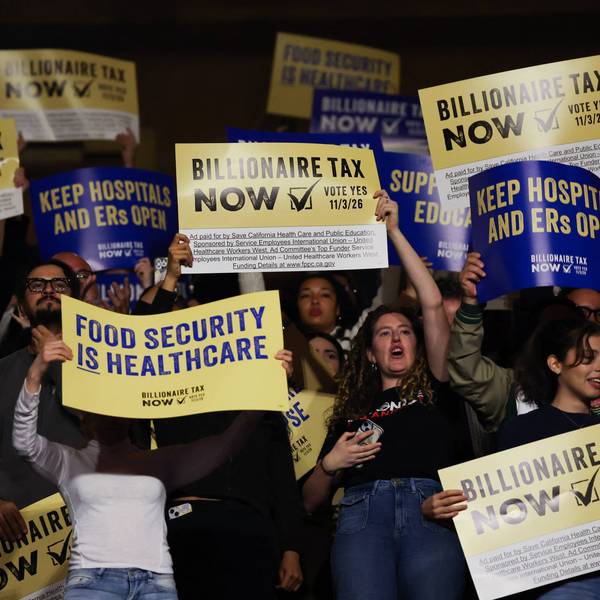
This fall, California residents will be voting on a measure that would impose a tax of 5% on people with wealth in excess of $1 billion. This is a serious tax on a small group of very wealthy people.
While some focus on the amount of tax that these super-rich people will pay, it’s worth keeping in mind how much they will still have after paying their tax bill. A billionaire with $5 billion in assets will pay $250 million in taxes, but they will still be left with $4,750,000,000. We probably still don’t have to worry about these folks collecting food stamps.
The proponents of the tax calculate that it will raise $100 billion. While it is a one-time tax, it can be paid over five years. This sum will roughly match the cuts in Medicaid funding over this period that the Trump administration has put in place.
It is important to recognize that capitalism is an infinitely malleable system. We have allowed the rich to structure it to give themselves all the money. That is a huge problem.
To me, this sounds like a great plan. The state needs money to provide essential services. Why not take it from the people who have money coming out of their ears?
Okay, but we know the real world is never this simple. The rich love their money and aren’t happy about turning over any portion of it to the state of California, no matter how little it affects their living standards. We have to ask how much money the tax will actually collect after the rich use all the tools available, both legal and illegal, to avoid paying.
The podcast Today Explained had an interesting discussion of this issue last week. It included comments from two economists who have done research on this issue: Joshua Rauh, a senior fellow at the Hoover Institution and Cristobal Young, a sociology professor at Cornell University. Rauh is a conservative, while Young is a liberal. Both have done serious work on taxing the rich.
Not surprisingly, Rauh opposed the wealth tax. He argued that the tax would end up as a net revenue loser. The tax would apply to billionaires who were in the state as of January 1 of this year, which means if they haven’t left the state already, they will still be liable for the tax even if they choose to leave later. But Rauh argues that the combination of lost future income tax revenue from the billionaires who have already left, combined with reduced collections from the billionaires who stay or don’t come to the state, will more than offset whatever revenue the state collects from the tax.
I take seriously the issues Rauh raises. Some billionaires have left the state. They also are very clever in finding ways to avoid taxes. Rauh did a paper a couple of years back that found that the rich managed to escape paying 60% of the anticipated tax revenue from a 3-percentage-point increase in the top tax rate paid by high-income people.
There clearly is some point where higher tax rates can actually result in less revenue, mostly due to increased evasion and avoidance, but there also is some negative incentive effect (definitely the smaller part of the story). Rauh’s work suggested California might not be far from that point. (Its top marginal tax rate is 13%.)
While Rauh’s view of the wealth tax was predictable, I was surprised to hear that Young also opposed it. Young has done considerable work that finds that rich people do not often move to escape higher state tax rates. It might have been expected that Young would think that the state does not have much to fear from billionaires leaving to escape the wealth tax.
However, Young opposed the tax on different grounds. He argued that the one-time infusion of revenue from the tax, collected over five years, would still leave a funding gap five years out, after the revenue stopped coming in.
This is hard for me to understand. Five years in Trump’s America in an eternity. It is reasonable to think that in five years we may again have a more normal government at the national level that is prepared to actually provide people with healthcare. In that case, the shortfall will not be an issue. Alternatively, if Trump and his followers still hold power, we are likely looking at a disaster story for which there is no real way to prepare.
There are a number of billionaires who very publicly left California before the start of the year and may thereby avoid the tax. This will reduce the revenue collected from the tax and will mean a loss of income tax revenue for the state in future years, but that is water under the bridge at this point.
We can all envision better ways to tax the rich in an ideal world. California’s Gov. Gavin Newsom opposed the state wealth tax because he says we should have a federal wealth tax. Perhaps we should, but a state wealth tax is what’s on the table, and proponents of taxing the rich would be foolish not to wholeheartedly support it.
If the wealth tax goes down, California is not about to institute Young or anyone else’s ideal tax on the rich. If it goes down, it’s a pretty sure bet that it will be some time before another tax on the super rich in California comes this close to becoming law.
I will add that I have long argued that we need to structure the economy differently so that we don’t give the rich all the money. Having shorter and weaker government-granted patent and copyright monopolies would be a good start. Also, changing bankruptcy laws so that private equity partners can’t walk away from companies they bankrupted with their pockets full. And applying a modest sales tax on financial transactions would downsize the sector and eliminate many of the great fortunes on Wall Street.
This is the topic of my book, Rigged (it’s free). It is important to recognize that capitalism is an infinitely malleable system. We have allowed the rich to structure it to give themselves all the money. That is a huge problem. Taxing some of it back is a great thing to do, but it would be even better not to give them the money in the first place. That’s not a reason to oppose the tax, but it would be good if progressives paid some attention to fundamental issues of how we structure the market.
Dear Common Dreams reader, It’s been nearly 30 years since I co-founded Common Dreams with my late wife, Lina Newhouser. We had the radical notion that journalism should serve the public good, not corporate profits. It was clear to us from the outset what it would take to build such a project. No paid advertisements. No corporate sponsors. No millionaire publisher telling us what to think or do. Many people said we wouldn't last a year, but we proved those doubters wrong. Together with a tremendous team of journalists and dedicated staff, we built an independent media outlet free from the constraints of profits and corporate control. Our mission has always been simple: To inform. To inspire. To ignite change for the common good. Building Common Dreams was not easy. Our survival was never guaranteed. When you take on the most powerful forces—Wall Street greed, fossil fuel industry destruction, Big Tech lobbyists, and uber-rich oligarchs who have spent billions upon billions rigging the economy and democracy in their favor—the only bulwark you have is supporters who believe in your work. But here’s the urgent message from me today. It's never been this bad out there. And it's never been this hard to keep us going. At the very moment Common Dreams is most needed, the threats we face are intensifying. We need your support now more than ever. We don't accept corporate advertising and never will. We don't have a paywall because we don't think people should be blocked from critical news based on their ability to pay. Everything we do is funded by the donations of readers like you. When everyone does the little they can afford, we are strong. But if that support retreats or dries up, so do we. Will you donate now to make sure Common Dreams not only survives but thrives? —Craig Brown, Co-founder |
This fall, California residents will be voting on a measure that would impose a tax of 5% on people with wealth in excess of $1 billion. This is a serious tax on a small group of very wealthy people.
While some focus on the amount of tax that these super-rich people will pay, it’s worth keeping in mind how much they will still have after paying their tax bill. A billionaire with $5 billion in assets will pay $250 million in taxes, but they will still be left with $4,750,000,000. We probably still don’t have to worry about these folks collecting food stamps.
The proponents of the tax calculate that it will raise $100 billion. While it is a one-time tax, it can be paid over five years. This sum will roughly match the cuts in Medicaid funding over this period that the Trump administration has put in place.
It is important to recognize that capitalism is an infinitely malleable system. We have allowed the rich to structure it to give themselves all the money. That is a huge problem.
To me, this sounds like a great plan. The state needs money to provide essential services. Why not take it from the people who have money coming out of their ears?
Okay, but we know the real world is never this simple. The rich love their money and aren’t happy about turning over any portion of it to the state of California, no matter how little it affects their living standards. We have to ask how much money the tax will actually collect after the rich use all the tools available, both legal and illegal, to avoid paying.
The podcast Today Explained had an interesting discussion of this issue last week. It included comments from two economists who have done research on this issue: Joshua Rauh, a senior fellow at the Hoover Institution and Cristobal Young, a sociology professor at Cornell University. Rauh is a conservative, while Young is a liberal. Both have done serious work on taxing the rich.
Not surprisingly, Rauh opposed the wealth tax. He argued that the tax would end up as a net revenue loser. The tax would apply to billionaires who were in the state as of January 1 of this year, which means if they haven’t left the state already, they will still be liable for the tax even if they choose to leave later. But Rauh argues that the combination of lost future income tax revenue from the billionaires who have already left, combined with reduced collections from the billionaires who stay or don’t come to the state, will more than offset whatever revenue the state collects from the tax.
I take seriously the issues Rauh raises. Some billionaires have left the state. They also are very clever in finding ways to avoid taxes. Rauh did a paper a couple of years back that found that the rich managed to escape paying 60% of the anticipated tax revenue from a 3-percentage-point increase in the top tax rate paid by high-income people.
There clearly is some point where higher tax rates can actually result in less revenue, mostly due to increased evasion and avoidance, but there also is some negative incentive effect (definitely the smaller part of the story). Rauh’s work suggested California might not be far from that point. (Its top marginal tax rate is 13%.)
While Rauh’s view of the wealth tax was predictable, I was surprised to hear that Young also opposed it. Young has done considerable work that finds that rich people do not often move to escape higher state tax rates. It might have been expected that Young would think that the state does not have much to fear from billionaires leaving to escape the wealth tax.
However, Young opposed the tax on different grounds. He argued that the one-time infusion of revenue from the tax, collected over five years, would still leave a funding gap five years out, after the revenue stopped coming in.
This is hard for me to understand. Five years in Trump’s America in an eternity. It is reasonable to think that in five years we may again have a more normal government at the national level that is prepared to actually provide people with healthcare. In that case, the shortfall will not be an issue. Alternatively, if Trump and his followers still hold power, we are likely looking at a disaster story for which there is no real way to prepare.
There are a number of billionaires who very publicly left California before the start of the year and may thereby avoid the tax. This will reduce the revenue collected from the tax and will mean a loss of income tax revenue for the state in future years, but that is water under the bridge at this point.
We can all envision better ways to tax the rich in an ideal world. California’s Gov. Gavin Newsom opposed the state wealth tax because he says we should have a federal wealth tax. Perhaps we should, but a state wealth tax is what’s on the table, and proponents of taxing the rich would be foolish not to wholeheartedly support it.
If the wealth tax goes down, California is not about to institute Young or anyone else’s ideal tax on the rich. If it goes down, it’s a pretty sure bet that it will be some time before another tax on the super rich in California comes this close to becoming law.
I will add that I have long argued that we need to structure the economy differently so that we don’t give the rich all the money. Having shorter and weaker government-granted patent and copyright monopolies would be a good start. Also, changing bankruptcy laws so that private equity partners can’t walk away from companies they bankrupted with their pockets full. And applying a modest sales tax on financial transactions would downsize the sector and eliminate many of the great fortunes on Wall Street.
This is the topic of my book, Rigged (it’s free). It is important to recognize that capitalism is an infinitely malleable system. We have allowed the rich to structure it to give themselves all the money. That is a huge problem. Taxing some of it back is a great thing to do, but it would be even better not to give them the money in the first place. That’s not a reason to oppose the tax, but it would be good if progressives paid some attention to fundamental issues of how we structure the market.
This fall, California residents will be voting on a measure that would impose a tax of 5% on people with wealth in excess of $1 billion. This is a serious tax on a small group of very wealthy people.
While some focus on the amount of tax that these super-rich people will pay, it’s worth keeping in mind how much they will still have after paying their tax bill. A billionaire with $5 billion in assets will pay $250 million in taxes, but they will still be left with $4,750,000,000. We probably still don’t have to worry about these folks collecting food stamps.
The proponents of the tax calculate that it will raise $100 billion. While it is a one-time tax, it can be paid over five years. This sum will roughly match the cuts in Medicaid funding over this period that the Trump administration has put in place.
It is important to recognize that capitalism is an infinitely malleable system. We have allowed the rich to structure it to give themselves all the money. That is a huge problem.
To me, this sounds like a great plan. The state needs money to provide essential services. Why not take it from the people who have money coming out of their ears?
Okay, but we know the real world is never this simple. The rich love their money and aren’t happy about turning over any portion of it to the state of California, no matter how little it affects their living standards. We have to ask how much money the tax will actually collect after the rich use all the tools available, both legal and illegal, to avoid paying.
The podcast Today Explained had an interesting discussion of this issue last week. It included comments from two economists who have done research on this issue: Joshua Rauh, a senior fellow at the Hoover Institution and Cristobal Young, a sociology professor at Cornell University. Rauh is a conservative, while Young is a liberal. Both have done serious work on taxing the rich.
Not surprisingly, Rauh opposed the wealth tax. He argued that the tax would end up as a net revenue loser. The tax would apply to billionaires who were in the state as of January 1 of this year, which means if they haven’t left the state already, they will still be liable for the tax even if they choose to leave later. But Rauh argues that the combination of lost future income tax revenue from the billionaires who have already left, combined with reduced collections from the billionaires who stay or don’t come to the state, will more than offset whatever revenue the state collects from the tax.
I take seriously the issues Rauh raises. Some billionaires have left the state. They also are very clever in finding ways to avoid taxes. Rauh did a paper a couple of years back that found that the rich managed to escape paying 60% of the anticipated tax revenue from a 3-percentage-point increase in the top tax rate paid by high-income people.
There clearly is some point where higher tax rates can actually result in less revenue, mostly due to increased evasion and avoidance, but there also is some negative incentive effect (definitely the smaller part of the story). Rauh’s work suggested California might not be far from that point. (Its top marginal tax rate is 13%.)
While Rauh’s view of the wealth tax was predictable, I was surprised to hear that Young also opposed it. Young has done considerable work that finds that rich people do not often move to escape higher state tax rates. It might have been expected that Young would think that the state does not have much to fear from billionaires leaving to escape the wealth tax.
However, Young opposed the tax on different grounds. He argued that the one-time infusion of revenue from the tax, collected over five years, would still leave a funding gap five years out, after the revenue stopped coming in.
This is hard for me to understand. Five years in Trump’s America in an eternity. It is reasonable to think that in five years we may again have a more normal government at the national level that is prepared to actually provide people with healthcare. In that case, the shortfall will not be an issue. Alternatively, if Trump and his followers still hold power, we are likely looking at a disaster story for which there is no real way to prepare.
There are a number of billionaires who very publicly left California before the start of the year and may thereby avoid the tax. This will reduce the revenue collected from the tax and will mean a loss of income tax revenue for the state in future years, but that is water under the bridge at this point.
We can all envision better ways to tax the rich in an ideal world. California’s Gov. Gavin Newsom opposed the state wealth tax because he says we should have a federal wealth tax. Perhaps we should, but a state wealth tax is what’s on the table, and proponents of taxing the rich would be foolish not to wholeheartedly support it.
If the wealth tax goes down, California is not about to institute Young or anyone else’s ideal tax on the rich. If it goes down, it’s a pretty sure bet that it will be some time before another tax on the super rich in California comes this close to becoming law.
I will add that I have long argued that we need to structure the economy differently so that we don’t give the rich all the money. Having shorter and weaker government-granted patent and copyright monopolies would be a good start. Also, changing bankruptcy laws so that private equity partners can’t walk away from companies they bankrupted with their pockets full. And applying a modest sales tax on financial transactions would downsize the sector and eliminate many of the great fortunes on Wall Street.
This is the topic of my book, Rigged (it’s free). It is important to recognize that capitalism is an infinitely malleable system. We have allowed the rich to structure it to give themselves all the money. That is a huge problem. Taxing some of it back is a great thing to do, but it would be even better not to give them the money in the first place. That’s not a reason to oppose the tax, but it would be good if progressives paid some attention to fundamental issues of how we structure the market.