5
#000000
#FFFFFF
To donate by check, phone, or other method, see our More Ways to Give page.
Daily news & progressive opinion—funded by the people, not the corporations—delivered straight to your inbox.
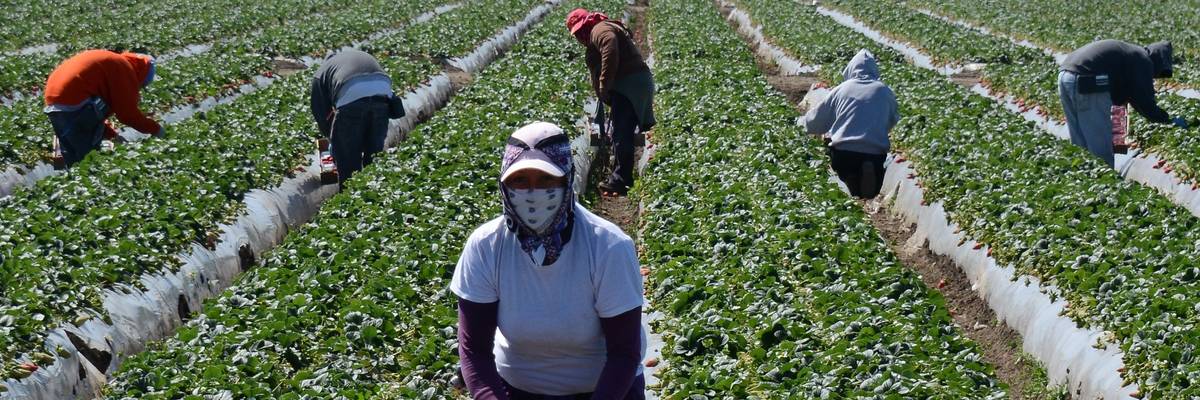
Migrant workers harvest strawberries at a farm March 13, 2013 near Oxnard, California.
Farmworkers need local and state governments to come to their aid in implementing policies recognizing the urgency of lethal heat while learning from one another as they pass laws where there are none, and improving standards where they exist.
Have you ever had to fight off a rattlesnake in the dark while on shift? Or struggled to breathe through heart palpitations, in a remote field dozens of miles away from the nearest hospital?
Farmworkers are increasingly having these experiences as extreme heat in certain states has forced people to pick onions, grapes, and berries at night when it is cooler and the work more tolerable.
Compounding the struggle, there’s the accompanying impaired visibility and occupational safety risks for workers planting seeds and picking crops before sunrise. For those partially or primarily laboring during the day, heatwaves continue to become longer year after year, more intense, and therefore, more deadly. Making matters worse are conditions for those who work at the pace of piece rate work, which pushes farmworkers to do more and faster for potential pay fueling more intense physical labor from the workers at all given times.
In an ideal world, farmworkers would have rights and protections guaranteed by the federal government so that they could labor during the day, and if needed, at night, without risking their basic bodily integrity to bring food to our tables. In fact, in 2024 the Biden administration took steps in this direction with a proposed heat standard that would require employers to establish heat safety plans, provide water and shade, and institute paid 15-minute breaks every two hours when the heat index reaches 80°F. While a final version of the rule was proposed, it has not been finalized, which means that it remains in regulatory limbo. Moreover, with a federal government brazenly hostile to federal regulations, as evident in several environmental policy rollbacks, it is unlikely that nationwide protections for workers will come into force in the immediate future.
As of last year, most states have no legislation providing protections to workers in relation to extreme heat while working outside, inside plant nurseries, or in nighttime darkness.
Still, not all hope is lost. While federal action to the benefit of farmworkers leaves much to be desired, there has actually been significant motion at the state level. In fact, some states are actively configuring and approving heat protection standards, while others are improving upon regulations already in place.
Some states, like Arizona, mandate that employers need to provide water to workers and provide shade should temperatures rise above 100°F. The Georgia House Legislature has proposed a bill with similar specifications, but has not advanced it to be signed into law by the governor, similar to New Mexico’s proposed heat stress rule. More recently, the state of Virginia approved legislation in April 2026 directing its health and labor agencies to implement heat safety standards. Despite these positive trends, California continues to be the only state to regulate nighttime work in agriculture. California also has a much lower extreme heat stress limit for daytime work—80°F—than other states for when shaded areas must be provided.
Surprisingly, these states are outliers. As of last year, most states have no legislation providing protections to workers in relation to extreme heat while working outside, inside plant nurseries, or in nighttime darkness.
For the states that have regulations, the next step to support farmworkers is to build from this regulatory patchwork and make enforcement real. Improvement, however, is a continuous uphill climb.
Currently California is considered to be the state with the best farmworker protections, yet their agency responsible for the state’s occupational safety, Cal-OSHA, reported last year how the institution suffers from a severe lack of resources and staff. The dearth of resources is so bad that case backlogs are months long, as officials cannot spend time reviewing those that don't result in fatalities, leaving workers with limited recourse.
For other states, establishment of basic protections are still needed.
Texas, for instance, has no heat stress protections for workers. This, as the Lone Star state ranks among others like California for having the highest number of farmworkers. In 2023, the state of Texas actually took a step in the opposite direction by approving legislation restricting local governments from enacting rules that go beyond the state law, striking down some city ordinances that had previously guaranteed 10-minute water and shade breaks for some outdoor workers, such as construction workers. Accordingly, workers in this state deserve at minimum the right to access cool potable water, and time in the shade should temperatures reach a certain level.
Typically, by now the high temperature season would be wrapping up but many regions are still experiencing heatwaves. While the federal government continues to lean into deregulation, Congress recently advanced the Heat Workforce Standards Act of 2025 (HR 6213), to the House floor on July 21. If passed, this bill would prohibit the Occupational Safety and Health Administration from finalizing, implementing, or enforcing its proposed federal heat injury and illness prevention standard.
Farmworkers need local and state governments to come to their aid in implementing policies recognizing the urgency of lethal heat while learning from one another as they pass laws where there are none, and improving standards where they exist. The status quo—rattlesnakes and all—is not just absurd, but inhumane. Farmworkers deserve better.
Dear Common Dreams reader, It’s been nearly 30 years since I co-founded Common Dreams with my late wife, Lina Newhouser. We had the radical notion that journalism should serve the public good, not corporate profits. It was clear to us from the outset what it would take to build such a project. No paid advertisements. No corporate sponsors. No millionaire publisher telling us what to think or do. Many people said we wouldn't last a year, but we proved those doubters wrong. Together with a tremendous team of journalists and dedicated staff, we built an independent media outlet free from the constraints of profits and corporate control. Our mission has always been simple: To inform. To inspire. To ignite change for the common good. Building Common Dreams was not easy. Our survival was never guaranteed. When you take on the most powerful forces—Wall Street greed, fossil fuel industry destruction, Big Tech lobbyists, and uber-rich oligarchs who have spent billions upon billions rigging the economy and democracy in their favor—the only bulwark you have is supporters who believe in your work. But here’s the urgent message from me today. It's never been this bad out there. And it's never been this hard to keep us going. At the very moment Common Dreams is most needed, the threats we face are intensifying. We need your support now more than ever. We don't accept corporate advertising and never will. We don't have a paywall because we don't think people should be blocked from critical news based on their ability to pay. Everything we do is funded by the donations of readers like you. When everyone does the little they can afford, we are strong. But if that support retreats or dries up, so do we. Will you donate now to make sure Common Dreams not only survives but thrives? —Craig Brown, Co-founder |
Have you ever had to fight off a rattlesnake in the dark while on shift? Or struggled to breathe through heart palpitations, in a remote field dozens of miles away from the nearest hospital?
Farmworkers are increasingly having these experiences as extreme heat in certain states has forced people to pick onions, grapes, and berries at night when it is cooler and the work more tolerable.
Compounding the struggle, there’s the accompanying impaired visibility and occupational safety risks for workers planting seeds and picking crops before sunrise. For those partially or primarily laboring during the day, heatwaves continue to become longer year after year, more intense, and therefore, more deadly. Making matters worse are conditions for those who work at the pace of piece rate work, which pushes farmworkers to do more and faster for potential pay fueling more intense physical labor from the workers at all given times.
In an ideal world, farmworkers would have rights and protections guaranteed by the federal government so that they could labor during the day, and if needed, at night, without risking their basic bodily integrity to bring food to our tables. In fact, in 2024 the Biden administration took steps in this direction with a proposed heat standard that would require employers to establish heat safety plans, provide water and shade, and institute paid 15-minute breaks every two hours when the heat index reaches 80°F. While a final version of the rule was proposed, it has not been finalized, which means that it remains in regulatory limbo. Moreover, with a federal government brazenly hostile to federal regulations, as evident in several environmental policy rollbacks, it is unlikely that nationwide protections for workers will come into force in the immediate future.
As of last year, most states have no legislation providing protections to workers in relation to extreme heat while working outside, inside plant nurseries, or in nighttime darkness.
Still, not all hope is lost. While federal action to the benefit of farmworkers leaves much to be desired, there has actually been significant motion at the state level. In fact, some states are actively configuring and approving heat protection standards, while others are improving upon regulations already in place.
Some states, like Arizona, mandate that employers need to provide water to workers and provide shade should temperatures rise above 100°F. The Georgia House Legislature has proposed a bill with similar specifications, but has not advanced it to be signed into law by the governor, similar to New Mexico’s proposed heat stress rule. More recently, the state of Virginia approved legislation in April 2026 directing its health and labor agencies to implement heat safety standards. Despite these positive trends, California continues to be the only state to regulate nighttime work in agriculture. California also has a much lower extreme heat stress limit for daytime work—80°F—than other states for when shaded areas must be provided.
Surprisingly, these states are outliers. As of last year, most states have no legislation providing protections to workers in relation to extreme heat while working outside, inside plant nurseries, or in nighttime darkness.
For the states that have regulations, the next step to support farmworkers is to build from this regulatory patchwork and make enforcement real. Improvement, however, is a continuous uphill climb.
Currently California is considered to be the state with the best farmworker protections, yet their agency responsible for the state’s occupational safety, Cal-OSHA, reported last year how the institution suffers from a severe lack of resources and staff. The dearth of resources is so bad that case backlogs are months long, as officials cannot spend time reviewing those that don't result in fatalities, leaving workers with limited recourse.
For other states, establishment of basic protections are still needed.
Texas, for instance, has no heat stress protections for workers. This, as the Lone Star state ranks among others like California for having the highest number of farmworkers. In 2023, the state of Texas actually took a step in the opposite direction by approving legislation restricting local governments from enacting rules that go beyond the state law, striking down some city ordinances that had previously guaranteed 10-minute water and shade breaks for some outdoor workers, such as construction workers. Accordingly, workers in this state deserve at minimum the right to access cool potable water, and time in the shade should temperatures reach a certain level.
Typically, by now the high temperature season would be wrapping up but many regions are still experiencing heatwaves. While the federal government continues to lean into deregulation, Congress recently advanced the Heat Workforce Standards Act of 2025 (HR 6213), to the House floor on July 21. If passed, this bill would prohibit the Occupational Safety and Health Administration from finalizing, implementing, or enforcing its proposed federal heat injury and illness prevention standard.
Farmworkers need local and state governments to come to their aid in implementing policies recognizing the urgency of lethal heat while learning from one another as they pass laws where there are none, and improving standards where they exist. The status quo—rattlesnakes and all—is not just absurd, but inhumane. Farmworkers deserve better.
Have you ever had to fight off a rattlesnake in the dark while on shift? Or struggled to breathe through heart palpitations, in a remote field dozens of miles away from the nearest hospital?
Farmworkers are increasingly having these experiences as extreme heat in certain states has forced people to pick onions, grapes, and berries at night when it is cooler and the work more tolerable.
Compounding the struggle, there’s the accompanying impaired visibility and occupational safety risks for workers planting seeds and picking crops before sunrise. For those partially or primarily laboring during the day, heatwaves continue to become longer year after year, more intense, and therefore, more deadly. Making matters worse are conditions for those who work at the pace of piece rate work, which pushes farmworkers to do more and faster for potential pay fueling more intense physical labor from the workers at all given times.
In an ideal world, farmworkers would have rights and protections guaranteed by the federal government so that they could labor during the day, and if needed, at night, without risking their basic bodily integrity to bring food to our tables. In fact, in 2024 the Biden administration took steps in this direction with a proposed heat standard that would require employers to establish heat safety plans, provide water and shade, and institute paid 15-minute breaks every two hours when the heat index reaches 80°F. While a final version of the rule was proposed, it has not been finalized, which means that it remains in regulatory limbo. Moreover, with a federal government brazenly hostile to federal regulations, as evident in several environmental policy rollbacks, it is unlikely that nationwide protections for workers will come into force in the immediate future.
As of last year, most states have no legislation providing protections to workers in relation to extreme heat while working outside, inside plant nurseries, or in nighttime darkness.
Still, not all hope is lost. While federal action to the benefit of farmworkers leaves much to be desired, there has actually been significant motion at the state level. In fact, some states are actively configuring and approving heat protection standards, while others are improving upon regulations already in place.
Some states, like Arizona, mandate that employers need to provide water to workers and provide shade should temperatures rise above 100°F. The Georgia House Legislature has proposed a bill with similar specifications, but has not advanced it to be signed into law by the governor, similar to New Mexico’s proposed heat stress rule. More recently, the state of Virginia approved legislation in April 2026 directing its health and labor agencies to implement heat safety standards. Despite these positive trends, California continues to be the only state to regulate nighttime work in agriculture. California also has a much lower extreme heat stress limit for daytime work—80°F—than other states for when shaded areas must be provided.
Surprisingly, these states are outliers. As of last year, most states have no legislation providing protections to workers in relation to extreme heat while working outside, inside plant nurseries, or in nighttime darkness.
For the states that have regulations, the next step to support farmworkers is to build from this regulatory patchwork and make enforcement real. Improvement, however, is a continuous uphill climb.
Currently California is considered to be the state with the best farmworker protections, yet their agency responsible for the state’s occupational safety, Cal-OSHA, reported last year how the institution suffers from a severe lack of resources and staff. The dearth of resources is so bad that case backlogs are months long, as officials cannot spend time reviewing those that don't result in fatalities, leaving workers with limited recourse.
For other states, establishment of basic protections are still needed.
Texas, for instance, has no heat stress protections for workers. This, as the Lone Star state ranks among others like California for having the highest number of farmworkers. In 2023, the state of Texas actually took a step in the opposite direction by approving legislation restricting local governments from enacting rules that go beyond the state law, striking down some city ordinances that had previously guaranteed 10-minute water and shade breaks for some outdoor workers, such as construction workers. Accordingly, workers in this state deserve at minimum the right to access cool potable water, and time in the shade should temperatures reach a certain level.
Typically, by now the high temperature season would be wrapping up but many regions are still experiencing heatwaves. While the federal government continues to lean into deregulation, Congress recently advanced the Heat Workforce Standards Act of 2025 (HR 6213), to the House floor on July 21. If passed, this bill would prohibit the Occupational Safety and Health Administration from finalizing, implementing, or enforcing its proposed federal heat injury and illness prevention standard.
Farmworkers need local and state governments to come to their aid in implementing policies recognizing the urgency of lethal heat while learning from one another as they pass laws where there are none, and improving standards where they exist. The status quo—rattlesnakes and all—is not just absurd, but inhumane. Farmworkers deserve better.