

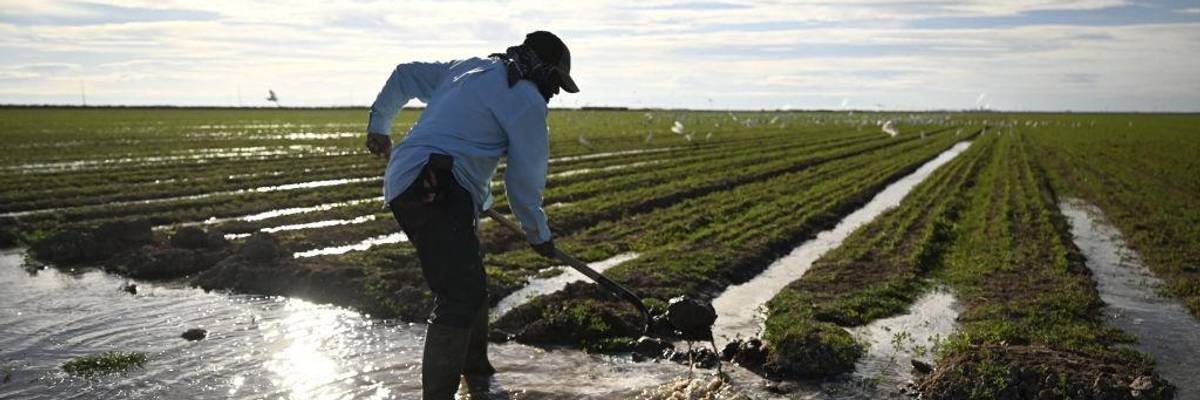
Farmworker Adrian Gonzalez irrigates a field of newly planted alfalfa on December 29, 2022 in Calipatria, California.
Low-Paid Immigrant Farmworkers Most at Risk From Toxic Weedkiller US Refuses to Ban
Farmworkers "should not be subjected to additional health risks due to the negligent actions of pesticide manufacturers, farm owners, and state regulatory agencies," said one analyst.
Concerns about the safety of paraquat, a highly toxic herbicide, pushed the U.S. Environmental Protection Agency in 2021 to ban its use on golf courses—but the weedkiller is still permitted for agricultural use, and a new first-of-its-kind analysis shows how the EPA's continued approval of the substance has put low-income Latino communities at disproportionate risk for health impacts.
The Environmental Working Group (EWG) found in a study released Wednesday that 5.3 million pounds of paraquat were sprayed over a five-year period in California, the only state with readily available figures on the herbicide.
Most of the weedkiller's use was concentrated in central counties where farms produce almonds, walnuts, alfalfa, and other crops—and where Latino people make up about 75% of the population and nearly the entire farm labor force.
Ninety-six percent of farmworkers in the state are Latino, and 90% of people in the agricultural workforce were born outside of the U.S., making immigrants who often work for low wages among the people who are most affected by continued use of paraquat on farms.
The ingestion of a single teaspoon of paraquat is considered deadly, which has led 60 countries to ban the chemical while the EPA released an analysis in January concluding that its health risks were outweighed by the economic benefits of using paraquat.
The weedkiller has been linked to non-Hodgkin lymphoma, respiratory damage, kidney disease, and childhood leukemia. Al Rabine, an analyst for EWG who authored the report, said the EPA has also ignored a "mountain of evidence" that paraquat causes Parkinson's disease.
An epidemiological study of central California found that people living within a third of a mile of where paraquat is sprayed are twice as likely to develop Parkinson's.
"Paraquat is not only a threat to our environment but also a direct danger to the health and well-being of these communities, particularly Latino populations, who make up the majority of the population," said Rabine. "The findings of our analysis underscore the urgent need for action by the state to protect these communities from the harmful effects of exposure to this toxic weedkiller."
Between 2017-21, EWG found, about 80% of the paraquat used on California crops was sprayed within Latino-majority census tracts. The group identified Kern County and the towns of Shafter and Wasco as "hot spots" for paraquat use.
"These three communities combined have over 80% Latino residents who witnessed almost 180,000 pounds of paraquat spraying during that time period," the group said.
In Kern County, which has a poverty rate of nearly 30%, EWG found that 1.2 million pounds of the herbicide were sprayed over roughly 1,200 square miles of farmland—threatening not only laborers who completed the work but also farmworkers who live in the surrounding communities, as paraquat can remain in soil and travel through the air—as well as coming home with workers on their clothing and potentially exposing their families.
EWG identified five "fatal flaws" in the analysis the EPA has used to defend its continued approval of paraquat for farming, including:
- Ignoring new evidence about the potential health impacts of paraquat that has come out of legal action against its manufacturer, the Switzerland-based and Chinese-owned Syngenta;
- Ignoring the fact that paraquat use is largely concentrated in specific communities inhabited largely by low-income Latino farmworkers;
- Excluding from its safety analysis paraquat applications that can drift through the aid, especially on windy days;
- Failing to consider the health and environmental costs to farm owners, workers, and people who live near farmland; and
- Dismissing a growing body of research linking paraquat to Parkinson's, including 90 articles of evidence and "cutting edge studies" submitted by the Michael J. Fox Foundation for Parkinson's Research.
EWG called on the EPA to follow the lead of dozens of countries that have banned paraquat—but warned that states must not wait for the federal government to take action.
"Federal pesticide law sets a floor, not a ceiling—states can choose to restrict a chemical, even without an EPA ban," wrote EWG government affairs manager Geoff Horsfield and toxicologist Alexis Temkin. "To protect their residents and public health, state and local governments should exercise their power to ban paraquat."
Immigrant communities across central California, Horsfield said, "should not be subjected to additional health risks due to the negligent actions of pesticide manufacturers, farm owners, and state regulatory agencies."
We are at a crossroads
This country and this world are at a monumental crossroads. In a few short weeks, US voters will have an opportunity to beat back the forces of fascism and confront the billionaires who are rigging the economy, our media system, and our democracy, making it increasingly impossible for ordinary people to get by. We’re not just talking about the election. We’re talking about what must be done once these fascist elements are vanquished from power. We need a bolder set of solutions than what either major party has so far been willing to offer and a working-class movement ready to fight like hell for it. Trump didn't emerge from nowhere. The conditions that fueled MAGA authoritarianism were created by decades of radical neoliberal economic policies and a corrupt political system dominated by corporate interests. They slashed taxes on the super-rich, promising that the benefits would trickle down. They said giveaways to the corporate titans would make life more affordable for the rest of us. It was all bullshit. And when a bitter, betrayed populace searches for someone to blame, right-wing demagogues have little trouble finding scapegoats. People know when they're being lied to, but you won't hear any of this from the corporate media. Only independent journalism—powered and funded by people who believe in building a better world—can deliver truly trustworthy daily news. Our Fall Campaign is underway, and we need your help. To power our newsroom through the rest of the year, we need to raise $125,000 by midnight on October 31. So if you share our vision, please contribute whatever you can to sustain our work. |
Concerns about the safety of paraquat, a highly toxic herbicide, pushed the U.S. Environmental Protection Agency in 2021 to ban its use on golf courses—but the weedkiller is still permitted for agricultural use, and a new first-of-its-kind analysis shows how the EPA's continued approval of the substance has put low-income Latino communities at disproportionate risk for health impacts.
The Environmental Working Group (EWG) found in a study released Wednesday that 5.3 million pounds of paraquat were sprayed over a five-year period in California, the only state with readily available figures on the herbicide.
Most of the weedkiller's use was concentrated in central counties where farms produce almonds, walnuts, alfalfa, and other crops—and where Latino people make up about 75% of the population and nearly the entire farm labor force.
Ninety-six percent of farmworkers in the state are Latino, and 90% of people in the agricultural workforce were born outside of the U.S., making immigrants who often work for low wages among the people who are most affected by continued use of paraquat on farms.
The ingestion of a single teaspoon of paraquat is considered deadly, which has led 60 countries to ban the chemical while the EPA released an analysis in January concluding that its health risks were outweighed by the economic benefits of using paraquat.
The weedkiller has been linked to non-Hodgkin lymphoma, respiratory damage, kidney disease, and childhood leukemia. Al Rabine, an analyst for EWG who authored the report, said the EPA has also ignored a "mountain of evidence" that paraquat causes Parkinson's disease.
An epidemiological study of central California found that people living within a third of a mile of where paraquat is sprayed are twice as likely to develop Parkinson's.
"Paraquat is not only a threat to our environment but also a direct danger to the health and well-being of these communities, particularly Latino populations, who make up the majority of the population," said Rabine. "The findings of our analysis underscore the urgent need for action by the state to protect these communities from the harmful effects of exposure to this toxic weedkiller."
Between 2017-21, EWG found, about 80% of the paraquat used on California crops was sprayed within Latino-majority census tracts. The group identified Kern County and the towns of Shafter and Wasco as "hot spots" for paraquat use.
"These three communities combined have over 80% Latino residents who witnessed almost 180,000 pounds of paraquat spraying during that time period," the group said.
In Kern County, which has a poverty rate of nearly 30%, EWG found that 1.2 million pounds of the herbicide were sprayed over roughly 1,200 square miles of farmland—threatening not only laborers who completed the work but also farmworkers who live in the surrounding communities, as paraquat can remain in soil and travel through the air—as well as coming home with workers on their clothing and potentially exposing their families.
EWG identified five "fatal flaws" in the analysis the EPA has used to defend its continued approval of paraquat for farming, including:
- Ignoring new evidence about the potential health impacts of paraquat that has come out of legal action against its manufacturer, the Switzerland-based and Chinese-owned Syngenta;
- Ignoring the fact that paraquat use is largely concentrated in specific communities inhabited largely by low-income Latino farmworkers;
- Excluding from its safety analysis paraquat applications that can drift through the aid, especially on windy days;
- Failing to consider the health and environmental costs to farm owners, workers, and people who live near farmland; and
- Dismissing a growing body of research linking paraquat to Parkinson's, including 90 articles of evidence and "cutting edge studies" submitted by the Michael J. Fox Foundation for Parkinson's Research.
EWG called on the EPA to follow the lead of dozens of countries that have banned paraquat—but warned that states must not wait for the federal government to take action.
"Federal pesticide law sets a floor, not a ceiling—states can choose to restrict a chemical, even without an EPA ban," wrote EWG government affairs manager Geoff Horsfield and toxicologist Alexis Temkin. "To protect their residents and public health, state and local governments should exercise their power to ban paraquat."
Immigrant communities across central California, Horsfield said, "should not be subjected to additional health risks due to the negligent actions of pesticide manufacturers, farm owners, and state regulatory agencies."
- Federal Court Halts Spraying of Monsanto’s Dicamba Pesticide Across Millions of Acres of Cotton, Soybeans ›
- Renewed Calls to Ban Glyphosate After Toxic Herbicide Found in 80% of US Urine Samples ›
- Trump EPA Denounced for 'Disgusting' Decision on Atrazine, Herbicide Tied to Birth Defects ›
- Vermont Applauded for Banning Parkinson's-Linked Neurotoxic Herbicide Paraquat | Common Dreams ›
- Opinion | With Nationwide Protections Unlikely, States Need to Step Up for Farmworkers | Common Dreams ›
Concerns about the safety of paraquat, a highly toxic herbicide, pushed the U.S. Environmental Protection Agency in 2021 to ban its use on golf courses—but the weedkiller is still permitted for agricultural use, and a new first-of-its-kind analysis shows how the EPA's continued approval of the substance has put low-income Latino communities at disproportionate risk for health impacts.
The Environmental Working Group (EWG) found in a study released Wednesday that 5.3 million pounds of paraquat were sprayed over a five-year period in California, the only state with readily available figures on the herbicide.
Most of the weedkiller's use was concentrated in central counties where farms produce almonds, walnuts, alfalfa, and other crops—and where Latino people make up about 75% of the population and nearly the entire farm labor force.
Ninety-six percent of farmworkers in the state are Latino, and 90% of people in the agricultural workforce were born outside of the U.S., making immigrants who often work for low wages among the people who are most affected by continued use of paraquat on farms.
The ingestion of a single teaspoon of paraquat is considered deadly, which has led 60 countries to ban the chemical while the EPA released an analysis in January concluding that its health risks were outweighed by the economic benefits of using paraquat.
The weedkiller has been linked to non-Hodgkin lymphoma, respiratory damage, kidney disease, and childhood leukemia. Al Rabine, an analyst for EWG who authored the report, said the EPA has also ignored a "mountain of evidence" that paraquat causes Parkinson's disease.
An epidemiological study of central California found that people living within a third of a mile of where paraquat is sprayed are twice as likely to develop Parkinson's.
"Paraquat is not only a threat to our environment but also a direct danger to the health and well-being of these communities, particularly Latino populations, who make up the majority of the population," said Rabine. "The findings of our analysis underscore the urgent need for action by the state to protect these communities from the harmful effects of exposure to this toxic weedkiller."
Between 2017-21, EWG found, about 80% of the paraquat used on California crops was sprayed within Latino-majority census tracts. The group identified Kern County and the towns of Shafter and Wasco as "hot spots" for paraquat use.
"These three communities combined have over 80% Latino residents who witnessed almost 180,000 pounds of paraquat spraying during that time period," the group said.
In Kern County, which has a poverty rate of nearly 30%, EWG found that 1.2 million pounds of the herbicide were sprayed over roughly 1,200 square miles of farmland—threatening not only laborers who completed the work but also farmworkers who live in the surrounding communities, as paraquat can remain in soil and travel through the air—as well as coming home with workers on their clothing and potentially exposing their families.
EWG identified five "fatal flaws" in the analysis the EPA has used to defend its continued approval of paraquat for farming, including:
- Ignoring new evidence about the potential health impacts of paraquat that has come out of legal action against its manufacturer, the Switzerland-based and Chinese-owned Syngenta;
- Ignoring the fact that paraquat use is largely concentrated in specific communities inhabited largely by low-income Latino farmworkers;
- Excluding from its safety analysis paraquat applications that can drift through the aid, especially on windy days;
- Failing to consider the health and environmental costs to farm owners, workers, and people who live near farmland; and
- Dismissing a growing body of research linking paraquat to Parkinson's, including 90 articles of evidence and "cutting edge studies" submitted by the Michael J. Fox Foundation for Parkinson's Research.
EWG called on the EPA to follow the lead of dozens of countries that have banned paraquat—but warned that states must not wait for the federal government to take action.
"Federal pesticide law sets a floor, not a ceiling—states can choose to restrict a chemical, even without an EPA ban," wrote EWG government affairs manager Geoff Horsfield and toxicologist Alexis Temkin. "To protect their residents and public health, state and local governments should exercise their power to ban paraquat."
Immigrant communities across central California, Horsfield said, "should not be subjected to additional health risks due to the negligent actions of pesticide manufacturers, farm owners, and state regulatory agencies."
- Federal Court Halts Spraying of Monsanto’s Dicamba Pesticide Across Millions of Acres of Cotton, Soybeans ›
- Renewed Calls to Ban Glyphosate After Toxic Herbicide Found in 80% of US Urine Samples ›
- Trump EPA Denounced for 'Disgusting' Decision on Atrazine, Herbicide Tied to Birth Defects ›
- Vermont Applauded for Banning Parkinson's-Linked Neurotoxic Herbicide Paraquat | Common Dreams ›
- Opinion | With Nationwide Protections Unlikely, States Need to Step Up for Farmworkers | Common Dreams ›