SUBSCRIBE TO OUR FREE NEWSLETTER
Daily news & progressive opinion—funded by the people, not the corporations—delivered straight to your inbox.
5
#000000
#FFFFFF
To donate by check, phone, or other method, see our More Ways to Give page.
Daily news & progressive opinion—funded by the people, not the corporations—delivered straight to your inbox.
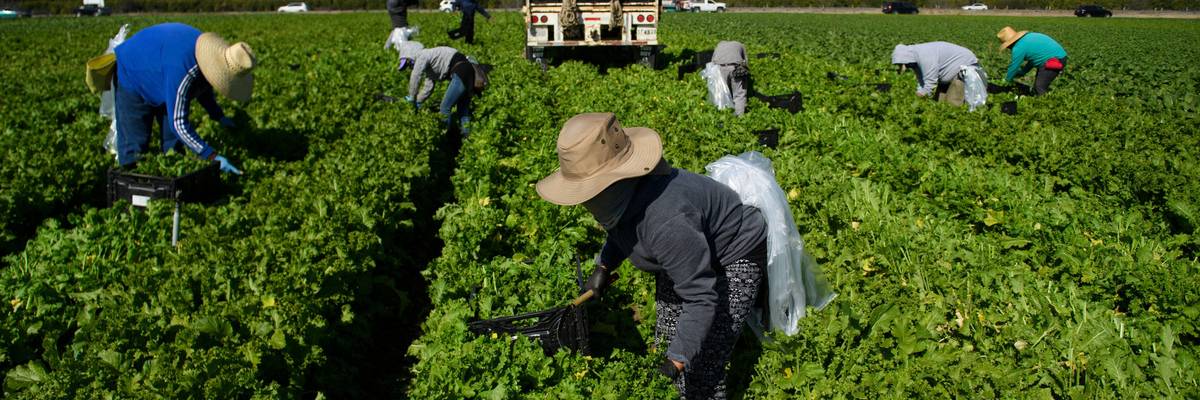
Farmworkers wear face masks while harvesting curly mustard in a field on February 10, 2021 in Ventura County, California. (Photo: Patrick T. Fallon/AFP via Getty Images)
In the early days of the pandemic, California farmworker Carolina Sanchez saw stark differences in how she was treated on union versus non-union jobs.
Farmworkers' Covid-related challenges came on top of years of exploitation, including exposure to toxic pesticides that she says has debilitated some of her co-workers.
When she was picking blueberries under a United Farm Workers contract, the union handed out masks and ensured other safety precautions. When she was picking table grapes without a contract, she says she had "no sick leave, no masks, no temperature checks--nothing."
She and other workers asked for a meeting to raise concerns with a supervisor.
"He told us:, 'If you've already eaten the meat, you must suck on the bone.' He let us know we weren't worth anything."
Sanchez shared her story at the Department of Labor headquarters in Washington, D.C. on September 1, as part of a ceremony to induct "Essential Workers of the Pandemic" into the Department's Hall of Honor. Farmworkers' Covid-related challenges came on top of years of exploitation, including exposure to toxic pesticides that she says has debilitated some of her co-workers. Sanchez ended her remarks by expressing how much it saddens her to see such a rich country treat workers so badly.
"Carolina, you're right," responded Labor Secretary Marty Walsh. "People don't understand and respect the work farmworkers do. In my fridge, there's blueberries. But I don't always think about how there were fingers on those berries--fingers that picked those blueberries and got them to my fridge. And even in non-pandemic times, those workers worked through very difficult conditions because a lot of times, the farmers in this country don't respect the farmworkers in this country. And we, as a country, need to start respecting farmworkers."
Sanchez was joined on stage by three other essential workers who shared personal testimony about their experiences during the pandemic.
Jose Rodriguez, an Illinois truck driver, described the pride he felt when he witnessed just how much people appreciated his deliveries at the beginning of the pandemic. One of his first assignments during the pandemic was to deliver a truck full of personal protective equipment to St. Jude's Children's Hospital. When he delivered an appliance to one older woman, she told him he was the first person she'd seen since her husband died several weeks before.
Eddie Quezada, a produce manager at a Stop & Shop in Huntington, New York, shared what it was like to see his 15 employees dwindle down to just four while dealing with a sales frenzy that was "like Thanksgiving every day for four to five weeks" with limited access to protective gear.
Andrea Beeman, a special needs paraeducator in Ohio and National Educators of America regional president, described how support staff stepped up to fill crucial roles while the buildings were closed.
"We were on the frontlines of the pandemic doing everything we could to minimize the impact of the pandemic on our students," Beeman said. "Cafeteria workers made sure students and their families received nutritious meals, bus drivers delivered learning materials to students, and paraeducators and library media clerks joined teachers in their online classrooms to ensure students had what they needed in order to learn."
Hall of Honor inductees are listed prominently in the lobby of the Labor Department building named after Frances Perkins, the first female member of a presidential cabinet and the first female Labor Secretary.
"The Hall of Honor is about people who changed history, and that's exactly what the essential workers of the coronavirus pandemic did for our country," said Walsh. "There will never be other names more important on the wall than the essential workers."
"The people on this wall did great things for labor--well most of them did anyway," he added.
A few names on the inductee list do stand out as rather puzzling. One of the Trump administration's picks was none other than union-busting Ronald Reagan. Yes, he was the president of the Screen Actors Guild, but his real stamp on the labor movement came when he fired more than 11,000 striking air traffic controllers in 1981 and replaced them with scabs. That move emboldened Corporate America to repress worker organizing, accelerating the decline in unionization.
But the Hall of Honor list includes many genuine labor heroes, including the man Carolina Sanchez says is her role model: Cesar Chavez, the fruit and vegetable picker who became the leader of the United Farm Workers of America.
"I'm married with seven children," Sanchez said. "I get up every day at 3 a.m. to take care of my children and I am in the fields by 6 a.m. I became a leader because when we don't work under a union contract, we are mistreated. I do this because I want my own children to one day do a little bit of what Cesar Chavez did. He was a leader."
Dear Common Dreams reader, It’s been nearly 30 years since I co-founded Common Dreams with my late wife, Lina Newhouser. We had the radical notion that journalism should serve the public good, not corporate profits. It was clear to us from the outset what it would take to build such a project. No paid advertisements. No corporate sponsors. No millionaire publisher telling us what to think or do. Many people said we wouldn't last a year, but we proved those doubters wrong. Together with a tremendous team of journalists and dedicated staff, we built an independent media outlet free from the constraints of profits and corporate control. Our mission has always been simple: To inform. To inspire. To ignite change for the common good. Building Common Dreams was not easy. Our survival was never guaranteed. When you take on the most powerful forces—Wall Street greed, fossil fuel industry destruction, Big Tech lobbyists, and uber-rich oligarchs who have spent billions upon billions rigging the economy and democracy in their favor—the only bulwark you have is supporters who believe in your work. But here’s the urgent message from me today. It's never been this bad out there. And it's never been this hard to keep us going. At the very moment Common Dreams is most needed, the threats we face are intensifying. We need your support now more than ever. We don't accept corporate advertising and never will. We don't have a paywall because we don't think people should be blocked from critical news based on their ability to pay. Everything we do is funded by the donations of readers like you. When everyone does the little they can afford, we are strong. But if that support retreats or dries up, so do we. Will you donate now to make sure Common Dreams not only survives but thrives? —Craig Brown, Co-founder |
In the early days of the pandemic, California farmworker Carolina Sanchez saw stark differences in how she was treated on union versus non-union jobs.
Farmworkers' Covid-related challenges came on top of years of exploitation, including exposure to toxic pesticides that she says has debilitated some of her co-workers.
When she was picking blueberries under a United Farm Workers contract, the union handed out masks and ensured other safety precautions. When she was picking table grapes without a contract, she says she had "no sick leave, no masks, no temperature checks--nothing."
She and other workers asked for a meeting to raise concerns with a supervisor.
"He told us:, 'If you've already eaten the meat, you must suck on the bone.' He let us know we weren't worth anything."
Sanchez shared her story at the Department of Labor headquarters in Washington, D.C. on September 1, as part of a ceremony to induct "Essential Workers of the Pandemic" into the Department's Hall of Honor. Farmworkers' Covid-related challenges came on top of years of exploitation, including exposure to toxic pesticides that she says has debilitated some of her co-workers. Sanchez ended her remarks by expressing how much it saddens her to see such a rich country treat workers so badly.
"Carolina, you're right," responded Labor Secretary Marty Walsh. "People don't understand and respect the work farmworkers do. In my fridge, there's blueberries. But I don't always think about how there were fingers on those berries--fingers that picked those blueberries and got them to my fridge. And even in non-pandemic times, those workers worked through very difficult conditions because a lot of times, the farmers in this country don't respect the farmworkers in this country. And we, as a country, need to start respecting farmworkers."
Sanchez was joined on stage by three other essential workers who shared personal testimony about their experiences during the pandemic.
Jose Rodriguez, an Illinois truck driver, described the pride he felt when he witnessed just how much people appreciated his deliveries at the beginning of the pandemic. One of his first assignments during the pandemic was to deliver a truck full of personal protective equipment to St. Jude's Children's Hospital. When he delivered an appliance to one older woman, she told him he was the first person she'd seen since her husband died several weeks before.
Eddie Quezada, a produce manager at a Stop & Shop in Huntington, New York, shared what it was like to see his 15 employees dwindle down to just four while dealing with a sales frenzy that was "like Thanksgiving every day for four to five weeks" with limited access to protective gear.
Andrea Beeman, a special needs paraeducator in Ohio and National Educators of America regional president, described how support staff stepped up to fill crucial roles while the buildings were closed.
"We were on the frontlines of the pandemic doing everything we could to minimize the impact of the pandemic on our students," Beeman said. "Cafeteria workers made sure students and their families received nutritious meals, bus drivers delivered learning materials to students, and paraeducators and library media clerks joined teachers in their online classrooms to ensure students had what they needed in order to learn."
Hall of Honor inductees are listed prominently in the lobby of the Labor Department building named after Frances Perkins, the first female member of a presidential cabinet and the first female Labor Secretary.
"The Hall of Honor is about people who changed history, and that's exactly what the essential workers of the coronavirus pandemic did for our country," said Walsh. "There will never be other names more important on the wall than the essential workers."
"The people on this wall did great things for labor--well most of them did anyway," he added.
A few names on the inductee list do stand out as rather puzzling. One of the Trump administration's picks was none other than union-busting Ronald Reagan. Yes, he was the president of the Screen Actors Guild, but his real stamp on the labor movement came when he fired more than 11,000 striking air traffic controllers in 1981 and replaced them with scabs. That move emboldened Corporate America to repress worker organizing, accelerating the decline in unionization.
But the Hall of Honor list includes many genuine labor heroes, including the man Carolina Sanchez says is her role model: Cesar Chavez, the fruit and vegetable picker who became the leader of the United Farm Workers of America.
"I'm married with seven children," Sanchez said. "I get up every day at 3 a.m. to take care of my children and I am in the fields by 6 a.m. I became a leader because when we don't work under a union contract, we are mistreated. I do this because I want my own children to one day do a little bit of what Cesar Chavez did. He was a leader."
In the early days of the pandemic, California farmworker Carolina Sanchez saw stark differences in how she was treated on union versus non-union jobs.
Farmworkers' Covid-related challenges came on top of years of exploitation, including exposure to toxic pesticides that she says has debilitated some of her co-workers.
When she was picking blueberries under a United Farm Workers contract, the union handed out masks and ensured other safety precautions. When she was picking table grapes without a contract, she says she had "no sick leave, no masks, no temperature checks--nothing."
She and other workers asked for a meeting to raise concerns with a supervisor.
"He told us:, 'If you've already eaten the meat, you must suck on the bone.' He let us know we weren't worth anything."
Sanchez shared her story at the Department of Labor headquarters in Washington, D.C. on September 1, as part of a ceremony to induct "Essential Workers of the Pandemic" into the Department's Hall of Honor. Farmworkers' Covid-related challenges came on top of years of exploitation, including exposure to toxic pesticides that she says has debilitated some of her co-workers. Sanchez ended her remarks by expressing how much it saddens her to see such a rich country treat workers so badly.
"Carolina, you're right," responded Labor Secretary Marty Walsh. "People don't understand and respect the work farmworkers do. In my fridge, there's blueberries. But I don't always think about how there were fingers on those berries--fingers that picked those blueberries and got them to my fridge. And even in non-pandemic times, those workers worked through very difficult conditions because a lot of times, the farmers in this country don't respect the farmworkers in this country. And we, as a country, need to start respecting farmworkers."
Sanchez was joined on stage by three other essential workers who shared personal testimony about their experiences during the pandemic.
Jose Rodriguez, an Illinois truck driver, described the pride he felt when he witnessed just how much people appreciated his deliveries at the beginning of the pandemic. One of his first assignments during the pandemic was to deliver a truck full of personal protective equipment to St. Jude's Children's Hospital. When he delivered an appliance to one older woman, she told him he was the first person she'd seen since her husband died several weeks before.
Eddie Quezada, a produce manager at a Stop & Shop in Huntington, New York, shared what it was like to see his 15 employees dwindle down to just four while dealing with a sales frenzy that was "like Thanksgiving every day for four to five weeks" with limited access to protective gear.
Andrea Beeman, a special needs paraeducator in Ohio and National Educators of America regional president, described how support staff stepped up to fill crucial roles while the buildings were closed.
"We were on the frontlines of the pandemic doing everything we could to minimize the impact of the pandemic on our students," Beeman said. "Cafeteria workers made sure students and their families received nutritious meals, bus drivers delivered learning materials to students, and paraeducators and library media clerks joined teachers in their online classrooms to ensure students had what they needed in order to learn."
Hall of Honor inductees are listed prominently in the lobby of the Labor Department building named after Frances Perkins, the first female member of a presidential cabinet and the first female Labor Secretary.
"The Hall of Honor is about people who changed history, and that's exactly what the essential workers of the coronavirus pandemic did for our country," said Walsh. "There will never be other names more important on the wall than the essential workers."
"The people on this wall did great things for labor--well most of them did anyway," he added.
A few names on the inductee list do stand out as rather puzzling. One of the Trump administration's picks was none other than union-busting Ronald Reagan. Yes, he was the president of the Screen Actors Guild, but his real stamp on the labor movement came when he fired more than 11,000 striking air traffic controllers in 1981 and replaced them with scabs. That move emboldened Corporate America to repress worker organizing, accelerating the decline in unionization.
But the Hall of Honor list includes many genuine labor heroes, including the man Carolina Sanchez says is her role model: Cesar Chavez, the fruit and vegetable picker who became the leader of the United Farm Workers of America.
"I'm married with seven children," Sanchez said. "I get up every day at 3 a.m. to take care of my children and I am in the fields by 6 a.m. I became a leader because when we don't work under a union contract, we are mistreated. I do this because I want my own children to one day do a little bit of what Cesar Chavez did. He was a leader."