
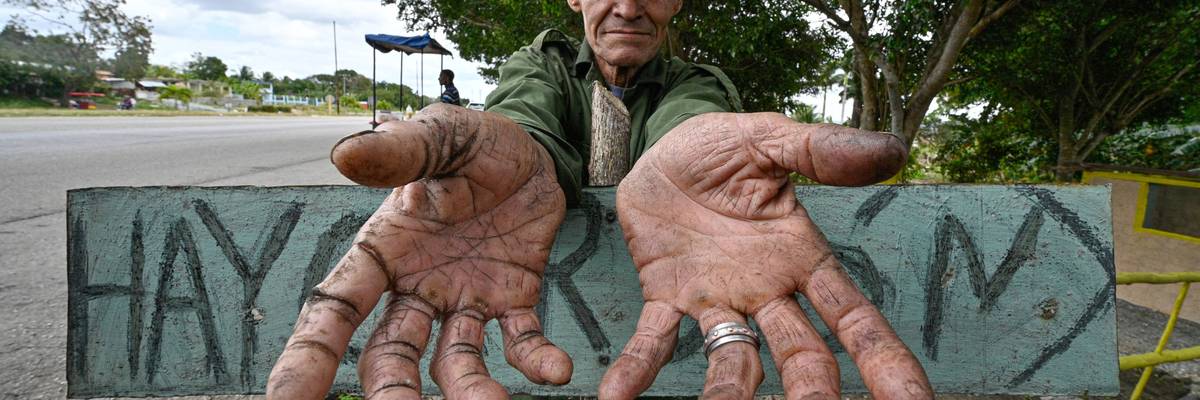
Charcoal seller Elio Galvan, 44, shows his hands as he waits for customers next to a sign advertising his product on a road in Havana on February 6, 2026.
The Architecture of Siege: Cuba, Gaza, and the Strategy of Everywhere at Once
The blockade is not foreign policy. It is a blueprint. And we have seen it before.
" Cuba is next," said Sen. Lindsey Graham on Sunday night in America, March 2, 2026, grinning between a Venezuelan surgical decapitation and an Iranian bombing campaign like a man checking items off a list. "They are going to fall. This communist dictatorship in Cuba, their days are numbered."
They are already falling.
They fall in hospitals without power. They fall in nursing homes without food. They fall in cancer wards where the machines went silent weeks ago and no one came back to restart them. They fall in kitchens where mothers boil water they carried for miles, over fires made from broken chairs and splintered tables. They fall in apartments dark for 20 hours a day, on an island 90 miles from Florida, while a United States senator smiles on television and calls it progress.
This is not a warning about what might happen to Cuba. It is a clinical description of what is happening right now, today, while you read this, while the news cycle skids forward to the next detonation and pretends the last one never happened.
The strategy is to open enough fronts to make sustained resistance on any single front feel impossible.
Since December 2025, the United States has seized oil tankers on the open sea, threatened tariffs against any nation that dares sell fuel to Cuba, and pressured Mexico into halting shipments. The timeline is precise: The first tanker seizure came on December 10. The last major fuel delivery arrived on January 9. On January 29, the executive order dropped, threatening tariffs on any country that supplies Cuba with oil. The island has not received a significant shipment since, and Bloomberg satellite analysis shows nighttime light levels across eastern Cuba have fallen by 50%. The island is going dark, and we can see it from space.
An engineer would call what followed a cascading systems failure. Fuel feeds the electrical grid. The grid powers the water pumps. The pumps keep millions of people alive, or they used to. Sever the first link and the rest follows with mechanical certainty, then human consequence, then preventable death.
Now the grid fails for up to 20 hours a day in parts of the country. Eighty-four percent of Cuba's water pumping infrastructure depends on electricity that no longer reliably exists, so taps go dry and pressure vanishes. Nearly 1 million people get drinking water from tanker trucks that are running out of diesel, which means even the emergency solution is collapsing. Five million Cubans live with chronic illnesses, and chronic illness does not pause for politics. Thousands of cancer patients have watched chemotherapy and radiotherapy simply stop, not because the medicine is gone, but because there is no power to deliver it. The United Nations resident coordinator in Havana has called it what it is: acute humanitarian risk, deteriorating by the day.
Cuba's population has plummeted from roughly 11 million to an estimated 8.6 million in five years, a peacetime collapse that demographers compare, for sheer velocity, to nations at war. Sugar production has fallen to its lowest level in over a century. The official inflation rate masks a real rate economists estimate near 70%, which means wages rot while prices sprint. Airports cannot provide jet fuel. Garbage trucks sit empty. Hospitals operate by flashlight, and a flashlight is not a ventilator.
And on Sunday, a senator from South Carolina went on television to say their days are numbered, as if the dying had not already begun, as if the darkness were not already inside the wards.
I am an engineer by training. I see systems. I also see what people do when they want to hurt civilians while keeping their hands clean.
Siege is a system.
It has inputs: fuel, food, medicine, money. It has choke points: tanker seizures, executive orders, tariff threats. It has predictable failure modes: grid collapse, pump failure, hospital shutdown, preventable death. It has a kill chain too, and it selects its victims with the cold efficiency of triage in reverse. The elderly go first. Then the chronically ill. Then the infants whose mothers cannot reach hospitals that cannot run incubators. Then everyone else, slowly, invisibly, deniably.
This is not new. The architecture is old. Only the language changes, and the public gets trained to hear that language as policy instead of violence.
In the Warsaw Ghetto, supply lines were severed, medical infrastructure collapsed, and a population was sealed inside and slowly starved. The authorities described it as a public health measure. The engineers of that system understood that you do not need to kill people directly if you can cut off what keeps them alive and let time do the rest. In Gaza, the same architecture returned: fuel cut, hospitals dark, water systems destroyed, international law invoked by everyone and enforced by no one, while cameras rolled and the death toll climbed and the world performed its anguish on schedule and moved on.
Cuba, March 2026: tankers seized on the open sea. Airports grounded. Cancer wards without power. A population that increasingly cannot leave because Nicaragua has closed its visa-free corridor and the Florida Straits remain as lethal as ever. The Supreme Court struck down the tariff mechanism that underpins the blockade, and the administration has shown no sign of relenting. Not a pause, not a pivot, not even the decency of shame.
The architect of this particular siege is Secretary of State Marco Rubio, a Cuban American whose parents left the island before Fidel Castro took power. He has spent a career positioning himself for this moment. That a man whose family left the island seeking a better life now engineers another for the millions who remain is not irony. It is the kind of cruelty that requires a surname and a face.
I am not calling this a genocide. I am describing a pattern, because the pattern is visible if you stop letting the headlines drag your eyes away. Civilian populations besieged through infrastructure strangulation. Justified by the language of regime change. Enabled by the manufactured exhaustion of everyone who might object.
That exhaustion is not an accident. It is the strategy.
I have spent the past year documenting how this administration builds systems designed to break people slowly. Detention facilities that warehouse human beings indefinitely while the paperwork dissolves—70,000 detained and climbing at 3,000 a month, with the courts gutted too fast to process them. Environmental protections gutted by executive order faster than any court can respond. Regulatory frameworks designed to expire by default if no one has the resources to defend them. The cruelty is not always loud, but it is always organized, and it always counts on you to look away.
Cuba is not a different story. It is the same story, told in Spanish, 90 miles from shore, with an ocean in between that is treated like a moat around your conscience.
Consider the sequence. In January, Venezuela was struck and its president seized. On January 29, the executive order blockading Cuba dropped, pushing its population into darkness. This weekend, Iran was struck. Immigration and Customs Enforcement continues to operate in American cities under rules that courts have challenged and the administration ignores. Detention capacity expands. Environmental rollbacks accelerate. Each crisis buries the last, and the burial is the point.
Venezuela buried the detention story. Iran buried Venezuela. Cuba is being buried by Iran. And by Tuesday, something new will bury Cuba, because the machine does not rest and it does not need your agreement. It only needs your fatigue.
This is not incompetence. It is architecture. The strategy is to open enough fronts to make sustained resistance on any single front feel impossible. To overwhelm not just governments and institutions but the moral attention of ordinary citizens. To make atrocity feel normal, ambient, inevitable, like background noise you learn to tune out because it hurts too much to keep hearing it.
Every authoritarian project in history has relied on the same calculation: The public's capacity for outrage is finite and can be outpaced. Move fast enough. Break enough things at once. People stop tracking the damage. Then silence arrives, and even when silence is not consent, it functions like consent, and the architects know that. They build for it.
We said, "Never again" after the Holocaust. We said it while watching Gaza in what should have been real time but always felt like delay. We are saying it now, about everything and nothing, the words worn down by repetition, polished by overuse, easy to carry and easier to abandon.
Cuba is 90 miles from Florida. The people are real. The starvation is real. The hospitals are dark. Cancer patients are dying. Water is not coming. And a United States senator went on television Sunday evening and smiled about it.
So here is the test, and it is not abstract. The lesson of "never again," apparently, is that it has a radius. It has an attention span. It has an expiration date. The architects of this era know exactly how to exploit all three, and they do it in plain sight, with clean suits and confident voices and a grin that dares you to care.
Do not let them.
Do not let Cuba become the crisis you meant to care about but never quite got around to, wedged between the bombing and the raid and the next emergency engineered to make you forget the last one. Do not outsource your moral attention to the news cycle. Do not accept exhaustion as an excuse. Do not accept policy language as a mask for suffering.
The siege is the strategy. The overwhelm is the weapon. And your attention, right now, today, is the one thing they cannot seize on the open sea.
An Urgent Message From Our Co-Founder
Dear Common Dreams reader, It’s been nearly 30 years since I co-founded Common Dreams with my late wife, Lina Newhouser. We had the radical notion that journalism should serve the public good, not corporate profits. It was clear to us from the outset what it would take to build such a project. No paid advertisements. No corporate sponsors. No millionaire publisher telling us what to think or do. Many people said we wouldn't last a year, but we proved those doubters wrong. Together with a tremendous team of journalists and dedicated staff, we built an independent media outlet free from the constraints of profits and corporate control. Our mission has always been simple: To inform. To inspire. To ignite change for the common good. Building Common Dreams was not easy. Our survival was never guaranteed. When you take on the most powerful forces—Wall Street greed, fossil fuel industry destruction, Big Tech lobbyists, and uber-rich oligarchs who have spent billions upon billions rigging the economy and democracy in their favor—the only bulwark you have is supporters who believe in your work. But here’s the urgent message from me today. It's never been this bad out there. And it's never been this hard to keep us going. At the very moment Common Dreams is most needed, the threats we face are intensifying. We need your support now more than ever. We don't accept corporate advertising and never will. We don't have a paywall because we don't think people should be blocked from critical news based on their ability to pay. Everything we do is funded by the donations of readers like you. When everyone does the little they can afford, we are strong. But if that support retreats or dries up, so do we. Will you donate now to make sure Common Dreams not only survives but thrives? —Craig Brown, Co-founder |
" Cuba is next," said Sen. Lindsey Graham on Sunday night in America, March 2, 2026, grinning between a Venezuelan surgical decapitation and an Iranian bombing campaign like a man checking items off a list. "They are going to fall. This communist dictatorship in Cuba, their days are numbered."
They are already falling.
They fall in hospitals without power. They fall in nursing homes without food. They fall in cancer wards where the machines went silent weeks ago and no one came back to restart them. They fall in kitchens where mothers boil water they carried for miles, over fires made from broken chairs and splintered tables. They fall in apartments dark for 20 hours a day, on an island 90 miles from Florida, while a United States senator smiles on television and calls it progress.
This is not a warning about what might happen to Cuba. It is a clinical description of what is happening right now, today, while you read this, while the news cycle skids forward to the next detonation and pretends the last one never happened.
The strategy is to open enough fronts to make sustained resistance on any single front feel impossible.
Since December 2025, the United States has seized oil tankers on the open sea, threatened tariffs against any nation that dares sell fuel to Cuba, and pressured Mexico into halting shipments. The timeline is precise: The first tanker seizure came on December 10. The last major fuel delivery arrived on January 9. On January 29, the executive order dropped, threatening tariffs on any country that supplies Cuba with oil. The island has not received a significant shipment since, and Bloomberg satellite analysis shows nighttime light levels across eastern Cuba have fallen by 50%. The island is going dark, and we can see it from space.
An engineer would call what followed a cascading systems failure. Fuel feeds the electrical grid. The grid powers the water pumps. The pumps keep millions of people alive, or they used to. Sever the first link and the rest follows with mechanical certainty, then human consequence, then preventable death.
Now the grid fails for up to 20 hours a day in parts of the country. Eighty-four percent of Cuba's water pumping infrastructure depends on electricity that no longer reliably exists, so taps go dry and pressure vanishes. Nearly 1 million people get drinking water from tanker trucks that are running out of diesel, which means even the emergency solution is collapsing. Five million Cubans live with chronic illnesses, and chronic illness does not pause for politics. Thousands of cancer patients have watched chemotherapy and radiotherapy simply stop, not because the medicine is gone, but because there is no power to deliver it. The United Nations resident coordinator in Havana has called it what it is: acute humanitarian risk, deteriorating by the day.
Cuba's population has plummeted from roughly 11 million to an estimated 8.6 million in five years, a peacetime collapse that demographers compare, for sheer velocity, to nations at war. Sugar production has fallen to its lowest level in over a century. The official inflation rate masks a real rate economists estimate near 70%, which means wages rot while prices sprint. Airports cannot provide jet fuel. Garbage trucks sit empty. Hospitals operate by flashlight, and a flashlight is not a ventilator.
And on Sunday, a senator from South Carolina went on television to say their days are numbered, as if the dying had not already begun, as if the darkness were not already inside the wards.
I am an engineer by training. I see systems. I also see what people do when they want to hurt civilians while keeping their hands clean.
Siege is a system.
It has inputs: fuel, food, medicine, money. It has choke points: tanker seizures, executive orders, tariff threats. It has predictable failure modes: grid collapse, pump failure, hospital shutdown, preventable death. It has a kill chain too, and it selects its victims with the cold efficiency of triage in reverse. The elderly go first. Then the chronically ill. Then the infants whose mothers cannot reach hospitals that cannot run incubators. Then everyone else, slowly, invisibly, deniably.
This is not new. The architecture is old. Only the language changes, and the public gets trained to hear that language as policy instead of violence.
In the Warsaw Ghetto, supply lines were severed, medical infrastructure collapsed, and a population was sealed inside and slowly starved. The authorities described it as a public health measure. The engineers of that system understood that you do not need to kill people directly if you can cut off what keeps them alive and let time do the rest. In Gaza, the same architecture returned: fuel cut, hospitals dark, water systems destroyed, international law invoked by everyone and enforced by no one, while cameras rolled and the death toll climbed and the world performed its anguish on schedule and moved on.
Cuba, March 2026: tankers seized on the open sea. Airports grounded. Cancer wards without power. A population that increasingly cannot leave because Nicaragua has closed its visa-free corridor and the Florida Straits remain as lethal as ever. The Supreme Court struck down the tariff mechanism that underpins the blockade, and the administration has shown no sign of relenting. Not a pause, not a pivot, not even the decency of shame.
The architect of this particular siege is Secretary of State Marco Rubio, a Cuban American whose parents left the island before Fidel Castro took power. He has spent a career positioning himself for this moment. That a man whose family left the island seeking a better life now engineers another for the millions who remain is not irony. It is the kind of cruelty that requires a surname and a face.
I am not calling this a genocide. I am describing a pattern, because the pattern is visible if you stop letting the headlines drag your eyes away. Civilian populations besieged through infrastructure strangulation. Justified by the language of regime change. Enabled by the manufactured exhaustion of everyone who might object.
That exhaustion is not an accident. It is the strategy.
I have spent the past year documenting how this administration builds systems designed to break people slowly. Detention facilities that warehouse human beings indefinitely while the paperwork dissolves—70,000 detained and climbing at 3,000 a month, with the courts gutted too fast to process them. Environmental protections gutted by executive order faster than any court can respond. Regulatory frameworks designed to expire by default if no one has the resources to defend them. The cruelty is not always loud, but it is always organized, and it always counts on you to look away.
Cuba is not a different story. It is the same story, told in Spanish, 90 miles from shore, with an ocean in between that is treated like a moat around your conscience.
Consider the sequence. In January, Venezuela was struck and its president seized. On January 29, the executive order blockading Cuba dropped, pushing its population into darkness. This weekend, Iran was struck. Immigration and Customs Enforcement continues to operate in American cities under rules that courts have challenged and the administration ignores. Detention capacity expands. Environmental rollbacks accelerate. Each crisis buries the last, and the burial is the point.
Venezuela buried the detention story. Iran buried Venezuela. Cuba is being buried by Iran. And by Tuesday, something new will bury Cuba, because the machine does not rest and it does not need your agreement. It only needs your fatigue.
This is not incompetence. It is architecture. The strategy is to open enough fronts to make sustained resistance on any single front feel impossible. To overwhelm not just governments and institutions but the moral attention of ordinary citizens. To make atrocity feel normal, ambient, inevitable, like background noise you learn to tune out because it hurts too much to keep hearing it.
Every authoritarian project in history has relied on the same calculation: The public's capacity for outrage is finite and can be outpaced. Move fast enough. Break enough things at once. People stop tracking the damage. Then silence arrives, and even when silence is not consent, it functions like consent, and the architects know that. They build for it.
We said, "Never again" after the Holocaust. We said it while watching Gaza in what should have been real time but always felt like delay. We are saying it now, about everything and nothing, the words worn down by repetition, polished by overuse, easy to carry and easier to abandon.
Cuba is 90 miles from Florida. The people are real. The starvation is real. The hospitals are dark. Cancer patients are dying. Water is not coming. And a United States senator went on television Sunday evening and smiled about it.
So here is the test, and it is not abstract. The lesson of "never again," apparently, is that it has a radius. It has an attention span. It has an expiration date. The architects of this era know exactly how to exploit all three, and they do it in plain sight, with clean suits and confident voices and a grin that dares you to care.
Do not let them.
Do not let Cuba become the crisis you meant to care about but never quite got around to, wedged between the bombing and the raid and the next emergency engineered to make you forget the last one. Do not outsource your moral attention to the news cycle. Do not accept exhaustion as an excuse. Do not accept policy language as a mask for suffering.
The siege is the strategy. The overwhelm is the weapon. And your attention, right now, today, is the one thing they cannot seize on the open sea.
- 'Two Genocidaires v. the World': US, Israel Oppose Lifting Cuba Blockade ›
- End the War on the Cuban People! ›
- From Gaza to Cuba, Canada Remains the World’s Most Tactful Bystander ›
- The World Say NO to US Blockade of Cuba ›
- 'We Are Sailing to Cuba': Humanitarian Coalition Announces Flotilla to Break US Blockade ›
- How the US Weaponizes Starvation and Aid in Gaza and Cuba ›
" Cuba is next," said Sen. Lindsey Graham on Sunday night in America, March 2, 2026, grinning between a Venezuelan surgical decapitation and an Iranian bombing campaign like a man checking items off a list. "They are going to fall. This communist dictatorship in Cuba, their days are numbered."
They are already falling.
They fall in hospitals without power. They fall in nursing homes without food. They fall in cancer wards where the machines went silent weeks ago and no one came back to restart them. They fall in kitchens where mothers boil water they carried for miles, over fires made from broken chairs and splintered tables. They fall in apartments dark for 20 hours a day, on an island 90 miles from Florida, while a United States senator smiles on television and calls it progress.
This is not a warning about what might happen to Cuba. It is a clinical description of what is happening right now, today, while you read this, while the news cycle skids forward to the next detonation and pretends the last one never happened.
The strategy is to open enough fronts to make sustained resistance on any single front feel impossible.
Since December 2025, the United States has seized oil tankers on the open sea, threatened tariffs against any nation that dares sell fuel to Cuba, and pressured Mexico into halting shipments. The timeline is precise: The first tanker seizure came on December 10. The last major fuel delivery arrived on January 9. On January 29, the executive order dropped, threatening tariffs on any country that supplies Cuba with oil. The island has not received a significant shipment since, and Bloomberg satellite analysis shows nighttime light levels across eastern Cuba have fallen by 50%. The island is going dark, and we can see it from space.
An engineer would call what followed a cascading systems failure. Fuel feeds the electrical grid. The grid powers the water pumps. The pumps keep millions of people alive, or they used to. Sever the first link and the rest follows with mechanical certainty, then human consequence, then preventable death.
Now the grid fails for up to 20 hours a day in parts of the country. Eighty-four percent of Cuba's water pumping infrastructure depends on electricity that no longer reliably exists, so taps go dry and pressure vanishes. Nearly 1 million people get drinking water from tanker trucks that are running out of diesel, which means even the emergency solution is collapsing. Five million Cubans live with chronic illnesses, and chronic illness does not pause for politics. Thousands of cancer patients have watched chemotherapy and radiotherapy simply stop, not because the medicine is gone, but because there is no power to deliver it. The United Nations resident coordinator in Havana has called it what it is: acute humanitarian risk, deteriorating by the day.
Cuba's population has plummeted from roughly 11 million to an estimated 8.6 million in five years, a peacetime collapse that demographers compare, for sheer velocity, to nations at war. Sugar production has fallen to its lowest level in over a century. The official inflation rate masks a real rate economists estimate near 70%, which means wages rot while prices sprint. Airports cannot provide jet fuel. Garbage trucks sit empty. Hospitals operate by flashlight, and a flashlight is not a ventilator.
And on Sunday, a senator from South Carolina went on television to say their days are numbered, as if the dying had not already begun, as if the darkness were not already inside the wards.
I am an engineer by training. I see systems. I also see what people do when they want to hurt civilians while keeping their hands clean.
Siege is a system.
It has inputs: fuel, food, medicine, money. It has choke points: tanker seizures, executive orders, tariff threats. It has predictable failure modes: grid collapse, pump failure, hospital shutdown, preventable death. It has a kill chain too, and it selects its victims with the cold efficiency of triage in reverse. The elderly go first. Then the chronically ill. Then the infants whose mothers cannot reach hospitals that cannot run incubators. Then everyone else, slowly, invisibly, deniably.
This is not new. The architecture is old. Only the language changes, and the public gets trained to hear that language as policy instead of violence.
In the Warsaw Ghetto, supply lines were severed, medical infrastructure collapsed, and a population was sealed inside and slowly starved. The authorities described it as a public health measure. The engineers of that system understood that you do not need to kill people directly if you can cut off what keeps them alive and let time do the rest. In Gaza, the same architecture returned: fuel cut, hospitals dark, water systems destroyed, international law invoked by everyone and enforced by no one, while cameras rolled and the death toll climbed and the world performed its anguish on schedule and moved on.
Cuba, March 2026: tankers seized on the open sea. Airports grounded. Cancer wards without power. A population that increasingly cannot leave because Nicaragua has closed its visa-free corridor and the Florida Straits remain as lethal as ever. The Supreme Court struck down the tariff mechanism that underpins the blockade, and the administration has shown no sign of relenting. Not a pause, not a pivot, not even the decency of shame.
The architect of this particular siege is Secretary of State Marco Rubio, a Cuban American whose parents left the island before Fidel Castro took power. He has spent a career positioning himself for this moment. That a man whose family left the island seeking a better life now engineers another for the millions who remain is not irony. It is the kind of cruelty that requires a surname and a face.
I am not calling this a genocide. I am describing a pattern, because the pattern is visible if you stop letting the headlines drag your eyes away. Civilian populations besieged through infrastructure strangulation. Justified by the language of regime change. Enabled by the manufactured exhaustion of everyone who might object.
That exhaustion is not an accident. It is the strategy.
I have spent the past year documenting how this administration builds systems designed to break people slowly. Detention facilities that warehouse human beings indefinitely while the paperwork dissolves—70,000 detained and climbing at 3,000 a month, with the courts gutted too fast to process them. Environmental protections gutted by executive order faster than any court can respond. Regulatory frameworks designed to expire by default if no one has the resources to defend them. The cruelty is not always loud, but it is always organized, and it always counts on you to look away.
Cuba is not a different story. It is the same story, told in Spanish, 90 miles from shore, with an ocean in between that is treated like a moat around your conscience.
Consider the sequence. In January, Venezuela was struck and its president seized. On January 29, the executive order blockading Cuba dropped, pushing its population into darkness. This weekend, Iran was struck. Immigration and Customs Enforcement continues to operate in American cities under rules that courts have challenged and the administration ignores. Detention capacity expands. Environmental rollbacks accelerate. Each crisis buries the last, and the burial is the point.
Venezuela buried the detention story. Iran buried Venezuela. Cuba is being buried by Iran. And by Tuesday, something new will bury Cuba, because the machine does not rest and it does not need your agreement. It only needs your fatigue.
This is not incompetence. It is architecture. The strategy is to open enough fronts to make sustained resistance on any single front feel impossible. To overwhelm not just governments and institutions but the moral attention of ordinary citizens. To make atrocity feel normal, ambient, inevitable, like background noise you learn to tune out because it hurts too much to keep hearing it.
Every authoritarian project in history has relied on the same calculation: The public's capacity for outrage is finite and can be outpaced. Move fast enough. Break enough things at once. People stop tracking the damage. Then silence arrives, and even when silence is not consent, it functions like consent, and the architects know that. They build for it.
We said, "Never again" after the Holocaust. We said it while watching Gaza in what should have been real time but always felt like delay. We are saying it now, about everything and nothing, the words worn down by repetition, polished by overuse, easy to carry and easier to abandon.
Cuba is 90 miles from Florida. The people are real. The starvation is real. The hospitals are dark. Cancer patients are dying. Water is not coming. And a United States senator went on television Sunday evening and smiled about it.
So here is the test, and it is not abstract. The lesson of "never again," apparently, is that it has a radius. It has an attention span. It has an expiration date. The architects of this era know exactly how to exploit all three, and they do it in plain sight, with clean suits and confident voices and a grin that dares you to care.
Do not let them.
Do not let Cuba become the crisis you meant to care about but never quite got around to, wedged between the bombing and the raid and the next emergency engineered to make you forget the last one. Do not outsource your moral attention to the news cycle. Do not accept exhaustion as an excuse. Do not accept policy language as a mask for suffering.
The siege is the strategy. The overwhelm is the weapon. And your attention, right now, today, is the one thing they cannot seize on the open sea.
- 'Two Genocidaires v. the World': US, Israel Oppose Lifting Cuba Blockade ›
- End the War on the Cuban People! ›
- From Gaza to Cuba, Canada Remains the World’s Most Tactful Bystander ›
- The World Say NO to US Blockade of Cuba ›
- 'We Are Sailing to Cuba': Humanitarian Coalition Announces Flotilla to Break US Blockade ›
- How the US Weaponizes Starvation and Aid in Gaza and Cuba ›