SUBSCRIBE TO OUR FREE NEWSLETTER
Daily news & progressive opinion—funded by the people, not the corporations—delivered straight to your inbox.
5
#000000
#FFFFFF
To donate by check, phone, or other method, see our More Ways to Give page.
Daily news & progressive opinion—funded by the people, not the corporations—delivered straight to your inbox.
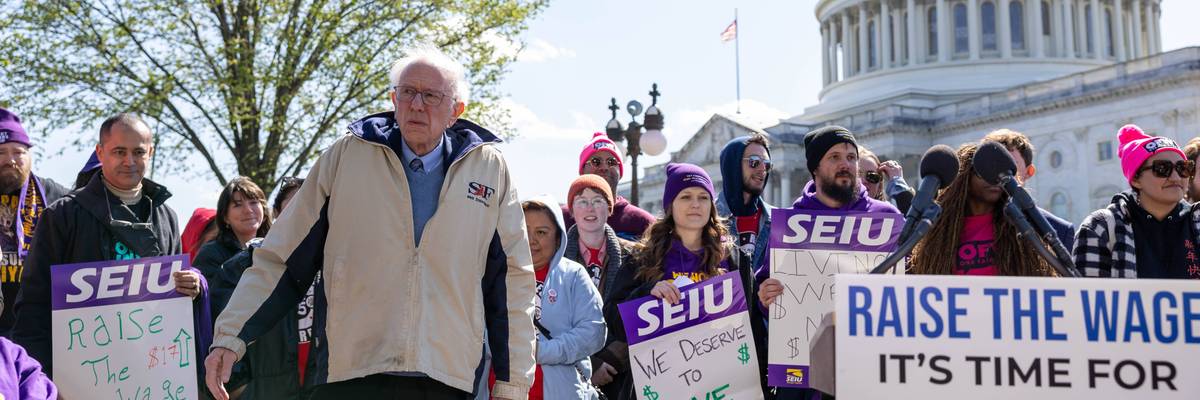
Sen. Bernie Sanders (I-Vt) greets workers at a press conference to reintroduce the Raise the Wage Act at the US Capitol on April 08, 2025 in Washington, DC.
"Raising the minimum wage is the single quickest policy to improve affordability for the greatest number of workers."
A group of economic policy experts argued Thursday that raising the federal minimum wage—which lawmakers haven't increased in nearly two decades—must be an integral part of the incoming Democratic Congress' affordability agenda.
Celine McNicholas, Samantha Sanders, and Ben Zipperer of the Economic Policy Institute (EPI) noted that the federal minimum wage, $7.25 an hour, is at "its lowest real value in 77 years" and "is a major driver of the affordability crisis facing low-wage workers."
While many states—thanks to massive grassroots pressure—have moved to raise their wage floors to at least $15 in the coming years, the EPI experts stressed that 55 million US workers still live in states where the federal minimum prevails.
"Earlier this year, EPI released a report calling on Congress to raise the federal minimum wage to two-thirds of the national median wage—equivalent to roughly $17.50 today, and a projected $20 in 2030," the experts noted. "Our proposed benchmark would lift pay for nearly 40 million workers, about a quarter of the workforce. It would also eliminate poverty wages and move the federal floor toward a living wage in much of the country, so that a single adult working full-time could cover modest expenses in half of US counties."
"Raising the minimum wage is the single quickest policy to improve affordability for the greatest number of workers," wrote McNicholas, Sanders, and Zipperer. "Time and time again, minimum wage increases have raised wages with little-to-no effect on the number of jobs. The income increases they generate are transformative for low-income families and far outweigh the small effects they have on prices."
"The 120th Congress has the chance to advance a true affordability agenda that raises wages for US workers," they added. "A core element of that agenda must be raising the federal minimum wage. This should be achievable, considering that more than a third of the newly elected members of Congress called for raising the minimum wage in their campaign platforms."
The EPI experts' analysis came a day after Sen. Bernie Sanders (I-Vt.) listed a federal minimum wage hike as one of his top legislative priorities in the new Congress, in which he is set to lead the Senate Health, Education, Labor, and Pensions Committee.
Sanders said Wednesday that the current $7.25 federal minimum wage is "totally absurd." The senator said he would propose incrementally raising the federal wage floor to $20 an hour "over a period of years."
This country and this world are at a monumental crossroads. US voters have an opportunity to beat back the forces of fascism and confront the billionaires who are rigging the economy, our media system, and our democracy, making it increasingly impossible for ordinary people to get by. We’re not just talking about the election. We’re talking about what must be done once these fascist elements are vanquished from power. We need a bolder set of solutions than what either major party has so far been willing to offer and a working-class movement ready to fight like hell for it. Trump didn't emerge from nowhere. The conditions that fueled MAGA authoritarianism were created by decades of radical neoliberal economic policies and a corrupt political system dominated by corporate interests. They slashed taxes on the super-rich, promising that the benefits would trickle down. They said giveaways to the corporate titans would make life more affordable for the rest of us. It was all bullshit. And when a bitter, betrayed populace searches for someone to blame, right-wing demagogues have little trouble finding scapegoats. People know when they're being lied to, but you won't hear any of this from the corporate media. Only independent journalism—powered and funded by people who believe in building a better world—can deliver truly trustworthy daily news. If you share our vision, please contribute whatever you can to sustain our work. |
A group of economic policy experts argued Thursday that raising the federal minimum wage—which lawmakers haven't increased in nearly two decades—must be an integral part of the incoming Democratic Congress' affordability agenda.
Celine McNicholas, Samantha Sanders, and Ben Zipperer of the Economic Policy Institute (EPI) noted that the federal minimum wage, $7.25 an hour, is at "its lowest real value in 77 years" and "is a major driver of the affordability crisis facing low-wage workers."
While many states—thanks to massive grassroots pressure—have moved to raise their wage floors to at least $15 in the coming years, the EPI experts stressed that 55 million US workers still live in states where the federal minimum prevails.
"Earlier this year, EPI released a report calling on Congress to raise the federal minimum wage to two-thirds of the national median wage—equivalent to roughly $17.50 today, and a projected $20 in 2030," the experts noted. "Our proposed benchmark would lift pay for nearly 40 million workers, about a quarter of the workforce. It would also eliminate poverty wages and move the federal floor toward a living wage in much of the country, so that a single adult working full-time could cover modest expenses in half of US counties."
"Raising the minimum wage is the single quickest policy to improve affordability for the greatest number of workers," wrote McNicholas, Sanders, and Zipperer. "Time and time again, minimum wage increases have raised wages with little-to-no effect on the number of jobs. The income increases they generate are transformative for low-income families and far outweigh the small effects they have on prices."
"The 120th Congress has the chance to advance a true affordability agenda that raises wages for US workers," they added. "A core element of that agenda must be raising the federal minimum wage. This should be achievable, considering that more than a third of the newly elected members of Congress called for raising the minimum wage in their campaign platforms."
The EPI experts' analysis came a day after Sen. Bernie Sanders (I-Vt.) listed a federal minimum wage hike as one of his top legislative priorities in the new Congress, in which he is set to lead the Senate Health, Education, Labor, and Pensions Committee.
Sanders said Wednesday that the current $7.25 federal minimum wage is "totally absurd." The senator said he would propose incrementally raising the federal wage floor to $20 an hour "over a period of years."