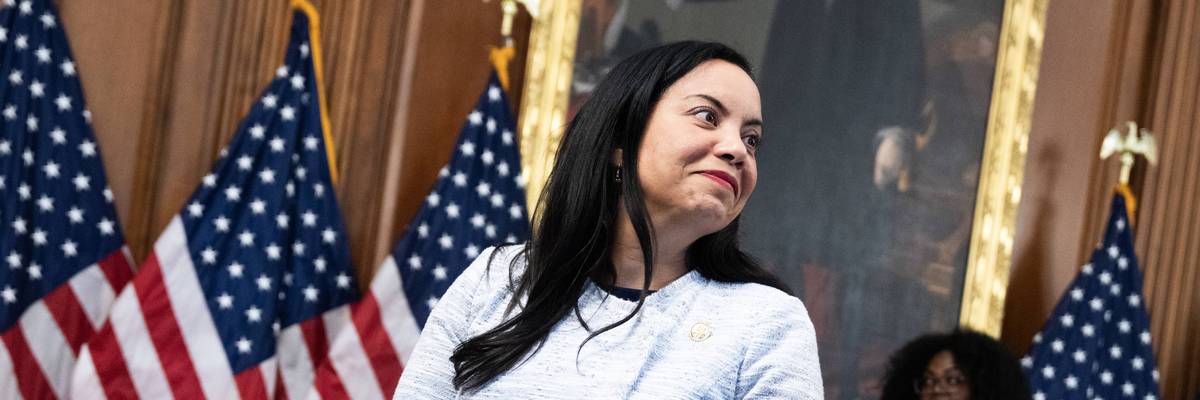
Rep. Analilia Mejia (D-NJ) is seen before her swearing-in ceremony on April 20, 2026.
To End 'New Gilded Age,' House Progressives Unveil Bill to Raise Federal Minimum Wage to $25 Per Hour
"We need an economy that reflects the realities of 2026, not one stuck over a decade ago," said the newly sworn-in Rep. Analilia Mejía, who helped lead the campaign to raise wages in her home state of New Jersey.
A pair of progressive Democrats unveiled a bill on Tuesday that would raise the federal minimum wage to $25 per hour, considered the bare minimum a single adult needs to meet the cost of living in much of the US.
The Living Wage For All Act is the first bill to be introduced by the newly sworn-in Rep. Analilia Mejía (D-NJ), who won a special election earlier this month after helping to lead the fight for a $15 minimum wage in her home state of New Jersey.
Citing data from MIT's Living Wage Calculator, the Living Wage For All campaign backing the legislation argues that $25/hour is needed for a single adult in most parts of the country to afford basic necessities like housing, food, and healthcare.
As the cost of living has skyrocketed over the past decade and a half, the federal minimum wage has remained frozen at $7.25 and hour since 2009.
"This is unacceptable," Mejía said. "We need an economy that reflects the realities of 2026, not one stuck over a decade ago."
The bill is cosponsored by Rep. Delia Ramirez (D-Ill.), the daughter of Guatemalan immigrants who, she said, worked multiple minimum-wage jobs just to get by.
“I remember being in the fourth grade, and my mom talked about her job, and she was getting paid $4.75 an hour,” the 42-year-old congresswoman said during a press conference on Capitol Hill Tuesday. “Yet the federal minimum wage is barely $7.25, many years later.”
"Today, as we think about companies reporting record high earnings, working people are still struggling to survive," she said. "People are working full-time jobs and still cannot afford to live."
A USA TODAY survey from January found that around 40% of workers say their paychecks have not grown enough to meet the rising cost of living, which has been further exacerbated by spiking inflation caused by President Donald Trump's erratic tariff regime and war in Iran. Another survey conducted by Resume Now in April found that about half of workers fear their wages will never catch up to the cost of living.
While some states and cities have gradually raised their minimum wages above the federal level and have seen modest declines in poverty as a result, none have been raised to the point of being considered a living wage.
The bill introduced by Mejía and Ramirez would similarly phase in its increase to the federal minimum wage over more than a decade, with larger employers leading the transition.
Companies with more than $1 billion gross revenue or more than 500 employees would be scheduled to increase their minimum pay to $25/hour by 2031, while smaller employers would be on a longer timeline to reach $25/hour by 2038.
To ensure wages don’t lag again in the following years, the bill also requires the minimum wage to automatically grow each year to reach the equivalent of two-thirds the national median hourly wage. It also eliminates the subminimum wage, which is paid to tipped workers, youth workers, and workers with disabilities.
The bill is almost certainly dead on arrival in a Republican-controlled Congress. Even if Democrats retake both chambers come November, it would likely face an uphill battle to pass.
In 2021, the last time Democrats had a governing trifecta, eight centrist members of the Democratic caucus killed an amendment by Sen. Bernie Sanders (I-Vt.) to include a $15/hour minimum wage in then-President Joe Biden's post-Covid budget reconciliation package, the American Rescue Plan.
But as Democrats seek to address rising fears about America's "affordability" crisis, Saru Jayaraman, the president of One Fair Wage, said politics are starting "to catch up to reality."
"Across the country—from California to the Midwest to the East Coast—workers are organizing for $25 and $30 because that is what it takes to live," she said. "The polling shows this is not just popular, it is necessary."
“We cannot talk about affordability without talking about what people are paid,” added Stuart Appelbaum, the president of the Retail, Wholesale, and Department Store Union.
More than 20 Democrats have signed onto the bill as cosponsors, including Congressional Progressive Caucus Chair Greg Casar (D-Texas) and Rep. Ro Khanna (D-Calif.).
The effort is being spearheaded by the Living Wage For All Coalition, a national collective of labor unions, civil rights groups, and other economic justice organizations that are simultaneously pushing legislation to adopt a living wage in states like New York, Illinois, and Maryland, and municipalities such as Los Angeles and Washington, DC.
April Verrett, the international president of the Service Employees International Union, which has more than 2 million members across North America, said that “the introduction of the Living Wage for All Act is a powerful testament to the worker-led movement that is forcing a new baseline for livable wages.”
We are at a crossroads
This country and this world are at a monumental crossroads. In a few short weeks, US voters will have an opportunity to beat back the forces of fascism and confront the billionaires who are rigging the economy, our media system, and our democracy, making it increasingly impossible for ordinary people to get by. We’re not just talking about the election. We’re talking about what must be done once these fascist elements are vanquished from power. We need a bolder set of solutions than what either major party has so far been willing to offer and a working-class movement ready to fight like hell for it. Trump didn't emerge from nowhere. The conditions that fueled MAGA authoritarianism were created by decades of radical neoliberal economic policies and a corrupt political system dominated by corporate interests. They slashed taxes on the super-rich, promising that the benefits would trickle down. They said giveaways to the corporate titans would make life more affordable for the rest of us. It was all bullshit. And when a bitter, betrayed populace searches for someone to blame, right-wing demagogues have little trouble finding scapegoats. People know when they're being lied to, but you won't hear any of this from the corporate media. Only independent journalism—powered and funded by people who believe in building a better world—can deliver truly trustworthy daily news. Our Fall Campaign is underway, and we need your help. To power our newsroom through the rest of the year, we need to raise $125,000 by midnight on October 31. So if you share our vision, please contribute whatever you can to sustain our work. |
A pair of progressive Democrats unveiled a bill on Tuesday that would raise the federal minimum wage to $25 per hour, considered the bare minimum a single adult needs to meet the cost of living in much of the US.
The Living Wage For All Act is the first bill to be introduced by the newly sworn-in Rep. Analilia Mejía (D-NJ), who won a special election earlier this month after helping to lead the fight for a $15 minimum wage in her home state of New Jersey.
Citing data from MIT's Living Wage Calculator, the Living Wage For All campaign backing the legislation argues that $25/hour is needed for a single adult in most parts of the country to afford basic necessities like housing, food, and healthcare.
As the cost of living has skyrocketed over the past decade and a half, the federal minimum wage has remained frozen at $7.25 and hour since 2009.
"This is unacceptable," Mejía said. "We need an economy that reflects the realities of 2026, not one stuck over a decade ago."
The bill is cosponsored by Rep. Delia Ramirez (D-Ill.), the daughter of Guatemalan immigrants who, she said, worked multiple minimum-wage jobs just to get by.
“I remember being in the fourth grade, and my mom talked about her job, and she was getting paid $4.75 an hour,” the 42-year-old congresswoman said during a press conference on Capitol Hill Tuesday. “Yet the federal minimum wage is barely $7.25, many years later.”
"Today, as we think about companies reporting record high earnings, working people are still struggling to survive," she said. "People are working full-time jobs and still cannot afford to live."
A USA TODAY survey from January found that around 40% of workers say their paychecks have not grown enough to meet the rising cost of living, which has been further exacerbated by spiking inflation caused by President Donald Trump's erratic tariff regime and war in Iran. Another survey conducted by Resume Now in April found that about half of workers fear their wages will never catch up to the cost of living.
While some states and cities have gradually raised their minimum wages above the federal level and have seen modest declines in poverty as a result, none have been raised to the point of being considered a living wage.
The bill introduced by Mejía and Ramirez would similarly phase in its increase to the federal minimum wage over more than a decade, with larger employers leading the transition.
Companies with more than $1 billion gross revenue or more than 500 employees would be scheduled to increase their minimum pay to $25/hour by 2031, while smaller employers would be on a longer timeline to reach $25/hour by 2038.
To ensure wages don’t lag again in the following years, the bill also requires the minimum wage to automatically grow each year to reach the equivalent of two-thirds the national median hourly wage. It also eliminates the subminimum wage, which is paid to tipped workers, youth workers, and workers with disabilities.
The bill is almost certainly dead on arrival in a Republican-controlled Congress. Even if Democrats retake both chambers come November, it would likely face an uphill battle to pass.
In 2021, the last time Democrats had a governing trifecta, eight centrist members of the Democratic caucus killed an amendment by Sen. Bernie Sanders (I-Vt.) to include a $15/hour minimum wage in then-President Joe Biden's post-Covid budget reconciliation package, the American Rescue Plan.
But as Democrats seek to address rising fears about America's "affordability" crisis, Saru Jayaraman, the president of One Fair Wage, said politics are starting "to catch up to reality."
"Across the country—from California to the Midwest to the East Coast—workers are organizing for $25 and $30 because that is what it takes to live," she said. "The polling shows this is not just popular, it is necessary."
“We cannot talk about affordability without talking about what people are paid,” added Stuart Appelbaum, the president of the Retail, Wholesale, and Department Store Union.
More than 20 Democrats have signed onto the bill as cosponsors, including Congressional Progressive Caucus Chair Greg Casar (D-Texas) and Rep. Ro Khanna (D-Calif.).
The effort is being spearheaded by the Living Wage For All Coalition, a national collective of labor unions, civil rights groups, and other economic justice organizations that are simultaneously pushing legislation to adopt a living wage in states like New York, Illinois, and Maryland, and municipalities such as Los Angeles and Washington, DC.
April Verrett, the international president of the Service Employees International Union, which has more than 2 million members across North America, said that “the introduction of the Living Wage for All Act is a powerful testament to the worker-led movement that is forcing a new baseline for livable wages.”
A pair of progressive Democrats unveiled a bill on Tuesday that would raise the federal minimum wage to $25 per hour, considered the bare minimum a single adult needs to meet the cost of living in much of the US.
The Living Wage For All Act is the first bill to be introduced by the newly sworn-in Rep. Analilia Mejía (D-NJ), who won a special election earlier this month after helping to lead the fight for a $15 minimum wage in her home state of New Jersey.
Citing data from MIT's Living Wage Calculator, the Living Wage For All campaign backing the legislation argues that $25/hour is needed for a single adult in most parts of the country to afford basic necessities like housing, food, and healthcare.
As the cost of living has skyrocketed over the past decade and a half, the federal minimum wage has remained frozen at $7.25 and hour since 2009.
"This is unacceptable," Mejía said. "We need an economy that reflects the realities of 2026, not one stuck over a decade ago."
The bill is cosponsored by Rep. Delia Ramirez (D-Ill.), the daughter of Guatemalan immigrants who, she said, worked multiple minimum-wage jobs just to get by.
“I remember being in the fourth grade, and my mom talked about her job, and she was getting paid $4.75 an hour,” the 42-year-old congresswoman said during a press conference on Capitol Hill Tuesday. “Yet the federal minimum wage is barely $7.25, many years later.”
"Today, as we think about companies reporting record high earnings, working people are still struggling to survive," she said. "People are working full-time jobs and still cannot afford to live."
A USA TODAY survey from January found that around 40% of workers say their paychecks have not grown enough to meet the rising cost of living, which has been further exacerbated by spiking inflation caused by President Donald Trump's erratic tariff regime and war in Iran. Another survey conducted by Resume Now in April found that about half of workers fear their wages will never catch up to the cost of living.
While some states and cities have gradually raised their minimum wages above the federal level and have seen modest declines in poverty as a result, none have been raised to the point of being considered a living wage.
The bill introduced by Mejía and Ramirez would similarly phase in its increase to the federal minimum wage over more than a decade, with larger employers leading the transition.
Companies with more than $1 billion gross revenue or more than 500 employees would be scheduled to increase their minimum pay to $25/hour by 2031, while smaller employers would be on a longer timeline to reach $25/hour by 2038.
To ensure wages don’t lag again in the following years, the bill also requires the minimum wage to automatically grow each year to reach the equivalent of two-thirds the national median hourly wage. It also eliminates the subminimum wage, which is paid to tipped workers, youth workers, and workers with disabilities.
The bill is almost certainly dead on arrival in a Republican-controlled Congress. Even if Democrats retake both chambers come November, it would likely face an uphill battle to pass.
In 2021, the last time Democrats had a governing trifecta, eight centrist members of the Democratic caucus killed an amendment by Sen. Bernie Sanders (I-Vt.) to include a $15/hour minimum wage in then-President Joe Biden's post-Covid budget reconciliation package, the American Rescue Plan.
But as Democrats seek to address rising fears about America's "affordability" crisis, Saru Jayaraman, the president of One Fair Wage, said politics are starting "to catch up to reality."
"Across the country—from California to the Midwest to the East Coast—workers are organizing for $25 and $30 because that is what it takes to live," she said. "The polling shows this is not just popular, it is necessary."
“We cannot talk about affordability without talking about what people are paid,” added Stuart Appelbaum, the president of the Retail, Wholesale, and Department Store Union.
More than 20 Democrats have signed onto the bill as cosponsors, including Congressional Progressive Caucus Chair Greg Casar (D-Texas) and Rep. Ro Khanna (D-Calif.).
The effort is being spearheaded by the Living Wage For All Coalition, a national collective of labor unions, civil rights groups, and other economic justice organizations that are simultaneously pushing legislation to adopt a living wage in states like New York, Illinois, and Maryland, and municipalities such as Los Angeles and Washington, DC.
April Verrett, the international president of the Service Employees International Union, which has more than 2 million members across North America, said that “the introduction of the Living Wage for All Act is a powerful testament to the worker-led movement that is forcing a new baseline for livable wages.”