SUBSCRIBE TO OUR FREE NEWSLETTER
Daily news & progressive opinion—funded by the people, not the corporations—delivered straight to your inbox.
5
#000000
#FFFFFF
To donate by check, phone, or other method, see our More Ways to Give page.
Daily news & progressive opinion—funded by the people, not the corporations—delivered straight to your inbox.
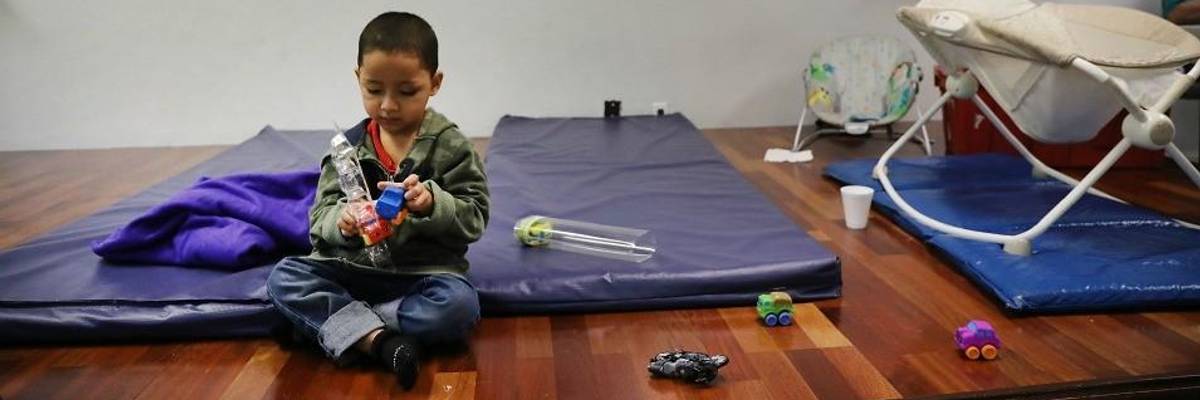
A Honduran child plays at the Catholic Charities Humanitarian Respite Center after recently crossing the U.S.-Mexico border with his father on June 21, 2018 in McAllen, Texas.
U.S. President-elect Donald Trump wants to eliminate the right to asylum, including for the most vulnerable: children.
The right to seek asylum or refuge from danger is a fundamental human right. It’s protected by both international and U.S. law.
But U.S. President-elect Donald Trump wants to eliminate that right, including for the most vulnerable: children. These children are often forced to cross the border without their parents to try and claim asylum in the United States.
I spoke with Arlene Rodriguez, Esteffany Luna, and Esther Ramos, who provide legal and social services to unaccompanied migrant youth in Texas. They gave me a glimpse into the daunting obstacles faced by young asylum seekers.
We’ll need to band together and advocate for local and state governments to pass legislation defending immigrant communities—and for President Joe Biden to take steps to protect migrants before Trump takes office.
Nearly a third of new cases in immigration court are minors, I learned, with 1 out of 8 being 0-4 years old.
But these children are expected to navigate the same complex processes as adults. “They have to sign their own agreements and applications, present themselves in court, and answer the judges’ questions,” said Ramos. “They’re treated very adversarially—not much different from adults.”
“Sometimes they’re so young they don’t understand what they’re being asked to do, or what is being asked of them,” Luna added.
Asylum applicants have to undergo “credible fear” screenings to convince authorities that it’s unsafe for them to go home. In interviews, documents, and court appearances, children are required to repeatedly disclose trauma, which takes a toll. “For older kids who are more conscious of the bad things they’ve experienced, it’s difficult to deal with having someone else know about it,” Rodriguez told me.
Unaccompanied minors with legal representation are nearly 100 times more likely to be granted relief than those without. But unfortunately, there’s no right to an attorney in immigration court, and pro bono legal services are scarce. And the few hard-won protections minors do have are at risk of being undermined as Trump retakes office.
During his first term, President Trump tried to terminate the 1997 Flores agreement, which set standards for the care and release of children in federal immigration custody. He gutted asylum qualifications, removing domestic and gang violence as reasons to obtain protection. And most notoriously, his “zero-tolerance” policy forcibly separated over 5,000 children from their parents in immigration custody.
Under a policy called Title 42, many asylum applicants were turned away altogether, violating their due process. Under “Remain in Mexico,” applicants including children were forced to await asylum hearings in Mexico, exposing many to danger. And courts were hostile and caseloads were rushed through.
Ramos put it bluntly: “Immigration law has always been hard—attorneys call it a dumpster fire. Under the Trump administration, it was like trying to put out a dumpster fire with a liter of gasoline.”
For children seeking asylum, the mental and emotional toll of these legal procedures is compounded by language barriers, social marginalization, and fear of deportation.
These fears can also deter their sponsors, the relatives or volunteers who take them in while their case proceeds—and who are often undocumented themselves. It can even discourage them from accessing medical care, educational services, and food banks due to fears of arrest.
The three experts I spoke to all agreed our immigration system is outdated and inefficient—but said reform should make it more welcoming, not restrictive.
Until then, we’ll need to band together and advocate for local and state governments to pass legislation defending immigrant communities—and for President Joe Biden to take steps to protect migrants before Trump takes office. You can also help by donating to organizations that support immigrants.
Asylum is a matter of life or death for these kids. If we truly care about the safety and dignity of children, our immigration policies must reflect that commitment.
Dear Common Dreams reader, It’s been nearly 30 years since I co-founded Common Dreams with my late wife, Lina Newhouser. We had the radical notion that journalism should serve the public good, not corporate profits. It was clear to us from the outset what it would take to build such a project. No paid advertisements. No corporate sponsors. No millionaire publisher telling us what to think or do. Many people said we wouldn't last a year, but we proved those doubters wrong. Together with a tremendous team of journalists and dedicated staff, we built an independent media outlet free from the constraints of profits and corporate control. Our mission has always been simple: To inform. To inspire. To ignite change for the common good. Building Common Dreams was not easy. Our survival was never guaranteed. When you take on the most powerful forces—Wall Street greed, fossil fuel industry destruction, Big Tech lobbyists, and uber-rich oligarchs who have spent billions upon billions rigging the economy and democracy in their favor—the only bulwark you have is supporters who believe in your work. But here’s the urgent message from me today. It's never been this bad out there. And it's never been this hard to keep us going. At the very moment Common Dreams is most needed, the threats we face are intensifying. We need your support now more than ever. We don't accept corporate advertising and never will. We don't have a paywall because we don't think people should be blocked from critical news based on their ability to pay. Everything we do is funded by the donations of readers like you. When everyone does the little they can afford, we are strong. But if that support retreats or dries up, so do we. Will you donate now to make sure Common Dreams not only survives but thrives? —Craig Brown, Co-founder |
The right to seek asylum or refuge from danger is a fundamental human right. It’s protected by both international and U.S. law.
But U.S. President-elect Donald Trump wants to eliminate that right, including for the most vulnerable: children. These children are often forced to cross the border without their parents to try and claim asylum in the United States.
I spoke with Arlene Rodriguez, Esteffany Luna, and Esther Ramos, who provide legal and social services to unaccompanied migrant youth in Texas. They gave me a glimpse into the daunting obstacles faced by young asylum seekers.
We’ll need to band together and advocate for local and state governments to pass legislation defending immigrant communities—and for President Joe Biden to take steps to protect migrants before Trump takes office.
Nearly a third of new cases in immigration court are minors, I learned, with 1 out of 8 being 0-4 years old.
But these children are expected to navigate the same complex processes as adults. “They have to sign their own agreements and applications, present themselves in court, and answer the judges’ questions,” said Ramos. “They’re treated very adversarially—not much different from adults.”
“Sometimes they’re so young they don’t understand what they’re being asked to do, or what is being asked of them,” Luna added.
Asylum applicants have to undergo “credible fear” screenings to convince authorities that it’s unsafe for them to go home. In interviews, documents, and court appearances, children are required to repeatedly disclose trauma, which takes a toll. “For older kids who are more conscious of the bad things they’ve experienced, it’s difficult to deal with having someone else know about it,” Rodriguez told me.
Unaccompanied minors with legal representation are nearly 100 times more likely to be granted relief than those without. But unfortunately, there’s no right to an attorney in immigration court, and pro bono legal services are scarce. And the few hard-won protections minors do have are at risk of being undermined as Trump retakes office.
During his first term, President Trump tried to terminate the 1997 Flores agreement, which set standards for the care and release of children in federal immigration custody. He gutted asylum qualifications, removing domestic and gang violence as reasons to obtain protection. And most notoriously, his “zero-tolerance” policy forcibly separated over 5,000 children from their parents in immigration custody.
Under a policy called Title 42, many asylum applicants were turned away altogether, violating their due process. Under “Remain in Mexico,” applicants including children were forced to await asylum hearings in Mexico, exposing many to danger. And courts were hostile and caseloads were rushed through.
Ramos put it bluntly: “Immigration law has always been hard—attorneys call it a dumpster fire. Under the Trump administration, it was like trying to put out a dumpster fire with a liter of gasoline.”
For children seeking asylum, the mental and emotional toll of these legal procedures is compounded by language barriers, social marginalization, and fear of deportation.
These fears can also deter their sponsors, the relatives or volunteers who take them in while their case proceeds—and who are often undocumented themselves. It can even discourage them from accessing medical care, educational services, and food banks due to fears of arrest.
The three experts I spoke to all agreed our immigration system is outdated and inefficient—but said reform should make it more welcoming, not restrictive.
Until then, we’ll need to band together and advocate for local and state governments to pass legislation defending immigrant communities—and for President Joe Biden to take steps to protect migrants before Trump takes office. You can also help by donating to organizations that support immigrants.
Asylum is a matter of life or death for these kids. If we truly care about the safety and dignity of children, our immigration policies must reflect that commitment.
The right to seek asylum or refuge from danger is a fundamental human right. It’s protected by both international and U.S. law.
But U.S. President-elect Donald Trump wants to eliminate that right, including for the most vulnerable: children. These children are often forced to cross the border without their parents to try and claim asylum in the United States.
I spoke with Arlene Rodriguez, Esteffany Luna, and Esther Ramos, who provide legal and social services to unaccompanied migrant youth in Texas. They gave me a glimpse into the daunting obstacles faced by young asylum seekers.
We’ll need to band together and advocate for local and state governments to pass legislation defending immigrant communities—and for President Joe Biden to take steps to protect migrants before Trump takes office.
Nearly a third of new cases in immigration court are minors, I learned, with 1 out of 8 being 0-4 years old.
But these children are expected to navigate the same complex processes as adults. “They have to sign their own agreements and applications, present themselves in court, and answer the judges’ questions,” said Ramos. “They’re treated very adversarially—not much different from adults.”
“Sometimes they’re so young they don’t understand what they’re being asked to do, or what is being asked of them,” Luna added.
Asylum applicants have to undergo “credible fear” screenings to convince authorities that it’s unsafe for them to go home. In interviews, documents, and court appearances, children are required to repeatedly disclose trauma, which takes a toll. “For older kids who are more conscious of the bad things they’ve experienced, it’s difficult to deal with having someone else know about it,” Rodriguez told me.
Unaccompanied minors with legal representation are nearly 100 times more likely to be granted relief than those without. But unfortunately, there’s no right to an attorney in immigration court, and pro bono legal services are scarce. And the few hard-won protections minors do have are at risk of being undermined as Trump retakes office.
During his first term, President Trump tried to terminate the 1997 Flores agreement, which set standards for the care and release of children in federal immigration custody. He gutted asylum qualifications, removing domestic and gang violence as reasons to obtain protection. And most notoriously, his “zero-tolerance” policy forcibly separated over 5,000 children from their parents in immigration custody.
Under a policy called Title 42, many asylum applicants were turned away altogether, violating their due process. Under “Remain in Mexico,” applicants including children were forced to await asylum hearings in Mexico, exposing many to danger. And courts were hostile and caseloads were rushed through.
Ramos put it bluntly: “Immigration law has always been hard—attorneys call it a dumpster fire. Under the Trump administration, it was like trying to put out a dumpster fire with a liter of gasoline.”
For children seeking asylum, the mental and emotional toll of these legal procedures is compounded by language barriers, social marginalization, and fear of deportation.
These fears can also deter their sponsors, the relatives or volunteers who take them in while their case proceeds—and who are often undocumented themselves. It can even discourage them from accessing medical care, educational services, and food banks due to fears of arrest.
The three experts I spoke to all agreed our immigration system is outdated and inefficient—but said reform should make it more welcoming, not restrictive.
Until then, we’ll need to band together and advocate for local and state governments to pass legislation defending immigrant communities—and for President Joe Biden to take steps to protect migrants before Trump takes office. You can also help by donating to organizations that support immigrants.
Asylum is a matter of life or death for these kids. If we truly care about the safety and dignity of children, our immigration policies must reflect that commitment.