SUBSCRIBE TO OUR FREE NEWSLETTER
Daily news & progressive opinion—funded by the people, not the corporations—delivered straight to your inbox.
5
#000000
#FFFFFF
To donate by check, phone, or other method, see our More Ways to Give page.
Daily news & progressive opinion—funded by the people, not the corporations—delivered straight to your inbox.
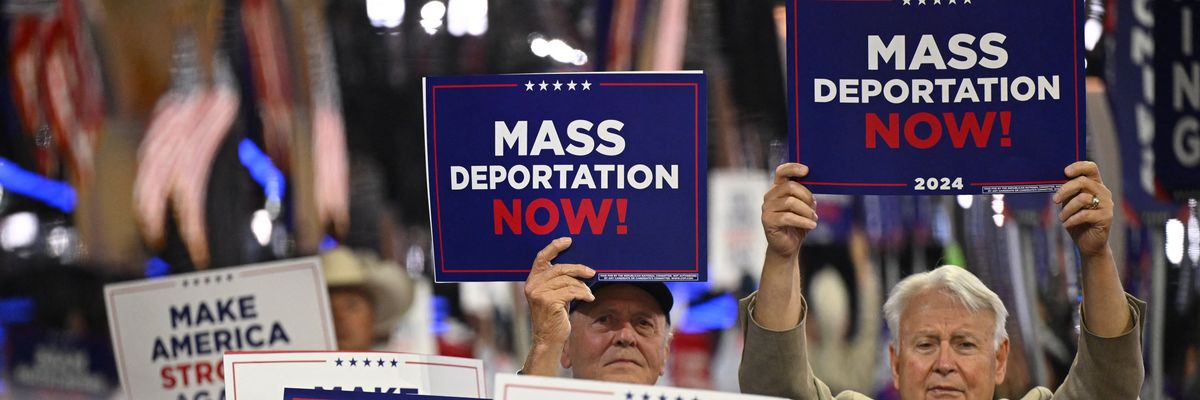
Attendees hold signs reading “Mass Deportation Now!” during the third day of the 2024 Republican National Convention at the Fiserv Forum in Milwaukee, Wisconsin, on July 17, 2024.
The mass deportations promised by Project 2025 would sweep away the dreams of DACA recipients like me and cause a logistical disaster, taking decades and costing billions.
There’s an image that’s stayed with me for weeks: A sea of people holding up “Mass Deportation Now” signs at the Republican National Convention.
Since then, I’ve been plagued with nightmares of mass raids by the military and police across the country. I see millions of families being torn apart, including families with citizen children. And I see DACA recipients—like me—carried away from the only life we’ve ever known.
Mass deportation wasn’t just a rallying cry at the GOP convention. It’s a key plank of Project 2025, a radical document written by white nationalists listing conservative policy priorities for the next administration.
Imagine your friends, neighbors, colleagues, peers, and caretakers being dragged away from their homes.
And it would be a disaster—not just for immigrants, but for our whole country.
I moved to the United States when I was six. Until my teenage years, I didn’t know I was undocumented—I only knew I was from the Philippines. I grew up in Chicago with my twin brother. Our parents worked hard, volunteered at my elementary school, and ensured we always had food on the table. They raised us to do well and be good people.
But when my twin and I learned that we were undocumented, we realized that living our dreams was going to be complicated—on top of the lasting fear of being deported.
Everything changed right before I entered high school in 2012: The Obama administration announced the Deferred Actions for Childhood Arrivals policy, or DACA. The program was designed to protect young people like my twin and me who arrived in the U.S. at a young age with limited or no knowledge of our life before. We’re two of the 600,000 DACA recipients today.
DACA opened many doors for us. It’s allowed to drive, attend college, and have jobs. And we’re temporarily exempt from deportation, a status we have to renew every two years.
DACA helped me set my sights high on my studies and career. Although I couldn’t apply for federal aid, with DACA I became eligible for a program called QuestBridge that granted me a full-ride scholarship to college. Today I work in public policy in the nation’s capital, with dreams of furthering my career through graduate school.
But if hardliners eliminate DACA and carry out their mass deportations, those dreams could be swept away. And it would be ugly—mass deportation would be a logistical disaster, taking decades and costing billions.
Imagine your friends, neighbors, colleagues, peers, and caretakers being dragged away from their homes. For me, it would mean being forced back to the Philippines, a place I haven’t seen in two decades. My partner, my friends, my work—all I’ve ever known is here, in the country I call home.
This country would suffer, too.
An estimated 11 million undocumented people live here. We’re doctors, chefs, librarians, construction workers, lawyers, drivers, scientists, and business owners. We fill labor shortages and help keep inflation down. We contribute nearly $100 billion each year to federal, state, and local taxes.
Fear-mongering politicians want you to believe we’re criminals, or that we’re voting illegally. But again and again, studies find that immigrants commit many fewer crimes than U.S.-born Americans. And though some of us have been long-time residents of this country, we cannot vote in state or federal elections.
Despite all the divisive rhetoric, the American people agree with immigration advocates: Our country needs to offer immigrants a path to legalization and citizenship. According to a Gallup poll last year, 68% of Americans support this.
My dark dreams of mass deportations are, thankfully, just nightmares for now. And my dreams of a secure future for my family and all people in this country outweigh my fears. We must do everything possible to keep all families together.
Dear Common Dreams reader, It’s been nearly 30 years since I co-founded Common Dreams with my late wife, Lina Newhouser. We had the radical notion that journalism should serve the public good, not corporate profits. It was clear to us from the outset what it would take to build such a project. No paid advertisements. No corporate sponsors. No millionaire publisher telling us what to think or do. Many people said we wouldn't last a year, but we proved those doubters wrong. Together with a tremendous team of journalists and dedicated staff, we built an independent media outlet free from the constraints of profits and corporate control. Our mission has always been simple: To inform. To inspire. To ignite change for the common good. Building Common Dreams was not easy. Our survival was never guaranteed. When you take on the most powerful forces—Wall Street greed, fossil fuel industry destruction, Big Tech lobbyists, and uber-rich oligarchs who have spent billions upon billions rigging the economy and democracy in their favor—the only bulwark you have is supporters who believe in your work. But here’s the urgent message from me today. It's never been this bad out there. And it's never been this hard to keep us going. At the very moment Common Dreams is most needed, the threats we face are intensifying. We need your support now more than ever. We don't accept corporate advertising and never will. We don't have a paywall because we don't think people should be blocked from critical news based on their ability to pay. Everything we do is funded by the donations of readers like you. When everyone does the little they can afford, we are strong. But if that support retreats or dries up, so do we. Will you donate now to make sure Common Dreams not only survives but thrives? —Craig Brown, Co-founder |
There’s an image that’s stayed with me for weeks: A sea of people holding up “Mass Deportation Now” signs at the Republican National Convention.
Since then, I’ve been plagued with nightmares of mass raids by the military and police across the country. I see millions of families being torn apart, including families with citizen children. And I see DACA recipients—like me—carried away from the only life we’ve ever known.
Mass deportation wasn’t just a rallying cry at the GOP convention. It’s a key plank of Project 2025, a radical document written by white nationalists listing conservative policy priorities for the next administration.
Imagine your friends, neighbors, colleagues, peers, and caretakers being dragged away from their homes.
And it would be a disaster—not just for immigrants, but for our whole country.
I moved to the United States when I was six. Until my teenage years, I didn’t know I was undocumented—I only knew I was from the Philippines. I grew up in Chicago with my twin brother. Our parents worked hard, volunteered at my elementary school, and ensured we always had food on the table. They raised us to do well and be good people.
But when my twin and I learned that we were undocumented, we realized that living our dreams was going to be complicated—on top of the lasting fear of being deported.
Everything changed right before I entered high school in 2012: The Obama administration announced the Deferred Actions for Childhood Arrivals policy, or DACA. The program was designed to protect young people like my twin and me who arrived in the U.S. at a young age with limited or no knowledge of our life before. We’re two of the 600,000 DACA recipients today.
DACA opened many doors for us. It’s allowed to drive, attend college, and have jobs. And we’re temporarily exempt from deportation, a status we have to renew every two years.
DACA helped me set my sights high on my studies and career. Although I couldn’t apply for federal aid, with DACA I became eligible for a program called QuestBridge that granted me a full-ride scholarship to college. Today I work in public policy in the nation’s capital, with dreams of furthering my career through graduate school.
But if hardliners eliminate DACA and carry out their mass deportations, those dreams could be swept away. And it would be ugly—mass deportation would be a logistical disaster, taking decades and costing billions.
Imagine your friends, neighbors, colleagues, peers, and caretakers being dragged away from their homes. For me, it would mean being forced back to the Philippines, a place I haven’t seen in two decades. My partner, my friends, my work—all I’ve ever known is here, in the country I call home.
This country would suffer, too.
An estimated 11 million undocumented people live here. We’re doctors, chefs, librarians, construction workers, lawyers, drivers, scientists, and business owners. We fill labor shortages and help keep inflation down. We contribute nearly $100 billion each year to federal, state, and local taxes.
Fear-mongering politicians want you to believe we’re criminals, or that we’re voting illegally. But again and again, studies find that immigrants commit many fewer crimes than U.S.-born Americans. And though some of us have been long-time residents of this country, we cannot vote in state or federal elections.
Despite all the divisive rhetoric, the American people agree with immigration advocates: Our country needs to offer immigrants a path to legalization and citizenship. According to a Gallup poll last year, 68% of Americans support this.
My dark dreams of mass deportations are, thankfully, just nightmares for now. And my dreams of a secure future for my family and all people in this country outweigh my fears. We must do everything possible to keep all families together.
There’s an image that’s stayed with me for weeks: A sea of people holding up “Mass Deportation Now” signs at the Republican National Convention.
Since then, I’ve been plagued with nightmares of mass raids by the military and police across the country. I see millions of families being torn apart, including families with citizen children. And I see DACA recipients—like me—carried away from the only life we’ve ever known.
Mass deportation wasn’t just a rallying cry at the GOP convention. It’s a key plank of Project 2025, a radical document written by white nationalists listing conservative policy priorities for the next administration.
Imagine your friends, neighbors, colleagues, peers, and caretakers being dragged away from their homes.
And it would be a disaster—not just for immigrants, but for our whole country.
I moved to the United States when I was six. Until my teenage years, I didn’t know I was undocumented—I only knew I was from the Philippines. I grew up in Chicago with my twin brother. Our parents worked hard, volunteered at my elementary school, and ensured we always had food on the table. They raised us to do well and be good people.
But when my twin and I learned that we were undocumented, we realized that living our dreams was going to be complicated—on top of the lasting fear of being deported.
Everything changed right before I entered high school in 2012: The Obama administration announced the Deferred Actions for Childhood Arrivals policy, or DACA. The program was designed to protect young people like my twin and me who arrived in the U.S. at a young age with limited or no knowledge of our life before. We’re two of the 600,000 DACA recipients today.
DACA opened many doors for us. It’s allowed to drive, attend college, and have jobs. And we’re temporarily exempt from deportation, a status we have to renew every two years.
DACA helped me set my sights high on my studies and career. Although I couldn’t apply for federal aid, with DACA I became eligible for a program called QuestBridge that granted me a full-ride scholarship to college. Today I work in public policy in the nation’s capital, with dreams of furthering my career through graduate school.
But if hardliners eliminate DACA and carry out their mass deportations, those dreams could be swept away. And it would be ugly—mass deportation would be a logistical disaster, taking decades and costing billions.
Imagine your friends, neighbors, colleagues, peers, and caretakers being dragged away from their homes. For me, it would mean being forced back to the Philippines, a place I haven’t seen in two decades. My partner, my friends, my work—all I’ve ever known is here, in the country I call home.
This country would suffer, too.
An estimated 11 million undocumented people live here. We’re doctors, chefs, librarians, construction workers, lawyers, drivers, scientists, and business owners. We fill labor shortages and help keep inflation down. We contribute nearly $100 billion each year to federal, state, and local taxes.
Fear-mongering politicians want you to believe we’re criminals, or that we’re voting illegally. But again and again, studies find that immigrants commit many fewer crimes than U.S.-born Americans. And though some of us have been long-time residents of this country, we cannot vote in state or federal elections.
Despite all the divisive rhetoric, the American people agree with immigration advocates: Our country needs to offer immigrants a path to legalization and citizenship. According to a Gallup poll last year, 68% of Americans support this.
My dark dreams of mass deportations are, thankfully, just nightmares for now. And my dreams of a secure future for my family and all people in this country outweigh my fears. We must do everything possible to keep all families together.