SUBSCRIBE TO OUR FREE NEWSLETTER
Daily news & progressive opinion—funded by the people, not the corporations—delivered straight to your inbox.
5
#000000
#FFFFFF
To donate by check, phone, or other method, see our More Ways to Give page.
Daily news & progressive opinion—funded by the people, not the corporations—delivered straight to your inbox.
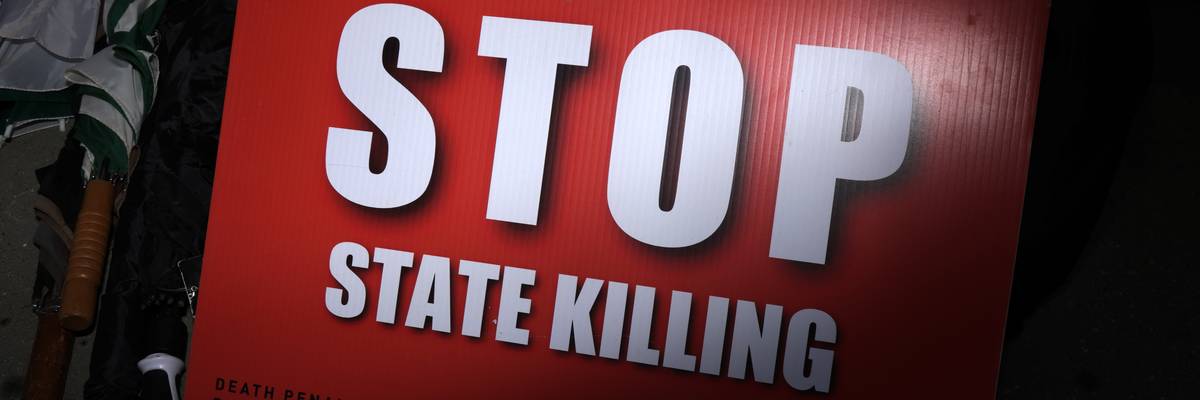
A sign that reads "Stop State Killing" is seen during a vigil against the death penalty in front of the US Supreme Court on June 29, 2021 in Washington, DC.
From noose to needle to nitrogen, our constant search for a more acceptable way to administer the death penalty is a story of failure—not moral progress.
As a long-time death penalty abolitionist, I’ve often compared the death penalty in America to a train with no brakes: Once the machinery starts moving, it becomes extraordinarily difficult to stop.
But the real problem is that the train should never have been built.
Today, Alabama, Louisiana, Mississippi, Oklahoma, and Arkansas are experimenting with nitrogen gas executions, a method officials claim is more humane. But from noose to needle to nitrogen, our constant search for a more acceptable way to kill is a story of failure—not moral progress.
There’s no acceptable way to practice a form of state killing that, for Black Americans especially, has long been intertwined with terror.
History should make us skeptical whenever governments begin searching for new technologies to make killing appear more acceptable.
Take my home state of Arkansas. Within a year of becoming a state in 1836, Arkansas adopted laws establishing a racial hierarchy by which even civilian whites could dispossess or punish a Black person. These codes even designated certain offenses as capital crimes when committed by Black people but lesser crimes when committed by white people.
The message was clear: Some lives were worth less than others.
That message echoed through the decades that followed. Between 1877 and 1950, Arkansas recorded 493 documented lynchings—the highest per capita rate in the nation. In Arkansas and throughout the South, these killings were not hidden crimes. They were public spectacles—acts of terror meant to reinforce social hierarchy.
Eventually, lynching became politically unacceptable. But state killing did not disappear—it simply changed form. The spectacle moved behind prison walls, and the language became more clinical. But the act of killing remained the same.
George Hays, who served two terms as governor of Arkansas, wrote in 1927 that “if the death penalty were to be removed from our statute-books, the tendency to commit deeds of violence would be heightened owing to the Negro problem. The greater number of the race do not maintain the same ideals as the whites.”
Since the Civil War, Arkansas has executed nearly 500 people—and 68% of those executed were Black or Native American. This is not distant history. Black inmates make up about 50% or more of the state’s death row today, despite Black Arkansans comprising less than 16% of the state’s total population.
Nor is Arkansas an outlier. Nationally, over half the people on death row today are Black or Hispanic.
Modern executions are often carried out by lethal injection, presented as sterile and humane. The condemned is strapped to a gurney while witnesses sit behind glass and chemicals stop the heart. But as these chemicals become less available, Arkansas and some other states have replaced lethal injection with nitrogen gas executions.
They claim the method is painless, but it is death by suffocation. Even veterinarians are forbidden from euthanizing cats and dogs with nitrogen hypoxia because it takes too long to lose consciousness and amounts to torture.
History should make us skeptical whenever governments begin searching for new technologies to make killing appear more acceptable. During the Holocaust, Nazi Germany constructed gas chambers designed to turn mass death into a technical process. This process was bureaucratic, hidden from public view, and deemed “efficient.”
Today, the death penalty follows a disturbingly similar logic. Each generation promises that the newest method will finally make execution humane. The noose. The electric chair. The gas chamber. Lethal injection. Now nitrogen gas.
Yet the fundamental act has never changed. The state still kills. The train keeps moving. Even when jurors change their minds. Even when victims’ families plead for mercy. Stopping the train requires courage—especially from elected leaders who have the power to do it.
Our history tells us what happens when a society accepts killing as justice. The death penalty has evolved for nearly two centuries, but there is only one real measure of moral progress: not how we kill, but whether we finally choose to stop.
Dear Common Dreams reader, It’s been nearly 30 years since I co-founded Common Dreams with my late wife, Lina Newhouser. We had the radical notion that journalism should serve the public good, not corporate profits. It was clear to us from the outset what it would take to build such a project. No paid advertisements. No corporate sponsors. No millionaire publisher telling us what to think or do. Many people said we wouldn't last a year, but we proved those doubters wrong. Together with a tremendous team of journalists and dedicated staff, we built an independent media outlet free from the constraints of profits and corporate control. Our mission has always been simple: To inform. To inspire. To ignite change for the common good. Building Common Dreams was not easy. Our survival was never guaranteed. When you take on the most powerful forces—Wall Street greed, fossil fuel industry destruction, Big Tech lobbyists, and uber-rich oligarchs who have spent billions upon billions rigging the economy and democracy in their favor—the only bulwark you have is supporters who believe in your work. But here’s the urgent message from me today. It's never been this bad out there. And it's never been this hard to keep us going. At the very moment Common Dreams is most needed, the threats we face are intensifying. We need your support now more than ever. We don't accept corporate advertising and never will. We don't have a paywall because we don't think people should be blocked from critical news based on their ability to pay. Everything we do is funded by the donations of readers like you. When everyone does the little they can afford, we are strong. But if that support retreats or dries up, so do we. Will you donate now to make sure Common Dreams not only survives but thrives? —Craig Brown, Co-founder |
As a long-time death penalty abolitionist, I’ve often compared the death penalty in America to a train with no brakes: Once the machinery starts moving, it becomes extraordinarily difficult to stop.
But the real problem is that the train should never have been built.
Today, Alabama, Louisiana, Mississippi, Oklahoma, and Arkansas are experimenting with nitrogen gas executions, a method officials claim is more humane. But from noose to needle to nitrogen, our constant search for a more acceptable way to kill is a story of failure—not moral progress.
There’s no acceptable way to practice a form of state killing that, for Black Americans especially, has long been intertwined with terror.
History should make us skeptical whenever governments begin searching for new technologies to make killing appear more acceptable.
Take my home state of Arkansas. Within a year of becoming a state in 1836, Arkansas adopted laws establishing a racial hierarchy by which even civilian whites could dispossess or punish a Black person. These codes even designated certain offenses as capital crimes when committed by Black people but lesser crimes when committed by white people.
The message was clear: Some lives were worth less than others.
That message echoed through the decades that followed. Between 1877 and 1950, Arkansas recorded 493 documented lynchings—the highest per capita rate in the nation. In Arkansas and throughout the South, these killings were not hidden crimes. They were public spectacles—acts of terror meant to reinforce social hierarchy.
Eventually, lynching became politically unacceptable. But state killing did not disappear—it simply changed form. The spectacle moved behind prison walls, and the language became more clinical. But the act of killing remained the same.
George Hays, who served two terms as governor of Arkansas, wrote in 1927 that “if the death penalty were to be removed from our statute-books, the tendency to commit deeds of violence would be heightened owing to the Negro problem. The greater number of the race do not maintain the same ideals as the whites.”
Since the Civil War, Arkansas has executed nearly 500 people—and 68% of those executed were Black or Native American. This is not distant history. Black inmates make up about 50% or more of the state’s death row today, despite Black Arkansans comprising less than 16% of the state’s total population.
Nor is Arkansas an outlier. Nationally, over half the people on death row today are Black or Hispanic.
Modern executions are often carried out by lethal injection, presented as sterile and humane. The condemned is strapped to a gurney while witnesses sit behind glass and chemicals stop the heart. But as these chemicals become less available, Arkansas and some other states have replaced lethal injection with nitrogen gas executions.
They claim the method is painless, but it is death by suffocation. Even veterinarians are forbidden from euthanizing cats and dogs with nitrogen hypoxia because it takes too long to lose consciousness and amounts to torture.
History should make us skeptical whenever governments begin searching for new technologies to make killing appear more acceptable. During the Holocaust, Nazi Germany constructed gas chambers designed to turn mass death into a technical process. This process was bureaucratic, hidden from public view, and deemed “efficient.”
Today, the death penalty follows a disturbingly similar logic. Each generation promises that the newest method will finally make execution humane. The noose. The electric chair. The gas chamber. Lethal injection. Now nitrogen gas.
Yet the fundamental act has never changed. The state still kills. The train keeps moving. Even when jurors change their minds. Even when victims’ families plead for mercy. Stopping the train requires courage—especially from elected leaders who have the power to do it.
Our history tells us what happens when a society accepts killing as justice. The death penalty has evolved for nearly two centuries, but there is only one real measure of moral progress: not how we kill, but whether we finally choose to stop.
As a long-time death penalty abolitionist, I’ve often compared the death penalty in America to a train with no brakes: Once the machinery starts moving, it becomes extraordinarily difficult to stop.
But the real problem is that the train should never have been built.
Today, Alabama, Louisiana, Mississippi, Oklahoma, and Arkansas are experimenting with nitrogen gas executions, a method officials claim is more humane. But from noose to needle to nitrogen, our constant search for a more acceptable way to kill is a story of failure—not moral progress.
There’s no acceptable way to practice a form of state killing that, for Black Americans especially, has long been intertwined with terror.
History should make us skeptical whenever governments begin searching for new technologies to make killing appear more acceptable.
Take my home state of Arkansas. Within a year of becoming a state in 1836, Arkansas adopted laws establishing a racial hierarchy by which even civilian whites could dispossess or punish a Black person. These codes even designated certain offenses as capital crimes when committed by Black people but lesser crimes when committed by white people.
The message was clear: Some lives were worth less than others.
That message echoed through the decades that followed. Between 1877 and 1950, Arkansas recorded 493 documented lynchings—the highest per capita rate in the nation. In Arkansas and throughout the South, these killings were not hidden crimes. They were public spectacles—acts of terror meant to reinforce social hierarchy.
Eventually, lynching became politically unacceptable. But state killing did not disappear—it simply changed form. The spectacle moved behind prison walls, and the language became more clinical. But the act of killing remained the same.
George Hays, who served two terms as governor of Arkansas, wrote in 1927 that “if the death penalty were to be removed from our statute-books, the tendency to commit deeds of violence would be heightened owing to the Negro problem. The greater number of the race do not maintain the same ideals as the whites.”
Since the Civil War, Arkansas has executed nearly 500 people—and 68% of those executed were Black or Native American. This is not distant history. Black inmates make up about 50% or more of the state’s death row today, despite Black Arkansans comprising less than 16% of the state’s total population.
Nor is Arkansas an outlier. Nationally, over half the people on death row today are Black or Hispanic.
Modern executions are often carried out by lethal injection, presented as sterile and humane. The condemned is strapped to a gurney while witnesses sit behind glass and chemicals stop the heart. But as these chemicals become less available, Arkansas and some other states have replaced lethal injection with nitrogen gas executions.
They claim the method is painless, but it is death by suffocation. Even veterinarians are forbidden from euthanizing cats and dogs with nitrogen hypoxia because it takes too long to lose consciousness and amounts to torture.
History should make us skeptical whenever governments begin searching for new technologies to make killing appear more acceptable. During the Holocaust, Nazi Germany constructed gas chambers designed to turn mass death into a technical process. This process was bureaucratic, hidden from public view, and deemed “efficient.”
Today, the death penalty follows a disturbingly similar logic. Each generation promises that the newest method will finally make execution humane. The noose. The electric chair. The gas chamber. Lethal injection. Now nitrogen gas.
Yet the fundamental act has never changed. The state still kills. The train keeps moving. Even when jurors change their minds. Even when victims’ families plead for mercy. Stopping the train requires courage—especially from elected leaders who have the power to do it.
Our history tells us what happens when a society accepts killing as justice. The death penalty has evolved for nearly two centuries, but there is only one real measure of moral progress: not how we kill, but whether we finally choose to stop.