
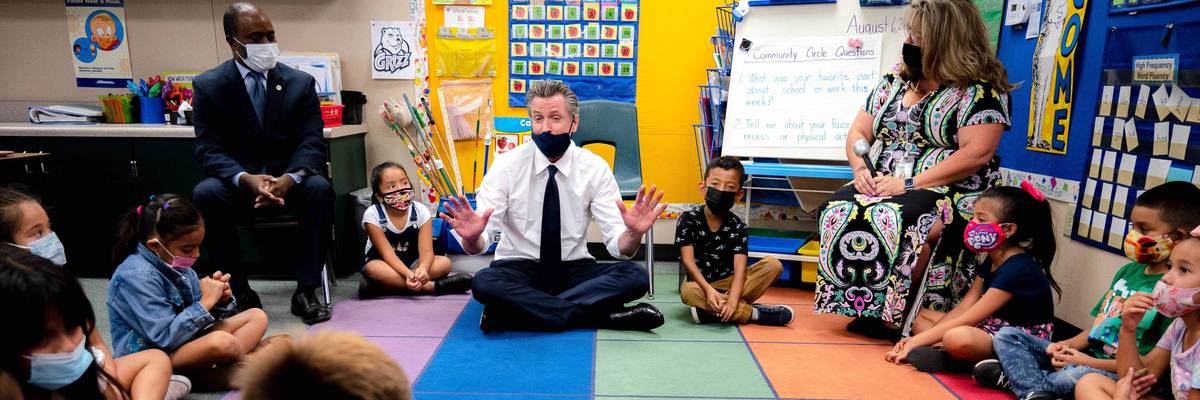
California Gov. Gavin Newsom spends time in a first-grade classroom at Juanita B. Jones Elementary in San Bernardino on Friday, Aug. 6, 2021, the first week back to in-person classes in the San Bernardino City Unified School District since March 2020.
When Parents Got Loud, Newsom Had to Listen, But More Still Must Be Done
Funding childcare is the difference between realized dreams and delayed futures.
As California's final state budget has been signed and Gov. Gavin Newsom prepares to leave office, we can’t help but look at the impact of childcare funding on families. To build a future, we must look at the present and past.
Ours is a tale of two families. We are both mothers and parent leaders with Parent Voices—Carmen in Marin and Marilynda in Los Angeles. This year, we both attended the 30th annual Parent Voices CA Stand for Children Day, where we joined hundreds of parents, children, and childcare providers to say something simple and urgent: Children matter. Together, we testified at the State Capitol until the final lap to the signing of the final state budget—to remind lawmakers: Superheroes Choose Kids, Not Billionaires!
We are similar in so many ways, but when it comes to access to childcare, we learned there is a disconnect in state policy across counties.
Imagine a state where every child has access to care from birth, where no parent has to choose between working and staying home, and where no child spends years on a waiting list.
I, Marilynda, was living in a homeless shelter when I was pregnant with my first child. I was fortunate to get off the waiting list for a childcare voucher. Because of that, I was able to get through graduate school, work, hold an internship, and earn my Master of Social Work. My daughter, Serenity, is learning, socializing, and growing, and we wouldn’t be where we are without that childcare.
I, Carmen, saw my oldest son age out of eligibility for a childcare voucher after more than 10 years stuck on the childcare waitlist. Years later, my two daughters gained access to childcare when Newsom added new childcare spaces, and today they are thriving. But now, my youngest son, Dyson, is stuck on the waitlist because the state has not expanded childcare since 2023. I don’t have reliable care for him; I can’t work more hours because I can’t leave him, which hurts my ability to provide for my family.
Our stories make it clear: Funding childcare is the difference between realized dreams and delayed futures. No childcare means lost wages for many California families.
Newsom once recognized that waiting is a policy failure. He made a promise to expand childcare, and that promise gave families hope. But then the promise was delayed. Newsom's May revision of the state budget did not provide enough to reach 200,000 new childcare spaces. It will leave more than 77,000 families remaining on what is now known as the "No Hope” childcare waitlist.
So, we advocated. We put pressure on Gov. Newsom to get closer to fulfilling his promise to childcare. He announced 130,000 childcare spaces, much closer to the 200,000 than originally proposed.
Compromises were made. But more must be done when there are thousands of eligible children stuck on the “No Hope” waitlist.
We teach our kids to keep their word. Why should we expect anything less from our governor?
At the same time, childcare educators will receive a 2% cost of living adjustment while TK-12 teachers get 4.31%. The first five years of a child's development are among the most critical, yet the educators who show up for those years are already the lowest paid and getting less than half the investment. That’s a reminder that childcare providers continue to be disrespected in budget decisions.
We have to ask a hard question: What kind of world are we building for our children?
Imagine if the billions lost to incarceration and tax cuts for corporations were invested in universal childcare instead.
Implementing universal childcare and properly supporting the industry is the solution to the affordability crisis. It unlocks opportunities for parents like us to work, pursue education, pay bills, and afford essentials like gas and food. If care becomes available for every family, the future will brighten for all families.
Imagine a state where every child has access to care from birth, where no parent has to choose between working and staying home, and where no child spends years on a waiting list.
This is not out of reach. It is about priorities.
The State has the money. But the commitment to invest in childcare has fallen short.
Will the next governor get closer to fulfilling the promise to fund childcare for all families?
We are at a crossroads
This country and this world are at a monumental crossroads. In a few short weeks, US voters will have an opportunity to beat back the forces of fascism and confront the billionaires who are rigging the economy, our media system, and our democracy, making it increasingly impossible for ordinary people to get by. We’re not just talking about the election. We’re talking about what must be done once these fascist elements are vanquished from power. We need a bolder set of solutions than what either major party has so far been willing to offer and a working-class movement ready to fight like hell for it. Trump didn't emerge from nowhere. The conditions that fueled MAGA authoritarianism were created by decades of radical neoliberal economic policies and a corrupt political system dominated by corporate interests. They slashed taxes on the super-rich, promising that the benefits would trickle down. They said giveaways to the corporate titans would make life more affordable for the rest of us. It was all bullshit. And when a bitter, betrayed populace searches for someone to blame, right-wing demagogues have little trouble finding scapegoats. People know when they're being lied to, but you won't hear any of this from the corporate media. Only independent journalism—powered and funded by people who believe in building a better world—can deliver truly trustworthy daily news. Our Fall Campaign is underway, and we need your help. To power our newsroom through the rest of the year, we need to raise $125,000 by midnight on October 31. So if you share our vision, please contribute whatever you can to sustain our work. |
As California's final state budget has been signed and Gov. Gavin Newsom prepares to leave office, we can’t help but look at the impact of childcare funding on families. To build a future, we must look at the present and past.
Ours is a tale of two families. We are both mothers and parent leaders with Parent Voices—Carmen in Marin and Marilynda in Los Angeles. This year, we both attended the 30th annual Parent Voices CA Stand for Children Day, where we joined hundreds of parents, children, and childcare providers to say something simple and urgent: Children matter. Together, we testified at the State Capitol until the final lap to the signing of the final state budget—to remind lawmakers: Superheroes Choose Kids, Not Billionaires!
We are similar in so many ways, but when it comes to access to childcare, we learned there is a disconnect in state policy across counties.
Imagine a state where every child has access to care from birth, where no parent has to choose between working and staying home, and where no child spends years on a waiting list.
I, Marilynda, was living in a homeless shelter when I was pregnant with my first child. I was fortunate to get off the waiting list for a childcare voucher. Because of that, I was able to get through graduate school, work, hold an internship, and earn my Master of Social Work. My daughter, Serenity, is learning, socializing, and growing, and we wouldn’t be where we are without that childcare.
I, Carmen, saw my oldest son age out of eligibility for a childcare voucher after more than 10 years stuck on the childcare waitlist. Years later, my two daughters gained access to childcare when Newsom added new childcare spaces, and today they are thriving. But now, my youngest son, Dyson, is stuck on the waitlist because the state has not expanded childcare since 2023. I don’t have reliable care for him; I can’t work more hours because I can’t leave him, which hurts my ability to provide for my family.
Our stories make it clear: Funding childcare is the difference between realized dreams and delayed futures. No childcare means lost wages for many California families.
Newsom once recognized that waiting is a policy failure. He made a promise to expand childcare, and that promise gave families hope. But then the promise was delayed. Newsom's May revision of the state budget did not provide enough to reach 200,000 new childcare spaces. It will leave more than 77,000 families remaining on what is now known as the "No Hope” childcare waitlist.
So, we advocated. We put pressure on Gov. Newsom to get closer to fulfilling his promise to childcare. He announced 130,000 childcare spaces, much closer to the 200,000 than originally proposed.
Compromises were made. But more must be done when there are thousands of eligible children stuck on the “No Hope” waitlist.
We teach our kids to keep their word. Why should we expect anything less from our governor?
At the same time, childcare educators will receive a 2% cost of living adjustment while TK-12 teachers get 4.31%. The first five years of a child's development are among the most critical, yet the educators who show up for those years are already the lowest paid and getting less than half the investment. That’s a reminder that childcare providers continue to be disrespected in budget decisions.
We have to ask a hard question: What kind of world are we building for our children?
Imagine if the billions lost to incarceration and tax cuts for corporations were invested in universal childcare instead.
Implementing universal childcare and properly supporting the industry is the solution to the affordability crisis. It unlocks opportunities for parents like us to work, pursue education, pay bills, and afford essentials like gas and food. If care becomes available for every family, the future will brighten for all families.
Imagine a state where every child has access to care from birth, where no parent has to choose between working and staying home, and where no child spends years on a waiting list.
This is not out of reach. It is about priorities.
The State has the money. But the commitment to invest in childcare has fallen short.
Will the next governor get closer to fulfilling the promise to fund childcare for all families?
- Why 'Are You Going to Let Strangers Raise Your Baby?' Is the Wrong Question ›
- 'Unbelievably Cruel': GOP Pushes Astronomical Cuts to Education, Housing, and Food Aid ›
- Gavin Newsom Wants a 'Big Tent Party,' But Opposes Wealth Tax Supported by Large Majority of Americans ›
- The Actual Gavin Newsom Is Much Worse Than You Think ›
As California's final state budget has been signed and Gov. Gavin Newsom prepares to leave office, we can’t help but look at the impact of childcare funding on families. To build a future, we must look at the present and past.
Ours is a tale of two families. We are both mothers and parent leaders with Parent Voices—Carmen in Marin and Marilynda in Los Angeles. This year, we both attended the 30th annual Parent Voices CA Stand for Children Day, where we joined hundreds of parents, children, and childcare providers to say something simple and urgent: Children matter. Together, we testified at the State Capitol until the final lap to the signing of the final state budget—to remind lawmakers: Superheroes Choose Kids, Not Billionaires!
We are similar in so many ways, but when it comes to access to childcare, we learned there is a disconnect in state policy across counties.
Imagine a state where every child has access to care from birth, where no parent has to choose between working and staying home, and where no child spends years on a waiting list.
I, Marilynda, was living in a homeless shelter when I was pregnant with my first child. I was fortunate to get off the waiting list for a childcare voucher. Because of that, I was able to get through graduate school, work, hold an internship, and earn my Master of Social Work. My daughter, Serenity, is learning, socializing, and growing, and we wouldn’t be where we are without that childcare.
I, Carmen, saw my oldest son age out of eligibility for a childcare voucher after more than 10 years stuck on the childcare waitlist. Years later, my two daughters gained access to childcare when Newsom added new childcare spaces, and today they are thriving. But now, my youngest son, Dyson, is stuck on the waitlist because the state has not expanded childcare since 2023. I don’t have reliable care for him; I can’t work more hours because I can’t leave him, which hurts my ability to provide for my family.
Our stories make it clear: Funding childcare is the difference between realized dreams and delayed futures. No childcare means lost wages for many California families.
Newsom once recognized that waiting is a policy failure. He made a promise to expand childcare, and that promise gave families hope. But then the promise was delayed. Newsom's May revision of the state budget did not provide enough to reach 200,000 new childcare spaces. It will leave more than 77,000 families remaining on what is now known as the "No Hope” childcare waitlist.
So, we advocated. We put pressure on Gov. Newsom to get closer to fulfilling his promise to childcare. He announced 130,000 childcare spaces, much closer to the 200,000 than originally proposed.
Compromises were made. But more must be done when there are thousands of eligible children stuck on the “No Hope” waitlist.
We teach our kids to keep their word. Why should we expect anything less from our governor?
At the same time, childcare educators will receive a 2% cost of living adjustment while TK-12 teachers get 4.31%. The first five years of a child's development are among the most critical, yet the educators who show up for those years are already the lowest paid and getting less than half the investment. That’s a reminder that childcare providers continue to be disrespected in budget decisions.
We have to ask a hard question: What kind of world are we building for our children?
Imagine if the billions lost to incarceration and tax cuts for corporations were invested in universal childcare instead.
Implementing universal childcare and properly supporting the industry is the solution to the affordability crisis. It unlocks opportunities for parents like us to work, pursue education, pay bills, and afford essentials like gas and food. If care becomes available for every family, the future will brighten for all families.
Imagine a state where every child has access to care from birth, where no parent has to choose between working and staying home, and where no child spends years on a waiting list.
This is not out of reach. It is about priorities.
The State has the money. But the commitment to invest in childcare has fallen short.
Will the next governor get closer to fulfilling the promise to fund childcare for all families?
- Why 'Are You Going to Let Strangers Raise Your Baby?' Is the Wrong Question ›
- 'Unbelievably Cruel': GOP Pushes Astronomical Cuts to Education, Housing, and Food Aid ›
- Gavin Newsom Wants a 'Big Tent Party,' But Opposes Wealth Tax Supported by Large Majority of Americans ›
- The Actual Gavin Newsom Is Much Worse Than You Think ›