SUBSCRIBE TO OUR FREE NEWSLETTER
Daily news & progressive opinion—funded by the people, not the corporations—delivered straight to your inbox.
5
#000000
#FFFFFF
To donate by check, phone, or other method, see our More Ways to Give page.
Daily news & progressive opinion—funded by the people, not the corporations—delivered straight to your inbox.
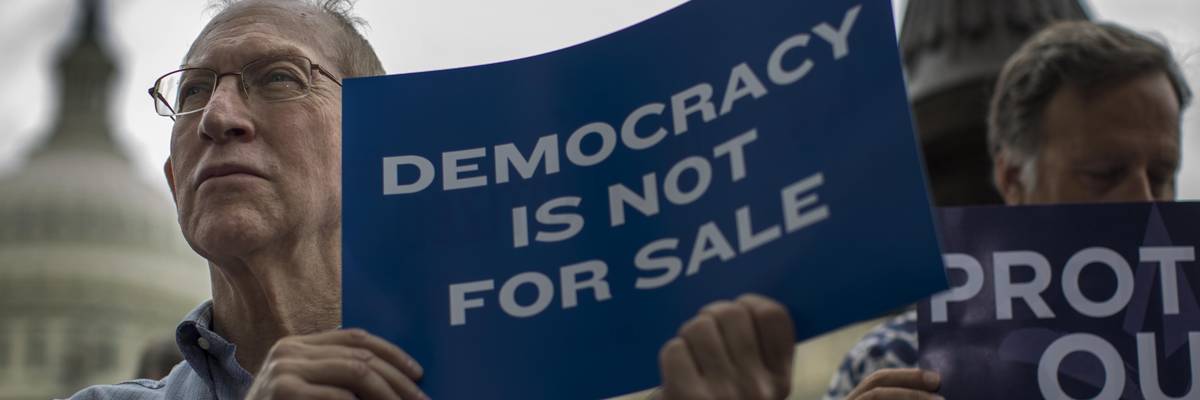
Lawmakers gather along with lobbying groups and Hank Ickes, left, from Arlington, Virginia, for a press conference to discuss a Constitutional Amendment on campaign finance reform overturning Citizens United, on Capitol Hill in Washington, DC, on Monday, September 8, 2014.
In the midterm election, American Promise seeks to return power to the American people through campaign finance reform.
As we approach the midterm elections, our country's most prominent voting concerns are back on the frontline. The US is experiencing historically high voter turnouts, yet voters are expressing record levels of dissatisfaction. Perhaps it is because one of the most salient topics across party lines is missing from the conversation: campaign finance reform.
The upcoming midterm election cycle is projected to be the most expensive in American history. Analysis by The New York Times found that 20 donors have already spent $1.2 billion on this year's campaigns to push candidates in battleground states and integrate corporate agendas into public policy. Special interest groups like the American Israel Public Affairs Committee and Musk’s America PAC are spending big to elect allies friendly to their political and economic interests. Not only do AI groups fund candidates, but increasingly dishonest and weird deepfake AI videos circulate online. Further analysis by Americans for Tax Fairness (ATF) Action Fund found that 172 billionaire families spent $1.7 billion. Over $1 billion in untraceable dark money is corrupting American democracy.
Americans are unhappy with the state of campaign finance in the US. But how did we end up here? In 1976, the Supreme Court’s Buckley v. Valeo paved the way for campaign finance laws by equating campaign donations to “free speech,” protected as a First Amendment right. In, 2010, the Supreme Court’s Citizens United v. FEC ruling enabled the creation of “super PACs,” allowing unlimited corporate donations beyond the previous $5,000 limit. As a result, US elections are dominated by corporate interests and lobbyists, increasing the cost and accessibility of running for office.
The For Our Freedom Amendment is here, and campaign spending limits are not far behind.
Several polls confirm Americans’ discontent. Many in both parties and in all regions of the country have lost faith in our system, feeling elected officials cater to lobbyists rather than constituents. Nearly 80% of voters believe big donations are linked to corruption, while merely 4% of American voters believe the United States’ current political system works well. This pattern is similarly present in congressional elections;8 out of every 10 adults in the US believe that people who donate money to political campaigns have too much of an influence over congressional decisions.
However, while many remain dissatisfied with the state of campaign finance, large majorities are optimistic about reform. Approximately 60% of Americans believe in the possibility of adopting laws that limit spending on political campaigns. An even greater majority desire doing so, with 72% of Americans believing in imposing spending limits on campaigns. All around the country, Americans support enforcing limits by margins of 3-to-1 or even greater.
Although many may be skeptical, wondering how campaign finance reform can take place when unlimited spending is protected under the First Amendment, change is already underway. The pathway lies in the very foundation of the American democratic system: the United States’ Constitution. Supermajorities up to 80% across the country support an amendment to limit campaign spending. Already, the cross-partisan nonprofit American Promise has drafted and is proposing the amendment.
The For Our Freedom Amendment was developed meticulously through the collaboration of citizens, lawmakers, and scholars from all parties. Its text gets straight to the point: It empowers the government by granting it constitutional authority to enforce campaign spending limits. The full text of the amendment is as follows:
Section 1. We the People have compelling sovereign interests in the freedom of speech, representative self-government, federalism, the integrity of the electoral process, and the political equality of natural persons.
Section 2. Nothing in this Constitution shall be construed to forbid Congress or the States, within their respective jurisdictions, from reasonably regulating and limiting contributions and spending in campaigns, elections, or ballot measures.
Section 3. Congress and the States shall have the power to implement and enforce this article by appropriate legislation and may distinguish between natural persons and artificial entities, including by prohibiting artificial entities from raising and spending money in campaigns, elections, or ballot measures.
Its concise and clear language makes it accessible to the average American. It conveys a refreshing honesty and constituent-first sentiment recently missing from political debate, placing it at the heart of political and individual dignity.
Not only is it drafted, but support for the amendment is significant. Twenty-three states have passed official resolutions calling on Congress, meaning it has garnered nearly half of the three-quarters majority required for Congress to propose the amendment.
While a constitutional amendment may feel beyond reach, we must keep constitutional change at the forefront of our political imagination. The seeds of reform have already been planted by the electorate. Electing proactive candidates enables conversations and reform in Congress. Rep. Tom Barrett (R-Mich.) proposed the House Joint Resolution 191, Constitutional Campaign Finance Reform Amendment, in collaboration with American Promise. With this, Rep. Barrett expressed unwavering American democratic spirit, and this is just the beginning.
It is now our job as citizens in this election cycle to keep the pressure on, which means greater voter participation. Congressional leaders are in charge of the Committee on Appropriations, which oversees and enforces campaign finance laws. Participating in the election of competent leaders can lead to higher standards of regulation; but beyond that, it may very well be a key stepping stone on the road to ratification.
Unequivocally, the facts do not lie: Americans want change. So, call your friends and family, or chat with your neighbors, and let them know: The For Our Freedom Amendment is here, and campaign spending limits are not far behind. We can make this happen
Dear Common Dreams reader, It’s been nearly 30 years since I co-founded Common Dreams with my late wife, Lina Newhouser. We had the radical notion that journalism should serve the public good, not corporate profits. It was clear to us from the outset what it would take to build such a project. No paid advertisements. No corporate sponsors. No millionaire publisher telling us what to think or do. Many people said we wouldn't last a year, but we proved those doubters wrong. Together with a tremendous team of journalists and dedicated staff, we built an independent media outlet free from the constraints of profits and corporate control. Our mission has always been simple: To inform. To inspire. To ignite change for the common good. Building Common Dreams was not easy. Our survival was never guaranteed. When you take on the most powerful forces—Wall Street greed, fossil fuel industry destruction, Big Tech lobbyists, and uber-rich oligarchs who have spent billions upon billions rigging the economy and democracy in their favor—the only bulwark you have is supporters who believe in your work. But here’s the urgent message from me today. It's never been this bad out there. And it's never been this hard to keep us going. At the very moment Common Dreams is most needed, the threats we face are intensifying. We need your support now more than ever. We don't accept corporate advertising and never will. We don't have a paywall because we don't think people should be blocked from critical news based on their ability to pay. Everything we do is funded by the donations of readers like you. When everyone does the little they can afford, we are strong. But if that support retreats or dries up, so do we. Will you donate now to make sure Common Dreams not only survives but thrives? —Craig Brown, Co-founder |
As we approach the midterm elections, our country's most prominent voting concerns are back on the frontline. The US is experiencing historically high voter turnouts, yet voters are expressing record levels of dissatisfaction. Perhaps it is because one of the most salient topics across party lines is missing from the conversation: campaign finance reform.
The upcoming midterm election cycle is projected to be the most expensive in American history. Analysis by The New York Times found that 20 donors have already spent $1.2 billion on this year's campaigns to push candidates in battleground states and integrate corporate agendas into public policy. Special interest groups like the American Israel Public Affairs Committee and Musk’s America PAC are spending big to elect allies friendly to their political and economic interests. Not only do AI groups fund candidates, but increasingly dishonest and weird deepfake AI videos circulate online. Further analysis by Americans for Tax Fairness (ATF) Action Fund found that 172 billionaire families spent $1.7 billion. Over $1 billion in untraceable dark money is corrupting American democracy.
Americans are unhappy with the state of campaign finance in the US. But how did we end up here? In 1976, the Supreme Court’s Buckley v. Valeo paved the way for campaign finance laws by equating campaign donations to “free speech,” protected as a First Amendment right. In, 2010, the Supreme Court’s Citizens United v. FEC ruling enabled the creation of “super PACs,” allowing unlimited corporate donations beyond the previous $5,000 limit. As a result, US elections are dominated by corporate interests and lobbyists, increasing the cost and accessibility of running for office.
The For Our Freedom Amendment is here, and campaign spending limits are not far behind.
Several polls confirm Americans’ discontent. Many in both parties and in all regions of the country have lost faith in our system, feeling elected officials cater to lobbyists rather than constituents. Nearly 80% of voters believe big donations are linked to corruption, while merely 4% of American voters believe the United States’ current political system works well. This pattern is similarly present in congressional elections;8 out of every 10 adults in the US believe that people who donate money to political campaigns have too much of an influence over congressional decisions.
However, while many remain dissatisfied with the state of campaign finance, large majorities are optimistic about reform. Approximately 60% of Americans believe in the possibility of adopting laws that limit spending on political campaigns. An even greater majority desire doing so, with 72% of Americans believing in imposing spending limits on campaigns. All around the country, Americans support enforcing limits by margins of 3-to-1 or even greater.
Although many may be skeptical, wondering how campaign finance reform can take place when unlimited spending is protected under the First Amendment, change is already underway. The pathway lies in the very foundation of the American democratic system: the United States’ Constitution. Supermajorities up to 80% across the country support an amendment to limit campaign spending. Already, the cross-partisan nonprofit American Promise has drafted and is proposing the amendment.
The For Our Freedom Amendment was developed meticulously through the collaboration of citizens, lawmakers, and scholars from all parties. Its text gets straight to the point: It empowers the government by granting it constitutional authority to enforce campaign spending limits. The full text of the amendment is as follows:
Section 1. We the People have compelling sovereign interests in the freedom of speech, representative self-government, federalism, the integrity of the electoral process, and the political equality of natural persons.
Section 2. Nothing in this Constitution shall be construed to forbid Congress or the States, within their respective jurisdictions, from reasonably regulating and limiting contributions and spending in campaigns, elections, or ballot measures.
Section 3. Congress and the States shall have the power to implement and enforce this article by appropriate legislation and may distinguish between natural persons and artificial entities, including by prohibiting artificial entities from raising and spending money in campaigns, elections, or ballot measures.
Its concise and clear language makes it accessible to the average American. It conveys a refreshing honesty and constituent-first sentiment recently missing from political debate, placing it at the heart of political and individual dignity.
Not only is it drafted, but support for the amendment is significant. Twenty-three states have passed official resolutions calling on Congress, meaning it has garnered nearly half of the three-quarters majority required for Congress to propose the amendment.
While a constitutional amendment may feel beyond reach, we must keep constitutional change at the forefront of our political imagination. The seeds of reform have already been planted by the electorate. Electing proactive candidates enables conversations and reform in Congress. Rep. Tom Barrett (R-Mich.) proposed the House Joint Resolution 191, Constitutional Campaign Finance Reform Amendment, in collaboration with American Promise. With this, Rep. Barrett expressed unwavering American democratic spirit, and this is just the beginning.
It is now our job as citizens in this election cycle to keep the pressure on, which means greater voter participation. Congressional leaders are in charge of the Committee on Appropriations, which oversees and enforces campaign finance laws. Participating in the election of competent leaders can lead to higher standards of regulation; but beyond that, it may very well be a key stepping stone on the road to ratification.
Unequivocally, the facts do not lie: Americans want change. So, call your friends and family, or chat with your neighbors, and let them know: The For Our Freedom Amendment is here, and campaign spending limits are not far behind. We can make this happen
As we approach the midterm elections, our country's most prominent voting concerns are back on the frontline. The US is experiencing historically high voter turnouts, yet voters are expressing record levels of dissatisfaction. Perhaps it is because one of the most salient topics across party lines is missing from the conversation: campaign finance reform.
The upcoming midterm election cycle is projected to be the most expensive in American history. Analysis by The New York Times found that 20 donors have already spent $1.2 billion on this year's campaigns to push candidates in battleground states and integrate corporate agendas into public policy. Special interest groups like the American Israel Public Affairs Committee and Musk’s America PAC are spending big to elect allies friendly to their political and economic interests. Not only do AI groups fund candidates, but increasingly dishonest and weird deepfake AI videos circulate online. Further analysis by Americans for Tax Fairness (ATF) Action Fund found that 172 billionaire families spent $1.7 billion. Over $1 billion in untraceable dark money is corrupting American democracy.
Americans are unhappy with the state of campaign finance in the US. But how did we end up here? In 1976, the Supreme Court’s Buckley v. Valeo paved the way for campaign finance laws by equating campaign donations to “free speech,” protected as a First Amendment right. In, 2010, the Supreme Court’s Citizens United v. FEC ruling enabled the creation of “super PACs,” allowing unlimited corporate donations beyond the previous $5,000 limit. As a result, US elections are dominated by corporate interests and lobbyists, increasing the cost and accessibility of running for office.
The For Our Freedom Amendment is here, and campaign spending limits are not far behind.
Several polls confirm Americans’ discontent. Many in both parties and in all regions of the country have lost faith in our system, feeling elected officials cater to lobbyists rather than constituents. Nearly 80% of voters believe big donations are linked to corruption, while merely 4% of American voters believe the United States’ current political system works well. This pattern is similarly present in congressional elections;8 out of every 10 adults in the US believe that people who donate money to political campaigns have too much of an influence over congressional decisions.
However, while many remain dissatisfied with the state of campaign finance, large majorities are optimistic about reform. Approximately 60% of Americans believe in the possibility of adopting laws that limit spending on political campaigns. An even greater majority desire doing so, with 72% of Americans believing in imposing spending limits on campaigns. All around the country, Americans support enforcing limits by margins of 3-to-1 or even greater.
Although many may be skeptical, wondering how campaign finance reform can take place when unlimited spending is protected under the First Amendment, change is already underway. The pathway lies in the very foundation of the American democratic system: the United States’ Constitution. Supermajorities up to 80% across the country support an amendment to limit campaign spending. Already, the cross-partisan nonprofit American Promise has drafted and is proposing the amendment.
The For Our Freedom Amendment was developed meticulously through the collaboration of citizens, lawmakers, and scholars from all parties. Its text gets straight to the point: It empowers the government by granting it constitutional authority to enforce campaign spending limits. The full text of the amendment is as follows:
Section 1. We the People have compelling sovereign interests in the freedom of speech, representative self-government, federalism, the integrity of the electoral process, and the political equality of natural persons.
Section 2. Nothing in this Constitution shall be construed to forbid Congress or the States, within their respective jurisdictions, from reasonably regulating and limiting contributions and spending in campaigns, elections, or ballot measures.
Section 3. Congress and the States shall have the power to implement and enforce this article by appropriate legislation and may distinguish between natural persons and artificial entities, including by prohibiting artificial entities from raising and spending money in campaigns, elections, or ballot measures.
Its concise and clear language makes it accessible to the average American. It conveys a refreshing honesty and constituent-first sentiment recently missing from political debate, placing it at the heart of political and individual dignity.
Not only is it drafted, but support for the amendment is significant. Twenty-three states have passed official resolutions calling on Congress, meaning it has garnered nearly half of the three-quarters majority required for Congress to propose the amendment.
While a constitutional amendment may feel beyond reach, we must keep constitutional change at the forefront of our political imagination. The seeds of reform have already been planted by the electorate. Electing proactive candidates enables conversations and reform in Congress. Rep. Tom Barrett (R-Mich.) proposed the House Joint Resolution 191, Constitutional Campaign Finance Reform Amendment, in collaboration with American Promise. With this, Rep. Barrett expressed unwavering American democratic spirit, and this is just the beginning.
It is now our job as citizens in this election cycle to keep the pressure on, which means greater voter participation. Congressional leaders are in charge of the Committee on Appropriations, which oversees and enforces campaign finance laws. Participating in the election of competent leaders can lead to higher standards of regulation; but beyond that, it may very well be a key stepping stone on the road to ratification.
Unequivocally, the facts do not lie: Americans want change. So, call your friends and family, or chat with your neighbors, and let them know: The For Our Freedom Amendment is here, and campaign spending limits are not far behind. We can make this happen