SUBSCRIBE TO OUR FREE NEWSLETTER
Daily news & progressive opinion—funded by the people, not the corporations—delivered straight to your inbox.
5
#000000
#FFFFFF
To donate by check, phone, or other method, see our More Ways to Give page.

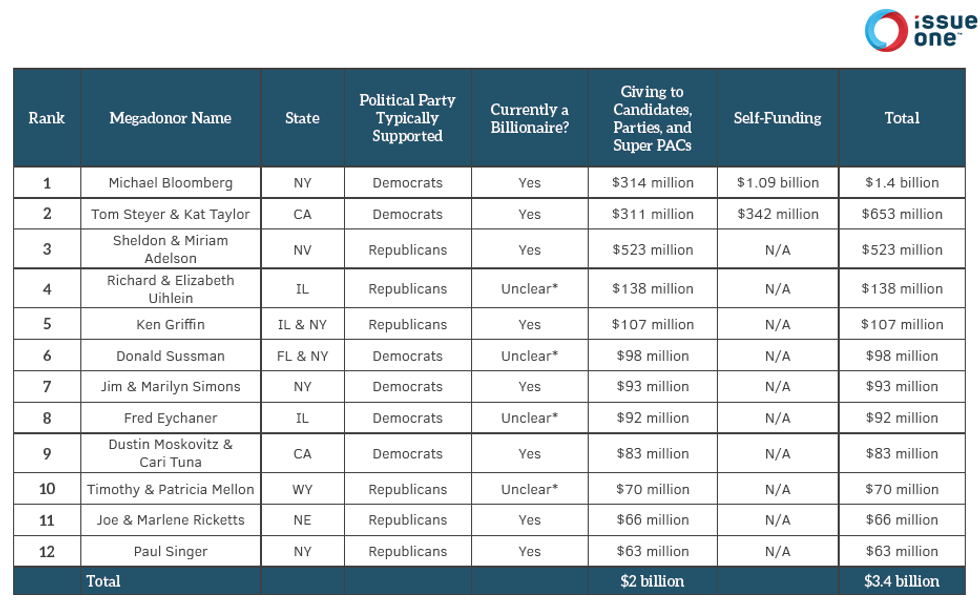
A dozen wealthy political donors and their spouses spent a combined $3.4 billion on federal elections in the U.S. between 2009 and 2020, accounting for $1 of every $13 contributed to political candidates and groups in the post-Citizens United era.
"Our government can't be responsive to all Americans if our elected officials are beholden to the elite donor class."
--Nick Penniman, Issue One
That's according to Outsized Influence, a new report released Tuesday by Issue One, a nonpartisan group that advocates for basic but transformative political reforms--including stricter campaign finance laws designed to empower ordinary Americans and reduce the undemocratic power of megadonors.
In response to the study illustrating the extent to which the super-rich have come to dominate political spending since 2010--when the U.S. Supreme Court's 5-4 ruling in Citizens United v. Federal Election Commission effectively legalized spending unlimited amounts of money to sway electoral outcomes--Sen. Bernie Sanders (I-Vt.) said: "That's what holds in place our rigged, corrupt economic and political systems."
"This research shows the alarming influence of just a handful of wealthy megadonors in our political system," said Issue One founder and CEO Nick Penniman. "Our government can't be responsive to all Americans if our elected officials are beholden to the elite donor class."
According to Issue One's analysis of data provided by the Center for Responsive Politics, the $3.4 billion that was contributed collectively by just a dozen super-rich households "amounts to 7.5% of the $45 billion that all federal candidates and political groups raised between January 2009 and December 2020."
"Put another way," wrote Michael Beckel, the author of the report, "this means that 12 megadonors and their spouses--a total of 19 individuals--accounted for about $1 of every $13 in federal politics."
The study confirms that the influence of concentrated wealth on politics is a bipartisan problem. Of the nation's top 12 megadonors, six generally supported Democrats while the other half generally supported Republicans.
In fact, two failed Democratic presidential candidates are responsible for a significant chunk of the billions that this tiny handful of super-rich Americans spent on politics in the past decade-plus.
The $3.4 billion sum "includes about $1.4 billion that billionaires Michael Bloomberg, a former mayor of New York City, and Tom Steyer, a former hedge fund manager from California, contributed from their own funds to their unsuccessful 2020 presidential campaigns," Beckel pointed out. "Bloomberg alone sunk $1.09 billion of his own funds into his failed presidential bid."
"The other $2 billion in political contributions by these 12 megadonors," Beckel added, "flowed to federal candidates and political party committees like the Democratic National Committee and Republican National Committee, as well as to super PACs, which, unlike candidates and political parties, are legally allowed to accept contributions of unlimited amounts."
Ten other mega-rich households, including at least six additional billionaires, joined Bloomberg and Steyer on the list of the biggest political spenders between 2009 and 2020. As the New York Times noted, "The list includes multiple Wall Street billionaires and investors, a Facebook co-founder, a shipping magnate, and the heir to a family fortune dating back to the Gilded Age."
"The growing influence of multimillion-dollar megadonors has been accompanied by another, competing trend: a surge of small online donations to politicians of both parties," the Times reported. "Those contributions--in $5, $10, and $25 increments--have given Democrats and Republicans an alternate source of money beyond the super-rich."
Nonetheless, the study found that the country's top 100 ZIP codes for political contributions, which are home to less than 1% of the total population, accounted for about 20% of the $45 billion that federal candidates and political groups raised between 2009 and 2020.
A substantial portion of political contributions from those top-giving ZIP codes "is attributable to a handful of wealthy megadonors, if not a single megadonor," the report noted. "The top 12 megadonors and their spouses accounted for roughly 25% of the money contributed by all residents of the 100 top-giving ZIP codes."
Notably, "five of the 100 top-giving ZIP codes--94126 in San Francisco; 10150, 10154, and 10106 in New York City; and 72221 in Little Rock, Arkansas--are not home to any actual people," the report added. "Instead, they are associated with skyscrapers and post office boxes that are regularly used as business addresses by wealthy political donors."
"Congress must urgently act to restrain the growing influence of money in our politics and build a system that truly represents all Americans, not just the wealthy few."
--Meredith McGehee, Issue One
As Issue One executive director Meredith McGehee said: "Americans are losing faith in our democratic institutions. They see political gridlock and a broken campaign finance system that gives undue influence to billionaires and millionaires across the political spectrum, while the vast majority of ordinary citizens lack a seat at the table."
McGehee added that "Congress must urgently act to restrain the growing influence of money in our politics and build a system that truly represents all Americans, not just the wealthy few."
Earlier this month, Rep. Pramila Jayapal (D-Wash.) led 50 members of Congress in introducing a constitutional amendment to end corporate personhood, reverse the Supreme Court's Citizens United decision, and "put power back into the hands of people."
And last month, after House Democrats passed the For the People Act, Senate Democrats introduced their version of the sweeping plan to strengthen voting rights and limit the impact of big money in politics; its passage now depends on eliminating or reforming the 60-vote filibuster rule.
"The time is now to get big money out of politics, and move to the public funding of elections," Sanders said Tuesday.
A dozen wealthy political donors and their spouses spent a combined $3.4 billion on federal elections in the U.S. between 2009 and 2020, accounting for $1 of every $13 contributed to political candidates and groups in the post-Citizens United era.
"Our government can't be responsive to all Americans if our elected officials are beholden to the elite donor class."
--Nick Penniman, Issue One
That's according to Outsized Influence, a new report released Tuesday by Issue One, a nonpartisan group that advocates for basic but transformative political reforms--including stricter campaign finance laws designed to empower ordinary Americans and reduce the undemocratic power of megadonors.
In response to the study illustrating the extent to which the super-rich have come to dominate political spending since 2010--when the U.S. Supreme Court's 5-4 ruling in Citizens United v. Federal Election Commission effectively legalized spending unlimited amounts of money to sway electoral outcomes--Sen. Bernie Sanders (I-Vt.) said: "That's what holds in place our rigged, corrupt economic and political systems."
"This research shows the alarming influence of just a handful of wealthy megadonors in our political system," said Issue One founder and CEO Nick Penniman. "Our government can't be responsive to all Americans if our elected officials are beholden to the elite donor class."
According to Issue One's analysis of data provided by the Center for Responsive Politics, the $3.4 billion that was contributed collectively by just a dozen super-rich households "amounts to 7.5% of the $45 billion that all federal candidates and political groups raised between January 2009 and December 2020."
"Put another way," wrote Michael Beckel, the author of the report, "this means that 12 megadonors and their spouses--a total of 19 individuals--accounted for about $1 of every $13 in federal politics."
The study confirms that the influence of concentrated wealth on politics is a bipartisan problem. Of the nation's top 12 megadonors, six generally supported Democrats while the other half generally supported Republicans.
In fact, two failed Democratic presidential candidates are responsible for a significant chunk of the billions that this tiny handful of super-rich Americans spent on politics in the past decade-plus.
The $3.4 billion sum "includes about $1.4 billion that billionaires Michael Bloomberg, a former mayor of New York City, and Tom Steyer, a former hedge fund manager from California, contributed from their own funds to their unsuccessful 2020 presidential campaigns," Beckel pointed out. "Bloomberg alone sunk $1.09 billion of his own funds into his failed presidential bid."
"The other $2 billion in political contributions by these 12 megadonors," Beckel added, "flowed to federal candidates and political party committees like the Democratic National Committee and Republican National Committee, as well as to super PACs, which, unlike candidates and political parties, are legally allowed to accept contributions of unlimited amounts."
Ten other mega-rich households, including at least six additional billionaires, joined Bloomberg and Steyer on the list of the biggest political spenders between 2009 and 2020. As the New York Times noted, "The list includes multiple Wall Street billionaires and investors, a Facebook co-founder, a shipping magnate, and the heir to a family fortune dating back to the Gilded Age."
"The growing influence of multimillion-dollar megadonors has been accompanied by another, competing trend: a surge of small online donations to politicians of both parties," the Times reported. "Those contributions--in $5, $10, and $25 increments--have given Democrats and Republicans an alternate source of money beyond the super-rich."
Nonetheless, the study found that the country's top 100 ZIP codes for political contributions, which are home to less than 1% of the total population, accounted for about 20% of the $45 billion that federal candidates and political groups raised between 2009 and 2020.
A substantial portion of political contributions from those top-giving ZIP codes "is attributable to a handful of wealthy megadonors, if not a single megadonor," the report noted. "The top 12 megadonors and their spouses accounted for roughly 25% of the money contributed by all residents of the 100 top-giving ZIP codes."
Notably, "five of the 100 top-giving ZIP codes--94126 in San Francisco; 10150, 10154, and 10106 in New York City; and 72221 in Little Rock, Arkansas--are not home to any actual people," the report added. "Instead, they are associated with skyscrapers and post office boxes that are regularly used as business addresses by wealthy political donors."
"Congress must urgently act to restrain the growing influence of money in our politics and build a system that truly represents all Americans, not just the wealthy few."
--Meredith McGehee, Issue One
As Issue One executive director Meredith McGehee said: "Americans are losing faith in our democratic institutions. They see political gridlock and a broken campaign finance system that gives undue influence to billionaires and millionaires across the political spectrum, while the vast majority of ordinary citizens lack a seat at the table."
McGehee added that "Congress must urgently act to restrain the growing influence of money in our politics and build a system that truly represents all Americans, not just the wealthy few."
Earlier this month, Rep. Pramila Jayapal (D-Wash.) led 50 members of Congress in introducing a constitutional amendment to end corporate personhood, reverse the Supreme Court's Citizens United decision, and "put power back into the hands of people."
And last month, after House Democrats passed the For the People Act, Senate Democrats introduced their version of the sweeping plan to strengthen voting rights and limit the impact of big money in politics; its passage now depends on eliminating or reforming the 60-vote filibuster rule.
"The time is now to get big money out of politics, and move to the public funding of elections," Sanders said Tuesday.
A dozen wealthy political donors and their spouses spent a combined $3.4 billion on federal elections in the U.S. between 2009 and 2020, accounting for $1 of every $13 contributed to political candidates and groups in the post-Citizens United era.
"Our government can't be responsive to all Americans if our elected officials are beholden to the elite donor class."
--Nick Penniman, Issue One
That's according to Outsized Influence, a new report released Tuesday by Issue One, a nonpartisan group that advocates for basic but transformative political reforms--including stricter campaign finance laws designed to empower ordinary Americans and reduce the undemocratic power of megadonors.
In response to the study illustrating the extent to which the super-rich have come to dominate political spending since 2010--when the U.S. Supreme Court's 5-4 ruling in Citizens United v. Federal Election Commission effectively legalized spending unlimited amounts of money to sway electoral outcomes--Sen. Bernie Sanders (I-Vt.) said: "That's what holds in place our rigged, corrupt economic and political systems."
"This research shows the alarming influence of just a handful of wealthy megadonors in our political system," said Issue One founder and CEO Nick Penniman. "Our government can't be responsive to all Americans if our elected officials are beholden to the elite donor class."
According to Issue One's analysis of data provided by the Center for Responsive Politics, the $3.4 billion that was contributed collectively by just a dozen super-rich households "amounts to 7.5% of the $45 billion that all federal candidates and political groups raised between January 2009 and December 2020."
"Put another way," wrote Michael Beckel, the author of the report, "this means that 12 megadonors and their spouses--a total of 19 individuals--accounted for about $1 of every $13 in federal politics."
The study confirms that the influence of concentrated wealth on politics is a bipartisan problem. Of the nation's top 12 megadonors, six generally supported Democrats while the other half generally supported Republicans.
In fact, two failed Democratic presidential candidates are responsible for a significant chunk of the billions that this tiny handful of super-rich Americans spent on politics in the past decade-plus.
The $3.4 billion sum "includes about $1.4 billion that billionaires Michael Bloomberg, a former mayor of New York City, and Tom Steyer, a former hedge fund manager from California, contributed from their own funds to their unsuccessful 2020 presidential campaigns," Beckel pointed out. "Bloomberg alone sunk $1.09 billion of his own funds into his failed presidential bid."
"The other $2 billion in political contributions by these 12 megadonors," Beckel added, "flowed to federal candidates and political party committees like the Democratic National Committee and Republican National Committee, as well as to super PACs, which, unlike candidates and political parties, are legally allowed to accept contributions of unlimited amounts."
Ten other mega-rich households, including at least six additional billionaires, joined Bloomberg and Steyer on the list of the biggest political spenders between 2009 and 2020. As the New York Times noted, "The list includes multiple Wall Street billionaires and investors, a Facebook co-founder, a shipping magnate, and the heir to a family fortune dating back to the Gilded Age."
"The growing influence of multimillion-dollar megadonors has been accompanied by another, competing trend: a surge of small online donations to politicians of both parties," the Times reported. "Those contributions--in $5, $10, and $25 increments--have given Democrats and Republicans an alternate source of money beyond the super-rich."
Nonetheless, the study found that the country's top 100 ZIP codes for political contributions, which are home to less than 1% of the total population, accounted for about 20% of the $45 billion that federal candidates and political groups raised between 2009 and 2020.
A substantial portion of political contributions from those top-giving ZIP codes "is attributable to a handful of wealthy megadonors, if not a single megadonor," the report noted. "The top 12 megadonors and their spouses accounted for roughly 25% of the money contributed by all residents of the 100 top-giving ZIP codes."
Notably, "five of the 100 top-giving ZIP codes--94126 in San Francisco; 10150, 10154, and 10106 in New York City; and 72221 in Little Rock, Arkansas--are not home to any actual people," the report added. "Instead, they are associated with skyscrapers and post office boxes that are regularly used as business addresses by wealthy political donors."
"Congress must urgently act to restrain the growing influence of money in our politics and build a system that truly represents all Americans, not just the wealthy few."
--Meredith McGehee, Issue One
As Issue One executive director Meredith McGehee said: "Americans are losing faith in our democratic institutions. They see political gridlock and a broken campaign finance system that gives undue influence to billionaires and millionaires across the political spectrum, while the vast majority of ordinary citizens lack a seat at the table."
McGehee added that "Congress must urgently act to restrain the growing influence of money in our politics and build a system that truly represents all Americans, not just the wealthy few."
Earlier this month, Rep. Pramila Jayapal (D-Wash.) led 50 members of Congress in introducing a constitutional amendment to end corporate personhood, reverse the Supreme Court's Citizens United decision, and "put power back into the hands of people."
And last month, after House Democrats passed the For the People Act, Senate Democrats introduced their version of the sweeping plan to strengthen voting rights and limit the impact of big money in politics; its passage now depends on eliminating or reforming the 60-vote filibuster rule.
"The time is now to get big money out of politics, and move to the public funding of elections," Sanders said Tuesday.