SUBSCRIBE TO OUR FREE NEWSLETTER
Daily news & progressive opinion—funded by the people, not the corporations—delivered straight to your inbox.
5
#000000
#FFFFFF
To donate by check, phone, or other method, see our More Ways to Give page.
Daily news & progressive opinion—funded by the people, not the corporations—delivered straight to your inbox.
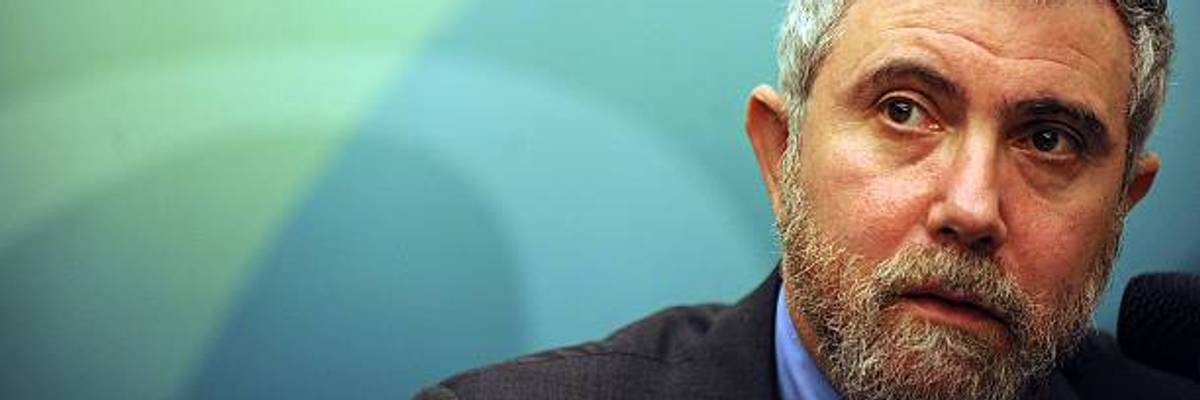
Dr Paul Krugman, 2008 Nobel Laureate, speaks at a press conference held by the Securities and Futures Commission in Hong Kong on May 22, 2009.
As a physician, my life’s goal is to practice medicine in a country where everyone has healthcare, everybody in and nobody out. Why not do battle with the insurance industry and their billionaire backers? There has to be a fight. Let's have it.
Paul Krugman won the Nobel Prize for Economics in 2008 and must be a smart fellow. He wrote on Substack August 11, “The U.S. Healthcare System is Already Mostly Socialized, and there’s nothing radical about wanting to end insurance company parasitism.”
Krugman explained that taxpayers currently pay two-thirds of US healthcare costs. It’s not just the costs of Medicare, Medicaid, the Indian Health Service, the VA, and the Affordable Care Act premium subsidies, but also employers deduct their contribution for their employees’ private insurance as a tax-deductible expense, while the employees owe no income tax on the value of employers’ contribution. Maybe that’s a bit wonky, but the point is simple - when we give tax breaks that subsidize heath insurance for employees, then the rest of us taxpayers have to make up the difference.
US taxpayers shelling out 2/3 of the cost of our healthcare system is more per capita than taxpayers in any other nation. Krugman says, “Much of U.S. healthcare is already ‘socialist’. In fact, the government’s role is so large that U.S. healthcare is better described as partially privatized socialism than as anything resembling a free market.”
Krugman goes on, “How should we think about this system? First of all, is Medicare socialist? Don’t tell anyone, but the way Medicare operates—it covers every senior’s medical expenses, whatever they turn out to be, while being funded by taxes that depend on one’s income—could be summarized by the old Marxist slogan “From each according to his ability, to each according to his need.” And back in 1961, when Ronald Reagan was the face of a last-ditch effort by the American Medical Association to block the creation of Medicare, he denounced Medicare as “socialized medicine” and warned that it would destroy our freedom.”
Krugman continues: “The case for viewing insurers as parasites is strong. Many Medicare benefits are now delivered via Medicare Advantage, that is, plans paid for by the government but run through insurance companies. MedPAC, an independent advisory commission, estimates that last year Medicare Advantage plans were overpaid by $84 billion, thanks to practices such as “upcoding,” in which patients’ health problems are overstated to get larger sums from Medicare.”
Krugman’s conclusion on August 11: “So let’s be clear: Abdul El-Sayed’s healthcare platform is perfectly reasonable on the merits of cost, fairness and health efficacy. And with private insurers never more hated, while millions of Americans are losing their health insurance, 2026 may be its time.”
Then, on August 14 he published another piece: “The Case for a Medicare Buy-In Option, Mandates vs options: The good, the bad, and the feasible.”
Just three days later and he is back-peddling like crazy. Suddenly, Medicare for All is not politically feasible: “There’s a strong case for a soft transition in which people can choose to be covered by Medicare via a Public Option… Why won’t making the legitimate case that Medicare for All is the best system be enough to win the political argument? The pervasive corruption of our political environment by corporate and right-leaning money is part of the answer. Health insurers may be parasites, but parasites make campaign contributions.”
From there, Krugman is in full retreat. He admits “No major government program is as popular as Medicare, which has an 82 percent favorable rating.” He continues by noting that “Americans have strongly negative views, verging on hatred, about the insurance industry.” Despite that, Krugman now wants a Public Option, or Medicare Buy-In as it is also called, which he claims would be less of a political lift. He describes, “A healthcare system in which many Americans under 65 buy into Medicare would not immediately deliver all the advantages of full Medicare for All. Some people and employers, despite the disadvantages, might retain private insurance… It would lack the clarity of a system in which every citizen knows that they are entitled to care. But it would be far better than what we currently have. Moreover, a system in which private health insurance is a rump industry, covering a dwindling fraction of the population, would be a better starting point for a full transition to universal coverage… There’s no obvious reason a public option would be any harder to implement than payments to the Medicare Advantage plans offered by private insurers.”
Medicare Advantage is a model for the Medicare Buy In? Remember in Krugman’s August 11 Substack he noted that "an independent advisory commission estimates that last year Medicare Advantage plans were overpaid by $84 billion.”
Medicare Advantage is the poster child for how privatized Medicare is corrupted by private for-profit insurance companies. I’m worried about Krugman’s memory.
Does Krugman remember 2009? We have been down this Public Option/Medicare Buy-In road before.
Does anyone remember the Blue Dog Caucus?
When the Affordable Care Act was being formulated in the summer of 2009, Democrats had a 257 to 178 majority in the House of Representatives, but there was a block of moderate Dems known as the Blue Dogs, and Baron Hill, Indiana’s 9th district Congressman, had a leadership role in the group. It included a number of skeptics about the ACA whose votes were going to be needed. I persuaded Baron to have me make a presentation, along with binders to distribute with the facts, figures and citations about the advantages of a Medicare for All system, even though few if any of them were singe payer supporters.
The meeting on June 18th in the Longworth Office Building was well attended, and with my wife Karen Green Stone, we had 20 minutes to make our pitch. They were engaged, had good questions, and let the time run over until they all had to leave to cast a vote. The idea was to present the “ideal system” and then work out the best achievable compromise.
As the ACA took shape in the House, the Public Option was under attack as soon as it was proposed. The entrenched healthcare industry deployed thousands of lobbyists to Capitol Hill to frame the Public Option as a costly “government takeover” and funded studies predicting severe disruptions to insurance markets. They partnered with conservative groups to run intense national advertising campaigns targeting vulnerable lawmakers. The Public Option was amended and weakened repeatedly until the version that passed out of the House was almost unrecognizable.
Then the Senate put it out of its misery. Democratic US Senators like Joe Lieberman of Connecticut and Evan Bayh of Indiana insisted that any Public Option/Medicare Buy-In be removed completely in order for them to provide filibuster-proof support to pass the Senate.
The Public Option proponents had insisted it would “keep insurance companies honest.” They used language similar to Krugman that a Public Option would be an easier way to eventually eliminate private insurance.
How could they think they could pass a bill that was intended to create a slippery slope to eliminate the insurance industry, and somehow the insurers wouldn’t notice, wouldn’t see it as just as much an existential threat as Medicare for All?
In 1998, 20 years before Paul Krugman was awarded his Nobel Prize, he predicted that the internet’s economic influence would be insignificant, “no greater than the fax machine’s,” because “most people have nothing to say to each other.” He has been wrong before.
My life’s goal is to practice medicine in a country where everyone has healthcare, everybody in and nobody out. I think expanding traditional American Medicare is the obvious way to get there. It has already been taking care of the oldest, sickest, most expensive patients for the past 60 years. It makes no sense to take that option off the table before we even start negotiating.
Why not take on the insurance industry and their billionaire backers?
Why not take them on?
Dear Common Dreams reader, It’s been nearly 30 years since I co-founded Common Dreams with my late wife, Lina Newhouser. We had the radical notion that journalism should serve the public good, not corporate profits. It was clear to us from the outset what it would take to build such a project. No paid advertisements. No corporate sponsors. No millionaire publisher telling us what to think or do. Many people said we wouldn't last a year, but we proved those doubters wrong. Together with a tremendous team of journalists and dedicated staff, we built an independent media outlet free from the constraints of profits and corporate control. Our mission has always been simple: To inform. To inspire. To ignite change for the common good. Building Common Dreams was not easy. Our survival was never guaranteed. When you take on the most powerful forces—Wall Street greed, fossil fuel industry destruction, Big Tech lobbyists, and uber-rich oligarchs who have spent billions upon billions rigging the economy and democracy in their favor—the only bulwark you have is supporters who believe in your work. But here’s the urgent message from me today. It's never been this bad out there. And it's never been this hard to keep us going. At the very moment Common Dreams is most needed, the threats we face are intensifying. We need your support now more than ever. We don't accept corporate advertising and never will. We don't have a paywall because we don't think people should be blocked from critical news based on their ability to pay. Everything we do is funded by the donations of readers like you. When everyone does the little they can afford, we are strong. But if that support retreats or dries up, so do we. Will you donate now to make sure Common Dreams not only survives but thrives? —Craig Brown, Co-founder |
Paul Krugman won the Nobel Prize for Economics in 2008 and must be a smart fellow. He wrote on Substack August 11, “The U.S. Healthcare System is Already Mostly Socialized, and there’s nothing radical about wanting to end insurance company parasitism.”
Krugman explained that taxpayers currently pay two-thirds of US healthcare costs. It’s not just the costs of Medicare, Medicaid, the Indian Health Service, the VA, and the Affordable Care Act premium subsidies, but also employers deduct their contribution for their employees’ private insurance as a tax-deductible expense, while the employees owe no income tax on the value of employers’ contribution. Maybe that’s a bit wonky, but the point is simple - when we give tax breaks that subsidize heath insurance for employees, then the rest of us taxpayers have to make up the difference.
US taxpayers shelling out 2/3 of the cost of our healthcare system is more per capita than taxpayers in any other nation. Krugman says, “Much of U.S. healthcare is already ‘socialist’. In fact, the government’s role is so large that U.S. healthcare is better described as partially privatized socialism than as anything resembling a free market.”
Krugman goes on, “How should we think about this system? First of all, is Medicare socialist? Don’t tell anyone, but the way Medicare operates—it covers every senior’s medical expenses, whatever they turn out to be, while being funded by taxes that depend on one’s income—could be summarized by the old Marxist slogan “From each according to his ability, to each according to his need.” And back in 1961, when Ronald Reagan was the face of a last-ditch effort by the American Medical Association to block the creation of Medicare, he denounced Medicare as “socialized medicine” and warned that it would destroy our freedom.”
Krugman continues: “The case for viewing insurers as parasites is strong. Many Medicare benefits are now delivered via Medicare Advantage, that is, plans paid for by the government but run through insurance companies. MedPAC, an independent advisory commission, estimates that last year Medicare Advantage plans were overpaid by $84 billion, thanks to practices such as “upcoding,” in which patients’ health problems are overstated to get larger sums from Medicare.”
Krugman’s conclusion on August 11: “So let’s be clear: Abdul El-Sayed’s healthcare platform is perfectly reasonable on the merits of cost, fairness and health efficacy. And with private insurers never more hated, while millions of Americans are losing their health insurance, 2026 may be its time.”
Then, on August 14 he published another piece: “The Case for a Medicare Buy-In Option, Mandates vs options: The good, the bad, and the feasible.”
Just three days later and he is back-peddling like crazy. Suddenly, Medicare for All is not politically feasible: “There’s a strong case for a soft transition in which people can choose to be covered by Medicare via a Public Option… Why won’t making the legitimate case that Medicare for All is the best system be enough to win the political argument? The pervasive corruption of our political environment by corporate and right-leaning money is part of the answer. Health insurers may be parasites, but parasites make campaign contributions.”
From there, Krugman is in full retreat. He admits “No major government program is as popular as Medicare, which has an 82 percent favorable rating.” He continues by noting that “Americans have strongly negative views, verging on hatred, about the insurance industry.” Despite that, Krugman now wants a Public Option, or Medicare Buy-In as it is also called, which he claims would be less of a political lift. He describes, “A healthcare system in which many Americans under 65 buy into Medicare would not immediately deliver all the advantages of full Medicare for All. Some people and employers, despite the disadvantages, might retain private insurance… It would lack the clarity of a system in which every citizen knows that they are entitled to care. But it would be far better than what we currently have. Moreover, a system in which private health insurance is a rump industry, covering a dwindling fraction of the population, would be a better starting point for a full transition to universal coverage… There’s no obvious reason a public option would be any harder to implement than payments to the Medicare Advantage plans offered by private insurers.”
Medicare Advantage is a model for the Medicare Buy In? Remember in Krugman’s August 11 Substack he noted that "an independent advisory commission estimates that last year Medicare Advantage plans were overpaid by $84 billion.”
Medicare Advantage is the poster child for how privatized Medicare is corrupted by private for-profit insurance companies. I’m worried about Krugman’s memory.
Does Krugman remember 2009? We have been down this Public Option/Medicare Buy-In road before.
Does anyone remember the Blue Dog Caucus?
When the Affordable Care Act was being formulated in the summer of 2009, Democrats had a 257 to 178 majority in the House of Representatives, but there was a block of moderate Dems known as the Blue Dogs, and Baron Hill, Indiana’s 9th district Congressman, had a leadership role in the group. It included a number of skeptics about the ACA whose votes were going to be needed. I persuaded Baron to have me make a presentation, along with binders to distribute with the facts, figures and citations about the advantages of a Medicare for All system, even though few if any of them were singe payer supporters.
The meeting on June 18th in the Longworth Office Building was well attended, and with my wife Karen Green Stone, we had 20 minutes to make our pitch. They were engaged, had good questions, and let the time run over until they all had to leave to cast a vote. The idea was to present the “ideal system” and then work out the best achievable compromise.
As the ACA took shape in the House, the Public Option was under attack as soon as it was proposed. The entrenched healthcare industry deployed thousands of lobbyists to Capitol Hill to frame the Public Option as a costly “government takeover” and funded studies predicting severe disruptions to insurance markets. They partnered with conservative groups to run intense national advertising campaigns targeting vulnerable lawmakers. The Public Option was amended and weakened repeatedly until the version that passed out of the House was almost unrecognizable.
Then the Senate put it out of its misery. Democratic US Senators like Joe Lieberman of Connecticut and Evan Bayh of Indiana insisted that any Public Option/Medicare Buy-In be removed completely in order for them to provide filibuster-proof support to pass the Senate.
The Public Option proponents had insisted it would “keep insurance companies honest.” They used language similar to Krugman that a Public Option would be an easier way to eventually eliminate private insurance.
How could they think they could pass a bill that was intended to create a slippery slope to eliminate the insurance industry, and somehow the insurers wouldn’t notice, wouldn’t see it as just as much an existential threat as Medicare for All?
In 1998, 20 years before Paul Krugman was awarded his Nobel Prize, he predicted that the internet’s economic influence would be insignificant, “no greater than the fax machine’s,” because “most people have nothing to say to each other.” He has been wrong before.
My life’s goal is to practice medicine in a country where everyone has healthcare, everybody in and nobody out. I think expanding traditional American Medicare is the obvious way to get there. It has already been taking care of the oldest, sickest, most expensive patients for the past 60 years. It makes no sense to take that option off the table before we even start negotiating.
Why not take on the insurance industry and their billionaire backers?
Why not take them on?
Paul Krugman won the Nobel Prize for Economics in 2008 and must be a smart fellow. He wrote on Substack August 11, “The U.S. Healthcare System is Already Mostly Socialized, and there’s nothing radical about wanting to end insurance company parasitism.”
Krugman explained that taxpayers currently pay two-thirds of US healthcare costs. It’s not just the costs of Medicare, Medicaid, the Indian Health Service, the VA, and the Affordable Care Act premium subsidies, but also employers deduct their contribution for their employees’ private insurance as a tax-deductible expense, while the employees owe no income tax on the value of employers’ contribution. Maybe that’s a bit wonky, but the point is simple - when we give tax breaks that subsidize heath insurance for employees, then the rest of us taxpayers have to make up the difference.
US taxpayers shelling out 2/3 of the cost of our healthcare system is more per capita than taxpayers in any other nation. Krugman says, “Much of U.S. healthcare is already ‘socialist’. In fact, the government’s role is so large that U.S. healthcare is better described as partially privatized socialism than as anything resembling a free market.”
Krugman goes on, “How should we think about this system? First of all, is Medicare socialist? Don’t tell anyone, but the way Medicare operates—it covers every senior’s medical expenses, whatever they turn out to be, while being funded by taxes that depend on one’s income—could be summarized by the old Marxist slogan “From each according to his ability, to each according to his need.” And back in 1961, when Ronald Reagan was the face of a last-ditch effort by the American Medical Association to block the creation of Medicare, he denounced Medicare as “socialized medicine” and warned that it would destroy our freedom.”
Krugman continues: “The case for viewing insurers as parasites is strong. Many Medicare benefits are now delivered via Medicare Advantage, that is, plans paid for by the government but run through insurance companies. MedPAC, an independent advisory commission, estimates that last year Medicare Advantage plans were overpaid by $84 billion, thanks to practices such as “upcoding,” in which patients’ health problems are overstated to get larger sums from Medicare.”
Krugman’s conclusion on August 11: “So let’s be clear: Abdul El-Sayed’s healthcare platform is perfectly reasonable on the merits of cost, fairness and health efficacy. And with private insurers never more hated, while millions of Americans are losing their health insurance, 2026 may be its time.”
Then, on August 14 he published another piece: “The Case for a Medicare Buy-In Option, Mandates vs options: The good, the bad, and the feasible.”
Just three days later and he is back-peddling like crazy. Suddenly, Medicare for All is not politically feasible: “There’s a strong case for a soft transition in which people can choose to be covered by Medicare via a Public Option… Why won’t making the legitimate case that Medicare for All is the best system be enough to win the political argument? The pervasive corruption of our political environment by corporate and right-leaning money is part of the answer. Health insurers may be parasites, but parasites make campaign contributions.”
From there, Krugman is in full retreat. He admits “No major government program is as popular as Medicare, which has an 82 percent favorable rating.” He continues by noting that “Americans have strongly negative views, verging on hatred, about the insurance industry.” Despite that, Krugman now wants a Public Option, or Medicare Buy-In as it is also called, which he claims would be less of a political lift. He describes, “A healthcare system in which many Americans under 65 buy into Medicare would not immediately deliver all the advantages of full Medicare for All. Some people and employers, despite the disadvantages, might retain private insurance… It would lack the clarity of a system in which every citizen knows that they are entitled to care. But it would be far better than what we currently have. Moreover, a system in which private health insurance is a rump industry, covering a dwindling fraction of the population, would be a better starting point for a full transition to universal coverage… There’s no obvious reason a public option would be any harder to implement than payments to the Medicare Advantage plans offered by private insurers.”
Medicare Advantage is a model for the Medicare Buy In? Remember in Krugman’s August 11 Substack he noted that "an independent advisory commission estimates that last year Medicare Advantage plans were overpaid by $84 billion.”
Medicare Advantage is the poster child for how privatized Medicare is corrupted by private for-profit insurance companies. I’m worried about Krugman’s memory.
Does Krugman remember 2009? We have been down this Public Option/Medicare Buy-In road before.
Does anyone remember the Blue Dog Caucus?
When the Affordable Care Act was being formulated in the summer of 2009, Democrats had a 257 to 178 majority in the House of Representatives, but there was a block of moderate Dems known as the Blue Dogs, and Baron Hill, Indiana’s 9th district Congressman, had a leadership role in the group. It included a number of skeptics about the ACA whose votes were going to be needed. I persuaded Baron to have me make a presentation, along with binders to distribute with the facts, figures and citations about the advantages of a Medicare for All system, even though few if any of them were singe payer supporters.
The meeting on June 18th in the Longworth Office Building was well attended, and with my wife Karen Green Stone, we had 20 minutes to make our pitch. They were engaged, had good questions, and let the time run over until they all had to leave to cast a vote. The idea was to present the “ideal system” and then work out the best achievable compromise.
As the ACA took shape in the House, the Public Option was under attack as soon as it was proposed. The entrenched healthcare industry deployed thousands of lobbyists to Capitol Hill to frame the Public Option as a costly “government takeover” and funded studies predicting severe disruptions to insurance markets. They partnered with conservative groups to run intense national advertising campaigns targeting vulnerable lawmakers. The Public Option was amended and weakened repeatedly until the version that passed out of the House was almost unrecognizable.
Then the Senate put it out of its misery. Democratic US Senators like Joe Lieberman of Connecticut and Evan Bayh of Indiana insisted that any Public Option/Medicare Buy-In be removed completely in order for them to provide filibuster-proof support to pass the Senate.
The Public Option proponents had insisted it would “keep insurance companies honest.” They used language similar to Krugman that a Public Option would be an easier way to eventually eliminate private insurance.
How could they think they could pass a bill that was intended to create a slippery slope to eliminate the insurance industry, and somehow the insurers wouldn’t notice, wouldn’t see it as just as much an existential threat as Medicare for All?
In 1998, 20 years before Paul Krugman was awarded his Nobel Prize, he predicted that the internet’s economic influence would be insignificant, “no greater than the fax machine’s,” because “most people have nothing to say to each other.” He has been wrong before.
My life’s goal is to practice medicine in a country where everyone has healthcare, everybody in and nobody out. I think expanding traditional American Medicare is the obvious way to get there. It has already been taking care of the oldest, sickest, most expensive patients for the past 60 years. It makes no sense to take that option off the table before we even start negotiating.
Why not take on the insurance industry and their billionaire backers?
Why not take them on?